Key takeaways
- UK walnuts crop at year 6-10 from planting and live 200-300 years
- Mature trees produce 10-40kg per year of in-shell nuts
- Broadview is the most reliable UK cultivar; Buccaneer crops fastest
- Walnut blight is the main UK disease threat in wet springs
- Trees secrete juglone, suppressing many neighbouring plants
- Late frosts destroy emerging leaves and the year's crop; choose sheltered sites
Walnuts are the long game of UK fruit growing. Apples crop at year 3. Plums at year 4. Cherries at year 5. Walnuts make you wait 6-10 years for the first handful of nuts. Most UK gardeners walk past the choice in a nursery and go for the faster fruit tree. They miss one of the most rewarding long-term trees Britain can grow.
This guide covers UK walnut realities: which cultivars work in British conditions, the walnut blight problem that decides whether spring nuts survive to harvest, the juglone effect that limits what can grow nearby, and the cropping timeline from planting to mature production. You will find the cultivar trio that gives the best UK harvest, the bordeaux mixture protocol that prevents blight, and the underplanting list of juglone-tolerant species. Pair this with our growing citrus trees for the broader unusual fruit cluster and how to grow hazel/cobnut for the faster-cropping UK nut alternative.
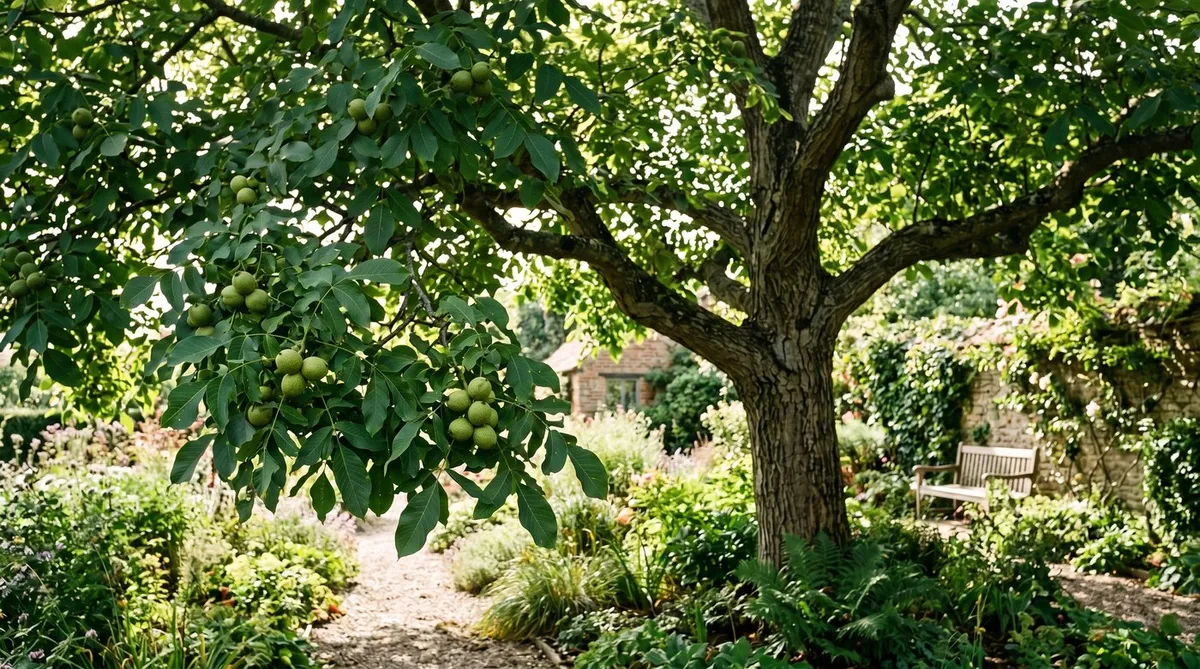
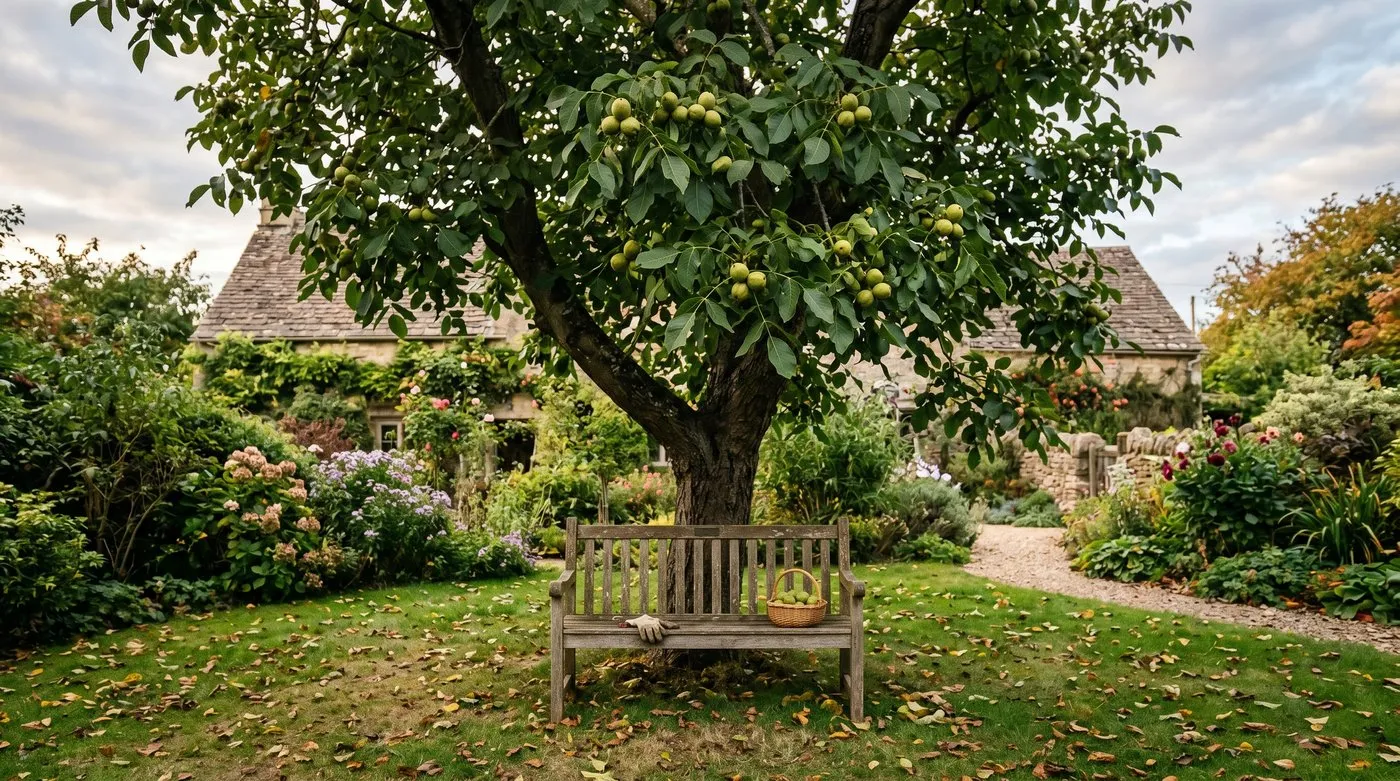 Mature 25-year Broadview walnut at peak crop, a single tree this age yields 20-35kg of in-shell nuts per autumn in southern UK conditions
Why UK walnuts crop reliably (with the right management)
Walnut (Juglans regia) is the European or Persian walnut grown commercially across the Mediterranean. The tree has been planted in the UK since Roman times and crops reliably from southern England through to the Scottish Borders given the right cultivar choice and frost protection.
The black walnut (Juglans nigra) is a different species, mainly grown for timber in the UK. Nuts are smaller, harder-shelled, and intensely flavoured but barely edible without specialist cracking equipment. This guide covers Juglans regia (the common walnut) only.
UK walnuts crop later than continental walnuts but the trees live longer. Cool wet springs delay flowering by 2-4 weeks compared with France or Italy. Late frosts limit early growth. Once established, UK trees suffer less drought stress than southern European trees and live 200-300 years (versus 100-150 in hotter climates).
The tree is hardy to -25C dormant and tolerates UK winters with no protection. The vulnerability is spring frost on emerging leaves and flowers. A single late-April frost destroys the year’s crop. Site selection matters.
Walnuts need deep free-draining soil. A 1.5-2m taproot establishes in years 1-3 and anchors the mature tree against wind. Heavy clay or shallow soil over rock stunts growth and reduces yield.
Mature yields in UK conditions: 10-40kg per tree at full production. Variable year to year because of weather and pollination. Three trees yield 30-100kg over 4-6 weeks of harvest.
| Walnut UK fact | Detail |
|---|---|
| Species | Juglans regia (common walnut) |
| Hardiness | -25C dormant, -2C spring damages buds |
| Tree size | 12-20m height, 8-15m spread |
| First crop | Year 5-7 (grafted), year 10-15 (seedling) |
| Mature yield | 10-40kg per tree per year |
| Productive lifespan | 200-300 years |
| Main UK disease | Walnut blight (Xanthomonas) |
| Main UK pest | Grey squirrel, walnut aphid |
The four UK cultivars that crop reliably
Broadview is the most widely sold UK walnut cultivar and the safest choice for most plots. Self-fertile (does not need a pollinator), vigorous, and starts cropping at year 5-7. Medium-sized sweet kernels. Reliable across southern and central England. Available £45-£85 per grafted tree.
Buccaneer is the fastest cropping UK walnut. First nuts at year 4-5 in some sites. Smaller tree (10-12m at maturity) suiting smaller gardens. Self-fertile but yields improve with a pollinator. Crops 15-25kg at maturity.
Franquette is the late-flowering UK option. Flowers 2-3 weeks after Broadview, missing late frosts. Larger nuts (12-18g kernels). Best for cooler northern UK sites. Needs a pollinator from a different cultivar.
Lara is the modern French cropping cultivar. Large heart-shaped nuts, very thin shells, premium kernel quality. Slightly slower to start cropping (year 7-9) but consistent once established.
A trio of Broadview + Buccaneer + Franquette gives the most reliable cross-pollination, the broadest flowering window, and three different harvest times across September-October. This is the recommended UK garden trio.
Avoid Mayette, Parisienne, and many other French commercial cultivars. Bred for southern French conditions, they flower too early for UK frost protection and crop unreliably north of London.
| Cultivar | UK first crop | Mature yield | Pollination | Notes |
|---|---|---|---|---|
| Broadview | Year 5-7 | 20-30kg | Self-fertile | Standard UK choice |
| Buccaneer | Year 4-5 | 15-25kg | Self-fertile, better with pollinator | Smaller tree |
| Franquette | Year 7-9 | 25-40kg | Needs pollinator | Late flowering, frost escape |
| Lara | Year 7-9 | 20-35kg | Needs pollinator | Premium kernel quality |
| Mayette | Year 8-10 | Variable | Needs pollinator | Avoid - too early flowering |
Soil, position and planting
Walnuts need deep free-draining soil at least 1.5m in profile. Shallow soil over rock or hard clay restricts taproot development and reduces eventual yield by 40-60%.
Soil pH 6.5-7.5 is ideal. Walnuts tolerate a wider pH range than chestnut but suffer on extreme acid soils below pH 5.5.
Position requires full sun and shelter from late spring frosts and strong cold winds. Frost pockets are the worst possible site. Walnuts on a slight north or east-facing slope often outperform south-facing slopes because the cooler microclimate delays bud break past the last hard frost.
Spacing 10-15m between trees. Closer spacing creates competition for light and reduces yield per tree. Wider spacing improves canopy development.
Plant November to March in dormant season. Bare-root grafted trees from specialist UK nurseries plant cheapest at £45-£85 each. Container trees plant any season but autumn establishment is best for taproot development.
Dig a wide planting hole (1m wide, 70-80cm deep) on heavy soils. Walnut roots cannot push through compacted clay; loosen below the planting depth.
Stake firmly with two angled stakes for 4-5 years. The tall slender young tree rocks in wind. Tie with broad rubber tree ties; never use wire that bites into bark.
Plant 6-10m clear of any house, drain, or paved surface. Walnut roots can extend 1.5x the canopy radius and can affect building foundations on shrinkable clay soils.
Position 6-10m clear of vegetable beds and sensitive plants to keep juglone effects from disrupting other crops. More on the juglone effect below.
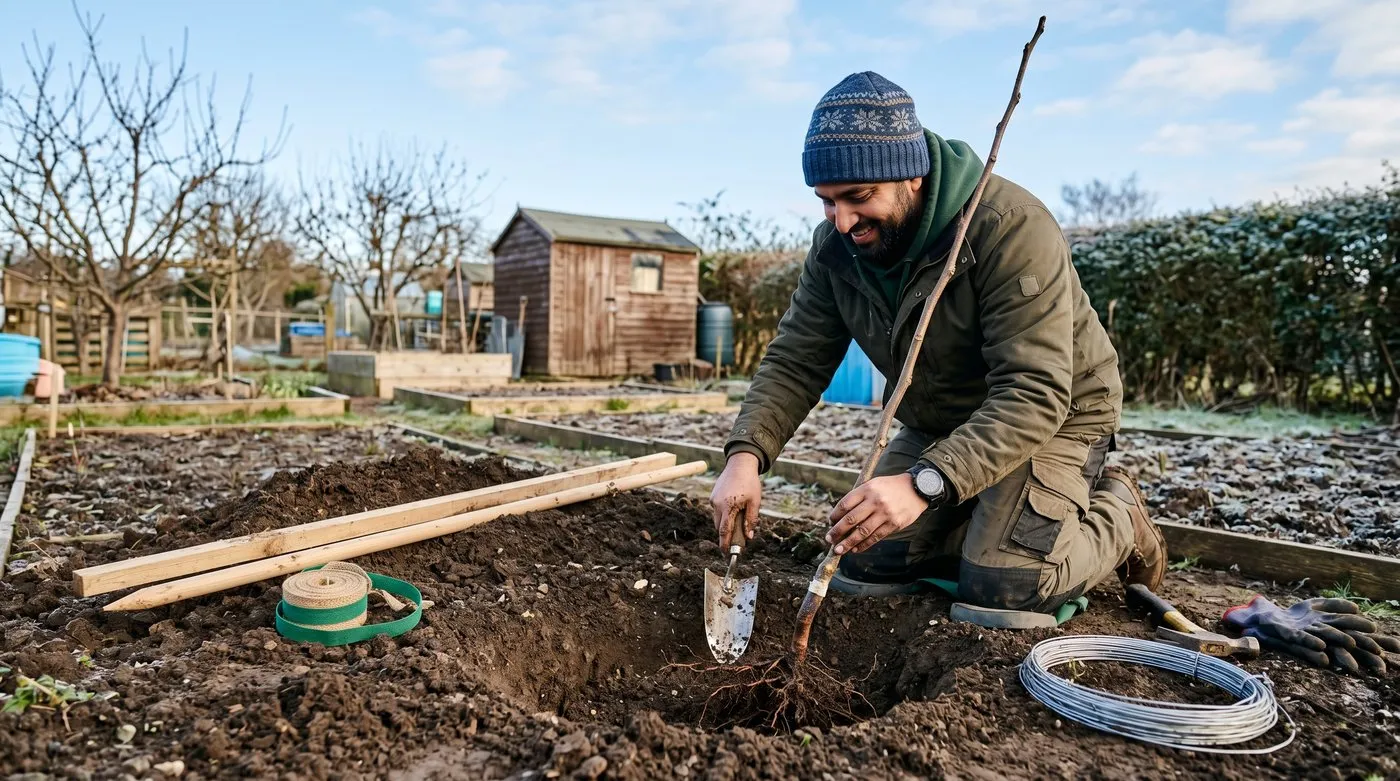 February bare-root planting on the Welsh borders. The 80cm-deep hole accommodates the taproot; firm staking for 4-5 years anchors the tree against wind
The juglone effect: what does and does not grow under walnut
Walnuts produce juglone (5-hydroxy-1,4-naphthoquinone), a phytotoxic compound secreted by roots, leaves, and especially walnut husks. Juglone inhibits germination and growth of many garden plants within a 6-10m radius of the trunk.
Sensitive plants that die or fail under walnut: tomatoes, potatoes, aubergines, peppers, blueberries, apples, pears, rhododendrons, azaleas, magnolias, lilacs, peonies, many roses.
Juglone-tolerant plants that grow well under walnut:
- Bulbs: daffodils, snowdrops, scilla, crocus, fritillaria
- Ferns: most native UK ferns
- Hostas: most cultivars
- Shrubs: yew, beech, juniper, dogwood (Cornus species)
- Perennials: pulmonaria, lamium, geranium (hardy), bergenia, brunnera
- Grasses: most ornamental grasses
- Vegetables: carrots, parsnips, onions, leeks tolerate juglone
The effect varies with site. Free-draining sandy soil leaches juglone faster than heavy clay. The lethal zone is smaller in sandy soil.
Walnut leaves and husks should not be composted in the main compost heap. Juglone persists in compost for 6-12 months. Use walnut leaf litter only as mulch around juglone-tolerant plants, or compost separately and apply only to lawn or grass areas.
Plan underplanting before planting the tree. Mature walnut canopy and root spread make changes difficult later. A 10m clear-zone around the planned trunk gives the most flexibility.
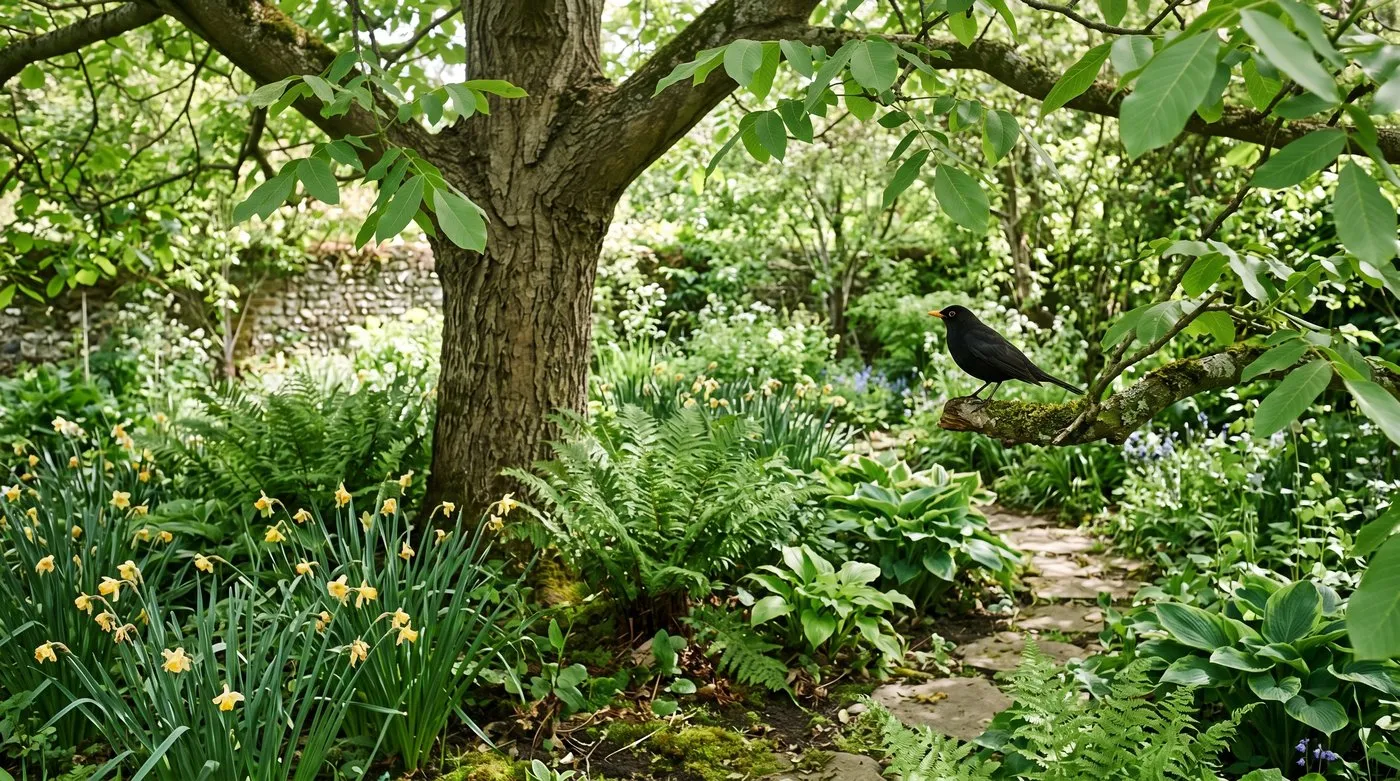 Juglone-tolerant underplanting: hostas, ferns and naturalised daffodils thrive beneath a mature walnut canopy where most ornamentals fail
Walnut blight and the bordeaux mixture protocol
Walnut blight (Xanthomonas arboricola pv. juglandis) is a bacterial disease that destroys developing nuts and damages leaves. In wet UK springs without prevention, 60-80% of nuts can be lost. With prevention, losses drop to 5-15%.
Symptoms: small black spots on young leaves, blackening on green husks, shrivelled black nuts falling in June-July. Affected nuts drop early and are inedible.
The bordeaux mixture protocol is the standard UK prevention. Apply at bud burst (typically late April) and again 14 days later. A third application at flowering helps in particularly wet springs.
Mix bordeaux at 0.5% strength (5g per litre water). Spray to the point of run-off, covering all branches, buds, and emerging leaves. Use a backpack sprayer for canopies above 4m.
Bordeaux mixture is a copper-based fungicide and is permitted under UK organic standards. Commercial products are sold under names like Cuprosan and Vitax Bordeaux Mixture, £8-£15 per 200g pack which mixes to roughly 40 litres of spray.
Alternative prevention: choose blight-resistant cultivars where possible. Lara shows partial resistance. Broadview and Buccaneer have moderate resistance. Franquette is more susceptible.
Pruning to maintain airflow through the canopy reduces blight pressure. Open vase shape with no crowded branches drives quicker drying after rain.
Gardener’s tip: Spray on a calm dry evening when no rain is forecast for 24 hours. Bordeaux mixture needs 24 hours to dry onto leaf surfaces. Rain within that window washes the protection off and requires a re-spray. Check the forecast carefully before mixing.
Pruning and shape
Walnuts develop naturally as central-leader trees with a high canopy. Minimal pruning gives the best long-term shape.
Prune in summer only, not winter. Walnuts bleed sap heavily from winter cuts; the bleeding weakens the tree and attracts pests. July-August prune is safe.
Years 1-3: establish the central leader and remove competing leaders. Light formative work only.
Years 4-7: build the scaffold framework. 4-6 main branches at different heights. Remove crossing branches and damaged wood.
Year 8 onwards: minimal maintenance pruning. Remove dead, diseased, and crossing branches only. Walnuts find their own shape and resent heavy pruning.
Lift the canopy to 2.5-3m clearance for grass mowing and pollinator access underneath. This is the only ongoing structural prune most walnuts need.
Use a sharp saw and clean cuts back to the branch collar. Walnuts seal cuts naturally if cuts are clean, but ragged cuts invite decay.
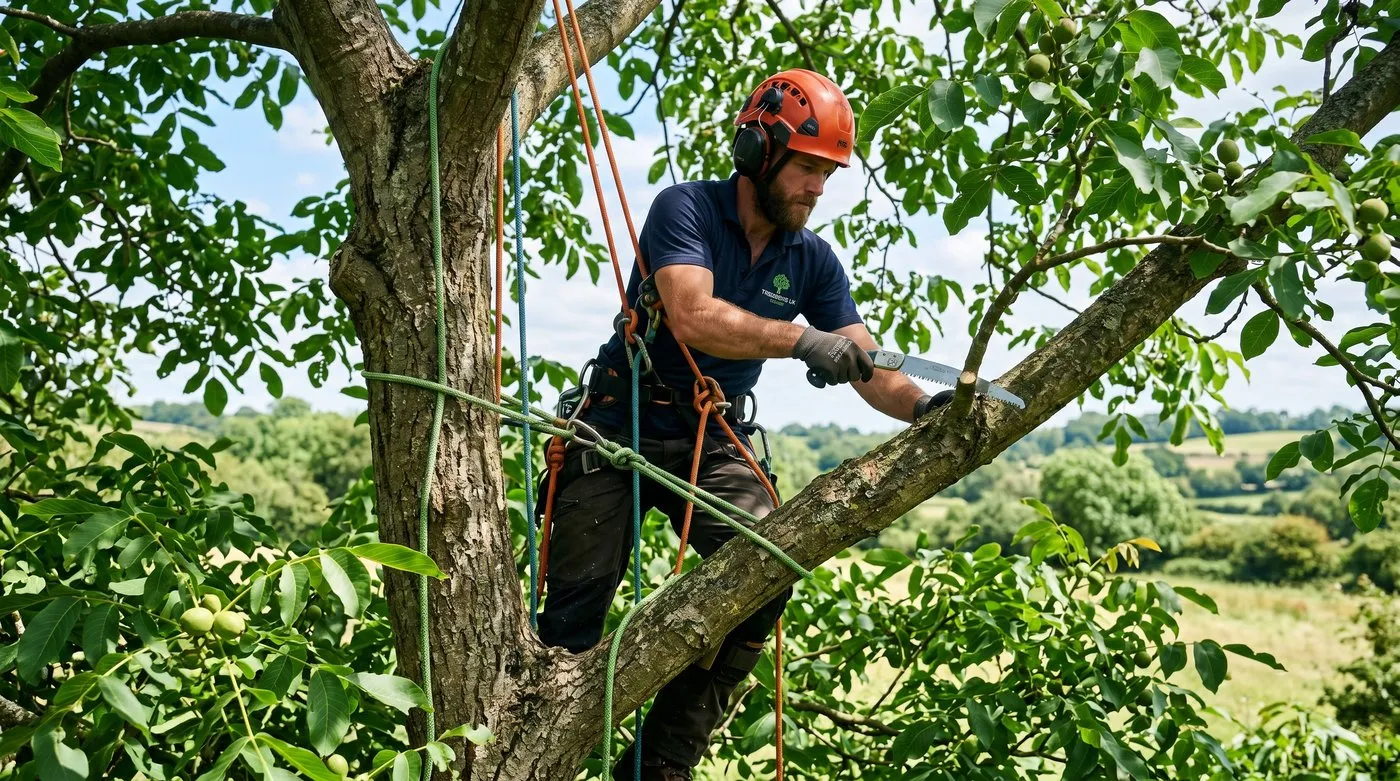 July summer prune to remove crossing internal branches. Winter pruning causes heavy sap bleeding that weakens the tree
Pests and other diseases
Grey squirrels are the biggest UK walnut pest. Squirrels strip nuts before they ripen and gnaw bark on young trees. Bird wire wrapped around trunks for the first 5-10 years protects from bark damage. Harvest nuts as soon as husks split to beat the squirrels.
Walnut aphid (Chromaphis juglandicola) sucks sap from leaves and produces sticky honeydew. Damage cosmetic in most years. Ladybirds and lacewings give natural control. Spray rarely justified.
Walnut leaf gall mite causes pimple-like swellings on leaves. Damage cosmetic only. No treatment needed.
Walnut anthracnose is a fungal leaf disease causing brown spots and early leaf fall. Less serious than blight. Bordeaux mixture controls both.
Codling moth occasionally infests walnuts but damage is minor compared to apples.
Honey fungus (Armillaria) can kill walnuts. Symptoms: sudden wilting, white fungal threads under bark. No treatment; remove and burn infected trees.
Harvest, husking and storage
UK walnuts ripen September to mid-October. Green husks split open along the seam and the nut inside is ready to fall. Some cultivars (Broadview, Buccaneer) ripen in September; Franquette and Lara ripen mid-October.
Pick from the ground daily during the 2-3 week harvest window. Lay tarpaulins under trees to make collection easier. Squirrels and rooks clear fallen nuts within hours.
Remove husks immediately after picking. The husk contains juglone that stains hands and walnuts. Wear nitrile gloves; juglone stains skin for 2-3 weeks.
Hose or scrub washed shelled nuts in a wire basket. Dry on racks in single layer in a warm dry shed.
Cure for 2-4 weeks until shells rattle slightly when shaken. Storage moisture is the deciding factor; under-dried nuts mould, over-dried nuts go rancid.
Store cured nuts in mesh sacks at 0-5C for 6-12 months. Refrigerator or cool larder works well. Once shelled, kernels keep 2-3 months at room temperature or 12 months in the freezer.
Yield in shell to kernel ratio is roughly 50%. A 25kg shell-on harvest gives 12.5kg of kernels: roughly 18-25 months of household kitchen supply for most families.
Common mistakes to avoid
Planting in a frost pocket. Late frosts destroy emerging leaves and flowers, losing the year’s crop. Choose sheltered or slightly north-facing slopes to delay bud break.
Skipping bordeaux mixture spray in wet springs. Untreated trees lose 60-80% of nuts to walnut blight in wet UK Mays.
Underestimating juglone. Tomatoes planted within 8m of a walnut die. Plan vegetable beds well away from any planned walnut.
Heavy winter pruning. Sap bleeding weakens the tree. Always prune July-August.
Inadequate drainage on heavy clay. Waterlogged taproots rot. Improve drainage or plant on a raised mound.
Single-stem seedling tree from a wild nut. Yields small kernels at year 12-15. Pay for grafted cultivars.
Step-by-step: planting a Broadview walnut
Step 1: choose the site. Sheltered, full sun, deep free-draining soil 1.5m+ profile, away from buildings and vegetable beds.
Step 2: test soil pH. Aim for 6.5-7.5. Add lime to acid soil in autumn before spring planting.
Step 3: order a grafted bare-root tree from a UK specialist nursery in November. Broadview is the standard choice. £45-£85.
Step 4: dig a wide planting hole 1m wide, 70-80cm deep. Loosen the base. On clay, improve with grit and compost.
Step 5: position the tree. Spread roots radially. Graft union 5cm above final soil level.
Step 6: backfill with mixed soil and compost (50/50). Firm gently around roots.
Step 7: water in with 20-30 litres. Mulch with 10cm compost in 1m circle, kept 5cm clear of trunk.
Step 8: stake firmly with two angled stakes. Use broad rubber tree ties.
Step 9: protect from squirrels. Bird wire wrapped around trunk to 1.5m height.
Step 10: water deeply through first three summers. 20-30 litres weekly in dry weather.
Step 11: spray bordeaux mixture annually from year 3 onwards. Bud burst plus 14 days. Optional flowering spray in wet springs.
Step 12: summer prune lightly from year 2 onwards. July-August, central leader and 4-6 scaffold branches.
Frequently asked questions
How long does a walnut tree take to fruit in the UK?
UK walnut trees crop at year 6-10 from planting. Grafted named varieties (Broadview, Buccaneer) reach first crop fastest. Seedling trees from a UK wild nut take 10-15 years. Mature trees crop reliably from year 12-15 onwards and yield 10-40kg per year for 200+ years. Buccaneer is the fastest UK cropper, sometimes producing first nuts in year 4-5.
What is the best walnut variety for UK gardens?
Broadview is the most reliable UK walnut cultivar. Self-fertile, vigorous, and produces medium-sized sweet nuts from year 5-7. Buccaneer is the fastest cropper. Franquette and Lara give the largest nuts but need pollinators. A trio of Broadview, Buccaneer, and Franquette gives the most reliable cross-pollination and spreads the harvest across September to mid-October.
Do walnuts kill plants growing nearby?
Yes, walnuts secrete juglone from their roots and leaves which inhibits or kills many garden plants within a 6-8 metre radius. Tomatoes, blueberries, apples, and many ornamentals are sensitive. Juglone-tolerant plants include daffodils, hostas, ferns, beech and yew. Underplant only with tested-tolerant species. Plan vegetable beds at least 10 metres from a planned walnut.
What is walnut blight?
Walnut blight (Xanthomonas arboricola) is a bacterial disease that infects developing nuts and leaves in wet springs. Symptoms are black spots on leaves and shrivelled black nuts that fall early. Prevention: copper-based bordeaux mixture sprays at bud burst and 14 days later. Wet UK Mays make the disease almost universal without spraying. Affected nuts must be picked up and binned to reduce next year’s spore load.
Can I grow walnuts from supermarket nuts?
Yes, supermarket walnuts germinate readily after a winter of cold stratification. The resulting tree will fruit at year 10-15 and produce kernels of variable size. Grafted named cultivars on rootstock are more reliable for cropping but seedling trees are free and acceptable for woodland or shade planting. Walnuts from California or France grown in UK conditions often crop reliably from the seedling.
Now you have a long-lived UK tree planted, see our growing citrus trees guide for the wider unusual fruit cluster and our hazel/cobnut growing guide for a faster-cropping UK-native nut. The Agroforestry Research Trust supplies grafted UK walnut cultivars and provides walnut-growing guidance.
Our team produces practical UK gardening guidance from source research, contributor records and established horticultural practice. Editorial standards are overseen by Matt W.