Key takeaways
- NVS Judges' Guide is the standard UK reference, with each vegetable scored out of a published maximum
- Onions, leeks and potatoes score out of 20; carrots out of 18; tomatoes out of 15
- Uniformity is the single biggest scoring factor on most classes
- Condition and freedom from blemish typically account for 30 to 40 percent of the score
- Staging faults (wrong count, missing trim, dirty roots) lose prizes more often than poor growing
- Collection classes are scored as a whole, with the weakest exhibit dragging the total down
- Always read the schedule before staging, and bring spares of every class you enter
This guide covers how UK allotment and country show vegetables are actually judged. It walks through the National Vegetable Society points system, the most-judged classes and what wins them, the staging rules nobody reads until they have been disqualified, and a checklist for the 48 hours before show day.
It is written for exhibitors, not growers. The growing side is covered separately in our vegetable showing growing guide and the giant vegetables UK guide for the record-chase end of the sport.
The NVS Judges’ Guide and why it matters
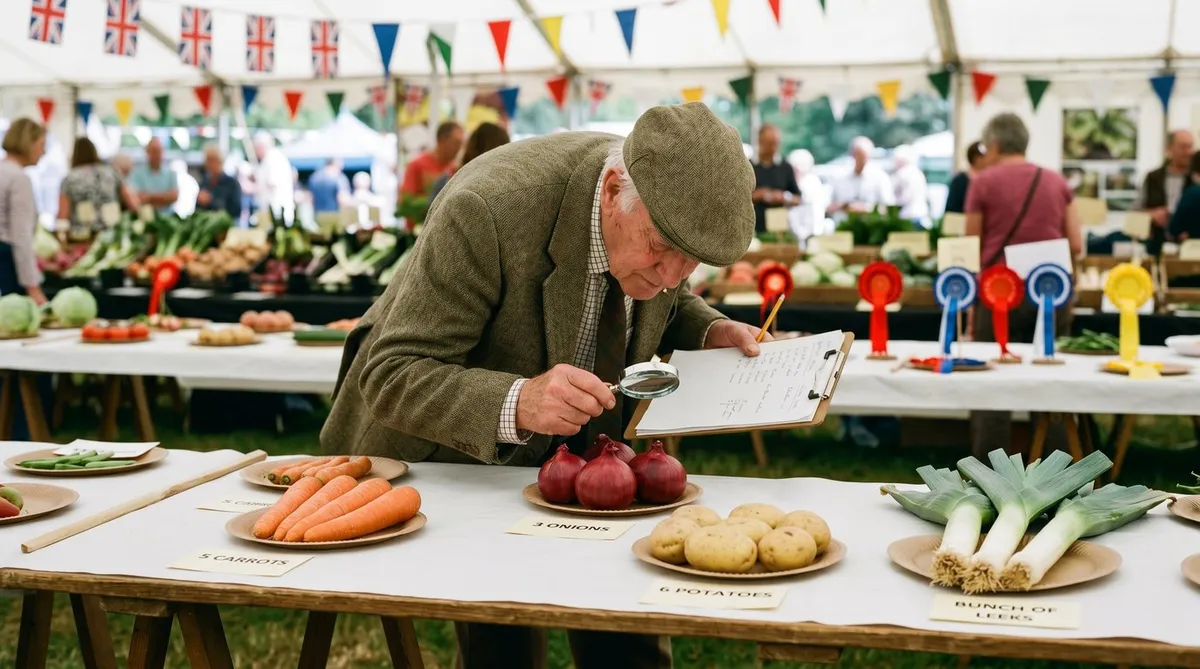
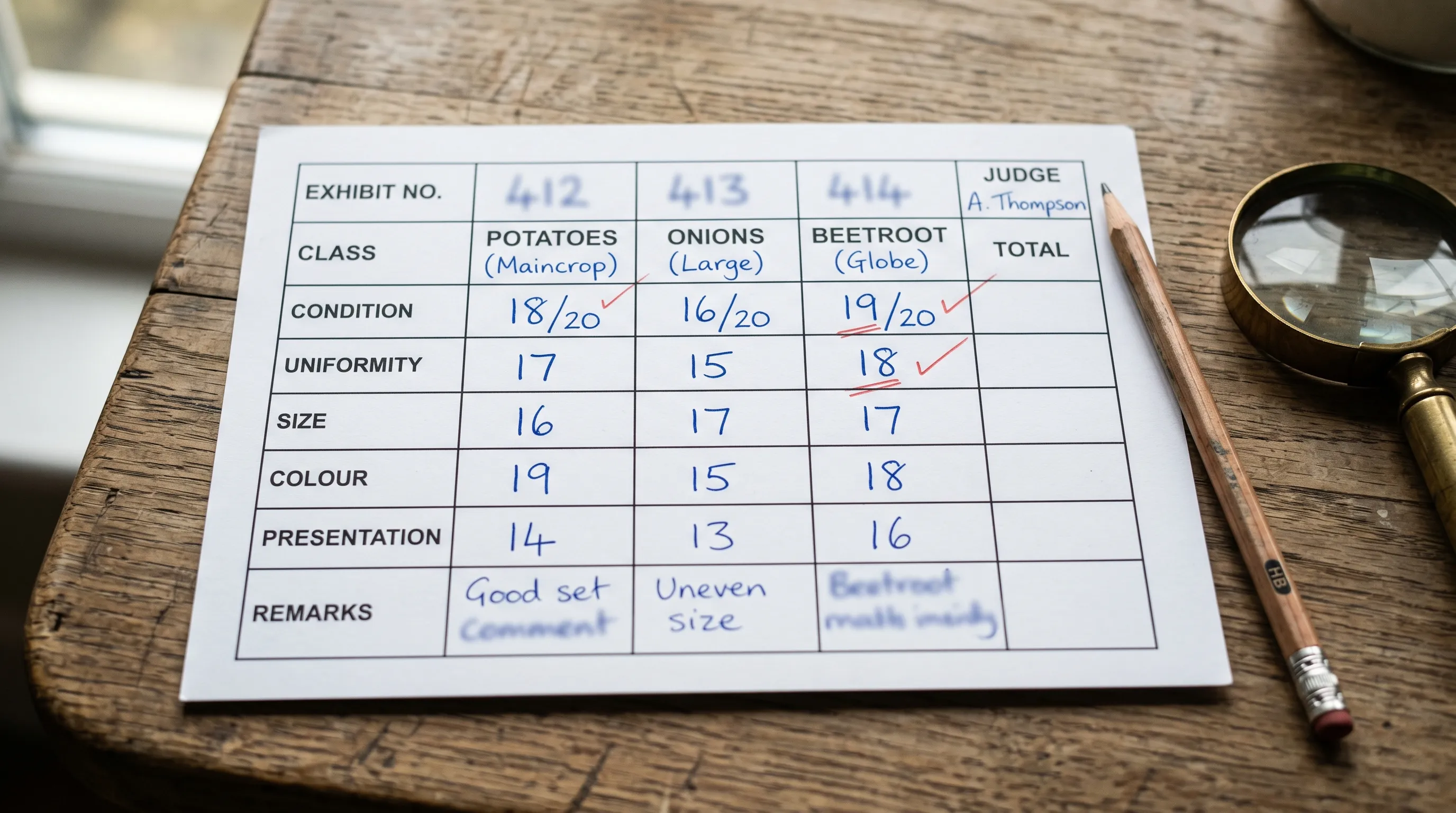
UK vegetable shows are not scored by gut feel. The National Vegetable Society publishes the Judges’ Guide, currently in its 8th edition. It sets out for each vegetable a maximum points value and how those points should be allocated between condition, uniformity, size, colour, and freedom from blemish. Almost every horticultural society in the UK references this guide, and most show judges are either NVS-trained or working directly from it.
The Royal Horticultural Society publishes its own Horticultural Show Handbook which sets out broader exhibition rules for shows under RHS affiliation. The NVS guide is the technical detail. The RHS handbook is the framework.
The single most useful thing a new exhibitor can do is buy the NVS Judges’ Guide (around 12 pounds from the NVS website) and read the entries for the classes they plan to enter. You then know exactly what the judge is looking at when they walk down the bench.
How points are allocated: the 20-point classes
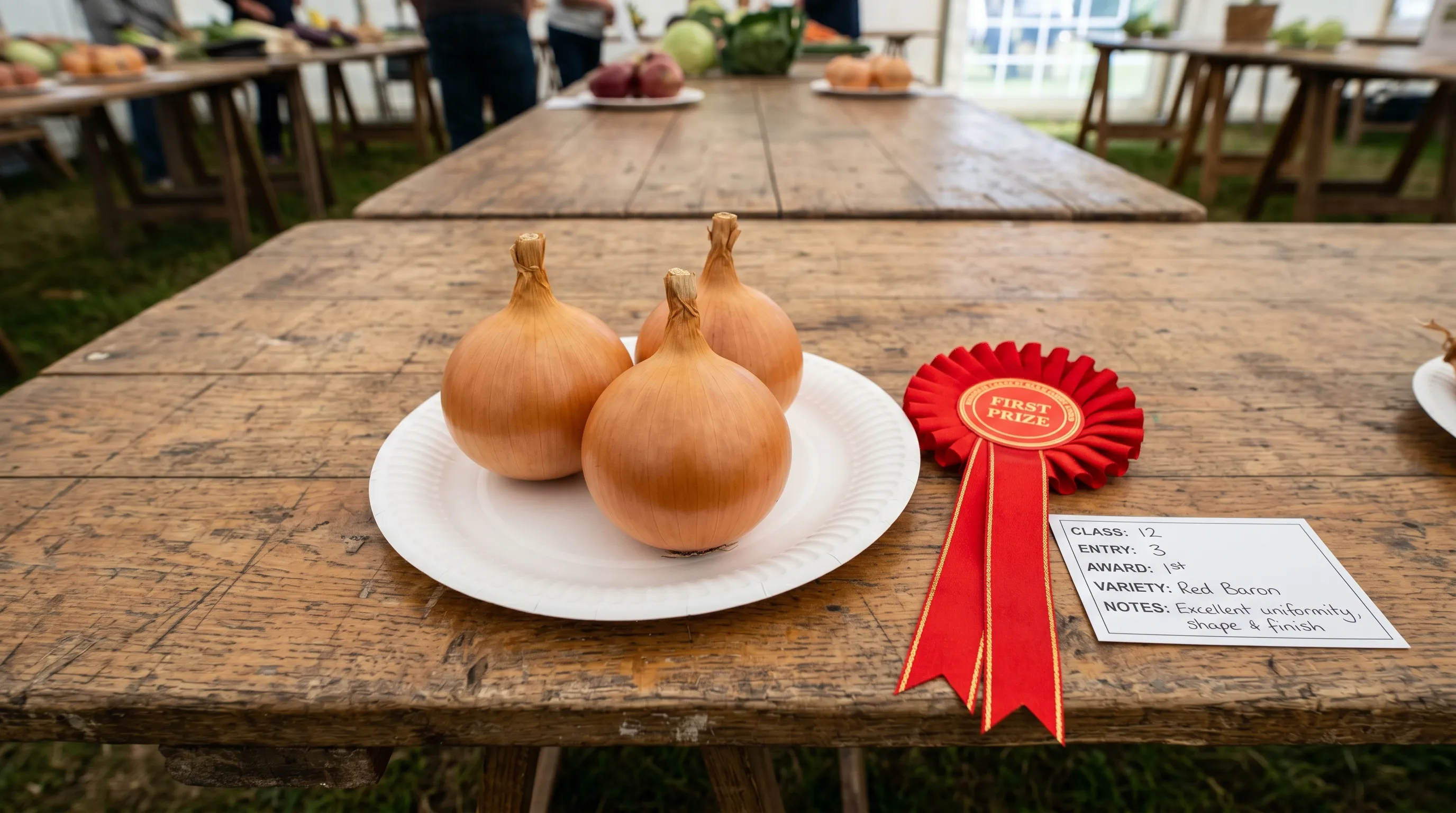
The most-judged single-vegetable classes in the UK are onions, leeks, potatoes, parsnips, and cabbages. All of these score out of 20 points. The breakdown is roughly consistent across them.
A typical 20-point class allocates points as follows:
- Condition: 6 points (firmness, freshness, ripeness, soundness)
- Uniformity: 5 points (matched size, shape, colour across the set)
- Size: 4 points (appropriate size for the vegetable, not always biggest)
- Colour: 3 points (clean, even, true to type)
- Freedom from blemish: 2 points (no marks, no damage, no pest scars)
Uniformity and condition together account for 11 of 20 points. That is over half the score on presentation factors rather than raw growing. A beginner who grows three perfectly matched onions of average size will outscore a veteran who grows six huge onions of varying shapes.
The 18-point classes (carrots, beetroot, turnips) and 15-point classes (tomatoes, runner beans, peas) follow the same pattern with smaller absolute numbers. Size carries proportionally less weight in the lower-point classes because for tomatoes, condition and uniformity are everything.
How points are allocated: the major classes by veg
| Class | Max points | Typical count | Top scoring factor | Common deduction |
|---|---|---|---|---|
| Onions, dressed | 20 | 3 | Uniformity | Soft neck, mismatched size |
| Leeks, blanch | 20 | 3 or 6 | Condition + size | Cracked barrels, mismatch |
| Potatoes | 20 | 6 or 9 | Freedom from blemish | Scab, eye damage, mismatched |
| Parsnips | 20 | 3 | Length + freedom from forks | Side roots, fanging |
| Carrots, long | 18 | 3 | Length + condition | Side roots, mismatched length |
| Carrots, stump | 18 | 3 | Shape uniformity | Forked tips, green shoulders |
| Tomatoes | 15 | 5 or 9 | Condition + colour | Cracking, uneven ripening |
| Runner beans | 15 | 9 | Length + straightness | Bulging seed, curl |
| Peas | 15 | 9 pods | Pod fill + freshness | Empty pods, dry tips |
| Cabbages | 20 | 1 or 2 | Heart + freshness | Outer leaf damage, slug holes |
| Marrows | 15 | 1 | Condition + colour | Sunburn, soft ends |
Counts vary by show schedule. Always read the schedule for your show before harvesting. The same vegetable might be called for three at one show and six at the next.
Staging: the half that beginners lose
Staging means how you present the exhibit on the bench. It is the part where most novice prizes are lost.
Reading the schedule
The show schedule is a printed booklet (or PDF). It lists every class, the count required, and any specific staging instructions. Read it three times. Highlight the classes you are entering. Note the counts. Note any class-specific rules (“tops to be left on”, “to be staged on a white plate”, “max combined length 30cm”).
A common schedule fault is misreading “3 of one variety” as “3 of mixed varieties”. Mixed-variety entries are disqualified in single-variety classes. Read carefully.
Trimming and presentation rules
These vary by vegetable but the NVS guide is consistent.
- Onions: tops tied with raffia 5cm above bulb. Roots trimmed flush. Skins intact and dry.
- Leeks: roots washed, trimmed to 2cm. Tops trimmed to remove flag-leaf damage. Class-specified length only for blanch classes.
- Potatoes: washed clean, dried, no skin damage from washing. Eyes intact.
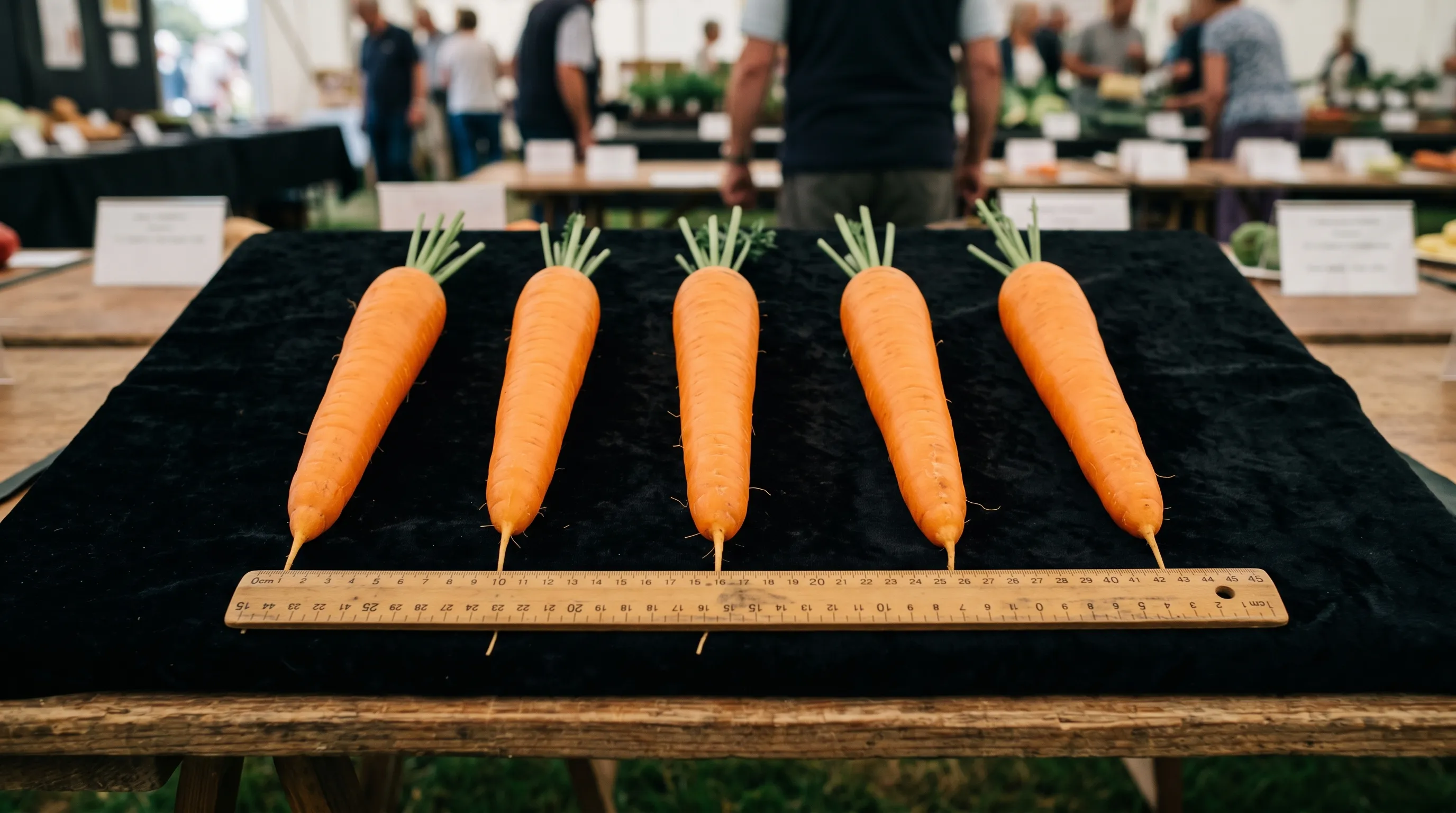
- Carrots: foliage trimmed to 8cm from shoulder. Roots washed gently, no scrubbing damage. Tip intact (do not break).
- Parsnips: as carrots, foliage to 8cm, roots washed, tip intact.
- Beetroot: foliage twisted off cleanly, not cut. Tap root intact, not trimmed.
- Cabbages: outer leaves trimmed but a frame of three or four healthy outer leaves left to frame the heart. Stem cut at 5cm.
Staging cloths matter. White paper plates are common and free at most shows. Black velvet pads make orange carrots, red beetroot, and white onions pop visually. The judge sees the colour contrast and the eye is drawn to perfection.
Count and arrangement
Most classes call for 3, 5, 6, or 9 specimens. Arrange odd numbers symmetrically: 3 in a triangle with the largest at top, 5 in a pyramid (3-2 stack), 9 in a 3-3-3 grid. Even numbers go in matched pairs or in a 2-2-2 line.
Largest at the back, smallest at the front. The judge’s eye is drawn to symmetry. A well-staged exhibit with average produce often beats poorly-staged outstanding produce.
Single-vegetable classes: what wins each
This is the practical view: for each major class, what the judge will look for first.
Onions
Three matched bulbs, equal in size, identical shape, smooth dry skins. The neck should be soft but not collapsed. Roots flush-trimmed. No splits, no soft spots. Most lost prizes here are about uniformity, not size. A 12oz bulb that perfectly matches two others beats an 18oz bulb with two mismatched companions.
Our UK onion varieties compared guide covers which varieties suit show classes (Kelsae and Mammoth for size, Sturon and Stuttgarter for shape).
Leeks
Two main classes: blanch (long white shanks, specified length) and pot (short, stocky). Both judged on uniformity, condition, and absence of barrel splits or rust. Class-specified length matters in blanch classes (typically 30 or 35cm) and exhibits outside the specified range are penalised heavily.
Potatoes
Six or nine matched tubers. Eyes intact. Skins unblemished. No scab, no greening, no damage from harvesting. White-skinned varieties show every mark, so most show exhibitors use red-skinned or yellow-skinned varieties (Maris Piper, Desiree, King Edward) to hide minor blemishes. Wash gently with a soft brush, not a scrubber.
Long carrots
The classic show class. Three matched carrots, foliage trimmed to specified length, tap root intact. Length is everything: a 45cm carrot beats a 30cm carrot even if shape is identical, provided condition and shape are equal. Long carrots are grown in deep bored holes or barrel-and-pipe systems specifically for length.
Tomatoes
Five or nine fruits, ideally with calyx (the green crown) intact and fresh. Even colour, no cracking, no shoulder green. Uniformity of size carries most points. Most shows prefer medium-sized fruits (cricket-ball size) over giant beefsteaks because medium-sized fruits ripen evenly.
Collection classes: the hardest to win
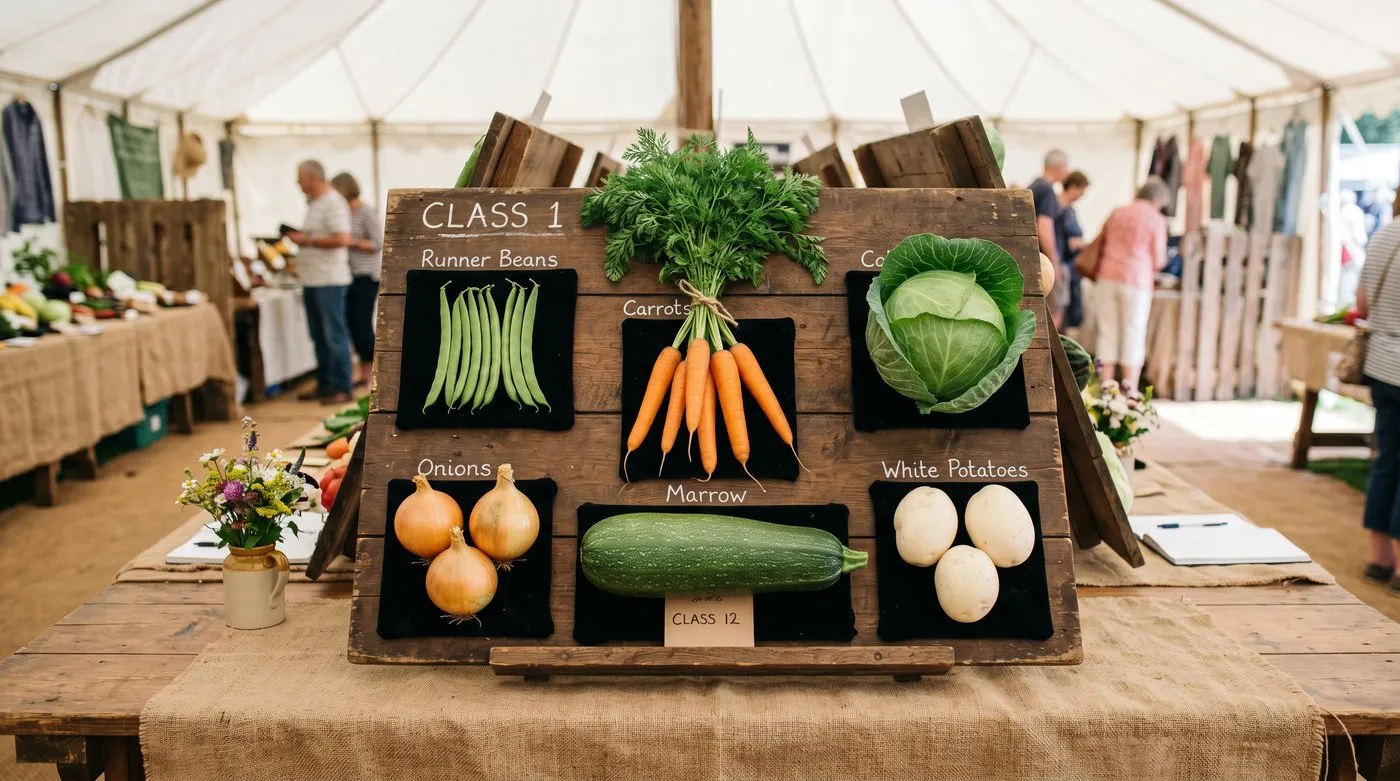
Many shows have a “collection” or “table of vegetables” class. This is an exhibit of multiple vegetables (commonly 5, 6, 7, or 9 different types) judged as a single display.
Collection classes score each vegetable individually using the standard guide, then sum the points. The weakest exhibit in the collection drags the whole score down. A perfect collection with one mediocre cabbage often loses to a slightly less perfect collection with no weak link.
Plan collection classes around what you can grow consistently well. Better to enter a 5-vegetable collection of your strongest crops than a 9-vegetable collection with three you struggled with.
The most common scoring losses
Wrong count. Class calls for 6, exhibitor stages 5. Automatic disqualification. Read the schedule.
Dirty roots. Especially on carrots, parsnips, leeks. A grubby root pad on an otherwise perfect carrot is a 1 to 2 point deduction. Wash gently the night before.
Mismatched specimens. Picking five great carrots and one slightly larger sixth pulls the whole set down. Grow more, select harder.
Damaged transport. A perfect leek with a bent tip from the boot of the car loses condition points. Pack in long boxes with rolled newspaper. Drive carefully.
Trim damage. Cutting carrot foliage too short (under 5cm) is a deduction. Twisting beetroot foliage off too aggressively and breaking the crown is a deduction.
Wrong variety in single-variety class. Mixed varieties disqualified. Tag and label your bench at home.
Late staging. Most shows close staging at a specified time (commonly 09:30 for an 11:00 judging). Arriving at 10:00 means your exhibit is not judged. Set your alarm.
The 48-hour countdown to show day
Saturday morning (show is Sunday):
- Harvest at peak. Carrots and parsnips: lift carefully with a fork, do not cut tap root. Leeks: dig out with as much root as possible. Onions: lift two weeks earlier and cure.
- Lay everything out on a clean cloth in the kitchen. Pick more than you need: aim for 150 percent of class count to allow selection.
- Wash gently in cool water. No scrubbing. Pat dry with clean towels.
Saturday afternoon:
- Trim to class requirements. Measure twice, cut once.
- Stage your bench at home on the kitchen table. Use the actual plates or velvet pads you will take to the show. Photograph the staging from above.
- Match specimens by eye. Pull out the closest set of 3 or 6 from the wider harvest.
Saturday evening:
- Pack into transport boxes. Carrots and parsnips in long shallow boxes with newspaper. Onions in trays with cloth between layers. Leeks lying flat, never standing.
- Print or write out class numbers and have your exhibitor’s card ready.
- Set two alarms for Sunday morning.
Sunday morning:
- Arrive at the show 30 to 45 minutes before staging closes. Find your benches. Stage in order of class number.
- Make any final trims or wipe-downs at the bench. Do not touch other exhibitors’ produce.
- Leave the marquee promptly when staging closes. Judges work undisturbed.
This is the discipline that turns growing skill into prizes.
Where to learn more and where to compete
The National Vegetable Society runs branches across the UK with monthly meetings, lectures, and members-only shows. Joining (annual subscription around 25 pounds) gives access to the Judges’ Guide at member rate, technical bulletins, and a network of experienced exhibitors who will help newcomers. Find your nearest branch on the NVS website.
Local shows are the right starting point. Most village horticultural societies welcome new exhibitors and run novice classes. The bigger county shows (Bakewell, Royal Welsh, Great Yorkshire) run open classes that draw national-level competition. The NVS National Championship rotates around the UK each September and represents the top of the sport.
Frequently asked questions
The questions below cover the points new exhibitors ask most often.
Our team produces practical UK gardening guidance from source research, contributor records and established horticultural practice. Editorial standards are overseen by Matt W.