Key takeaways
- Basil germinates in 5-7 days at 22C and is ready for first pick in 4 weeks
- South or south-east windowsills give the 4-6 hours of light needed for healthy growth
- Bottom watering through saucers prevents damping off and overwatered seedlings
- Sow every 3-4 weeks for continuous fresh herbs
- Peat-free seed compost beats general-purpose compost for fast clean germination
- Use 9cm terracotta pots for the first 4-6 weeks; pot up to 12-15cm afterwards
Growing herbs from seed indoors is the cheapest, fastest, and most rewarding way to keep a UK kitchen in fresh basil, parsley, chives, and coriander. A £2 packet of basil seed gives more pots than a year of supermarket pot herbs. The result is fresher leaves, healthier plants, and the option to grow varieties supermarkets never stock.
This guide is a 4-week starter plan for any UK kitchen with a south or south-east facing window. You will find the compost choice that beats general-purpose, the bottom-watering technique that prevents the most common cause of seedling death, the succession schedule that gives continuous herbs, and the species choice that matches your light and time. Pair this with our supermarket herbs alive indoors guide for the alternative bought-plant route, and our how to grow herbs for the wider outdoor cluster.
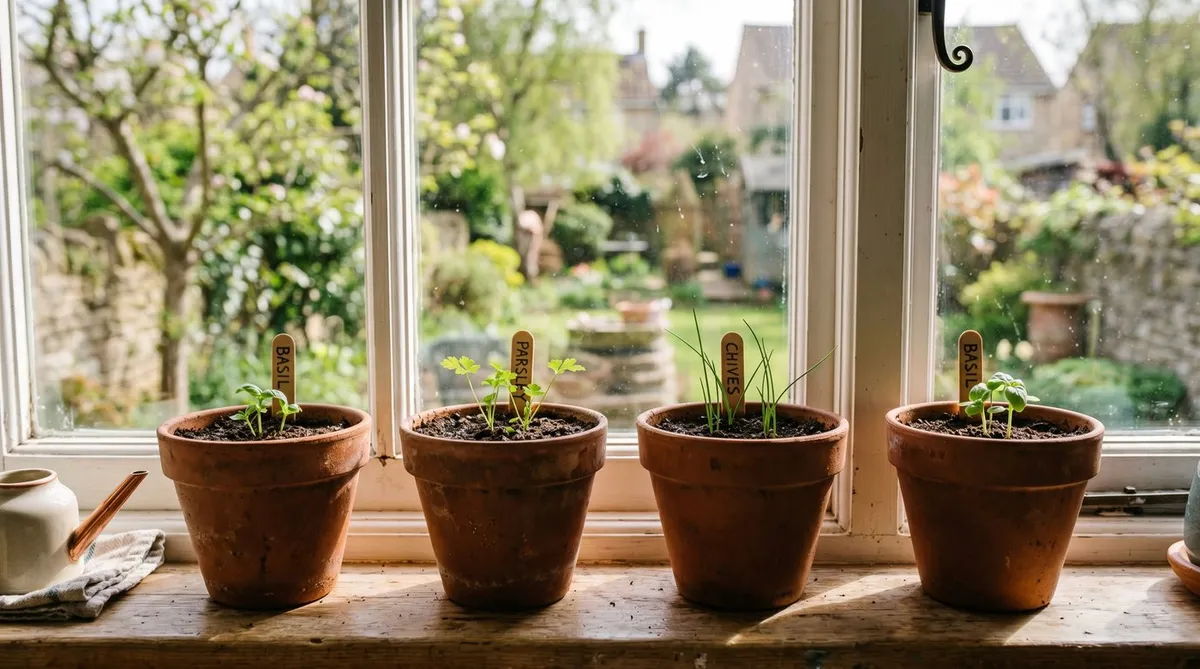
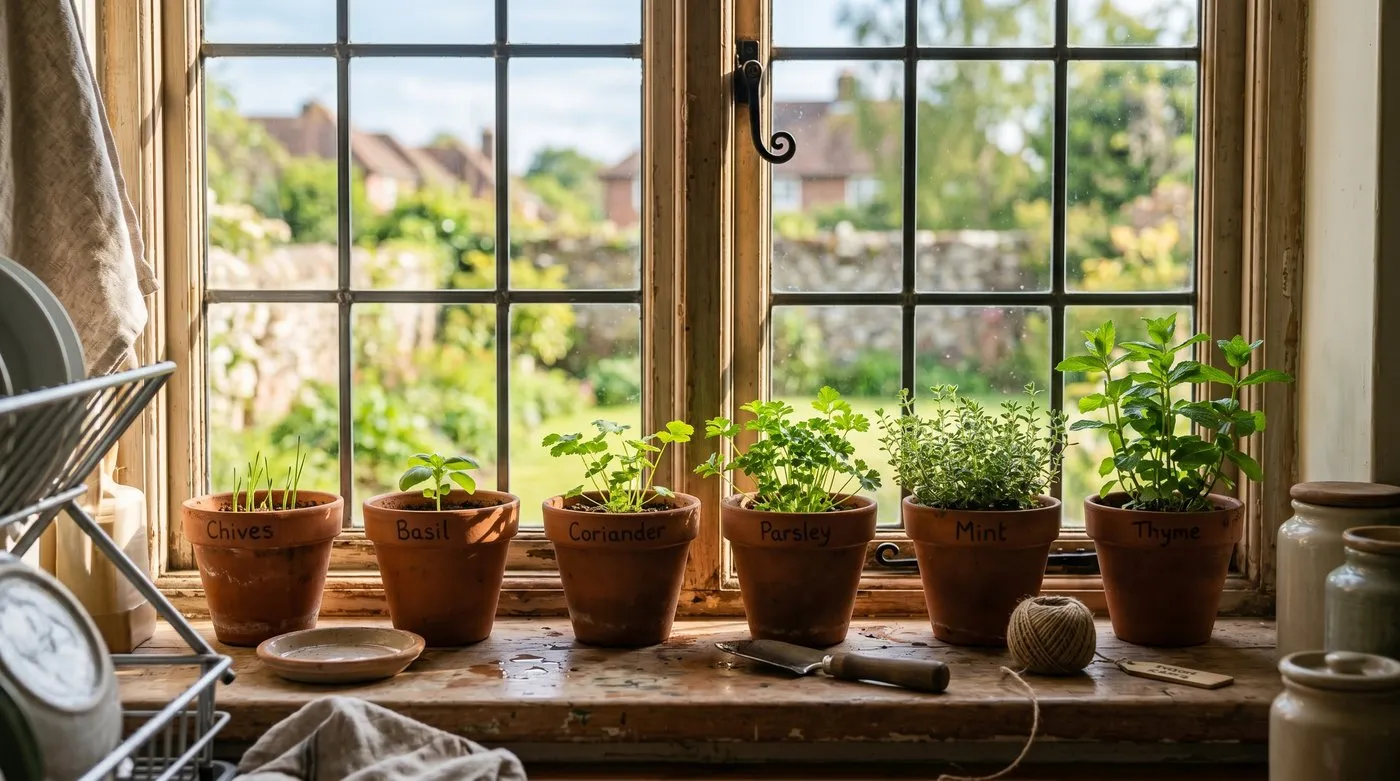 Six-pot succession system on a south-facing windowsill, with herbs at different stages from week 1 (just emerged) to week 5 (ready to pick). Continuous fresh supply year-round
Why grow herbs from seed indoors
A £2 seed packet outperforms £10 of supermarket pot herbs. A standard basil packet contains 300-500 seeds. Each can become a productive plant. The maths is overwhelming: roughly 10p of seed gives a £3-£4 supermarket pot of herbs.
Seed offers variety choices supermarkets do not. Genovese basil is the standard supermarket type; the home grower can choose Thai, lemon, holy, purple, lettuce-leaf, Greek bush, and many others. The same applies across parsley, mint, oregano, thyme, and chives.
Indoor seed sowing extends the herb season to year-round. Outdoor herbs in UK gardens crop April to October. Indoor sowing on a sunny windowsill works February to November with care, and winter-only with a small grow light.
Children love it. Indoor herb sowing is a quick gardening project; basil emerges in 5-7 days. Schoolchildren can plant, water, observe, and harvest within a half-term.
The risk of bringing pests indoors is low compared with overwintered outdoor herbs. Seed sowing starts clean; supermarket plants often carry aphids or whitefly into the kitchen.
The economics improve year on year. Saved seed from year 1 plants supplies year 2 sowings. A single year of careful seed-saving cuts costs by 60-80%.
| Sowing method | Pros | Cons |
|---|---|---|
| From seed indoors | Cheap, variety choice, year-round | Slower start, needs windowsill space |
| Supermarket pots | Instant, no setup needed | Expensive, short-lived, limited varieties |
| Cuttings from supermarket stems | Cheap once started, fast | Limited to root-capable herbs (mint, basil) |
| Garden centre plants | Mature plants instantly | Mid-price, often pesticide-treated |
The six easiest herbs from indoor seed
Basil (Ocimum basilicum) germinates in 5-7 days at 22C and is ready for first cut in 4 weeks. Genovese and Greek bush are the easiest varieties. Needs warmth and bright light.
Parsley (Petroselinum crispum) germinates in 14-21 days. Flat-leaf and curled both work indoors. Slow start, but plants crop for 8-12 months once established.
Chives (Allium schoenoprasum) germinate in 10-14 days. Hardy perennial that produces year-round. Most forgiving herb for low-light kitchens.
Coriander (Coriandrum sativum) germinates in 7-14 days. Bolts fast indoors; succession-sow every 3 weeks for continuous supply. Slow-bolt varieties (Calypso, Confetti) extend cutting window.
Dill (Anethum graveolens) germinates in 10-14 days. Strong taproot dislikes transplanting; sow direct in final pot.
Rocket (Eruca sativa) germinates in 5-7 days. Bolts fast indoors in summer; succession-sow every 3 weeks.
Mint, oregano, thyme, sage, and rosemary are slower from seed and easier to start from cuttings or supermarket plants. Avoid these as your first indoor herb seed crops.
| Herb | Germination at 22C | Time to first cut | Pot size at maturity |
|---|---|---|---|
| Basil | 5-7 days | 4 weeks | 12-15cm |
| Parsley | 14-21 days | 6 weeks | 12-15cm |
| Chives | 10-14 days | 5 weeks | 12cm |
| Coriander | 7-14 days | 4 weeks | 12cm |
| Dill | 10-14 days | 6 weeks | 15-18cm |
| Rocket | 5-7 days | 4 weeks | 12cm |
Compost, pots and equipment
Use peat-free seed compost, not general-purpose compost. Seed compost is finer textured, lower in fertilising chemicals, and clean of weed seeds. General-purpose compost is too coarse and too fertile for delicate seedlings.
UK brands of peat-free seed compost: Dalefoot, Melcourt, SylvaGrow, Carbon Gold. All available at garden centres or online for £6-£10 per 20-litre bag. One bag sows 30-50 small pots.
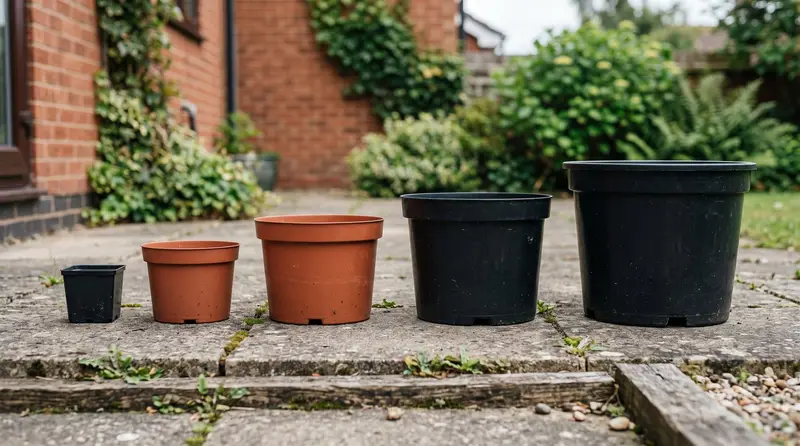
9cm terracotta pots are the standard starter. Plastic pots work but terracotta breathes and helps prevent overwatering. Save the small pots that supermarket basil came in; they are exactly 9cm.
Add 1cm of crocks or coarse grit at the bottom for drainage. Then fill with peat-free compost to within 1cm of the rim. Press lightly with a flat hand to firm but not compact.
Saucers under each pot are essential. Bottom watering needs a saucer to pour water into. Plastic plant saucers are 30-60p each; cheap supermarket plant trays work too.
Optional: a propagator with clear lid speeds germination. Available £8-£20 from garden centres. The warm humid environment cuts germination time by 2-4 days.
Optional: a small LED grow light (£15-£25) extends the season. Useful on cloudy weeks, in winter, or for north-facing kitchens.
The 4-week growing plan
Week 0 (Day 0): sow. Fill 6 pots with peat-free seed compost. Water from below to settle the compost. Sow 8-12 seeds per pot 5mm deep. Cover lightly with sieved compost. Place on south-facing windowsill in a propagator at 18-22C.
Week 1 (Days 1-7): germinate. Keep compost moist but never waterlogged. Basil and rocket emerge in 5-7 days. Slower species emerge in 10-21 days. Remove propagator lid as soon as 50% of seedlings show.
Week 2 (Days 7-14): true leaves emerge. First true leaves (after the two seed leaves) appear. Plants need bright light to prevent leggy growth. Rotate pots a quarter turn daily so seedlings grow straight.
Week 3 (Days 14-21): thin and feed. Thin to 3-4 strong seedlings per pot. Pinch off weaker seedlings at the base or snip with scissors. Begin feeding once a week with diluted seaweed feed (half-strength).
Week 4 (Days 21-28): first cut. Plants reach 8-12cm tall with multiple sets of true leaves. Cut top 2-3 sets of leaves from each plant. The plant branches sideways and produces more leaves.
Subsequent cuts: Every 7-14 days. Continue feeding weekly. Pot up to 12-15cm pots if root crowding develops.
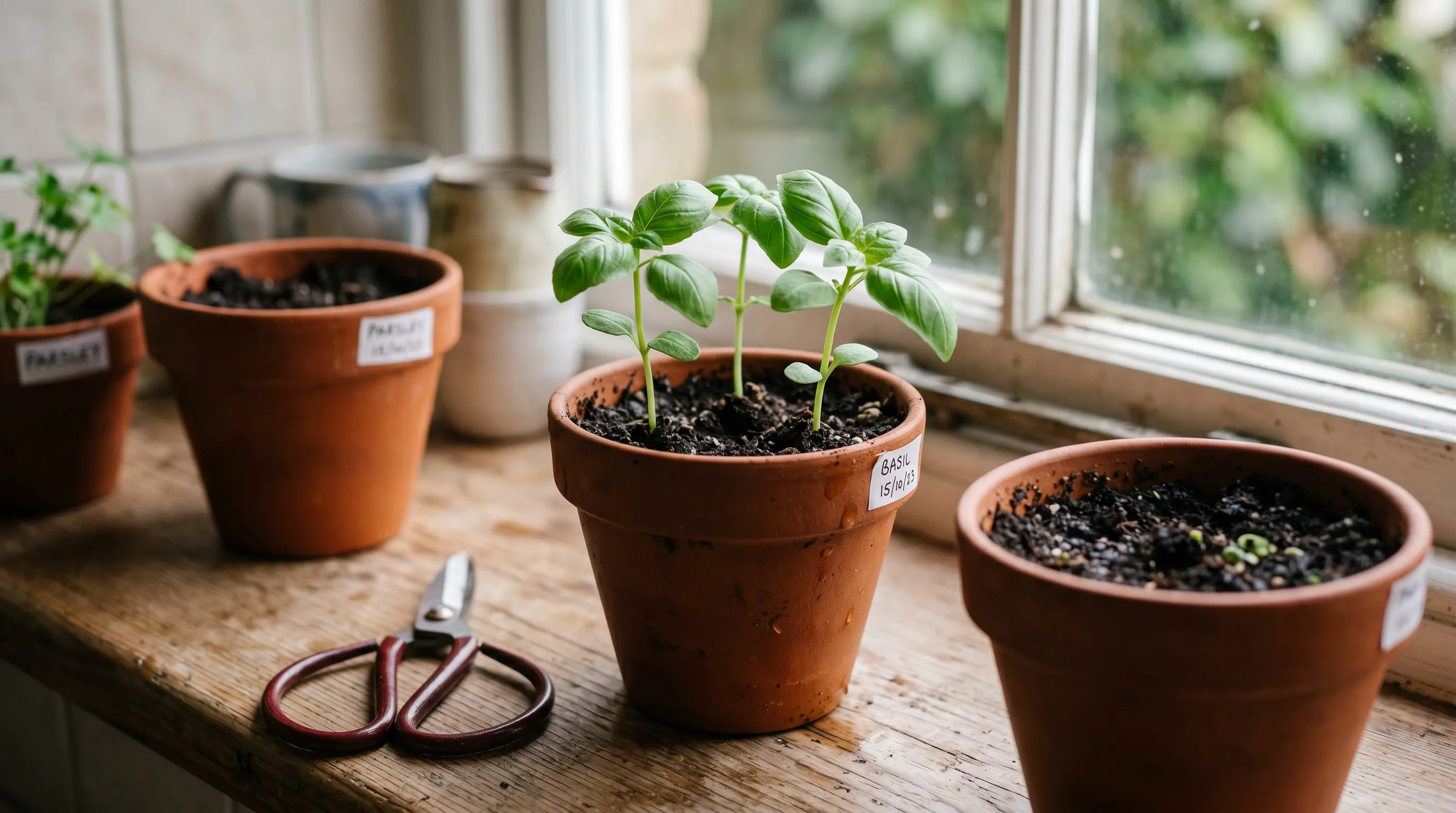 Week 3 of the growing plan. Thin to 3-4 strong seedlings per 9cm pot. The remaining plants then grow vigorously with full root and light access
Light: the deciding factor
South or south-east-facing windowsills give the 4-6 hours of direct sunlight needed for healthy growth. This is the easiest variable to get wrong.
East-facing windowsills work for chives, parsley, and dill which tolerate slightly lower light. Basil and coriander on east-facing windows tend to grow leggy.
West-facing windowsills work for most species. Afternoon sun is strong enough for basil and rocket.
North-facing windowsills do not provide enough natural light. Plants on north windows etiolate (stretch towards light) and remain weak. Use a small grow light to supplement.
LED grow lights cost £15-£25 for a 10-15W unit suitable for 4-6 small pots. Position 15-30cm above plants. Run 12-14 hours per day. The Sansi 15W LED full-spectrum bulb is the standard recommendation for UK windowsills.
Rotate pots daily. Plants grow towards the light source. Without rotation, seedlings lean and become weak on the shaded side.
Winter light hours. UK December has just 8 hours of daylight; useful light hours for indoor herbs are 4-6 hours of direct sun. Supplement with a grow light from November to mid-February for continuous winter growth.
Watering: bottom watering is the difference
Bottom watering through saucers is the single most useful technique for indoor herbs. Pour 100-200ml of water into each saucer, leave for 20-30 minutes, drain any excess back out.
The compost wicks water up from below. Roots grow downwards searching for moisture. The surface stays drier; this prevents damping off and fungus gnats.
Top watering with a small watering can works but has drawbacks. Heavy top water disturbs seedlings, washes seeds out of position, and saturates the surface where damping off thrives. Use top water only for established plants beyond week 6.
Check moisture daily by lifting the pot. A wet pot is heavy; a dry pot is light. With practice, you can judge watering needs without touching the compost.
Frequency varies by species and season. Basil drinks heavily in summer; parsley moderately; chives lightly. Hot dry kitchens need watering every 1-2 days; cool damp kitchens every 4-7 days.
Never let pots stand in standing water. Drain saucers within an hour of bottom watering. Waterlogged roots rot.
Mist plants weekly if kitchen air is dry. Particularly in winter when central heating dries the air. Basil and coriander appreciate occasional misting.
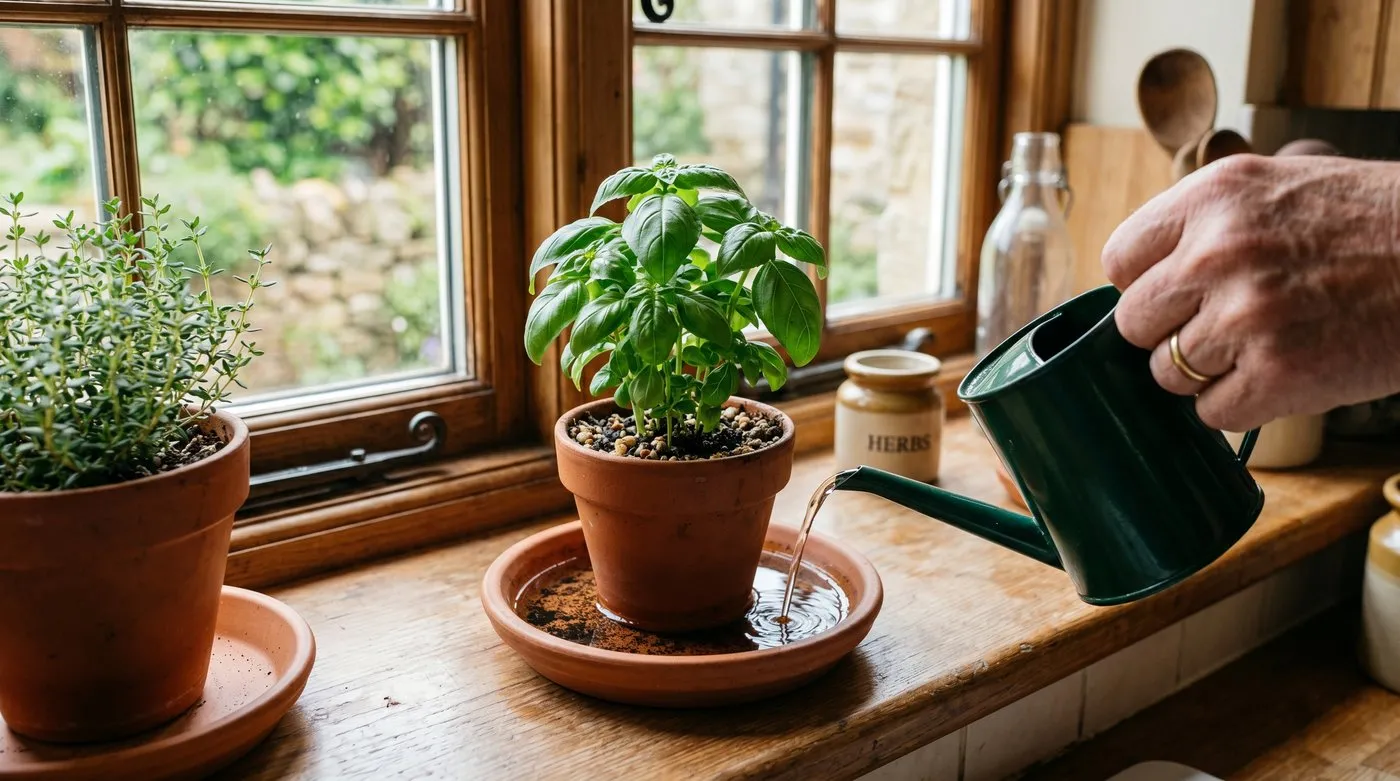 Bottom watering: pour water into the saucer, leave for 20-30 minutes, drain the excess. Prevents damping off and overwatered seedlings
Feeding and potting on
No feeding for the first 3 weeks. Seed compost contains enough nutrients for early growth.
From week 3 onwards, feed weekly with half-strength liquid seaweed or balanced liquid fertiliser. Tomorite at half-strength works well. Maxicrop seaweed feed is the organic option.
Pot on to 12-15cm pots after week 6-8 if root crowding develops. Tip out and check roots; if they fill the pot, repot up.
Use peat-free general-purpose compost for potting on. Seed compost is too low in nutrients beyond week 4.
Compost-on every 4-6 months for long-lived herbs. Parsley, chives, and dill can crop for 8-12 months from a single sowing if repotted and fed.
Replace plants when production drops. Basil typically tires after 4-5 cuts. Discard and start fresh from the next succession sowing.
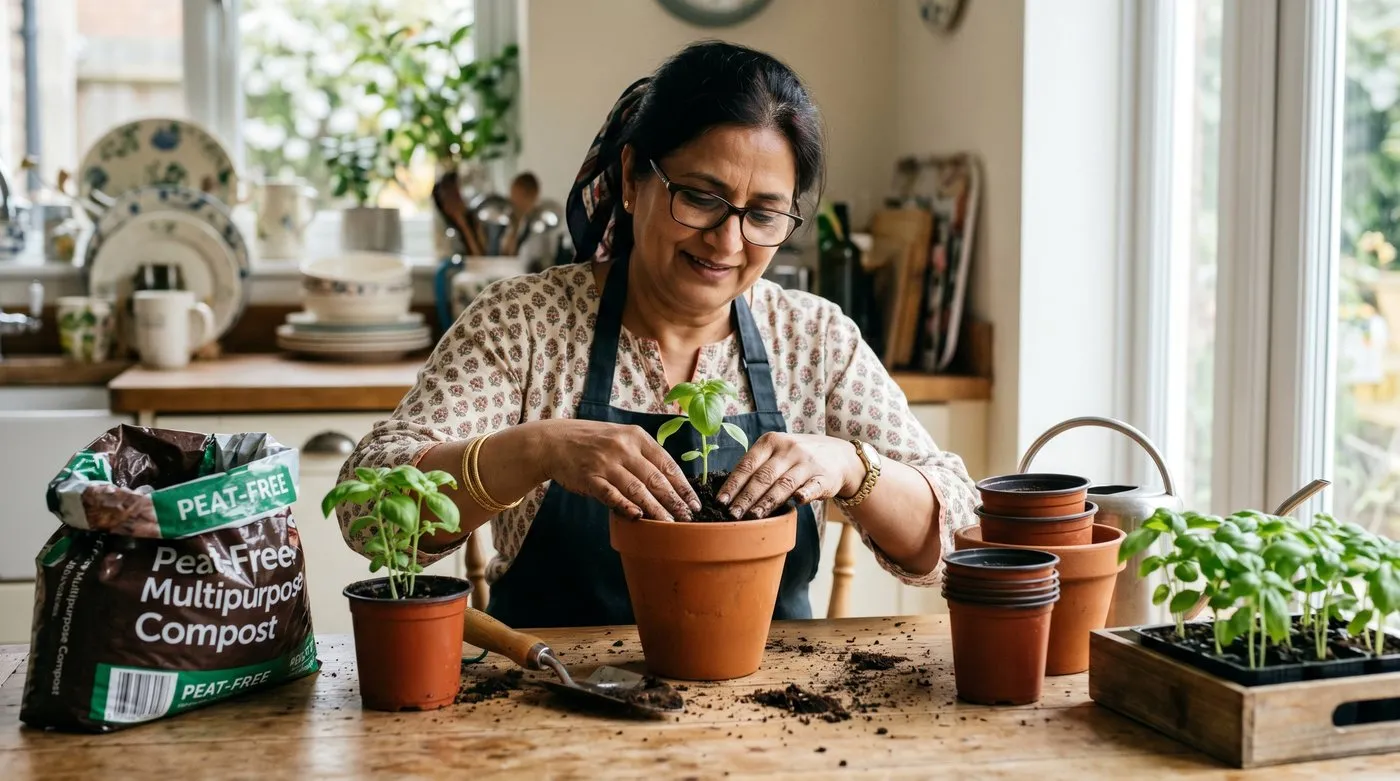 Week 6 potting up from 9cm starter pots to 15cm production pots. Larger pots extend plant life and allow heavier harvests
Succession sowing for year-round herbs
Sow every 3-4 weeks for continuous fresh herbs. This is the single most important habit for indoor herb growers.
A 6-pot succession system:
- Pot 1: week 0 sown
- Pot 2: week 3 sown
- Pot 3: week 6 sown
- Pot 4: week 9 sown
- Pot 5: week 12 sown
- Pot 6: week 15 sown
After 4 cuts on Pot 1 (roughly 6 weeks of production), it is replaced by a new sowing. The system holds 6 pots at different stages always.
Sow extra during peak demand months. Summer cooking uses more basil and coriander; double sowings in June-August.
Winter slowdown. UK December-February growth slows significantly. Reduce to one new sowing every 5-6 weeks unless using a grow light.
Mark each pot with sowing date. Permanent marker on a wooden plant label or stuck to the pot. Helps track succession.
Common mistakes to avoid
Too many seeds per pot. 8-12 seeds is fine for germination, but failing to thin leaves all plants weak. Always thin to 3-4 strong seedlings per 9cm pot.
General-purpose compost for sowing. Too coarse, too fertile, often weedy. Use peat-free seed compost.
Top watering at seedling stage. Saturates surface, drowns roots, spreads damping off. Bottom water instead.
Insufficient light. North-facing windowsills produce weak leggy plants. Use a south or south-east window, or supplement with grow lights.
Sowing one big batch instead of succession. Gives a glut of herbs then nothing. Sow every 3-4 weeks for continuous supply.
Skipping the feed. Plants beyond week 4 in 9cm pots need weekly feeding. Without it, leaves yellow and growth stalls.
Step-by-step: sowing 6 pots of basil
Step 1: gather materials. 6 small 9cm terracotta pots, 6 saucers, peat-free seed compost, 1 packet of basil seed (Genovese standard), small watering can with fine rose, plant labels, permanent marker.
Step 2: fill pots. Add 1cm crocks or grit at the bottom of each pot. Fill with peat-free seed compost to 1cm below rim. Press lightly.
Step 3: water from below. Place pots on saucers. Pour 100-200ml water into each saucer. Wait 20 minutes for compost to absorb moisture.
Step 4: sow seed. Sprinkle 8-12 basil seeds evenly across the surface of each pot. Cover with 5mm of sieved compost.
Step 5: label. Write ‘Basil Genovese’ and the sowing date on labels. Place one in each pot.
Step 6: cover with propagator lid or clear plastic. Maintain humidity. Place on south-facing windowsill at 18-22C.
Step 7: check daily. Remove condensation from cover lid; lift to check moisture. Water from below if surface looks dry.
Step 8: remove cover at 50% germination (around day 5-7). Continue watering from below.
Step 9: rotate pots daily. Quarter turn each pot to keep seedlings straight.
Step 10: thin at day 21 to 3-4 strongest seedlings. Compost or eat the thinnings as microgreens.
Step 11: first cut at day 28. Cut top 2-3 sets of leaves with scissors.
Step 12: feed weekly from day 21. Half-strength seaweed or balanced liquid fertiliser.
Frequently asked questions
Which herbs grow easiest indoors from seed?
Basil, parsley, chives, coriander, dill, and rocket are the easiest indoor herbs from seed. All germinate within 7-21 days at 18-22C and reach cutting size in 4-6 weeks. Mint, oregano, thyme, sage, and rosemary are slower from seed and easier to start from supermarket plants or cuttings. Start with basil and chives as the most rewarding first-time crops.
What is the best compost for sowing herbs indoors?
Peat-free seed compost is the best choice. It is finer textured, lower in nutrients (which prevents leggy growth), and clean of weed seeds. Avoid general-purpose compost for seed sowing; it is too coarse and too fertile for delicate herb seedlings. Top-quality seed compost is worth the extra £2-£3 per bag. Dalefoot, SylvaGrow, and Melcourt are the leading UK peat-free brands.
How much light do indoor herbs need?
Indoor herbs need 4-6 hours of direct sunlight per day for healthy growth. South or south-east facing windowsills are best. North-facing windowsills do not provide enough light and produce leggy weak plants. Supplement with a small LED grow light (£15-£25) on cloudy days or in winter to maintain light hours. Rotate pots daily so seedlings grow straight.
Why are my indoor herb seedlings dying?
The most common causes are overwatering (damping off, soft black stems), inadequate light (leggy weak growth, pale leaves), and root crowding (too many seedlings in one pot). Fix with bottom watering, a brighter windowsill or grow light, and thinning to 3-4 seedlings per 9cm pot at the 4-leaf stage. Damping off is the single most common killer; bottom watering is the fix.
How do I keep indoor herbs producing year-round?
Sow successively every 3-4 weeks. A new batch sown when the previous one is at 3 weeks gives continuous fresh herbs. Use 6 small pots per herb species in rotation. After 4-6 cuts each plant tires and is replaced by the next pot. The kitchen has fresh herbs all year through this assembly-line approach. Winter growth slows; supplement light with a grow lamp in deep winter.
Now you have an indoor herb factory in the kitchen, see our supermarket herbs alive indoors guide for the supermarket-rescue route and our how to grow herbs for outdoor cultivation. The Royal Horticultural Society herb growing guide covers the broader UK herb cluster and complementary species.
Our team produces practical UK gardening guidance from source research, contributor records and established horticultural practice. Editorial standards are overseen by Matt W.