Key takeaways
- Most UK council allotment agreements ban general burning and only permit dry plot-grown woody waste on stated evenings
- Smoke that drifts onto a neighbour's property is a statutory nuisance under the 1990 Environmental Protection Act
- October to March is the standard UK burn window; outside this period burning is usually prohibited
- A garden chipper (£150-£400 to hire or buy) reduces 90% of woody waste to mulch in one afternoon
- Council green waste collection takes 240-litre brown bins fortnightly for £30-£60 per year
- Hot composting at 60-70C breaks down brassica stalks and woody prunings in 8-12 weeks
Bonfires on allotments are the single most argued-about activity on UK plots. They generate complaints, attract council attention, and on dry days they get out of hand. The rules are clear in the council bylaws if you read them, and most plot holders never do. This guide explains what the law says, what site rules typically permit, when you can burn, and the five alternatives that handle 90% of plot waste without smoke.
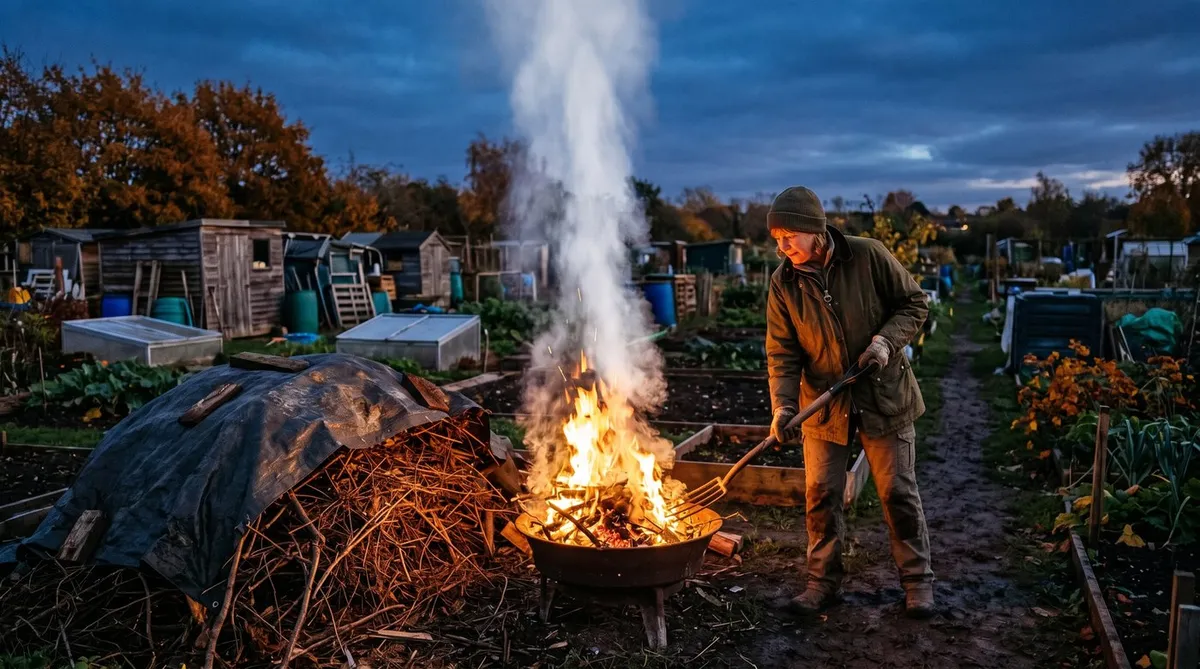
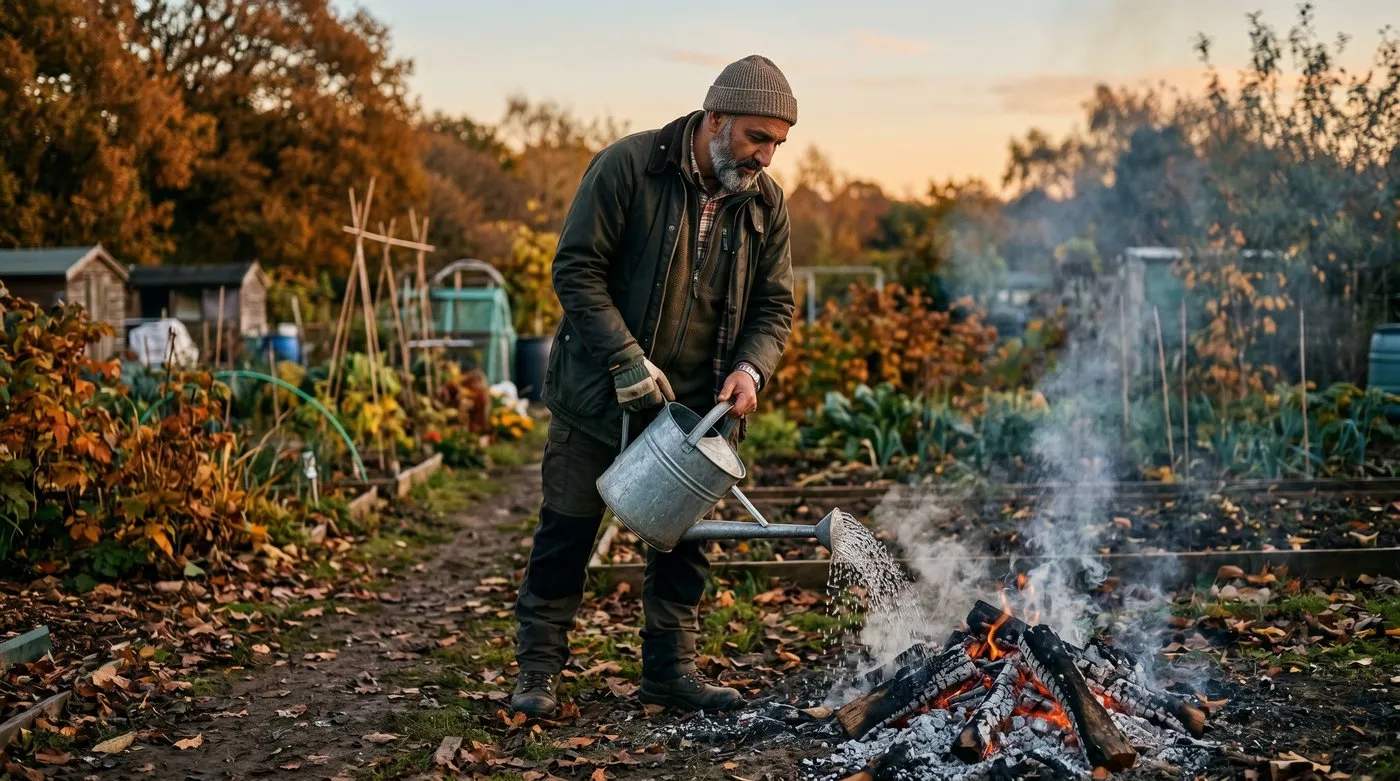
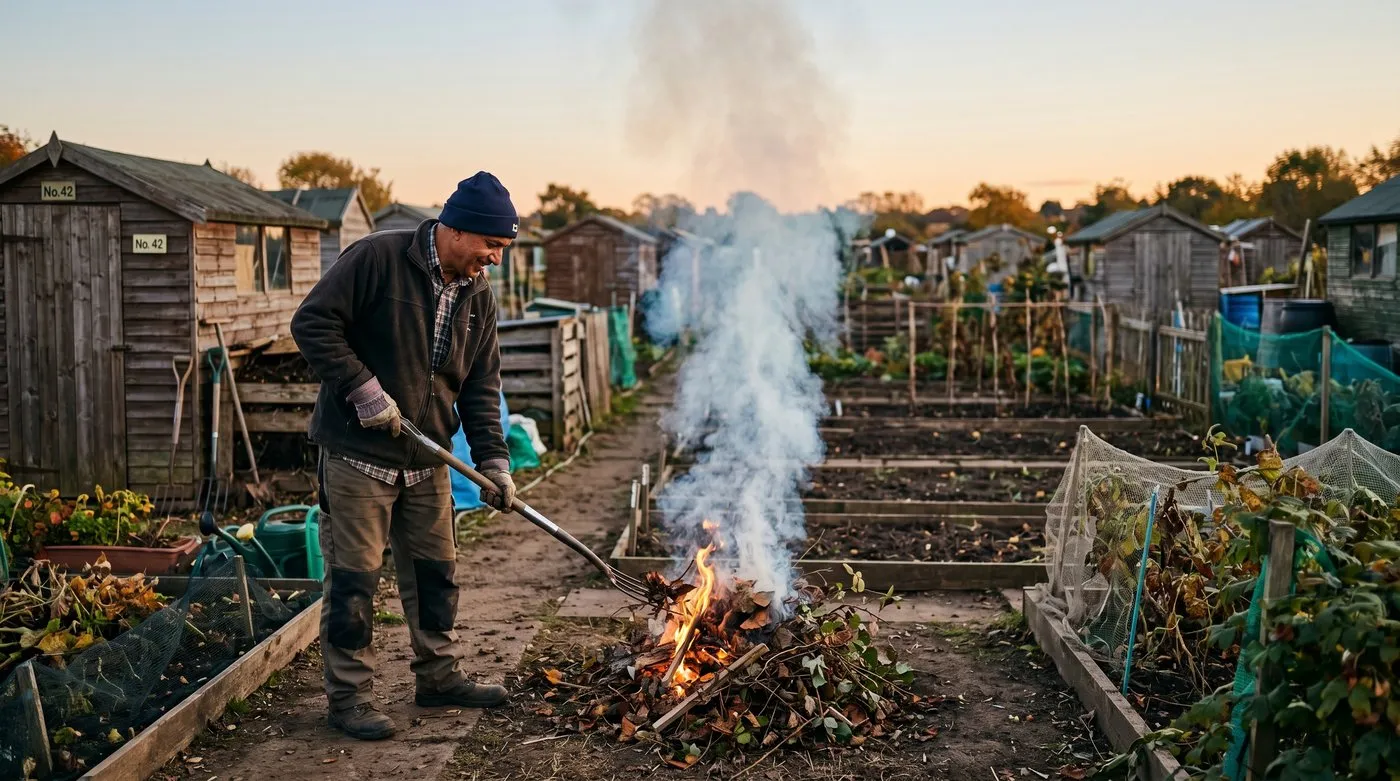 A small, hot, dry-wood bonfire on a still October evening, the only legal style of allotment burning under most council rules
What UK law says about allotment bonfires
There is no national ban on bonfires in UK gardens or allotments. What exists is a layered set of rules: site rules in your tenancy agreement, council bylaws under the Allotments Act 1922 and 1950, the Environmental Protection Act 1990 (smoke nuisance), the Clean Air Act 1993 (Smoke Control Areas), and at the extreme, the Public Health Act 1936 for serious health risks.
Site rules in your tenancy agreement come first. Most UK councils write the standard wording: bonfires permitted only for material that cannot be composted, only October to March, only on stated evenings, only with the wind blowing away from properties, and only with a responsible adult tending the fire. Some sites ban bonfires outright. Birmingham City Council banned all allotment bonfires in 2018. Manchester restricts them to one named day per month.
The Environmental Protection Act 1990 makes smoke nuisance a council enforcement matter. If a neighbour reports smoke drifting onto their property and disrupting normal use, the council Environmental Health team will investigate. Three confirmed reports usually trigger an abatement notice. Continued nuisance after the notice can lead to fines of up to £5,000 and, on allotment land, loss of tenancy.
Clean Air Act 1993 adds restrictions in Smoke Control Areas. Most UK urban centres are designated Smoke Control Areas. The Act allows only “smokeless” fuels in domestic appliances. Open garden bonfires are not technically appliances, so the Act does not directly prohibit them, but the Environmental Protection Act covers any smoke that does cause nuisance. Check whether your allotment is inside a Smoke Control Area on your council website.
Burning waste from outside the plot is illegal. This is the rule most often broken. Plot holders cannot bring household rubbish, building waste, or non-allotment garden waste onto the plot for burning. Doing so is unlicensed waste disposal under the Environmental Protection Act 1990 section 33, with fines of up to £50,000 for individuals.
| Law | What it covers | Enforcement |
|---|---|---|
| Site tenancy rules | Burn windows, materials, frequency | Loss of tenancy |
| Environmental Protection Act 1990 | Smoke nuisance, illegal waste | Abatement notice, £5,000 fine |
| Clean Air Act 1993 | Smoke Control Area restrictions | Council enforcement |
| Allotments Act 1922 plus 1950 | Tenancy basis | Site rule legitimacy |
When you can burn: the wind test and burn window
The standard UK allotment burn window is October to March. Outside this period burning is usually prohibited because of dry conditions, wildfires risk, and people using gardens. October to March covers the wet, cold months when smoke disperses faster and most gardens are not in active use.
The wind direction test is the practical legal threshold. Light a fire only when the wind is blowing away from any house, road, or footpath within 100 metres. Stand at the fire site, hold a piece of dry grass aloft, and watch where the wisp drifts. If the wisp goes towards a property, do not light. Wind direction can change in minutes; check at every load of fuel.
Still air is worse than steady wind. Without a breeze, smoke pools at ground level and seeps into adjacent gardens. A steady 5-10 mph wind is ideal. Above 15 mph the fire becomes uncontrollable.
Time of day matters. Most council rules specify weekday evenings between 5pm and 9pm. The wind drops at dusk, the smoke disperses upwards in cooler air, and most neighbours have finished outdoor activities. Daytime burning generates more complaints.
The 30-minute rule. Aim to burn out the fire within 30 minutes of lighting. Hot fast fires produce less smoke than slow smouldering ones. A hot fire reaches 600-800C, burns the volatile compounds in the smoke, and reduces visible plume by 80%. A smouldering fire at 200-300C produces dense white smoke for hours.
Warning: Never use petrol, paraffin, or other accelerants to start the fire. They produce unburnt vapour, black smoke, and immediate council complaint. Use a small handful of dry kindling and rolled-up newspaper. If the fire will not light without accelerant, the wood is too wet to burn.
What you can and cannot burn
Burn only dry, woody, plot-grown waste. This is the universal rule across UK councils. Specifically permitted: dead branches over 25mm thick, woody hedge cuttings, sweetcorn stalks (dried), bean haulm, brassica stumps after composting attempt, raspberry canes, woody perennial top growth, dead Christmas trees from your own plot.
Do not burn green or wet material. Fresh leaves, grass clippings, soft prunings, and recently cut hedge produce dense smoke and smouldering fires. Stack the material undercover for 4-6 weeks until it dries, or compost it.
Do not burn diseased material at low temperatures. Club-root, honey fungus, and brassica viruses survive temperatures under 60C. A smouldering bonfire can spread spores. Burn diseased material in a hot fire that completes within 20-30 minutes, or use the council clinical waste route.
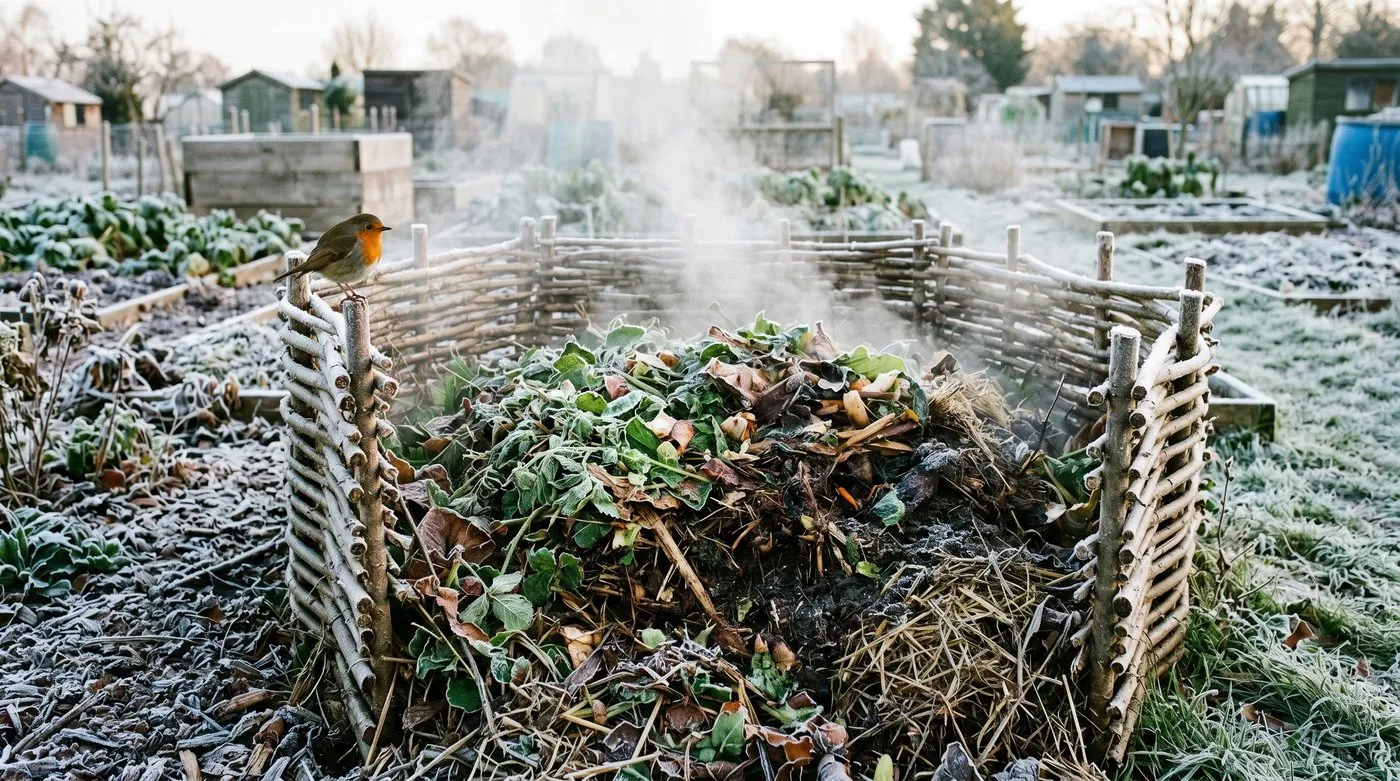 A hot compost heap reaching 65C in February steam shows internal heat. Hot composting handles brassica stumps and woody prunings without bonfires
Never burn plastic, treated wood, painted wood, tyres, or carpet. All produce toxic smoke and are illegal. Treated timber from old fence panels often contains copper-chrome-arsenic that releases poisonous fumes. Painted wood produces lead and chromium fumes. These are immediate council prosecution offences.
Plastic plant labels, twine, polythene mulch sheeting, and old fleece produce toxic dioxins. Sort these out of your bonfire pile every time. A single piece of polythene burnt openly produces enough dioxin to exceed daily safe exposure for someone downwind for hours.
| Material | Burn? | Reason |
|---|---|---|
| Dead branches over 25mm | Yes | Burns hot, low smoke |
| Woody prunings | Yes | If dry, low smoke |
| Brassica stumps | Yes if dry | Otherwise compost |
| Diseased plant material | Yes only | Burning is the safe disposal |
| Green leaves and grass | No | Smouldering, dense smoke |
| Treated or painted wood | No | Toxic fumes, illegal |
| Plastic, fleece, polythene | No | Toxic dioxins, illegal |
| Off-plot waste | No | Illegal waste disposal |
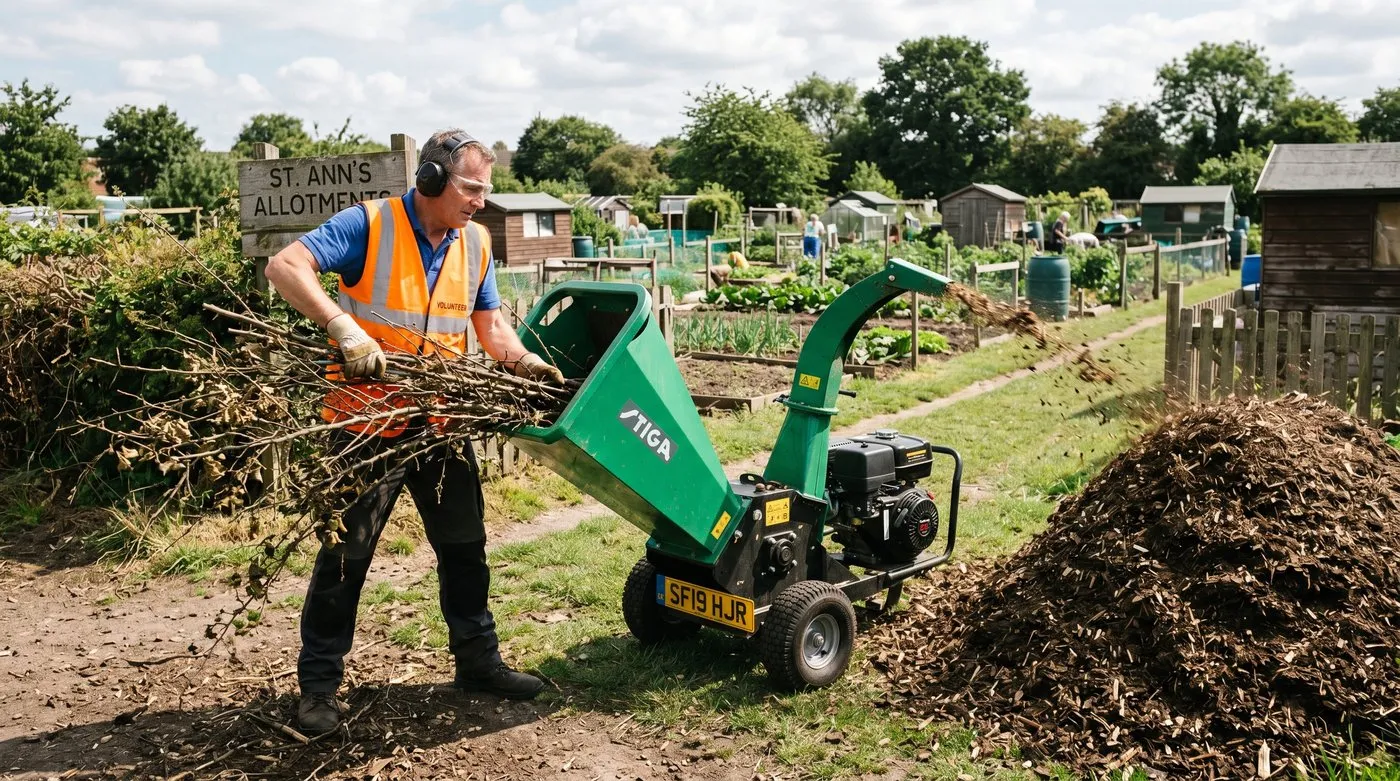 A 6.5hp petrol chipper turning a 5 cubic metre pile of woody prunings into mulch in 90 minutes, the leading alternative to allotment bonfires
Five alternatives that handle 90% of plot waste
Alternative 1: hire a chipper. Petrol garden chippers handle branches up to 50mm diameter. Hire from HSS Hire, Speedy, or A-Plant for £40-£75 per half day. A 6.5hp chipper reduces 5 cubic metres of prunings to 1.5 cubic metres of mulch in 90 minutes. The mulch goes straight onto paths or beds. Buy outright from £150-£400 if you process more than 10 cubic metres a year.
Alternative 2: hot composting. A hot heap reaches 60-70C in the centre and breaks down most plot waste in 8-12 weeks. The heap needs to be at least 1 cubic metre, layered with brown (woody) and green (leafy) material, turned every 2 weeks. Brassica stumps need crushing first. Hot composting kills weed seeds and most pathogens. See our composting for wildlife guide for the full method.
Alternative 3: council green waste collection. Most UK councils run a fortnightly garden waste collection in 240-litre brown bins. Annual cost £30-£60. The collection takes branches up to 75mm thick, sods, leaves, and most plot waste. Subscribe through your council website. Some councils accept allotment waste at the kerbside if delivered in council-issue bags.
Alternative 4: Hugel beds. A Hugel bed is a raised bed built over a buried core of woody prunings. Dig a trench 50cm deep, fill with branches, top with topsoil and compost. The wood breaks down over 2-3 years releasing slow nutrients into the bed above. Useful for larger prunings that would otherwise go on the bonfire.
Alternative 5: shared wood store and chip on demand. Many sites now run a communal wood pile where members deposit woody waste through the year. The site committee hires a chipper twice a year and processes the pile in bulk. Cost per plot is typically £5-£15 per year. If your site does not have one, propose it.
| Alternative | Cost per year | Volume handled | Best for |
|---|---|---|---|
| Hire chipper | £80-£150 | 10 cubic metres | Woody waste |
| Hot composting | £0 | 5 cubic metres | All except diseased |
| Council collection | £30-£60 | 6 cubic metres | Mixed waste |
| Hugel beds | £0 | 4 cubic metres | New beds |
| Shared site chipper | £5-£15 | 8 cubic metres | All sites |
Smoke nuisance: what triggers a complaint
Smoke that drifts onto neighbouring property for more than a few minutes is a statutory nuisance. This is the legal threshold under the Environmental Protection Act 1990. The council does not need to prove harm, only that the smoke disrupts normal use of the affected property.
Council Environmental Health teams investigate on first complaint. They visit, log conditions, talk to the plot holder, and usually issue informal advice the first time. A second complaint within 6 months almost always triggers a formal abatement notice. The notice gives you a defined period (usually 21 days) to comply. Failure to comply is a criminal offence.
Three signs the fire is creating nuisance:
- Visible smoke crosses your boundary at chest height or below
- Smoke is dense enough to cast a visible shadow on the ground
- Smoke smells of plastic, paint, or chemical accelerants
Most complaints come from neighbours within 100 metres. Beyond 100 metres smoke usually disperses enough not to be a nuisance, except in still air. Allotment sites within 50 metres of housing rarely permit any burning at all.
Photograph the fire and conditions. If the council investigates, photographs of the fire size, smoke colour and wind direction help your case. Most complaints are subjective and a photograph showing a small, hot, well-tended fire on a steady breeze can settle the matter.
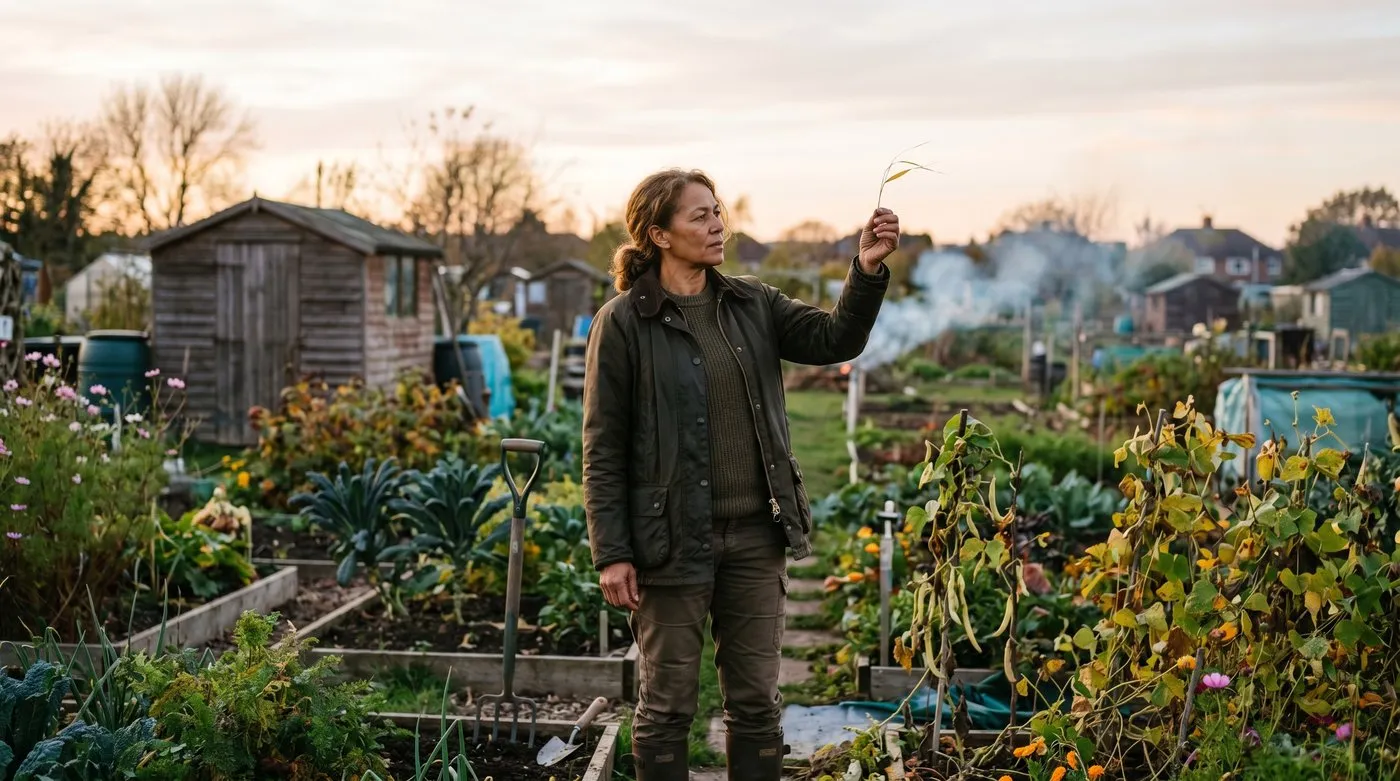 The wind test in practice. A wisp of dry grass shows the smoke direction at ignition height. If it drifts towards a house, do not light
Step-by-step: a legal allotment bonfire
Step 1: check site rules. Read the current tenancy agreement and site bulletin board. Confirm bonfires are permitted in the current month and on the current day.
Step 2: check Smoke Control Area status. Look up the council postcode tool. If the plot is inside a Smoke Control Area, get explicit written permission from the site secretary before burning.
Step 3: assemble dry woody material only. No green leaves, no plastic, no off-plot waste. Stack the pile under cover for 4-6 weeks before burning if material is damp.
Step 4: choose the date and time. Weekday evening between 5pm and 9pm in October to March. Check the wind forecast. Do not light in still air or wind over 15 mph.
Step 5: do the wind test. Hold a piece of dry grass at the fire site. Watch the wisp. If it goes towards any house, road or footpath within 100 metres, do not light.
Step 6: tell neighbouring plot holders. A 5-minute heads-up on the day prevents most of the bad feeling that escalates to a council complaint.
Step 7: light a small fire with kindling and newspaper. No accelerants. Start with a 1-cubic-metre pile, not a 5-cubic-metre pile. Add fuel as the fire establishes.
Step 8: tend the fire constantly. Stand within 5 metres with a fork, a hose, and a bucket of water. Never leave the fire unattended.
Step 9: burn out within 30 minutes. A hot fire reaches 600C and produces less smoke than a smouldering one. Add small loads of fuel to keep the temperature high.
Step 10: extinguish with water and bury the ash. Do not leave embers smouldering. Cool ash to ambient temperature before burying or composting. Wood ash is alkaline and a useful potash source on bed soil.
 Cooling the fire with water and burying the ash before leaving the plot, a 5-minute job that prevents wind-blown embers from re-igniting overnight
Common mistakes to avoid
Burning wet material. Smoulders for hours, generates dense smoke, and triggers complaints. Stack and dry material for 4-6 weeks before burning.
Building the pile too big. A 5-cubic-metre pile burns slowly with a long smoke plume. Break it down into 4-5 smaller fires across the season, each under 1 cubic metre.
Using accelerants. Petrol and paraffin produce unburnt vapour and black smoke. The fire then burns out of control. Use kindling and newspaper only.
Burning in still air. Smoke pools at ground level and seeps into nearby gardens. Wait for a steady 5-10 mph breeze.
Bringing waste from home. Off-plot waste burning is unlicensed waste disposal under the Environmental Protection Act, with fines up to £50,000.
Skipping the wind test. The 30-second test of holding grass aloft saves the entire enforcement chain that follows a complaint.
Council differences across the UK
Birmingham: All allotment bonfires banned since 2018. Use council green waste only.
Manchester: Bonfires permitted on the second Saturday of each month October to March, 4pm to 8pm.
Leeds: Permitted October to February only. Smoke complaints handled by Environmental Health.
Edinburgh: Permitted at site discretion, with explicit prohibition near tenement housing.
Bristol: Banned during dry summer months, permitted October to March on still evenings.
Cardiff: Permitted October to March, weekday evenings only.
Always check the specific council rules. This is not a full UK list. The current ruleset is usually published on the allotment service page of each council website.
Frequently asked questions
Can I have a bonfire on my UK allotment?
Only if your site rules permit it and you burn only dry, woody, plot-grown waste. Most UK council allotment agreements restrict bonfires to October-March, on specific evenings, and only for material that cannot be composted. Always check the site rulebook before lighting any fire on the plot. Some councils, including Birmingham, have banned allotment bonfires entirely.
When are bonfires allowed on UK allotments?
The standard UK burn window is October to March, on still evenings between 5pm and 9pm, with the wind blowing away from neighbouring houses. Many councils restrict burning further to weekday evenings only, or ban burning during dry weather. Check the specific site rules each season. Daytime burning generates many more complaints than evening burning.
What is a smoke nuisance under UK law?
Under the 1990 Environmental Protection Act, smoke that drifts onto neighbouring property for more than a few minutes is a statutory nuisance. Councils can serve abatement notices on individual plot holders. Repeated nuisance can lead to fines of up to £5,000 and loss of the allotment tenancy. Photograph the fire and conditions to defend any complaint.
What are the best alternatives to a bonfire on an allotment?
The four best alternatives are hire-chipping woody waste at £40-£75 per half-day, hot composting at 60-70C, council green waste collection in 240-litre bins, and Hugel beds where prunings buried under soil rot down over 2-3 years. Most plots only need a bonfire for diseased material. A site-shared chipper costs £5-£15 per plot per year.
Can I burn diseased plants on the allotment?
Yes, in most council areas diseased material is the one category that does justify burning. Club-root brassica stumps, blighted potato haulm, woolly aphid prunings, and honey fungus root plates should be burnt rather than composted. Burn in small hot fires lasting under 30 minutes and bury the cool ash. The intense heat kills pathogens that survive normal composting temperatures.
Our team produces practical UK gardening guidance from source research, contributor records and established horticultural practice. Editorial standards are overseen by Matt W.