Key takeaways
- Spine paths need to be 90-100cm wide so a loaded wheelbarrow has elbow room either side
- Cross paths between beds work at 45-60cm; narrower paths catch ankles and tools
- Woodchip is the lowest cost surface but needs topping up every 18-24 months
- Reclaimed slabs on sand last 15-20 years and cost £8-£20 per square metre
- A 5-10cm gravel mowing strip stops grass running into beds and cuts mowing time by 30-40%
- Always lay weed-suppressant fabric under loose materials or perennial weeds resurface within a season
Allotment path construction is the unglamorous half of plot design that determines whether the plot works for the next 10 years. Spine paths take a loaded wheelbarrow daily through April to October. Cross paths take footfall, hose, kneeler, and the occasional wheelbarrow tip when nobody is looking. Get the width and surface wrong and the plot fights you every visit.
 A 95cm spine path of woodchip on weed fabric with reclaimed scaffold-board edging, the standard layout that took eight years of trial and error to settle on
Path widths that actually work in practice
Spine paths need to be 90-100cm wide minimum on any plot that uses a wheelbarrow. The standard UK garden wheelbarrow is 60cm wide at the wheels and 75cm at the handles. Add 7-10cm clearance each side for elbow room and tipping leverage. Anything below 80cm and you scrape bed edges. Below 70cm and you cannot turn the barrow without lifting one handle clear of a bed.
Cross paths between beds work at 45-60cm. This is enough for kneeling, foot traffic, and a bucket between the legs. Cross paths under 45cm catch ankles, tangle hose, and force gardeners to step on bed corners. Cross paths over 60cm waste growing space without adding utility.
Headland paths around the plot edge should match the spine width so a barrow can reach any bed corner. On 10-rod plots this is roughly the perimeter of a 25 by 10 metre rectangle. On 5-rod plots it is a 12.5 by 10 metre rectangle.
Tool path widths should be checked against your actual tools. A petrol rotavator is 60-70cm wide at the tines. A push mower is 35-50cm. A plot trolley is 50cm. The narrowest path on the plot must clear the widest tool plus 10cm.
| Path type | Minimum width | Recommended width | What fits |
|---|---|---|---|
| Spine path | 90cm | 95-100cm | Wheelbarrow plus elbow room |
| Cross path | 45cm | 50-60cm | Foot, kneel, bucket |
| Headland | 90cm | 95-100cm | Wheelbarrow turning |
| Tool access | 60cm | 70cm | Rotavator, mower |
Material 1: woodchip and bark chip
Woodchip is the cheapest, lightest and easiest path material on UK allotments. Most tree surgeons drop loads for free or £40-£60 for a full tipper if you can take 4-5 cubic metres at once. Bark chip from a garden centre runs at £8-£15 per 70-litre bag, working out at £100-£200 per cubic metre, useful for show paths only.
Lay woodchip 75-100mm deep over woven weed-suppressant fabric pinned at 50cm intervals. Without the fabric, couch grass, bindweed and dock push through within one growing season. With it, the path stays clean for 18-24 months before the chip composts down enough to need topping up.
The critical mistake is laying chip on bare soil with no edging. The chip migrates into beds within 6 weeks. Use timber edges (scaffold boards, decking off-cuts, or treated timber) screwed to ground stakes at 100cm intervals. The edging keeps the chip in place and gives a clean line for the mower if grass borders the path.
Composting woodchip becomes mulch within 24 months. This is a feature not a bug. The path edges and surface release slow, low-grade nutrients into adjacent beds. Top-ups can come from the plot’s own pruning if you run a chipper, or from another free tree surgeon load.
Gardener’s tip: Avoid fresh sawdust and conifer chip. Sawdust packs solid and rots into a slimy mat. Conifer chip releases tannins that suppress germination on the bed edges. Hardwood broadleaf chip from oak, ash, sycamore or beech is the gold standard.
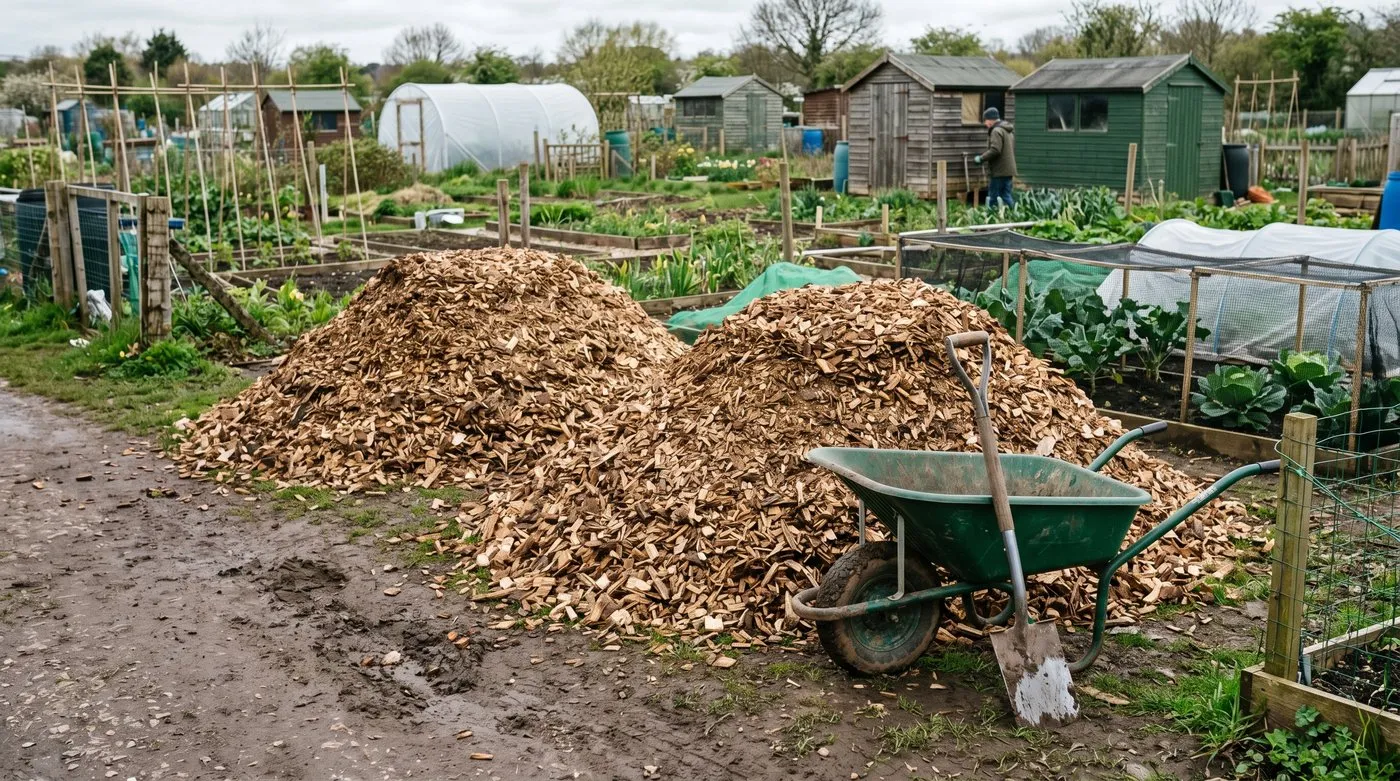 A 4 cubic metre tree surgeon load, enough to redo every path on a 10-rod plot at 75mm depth with reserve for top-ups
Material 2: reclaimed slabs and concrete pavers
Reclaimed concrete slabs are the longest-lasting allotment path surface within a sensible budget. Standard 600x600mm slabs cost £2-£5 each from reclamation yards or Facebook Marketplace, working out at roughly £8-£20 per square metre laid. New slabs cost more but rarely needed. A slab path lasts 15-20 years before the joints loosen.
Lay slabs on a 50mm sharp sand bed over 50mm of compacted scalpings. This is enough for foot traffic and a wheelbarrow. Heavier loads (mini digger, ride-on mower) need 100mm scalpings minimum. The sand bed allows lifting and re-laying when bed layouts change.
Most UK councils permit slabs because they can be lifted. Council allotment rules typically prohibit “permanent structures” or “concrete foundations”. A slab path on sand is removable and falls outside that rule. Always check the specific council bylaw. Birmingham, Manchester and Edinburgh allow slabs explicitly, but a few smaller councils ban any hard surface.
Slabs lock together better with a 10mm gap pointed with kiln-dried sand or fine grit. This stops weeds, allows water through, and lets slabs flex slightly under load without cracking. Cement pointing locks slabs but cracks within 5 years on shifting clay sites.
Edging slab paths is optional but worthwhile. A row of bricks or paver setts on edge gives a clean line and stops bed soil washing onto the slabs in heavy rain.
| Surface | Cost per m2 | Lifespan | Drainage | Council acceptance |
|---|---|---|---|---|
| Free woodchip | £0-£5 | 18-24 months | Excellent | All UK councils |
| Bagged bark | £100-£200 | 12-18 months | Good | All |
| Reclaimed slabs | £8-£20 | 15-20 years | Moderate | Most |
| Gravel plus membrane | £15-£25 | 8-12 years | Excellent | All |
| Scalpings | £10-£18 | 5-8 years | Good | Most |
| Pallet boardwalk | £0-£5 | 3-5 years | Excellent | Site-dependent |
Material 3: gravel over membrane
Gravel paths give a clean, formal look that suits show plots and ornamental allotments. Self-binding gravel (also called golden gravel or hoggin) packs down hard and walks without rutting. Pea shingle and decorative gravel look pretty but shift underfoot and migrate into beds.
Lay 50mm of gravel over woven membrane over a 50mm scalpings sub-base. Total depth 100mm. Self-binding gravel needs a heavy roller or wacker plate to compact properly. Most tool hire outlets rent a wacker for £40 per day. Without compaction, the path stays loose and drains too fast in summer dust, too slow in winter mud.
The hidden cost of gravel is replacement. Gravel compacts and migrates over 8-12 years. Top-ups every 3-4 years keep the surface walkable. Budget £30-£50 per cubic metre for top-up material plus weekend labour.
Edging is mandatory for gravel paths. Without timber, brick or steel edging, the gravel walks into beds within 2 seasons. The edging also gives a clean line and stops the mower hitting loose stones.
Material 4: scalpings (MOT type 1)
Scalpings (MOT type 1) is crushed road stone with fines, used as a base material for drives and yards. Used as a finished surface, it makes a hard, free-draining path that takes barrow traffic and small vehicles. Cost £10-£18 per square metre laid 75mm deep.
The advantage of scalpings is structural strength. A scalpings path takes a quad bike, ride-on mower, or mini digger without rutting. Useful on plots with shared site infrastructure or where the spine path doubles as service access.
The disadvantage is colour and dust. Fresh scalpings is grey and chunky. The fines wash out over 3-5 seasons leaving a cleaner stone surface but more rattle underfoot. In dry summers the dust coats nearby crops.
Edge scalpings with timber and pin a membrane underneath. As with gravel, without containment the path migrates into beds.
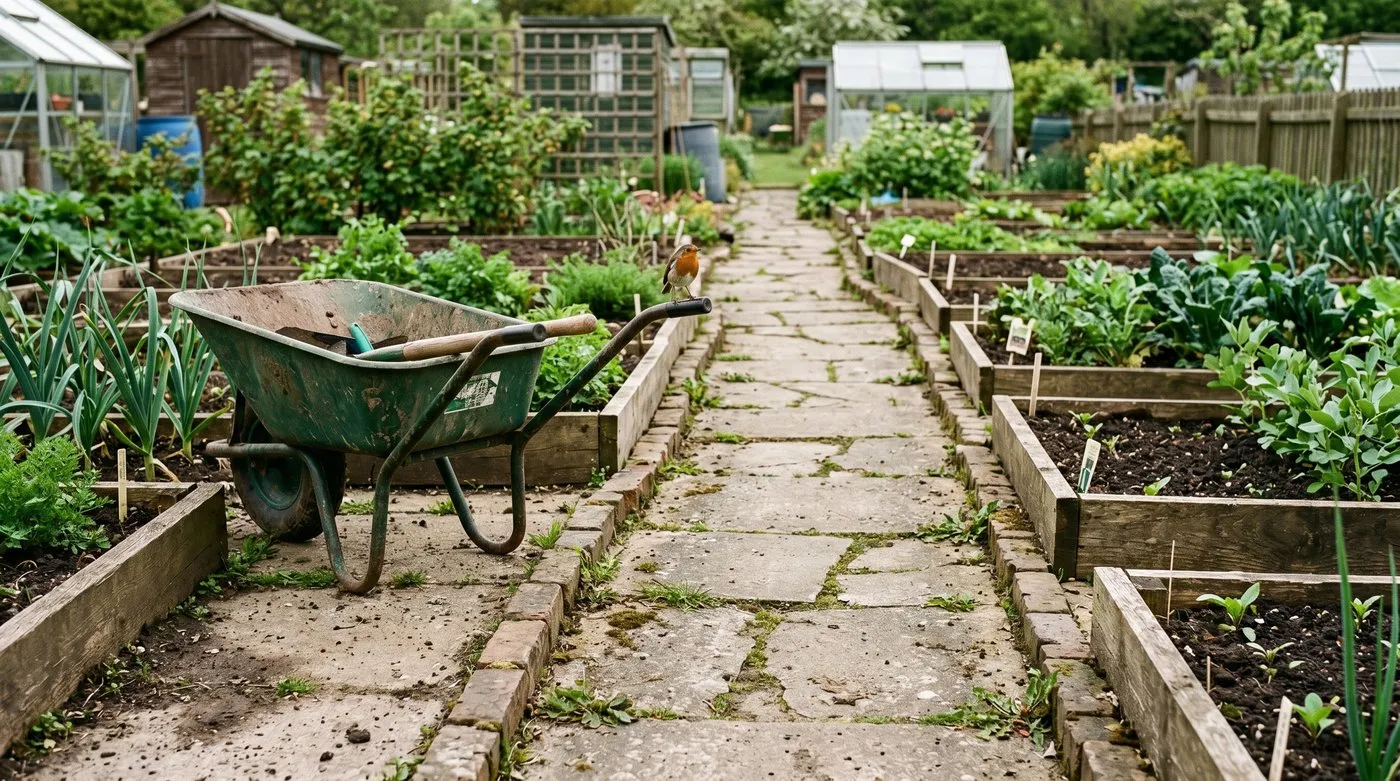 Reclaimed slab spine path on 50mm sharp sand over 50mm scalpings, the longest-lasting surface within a sensible plot budget
Material 5: grass paths and the mowing strip detail
Grass paths on allotments work but need specific maintenance that most plot holders skip. Grass paths look beautiful, feel soft underfoot, and cost nothing in materials. The hidden costs are time and the mowing strip.
Mow grass paths every 7-14 days through April to October. Skip a fortnight and the grass goes to seed. Seeded grass invades adjacent beds within 2-3 weeks. The path also looks shabby and walks unevenly.
Sow a hard-wearing path mix, not a fine lawn mix. Look for ryegrass-dominant blends marketed for sports pitches or play areas. Avoid fescue-bent fine lawn mixes. They look pristine for 6 weeks then collapse under wheelbarrow traffic. Cost roughly £8-£15 per kilogram, sown at 35g per square metre.
The mowing strip is the detail that makes grass paths viable. A 5-10cm wide strip of gravel, brick paviours, or slab offcuts at every grass-to-bed boundary stops grass running into beds and gives the mower wheel a clean line. The strip cuts edging time by 30-40% over a season.
Lay the mowing strip 5-10mm below grass level. This way the mower wheel sits on the strip and cuts the grass cleanly to the edge. Strips above grass level scalp the surrounding turf. Strips deeper than 10mm collect leaves and debris.
The mowing strip in detail
A mowing strip is a hard edge running along the boundary between a grass path and a bed, set flush or slightly below grass level. It is the single most useful detail on a grass-path plot and the easiest to retrofit.
Materials for mowing strips, in order of cost:
- Brick paviours laid on edge, £8-£15 per metre, lasts 20+ years
- Slab off-cuts, £2-£8 per metre using salvaged material
- Gravel band 5-8cm wide, £4-£10 per metre over membrane
- Steel edging strip, £15-£30 per metre, lasts 20+ years
- Treated timber on edge, £6-£12 per metre, lasts 8-12 years
Set the strip flush or 5-10mm below the grass. Excavate a trench 10-15cm deep along the bed edge. Lay 50mm of mortar mix or sharp sand. Set the bricks, slabs or paviours level with the grass surface. Backfill behind with bed soil so the strip sits between the path turf and the bed.
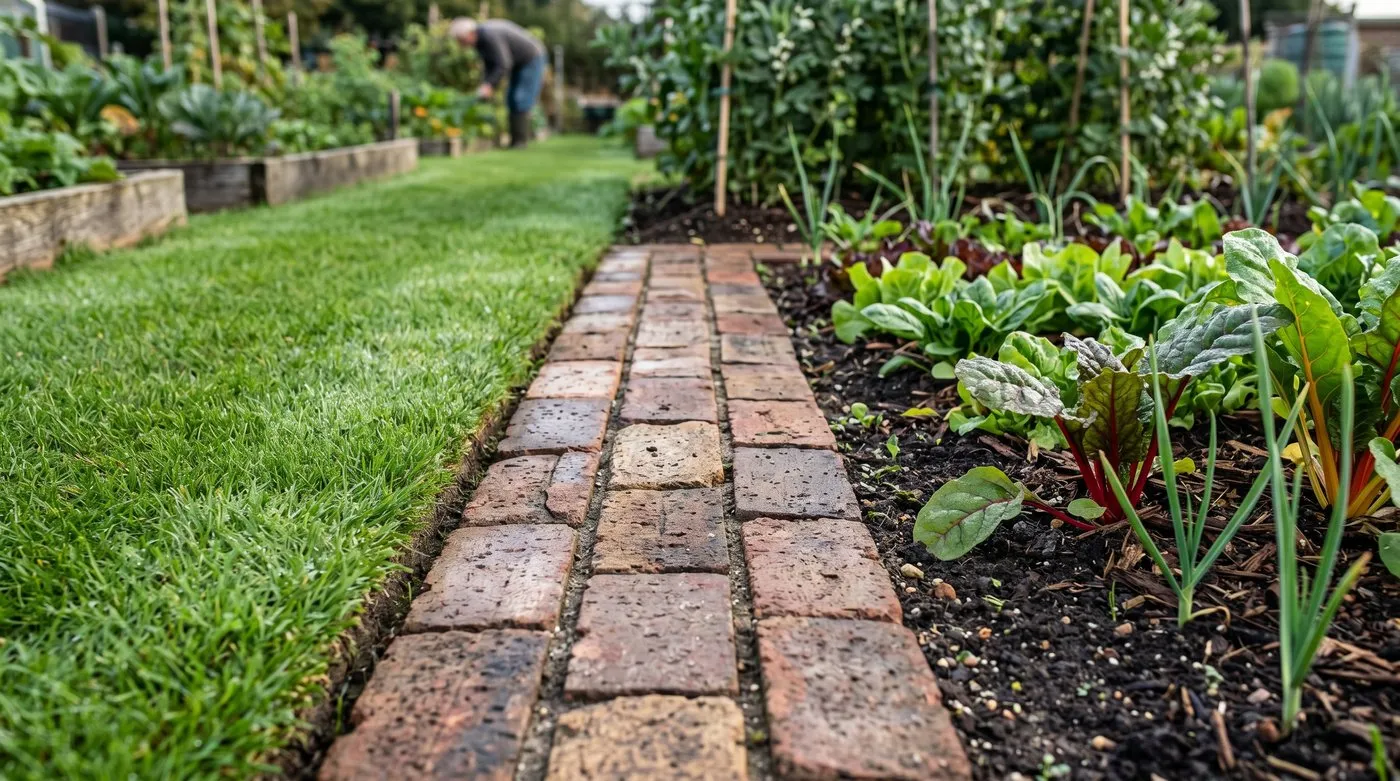 Brick paviour mowing strip set flush with the grass surface, the detail that cuts edging time by 30-40% and stops grass invading beds
Drainage and the crowned path
Allotment paths flood in winter unless they are crowned and drained. A flat path holds water, soaks the wheelbarrow tracks, and freezes into hazardous patches in January.
Crown the path 2-3cm higher in the centre than at the edges. This shed angle is enough for water to run sideways into adjacent beds or grass headlands. On 1-metre-wide spine paths, that is a gentle dome you can barely see but feel underfoot.
On heavy clay sites, lay a 50mm scalpings sub-base under any surface material. The scalpings give a free-draining layer that stops the path becoming a bog. Below the scalpings, on chronic flooding sites, dig a French drain (a 30cm-deep trench filled with 20mm gravel around a perforated 100mm pipe) running to a soakaway or ditch.
Avoid solid edges that trap water. Continuous concrete or timber edging sealed at the joints traps water on the path side. Use spaced timber sleepers, gappy stone edging, or pegged scaffold boards with 5mm gaps every 1-2 metres.
Common mistakes to avoid
Building paths too narrow. The single most common error. A 60cm spine path looks fine on plan but tips a barrow within a season. Always start at 90cm minimum.
No weed barrier under loose materials. Woodchip, gravel and bark on bare soil is a guaranteed weed flush within a season. The £40 cost of a 50m roll of woven membrane saves 30+ hours of weeding over 2 years.
Using softwood sawdust as the surface. Sawdust packs into a slimy mat that traps water and rots quickly. Use chipped wood with visible chunks. Sawdust belongs on the compost heap, not the path.
Skipping the mowing strip on grass paths. Without it, grass runs into beds, the mower wheel scalps turf, and edging time triples. Add the strip when you build the path or expect to add it later.
Concrete on a rented plot. Most councils prohibit permanent foundations and the cost of removal at the end of tenancy falls on the tenant. Use slabs on sand instead.
Step-by-step: building a 1-metre woodchip spine path
Step 1: mark the path with string and pegs along both edges. Width 100cm. Length whatever your plot needs. Cut existing turf with a half-moon cutter or sharp spade.
Step 2: dig out the path bed to 75-100mm below surrounding ground level. Set the topsoil aside for adjacent beds. Dispose of subsoil or use it to crown the path.
Step 3: lay woven weed-suppressant membrane (100gsm minimum) the full length, with 100mm overlap at any joins. Pin at 50cm intervals using 150mm steel pegs.
Step 4: install timber edging. Scaffold boards or 100mm decking off-cuts work well. Drive 50x50mm stakes into the path bed at 100cm intervals. Screw the edging to the stakes flush with surrounding ground level.
Step 5: spread woodchip 75mm deep across the membrane. Rake level. Crown the centre 2-3cm higher than the edges for drainage.
Step 6: water lightly to settle the chip and check the levels. Top up any low spots after a week of foot traffic.
Total time: 1 day for a 10-metre run with a helper. Materials cost £40-£80 if you scrounge the chip and edging.
 Installing timber edging to ground stakes before woodchip surfacing, the rigid edge keeps the chip in place and gives a clean mower line
Council rules and allotment-specific constraints
Most UK council allotment agreements limit hard landscaping. The standard wording prohibits “permanent foundations”, “concrete bases”, and “structures requiring planning permission”. Slabs on sand, woodchip, gravel, and grass all fall outside these rules. Concrete poured in situ usually does not.
Site rules often dictate edging materials. Some sites ban treated timber due to chemical leaching concerns. Untreated softwood lasts 4-7 years. Hardwood (oak, sweet chestnut) lasts 10-20 years untreated. Plastic edging and recycled-rubber edging is permitted on most sites.
Path widths sometimes have site minimums. A few sites mandate 100cm spine paths so site officers can access plots with mowers and trailers. Check the site agreement before narrowing paths.
Always pull paths before quitting a plot. End-of-tenancy clauses typically require the plot to return to its original state. Slabs, woodchip and timber edging can be lifted in a weekend. Concrete cannot.
Frequently asked questions
How wide should an allotment path be?
Allotment spine paths should be 90-100cm wide for wheelbarrow access. Cross paths between beds work at 45-60cm. Anything narrower than 45cm catches ankles and is too tight for tools. Mark out the wheelbarrow track plus 15cm clearance each side before building. On larger plots that take a quad bike or ride-on mower, widen the spine to 120cm minimum.
What is the cheapest allotment path material?
Free woodchip from a tree surgeon is the cheapest at £0 per square metre. Most UK tree surgeons drop loads for free if you can take 4-5 cubic metres at once. Lay 75mm deep over woven weed-suppressant fabric. Top up every 18-24 months as it composts down. Bark chip from a garden centre is the most expensive loose material at £100-£200 per cubic metre.
Do allotment paths need a weed barrier?
Yes for loose materials. Woodchip, gravel, bark and scalpings need woven weed-suppressant fabric (100gsm minimum) under them. Without a barrier, perennial weeds like couch grass and bindweed push back through within one growing season. Slabs and concrete do not need fabric. Use steel pegs at 50cm intervals to hold the fabric flat.
How do I stop allotment paths flooding in winter?
What is a mowing strip and do I need one?
A mowing strip is a hard or stone edge between a grass path and a planting bed. It stops grass invading the bed, gives the mower wheel a clean run, and cuts edging time. A 5-10cm wide strip of gravel, slab off-cuts, or paver bricks works. Save 30-40% of weekly mowing time. The strip is the single most useful retrofit on an existing grass-path plot.
Our team produces practical UK gardening guidance from source research, contributor records and established horticultural practice. Editorial standards are overseen by Matt W.