Carbon-Friendly Gardening: Cut Your Footprint
Carbon-friendly gardening cuts your footprint via composting, no-dig beds, rainwater harvesting, and native planting. UK data, costs, and real results.
Key takeaways
- Peat extraction releases up to 2,700 kg of CO2 per hectare per year — switching to peat-free compost eliminates this from your garden immediately
- No-dig beds store carbon in the soil instead of releasing it through oxidation caused by annual digging
- Home composting diverts food and garden waste from landfill, where it would produce methane — a greenhouse gas 28 times more potent than CO2
- Rainwater harvesting saves an average 85,000 litres per household per year, reducing energy used to treat and pump mains water
- Planting a single native tree sequesters 21 kg of CO2 per year on average — a row of five trees along a boundary removes more carbon than a typical car produces in a month
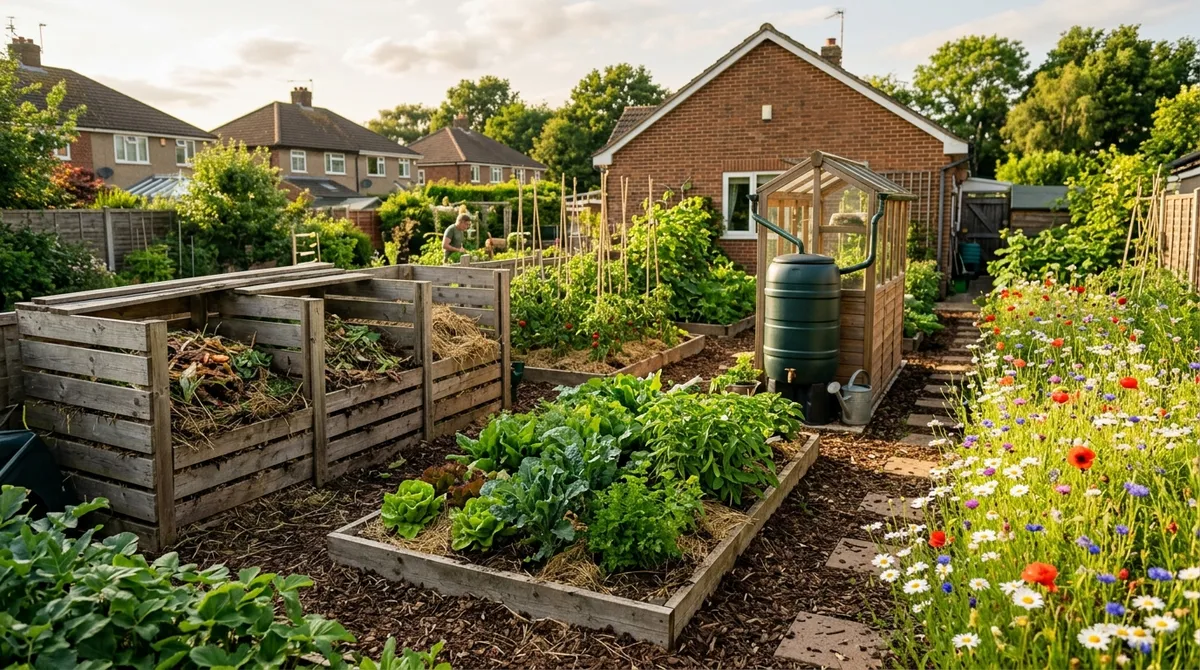
Carbon-friendly gardening is not a niche pursuit — it is the most practical way to cut your environmental impact at home, and it saves money in the process. UK gardens collectively cover 400,000 hectares, more land than all the national nature reserves combined. What we do with that land matters.
I have been working to reduce my own garden’s carbon footprint since 2022. What I found surprised me: the biggest gains came not from grand gestures but from stopping a handful of high-impact habits — chiefly buying peat compost, running a petrol mower, and purchasing fertilisers I could make myself. This guide covers every practical change, with data on how much each one actually helps.
Why does your garden have a carbon footprint?
A UK garden produces 200–500 kg of CO2-equivalent emissions per year through bought inputs, powered tools, and poor waste management. The sources are not always obvious.
Peat-based compost is the biggest single contributor for most gardeners. Peatlands store around 3.2 billion tonnes of carbon in the UK alone. When peat is extracted for growing media, that stored carbon oxidises and releases CO2. The extraction process itself releases up to 2,700 kg of CO2 per hectare per year — more than many industrial processes.
Beyond peat, the other major sources in a typical UK garden include:
- Petrol or electric lawn mowers (petrol mowers produce around 40 kg CO2 per season for a medium garden)
- Bought fertilisers (manufacturing synthetic nitrogen fertiliser produces around 3.5 kg CO2 per kg of fertiliser)
- Plastic pots, trays, and bags (virtually all non-recyclable)
- Mains water use (0.34 kg CO2 per cubic metre treated and pumped)
- Food waste sent to landfill rather than composted
The good news is that every one of these can be reduced significantly with methods that also improve your growing results.
Go peat-free immediately
Switching to peat-free compost is the single highest-impact change most UK gardeners can make. It removes the largest carbon source from your gardening footprint at no extra cost — most peat-free composts are priced the same as peat-based equivalents.
The UK has committed to phasing out peat in amateur horticulture by 2030. Many garden centres have already removed peat-based products voluntarily. But millions of bags are still sold each year.
Our full peat-free compost guide covers the best available products and how to use them effectively. In brief:
- Bark-based peat-free composts suit most vegetables and bedding plants
- Coir-based composts hold moisture better and suit containers and hanging baskets
- Wood fibre composts are cheapest but need more careful watering and supplementary feeding
- Avoid cheapest own-brand peat-free — quality varies enormously
The RHS has endorsed peat-free growing and publishes independent trial results on its website, which provide a useful comparison between brands.
Compost everything — kitchen waste included
Home composting prevents methane emissions from landfill and produces free, carbon-rich growing media. A household producing 150 kg of compostable waste per year prevents around 400 kg of CO2-equivalent greenhouse gas from entering the atmosphere.
Most UK gardens only compost garden waste. Kitchen waste — vegetable peelings, fruit scraps, coffee grounds, eggshells, cardboard — is equally valuable and makes compost faster by adding nitrogen. Our composting guide covers the full process from bin setup to finished product.
Double compost bins allow one bay to mature while the other fills. Mixing brown (cardboard, straw) and green (kitchen waste, grass) material in equal measure produces usable compost in 3-6 months.
For households generating more waste than a standard compost bin handles, two approaches work well together:
Bokashi fermentation handles all cooked food, meat, and dairy — materials that a standard compost bin cannot process. A sealed bokashi bin uses anaerobic fermentation to break down even difficult food waste. The liquid produced dilutes as a plant feed; the solid material buries in the garden or goes into the compost bin. See our bokashi guide for setup details.
Worm composting (vermiculture) produces highly concentrated worm castings — pound for pound the most nutrient-rich growing medium available. A wormery processes kitchen waste 5-10 times faster than a standard bin and fits under a kitchen sink. Our worm composting guide explains how to manage one year-round.
Switch to no-dig growing
No-dig beds sequester carbon in the soil instead of releasing it through annual digging. This is the most important structural change to how you manage growing beds.
Every time you dig, fork, or rotavate soil, you expose organic matter to oxygen. The aerobic decomposition that follows releases CO2 rapidly. Research shows tillage increases soil carbon loss by 0.1–0.4 tonnes per hectare per year compared with undisturbed soil.
No-dig beds do the opposite. The annual layer of compost on the surface — 5-15cm — feeds soil biology without disturbing the structure below. Earthworms pull organic matter downward, building stable soil carbon compounds (humic acids and aggregates) that remain locked in place for decades.
Our no-dig gardening guide covers the full method. The practical setup is simple:
- Lay overlapping cardboard on the ground
- Cover with 15cm of compost
- Plant or sow directly
- Never dig the bed again — simply top up with 5cm of compost each autumn
A no-dig bed in its third year. The dark, crumbly surface shows active soil biology and high organic matter content — carbon is being stored, not released.
The other advantage of no-dig is weed suppression. Dormant weed seeds remain buried and do not germinate when soil is undisturbed. From year two, weeding time drops by 50–75% compared with dug beds — meaning less physical effort and zero temptation to reach for a petrol rotavator.
Make your own liquid feeds
Homemade liquid feeds from comfrey and nettles replace bought fertilisers entirely for most vegetable growing. A litre of commercial liquid fertiliser costs £8–15 and carries the carbon cost of manufacture, packaging, and transport. Comfrey and nettle feeds cost nothing.
Comfrey (particularly the variety Bocking 14) accumulates high levels of potassium and phosphorus in its leaves. A bucket of wilted leaves submerged in water and left for 3-4 weeks produces a concentrated liquid that dilutes at 1:10 for use as a feed. It smells unpleasant during fermentation, but the results are excellent for tomatoes, courgettes, and fruiting crops.
Nettles are high in nitrogen and calcium, making nettle feed ideal for leafy growth in early spring. Follow the same process as comfrey. Our full guide to making comfrey and nettle feeds covers ratios, timing, and which crops benefit most.
Green manures complement homemade liquid feeds by fixing atmospheric nitrogen directly into the soil. Leguminous green manures like clover, vetch, and field beans convert nitrogen gas into plant-available nitrates through root nodule bacteria. Digging these in or cutting and leaving on the surface as mulch replaces the need for bought nitrogen fertiliser on empty beds.
Harvest and reuse rainwater
Rainwater harvesting cuts mains water use and reduces the energy cost of treating and pumping water to your garden. A standard 210-litre water butt saves around 8–10 kg of CO2 per growing season. A network of three or four butts connected to different downpipes can save 85,000 litres per household per year.
The UK receives an average of 885mm of rain annually. A standard house roof of 50 square metres catches approximately 44,000 litres per year — enough to water a medium-sized garden through most summers without touching the mains.
A linked pair of 210-litre water butts connected to a garage downpipe. A simple diverter valve directs rainwater when butts are full. Cost: around £60 for both butts and fittings.
Our detailed rainwater harvesting guide covers installation for water butts, underground tanks, and gravity-fed drip irrigation. For watering efficiency beyond rainwater capture, our water-efficient gardening guide covers mulching, drip irrigation, and timing strategies that reduce water use by 30–50%.
Leaf mould — made from autumn leaves collected and stored in wire cages — is an outstanding mulch for conserving soil moisture, reducing watering frequency by up to 40%. Our guide to making leaf mould explains a two-year composting process that costs nothing.
Choose manual tools over powered ones
A petrol rotavator or mower produces significantly more carbon than a hand tool per hour of use. A 4-stroke petrol mower produces around 2.5 kg of CO2 per hour of use — roughly 40 kg over a typical UK mowing season.
| Tool comparison | Carbon per season | Cost per season | Notes |
|---|---|---|---|
| Petrol mower (300m² lawn) | 38–45 kg CO2 | £25–40 fuel | Plus oil, servicing costs |
| Electric corded mower | 8–12 kg CO2 | £6–10 electricity | Carbon depends on grid mix |
| Robotic mower | 4–8 kg CO2 | £3–6 electricity | Lowest per-m², slow |
| Push cylinder mower | <0.1 kg CO2 | £0 | Zero fuel, good for smaller lawns |
| Petrol strimmer | 5–8 kg CO2 per season | £8–15 fuel | Replace with scythe or shears for edges |
| Electric leaf blower | 1–2 kg CO2 | £1–3 electricity | Replace with rake and sheet mulching |
| Petrol rotavator (annual) | 3–5 kg CO2 per use | £5–10 fuel | Eliminate by switching to no-dig |
The simplest swap is eliminating the rotavator entirely by adopting no-dig. A push cylinder mower works well for smaller UK lawns (under 150m²). For larger lawns, switching from petrol to battery-electric cuts emissions by around 70% at current UK grid carbon intensity.
Grow your own food to cut food miles
Growing your own vegetables eliminates the carbon cost of imported and supermarket produce. UK-grown salad leaves travel an average of 2,500 km to reach supermarket shelves in winter. Tomatoes and peppers often travel 3,000–5,000 km from Spain, Morocco, or the Netherlands.
Home-grown produce has effectively zero food miles. A 6m² raised bed growing tomatoes, salad, courgettes, and beans produces roughly 40–60 kg of fresh vegetables per season. Buying equivalent produce from a supermarket generates approximately 15–30 kg of CO2 in transport and packaging.
Growing in a greenhouse or cold frame extends the season and reduces reliance on imported winter vegetables. Our article on climate-resilient plants for UK gardens includes varieties that perform without heated protection, further reducing energy inputs.
Saving seed from non-hybrid (open-pollinated) varieties takes this further. Our seed saving guide for beginners covers the easiest species to start with: tomatoes, courgettes, French beans, and lettuce all seed-save well with no specialist equipment.
Plant native trees and shrubs
Native trees are the most powerful long-term carbon tool available to a UK gardener. A native broadleaf tree sequesters an average of 21 kg of CO2 per year. A hawthorn hedge 10 metres long sequesters approximately 15 kg of CO2 per year while providing nesting habitat, food for birds, and a windbreak.
Native species require no fertiliser, minimal watering once established, and no pesticides — making their lifetime carbon savings genuinely high. Our guide to native trees for UK gardens covers species suited to different garden sizes, from multi-stemmed hazel and elder for small plots to field maple and rowan for larger gardens.
Garden Organic, the UK’s leading organic growing charity, recommends planting trees as part of a whole-garden carbon strategy alongside composting and peat-free growing. Garden Organic’s carbon-friendly gardening guidance provides additional evidence-based recommendations aligned with UK conditions.
Native planting also benefits local wildlife. A biodiverse garden absorbs carbon more efficiently than a monoculture — shrubs, wildflowers, and trees together create layered habitats that support fungi, invertebrates, and soil biology. Our wildlife garden guide covers how to structure these plantings for maximum impact.
Reduce plastic use across the garden
Plastic pots, trays, bags, and labels represent a significant and overlooked carbon cost. A standard 9cm plastic pot weighs around 50g and is made from polypropylene, which has a carbon footprint of approximately 4.9 kg CO2 per kg of plastic produced. The UK horticultural industry uses an estimated 500 million plastic pots per year, most of which go to landfill.
Practical alternatives:
- Newspaper pots for starting seeds — biodegrade in the soil when planted out
- Terracotta pots for permanent planting — high embodied carbon at manufacture, but last decades
- Compostable trays from seed suppliers — grow-your-own supplier Rocket Gardens sells fully compostable versions
- Reuse vigorously — wash and reuse every pot, tray, and label each season
- Buy bare-root rather than container-grown trees and hedging — bare-root plants arrive with no plastic and establish just as well if planted between November and March
Refuse plastic-wrapped peat-free compost where bulk or paper-sacked alternatives exist. Several UK suppliers including Dalefoot Composts and Carbon Gold offer paper-sacked or biodegradable packaging options.
Carbon-friendly gardening: method comparison
| Practice | Annual CO2 saving | Cost saving per year | Effort |
|---|---|---|---|
| Switch to peat-free compost | 50–150 kg CO2 | £0 (same price) | None |
| Home composting (150 kg waste) | 400 kg CO2-equivalent | £60–90 in bought compost | Low |
| Switch to no-dig beds | 20–80 kg CO2 per 100m² | £30–50 in fuel and labour | Low |
| Homemade liquid feeds (comfrey/nettle) | 5–15 kg CO2 | £40–80 in bought fertiliser | Low |
| Rainwater harvesting (3 butts) | 15–25 kg CO2 | £10–20 in water bills | Low (one-off install) |
| Switch petrol to electric/manual tools | 30–40 kg CO2 | £15–30 in fuel | None after switch |
| Grow your own vegetables (6m² bed) | 15–30 kg CO2 | £80–150 in food costs | Moderate |
| Plant 5 native trees | 105 kg CO2/yr (builds annually) | £0 after establishment | Low after planting |
| Reduce plastic (reuse and refuse) | 10–20 kg CO2 | £20–40 in purchases | Low |
| Total (all practices combined) | 650–960 kg CO2-equivalent | £255–430/yr | Builds progressively |
These figures represent conservative estimates for a typical UK suburban garden. Implementing all practices simultaneously reduces most gardens’ carbon footprint by 60–80% within three years.
The RHS’s sustainability guidance provides additional data on carbon-friendly practices, with particular detail on soil carbon storage and water conservation.
Frequently asked questions
What is the biggest source of carbon in a UK garden?
Peat-based compost is the single largest carbon source in most UK gardens. Peat extraction releases up to 2,700 kg of CO2 per hectare annually, and until recently most UK gardeners bought peat-based growing media without realising the impact. Switching to peat-free compost immediately eliminates this from your garden footprint. After that, the next biggest sources are petrol-powered tools (lawnmowers, strimmers), bought-in plastic products, and food miles from purchasing rather than growing your own produce.
Does composting at home really make a carbon difference?
Yes — home composting prevents significant methane emissions from landfill. When organic waste goes to landfill, it decomposes anaerobically and produces methane, which is 28 times more potent than CO2 over a 100-year period. A typical household produces around 150 kg of compostable kitchen and garden waste per year. Composting this at home prevents the equivalent of roughly 400 kg of CO2-equivalent greenhouse gas from entering the atmosphere.
How does no-dig gardening reduce carbon emissions?
No-dig gardening keeps carbon locked in the soil instead of releasing it. When you dig or rotavate soil, you expose organic matter to oxygen, which triggers rapid decomposition and CO2 release. Research published in the journal Nature estimates that tillage increases soil carbon loss by 0.1–0.4 t/ha/yr compared with undisturbed soil. No-dig beds actively build soil carbon over time, with studies showing gains of 0.3–0.5 t/ha/yr in consistently managed no-dig plots.
Is peat-free compost as good as peat-based for growing?
Modern peat-free composts perform as well as peat for most plants when managed correctly. They need slightly more careful watering — they can dry out faster — but results for vegetables, bedding plants, and perennials are comparable. The RHS conducted multi-year trials and found peat-free alternatives produced equal or better results for most edible crops. The key is choosing a quality product: bark-based or coir-based peat-free composts generally outperform cheaper wood fibre alternatives.
Can I use tap water or should I only use harvested rainwater?
Rainwater is always preferable from a carbon standpoint. Mains water is treated with energy-intensive processes and pumped under pressure, producing around 0.34 kg of CO2 per cubic metre. A 210-litre water butt filled once a week through summer saves roughly 8–10 kg of CO2 per season. Plants also prefer rainwater — it is slightly acidic and free of chlorine, which suits ericaceous plants and root development.
Do homemade liquid feeds really replace bought fertilisers?
Homemade comfrey and nettle feeds replace most bought granular or liquid fertilisers for vegetable growing. Comfrey leaves contain high levels of potassium, phosphorus, and moderate nitrogen — similar to a balanced NPK fertiliser. A 5-gallon bucket of fermented comfrey diluted at 1:10 costs nothing beyond time. Commercial liquid feeds typically cost £8–15 per litre and involve production, packaging, and transport emissions.
How many trees should I plant to offset my garden’s carbon footprint?
A native broadleaf tree sequesters an average of 21 kg of CO2 per year in its early decades. A typical UK suburban garden generates roughly 200–500 kg of CO2-equivalent emissions annually through bought inputs and powered tools. Planting 5–10 native trees would offset the majority of this, though full sequestration takes 10–20 years to build. Native species like rowan, birch, and hazel also support wildlife and require zero inputs once established.
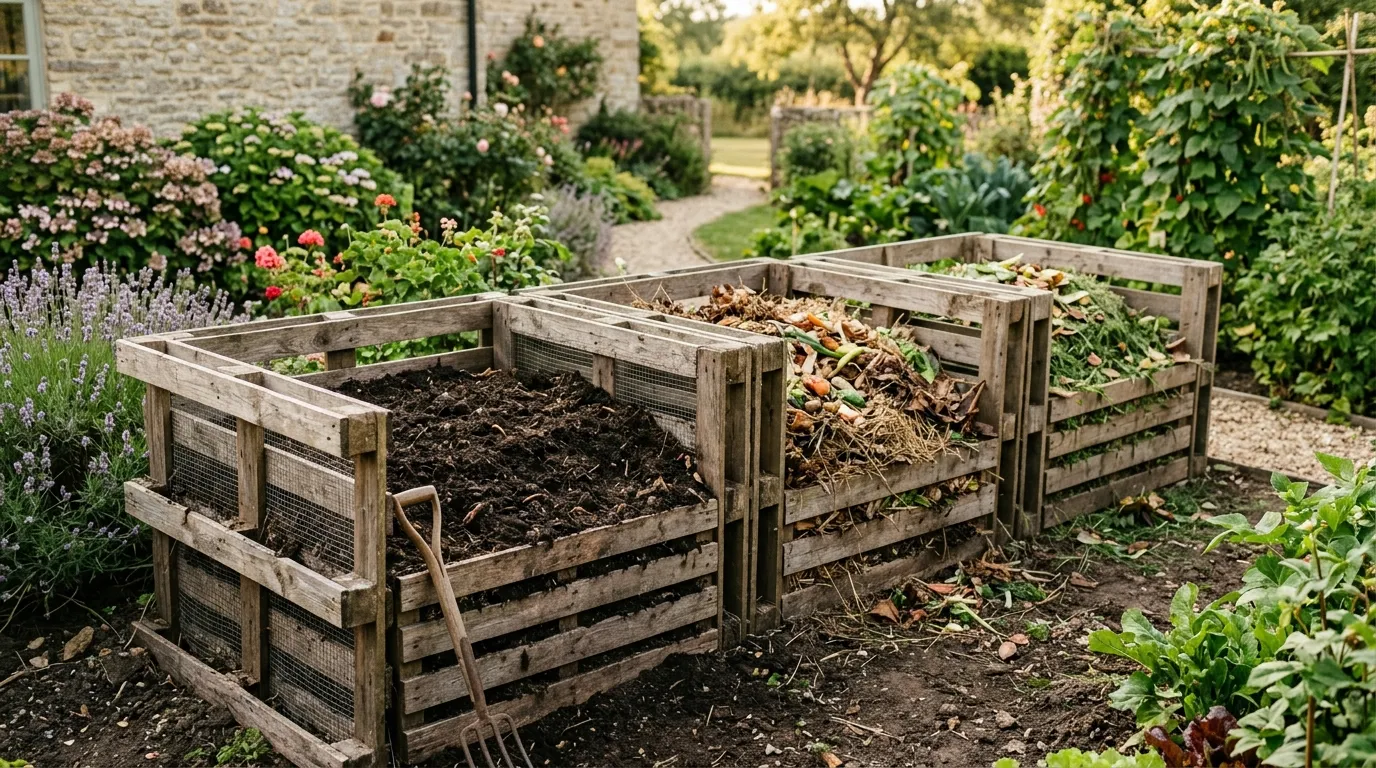
Home composting diverts 150kg of waste per household per year from landfill, preventing methane emissions.
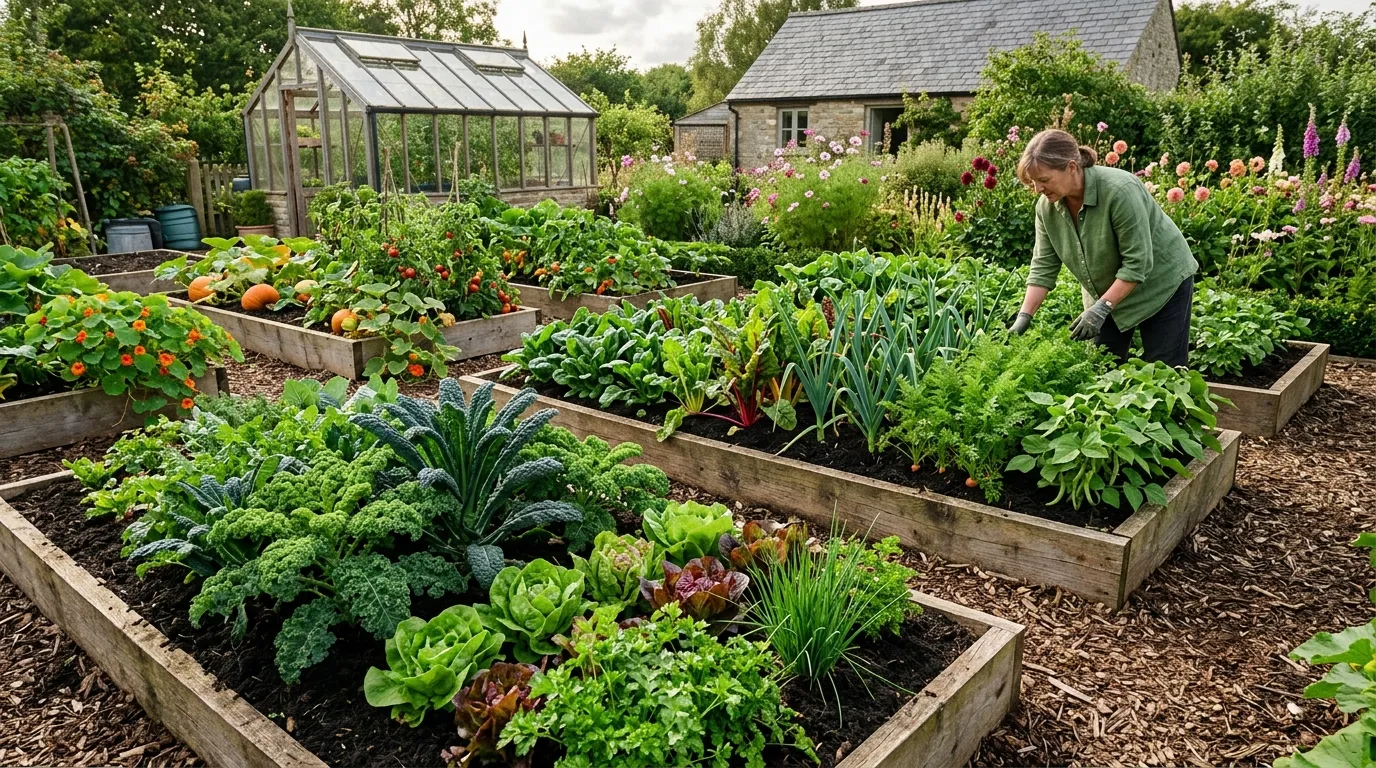
No-dig beds store carbon in the soil instead of releasing it. Annual mulching builds organic matter each year.
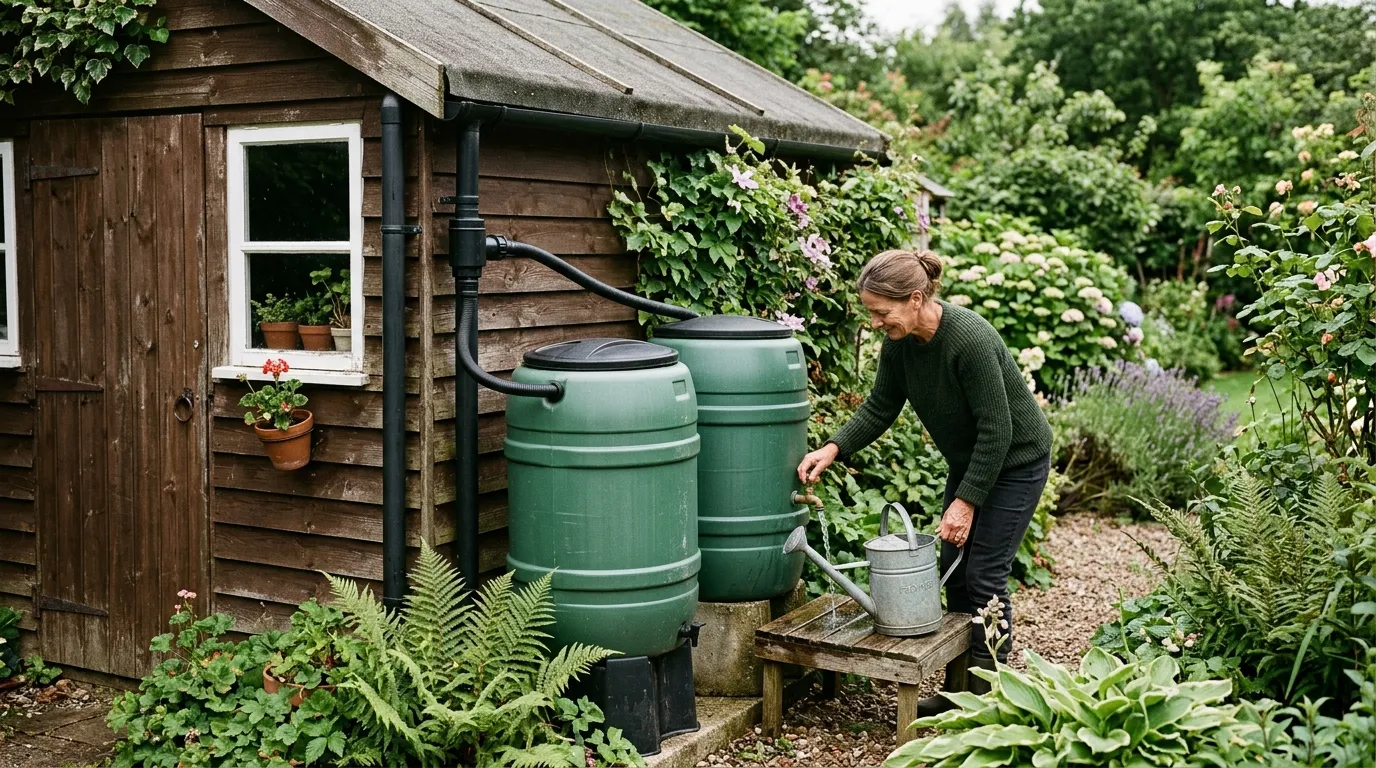
A 210-litre water butt filled weekly through summer saves roughly 8-10kg of CO2 per season.
Related reading
- How to Make Compost — turn kitchen and garden waste into free growing media
- Peat-Free Compost Guide for UK Gardens — the best brands tested and rated
- No-Dig Gardening: The UK Guide — how to set up and manage no-dig beds
- Rainwater Harvesting for Gardens — water butt setup, underground tanks, and drip irrigation
- Green Manures and Cover Crops — fix nitrogen and build soil carbon between growing seasons
Lawrie has been gardening in the West Midlands for over 30 years. He grows his own veg using no-dig methods, keeps a wildlife-friendly garden, and writes practical advice based on real UK growing conditions.