Key takeaways
- Container plants face faster pest build-up than ground plants - inspect weekly
- Vine weevil: nematode drench August + March, kills grubs in compost
- Slugs and snails: copper tape on every pot rim, hand-pick at dusk
- Aphids: water-jet first, ladybird intro second, soap spray last resort
- Lily beetle: hand-pick April-July - the red adults are easy to spot
- Annual compost change kills overwintering pests in small pots
Container pests punch above their weight because the limited soil volume of a pot is more vulnerable than the open ground. A vine weevil grub population that would be diluted across a flower border can wipe out a single 30-litre pot of heuchera in one season. Slugs that take half a lettuce from a ground bed take all the lettuce from a pot. Aphid colonies on container plants escalate faster because predator populations rarely establish on pot-by-pot scales.
For wider context on the patio plants themselves, see our container vegetable gardening UK, 20 vegetables that thrive in pots and container gardening ideas UK guides.
Why containers are pest-vulnerable
Three structural reasons container plants face higher pest pressure than ground plants:
Limited soil volume. A 30-litre pot holds 0.03m³ of compost. A vine weevil female lays 500-1,500 eggs in her life; in an open border those eggs disperse across many square metres, but in a pot a fraction of one female’s lay can saturate the compost.
Concentrated stress. Pot-grown plants suffer drought, heat, root constraint and nutrient limits more often than ground plants. Stressed plants emit chemical signals that pests detect; aphids in particular are attracted to nutrient-stressed plants.
Microclimate. Pots warm faster in spring and cool slower in autumn than open ground. This extends the active season for many pest species (vine weevil, lily beetle, aphids) compared to plants in the same garden’s open beds.
The flip side: containers are easier to inspect, protect and treat than open beds. A pest problem that’s hard to spot in a 6m flower border is obvious in a 30-litre pot - if you look weekly.
Vine weevil - the silent container killer
Otiorhynchus sulcatus is the single most damaging UK container pest. Adults are 8-10mm matt-black weevils with rough textured bodies. Grubs are 8-10mm creamy-white C-shaped larvae with brown heads, found in compost around plant roots.
The damage pattern
Adults emerge late May through September. They feed on leaves at night, leaving distinctive U-shaped notches around leaf edges - the visible warning sign. Each female lays 500-1,500 eggs in compost over her life.
The grubs hatch August-September and feed on roots through winter and into spring. By the time the plant shows wilting or yellowing, the root system is usually 60-80% destroyed and recovery is rare.
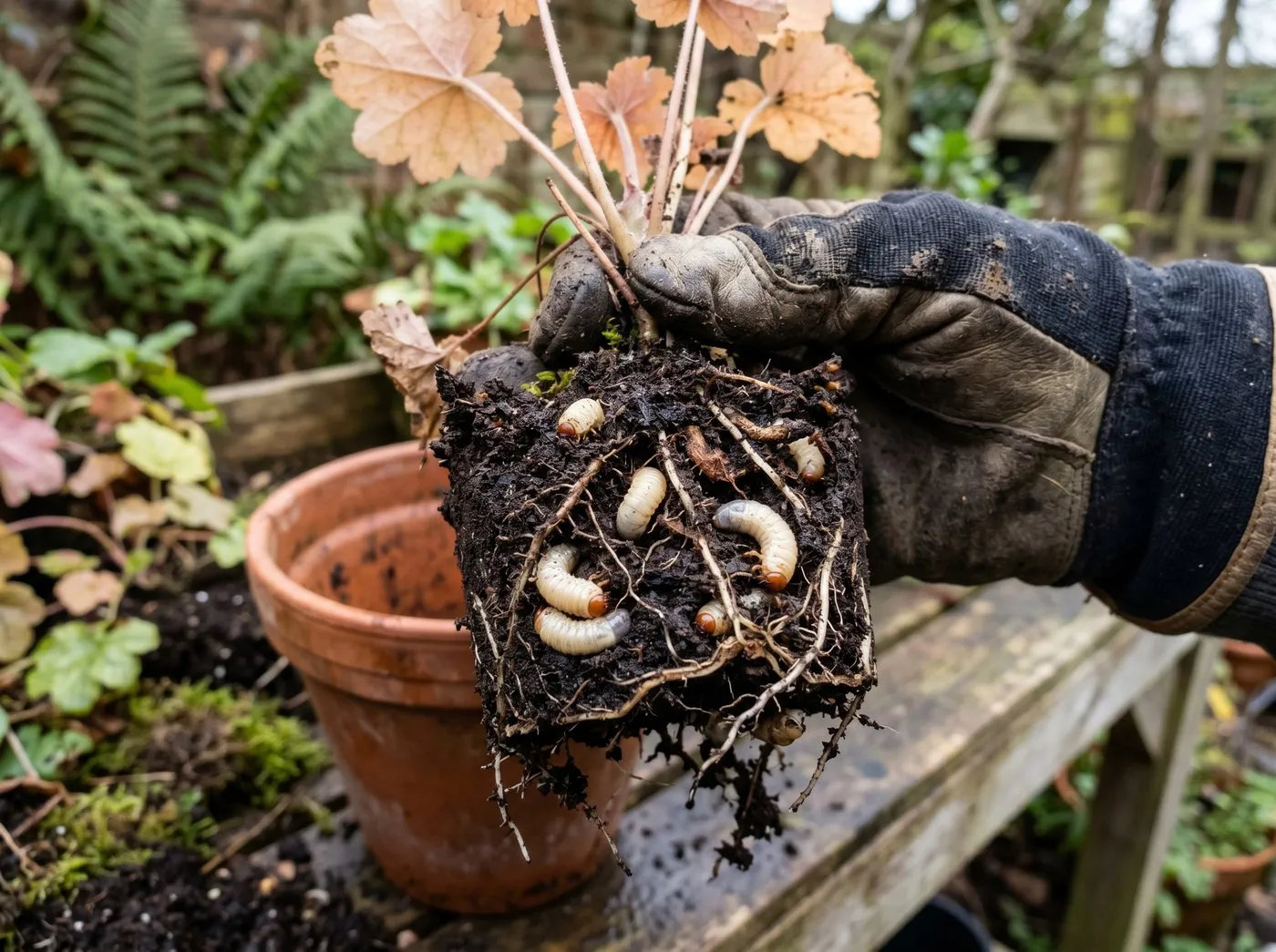 The damage you don’t see until it’s too late - vine weevil grubs in the rootball of a potted heuchera. By autumn each grub eats 1-2g of roots per week.
Plants most at risk
Strong preference for: heuchera, primula, sedum, cyclamen, strawberry, hosta, polyanthus, fuchsia, rhododendron in pots, viburnum, euonymus. Less attractive but still vulnerable: most herbaceous perennials in pots.
The effective control - nematodes
The only reliable UK control is biological: Steinernema kraussei nematodes (sold as Nemasys Vine Weevil Killer, BASF Larvae Killer, or similar). Microscopic worms that infect and kill vine weevil grubs from inside.
Timing matters. Apply when soil temperature is above 5C and grubs are active:
- First application: late August or early September - catches the new generation of grubs from spring egg-lay
- Second application: late March or early April - catches overwintering grubs before they pupate
Method: dissolve the pack contents in 5-10 litres of water following pack instructions. Drench around each plant base, working the solution into the compost. Water well before and after. Avoid bright sunlight (UV kills nematodes); apply in the evening.
One £15 pack treats around 40 pots or 100m² of border. Two applications a year for full prevention: about £30 per year total cost.
Other defences
- Adult traps: corrugated cardboard rolls under each pot. Adults hide in them during the day; check daily and dispose. Time-consuming but reduces egg-lay.
- Compost change: replace at least the top 5cm of compost annually, full compost every 2-3 years.
- Plant choice: if you’ve lost a pot to vine weevil, replant with something less attractive (grasses, hardy ferns, ornamental cabbages) for one season before trying heuchera again.
- Pot stand: raising pots 5cm off the ground on feet stops adults walking up from soil-level. Limited but useful.
Slugs and snails - the overnight raiders
Slugs are the most-asked-about UK container pest. They climb pot rims at dusk, especially after watering or rain, and eat the same crops they target at ground level - lettuce, hostas, strawberries, dahlias, marigolds, and any young seedling.
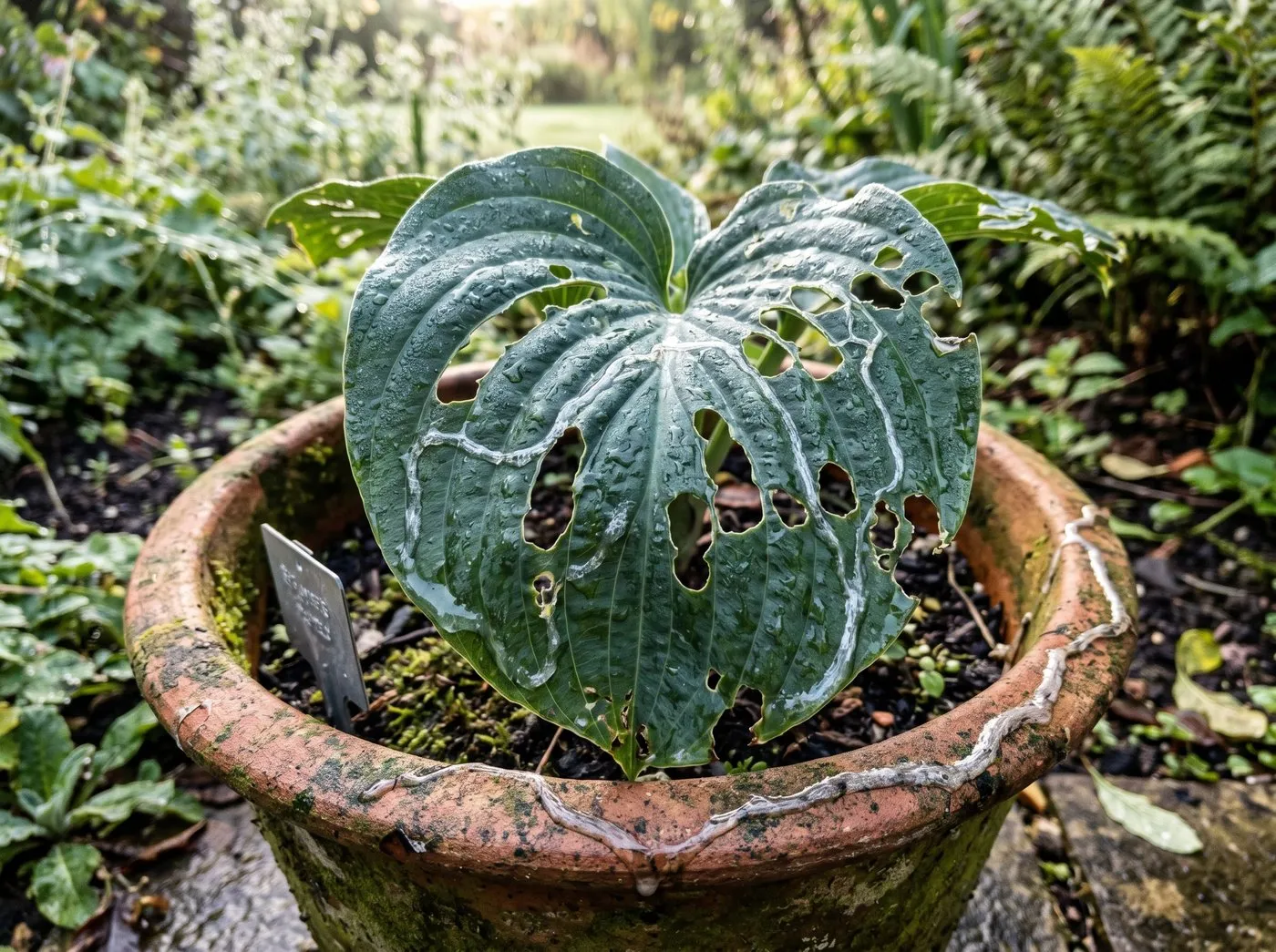 The morning-after evidence - irregular holes and slime trails on a potted hosta leaf. Slugs climb container rims overnight even when ground-bed crops are available.
Copper tape - the effective physical barrier
Copper tape works through galvanic reaction with slug slime. Stick a 25mm band of self-adhesive copper tape around the pot rim. Cost: £5-£8 per roll, enough for 8-12 large pots.
The non-negotiable detail: the band must be continuous with NO gaps. A 5mm break is enough for slugs to bypass. Check after rain and re-stick any peeling sections. Trim back any plant foliage that drapes over the rim - leaves bridging the tape allow slugs to walk over.
Also block these routes:
- Saucers under pots - slugs hide there during the day. Empty and clean weekly.
- Bricks or feet supporting the pot - check the contact points where slugs can climb.
- Trellises and supports - any stake reaching the ground gives slugs a route in.
Hand-picking - still essential
Even with copper tape, do a 15-minute slug patrol at dusk after rain through April-October. Carry a small bucket and a torch. Pick by hand (or gloved hand) and dispose - either into deep water, into the compost bin (sealed bag), or onto the bird table for thrushes.
Typical yield from 40 patio containers after a wet evening: 15-30 slugs in early spring, dropping to 5-10 by midsummer if copper tape is in place. Without copper tape, 50+ slugs a night is normal.
Other slug controls
- Beer traps: sunken pot of beer attracts slugs at dusk. Effective but kills indiscriminately (including useful ground beetles).
- Nematode drench: Phasmarhabditis hermaphrodita nematodes drench soil and kill slugs underground. £15 per pack covers about 40 pots. Best in spring (March-April).
- Slug pellets: ferric phosphate-based pellets (Sluggo or similar) are RHS-approved as wildlife-safe. Scatter sparingly around each pot.
- Hostas in particular: consider growing slug-resistant varieties (H. sieboldiana ‘Elegans’, H. ‘June’, H. ‘Halcyon’).
See our how to get rid of slugs guide for the full UK slug control picture.
Aphids - the spring invaders
Aphids appear on container plants from mid-April. Black aphids on broad beans and dahlias, green aphids on roses and most herbaceous plants, white woolly aphids on apples in pots. Reproduction is explosive - one female can produce 60+ daughters per week from May through August.
Damage and warning signs
- Sticky honeydew on leaves and stems
- Curled or distorted new growth
- Sooty mould on leaves below the colony
- Ants travelling up stems (they farm aphids for the honeydew)
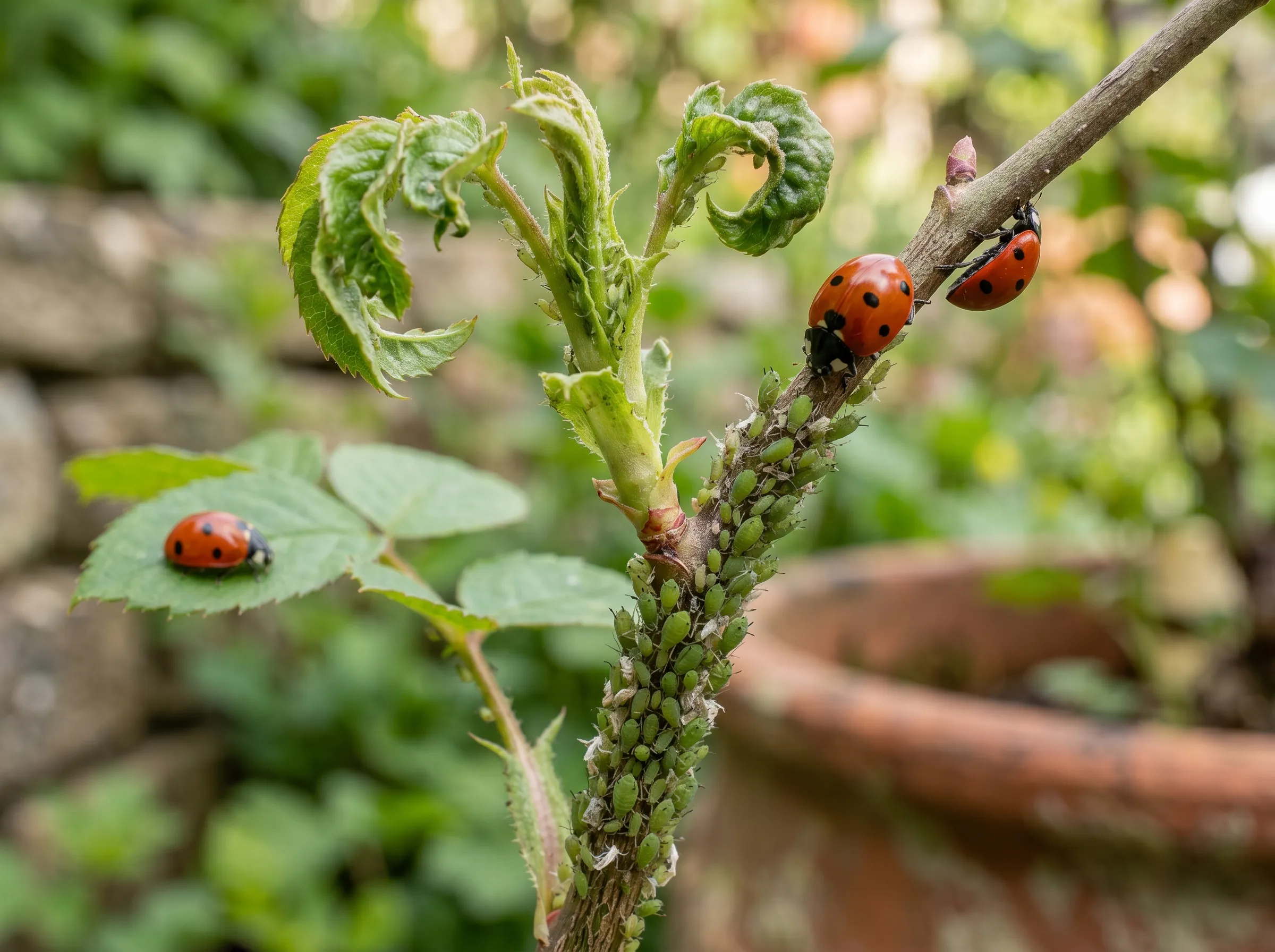 A spring aphid colony on container new growth. Catch it at this stage - a hard water jet daily for 3 days breaks the colony before it explodes.
The 3-step control sequence
Step 1: Water jet (free, immediate)
A strong jet of water from a hose or spray bottle knocks aphids off the plant. Repeat daily for 3-4 days. Most aphids that fall to the ground cannot climb back up. This breaks the colony cycle without chemicals or biological agents.
Step 2: Beneficial insects (£10-£20)
If water doesn’t clear the colony, introduce ladybird larvae or lacewing larvae from a UK supplier (Green Gardener, Defenders, Dragonfli). One pack releases 50-100 larvae which eat aphids voraciously for 2-3 weeks before pupating into adults.
Step 3: Insecticidal soap (last resort)
Spray with 1% insecticidal soap solution (£8-£12 per litre concentrate) in the cool of evening. Soaps work by disrupting aphid cell membranes. Repeat after 7 days. Less harm to beneficial insects than chemical sprays but still kills any soft-bodied insect it directly contacts.
What NOT to do
- Don’t use systemic insecticides like neonicotinoids. Banned in most UK garden settings; harm bees and beneficial insects.
- Don’t squash by hand if you can avoid - releases alarm pheromones that scatter the colony to nearby plants.
- Don’t rely on companion planting alone on patios. Nasturtiums attract aphids but in pot-scale it doesn’t help.
See our how to get rid of aphids UK guide for variety-by-variety detail.
Lily beetle - the red invader
Lilioceris lilii is bright red and unmistakable - 8mm long, glossy red back, black legs and head. Adults appear April-July. They lay orange eggs on leaf undersides; larvae are black-slime-covered grubs that defoliate plants within days.
Plants at risk
Lilies (Asiatic and Oriental in particular), fritillaries, Solomon’s seal. Occasionally other lily-family plants.
Control - hand-picking
The most effective approach is also the simplest: weekly hand-picking April-July.
- Inspect every lily and fritillary pot once a week from April through July.
- Pick adult beetles off and squash. They drop to the ground when disturbed and play dead - hold a hand or cup underneath to catch them.
- Wipe orange egg clusters off leaf undersides with a damp cloth.
- Squash or wipe off the black-slime-covered grubs (yes, it’s unpleasant).
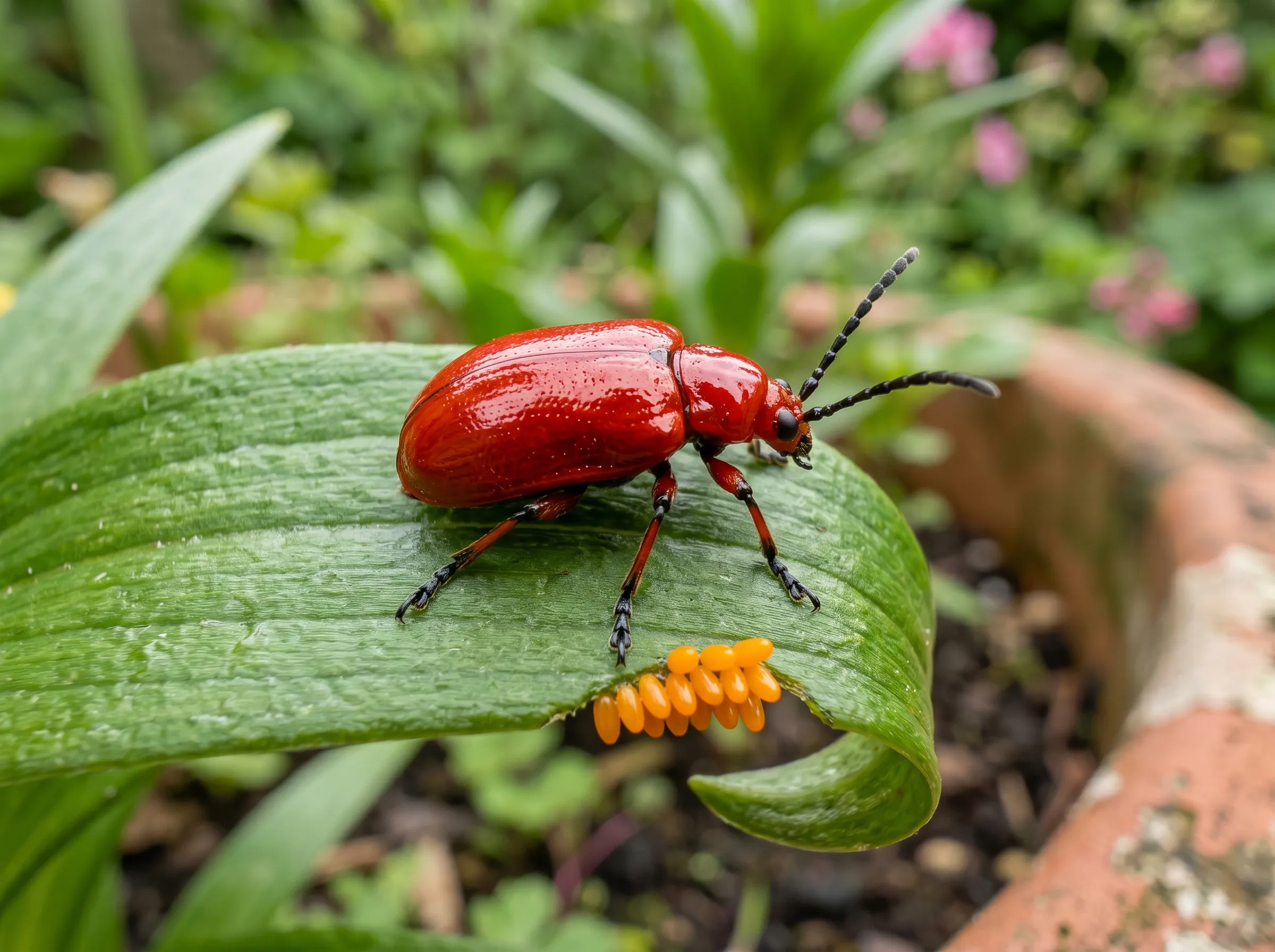 Lily beetle - 8mm of bright red on lily and fritillary foliage. Weekly hand-picking April-July keeps populations in check on patio lilies.
Five minutes a week on 6-8 lily pots through 16 weeks of spring and summer. That’s the entire defence routine.
What doesn’t work
- Sprays: lily beetle has developed resistance to most contact insecticides; pyrethroids work briefly but kill pollinators visiting lily flowers too.
- Companion plants: mints and chives are claimed to deter but trials show no measurable effect.
- Sticky traps: don’t catch lily beetles - they’re too heavy.
Hand-picking is the only reliable UK control.
Other UK container pests
Cabbage white caterpillars on patio brassicas
Adult butterflies lay yellow eggs on potted kale, pak choi and rocket. Caterpillars eat foliage to skeleton fast. Cover with fine mesh netting from May through September.
Carrot root fly on container carrots
Adult flies lay eggs at soil level; maggots tunnel through carrot roots. Use fine mesh covers or 60cm tall barriers around carrot pots. See our carrot root fly prevention UK guide.
Spider mites in hot dry greenhouses or sheltered patios
Tiny red-brown mites cause stippled yellowing on leaves and fine webbing. Raise humidity with daily misting; introduce predatory mites (Phytoseiulus persimilis) for severe infestations.
Fungus gnats in damp houseplant compost
Small black flies above houseplant pots. Larvae eat young roots. Let compost surface dry between waterings; apply yellow sticky traps. Severe infestations: drench with nematodes (Steinernema feltiae).
The annual pest-prevention routine
| Time | Action |
|---|---|
| March | Top up or replace compost (top 5cm minimum). Inspect for vine weevil grubs. |
| Late March | First nematode drench for vine weevil. |
| April | Install copper tape on rims of all vulnerable pots. Start weekly lily-beetle patrol. |
| May-June | Weekly inspection for aphid colonies. Knock back with water jet. |
| July | Continue lily-beetle picking. Check for caterpillars on brassicas. |
| August | Watch for adult vine weevil leaf damage. Set cardboard traps if seen. |
| Late August-September | Second nematode drench. |
| October-November | Empty seasonal pots. Wash with mild detergent before storage. Bin spent compost. |
| December-February | Inspect overwintering pots monthly. Check for slug damage. |
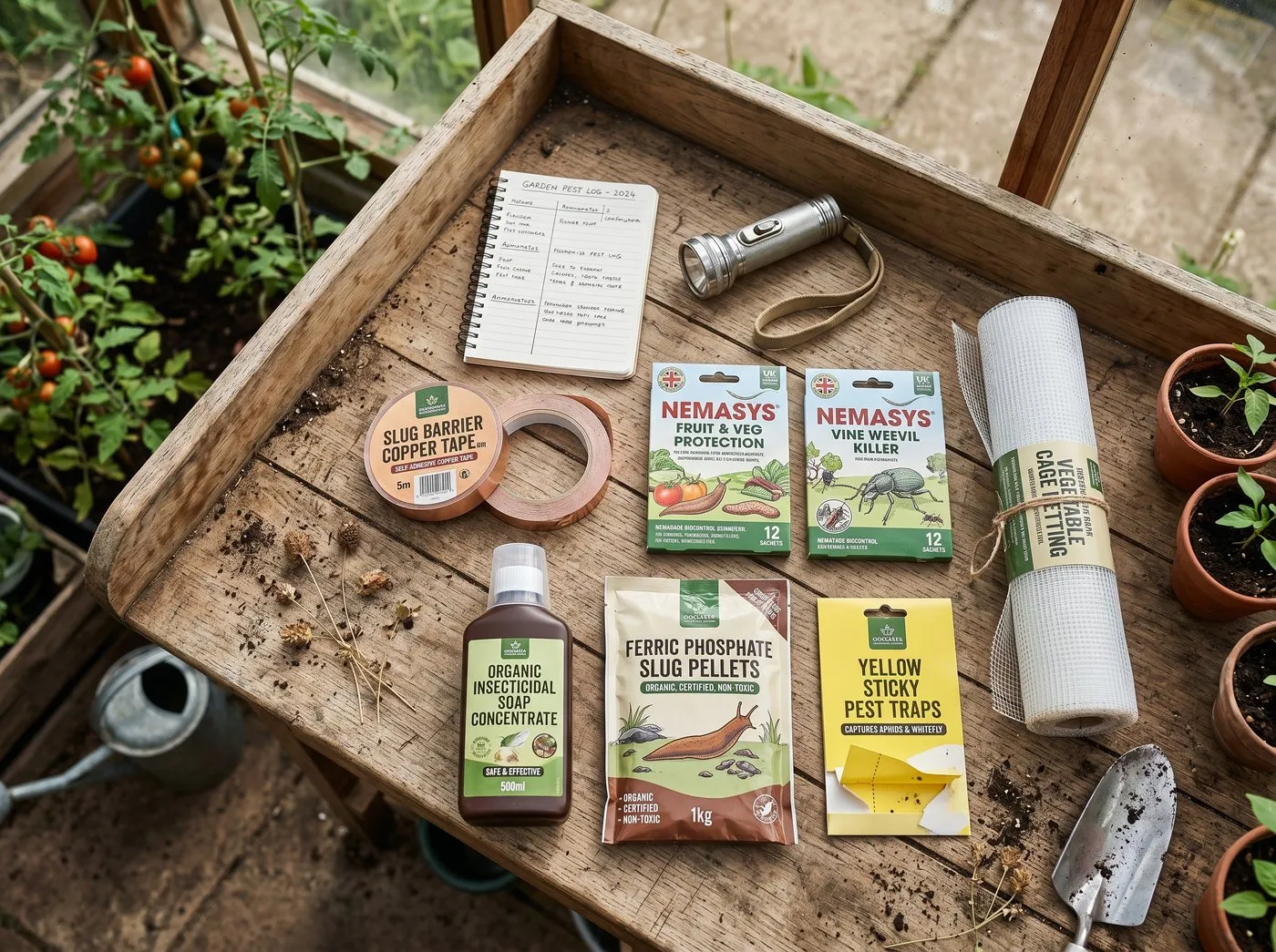 The annual UK defence kit - copper tape, two nematode packs, fine mesh netting, ferric phosphate slug pellets, insecticidal soap. Total cost about £50, protects 30-40 containers for a year.
Cost of a year’s protection
For a typical 30-40 pot UK patio:
| Item | Annual cost |
|---|---|
| Copper tape (1 roll) | £6 |
| Vine weevil nematodes (2 packs) | £30 |
| Slug nematodes (1 pack, optional) | £15 |
| Ferric phosphate slug pellets | £8 |
| Fine mesh netting | £12 |
| Insecticidal soap concentrate | £10 |
| Total | £81 |
Replace once: copper tape lasts 2 seasons before adhesive fails. Nematodes are annual. Soap concentrate lasts 2-3 years.
Compare to losing 4-5 plants a year at £8-£25 each (£40-£125 of replacement plants), plus the loss of mature established displays that can take 2-3 years to rebuild. The defence kit pays back in plants saved within the first season.
Field note: The RHS plant pests advice covers identification photographs and current UK control recommendations across the full pest range. Their advice updates yearly as new control products and biological agents come to market.
What about chemical pesticides?
Most chemical pesticides previously available to UK gardeners are now restricted. Glyphosate is for weeds, not pests. Neonicotinoids are banned. Pyrethroid sprays remain available but kill pollinators and beneficial predators alongside pests - a poor trade for container gardens that depend on bee visits for tomatoes, courgettes and peppers.
Modern UK container pest management is overwhelmingly biological (nematodes, ladybirds, predatory mites), physical (copper tape, mesh netting, hand-picking) and cultural (compost change, plant choice, inspection routine). The chemical option exists for genuine emergencies but should be the last tool used, not the first.
A working defence philosophy
Patio pest pressure is a constant background condition - you don’t eliminate it, you manage it down to acceptable levels.
The four habits that matter most:
-
Weekly inspection April-October. 15 minutes round the pots looking under leaves, at the compost surface, around the rim.
-
Compost refresh annually. Removes 60-80% of overwintering pest pressure with no extra effort beyond standard pot maintenance.
-
Copper tape and nematodes as preventive standing measures. Cheap, effective, no harm to beneficial wildlife.
-
Hand-picking when you see something - lily beetle, vine weevil adults, caterpillars. Five minutes immediately beats 30 minutes of remedial spraying later.
Now you’ve got the defence playbook
For specific pest deep-dives, our vine weevil treatment UK, how to get rid of slugs, how to get rid of aphids UK and woolly aphid identification and treatment UK guides cover each species in more detail.
Watch for new pests when putting houseplants outdoors for summer.
Our team produces practical UK gardening guidance from source research, contributor records and established horticultural practice. Editorial standards are overseen by Matt W.