Key takeaways
- Air drying costs nothing and works for woody herbs like rosemary, thyme, and oregano in 7-14 days
- Oven drying at 50-60 degrees Celsius handles fruit and veg in 4-12 hours with the door propped open
- Electric dehydrators give the most reliable results and cost £30-50 for a basic five-tray model
- UK humidity makes air drying fruit unreliable — use a dehydrator or oven for apples, plums, and tomatoes
- Dried produce stores for 6-12 months in airtight glass jars kept in a cool, dark cupboard
- Blanch vegetables for 2-3 minutes before drying to preserve colour, texture, and vitamin content
Drying is the simplest, cheapest, and oldest way to preserve a garden surplus. A glut of tomatoes, a rosemary bush producing more than you can use, a chilli plant loaded with fruit in September, all of these dry well and store for months. The dried produce takes up a fraction of the freezer space, needs no electricity to store, and often concentrates flavour rather than diluting it.
The challenge in the UK is humidity. Mediterranean gardeners dry tomatoes on rooftops in 35-degree heat and 30% humidity. British gardeners work with 18-degree summers and 70% humidity. That means we rely on heat assistance, ovens and dehydrators, for most crops. Only woody herbs and thin-walled chillies dry reliably in open air in Britain.
What are the three methods of drying garden produce?
Three methods cover every crop a UK garden produces. Each has different costs, timescales, and results. The right method depends on what you are drying and how much you want to invest.
Air drying: free but limited
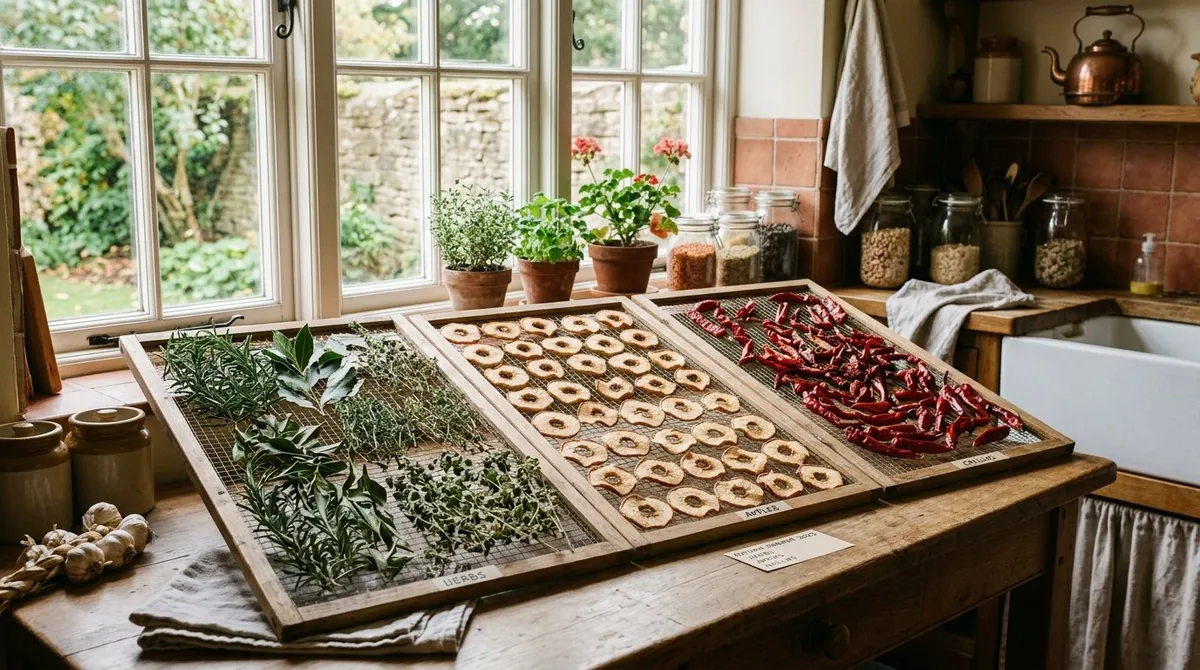
Air drying works by circulating ambient air around the produce in a warm, dry room. It costs nothing and needs no equipment beyond string, hooks, and a ventilated space. The limitation is speed. At UK humidity levels, air drying takes 7-14 days for herbs and 2-4 weeks for chillies. Fruit and most vegetables develop mould before they dry fully.
Best for: rosemary, thyme, oregano, sage, bay leaves, lavender, and thin-walled chillies like cayenne, bird’s eye, and Thai. Our herb drying guide covers herb-specific techniques in full detail.
Oven drying: accessible but imperfect
Most ovens reach 50-70 degrees Celsius on their lowest setting. Prop the door open 2-3cm with a wooden spoon to let moisture escape. Spread produce on wire racks (not solid trays, which trap steam underneath). Oven drying handles fruit, vegetables, and herbs in 4-12 hours.
The downsides are uneven heat distribution and energy cost. Front-of-oven items dry faster than those at the back. Rotating trays every hour improves consistency. A single oven batch of apple slices uses roughly 3-4 kWh of electricity at current UK rates.
Electric dehydrator: the most reliable method
A dehydrator circulates warm air at a constant temperature through stacked trays. Entry-level five-tray models from Klarstein, Andrew James, or Lakeland cost £30-50. Professional models with digital controls and timers cost £80-150.
Dehydrators use 300-500 watts, roughly one-fifth of an oven. They run for 8-24 hours per batch depending on the produce. A £40 dehydrator processes 1-2kg per batch and pays for itself within one summer if you grow surplus tomatoes, apples, or herbs.
Which crops dry best from a UK garden?
Not every garden crop dries well. Some lose too much flavour. Others turn to leather. The crops listed here produce consistently good results with standard home equipment.
Drying times and temperatures for 10 common crops
| Crop | Method | Temperature | Drying Time | Shelf Life | Notes |
|---|---|---|---|---|---|
| Rosemary | Air dry | Room temp | 7-10 days | 12 months | Strip leaves after drying |
| Thyme | Air dry | Room temp | 7-10 days | 12 months | Dry on the stem |
| Oregano | Air dry | Room temp | 10-14 days | 12 months | Strongest flavour dried |
| Mint | Dehydrator | 35°C | 3-4 hours | 6 months | Loses colour at higher temps |
| Apple rings | Dehydrator | 57°C | 8-12 hours | 9 months | Core and slice 5mm thick |
| Plum halves | Dehydrator | 57°C | 12-18 hours | 6 months | Stone and halve; cut side up |
| Tomatoes | Dehydrator | 60°C | 8-14 hours | 9 months | Halve cherry; slice large |
| Courgette slices | Dehydrator | 55°C | 8-12 hours | 6 months | Blanch 2 min first |
| Peppers | Dehydrator | 55°C | 6-10 hours | 9 months | No blanching needed |
| Mushrooms | Dehydrator | 55°C | 6-8 hours | 12 months | Slice 5mm; no blanching |
Tomatoes are the single most rewarding crop to dehydrate. A summer glut of cherry tomatoes from the greenhouse concentrates into intense, sweet dried halves that taste better than anything from a shop. Slice large tomatoes 8mm thick or halve cherry types. Lay cut-side up on the dehydrator trays.
How do I air dry herbs from the garden?
Harvest herbs mid-morning after the dew has evaporated but before the midday sun drives off essential oils. Cut stems 15-20cm long. Gather 5-8 stems into a small bundle and tie with string or an elastic band.
The bunching method
Hang bundles upside down from hooks, a beam, or a drying rack in a warm room with good airflow. A kitchen, utility room, or spare bedroom works well. Avoid bathrooms and laundry rooms, the humidity is too high. Direct sunlight fades leaf colour, so choose a spot out of strong light.
How do I oven dry fruit and vegetables?
Oven drying works for any produce that fits on a wire rack. The key is low, steady heat with good moisture extraction. Most conventional ovens have a lowest setting of 50-70 degrees Celsius. Fan-assisted ovens circulate air better and give more even results.
Step-by-step oven drying
Wash and prepare produce. Slice fruit 5-8mm thick. Core apples and cut into rings. Halve plums and remove stones. Blanch vegetables (except peppers, mushrooms, onions, and tomatoes) in boiling water for 2-3 minutes, then plunge into ice water.
Arrange slices in a single layer on wire racks set over baking trays. Leave 1cm gaps between pieces. Set the oven to 50-60 degrees Celsius. Prop the door open 2-3cm. Rotate trays from top to bottom every 2 hours. Drying takes 4-12 hours depending on the produce, thickness, and your oven.
Test by removing a piece and letting it cool for 2 minutes. Dried fruit should be pliable but not sticky. Dried vegetables should be brittle and snap cleanly. If pieces feel soft or bendy, return them for another hour.
What makes a good dehydrator for UK gardeners?
A dehydrator is the single most useful piece of equipment for preserving garden produce beyond the freezer. It works overnight, uses minimal electricity, and produces consistent results batch after batch.
What to look for when buying
Five features matter: adjustable temperature (35-70 degrees Celsius), a fan for air circulation, at least five trays, a timer, and stackable or removable trays for cleaning. Basic models with a fixed temperature and no timer cost £30-40. Digital models with precise controls cost £80-150.
| Feature | Budget (£30-50) | Mid-Range (£50-100) | Premium (£100-150) |
|---|---|---|---|
| Trays | 5 round | 5-6 square | 9-10 square |
| Temperature | Fixed or dial | Digital, adjustable | Digital, precise |
| Timer | None | Up to 24 hours | Up to 48 hours |
| Fan position | Base | Base | Rear-mounted |
| Capacity per batch | 1-1.5kg | 1.5-2.5kg | 3-5kg |
| Best for | Herbs, small batches | Most home gardeners | Allotment-scale surplus |
A rear-mounted fan distributes heat more evenly than a base-mounted one. Square trays hold more produce than round ones and waste less space. For most home gardeners processing a moderate summer surplus, a mid-range model at £60-80 is the sweet spot.
How do I dry chillies from the garden?
Chillies are one of the easiest crops to dry because their relatively low moisture content and capsaicin levels resist mould growth. Thin-walled varieties dry perfectly in open air. Thick-walled types need heat assistance.
Air drying thin-walled chillies
Thread a large needle with cotton thread and push it through the stalk of each chilli, spacing them 3cm apart. Hang the string in a warm room with airflow. Cayenne, bird’s eye, Thai, and ring of fire chillies dry in 2-3 weeks. They are ready when brittle and snap cleanly.
Thick-walled varieties like jalapeno, Hungarian wax, and poblano contain too much moisture for reliable air drying in the UK. Halve them lengthways, remove seeds, and dehydrate at 55 degrees Celsius for 6-10 hours. Our chilli growing guide covers varieties, heat levels, and harvest timing.
Why does UK humidity make drying harder?
Mediterranean and continental European gardeners dry produce outdoors in summer because ambient humidity drops below 40%. British summer humidity averages 65-80%, rising higher in the north and west. At these levels, exposed produce absorbs moisture from the air as fast as it loses it through evaporation.
The practical effect
Herbs with thick, waxy leaves (rosemary, thyme, bay) cope because their leaf structure resists ambient moisture. Soft fruit like strawberries, thin-skinned plums, and sliced apples develop surface mould within 48 hours of air exposure at British humidity levels. Tomatoes fare slightly better but still ferment before drying.
The solution is enclosed heat. An oven or dehydrator makes a low-humidity environment inside the machine by heating air and exhausting moisture through vents. This bypasses the ambient humidity problem entirely. Even a basic dehydrator reduces the air around the produce to 15-20% relative humidity, well below the 40% threshold needed for safe drying.
How do I store dried produce for maximum shelf life?
Proper storage matters as much as proper drying. Dried produce that reabsorbs moisture from the air develops mould within weeks. The goal is zero moisture ingress from the moment drying finishes.
The jar conditioning method
After drying, pack produce loosely into clean, dry glass jars (Kilner jars or recycled jam jars with new lids). Fill to 80% capacity. Seal the lids and leave on the worktop for 7 days. Check daily. If condensation forms inside the jar, the produce is not fully dry, return it to the dehydrator for another 2-4 hours.
After 7 days with no condensation, the produce is conditioned and ready for long-term storage. Move jars to a cool, dark cupboard at 15-20 degrees Celsius. Dried herbs last 12 months. Dried fruit lasts 6-9 months. Dried vegetables last 6-9 months. Label every jar with the contents and date.
For other preservation methods including bottling, jam making, and freezing, see our preserving guide, jam making guide, and freezing guide.
What are the best crops to grow specifically for drying?
Some crops taste better dried than fresh. Others produce such heavy gluts that drying is the only practical way to use the surplus. Growing with drying in mind changes what you plant and how much.
Top performers for dehydrating
Oregano is the standout. Dried oregano has a stronger, more concentrated flavour than fresh. Greek oregano (Origanum vulgare subsp. hirtum) is the best culinary variety and dries superbly. Grow it in full sun in well-drained soil. A single mature plant produces enough dried oregano to fill several jars.
Cherry tomatoes are second. Varieties like Sungold, Gardener’s Delight, and Sweet Million produce 4-6kg per plant. Dried cherry tomato halves store in olive oil or plain in jars. They rehydrate in pasta sauces, risottos, and stews. For growing advice, see our tomato growing guide.
Mushrooms dry exceptionally well if you grow your own. Shiitake, oyster, and lion’s mane all concentrate in flavour when dried. Our mushroom growing guide covers indoor cultivation methods. Apple rings from garden trees are another staple, use a corer-slicer for uniform 5mm rings and store for up to 9 months. The Food Standards Agency provides safety guidance on home food preservation.
Frequently asked questions
How long does dried garden produce last?
Dried herbs last 6-12 months; dried fruit and vegetables last 6-9 months. Store in airtight glass jars in a cool, dark cupboard at 15-20 degrees Celsius. Label each jar with the contents and drying date. Discard anything that shows mould, off smells, or moisture inside the jar.
Is a dehydrator better than oven drying?
A dehydrator gives more even results and uses less energy than an oven. It circulates warm air at a constant temperature, drying produce uniformly. An oven works but needs the door propped open to release moisture, which wastes heat. A five-tray dehydrator costs £30-50 and handles 1-2kg of produce per batch.
Can I air dry fruit in the UK?
UK humidity makes air drying fruit unreliable in most regions. Mediterranean countries dry figs, tomatoes, and grapes in open air because humidity is below 40%. British summer humidity averages 65-80%, which encourages mould before the fruit dries fully. Use a dehydrator or oven for fruit.
Do I need to blanch vegetables before drying?
Yes, blanching preserves colour, texture, and vitamins. Steam blanch for 2-3 minutes or water blanch for 1-2 minutes. Plunge into ice water immediately after. This stops enzyme activity that causes flavour and colour loss during storage. Skip blanching only for onions, peppers, mushrooms, and tomatoes.
What is the best temperature for drying herbs?
Dry herbs at 35-45 degrees Celsius to preserve essential oils. Higher temperatures evaporate the volatile oils that give herbs their flavour and aroma. Woody herbs like rosemary and thyme tolerate slightly higher heat. Delicate herbs like basil and parsley need the lowest setting.
Can I dry chillies by hanging them up?
Yes, chillies air dry well in the UK because their low moisture content resists mould. Thread a needle through the stalks and hang strings in a warm, dry room with good airflow. Thin-walled varieties like cayenne dry in 2-3 weeks. Thick-walled types like jalapeno need a dehydrator to prevent mould.
How do I store dried produce safely?
Use airtight glass jars, not plastic bags or open containers. Glass prevents moisture re-entering and does not absorb or transfer flavours. Fill jars to 80% capacity to allow a small air space. Store in a dark cupboard away from heat sources. Check jars weekly for the first month for any signs of moisture.
Our team produces practical UK gardening guidance from source research, contributor records and established horticultural practice. Editorial standards are overseen by Matt W.