Key takeaways
- Mulching cuts garden water use by 40-60% through reduced evaporation
- Deep watering twice a week beats light daily watering for plant health and water use
- Soaker hoses use 30-50% less water than overhead sprinklers
- A 200L water butt holds 4-6 weeks of summer watering for a typical UK back garden
- Drought-tolerant Mediterranean planting (lavender, rosemary) needs zero summer watering
- Water at the base, in the evening, slowly - the three rules that beat any kit
This guide covers the five linked techniques that compound to that result - mulching, watering behaviour, kit selection, drought-tolerant planting, and rainwater capture. It pairs with our rainwater harvesting for UK gardens guide which covers the technical side of capturing and storing rainfall.
The five techniques that compound
UK garden water use is dominated by summer evaporation losses and sub-optimal watering behaviour. Five interventions, applied together, transform summer watering:
- Mulch every bed in May before the dry weather (40-60% reduction in evaporation)
- Water deeply, infrequently, at the base (30-50% reduction through better uptake)
- Use soaker hoses or drip lines instead of overhead sprinklers (30-50% reduction)
- Capture rainwater in linked butts (replaces 40-60% of summer mains use)
- Plant drought-tolerant species in zones you do not want to water (eliminates watering for 30-40% of beds)
The compound effect is significant - a typical UK back garden using 800 litres per week in July with sprinkler-based daily watering can drop to 300-380 litres with the full system, and a heavily-adapted garden with strategic drought planting can drop to 100-200 litres in the same period.
Technique 1: Mulch every bed
Mulching is the single most effective UK water-conservation intervention. A 50-75mm layer of organic material across the soil surface cuts evaporation losses by 40-60% and reduces watering frequency from every 2-3 days to every 5-7 days.
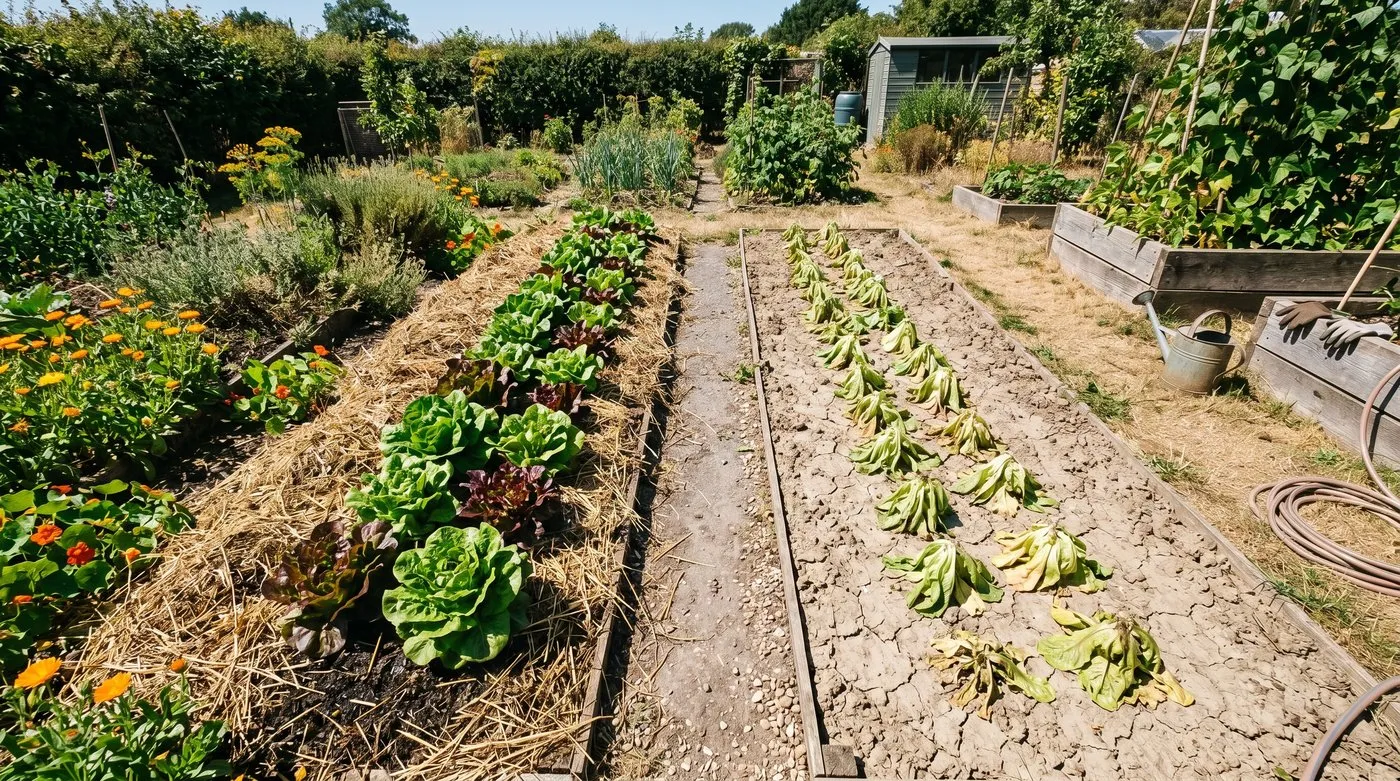 Same garden, same day. Mulched bed (left) holds soil moisture; unmulched bed (right) shows wilt by mid-morning.
What mulch to use
Bark chip (most durable). 50-75mm layer, lasts 18-24 months. Best for permanent plantings - shrub borders, fruit beds, perennials. £30-£60 per cubic metre at most UK garden centres.
Composted woodchip (best for veg). 50mm layer, lasts 9-12 months. Decomposes into the soil and feeds it. The right call for vegetable beds where you want the mulch to integrate over the season.
Garden compost (cheapest if you make it). 25-50mm layer, lasts 6-9 months. Acts as both mulch and feed. The end product of a working compost system is essentially free mulch.
Leaf mould (free and excellent). 50mm layer, lasts 12-18 months. Slightly acidifying so good for blueberries and rhododendrons but fine on most beds. Gather autumn leaves and store in a wire cage for 12-18 months before use.
Strawy manure (best for fruit and roses). 75-100mm layer, lasts 12 months. Adds nutrients as it breaks down. Apply in spring after the last frost.
What NOT to use as mulch
- Fresh grass clippings (thick layer). Compacts and forms an impermeable mat. OK as a thin layer mixed with browns.
- Plastic sheet mulch. Stops rain reaching the roots. Sealed plastic deserts the soil over time.
- Gravel or pebbles on vegetable beds. Useful on ornamental drought gardens but lock heat into UK summer soil at root depth.
When to apply
Apply mulch in late April to early May when the soil has warmed and dried slightly but before the dry summer weather starts. Mulching cold wet spring soil holds the cold in and slows the season’s start.
Top up mulch annually in spring. Add a fresh 25mm layer over the previous year’s mulch each May.
For deeper soil-improvement context including mulch fertilisation, see our how to improve clay soil and how to improve sandy soil UK guides.
Technique 2: Watering behaviour
How you water matters as much as how much. Three rules that beat any kit upgrade:
Rule 1: Deep and infrequent beats shallow and daily
Apply at least 15-20 litres per square metre per watering session, wetting the soil 100mm deep. Then leave the bed alone for 5-7 days (mulched) or 2-3 days (unmulched). Deep watering forces roots to grow down toward moisture. Shallow daily watering produces shallow roots that suffer the moment you skip a day.
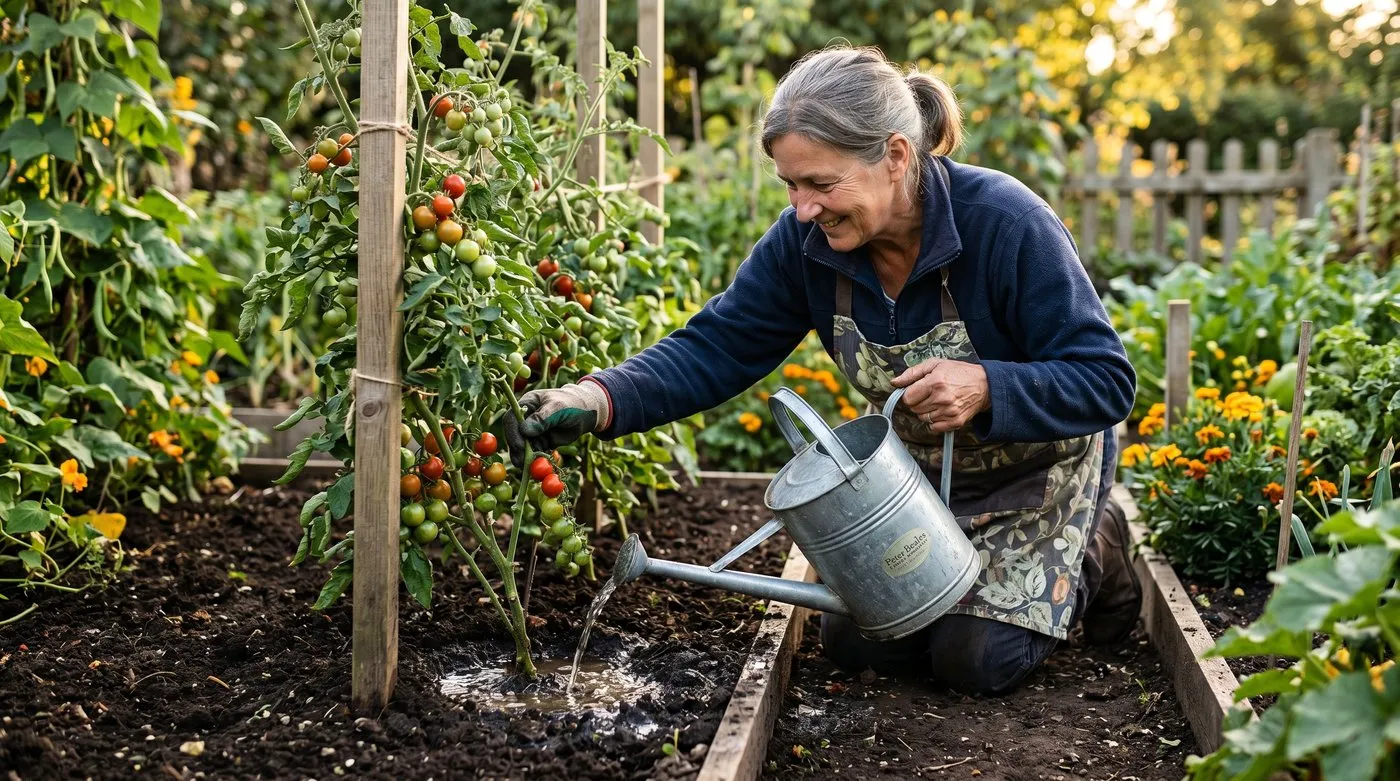 A scooped hollow at the plant base directs water straight to the root zone. Slow application gives the water time to soak in rather than running off.
How to check soil moisture before watering:
- Push a finger 100mm into the soil. If dry, water. If damp, wait.
- Or use a soil moisture probe (£8-£15 from any UK garden centre).
- Walk the garden in the morning before sun heats the surface - droopy plants signal the bed needs water, but check by finger before assuming.
Rule 2: Water at the base, not the leaves
Splashing water onto leaves wastes water and increases fungal disease pressure. Direct water to the soil at the plant base. Three implementations:
- Watering can with long spout for hand-watered beds
- Soaker hose under mulch for permanent vegetable beds
- Hose with a slow-soak head for trees and shrubs
Avoid: rotary sprinklers (30-40% water lost to evaporation and drift), spray hoses on a coarse setting (50% water hits foliage rather than soil), and rose-end watering cans for established plants (good for seedlings only).
Rule 3: Evening is best, morning is second-best
Water between 6pm and 9pm for the best UK results. The cool overnight hours let water soak deep into the soil before any sun-driven evaporation. Roots take up the water through the night. Plants face the next day’s heat already hydrated.
Morning watering (6am-9am) works almost as well. Midday and afternoon watering is the worst choice - 30-50% of the water evaporates before reaching the roots, and any splash on leaves can scorch in the strong sun.
The one exception: water immediately if a plant is showing acute wilt at any time of day. Recovery matters more than timing in an emergency.
Technique 3: Soaker hoses and drip irrigation
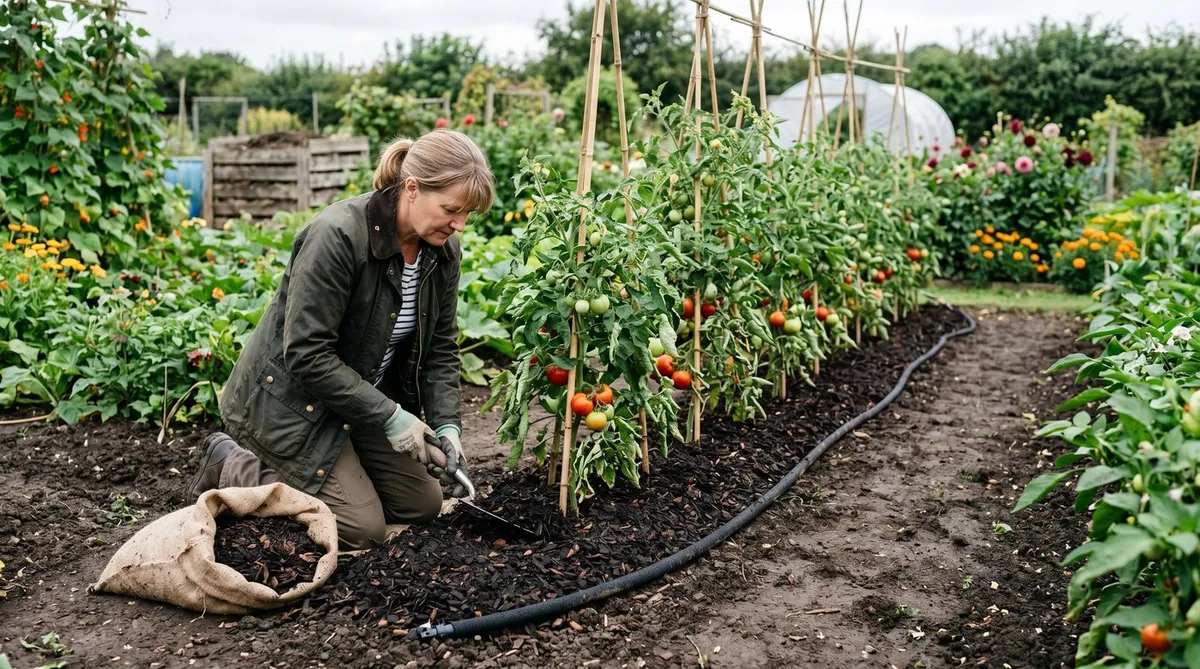
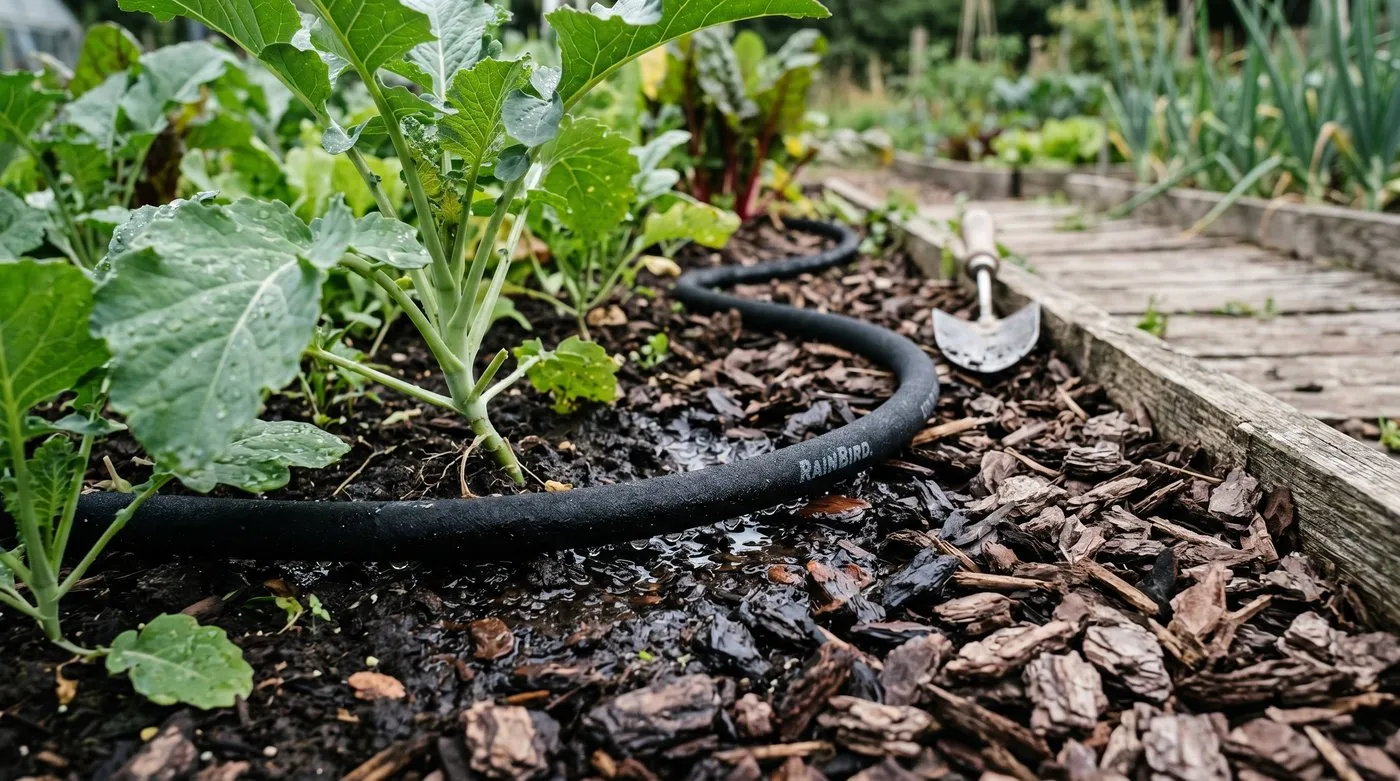 Soaker hose threaded along the bed, then buried under mulch. Water seeps directly to the root zone over hours rather than minutes.
A soaker hose is a porous tube laid along a bed and connected to the mains tap. Water seeps slowly through the entire length of the hose, delivering moisture directly to the root zone with near-zero evaporation loss.
Setup
- 15-25m of soaker hose for a typical UK back garden bed network
- Y-connector and tap timer at the mains end
- Lay the hose along the row, 50-100mm from the plant stems
- Cover with 50mm of mulch to retain moisture and protect the hose from UV
Running schedule
A typical soaker hose delivers 4-6 litres per metre per hour. For a 20m hose:
- Drought conditions: 60-90 minutes per session = 80-130L of water, twice a week
- Normal UK summer: 45-60 minutes per session, once a week (mulched)
- Spring and autumn: rarely needed - rain usually sufficient
Compared to a sprinkler delivering equivalent root-zone moisture, soaker hoses use 30-50% less water.
Tap timer
A battery-powered tap timer (£20-£40 from any UK garden centre) automates the schedule. Set it to come on at 7pm twice a week. Combined with mulched beds, this is the lowest-attention high-efficiency UK garden watering setup.
Drip irrigation
Drip-irrigation kits (£40-£120 from specialist suppliers) use individual emitters at each plant rather than a continuous hose. Best for container plantings, glasshouses, and beds with widely-spaced plants. Slightly more efficient than soaker hoses but more complex to install and maintain.
Technique 4: Rainwater capture
UK rainfall averages 800-1,500mm per year depending on region. A typical 6x4m shed roof catches roughly 2-4m³ of rainwater per year - enough to cover most garden watering needs without any mains water.
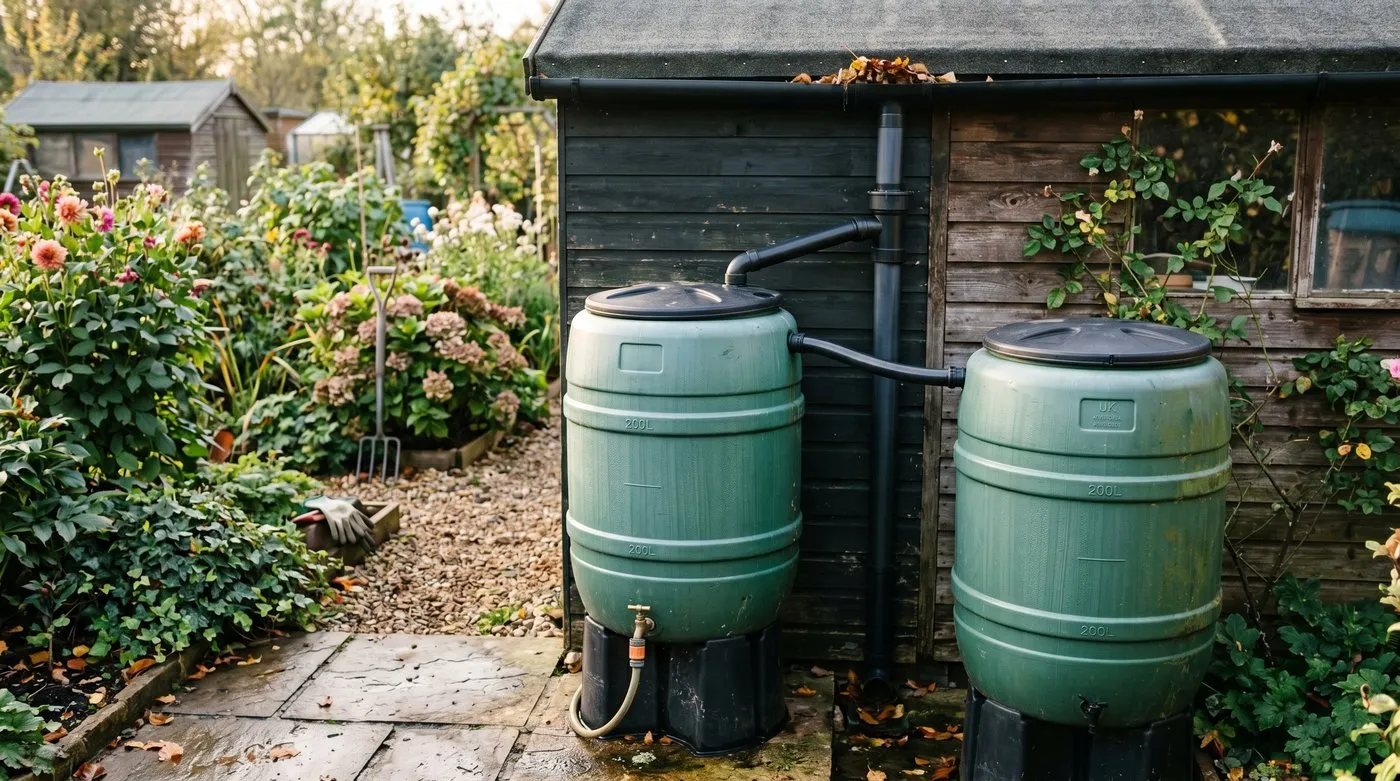 Linked butts double the storage volume. A standard 200L butt fills in 1-2 typical UK rainfall events.
Capture rates
A square metre of roof surface catches 1 litre of water per millimetre of rainfall. For a UK garden:
- Shed roof (typically 4-6m²): 4-6 litres per mm rainfall = 3,000-9,000 litres per year
- House extension roof (5-10m²): 5-10 litres per mm = 4,000-15,000 litres per year
- Greenhouse roof (3-5m²): 3-5 litres per mm = 2,500-7,500 litres per year
Water butt sizing
A typical UK garden needs 4-6 weeks of summer watering capacity in stored rainwater. Calculation:
| Garden size | Weekly summer use | 6-week storage |
|---|---|---|
| Small back garden (under 50m²) | 50-100L | 300-600L |
| Medium back garden (50-100m²) | 100-200L | 600-1,200L |
| Large garden / allotment (100m²+) | 200-400L | 1,200-2,400L |
Standard UK water butts are 100L, 200L and 350L. Link multiple butts with overflow kits to reach the required volume. A 200L butt costs £40-£80; a 350L butt costs £80-£140; linking kits are £15-£25.
For the full rainwater harvesting setup including filtering, pumping and using harvested water on edible crops, see our rainwater harvesting for UK gardens guide.
Where to place the butt
- Under a downpipe that drains a significant roof area
- Sloping slightly away from the building foundation to avoid damp issues
- Within hose reach of the garden it serves
- Out of direct south-facing sun in summer (slows algae growth in the water)
- On a 30-60cm-tall stand so a watering can fits under the tap
Technique 5: Drought-tolerant planting
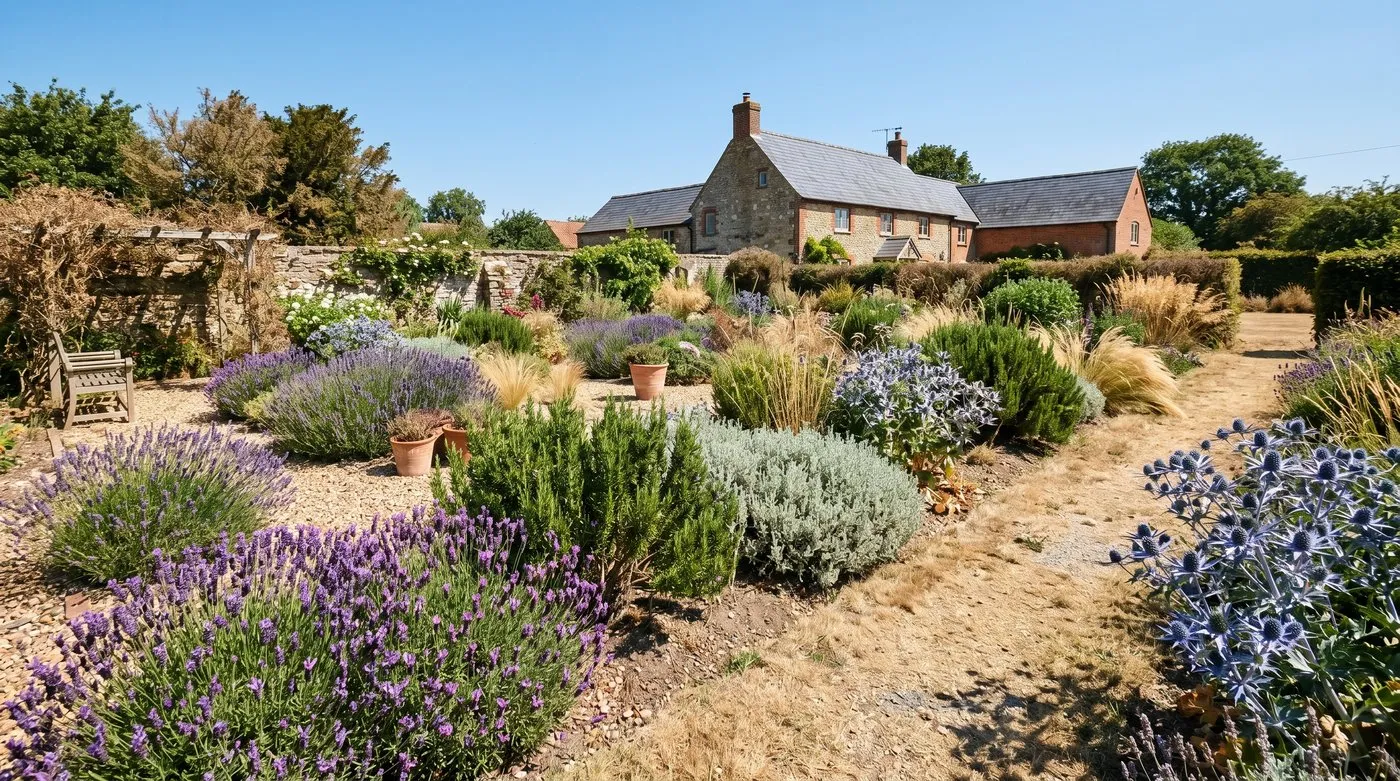 Mediterranean planting holds up through UK heatwaves without watering. The right species, planted in well-drained soil, eliminates summer water demand for whole zones of the garden.
Some UK garden zones do not need watering at all once established - if you choose drought-tolerant species. The water saving over a typical 4-month summer is significant.
Drought-tolerant ornamentals
Mediterranean perennials and herbs: lavender, rosemary, sage, thyme, oregano, hyssop, santolina, helichrysum, perovskia, nepeta. All thrive in dry, well-drained UK soil with no summer watering once established.
Drought-tolerant grasses: Stipa tenuissima, Festuca glauca, Carex testacea, Pennisetum ‘Hameln’. Add structure without water needs.
Mediterranean shrubs: Cistus (rock rose), Phlomis, Halimium, Phygelius, Genista, Cytisus. All need a sheltered south-facing position but no watering.
Sedums and succulents: Sedum spectabile, Sempervivum, Hylotelephium ‘Herbstfreude’. Pure drought specialists for the hottest sunniest spots.
Drought-tolerant edibles
Most UK vegetables need watering through dry summers. A few exceptions:
- Onions, garlic and shallots after the bulbs start swelling (water dries them out at the wrong moment)
- Established Mediterranean herbs (as above)
- Established fruit trees with deep root systems (apple, pear, plum)
- Globe artichokes, rhubarb, asparagus - all deep-rooted perennials
Planting drought-tolerant beds
- Improve drainage with grit or coarse sand before planting (drought plants hate winter waterlogging)
- Plant in autumn or spring, not summer
- Water heavily for the first 6-8 weeks while roots establish
- Then stop watering and let the plants find their own water
Common UK garden water mistakes
Mistake 1: Daily light watering. Encourages shallow roots and increases the per-week total volume. Deep watering twice a week uses less water and produces better plants.
Mistake 2: Sprinklers on lawns. UK lawn grass survives drought by going dormant - the grass yellows but recovers within 2-3 weeks of autumn rain. Watering lawns in drought wastes 30-50% of all household garden water for no benefit.
Mistake 3: Watering in midday sun. 30-50% of the water evaporates before reaching the roots. Wait until evening or move to morning.
Mistake 4: Over-watering containers. Containers need water more often than beds, but most UK gardeners water by habit rather than checking. Push a finger in the top 30mm before each session - skip if damp.
Mistake 5: Mulching wet cold spring soil. Locks in the cold and delays the season. Wait until late April / early May.
Mistake 6: Ignoring leaks. A dripping tap in the garden loses 5-10 litres per day, 35-70 litres per week. Fix it within a week.
A typical UK garden water budget
For a 100m² back garden with mixed planting under the full conservation system:
| Source | Annual use |
|---|---|
| Mains water (tap) - dry weeks | 800-1,200L |
| Mains water (tap) - normal weeks | 400-800L |
| Rainwater (butts) | 1,500-3,000L |
| Direct rainfall (uncaptured but used by plants) | 80,000-150,000L |
| Annual mains use | 1,200-2,000L |
The same garden without conservation typically uses 4,000-6,000L of mains water annually. The conservation system reduces mains use by 60-70%.
At 2026 metered rates of around £4 per cubic metre, the saving is £12-£20 per year per typical garden - modest in cash terms but matters at scale and during hosepipe ban events.
Watering during a hosepipe ban
Hosepipe bans now affect parts of the UK most summers. The standard rules:
Allowed: watering with a watering can, watering with greywater or rainwater (from butts), drip irrigation for food production in some regions.
Not allowed: hosepipes, sprinklers, automatic irrigation systems (unless on captured rainwater).
Practical implications:
- Water butts become primary - the only unrestricted source for most watering
- Mulch matters more - reduces the frequency you need to water from the butts
- Greywater from baths and showers becomes useful (collect in buckets and bring to garden)
- Lawn dormancy is accepted - water only newly planted areas
- Prioritise edibles - tomatoes, salad, fruit get the limited water; ornamentals coast
The Environment Agency website publishes regional drought permits during major ban periods. Check the rules for your specific water company.
Greywater for the garden
Used bath, shower and basin water (no detergent residue, no bleach) is greywater and can legally be used on UK gardens. Two categories:
Safe for any garden use: plain bath water with normal body wash and shampoo, shower water, hand-basin water (with mild soap).
Avoid for edibles: water with strong detergent, bleach, hair dye, antibacterial soap. Use on lawns and ornamentals only.
Method: collect with buckets while showering, or fit a temporary diversion to the bath drain (£15-£30 from any plumbing supplier). Use within 24 hours - greywater goes anaerobic quickly and smells.
Quantity: a typical UK bath holds 80-150L of water. A 5-minute shower uses 40-80L. Capturing one bath a day saves 28,000-55,000L of mains water per year.
Monthly UK water conservation calendar
| Month | Task |
|---|---|
| January-February | Plan summer watering kit upgrades. Order butts and timers before April rush. |
| March | Clean and prepare existing water butts. Empty, scrub, refit. |
| April | Install new butts and soaker hoses. Connect timers. |
| Late April-Early May | Apply 50-75mm mulch to all beds. The single biggest task. |
| May-June | Establish new drought-tolerant plantings while spring rain is still helping. |
| July-August | Run the conservation system. Adjust frequency to weather. |
| September | Tidy soaker hoses. Drain timers before frost. |
| October-November | Empty and clean butts. Cover or drain to prevent winter ice damage. |
| December | Garden mostly dormant. Plan next year’s improvements. |
The two highest-impact months are May (mulch application) and June (system tuning before the dry period starts).
Now you’ve covered the basics
For the technical side of rainwater capture including filtering, pumping and using harvested water on edibles, read our rainwater harvesting for UK gardens guide.
Our team produces practical UK gardening guidance from source research, contributor records and established horticultural practice. Editorial standards are overseen by Matt W.