Key takeaways
- Chest freezers are 30-40% cheaper to buy per litre than uprights
- Chest freezers cost £8-£15/year less in electricity (2026 UK prices)
- Uprights are far easier to organise with shelves and drawers
- Chest freezers hold temperature 24-48 hours longer in a power cut
- Chest freezers need more floor space; uprights need 60cm width and ventilation
- Pick chest for bulk harvest storage, upright for weekly kitchen use
Chest or upright freezer? For a UK gardener with an allotment glut or a productive vegetable patch, the freezer is the single biggest piece of kit after a greenhouse. The chest costs less per litre, runs cheaper and survives power cuts longer. The upright takes less floor space, organises far better, and is easier to use day-to-day.
This guide compares the two formats on the criteria that matter for kitchen gardeners: cost, capacity, running costs, organisation, power-cut hold, and lifespan. Based on side-by-side use of a Beko 240-litre chest and a Bosch 242-litre upright over 2023-2024.
Purchase cost per litre
Chest freezers cost roughly 30-40% less per litre than uprights at every capacity tier. Typical UK 2026 retail prices:
| Capacity | Chest price | Upright price | Difference |
|---|---|---|---|
| 100 litres | £160 | £220 | +38% upright |
| 150 litres | £180 | £260 | +44% upright |
| 200 litres | £210 | £320 | +52% upright |
| 250 litres | £260 | £380 | +46% upright |
| 300 litres | £320 | £450 | +41% upright |
The price gap is driven by manufacturing simplicity. A chest is essentially an insulated box with one motor at the back. An upright has more complex internal architecture, multiple shelves and drawers, and door seals that need engineering for long opening cycles.
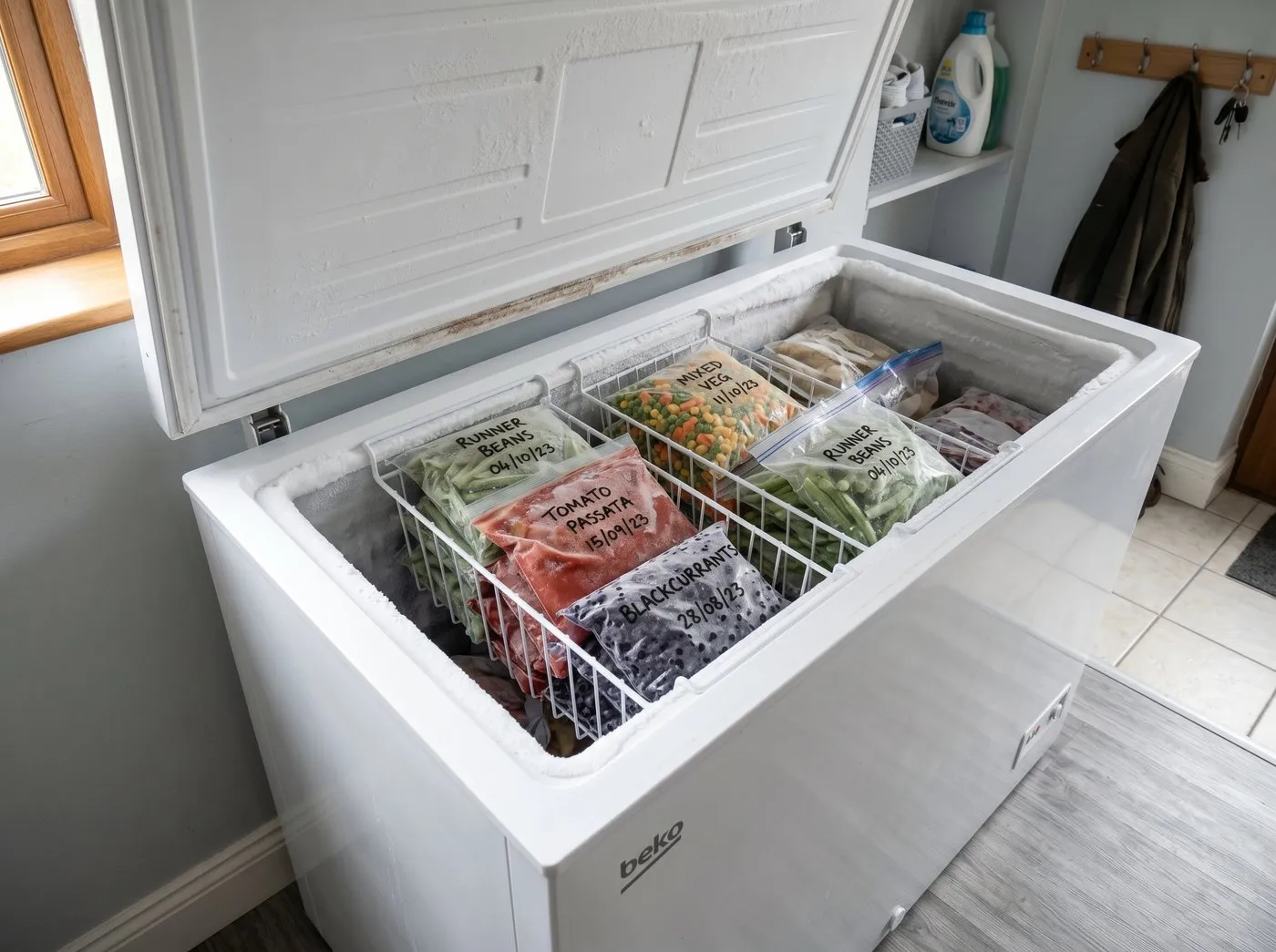 A 240-litre Beko chest freezer with hanging baskets and labelled bags. About £210 in 2026, holding the equivalent of 220 litres of usable space.
Running costs in 2026
Why chests cost less to run:
Cold air sinks. When the chest lid opens, cold air stays in the box. When the upright door opens, cold air pours out at floor level and warm air rushes in. The compressor then works harder to re-cool.
Better insulation per surface area. A chest has the smallest surface-area-to-volume ratio of any freezer shape. Less heat ingress means less compressor work.
Slower cycling. Modern uprights have automatic defrost cycles that warm the freezer briefly every 6-12 hours. Chest freezers usually have manual defrost - they run their compressor less often.
On Octopus Cosy tariff (averaging 22p/kWh), the chest costs about £35/year and the upright £46/year - the gap holds proportionally regardless of unit rate.
Power-cut performance
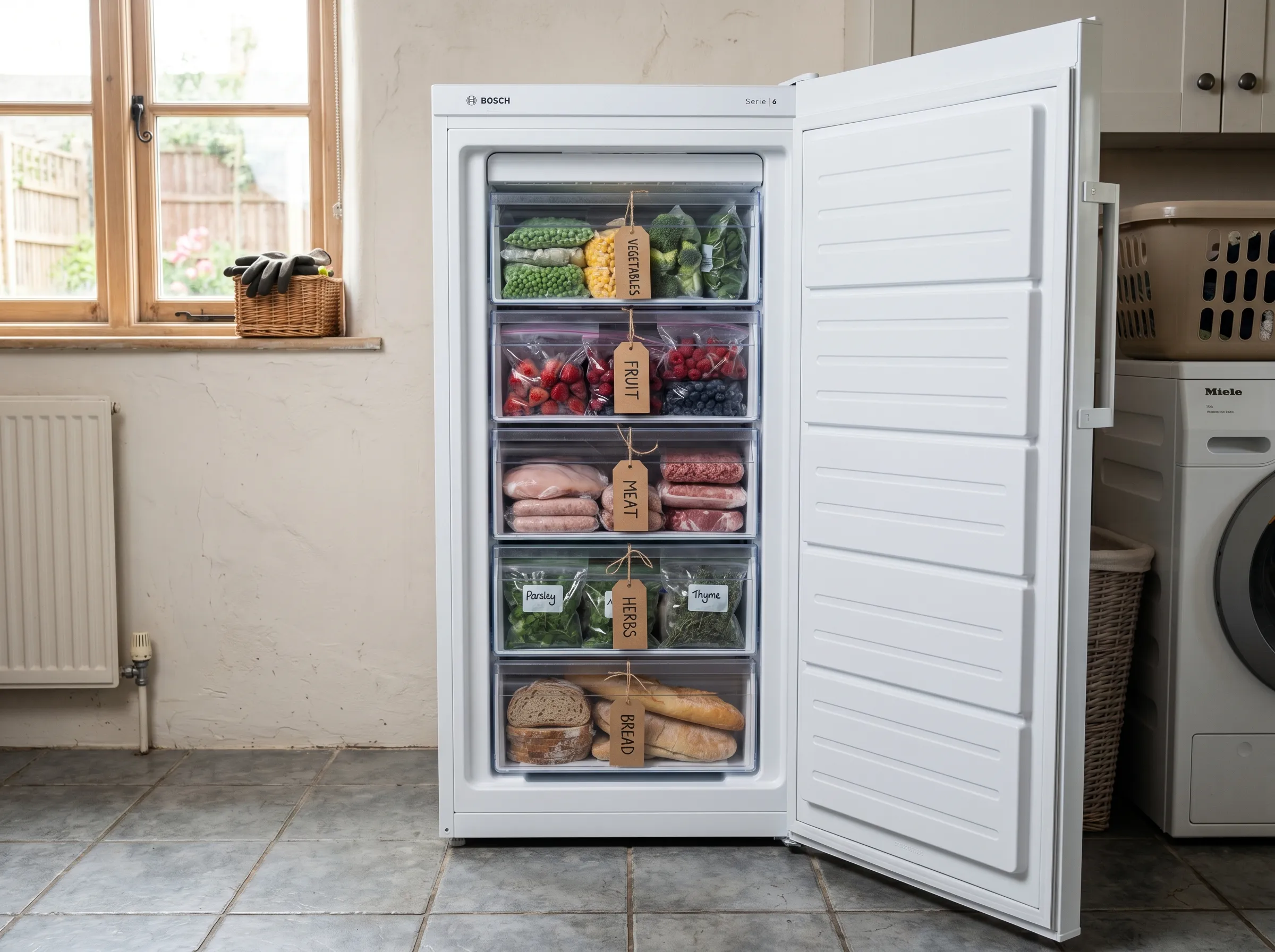 Upright freezer with labelled drawers - easier to find anything quickly, but cold air escapes every time the door opens.
Power cut hold times (full freezer, lid/door kept closed):
| Format | First 24hr | At 48hr | At 72hr |
|---|---|---|---|
| Chest (full) | -18C maintained | -10C (still safe) | -4C (use immediately) |
| Chest (half-full) | -15C | -5C | thawing |
| Upright (full) | -15C | thawing | thawed |
| Upright (half-full) | -10C | thawing | thawed |
A full chest gives 48-72 hours of safety; a full upright gives 24-36 hours. Half-fill anything and roughly halve the time.
Why chest holds better: the lid seal sits on top and gravity holds it closed. The upright door is held by a magnetic seal alone, and the seal-to-frame gap is the main heat ingress route once the compressor stops. Chest freezers also tend to be more heavily insulated since they need to handle higher ambient temperatures in garages.
Organisation
The upright wins this one outright. Drawers and shelves mean nothing gets lost. You see what you have without unpacking the whole freezer. Frozen produce stays in clear categories.
A chest freezer needs deliberate organisation to be usable:
- Use labelled wire baskets to divide the volume into sections.
- Bag in 250-500g portions with date and contents.
- Keep an inventory list on the lid - cross off as you use, add as you freeze.
- Group by category in vertical zones: vegetables in basket 1, fruit in basket 2, meat in basket 3, prepared meals in the lower volume.
Without organisation, a chest freezer becomes a glacier of mystery items at the bottom. The bottom 30% gets ignored and freezer-burned.
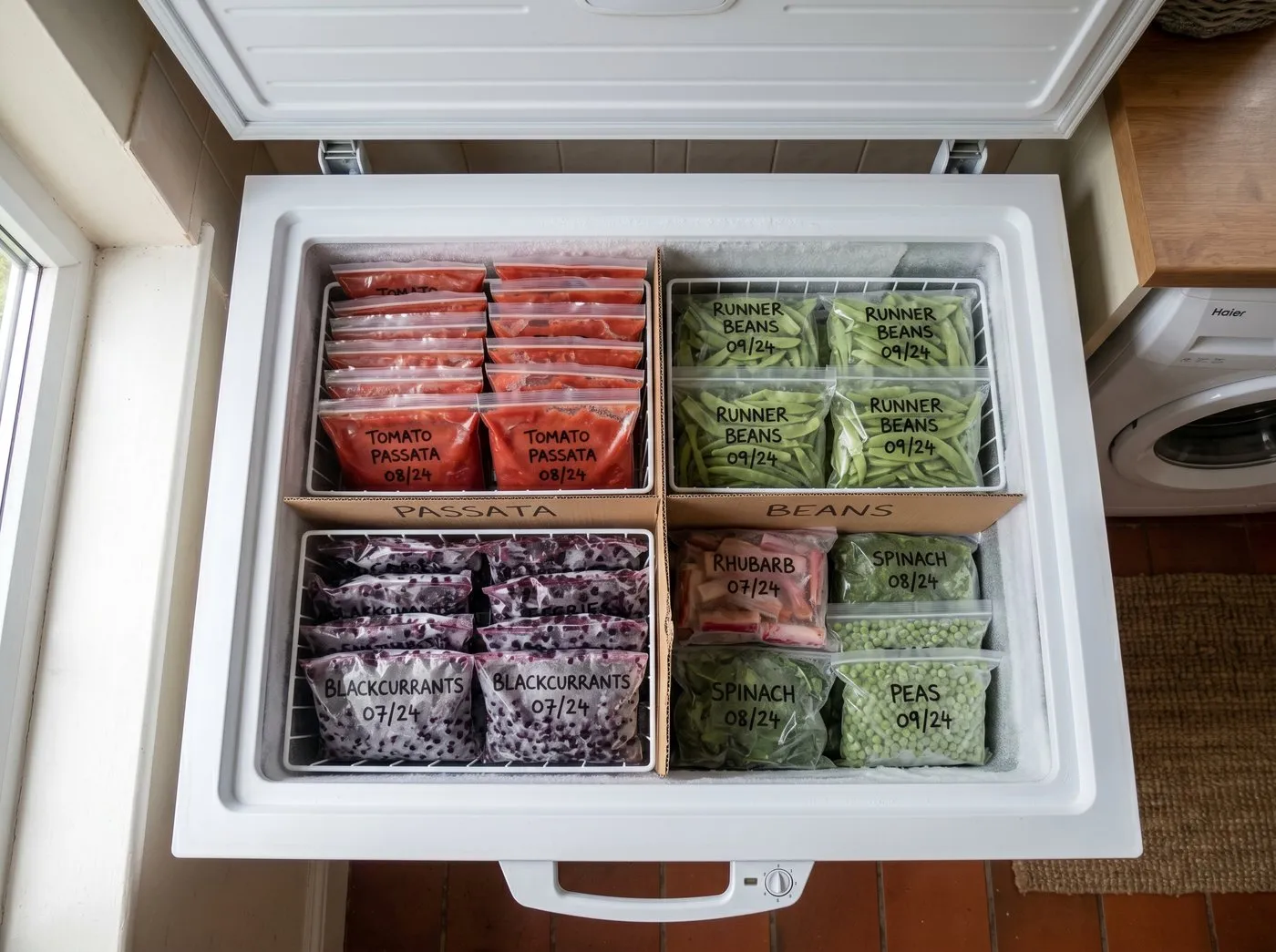 Labelled box system for chest freezer organisation - the single biggest factor in actually using what you store.
Volume and capacity per pound
For a kitchen gardener’s purpose - bulk preserving an allotment harvest - a chest delivers more usable storage per pound spent and per square metre of floor occupied.
Approximate annual freezer needs for a typical UK allotment:
| Crop | Annual yield | Frozen volume |
|---|---|---|
| Runner beans | 6kg | 12 litres |
| Broad beans | 4kg | 8 litres |
| Soft fruit (raspberries, currants) | 8kg | 16 litres |
| Tomato passata | 10 litres | 10 litres |
| Sweetcorn | 3kg cobs | 8 litres |
| Apple slices | 6kg | 12 litres |
| Herbs (cubes) | 3kg | 4 litres |
| Total | - | 70 litres |
Plus household food: meat (15 litres), batch cooked meals (20 litres), bread (10 litres), ice cream (5 litres) = roughly 50 litres for non-garden food.
Total realistic annual freezer use for an active kitchen gardener: 120 litres. A 200-litre chest holds this comfortably with headroom for surge weeks (apple harvest, soft fruit glut).
Climate class - the garage problem
A common UK issue: gardeners want to put the freezer in an unheated garage to free up kitchen space. The freezer’s climate class determines whether this works.
| Class | Operating range | Garage suitable? |
|---|---|---|
| SN | 10C to 32C | No - garages drop below 10C |
| N | 16C to 32C | No |
| ST | 18C to 38C | No |
| T | 16C to 43C | No |
| SN-T | 10C to 43C | Yes - widest range |
| N-T | 16C to 43C | Marginal |
For a UK garage, you need an SN-T or garage-rated freezer. The Beko CF374W tested here is SN-T rated and runs reliably down to 5C ambient in our Staffordshire garage. Below that the compressor stops and the contents start warming.
Some manufacturers (Hisense, Beko, Hotpoint) make specifically “garage-ready” models that work down to -15C ambient. Worth the £30-£50 premium if the freezer is going outside the heated envelope.
Defrost - manual vs automatic
Chest freezers are usually manual defrost. You unplug them once a year, take everything out, let ice melt, mop up. Annoying but cheap to run.
Upright freezers mostly have automatic frost-free systems. A heater inside the freezer warms briefly every 6-12 hours to vaporise ice from the evaporator coils. Convenient but adds 15-20% to energy use, and causes the contents to thaw slightly each cycle (the source of freezer burn over time).
A manual-defrost chest with well-bagged contents holds quality longer than an automatic upright. Both are usable.
Lifespan
| Format | Typical UK service life |
|---|---|
| Chest freezer | 15-20 years |
| Upright freezer | 12-15 years |
Chests last longer because:
- The lid seal is on top, sees little wear.
- Manual defrost models have fewer electronic components to fail.
- The compressor cycles less often.
Uprights fail most often at:
- Door seal (replaceable, £30-£50 parts).
- Defrost heater (£60-£100 parts plus labour).
- Thermostat board (£100-£200 plus labour).
Pick a chest if:
- You preserve an allotment harvest in autumn batches
- You have garage or utility-room space
- You want lowest running costs
- Power cuts in your area are a real concern
Pick an upright if:
- You use the freezer daily for cooking
- Floor space is tight and you have kitchen depth
- You hate sorting through boxes
- You shop in small frequent batches
Pick both if:
- You can. Chest for bulk harvest, upright for weekly use. Total cost about £530 in 2026, total running cost about £103/year. The split is what most active allotment holders end up with.
For a single freezer on a budget, the chest wins on every metric except convenience. For day-to-day cooking, the upright is much pleasanter to live with.
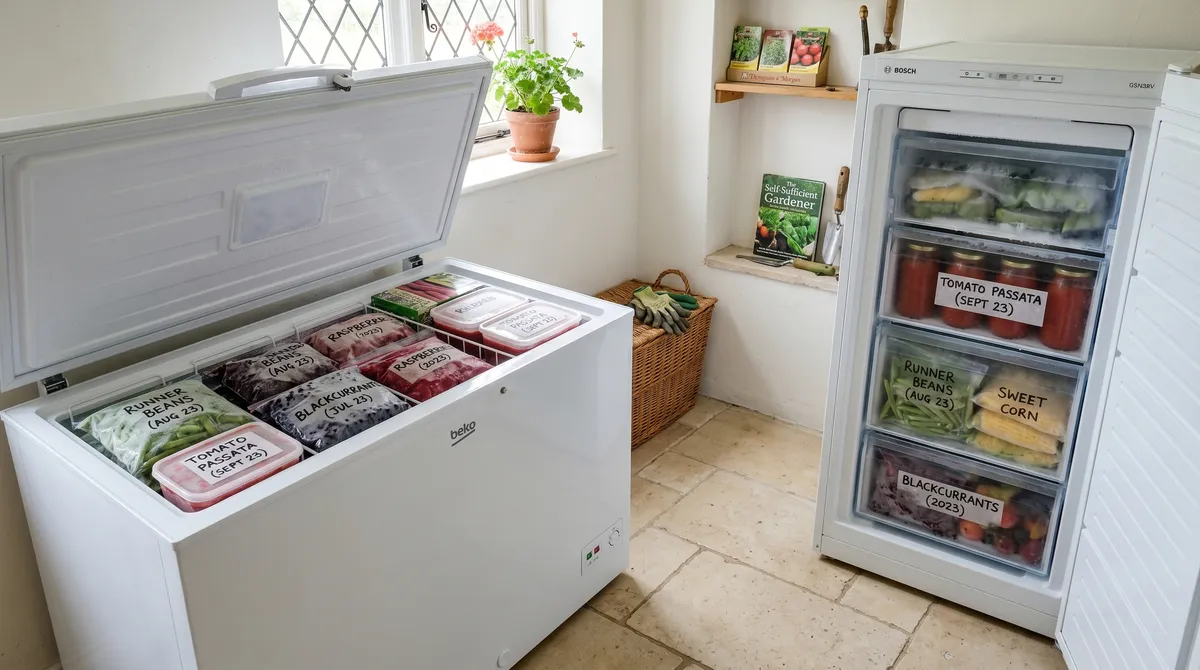
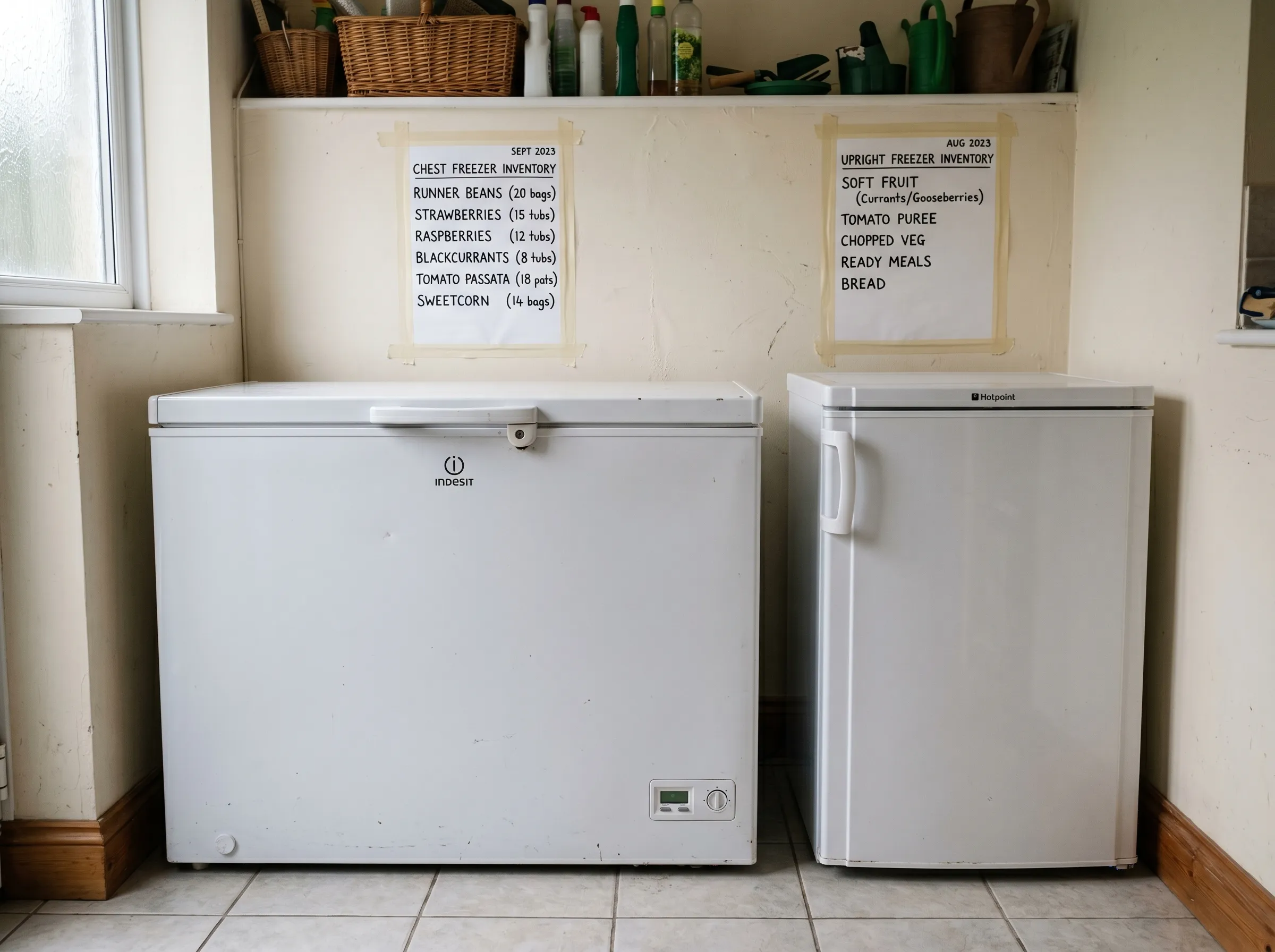 The combined setup - chest for bulk harvest, upright for daily kitchen use. About £530 total cost in 2026 for 440 litres of storage.
Maintenance basics
Both formats need:
- Annual defrost (manual models) - one full day, contents into a coolbox.
- Coil cleaning at the back every 6 months - dust on condenser coils adds 10-15% to running costs.
- Seal inspection every year - a £5 piece of paper test (close door on paper, try to pull paper out; if it slides easily, the seal needs replacing).
- Half-load minimum - empty freezers cost more to run because air has lower thermal mass than frozen food. Fill empty space with bottles of water if storing little.
Field note: The Energy Saving Trust freezer guide lists energy ratings, climate classes and 2026 UK efficiency standards.
Bagging and packing - the make-or-break detail
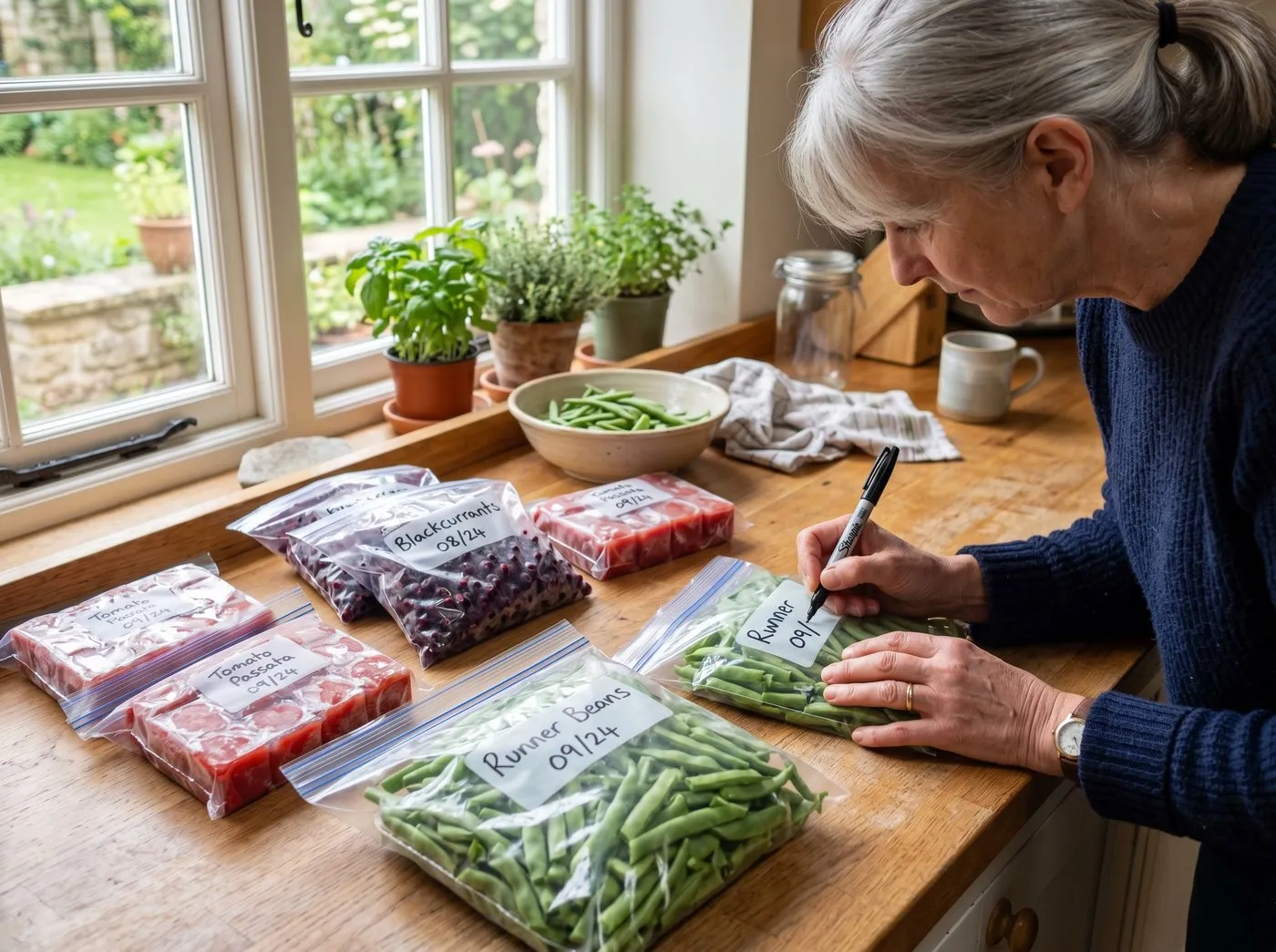 Bagging and labelling - 250-500g per bag, lay flat to freeze, stack once solid. Wire freezer baskets cost £8-£12 each and pay back in usability within weeks.
A chest freezer with well-bagged contents in labelled boxes is the most efficient kitchen-garden storage system there is. A chest freezer with loose bags piled on top of each other is a frozen midden.
Standard pack for everything: 250-500g per bag, labelled with name and date, lying flat to freeze, then stacked. Wire freezer baskets cost £8-£12 each and pay back in usability within weeks.
For herbs specifically, the frozen cubes from our how to dry and store herbs guide go in a labelled shoebox-sized container at the top of the chest where you can find them.
Now you’ve chosen the format
Our team produces practical UK gardening guidance from source research, contributor records and established horticultural practice. Editorial standards are overseen by Matt W.