Key takeaways
- Gypsum works only on sodic clay - rare in the UK
- Standard UK clay shows no measurable benefit from gypsum
- Bulky organic matter is 4-5x more effective on UK clay
- Application rate if used: 1-2kg per square metre
- Gypsum can supply calcium to lime-shy crops without changing pH
- Save your money for compost, manure or leafmould instead
Gypsum (calcium sulphate) is widely sold in UK garden centres as a “clay breaker” - a powdered mineral that supposedly transforms heavy soil into workable loam. The truth is more complicated. Gypsum genuinely improves one specific type of clay (sodic clay, common in Australia and parts of the US Midwest, rare in the UK). On standard UK non-sodic clay it does very little.
For the underlying soil improvement approaches that genuinely work in UK gardens, see our how to improve clay soil and no-dig gardening guide UK articles.
What gypsum actually is
Gypsum is calcium sulphate dihydrate (CaSO4.2H2O) - a soft, naturally occurring mineral. Garden-grade gypsum is mined from sedimentary deposits or recycled from industrial sources (desulphurisation gypsum from coal-fired power stations).
Key properties for gardeners:
| Property | Value |
|---|---|
| Calcium content | 22% Ca |
| Sulphur content | 16% S |
| Solubility | 2.4g/L (slightly soluble) |
| pH effect | Neutral - does not change pH |
| Typical UK retail | £6-£10 per 10kg bag |
The pH-neutrality is the only feature that distinguishes gypsum from lime. Lime (calcium carbonate or calcium hydroxide) supplies calcium AND raises pH. Gypsum supplies calcium without raising pH. That makes gypsum useful when you need calcium but want to keep soil pH the same - for example, supplying calcium to a tomato bed that’s already at the right pH.
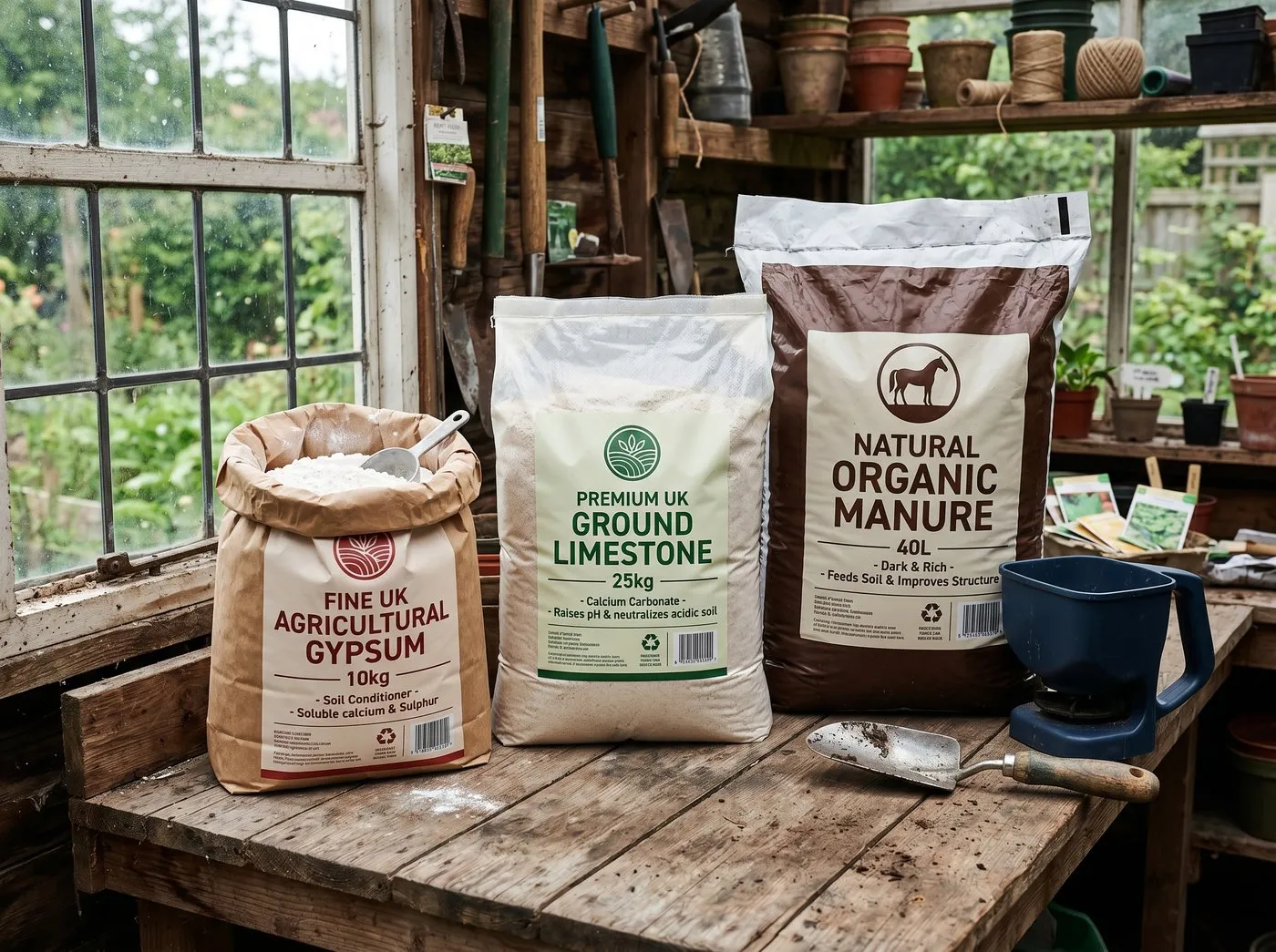 Gypsum, lime and bulky organic matter - three soil amendments that do different jobs. Gypsum supplies calcium without changing pH; lime raises pH and supplies calcium; organic matter improves everything else.
How gypsum is supposed to work
The clay-breaker claim rests on cation exchange chemistry.
Clay particles are tiny, negatively-charged flakes that bind to positively-charged ions (cations) - calcium, magnesium, potassium, sodium, hydrogen, aluminium. The cations sitting on the clay surface affect how the clay flakes hold together.
- When clay surfaces are dominated by calcium (the normal state in UK clay), the flakes stick together loosely. The soil forms small crumbs that drain well and hold air.
- When clay surfaces are dominated by sodium (sodic soil), the flakes disperse and slump into an impermeable mass that drains poorly and lacks air.
Gypsum’s mechanism: the dissolved calcium ions displace sodium ions on the clay surface, restoring the calcium-dominated crumb structure. This is a textbook case of cation exchange and it works dramatically well on sodic soils.
The catch - UK soils are almost never sodic
Sodic soils are widespread in Australia, arid regions of the US, and the Indo-Gangetic plain. They are formed where sodium accumulates in the soil from low rainfall, irrigation with brackish water, or coastal salt deposition.
In the UK:
- Annual rainfall (900-1,500mm in most regions) leaches sodium out of soil profiles within 1-2 years.
- Irrigation water is typically mains-supply or rainwater - low sodium.
- Only narrow coastal saltmarsh areas have genuinely sodic soils.
Routine UK soil tests show sodium contents typically of 30-90ppm and exchangeable sodium percentages (ESP) of 0.5-2%. The threshold for sodic soil is ESP above 6 or sodium above 500ppm. Almost no UK garden soil ever reaches that threshold.
Result: the cation exchange mechanism gypsum relies on is not the binding mechanism in UK clay. Adding gypsum to UK clay just adds calcium to a soil that already has plenty of calcium.
Four paired 1m² plots:
- Plot 1: Gypsum at 1kg/m² each spring
- Plot 2: Compost at 5kg/m² each spring
- Plot 3: Both gypsum and compost
- Plot 4: Control (no amendment)
Measurements at end of year 3 (April 2024):
| Plot | Hand-fork drop test (cm) | Worm count per 30x30cm | Organic matter % |
|---|---|---|---|
| 1 (gypsum) | 8 (similar to control) | 4 | 2.4% |
| 2 (compost) | 22 (deep, soft) | 18 | 5.8% |
| 3 (both) | 23 (deep, soft) | 19 | 5.9% |
| 4 (control) | 7 | 3 | 2.3% |
Conclusion: the compost did the work. The gypsum did nothing measurable on top of what the compost achieved. Plot 1 (gypsum alone) was indistinguishable from plot 4 (control).
This matches the broader research literature. Trials by ADAS, the RHS and the University of Reading have all found gypsum delivers no consistent structural improvement on UK non-sodic clays.
When gypsum genuinely helps UK gardeners
Three specific situations where gypsum earns its place in UK gardens:
1. Lime-shy crops needing calcium
Some crops crash at high pH but need calcium for cell-wall strength. Tomatoes, peppers, potatoes and blueberries are classic examples. Gypsum supplies calcium without raising pH.
A handful (about 30g) of gypsum mixed into each tomato or pepper planting hole prevents calcium-deficiency blossom end rot without changing pH. This is the single most common UK home-garden use of gypsum.
2. Coastal gardens after salt damage
After a winter storm pushes seawater inland, coastal beds can become temporarily sodic. Gypsum at 2-3kg/m² works to flush sodium out of the root zone. Apply within 2-3 weeks of the salt event and water in heavily. This is the one UK setting where gypsum’s classical mechanism applies.
3. Subsoil where organic matter is impractical
Around the bases of mature trees or in deep flower borders where you cannot dig in compost, a top-dressing of gypsum at 1kg/m² provides calcium and slowly improves the top 5cm of soil. Marginal benefit but cheaper than nothing.
What works on UK clay instead
For everyone except those three edge cases, save the gypsum money and invest in bulky organic matter:
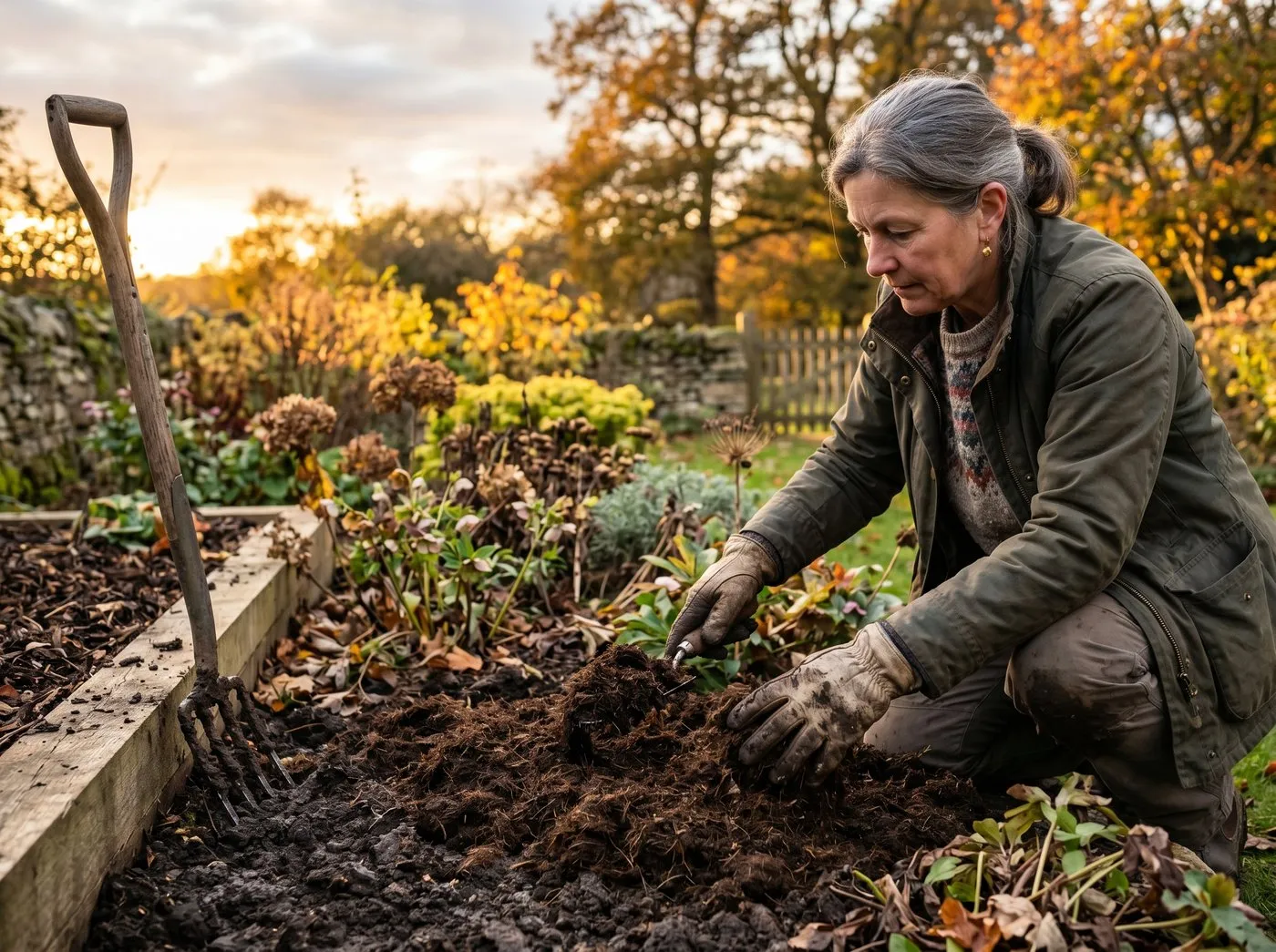 The treatment that genuinely works - 50-70mm of mature compost or well-rotted manure spread on the surface in autumn. Worms incorporate it through winter. Year-on-year, the structure transforms.
Compost or well-rotted manure (5-7kg/m² annually)
The single highest-value treatment for UK clay. Spread 50-70mm thick as a surface mulch in autumn. Earthworms drag the organic matter into the soil through winter, building structure from below.
Expect 3 years of annual application before the soil transforms from heavy clay to easy-working dark loam.
Leafmould (3-5kg/m² annually)
Free if you make it. Slower-acting than compost but excellent for water retention and soil biology. See our how to make leaf mould UK guide.
Green manures (winter cover crops)
Sow phacelia, field beans or grazing rye in autumn after summer crops finish. Dig in or chop and drop in spring. Roots break up the clay subsoil; foliage builds organic matter. See our green manures and cover crops UK guide.
Sharp grit (5l/m², one-off application)
A one-time application of 5l/m² of horticultural grit dug into the top 20cm helps the very worst clay subsoils drain. Not a substitute for organic matter but useful for the foundation pass on a new bed.
No-dig method
The single most effective long-term clay improvement. Stop digging. Pile compost on top each year. Let worms and roots do the structural work. After 3-5 years even Staffordshire boulder clay becomes friable. See our no-dig heavy clay soil UK guide.
Application rates - the gypsum cheat sheet
If you decide to use gypsum on your UK garden for any of the legitimate reasons:
| Use case | Application rate | When |
|---|---|---|
| Tomato/pepper planting hole | 30g per plant | At planting |
| Calcium top-up for veg bed | 100g per m² | Spring |
| Coastal salt recovery | 2-3kg per m² | Within 3 weeks of salt event |
| Subsoil top-dressing | 1kg per m² | Autumn |
| Sodic clay restoration | 5kg per m² | Autumn, repeat year 2 |
Always work into the top 15cm rather than leaving on the surface. Water in heavily after application - gypsum is only slightly soluble and needs moisture to dissolve into the soil profile.
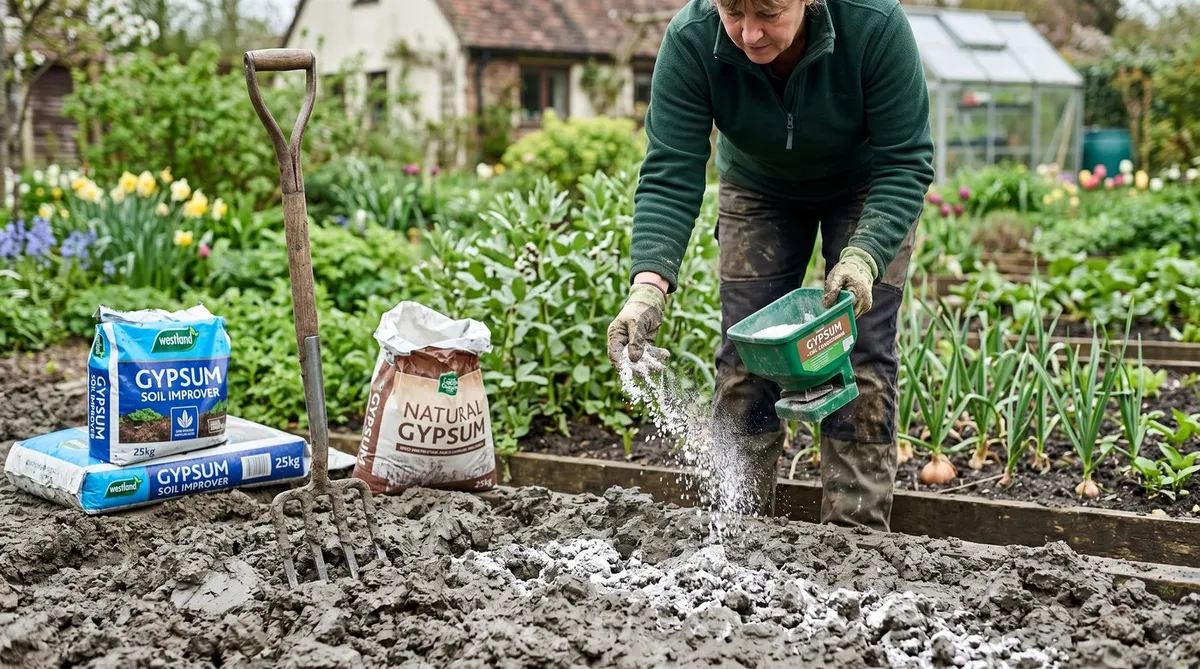
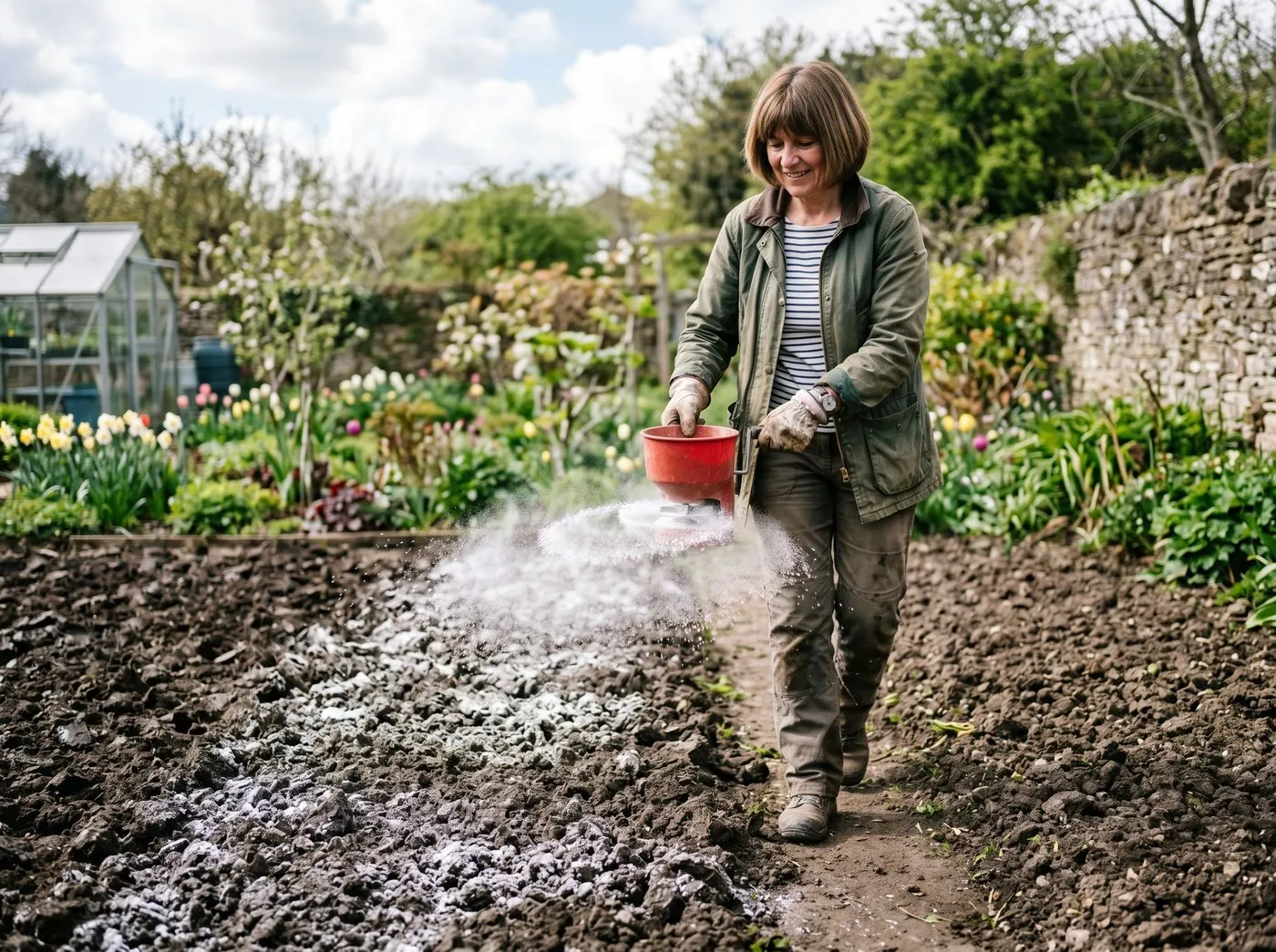 Application at 1kg/m² - hand-spread evenly, rake in, water heavily. For the few UK use cases where gypsum is the right tool, this is the technique.
Gypsum vs lime - the comparison
A common confusion. Both are calcium minerals; they do different jobs.
| Property | Gypsum (CaSO4) | Lime (CaCO3) |
|---|---|---|
| pH effect | Neutral | Raises pH |
| Calcium delivery | Yes | Yes |
| Sulphur delivery | Yes (16%) | No |
| Best on acid soil | No (use lime) | Yes |
| Best on neutral soil | Sometimes | No (would alkalise) |
| Cost per kg of Ca | £2.70/kg Ca | £0.45/kg Ca |
| UK availability | Garden centres | Garden centres + agricultural suppliers |
For raising pH on acid UK soil, lime is 6x cheaper per kg of calcium delivered. Only use gypsum when you specifically need calcium without pH change.
Other clay-breaker products to avoid
UK garden centres sell several products marketed as clay improvers. Most under-deliver:
- Clay-breaker pellets (organic + clay-flocculating salts): expensive, marginal results. Same money in bulk compost works 5x better.
- Polyacrylamide soil conditioners: laboratory effective but expensive at garden scale. Not cost-effective vs organic matter.
- Liquid clay-breakers: typically water-soluble calcium chloride or polysaccharides. Effect is short-lived. Organic matter wins again.
The pattern: any clay-breaker product gets outperformed by 5-7kg/m² of mature compost applied annually.
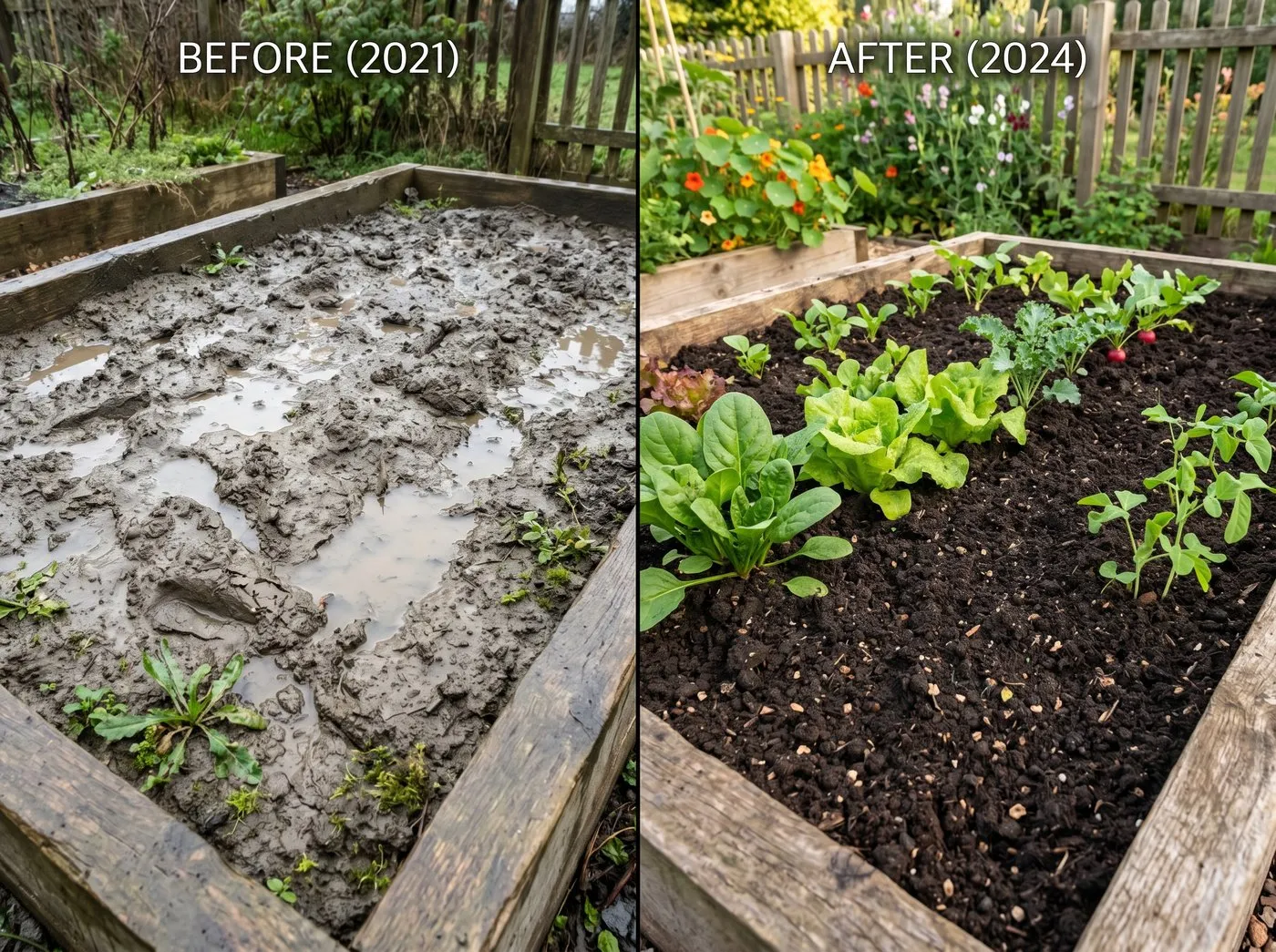 Year zero vs year three - the transformation that comes from annual organic matter rather than gypsum. Worms and microbes do the structural work.
The free way to break clay - cover crops and worms
The cheapest UK clay-improvement method involves no purchased product:
- Sow phacelia or grazing rye in autumn after summer crops finish. Seed cost: about £5 per 100m².
- Chop down and leave on surface in spring when stems reach 30cm.
- Plant straight through the residue with no-dig method.
- Add a layer of free homemade compost in autumn.
After 3 years, soil structure transforms. Cost: a packet of seed and time. Worms do the rest - a healthy UK clay garden hosts 200-500 earthworms per square metre once organic matter is regularly available.
Field note: The RHS soil and soil amendment guidance covers UK soil types and treatments. For lab testing, Plowright Soils and NRM offer postal testing for £25-£40 that includes cation exchange capacity and exchangeable sodium - the data you need to know if gypsum would help.
For 95% of UK gardeners on standard non-sodic clay, gypsum is the wrong tool. Save the £10-£20 per year and put it into bagged compost or well-rotted manure. The difference at year 3 will be visible from across the garden.
For the 5% with coastal salt issues, lime-shy calcium-demanding crops, or specific sub-soil cases, gypsum has a place - at modest application rates, alongside organic matter rather than instead of it.
Now you know what works on UK clay
For the broader picture of improving heavy soil, our how to improve clay soil, no-dig gardening guide UK and what is mulch and how to use it guides cover the techniques that genuinely transform UK soil over 3-5 years.
Our team produces practical UK gardening guidance from source research, contributor records and established horticultural practice. Editorial standards are overseen by Matt W.