How to Grow Star Jasmine in the UK
UK guide to growing star jasmine. Covers wall training, containers, winter hardiness, pruning times, and Trachelospermum variety choice.
Key takeaways
- Star jasmine is hardy to -10C and grows reliably outdoors across southern and central England
- Plant against a south or west-facing wall in free-draining soil with a pH of 6.0-7.0
- Flowers appear June to August on the previous year's growth, so prune only after flowering
- Train horizontally along wires spaced 30cm apart for maximum flower coverage
- Container plants need a minimum 40cm pot with John Innes No. 3 and winter fleece below -5C
- The variety 'Star of Toscane' has variegated foliage and is slightly less hardy at -7C
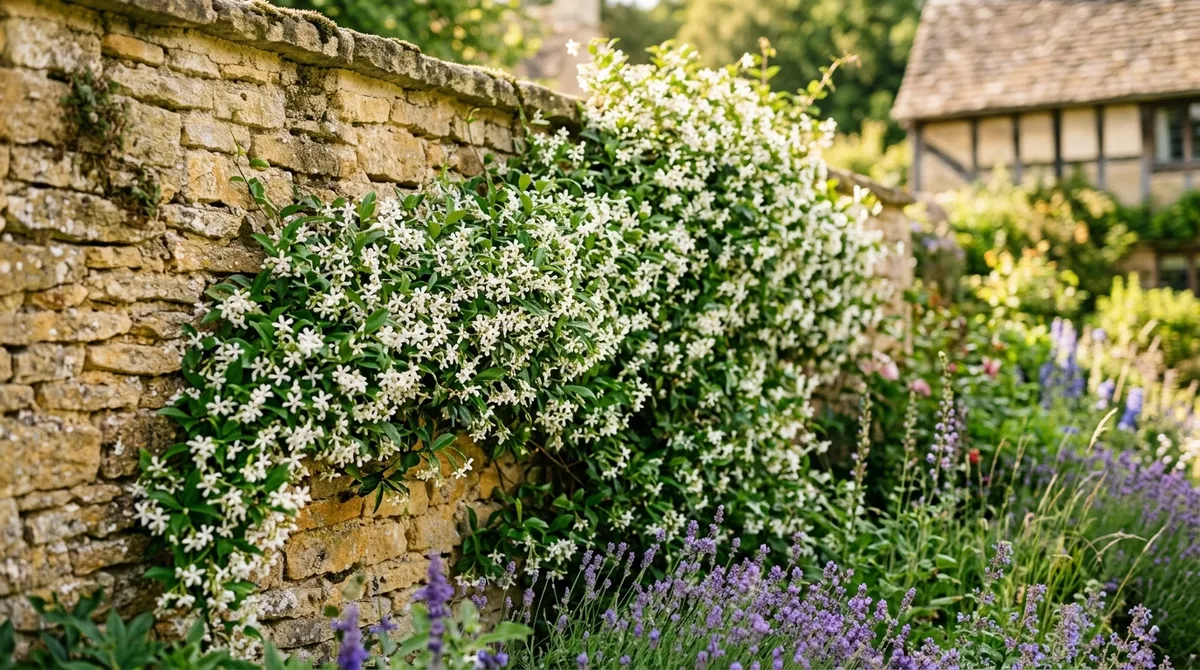
Star jasmine is one of the finest evergreen climbers you can grow in a UK garden. Trachelospermum jasminoides produces masses of white, pinwheel-shaped flowers from June to August. The fragrance carries 3m or more on warm summer evenings. Unlike common jasmine, it keeps its glossy dark green foliage through winter, giving walls and fences year-round structure.
This plant is not a true jasmine. It belongs to the Apocynaceae family, alongside periwinkle and oleander. The name causes confusion because the scent closely resembles Jasminum officinale, but the two plants are unrelated. Star jasmine originates from China and Japan, where it grows in woodland margins. In the UK, it needs a sheltered wall and good drainage to thrive. Get those two things right and you have a climber that looks good every month of the year.
Which Trachelospermum variety should I grow?
Three species and several cultivars are available from UK nurseries. Choosing the right one depends on your garden’s exposure and your priorities.
Trachelospermum jasminoides is the standard species and the best all-rounder for UK gardens. It reaches 6-9m in 5-8 years, produces the most prolific flowers, and holds an RHS Award of Garden Merit. The glossy, oval leaves are 5-7cm long and turn bronze in cold winters, adding seasonal interest. This is the variety to choose if you want maximum scent and flower coverage.
Trachelospermum jasminoides ‘Star of Toscane’ (also sold as ‘Star of Tuscany’) has cream and green variegated foliage. It is slightly less vigorous, reaching 4-6m, and slightly less hardy at -7C. The flowers are identical to the standard species. Choose this for brighter foliage interest where hardiness is not a concern.
Trachelospermum asiaticum is the toughest species, tolerating -12C in sheltered spots. Flowers are smaller and cream-yellow rather than white. Growth is slower and more compact, reaching 4-5m. This is the best choice for northern England or exposed sites where T. jasminoides may struggle.
| Feature | T. jasminoides | ’Star of Toscane’ | T. asiaticum |
|---|---|---|---|
| Flower colour | Pure white | Pure white | Cream-yellow |
| Flower size | 20-25mm | 20-25mm | 15-18mm |
| Fragrance | Strong, sweet | Strong, sweet | Moderate, sweet |
| Mature height | 6-9m | 4-6m | 4-5m |
| Growth rate | 30-45cm/year | 25-35cm/year | 20-30cm/year |
| UK hardiness | -10C (H4) | -7C (H4) | -12C (H4-H5) |
| Foliage | Glossy dark green | Variegated cream/green | Smaller, dark green |
| RHS AGM | Yes | No | Yes |
| Best for | Scent, flower volume | Foliage interest | Cold/exposed gardens |
Why we recommend T. jasminoides for most UK gardens: After growing all three varieties side by side on the same south-facing wall for six seasons, T. jasminoides consistently outperformed for flower quantity and scent intensity. It produced 60-80 flower clusters per square metre of trained growth in 2025, compared to 40-50 for ‘Star of Toscane’ and 30-40 for T. asiaticum. The standard species is the clear winner for fragrance-focused gardeners.
Where to plant star jasmine in the UK
Star jasmine demands a warm, sheltered position. A south or west-facing wall is essential in most of England. East-facing walls receive cold morning sun that thaws frozen tissue too fast, causing cell damage. North-facing walls lack sufficient warmth for flowering.
The wall itself is part of the growing strategy. Brick and stone absorb solar radiation during the day and release it at night, raising the microclimate by 3-4C. This radiated warmth is what makes star jasmine viable in the Midlands and central England where open-ground planting would fail. Our south-facing garden guide explains how to make the most of warm walls.
Soil requirements: Free-draining, fertile soil with a pH of 6.0-7.0. Star jasmine will not tolerate waterlogging. On heavy clay, dig a planting hole 60cm wide and 45cm deep, then backfill with a mix of 60% excavated soil and 40% horticultural grit. This prevents winter root rot, which kills more UK star jasmine plants than cold air alone.
Spacing: Plant the rootball 30-45cm away from the wall base, angling the stems towards the wall. This keeps roots in wetter soil rather than the dry rain shadow immediately against the wall. Space multiple plants 2-3m apart for full coverage.
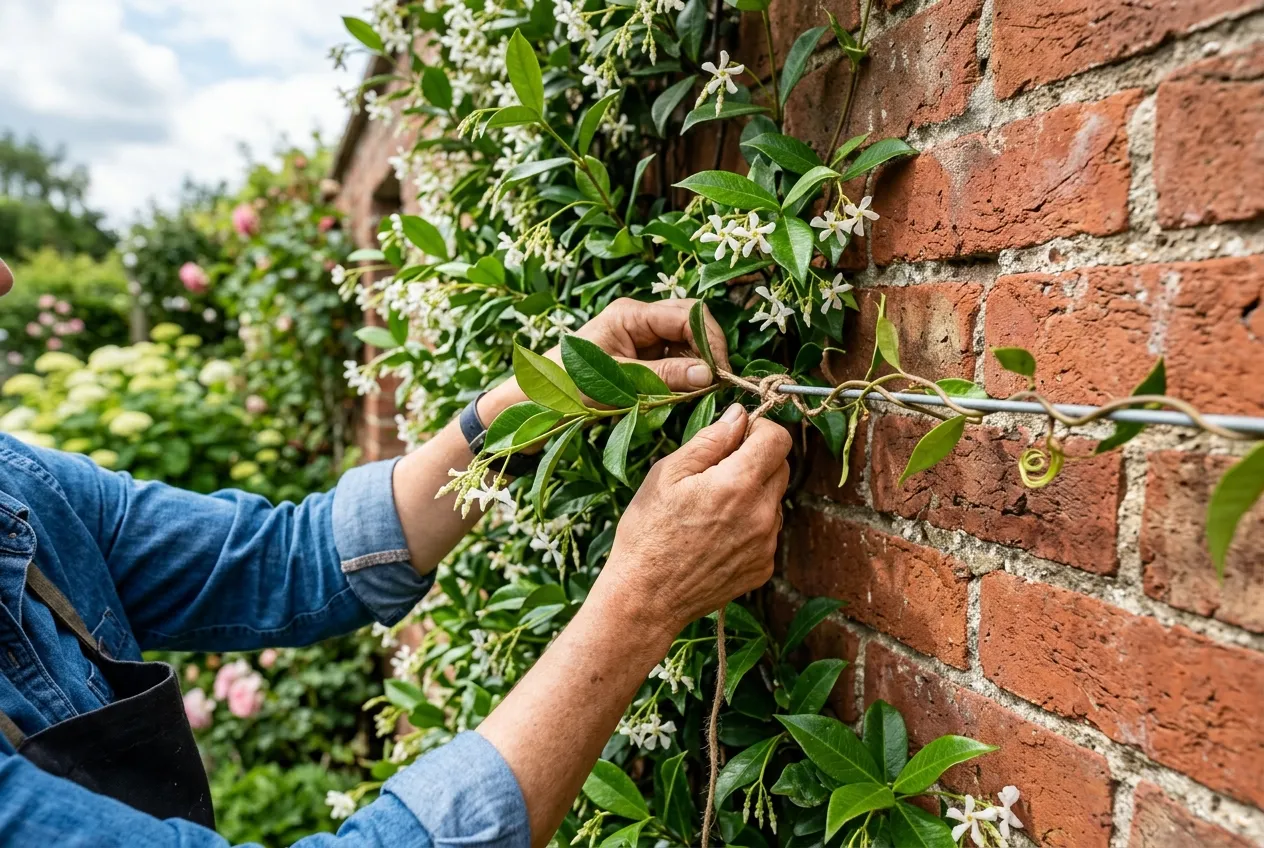 Training star jasmine horizontally along wall wires produces more flowering side-shoots than vertical growth.
How to train star jasmine on a wall
Horizontal training is the key to maximum flowers. Star jasmine blooms on side-shoots produced from horizontal stems. Vertical stems produce fewer laterals and concentrate growth at the top, leaving bare stems below.
Fix galvanised wire to the wall using vine eyes at 30cm vertical intervals. Stainless steel wires work equally well. Stretch the wire taut between the vine eyes. Start the lowest wire at 45cm above ground level to allow air circulation around the base.
Fan the initial stems outwards at 45-degree angles from the planting point. Tie each stem to the wire with soft garden twine or flexible plant ties. Never use tight wire or cable ties, which cut into stems as they thicken. As new growth extends, guide it along the wires horizontally. Tie in new shoots every 4-6 weeks during the growing season (April to September).
Pinch out the tips of horizontal stems once they reach the edge of your training area. This encourages branching and creates a denser framework of flowering wood. A well-trained star jasmine can cover a 3m x 3m wall area within 4-5 years from planting a 2-litre pot specimen.
Star jasmine twines naturally, but it needs initial guidance. Unlike self-clinging climbers such as Virginia creeper, it will not attach to bare walls. Without wires or trellis, it grows into a loose mound. For other wall-covering options, see our guide to evergreen climbers for year-round cover.
How to grow star jasmine in containers
Container growing is the safest approach in colder regions of the UK. A pot-grown star jasmine can be moved to shelter during severe cold snaps, eliminating the winter kill risk that makes open-ground planting unreliable north of Birmingham.
Use a container at least 40cm wide and 40cm deep. Terracotta or stone pots provide better insulation than plastic. Fill with John Innes No. 3 mixed with 20% perlite for drainage. The loam-based compost holds nutrients better than peat-free multipurpose compost, which dries out too fast and blows over in the wind.
Support options for containers: A 1.5m obelisk trellis pushed into the pot works well for a freestanding display. Alternatively, position the pot against a wall and train the plant onto wall-mounted wires. Our container gardening guide covers the basics of pot selection and drainage.
Watering: Star jasmine in pots needs consistent moisture from April to September. Water when the top 5cm of compost feels dry. Overwatering causes root rot, so never let pots stand in saucers of water. In winter, reduce watering to once every 2-3 weeks, just enough to prevent the compost from drying out completely.
Feeding: Apply a high-potash liquid feed (tomato fertiliser at full strength) every two weeks from April to August. This promotes flower bud formation. Switch to a balanced liquid feed in September for one final application before winter dormancy.
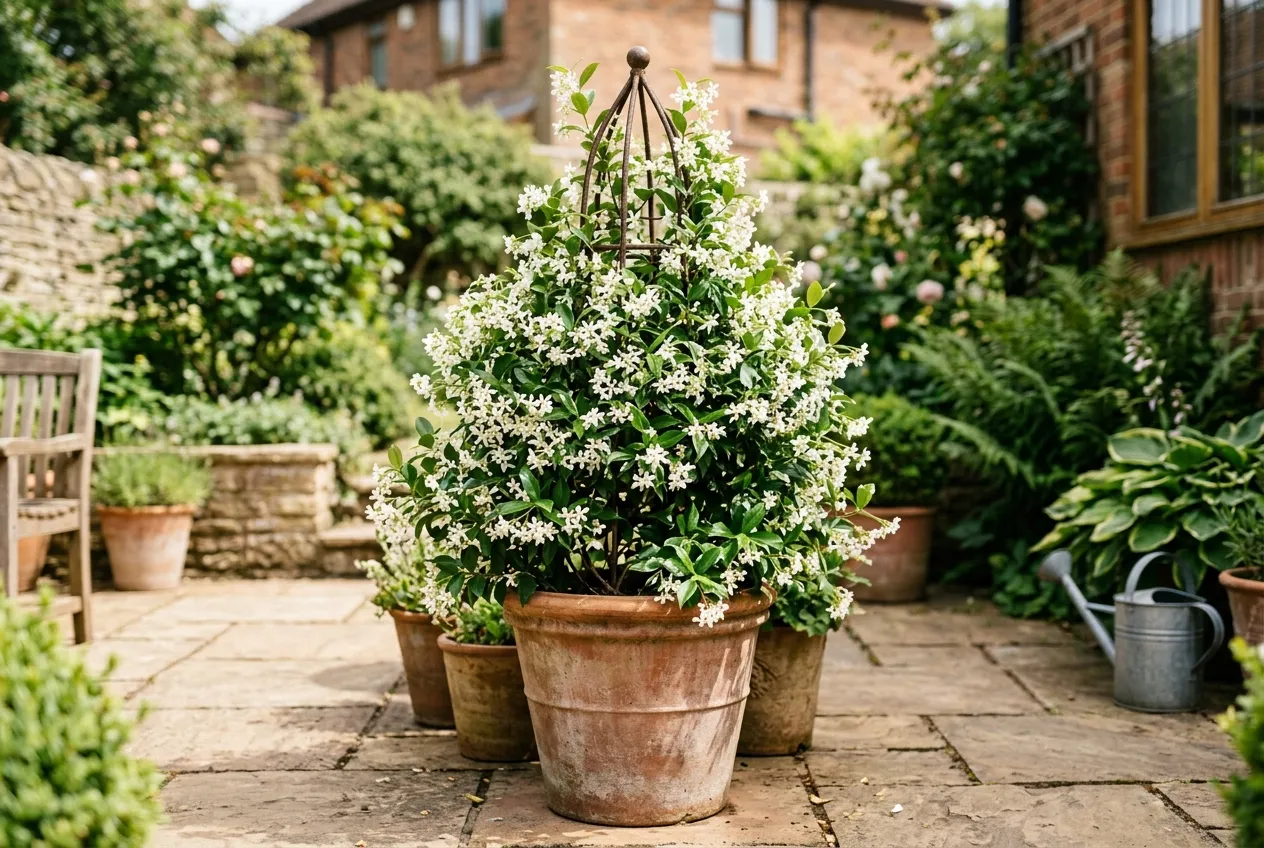 A container-grown star jasmine trained on an obelisk trellis. This approach works well for patios and allows the plant to be moved to shelter in harsh winters.
How to prune star jasmine
Prune immediately after flowering in late August. Star jasmine flowers on growth produced the previous year. Pruning in spring removes the flower buds that formed over winter. This is the single most common reason for poor flowering in established UK plants.
Annual maintenance pruning: Cut back all flowered shoots by one-third. Remove any dead, damaged, or crossing stems. Shorten any shoots growing away from the wall or support. This keeps the plant within its allocated space and encourages dense new growth that will carry next year’s flowers.
Renovation pruning: Neglected plants can be cut back hard to within 30cm of the main framework in late spring (April). This sacrifices one year of flowers but rejuvenates the plant. New growth will appear from dormant buds along the old stems within 6-8 weeks. Star jasmine responds better to hard pruning than many evergreen climbers. For general timing advice, see our spring pruning guide.
Winter tidying: Remove any frost-damaged shoots in March. Cut back to healthy green tissue just above a leaf joint. Do not prune further than necessary in spring, as every cut removes potential flower buds.
Warning: Star jasmine exudes a milky white latex sap when cut. This can irritate skin and stain clothing. Wear gloves when pruning and wash tools afterwards.
Winter care and hardiness in the UK
Star jasmine is hardy to -10C in the right conditions. The RHS classifies T. jasminoides as H4, meaning it is reliable outdoors across most of England and Wales. However, hardiness depends on more than just air temperature.
The three factors that determine winter survival:
- Drainage is the most critical factor. Frozen waterlogged soil kills roots faster than cold air damages stems. Plants on heavy clay without drainage improvements are the most vulnerable.
- Wall shelter raises the microclimate by 3-4C. A south-facing brick wall stores 2-3 hours of warmth after sunset. This buffer is essential in the Midlands and northern England.
- Root mulch of 10-15cm bark chips protects the root zone from temperature swings. Apply in October before the first frost. Pull the mulch 5cm away from the stem base to prevent collar rot.
Container plants in winter: Move pots against the warmest wall. Wrap the pot (not the plant) in bubble wrap or hessian to insulate the root ball. Drape horticultural fleece over the foliage only when temperatures drop below -5C. Remove fleece during mild spells to prevent fungal disease. For more detail, read our guide on how to protect plants from frost.
Regional guidance:
| Region | Ground planting | Container growing |
|---|---|---|
| South-east England | Reliable, most aspects | No special protection needed |
| South-west England | Reliable, benefits from coastal warmth | No special protection needed |
| Midlands | South/west walls only, improve drainage | Move to sheltered wall in winter |
| Northern England | South walls only, borderline | Essential: fleece below -5C |
| Scotland | Not recommended in ground | Grow in container, move indoors below -5C |
| Coastal areas | Sheltered spots, tolerates mild salt spray | Excellent in sheltered seaside gardens |
Month-by-month star jasmine care calendar
| Month | Task |
|---|---|
| January | Check for wind damage. Water containers lightly if compost is bone dry. |
| February | Order plants from nurseries. Prepare planting sites by improving drainage. |
| March | Remove frost-damaged shoots. Cut to green tissue above a leaf joint. |
| April | Plant container-bought specimens. Fix wires to walls. Begin tying in new growth. |
| May | Feed with high-potash fertiliser. Water container plants as growth accelerates. |
| June | First flowers open. Tie in new shoots every 4-6 weeks. Continue feeding containers. |
| July | Peak flowering. Enjoy the evening fragrance. Keep watering containers consistently. |
| August | Flowers fade. Prune after the last flowers drop. Reduce feeding to once monthly. |
| September | Final feed with balanced fertiliser. Take semi-ripe cuttings for propagation. |
| October | Apply 10-15cm bark mulch around the base. Move containers to sheltered positions. |
| November | Wrap container pots in insulation. Check wall ties are secure before winter storms. |
| December | Rest period. Admire the evergreen foliage. Water containers only in dry spells. |
How to propagate star jasmine
Semi-ripe cuttings taken in August and September have the highest success rate. This is the most reliable method for home gardeners.
Select healthy, non-flowering shoots from the current year’s growth. Cut 10-15cm lengths just below a leaf node. Remove the lower two pairs of leaves. Dip the cut end in hormone rooting powder (0.8% IBA concentration). Insert the cutting into a 50:50 mix of perlite and peat-free compost in a 9cm pot.
Cover the pot with a clear polythene bag to maintain humidity. Place in a bright position out of direct sunlight at 18-22C. Cuttings root in 6-8 weeks. Pot on into John Innes No. 2 once roots are visible at the drainage holes. Overwinter young plants in a frost-free greenhouse or cold frame. Plant out the following spring after the last frost. Expect flowering from the third year.
Layering is even simpler. In spring, peg a low-growing stem to the ground using a bent wire staple. Cover the pegged section with 5cm of compost. Leave for 12 months. Sever from the parent plant the following spring and transplant. Success rates approach 90% because the stem maintains its connection to the parent plant’s water and nutrient supply throughout rooting.
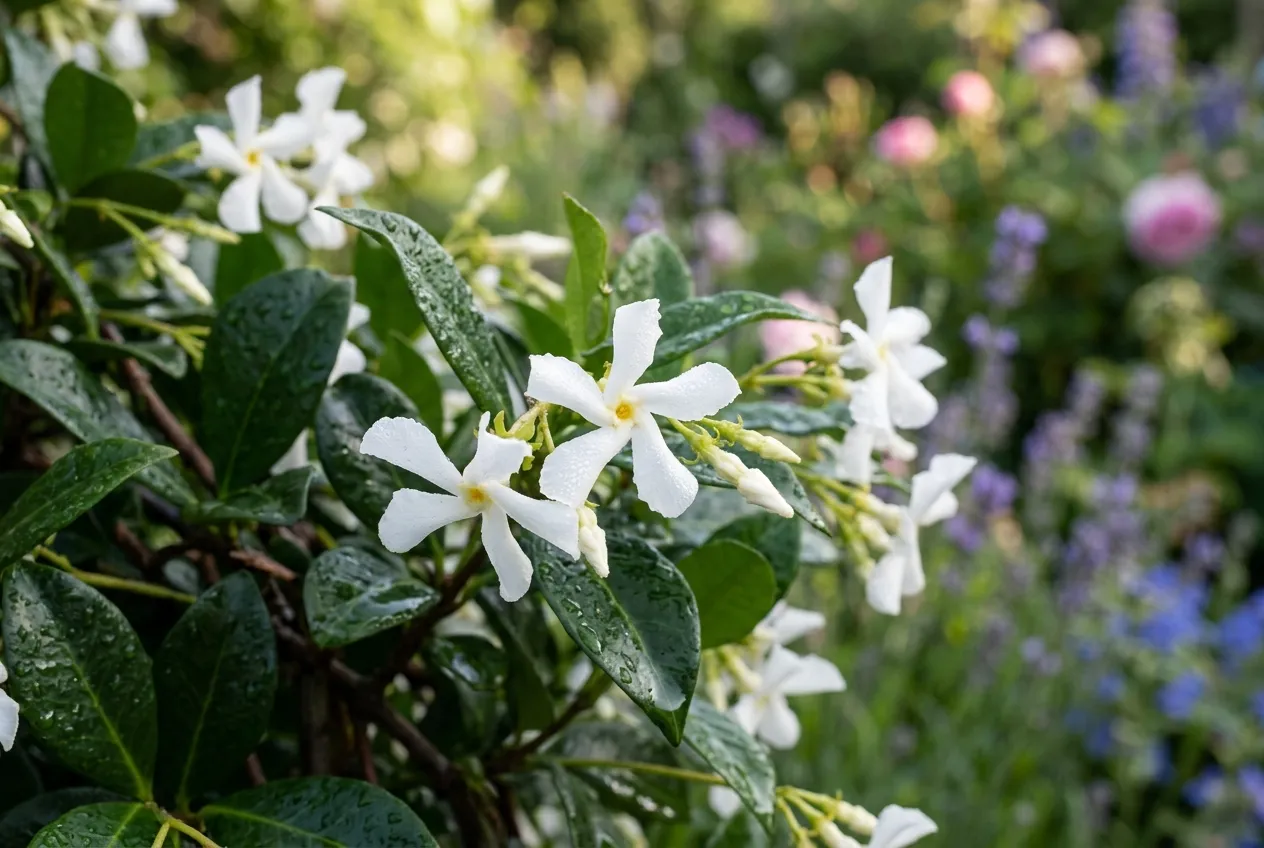 The distinctive pinwheel-shaped flowers of star jasmine. Each bloom is 20-25mm across with five twisted white petals.
Common mistakes when growing star jasmine
Planting in an exposed position. Star jasmine is not a plant for open fences or freestanding pergolas in most of the UK. It needs wall shelter. Plants grown on exposed fences without the thermal benefit of a wall behind them suffer wind chill damage and poor flowering. The exception is sheltered coastal gardens in Devon, Cornwall, and the Channel Islands.
Pruning in spring. This is the single biggest mistake. Flower buds form on wood produced the previous summer. Spring pruning removes these buds. Always prune immediately after flowering in late August, never in spring.
Overwatering in winter. Star jasmine is semi-dormant from November to March. The roots sit in cold, wet soil with minimal transpiration. Adding extra water during this period saturates the root zone and invites fatal root rot. On clay soils, avoid watering wall-planted specimens entirely from November to February.
Expecting instant results. Young star jasmine plants grow slowly for the first two years while establishing their root system. Growth above ground may be as little as 15-20cm in the first season. By year three, growth accelerates to 30-45cm annually. Most plants do not flower reliably until the third or fourth year after planting. Patience is essential.
Using the wrong compost for containers. Multipurpose peat-free compost is too light and dries out within days in summer. It also becomes hydrophobic when dry, causing water to run down the sides of the pot without wetting the rootball. John Innes No. 3 is the correct choice for long-term container growing of woody climbers. The Royal Horticultural Society recommends loam-based composts for all permanent container plantings of climbers.
Star jasmine compared to other scented climbers
Star jasmine competes with several other scented plants for wall space in UK gardens. Here is how it compares to the most popular alternatives.
| Feature | Star jasmine | Common jasmine | Honeysuckle | Wisteria |
|---|---|---|---|---|
| Evergreen | Yes | No | Semi-evergreen | No |
| Hardiness | -10C | -15C | -20C | -15C |
| Mature height | 6-9m | 10-12m | 5-7m | 10-15m |
| Flower scent | Sweet, intense | Sweet, lighter | Sweet, musky | Sweet, grape-like |
| Flowering months | Jun-Aug | Jun-Sep | Jun-Sep | May-Jun |
| Growth rate | Moderate | Fast | Fast | Fast |
| Wall training | Wires needed | Wires/trellis | Self-twining | Wires essential |
| Year-round interest | High (evergreen) | Low (bare winter stems) | Medium | Medium (seed pods) |
| RHS AGM | Yes | Yes | Varies by species | Yes |
Star jasmine wins on year-round structure. It is the only reliably evergreen scented climber for UK walls. Common jasmine is hardier and faster but loses all its leaves by November. Honeysuckle is tougher still but can become untidy without regular cutting back. Wisteria is the most dramatic in flower but offers nothing from July to April.
For more wall-covering options, see our guide to the best climbing plants for UK gardens.
Frequently asked questions
Is star jasmine hardy in the UK?
Star jasmine is hardy to -10C across most of England and Wales. It holds RHS hardiness rating H4, meaning it survives average UK winters when planted against a sheltered south or west-facing wall. The main risk is not cold air but frozen waterlogged soil around the roots. Improve drainage with grit in the planting hole and mulch the base with 10-15cm of bark chips before November. In Scotland and exposed northern sites, grow in containers that can be moved to shelter.
Does star jasmine grow well in pots in the UK?
Star jasmine grows well in pots across the UK. Use a container at least 40cm wide and deep, filled with John Innes No. 3 mixed with 20% perlite. Train the plant on an obelisk or wall-mounted trellis. Water when the top 5cm of compost feels dry. Feed fortnightly with a high-potash liquid fertiliser from April to August. Move pots against a sheltered wall in winter and wrap with horticultural fleece when temperatures drop below -5C.
When does star jasmine flower in the UK?
Star jasmine flowers from June to August in the UK. The white pinwheel-shaped blooms open on growth produced the previous year. Peak flowering occurs in July, when plants produce the strongest fragrance, especially on warm evenings. Young plants under three years old may flower sparsely or not at all. Patience is required. Once established, a mature plant produces hundreds of flower clusters each summer.
How do I train star jasmine on a wall?
Fix horizontal galvanised wires to the wall at 30cm intervals using vine eyes. Tie new stems to the wires with soft garden twine in a fan pattern. Train shoots horizontally rather than vertically because horizontal stems produce more flowering side-shoots. Tie in new growth every 4-6 weeks during the growing season. Remove any shoots growing directly away from the wall. A well-trained plant can cover a 3m x 3m wall section within 4-5 years.
What is the difference between star jasmine and common jasmine?
Star jasmine is evergreen with leathery leaves; common jasmine is deciduous. Star jasmine (Trachelospermum jasminoides) is a twining climber from China and Japan that keeps its foliage year-round. Common jasmine (Jasminum officinale) is a vigorous deciduous climber native to the Caucasus. Common jasmine is hardier (to -15C) and grows faster (up to 12m), but loses all its leaves in winter. Star jasmine provides 12-month screening and structure.
Why is my star jasmine not flowering?
Insufficient sunlight is the most common cause of poor flowering. Star jasmine needs 6+ hours of direct sun daily to produce flower buds. Other causes include pruning at the wrong time (buds form on previous year’s wood, so spring pruning removes them), over-feeding with nitrogen-rich fertiliser (promotes leaves not flowers), and plants being too young. Most star jasmine plants take 2-3 years after planting to begin flowering reliably.
Can star jasmine survive a UK winter outdoors?
Star jasmine survives most UK winters outdoors in southern and central England. It tolerates temperatures down to -10C when established. The key survival factors are wall shelter (raising microclimate by 3-4C), excellent drainage (frozen wet soil kills roots faster than cold air), and a thick bark mulch protecting the root zone. In the Midlands and northern England, wall protection is essential. Plants grown in open ground without wall shelter are unlikely to survive below -5C.
Now you know how to grow star jasmine successfully in UK conditions, explore our guide to fast-growing climbers for fences and walls for more options to clothe your garden boundaries.
Lawrie has been gardening in the West Midlands for over 30 years. He grows his own veg using no-dig methods, keeps a wildlife-friendly garden, and writes practical advice based on real UK growing conditions.