How to Grow Zinnias in the UK
Learn how to grow zinnias in the UK from seed. Covers elegans, haageana, and marylandica types, sowing dates, pinching, deadheading, and cut flower care.
Key takeaways
- Sow indoors from mid-March at 20-24C. Seeds germinate in 5-7 days and resent root disturbance
- Pinch the growing tip at 15cm tall to double the number of flowering stems
- Zinnia elegans is the best species for cutting, reaching 60-90cm with blooms up to 12cm across
- Zinnia haageana (Persian Carpet) is compact at 25-40cm, ideal for pots and border fronts
- Deadhead every 3-4 days to sustain flowering from July until the first October frost
- Zinnias need full sun (6+ hours), warmth, and shelter from wind. They will not tolerate cold, wet soil
Zinnias are one of the most rewarding half-hardy annuals to grow in the UK. These Mexican natives deliver bold, vivid colour from July through to the first frost, producing 30-50 cut flower stems per plant when pinched and deadheaded properly.
Despite their tropical origins, zinnias thrive in UK summers. The key is warmth at every stage. Sow indoors from mid-March at 20-24C, harden off carefully, and plant into warm soil after the last frost. Get these three steps right and you will have armfuls of flowers from midsummer onwards. This guide covers every stage from seed to vase, drawing on three seasons of trials on Staffordshire clay.
Which type of zinnia should I grow?
Three zinnia species matter for UK gardeners. Each has a different habit, flower form, and best use. Choosing the right species determines whether your zinnias end up as cut flowers, border fillers, or container highlights.
Zinnia elegans is the tall, large-flowered species that most people picture when they think of zinnias. Plants reach 60-90cm with fully double blooms measuring 8-12cm across. This is the species grown commercially for floristry. Flower forms include dahlia-flowered, cactus-flowered, and pompom types. Colours span white, cream, yellow, orange, coral, pink, magenta, red, and lime green. Elegans is the best choice for a cutting garden.
Zinnia haageana (Mexican zinnia) is a compact, bushy plant reaching 25-40cm. It produces smaller single or semi-double flowers in warm bicolour tones of red, gold, and mahogany. The variety ‘Persian Carpet’ is the most widely grown haageana and produces masses of 4-5cm flowers on branching stems. This species handles wind better than elegans and suits the front of mixed borders and containers.
Zinnia marylandica is a hybrid between elegans and angustifolia. It combines the flower size of elegans (5-7cm) with the disease resistance and weather tolerance of the smaller species. The ‘Zahara’ and ‘Profusion’ series are marylandica hybrids and are the most reliable zinnias for exposed UK gardens. Plants reach 25-45cm and shrug off powdery mildew.
| Feature | Zinnia elegans | Zinnia haageana | Zinnia marylandica |
|---|---|---|---|
| Height | 60-90cm | 25-40cm | 25-45cm |
| Flower size | 8-12cm | 4-5cm | 5-7cm |
| Flower form | Double, cactus, pompom | Single, semi-double bicolour | Single to semi-double |
| Best for | Cut flowers, back of border | Pots, border fronts, edging | Exposed sites, low maintenance |
| Mildew resistance | Low to moderate | Moderate | High |
| Stems per plant | 30-50 (pinched) | 40-60 | 35-50 |
| Colours | All except blue | Red, gold, mahogany bicolours | Orange, red, yellow, white, cherry |
| Seed cost (approx.) | £2-4 per packet | £2-3 per packet | £3-5 per packet |
| UK availability | Widely available | Moderate | Good (Zahara, Profusion) |
Why we recommend growing all three: After trialling 14 varieties across three Staffordshire seasons, the elegans types gave the best cut flowers, haageana filled gaps at the border front beautifully, and the marylandica hybrids survived a wet August in 2024 that destroyed most of the elegans plants with mildew. Growing all three gives you both quality and resilience.
How to sow zinnia seeds indoors
Zinnias germinate fast but hate root disturbance. This is the single most important fact for UK growers. Always sow into individual modules or 9cm pots, never into seed trays that require pricking out.
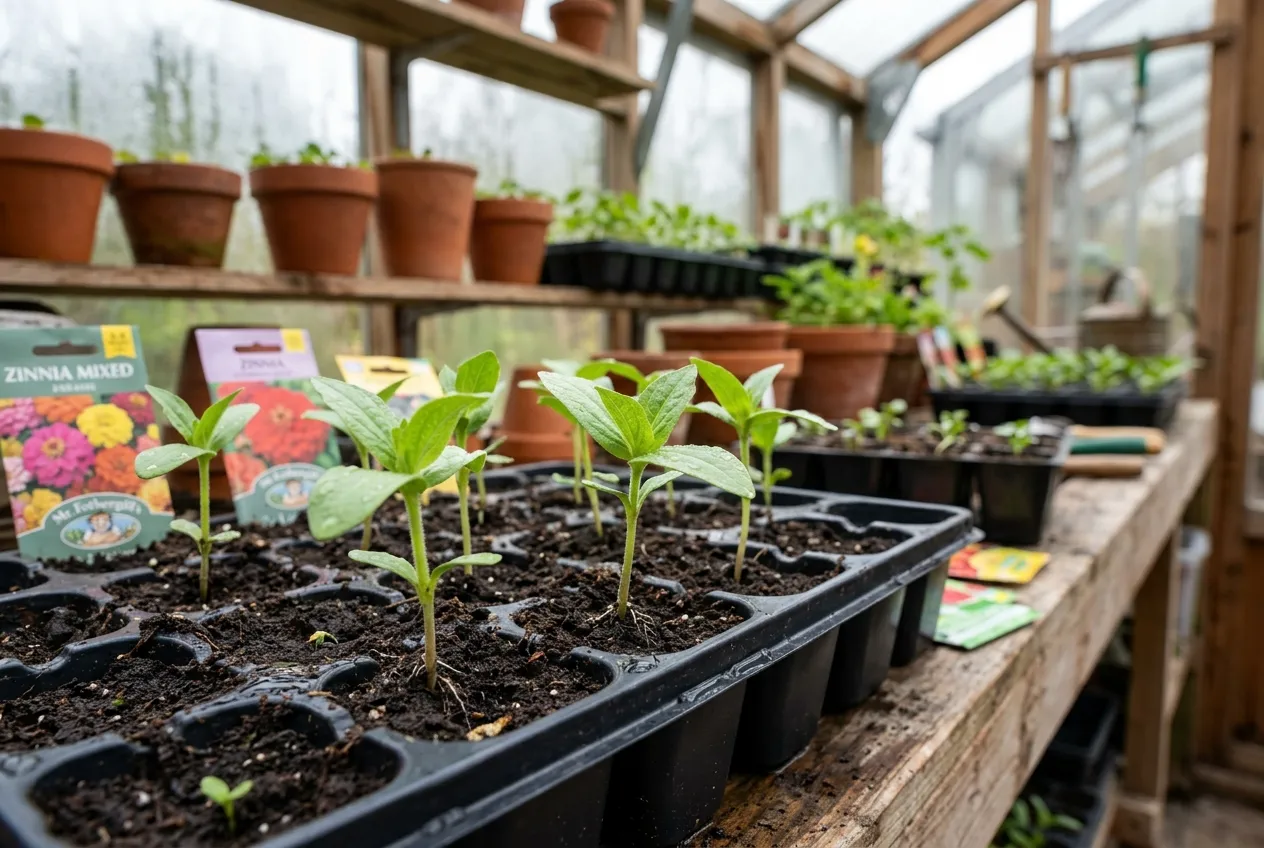 Zinnia seedlings at 3-4 weeks old showing their first true leaves. Sow one seed per module to avoid root disturbance at planting-out time.
Timing: Sow from mid-March to mid-April. Earlier sowings need supplementary light. Later sowings catch up fast in warm conditions. Our guide to sowing seeds indoors covers the general technique in detail.
Method: Fill modules or 9cm pots with multipurpose compost mixed with 20% perlite for drainage. Push one seed per cell 6-8mm deep. Water from below by standing trays in 2cm of tepid water for 10 minutes. Cover with a clear lid or cling film. Place in a heated propagator or warm spot at 20-24C. Seeds germinate in 5-7 days.
After germination: Remove covers immediately once seedlings emerge. Move to the brightest position available. A south-facing windowsill provides 6-8 hours of light in March, but zinnias ideally need 14-16 hours. Supplementary grow lights positioned 10-15cm above the plants prevent leggy growth. Reduce temperature to 18-20C once true leaves appear.
Feeding seedlings: Begin liquid feeding at quarter strength when the first pair of true leaves opens, roughly 10-14 days after germination. Use a balanced feed (NPK 10-10-10) weekly. Switch to a high-potash feed (tomato fertiliser) once flower buds form.
How to harden off and plant out zinnias
Zinnias are half-hardy. Any frost kills them outright. Never plant out before the last frost date for your area, which is typically late May in southern England and early to mid-June in the Midlands, northern England, and Scotland.
Hardening off takes 10-14 days. Begin by placing seedlings outdoors in a sheltered spot for 2 hours on the first day. Increase by 1-2 hours daily. Bring indoors every night for the first week. By day 10, leave them out overnight if temperatures stay above 8C. Our hardening off guide covers the full process.
Soil preparation: Zinnias need full sun (minimum 6 hours direct) and free-draining soil. On heavy clay, dig in 5-10 litres of horticultural grit per square metre. Work in a handful of garden compost per planting hole. The ideal soil pH is 5.5-7.5. Avoid wet, shaded positions entirely.
Warming the soil: On cold, heavy ground, lay black polythene over the planting area for two weeks before planting. This raises soil temperature by 3-5C. In our Staffordshire trial, plants in warmed soil grew 40% faster in the first three weeks and flowered 10 days earlier than those in unwarmed clay.
Spacing: Plant elegans varieties 30-40cm apart. Plant haageana and marylandica 25-30cm apart. Water in well with 2 litres per plant. Mulch around plants with 5cm of bark or compost to retain moisture, but keep mulch 5cm clear of the stem to prevent rot.
How to pinch zinnias for more flowers
Pinching is the single most effective technique for increasing zinnia yields. Pinch the central growing tip when seedlings reach 15cm tall. This removes apical dominance, the hormonal signal from the lead shoot that suppresses side branching.
Pinch cleanly with your fingernails or a sharp pair of snips just above a leaf pair. Two or more side shoots will emerge from the leaf nodes below within 5-7 days. Each side shoot develops its own terminal flower bud. A pinched zinnia elegans typically produces 30-50 flowering stems over the season. An unpinched plant produces 15-20 stems with one dominant central bloom.
The trade-off: Pinching delays the first flowers by 7-10 days. The central bud you remove would have been the earliest bloom. But the total flower count more than doubles, and stem length on side shoots reaches 30-45cm, ideal for cutting. If you want the earliest possible blooms for summer flower displays, leave a few plants unpinched and pinch the rest.
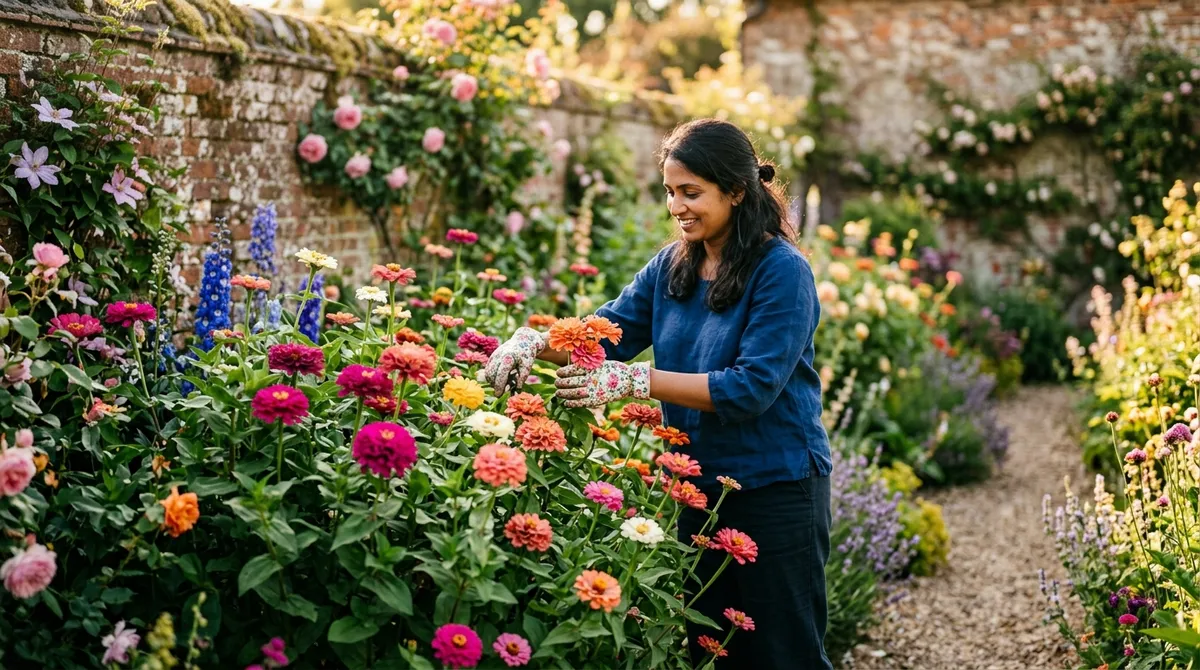
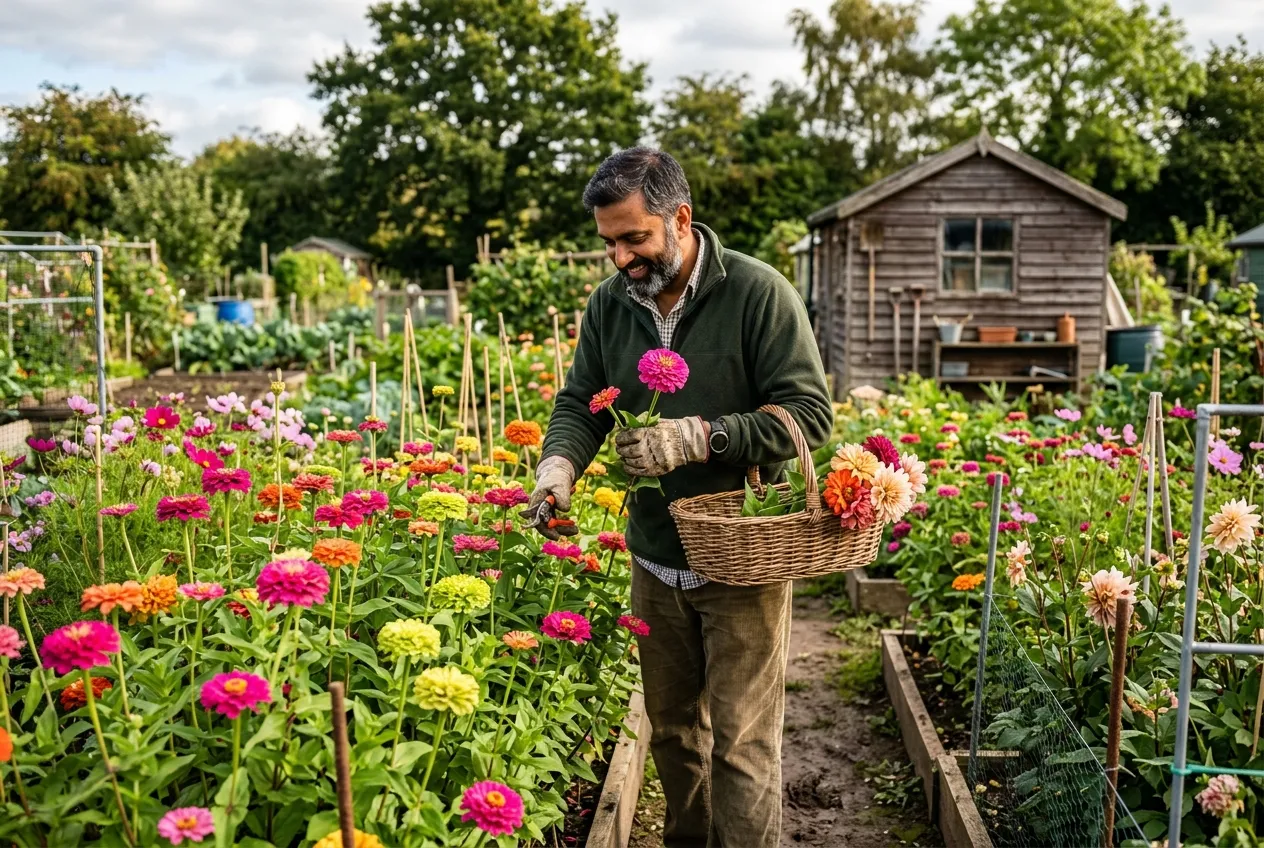 A cutting garden with rows of Zinnia elegans in full production. Cut stems when the first row of petals opens fully for the longest vase life.
How to deadhead zinnias properly
Deadhead every 3-4 days throughout the flowering season. Zinnias are programmed to set seed. Once a flower head matures and begins to form seed, the plant diverts energy away from new buds. Regular deadheading keeps the plant in flowering mode from July until the first frost.
Where to cut: Follow the spent flower stem down to the first set of strong leaves. Cut just above this leaf pair. New shoots will emerge from these leaf nodes within a week. Never snap stems by hand because the ragged wound invites botrytis (grey mould). Use clean, sharp secateurs or scissors.
For cut flowers: Cut stems when the first row of petals has fully opened and the centre of the flower still feels firm. Stems cut at this stage last 7-10 days in a vase. Our guide to conditioning cut flowers covers the post-harvest treatment that maximises vase life. Strip all foliage below the waterline and change the water every 2 days.
Seed saving: In September, stop deadheading and allow 3-5 of the best flower heads to mature fully on the plant. The heads are ready when the petals have dried and the base feels papery. Cut the whole head, hang upside down in a dry, airy room for 2 weeks, then rub out the arrow-shaped seeds. Store in a labelled paper envelope. Properly stored zinnia seed remains viable for 3-5 years. Our seed saving guide covers the detail.
Growing zinnias in containers
Zinnias grow well in pots, making them a practical option for patios, balconies, and small spaces. The compact haageana and marylandica types perform best in containers. Elegans varieties need large pots of 30cm+ diameter to support their height.
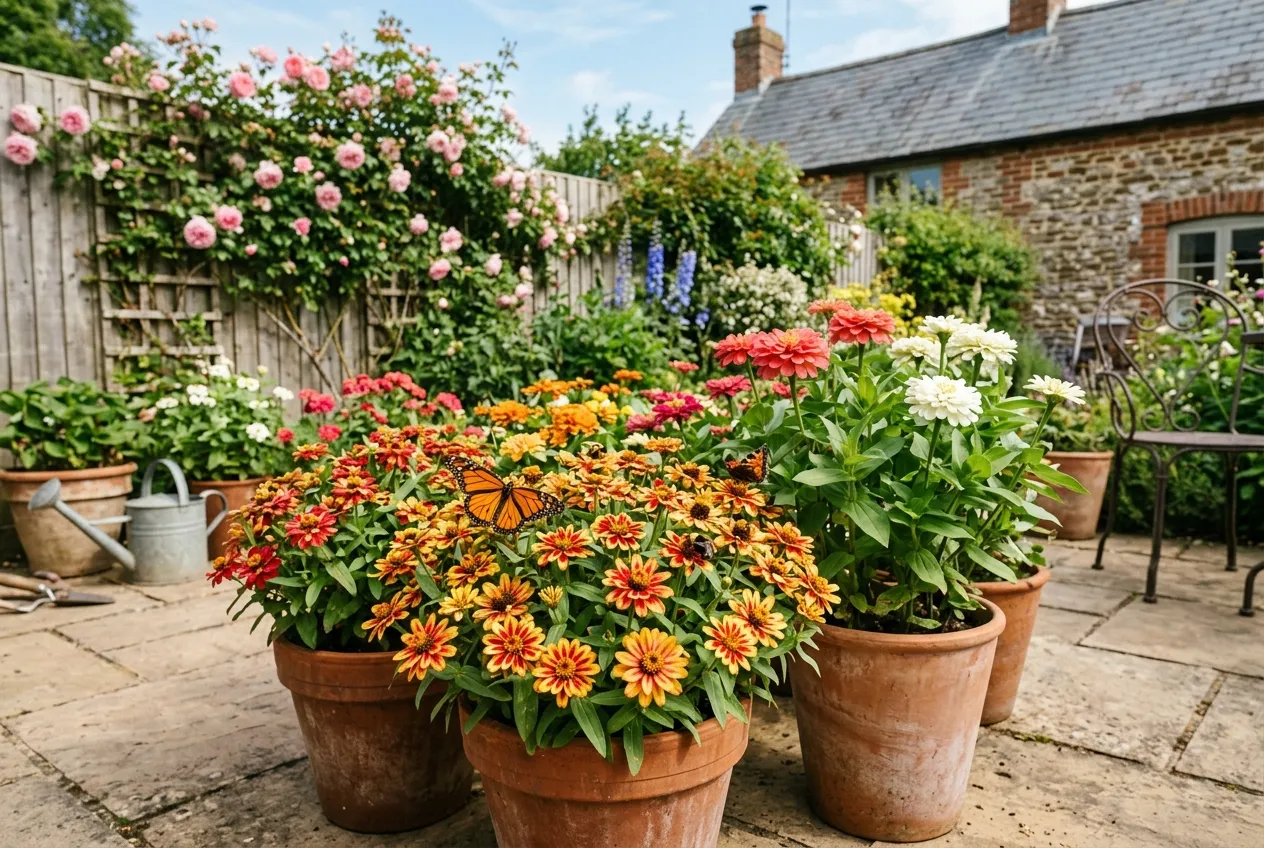 Compact Zinnia haageana ‘Persian Carpet’ in terracotta pots on a sheltered UK patio. Dwarf varieties suit containers from 25cm diameter upwards.
Pot size: Minimum 25cm diameter for haageana and marylandica. Minimum 30cm for elegans. Depth of at least 20cm is essential because zinnias produce a deep taproot. Terracotta dries faster than plastic, which suits zinnias because they prefer dry conditions between waterings.
Compost mix: Use 70% multipurpose compost and 30% perlite or horticultural grit. Zinnias in containers rot quickly if drainage is poor. Add 5cm of crocks or gravel to the base of each pot.
Watering: Water daily in hot weather. Check morning and evening during heatwaves. Water at the base, never overhead. Wet foliage in still air triggers powdery mildew within days. Allow the top 2cm of compost to dry between waterings in cooler spells.
Feeding: Apply high-potash liquid feed (tomato fertiliser at full strength) weekly from first bud until the end of the season. Potassium drives flower production. Do not use high-nitrogen feeds, which push foliage at the expense of blooms.
Container zinnias make excellent companions alongside dahlias in pots and other summer-flowering container combinations.
Common zinnia problems in the UK
Powdery mildew is the biggest disease problem for UK zinnias. It appears as a white, dusty coating on leaves from late July onwards, especially in humid weather. Elegans varieties are the most susceptible. Prevention is more effective than cure. Space plants 25-30cm apart, water at the base only, and grow mildew-resistant varieties (‘Zowie! Yellow Flame’, Zahara series, Profusion series). Remove affected leaves immediately and bin them. Fungal disease identification is covered in our separate guide.
Slugs and snails attack young seedlings at planting-out time. The first two weeks after transplanting are the danger period. Use copper tape around containers, organic slug pellets (ferric phosphate), or biological nematode control (Nemaslug applied when soil temperature exceeds 5C). Our guide on getting rid of slugs naturally covers every method ranked by effectiveness.
Botrytis (grey mould) strikes in cool, wet summers. It appears as grey, fuzzy growth on stems, leaves, and dead flower heads. Remove all dead material promptly. Improve air circulation by thinning overcrowded plants. Avoid evening watering.
Alternaria leaf spot causes dark brown spots with concentric rings on lower leaves. It spreads in wet conditions by rain-splash. Remove and bin affected foliage. Mulch around the base to prevent soil splashing onto leaves. Rotate planting positions annually.
Stunted growth and yellowing: Usually caused by planting into cold soil below 15C. Zinnias are tropical plants that stop growing below 10C. If planted too early, they sit dormant and often develop root rot. Wait for consistently warm soil before planting.
Month-by-month zinnia care calendar
| Month | Task |
|---|---|
| January | Order seed from catalogues. Choose varieties for cutting, borders, and pots. |
| February | Check propagation equipment. Clean trays and modules. Prepare grow lights. |
| March | Sow indoors from mid-March at 20-24C. First sowings germinate within a week. |
| April | Continue sowing. Pot on into 9cm pots when roots fill modules. Begin feeding. |
| May | Harden off from mid-month. Plant out in late May (south) once frost risk passes. |
| June | Plant out in north/Scotland. Pinch growing tips at 15cm. Water in dry spells. Lay black mulch. |
| July | First flowers appear. Begin deadheading every 3-4 days. Start cutting for vases. Feed weekly. |
| August | Peak flowering. Watch for powdery mildew in humid weather. Continue deadheading and feeding. |
| September | Stop deadheading 3-5 heads for seed saving. Continue cutting remaining flowers. |
| October | First frosts end the season. Pull spent plants. Collect dried seed heads. Compost plant debris. |
| November | Clean and store seed in paper envelopes. Plan next year’s varieties and colour schemes. |
| December | Rest period. Browse catalogues. Zinnia seed remains viable 3-5 years in cool, dry storage. |
This calendar works alongside the broader flower planting calendar for planning your full season of blooms.
Best zinnia varieties for UK gardens
After trialling 14 varieties across three seasons, these are the standout performers for UK conditions.
For cut flowers:
- ‘Benary’s Giant’ (elegans, 90cm, 12cm blooms). The industry standard for cut zinnias. Eight colours including lime green, salmon, and wine. Produced 45 stems per plant in our trial. Long, strong stems of 40-50cm. Needs staking in exposed positions.
- ‘Oklahoma’ (elegans, 75cm, fully double). More compact than Benary’s Giant with excellent rain resistance. The petals overlap tightly, which sheds water instead of trapping it. Flowered 5 days earlier than Benary’s Giant in our trial.
- ‘Queen Lime Red’ (elegans, 75cm). Unusual lime green to red gradient. A florist favourite. Slightly lower yield at 30 stems per plant but every stem is striking.
For borders and bedding:
- ‘Zowie! Yellow Flame’ (elegans, 60cm). Bicolour red and yellow petals. RHS Award of Garden Merit. Outstanding mildew resistance. The most reliable elegans for British weather.
- ‘Lilliput’ (elegans, 45cm, pompom). Small 4cm pompom flowers in mixed colours. Dense, bushy habit. Excellent for cottage garden planting.
For containers and small spaces:
- ‘Persian Carpet’ (haageana, 30cm). Single bicolour flowers in red, gold, and mahogany. Compact, self-branching. No pinching needed. The best zinnia for small pots.
- ‘Zahara Double Fire’ (marylandica, 25cm). Cherry red semi-double flowers. Exceptional mildew and weather resistance. Grows and flowers in cooler conditions than most zinnias.
Zinnias as pollinator plants
Zinnias are outstanding pollinator plants. Single and semi-double varieties are more accessible to insects than fully double forms because the central disc of nectar-rich florets is exposed.
In our Staffordshire trial plots, zinnia patches attracted painted lady butterflies, red admirals, small tortoiseshells, buff-tailed bumblebees, and marmalade hoverflies. The haageana varieties drew the most diverse range of visitors because their smaller, open flowers suit short-tongued insects that cannot access deep, doubled blooms.
If you grow zinnias specifically for pollinators, choose single-flowered varieties and leave some flower heads to set seed in autumn. Goldfinches feed on zinnia seed heads from September onwards. Combine zinnias with cosmos and sunflowers for a succession of pollinator food from June through October.
Field Report: GardenUK Trial Plot, Midlands (Heavy Clay) Dates tested: March 2023 to October 2025 (3 full seasons) Conditions: South-facing, partially sheltered by 1.8m fence, heavy Staffordshire clay improved with grit Observation: ‘Benary’s Giant’ lime green outperformed all other varieties for stem count and vase life (9 days average). Black polythene soil warming before planting was the single biggest intervention, raising soil temperature from 12C to 17C and cutting establishment time in half. The wet August of 2024 destroyed 70% of elegans foliage with mildew, while marylandica ‘Zahara’ showed zero symptoms in the same bed. For UK reliability, always grow at least one marylandica variety as insurance.
Frequently asked questions
When should I sow zinnia seeds in the UK?
Sow zinnia seeds indoors from mid-March to mid-April at 20-24C. Seeds germinate in 5-7 days. Do not direct sow outdoors before late May as zinnias are half-hardy and soil must reach 15C minimum. In northern England and Scotland, delay outdoor planting until mid-June when night temperatures stay above 10C consistently.
Can zinnias survive UK winters?
No, zinnias cannot survive UK winters. They are half-hardy annuals from Mexico, killed outright by any frost below 0C. In the UK, the first autumn frost in October or November ends their season entirely. You must sow fresh seed each spring. Save seed from the best flower heads in September by allowing them to dry fully on the plant.
Why are my zinnia seedlings leggy and weak?
Insufficient light causes leggy zinnia seedlings. Zinnias need 14-16 hours of bright light daily during the seedling stage. A south-facing windowsill provides only 6-8 hours in March. Use supplementary grow lights positioned 10-15cm above the seedlings. Also ensure the temperature stays at 20-24C. Cooler windowsills at 12-15C slow growth and encourage stretching.
Do zinnias grow well in pots in the UK?
Yes, zinnias grow well in pots if you choose compact varieties. Zinnia haageana ‘Persian Carpet’ and Zinnia elegans ‘Thumbelina’ stay under 40cm and suit containers from 25cm diameter upwards. Use free-draining compost with 20% added perlite. Water daily in summer as pots dry fast. Feed weekly with a high-potash liquid fertiliser from first bud to sustain flowering.
How do I stop zinnias getting powdery mildew?
Water at the base, never overhead. Powdery mildew strikes zinnias when foliage stays wet in still, humid conditions. Space plants 25-30cm apart for air circulation. Water in the morning so leaves dry before evening. Choose mildew-resistant varieties such as ‘Zowie! Yellow Flame’ and the Zahara series. Remove and bin affected leaves immediately to prevent spread.
Should I pinch out zinnia seedlings?
Yes, pinch the central growing tip when seedlings reach 15cm tall. This removes apical dominance and forces two or more side shoots from the leaf nodes below. Each side shoot produces its own flower. A pinched plant produces 30-50 stems over the season compared to 15-20 from an unpinched plant. Pinch cleanly with fingernails or sharp snips just above a leaf pair.
What are the best zinnia varieties for UK gardens?
For cut flowers, grow ‘Benary’s Giant’ (90cm, 12cm blooms in 8 colours) or ‘Oklahoma’ (75cm, fully double). For borders, ‘Zowie! Yellow Flame’ (60cm, bicolour, mildew-resistant) is outstanding. For pots, ‘Persian Carpet’ (30cm, single bicolour) or ‘Zahara’ series (25cm, disease-resistant). All perform well in the UK’s maritime climate given full sun and shelter.
Zinnias are among the best hardy annual flowers to grow from seed for UK gardens. Once you master the warmth-at-every-stage approach, these plants reward with months of cutting-quality flowers in colours no other annual can match. Try them alongside the RHS zinnia growing guide recommendations for even more variety options.
Lawrie has been gardening in the West Midlands for over 30 years. He grows his own veg using no-dig methods, keeps a wildlife-friendly garden, and writes practical advice based on real UK growing conditions.