Key takeaways
- Brown grass is dormant, not dead: scratch the soil at 25mm depth and look for white living rhizome runners and crown tissue
- Perennial UK lawn grasses survive 6-8 weeks of dormancy and visibly regrow within 14-21 days of rain returning
- Water deeply at 25mm once per week before 9am rather than shallow daily watering, hosepipe ban permitting
- Raise the mower height to 50-65mm during recovery and never cut more than a third of the blade in one pass
- Overseed bare patches at 35g/m2 with a drought-tolerant ryegrass and turf-type tall fescue mix
- Feed with low nitrogen and high potassium (5g/m2 of potassium sulphate) to rebuild roots, not push soft top growth
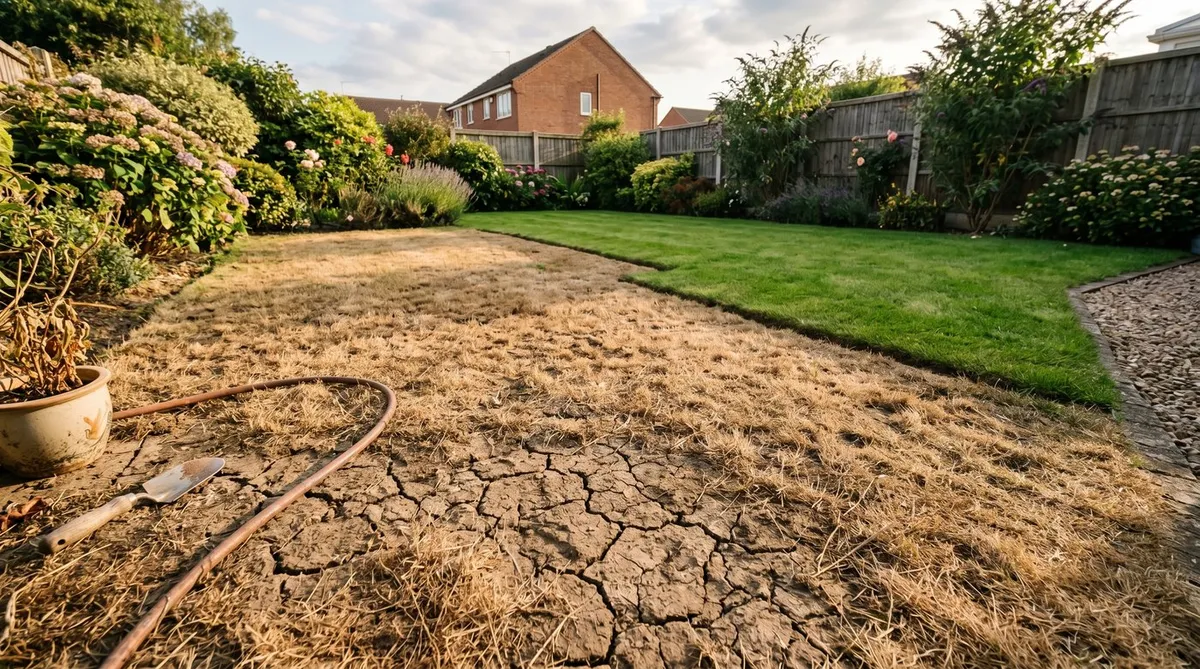
A UK lawn turning brown after a heatwave is not the disaster it looks. Perennial ryegrass, the dominant species in nearly every domestic British lawn, is one of the most heat-tolerant cool-season grasses in cultivation. It survives 6-8 weeks of full dormancy and rebuilds itself once soil moisture returns. The mistake most gardeners make is panicking, ripping up turf that would have come back, and spending 400-700 pounds on a replacement that the old lawn would have done for free.
This guide walks through what actually happens to UK lawn grasses in extreme heat, how to tell living from dead in 30 seconds with a trowel, and the four-week programme that turns a brown lawn back to green. The science is settled and the methods are simple. What kills lawns more often than the heat itself is well-meaning intervention at the wrong moment.
What dormancy really is
Cool-season grasses like perennial ryegrass, fine fescues and smooth-stalked meadow grass evolved for northern European summers of 16-22C and steady rainfall. When soil temperature rises above 26C and soil moisture drops below 20% volumetric water content, these grasses shut down photosynthesis and pull energy and water back into the crown and the rhizomes (the underground runners). The blades above ground brown off and die. The crown and rhizomes go quiet.
Dormancy is a survival strategy, not death. The crown holds living tissue for 6-8 weeks under most UK summer conditions. After about 8 weeks of bone-dry soil the crown begins to die in patches, and at around 10-12 weeks the lawn passes the point of full recovery. The trigger for waking up is the return of soil moisture, not air temperature. A 25mm rainfall event in late August will visibly green up a dormant ryegrass lawn within 14 days.
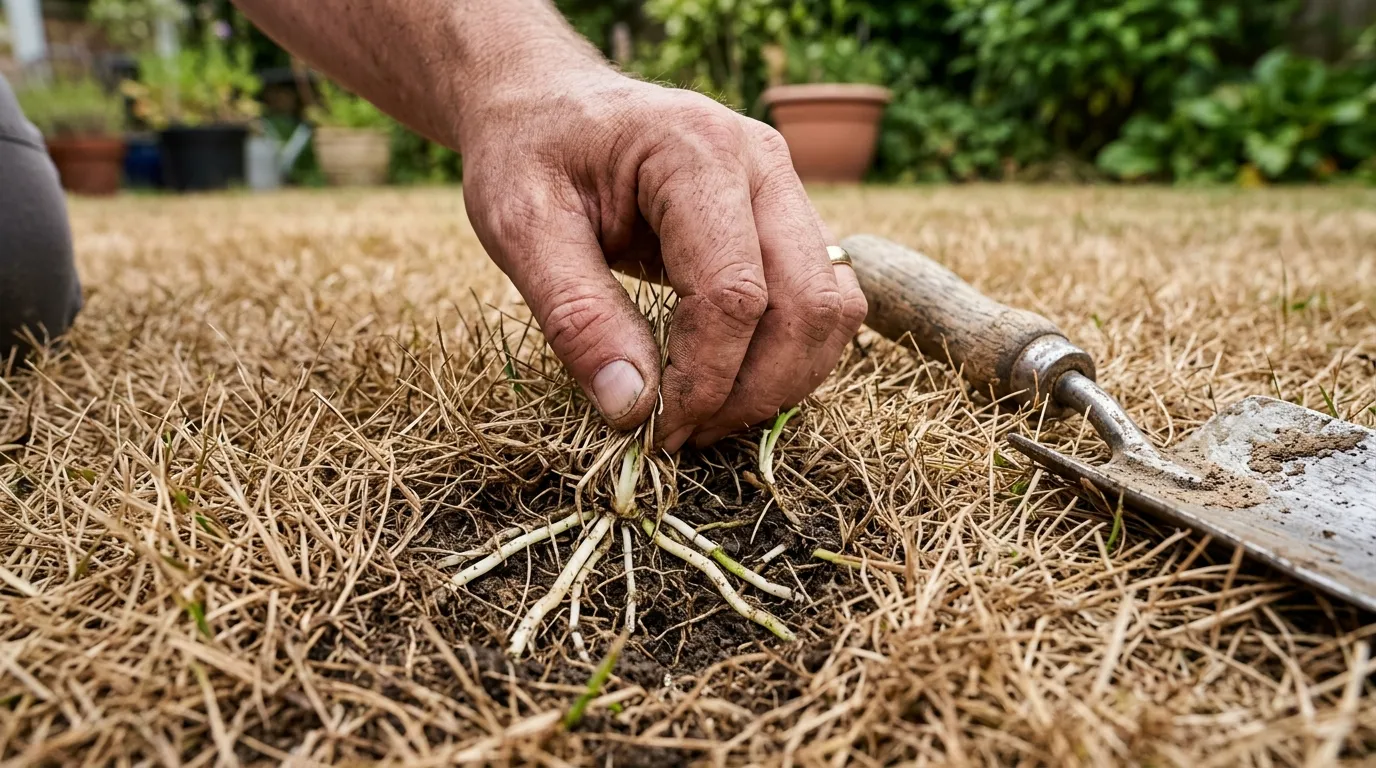
The Met Office logged 19 July 2022 at 38.7C in eastern England, the hottest UK day on record at the time. By early August large stretches of southern England were brown end to end. The same lawns that looked dead in mid-August were largely back to green by the end of September after average autumn rainfall. That recovery curve is the rule, not the exception, for healthy perennial ryegrass and fescue lawns on soils with at least 100mm of topsoil depth. Shallow soils over chalk or compacted clay struggle more, and any south-facing slope on free-draining sand will be the last to recover.
Dormancy is also species-specific. Annual meadow grass (Poa annua), which sneaks into most UK lawns over time, is far less heat-tolerant than perennial ryegrass and often dies outright in 5-6 weeks of drought. A lawn that comes back patchy after a long heatwave is sometimes a lawn that has been pruning itself of weak Poa annua, which is no bad thing for the long-term species mix. The bare patches left behind are an opportunity to overseed with hardier species.
The UK heatwave context
Domestic lawns in the UK fall into three drought-risk bands by region. The south and east (Kent, Essex, Suffolk, Norfolk, Cambridgeshire, Bedfordshire, London) get the longest dry spells and warmest temperatures, and lawns there go dormant in most summers. The Midlands and south-west sit in the moderate band, with dormancy events every three to four years. The north, west Wales and Scotland rarely see full dormancy outside extreme years. The recovery programme below works across all three bands, with the main difference being how often it gets used.
Soil type modifies the risk further. Sandy and gravelly soils drain fast and reach drought stress in days. Heavy clay holds water but cracks badly above 30C and roots cannot reach the moisture under the cracks. Loamy soils are the best buffer. A lawn on free-draining sand in Kent might go dormant after 14 days of dry heat. The same lawn in heavy clay in Lancashire might last 35 days before browning. Knowing your local soil type helps set realistic expectations for the year ahead.
How to read your lawn after a heatwave
Three signals tell you what state the lawn is in:
- Blade colour: uniform straw-brown across whole zones suggests classic dormancy. Patchy yellowing in isolated rings suggests fungal disease (see lawn diseases identification and treatment for the distinction).
- Crown condition: white runners at 25mm depth means dormant. Black or brittle means dead, often only in worst-affected pockets like south-facing slopes or compacted areas around tree roots.
- Weed creep: drought-tolerant weeds like yarrow, plantain and clover stay green when grass dies. A lawn that is green in patches with broadleaf weeds is signalling a wider weed problem (covered in lawn weeds identification and control) on top of the drought damage.
Treat the lawn as a patchwork. Some areas will be fully alive, some 50-80% alive, and small zones may be genuinely dead. The four-week programme below handles each category differently.
Watering rules during and after drought
Most UK gardeners water lawns wrong, and getting how often to water a lawn right matters as much in recovery as in a heatwave. The default routine of 10 minutes with the sprinkler every evening keeps the top 10mm of soil damp and drives roots shallow, which makes the next drought worse. The science-backed UK schedule is 25mm of water in one session, once per week, applied before 9am, hosepipe ban permitting.
To measure 25mm accurately, place three empty tuna cans across the sprinkler arc, run the sprinkler, and time how long it takes the cans to fill to 25mm depth. Most domestic oscillating sprinklers need 60-90 minutes per pass to deliver 25mm. Do not water at midday (the spray evaporates), do not water in the evening (the blades stay wet overnight and invite fungal disease), and do not water shallowly daily.
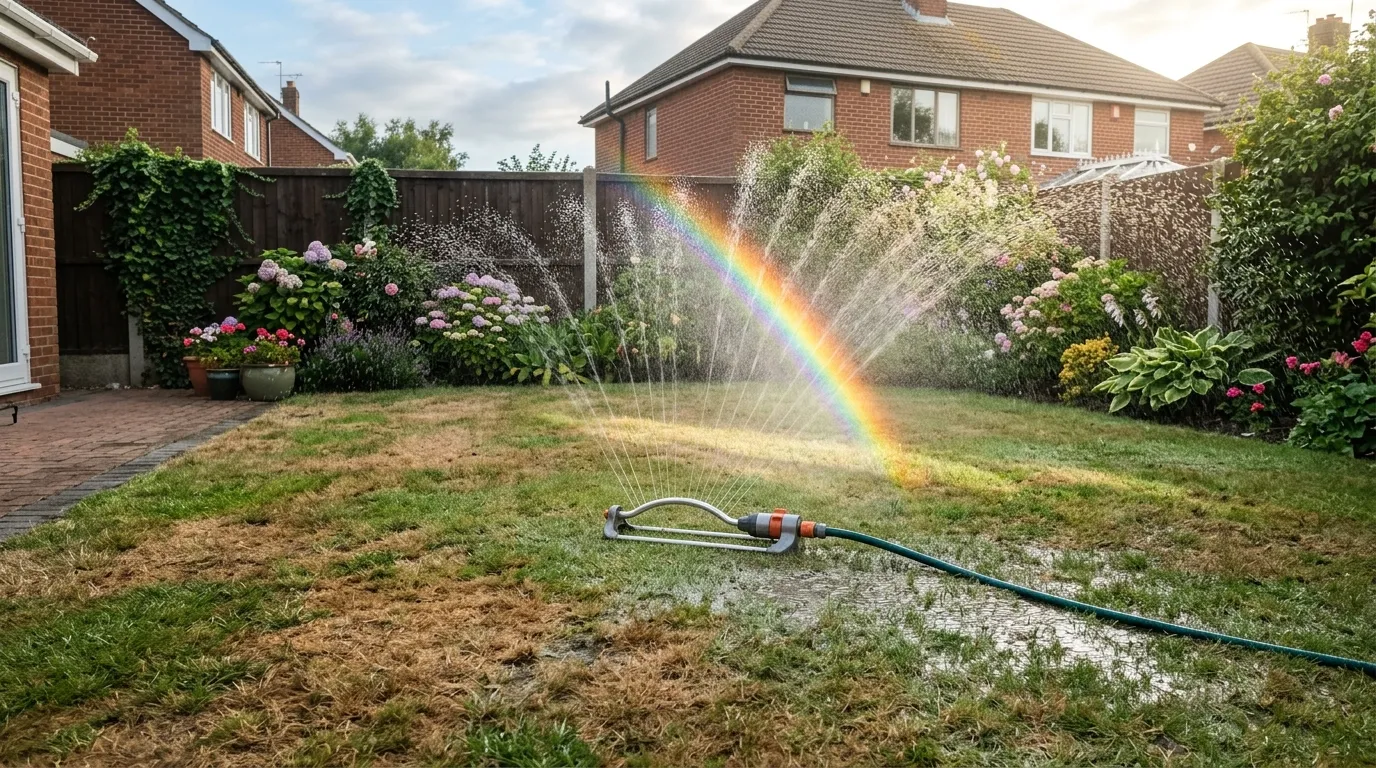
During a hosepipe ban, leave dormant grass alone. The crown is safe without water for 6-8 weeks and irrigation breaches restrictions. Save household grey water from washing-up bowls and showers for prized specimen trees and vegetable beds, not the lawn. Lawns recover from drought far better than mature shrubs and trees, which is the right way around to set priorities.
The other myth to bust is wetting agent sprays. Garden centres push them in heatwave summers as a way to keep dormant lawns green. They do not. Wetting agents help water penetrate hydrophobic dry soil and are useful in the recovery phase after rain returns, but applying them mid-drought to no rainfall is wasted money. Save the 25-40 pounds the bottle costs and put it toward sandy loam top-dressing in autumn instead.
A tuna can is also the right tool for measuring rainfall during the recovery weeks. Three cans placed across the lawn (away from overhanging trees) catch a week’s rainfall accurately enough to decide whether the lawn needs supplementary water. If the cans collect 15mm or more between Monday and Sunday, the lawn does not need watering. Below 15mm and a single deep top-up at 25mm minus the rainfall total takes the lawn to its weekly quota. Tracking water this way for two seasons usually surprises gardeners who thought they were undersupplying the lawn.
The four-week recovery programme
Once rain returns or the hosepipe ban lifts, the following programme rebuilds a dormant lawn faster than any single big intervention.
Week 1: stop, deep water, raise the mower
The week the rain returns is the week to do nothing dramatic. Apply one 25mm deep water if there has been less than 15mm of rainfall that week. Raise the mower height to 50-65mm and leave the lawn at that height for the rest of the season. Cutting brown grass short will scalp the crown and convert dormant tissue into dead tissue.
If the lawn was last cut to 25mm, raising the mower 25mm in one pass means cutting nothing on the first mow. That is the right call. Wait for visible green regrowth at 50mm before taking the first cut, and then never remove more than a third of the blade at any one pass.
Foot traffic also pauses in week 1. A recovering lawn with weak crown tissue tears easily under garden furniture, paddling pools and football boots. Move tables, trampolines and any heavy items off the worst patches for at least the first fortnight. The cost is a few weeks of inconvenience. The benefit is that bruised crowns get a chance to fire new shoots without being trampled flat.
If pets use the garden, keep them off the worst recovery zones with a temporary post-and-twine boundary or move their toilet area to a gravelled corner for a month. Urine spotting on heat-stressed turf often finishes off a crown that the drought left clinging on. The ammonia equivalent in concentrated urine is enough to scorch already-stressed tissue in a single application.
Week 2: assess and feed lightly
By the end of week 2 about 60-75% of dormant zones will be showing visible green regrowth at the base of the brown blades. This is the time to feed, but the feed matters.
Skip the high-nitrogen summer lawn feed. Nitrogen pushes soft top growth at the expense of root rebuilding, and a heat-stressed lawn needs roots before blades. Use a low-nitrogen, high-potassium feed: sulphate of potash (potassium sulphate) at 5g per square metre, broadcast by hand or with a hand-spreader. Potassium strengthens cell walls, improves drought tolerance for next year, and helps the crown rebuild reserves before autumn.
For a fuller picture of seasonal feeding see how to feed a UK lawn and the year-round plan in the UK lawn care calendar.
Sulphate of potash is sold in 5kg and 25kg bags at most garden centres and farm merchants. A 5kg bag at 12-18 pounds covers around 1,000 square metres at the recovery rate, which is enough for most domestic lawns several times over. Store the bag in a dry shed because potassium sulphate clumps badly once damp. The granules are fine enough to broadcast by hand wearing a glove, or feed them into a hand-spreader on the smallest setting.
The week 2 feed window matters more than the exact product. Apply too early (week 1, before regrowth) and the feed sits unused on dead blades. Apply too late (week 4 or beyond) and the lawn has burned through its remaining root reserves trying to push regrowth without help. The Saturday of the second week after rain returns is the right anchor day for most UK gardeners.
Week 3: scarify and overseed bare patches
By week 3 the lawn has a thick layer of dead thatch (the dried-out blades from the dormancy period) lying on the surface. This thatch will smother regrowth and harbour fungal disease if it stays. Scarify lightly with an electric scarifier set to the minimum depth or hand-rake the worst areas with a spring-tine rake. The goal is to lift the dead material without tearing into living crowns.
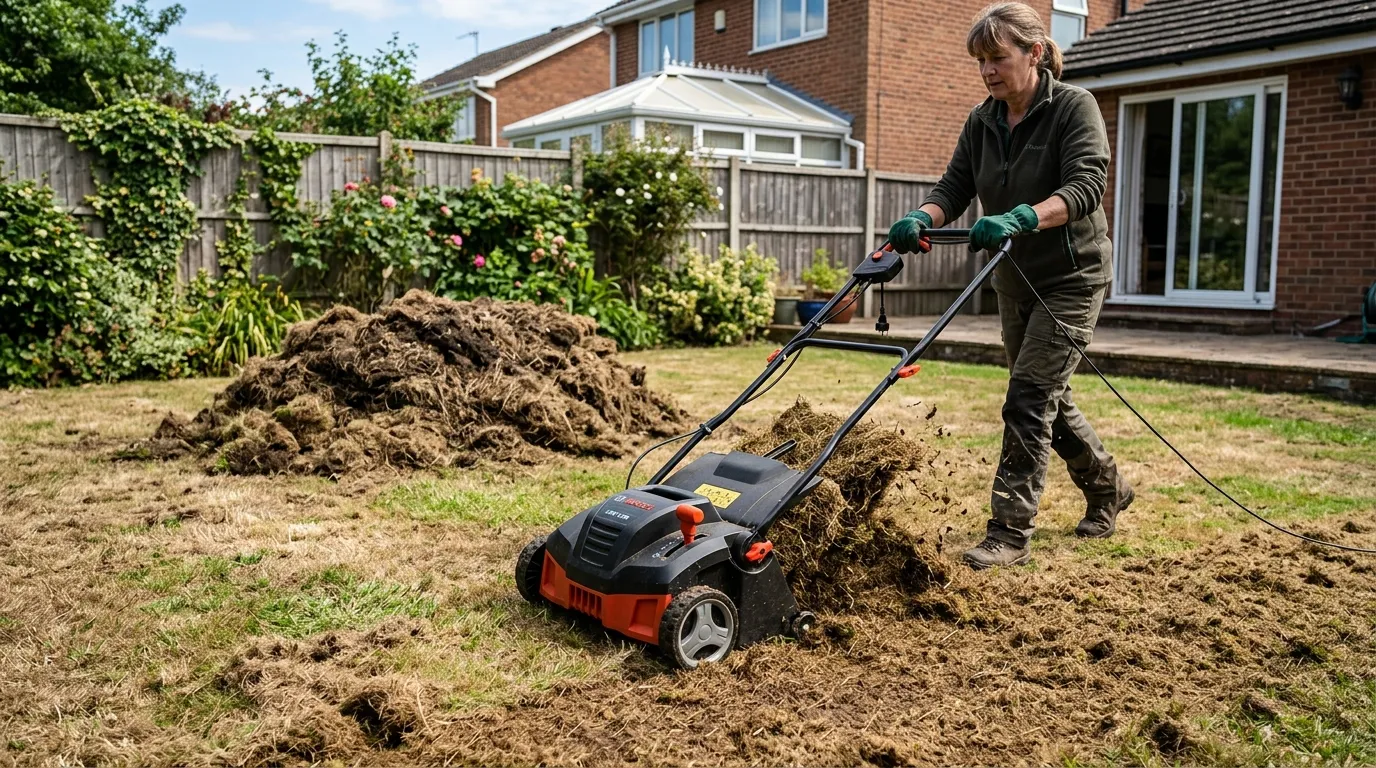
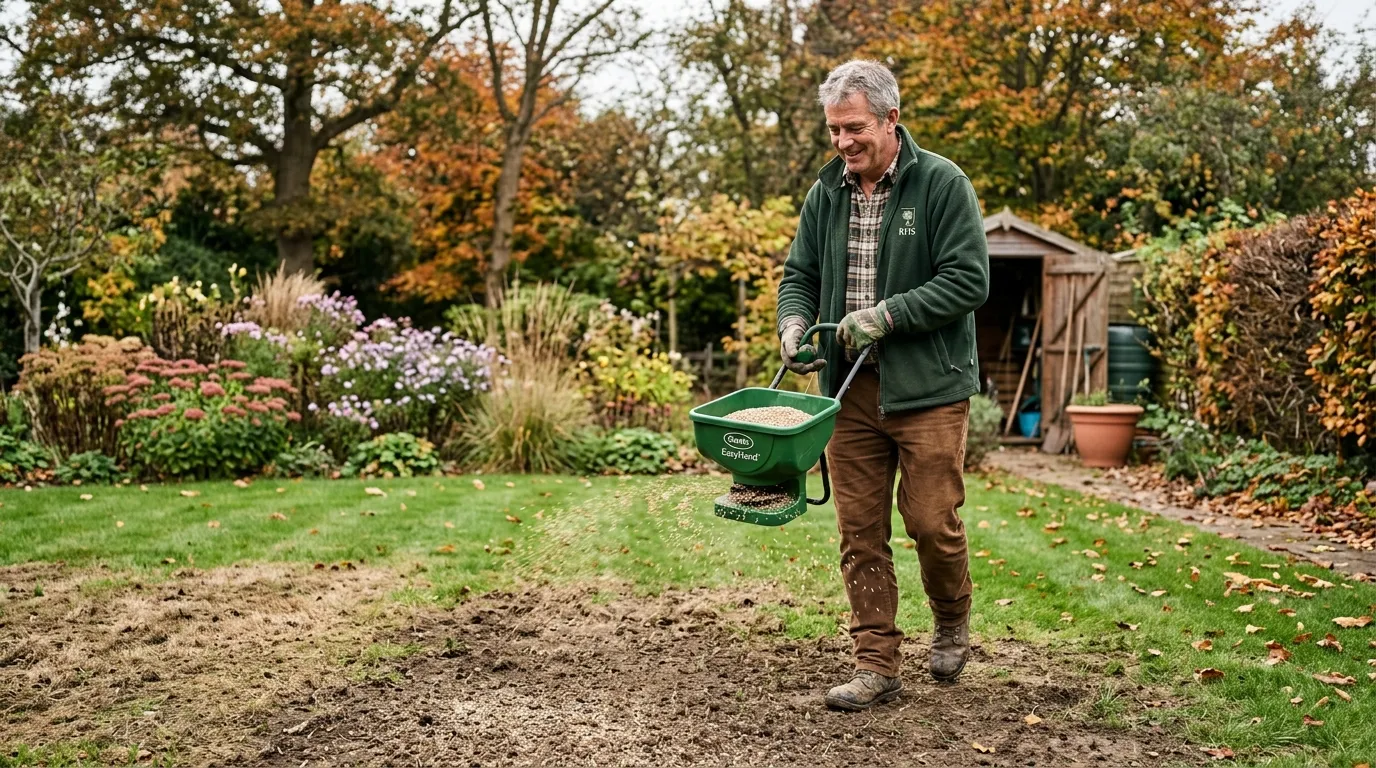
After scarifying, identify the genuinely dead patches (no green regrowth, scratch test failed) and overseed at 35g/m2 with a drought-tolerant ryegrass and turf-type tall fescue mix. On thin or pale areas (some regrowth but sparse) overseed at 25g/m2. For full method see how to fix a patchy lawn and the deeper detail in how to scarify and aerate a lawn.
Water the overseeded areas lightly twice a day for the first 14 days to keep the seed bed damp. This is the one time daily watering is right, because newly germinated seedlings have no root system to draw on.
Seed contact with soil is the make-or-break detail. Broadcasting seed onto thatch or onto dry crusted soil gives 20-30% germination. Raking lightly to scratch the surface, broadcasting seed, then walking the area or pressing with a flat roller lifts germination to 70-80%. A 1.2m wide log rolled across the bed works as well as a hired roller for small lawns. Cover the seeded patches with a thin scattering of horticultural grit or screened topsoil to deter pigeons and starlings.
Germination times depend on soil temperature. At 12-15C (typical mid-September UK) ryegrass shows in 5-7 days and tall fescue in 8-12 days. Below 10C (late October onwards) germination slows or stops, which is why the September window is critical. Patches overseeded in early November might not germinate until March the following year, which leaves bare soil exposed to winter rain and weed colonisation.
Week 4: top-dress and water in
Apply a light top-dressing of 5mm coarse sand mixed with screened sandy loam across the lawn (about 5kg per square metre). Work it into the surface with the back of a rake so it falls between the blades and onto bare soil. Top-dressing fills small surface hollows, improves drainage on heavy clay, and gives overseeded zones a warm covering that boosts germination.
The technique and timing are covered in how to top-dress a UK lawn, which pairs naturally with this recovery programme. Water in with a final 15mm soak. From this point the lawn is on its autumn schedule: regular mowing as it greens up (see when to mow a UK lawn for the autumn cut height), no further feeding until next spring, and normal weed and moss watch through October.
Drought-tolerant grass species worth knowing
The grasses in most UK lawns are inherited from the 1960s seed mixes that assumed reliable summer rainfall. The Met Office now records heatwaves above 35C every two to three years on average, and that pattern is not going back. The smart move is to slowly shift the species mix toward drought tolerance.
| Species | Drought tolerance | Wear tolerance | Best for | Notes |
|---|---|---|---|---|
| Perennial ryegrass (DLF Profile, Limagrain Mathilde) | Good | Excellent | Family lawns, sports use | Standard UK species, recovers well from dormancy but browns fast |
| Turf-type tall fescue (TTTF) | Excellent | Excellent | Drought-prone south-facing lawns | Deeper roots (600-900mm vs ryegrass 150-300mm), greener through heatwaves |
| Strong creeping red fescue | Very good | Moderate | Shaded and low-traffic lawns | Fine blade, self-repairing through rhizomes |
| Smooth-stalked meadow grass | Moderate | Good | Mixed family lawns | Slow to establish but good rhizome network for fill-in |
| Microclover (Trifolium repens Pirouette) | Excellent | Moderate | Eco-conscious lawns | Fixes nitrogen, stays green in drought, mixes with ryegrass |
For a south-facing UK lawn on free-draining sandy soil, a 60% turf-type tall fescue, 30% ryegrass, 10% microclover blend will outperform pure ryegrass through a 35C heatwave by a wide margin. The British and Irish Association of Greenkeepers (the trade body for UK turf professionals at BIGGA) publishes regular UK trial data on drought-tolerant cultivars that is worth a read before buying seed.
Switching a fully established lawn to TTTF takes 3-4 years of overseeding every autumn. There is no need to lift the existing turf. Each autumn overseed the worst areas with the new blend and let the deeper-rooted species progressively take over.
When recovery is not realistic
A small number of UK lawns will not recover even with the right programme. The decision tree below helps separate recoverable from rebuild.
| Symptom | Recoverable? | Action |
|---|---|---|
| Brown across whole lawn, scratch test mostly white | Yes | Four-week recovery programme |
| Brown patches, scratch test 50% white | Yes, with overseed | Recovery programme plus overseed on dead patches |
| Brown across lawn for 10+ weeks dry, scratch test all brittle | No | Lift, level, reseed or returf |
| Lawn 30%+ weeds with green creeping weeds dominant | Borderline | Treat weeds first, then assess turf separately |
| Compacted bare patches with no crown remains | No | Aerate, top-dress with sandy loam, reseed |
| Lawn under heavy tree shade with no recovery in 6 weeks | No | Switch to shade-tolerant species or a lawn alternative |
If the scratch test fails across 70% or more of the lawn after a long heatwave, full renovation is faster and cheaper than partial repair. Lift the dead turf with a turf cutter (hire cost 40-60 pounds per day), rotovate to 100mm, rake level, and either returf at 4-7 pounds per square metre or reseed at 0.30-0.50 pounds per square metre. Reseeding gives a better long-term result because the new lawn establishes a deep root system from the start.
Future-proofing against the next heatwave
Recovery is one half of the job. The other half is making sure the lawn handles the next drought better than the last one. Five permanent changes shift the odds.
- Raise mowing height to 50mm year-round. Longer blades shade the crown, slow evaporation and force roots deeper. UK research shows a 50mm cut height doubles drought tolerance vs a 25mm cut.
- Top-dress with sandy loam every spring. A 5kg per square metre top-dressing across two years lifts heavy clay soil into a loamy structure that holds 40% more available water.
- Replace pure ryegrass with TTTF-led blends over 3 years. Each autumn overseed at 25g/m2 with a 60% TTTF, 30% ryegrass, 10% microclover mix. By year three the lawn is dominantly drought-tolerant.
- Install a wildflower lawn area on south-facing plots. A 2-4m strip of wildflower meadow (yarrow, self-heal, clover, birdsfoot trefoil) stays green on a fraction of the water and works alongside conventional turf. The how to create a wildflower lawn guide walks through the species mix and timing.
- Switch the south-facing dead corners to ground cover. Where lawn struggles year after year, take the area out of grass and plant a low-traffic ground cover instead (full options in lawn alternatives and ground cover). Drought-tolerant flowering perennials such as gaura also thrive in these hot dry corners once the turf comes out.
The economics work in favour of changing rather than persisting. A 100 square metre lawn rebuilt as 70 square metres of resilient turf plus 30 square metres of wildflower meadow or ground cover uses 60-70% less water and stays presentable through every UK summer, including the bad ones. Annual maintenance time also drops because the meadow and ground cover need 2-4 cuts per year rather than 25-30.
Common mistakes that ruin recovery
- Scalping the lawn too soon. Mowing dormant brown grass to 25mm in early August cuts through the crown and converts dormant tissue into dead tissue. Wait for visible green regrowth before any cut.
- Heavy nitrogen feed in weeks 1-2. A spring lawn feed bag emptied onto recovering turf pushes soft top growth at the expense of root rebuilding and often scorches the crown. Save the nitrogen for next spring.
- Reseeding before assessing. Buying turf or seed in week 1 wastes money on areas that would have recovered for free. Wait 4 weeks before deciding which patches are genuinely dead.
- Watering daily and shallow. Twenty minutes of sprinkler every evening keeps roots in the top 10mm and weakens the lawn against the next dry spell. Deep weekly watering is the rule.
- Ignoring soil compaction. Heavily walked-on lawns recover badly because the compacted soil keeps water and air out of the root zone. Core aerate in early autumn before overseeding.
A note on mushrooms and disease after recovery
A wet recovery after a long dry spell is exactly the conditions UK lawn fungi exploit. Fairy rings, ink caps and red thread can all appear in the first weeks of regrowth. The flush of fruiting bodies is harmless to humans and pets in most cases, and the article on UK lawn mushrooms explains which species to watch and which to ignore.
Active fungal disease (visible rings of yellow or pink threads) is more serious and needs spotting early. The diagnostic guide in lawn diseases identification and treatment covers the common UK pathogens and the treatment thresholds.
When professional help is worth it
For lawns above 200 square metres or with persistent recovery failure after two seasons, a soil test (10-25 pounds per sample) and a professional renovation quote are worth the spend. A good turf contractor will core-aerate, scarify, overseed with the right blend, and top-dress in a single autumn pass for 800-1,500 pounds on a 200 square metre lawn. The lawn comes back stronger than it was before the drought and is set up to handle the next one without dropping into deep dormancy.
Soil testing returns three numbers that matter: pH, phosphorus and potassium index, and organic matter percentage. A pH below 6.0 reduces nutrient uptake and is corrected with garden lime at 100-200g per square metre in autumn. Potassium index below 1 means the lawn cannot rebuild drought reserves and needs a programme of autumn potash feeds for two to three years. Organic matter below 3% means the soil holds little water and needs sandy loam top-dressing and a switch to deeper-rooted species. None of these issues are visible to the eye, which is why a 15 pound soil test pays for itself.
For a structured approach to year-round maintenance once recovery is complete, the UK lawn care calendar lays out the monthly jobs that keep the lawn drought-ready.
Related guides
This recovery guide pairs naturally with the broader lawn care pieces: how to feed a UK lawn, how to top-dress a UK lawn, how to scarify and aerate a lawn, how to fix a patchy lawn and the seasonal UK lawn care calendar. For diagnosing what else might be going wrong see lawn diseases identification and treatment and lawn weeds identification and control. Considering alternatives? Lawn alternatives and ground cover is the place to start.
Our team produces practical UK gardening guidance from source research, contributor records and established horticultural practice. Editorial standards are overseen by Matt W.