Key takeaways
- Full-spectrum white LEDs work for every stage from seed to harvest
- Blurple (red-blue) LEDs are cheaper but visually unpleasant
- Budget 20-30W per square foot for seedlings, 40-60W for fruiting
- Run cost: £8-£15 per month for a 100W LED at 16h/day
- PPFD 200-400 for seedlings, 600-900 for fruiting tomatoes
- Distance: 200-400mm from canopy for full-spectrum LED
LED grow lights have replaced compact fluorescent and HPS (high pressure sodium) for UK indoor growing in the last 6-8 years. They cost less to run, last longer, produce less heat, and now match the yield of the older systems on every measure. This guide covers spectrum, wattage, hanging distance, PPFD targets, running costs, and what to buy for a UK seed-starting bench or full indoor grow tent.
Full-Spectrum vs Blurple LEDs
LED grow lights split into two main categories by light colour.
Full-spectrum white LEDs produce a balanced white light covering 400-700nm with red and blue peaks. The light looks like daylight or warm white. Pleasant to work under. Easy to spot pest and disease.
Blurple LEDs combine red diodes (660nm) and blue diodes (450nm) for theoretical maximum photosynthesis efficiency. The light looks purple-magenta. Hard to inspect plants. Uncomfortable for human use.
| Type | Cost (100W) | Run cost | Yield | Inspection | Eye comfort |
|---|---|---|---|---|---|
| Full-spectrum white LED | £80-£180 | £15-£17/mo | Baseline | Excellent | Comfortable |
| Blurple LED | £50-£140 | £15-£17/mo | Equal to white | Poor | Uncomfortable |
| Quantum board (full-spec) | £120-£250 | £15-£17/mo | Same baseline | Excellent | Most comfortable |
| HPS (sodium, old tech) | £80-£180 | £25-£35/mo | Equal yield | Yellow tint | Hot |
| CFL (compact fluorescent) | £20-£60 | £12-£15/mo | 60-70% of LED | Pink-yellow | Acceptable |
For UK home growers, full-spectrum white LED is the right choice. The £20-£60 price premium pays back in better plant inspection, faster pest catches, and longer enjoyment of the growing space.
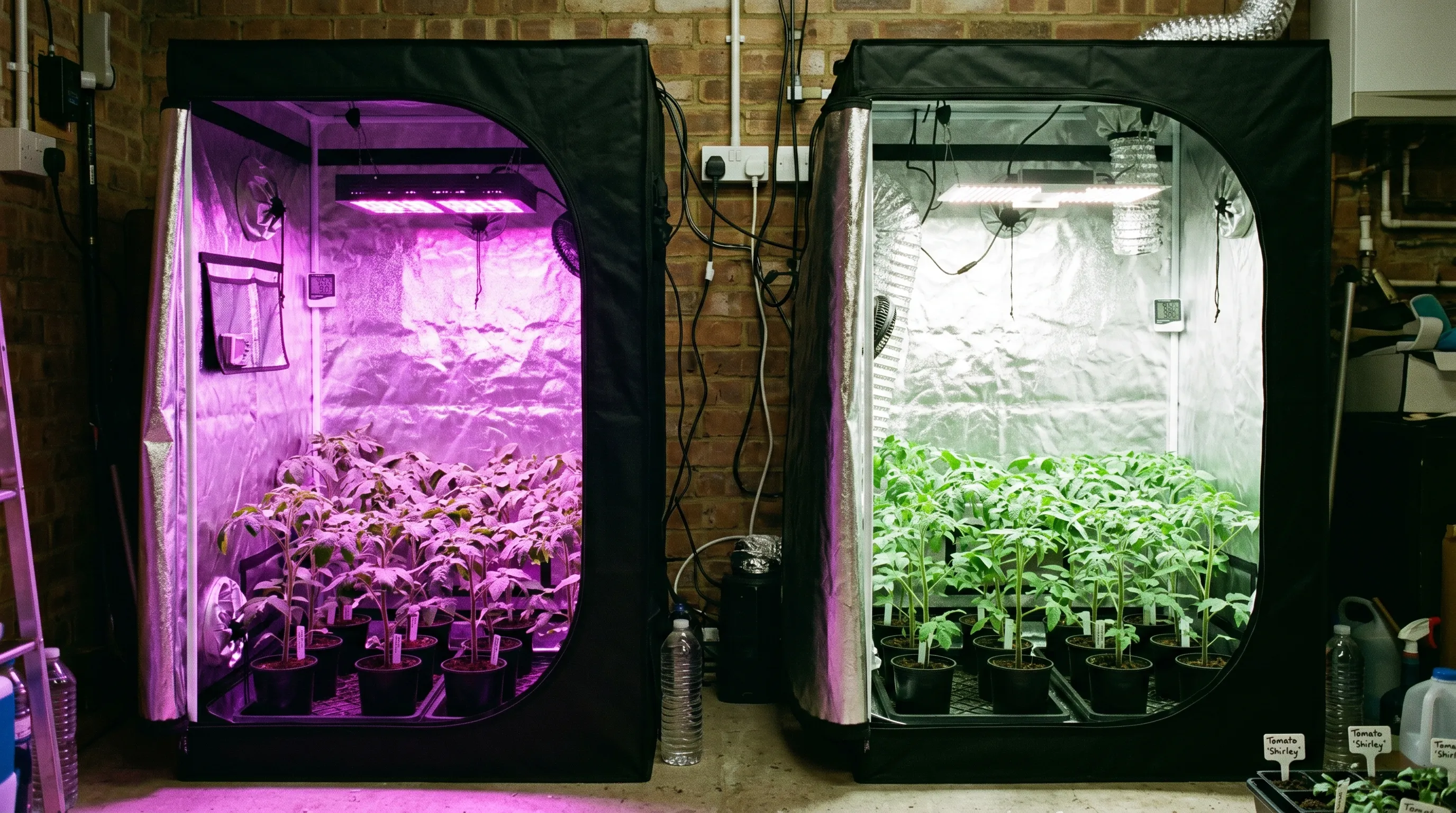 Full-spectrum white LED (right) versus blurple red-blue LED (left). Same wattage, same crops, same yield. The full-spectrum tent is far easier to inspect for aphids, disease and leaf damage.
Wattage by Crop Stage
LED grow light wattage is measured by actual draw at the wall, not by the inflated “equivalent” claims many cheap manufacturers print on the box.
| Crop and stage | Wattage per sq ft | Wattage per sq m | PPFD target |
|---|---|---|---|
| Seedlings and propagation | 20-30W | 215-323W | 200-400 |
| Lettuce and salad leaves | 25-35W | 269-377W | 300-500 |
| Herbs (basil, parsley, mint) | 25-35W | 269-377W | 300-500 |
| Strawberries (indoor) | 30-40W | 323-431W | 400-600 |
| Tomatoes (vegetative) | 35-50W | 377-538W | 400-600 |
| Tomatoes (flowering, fruiting) | 40-60W | 431-646W | 600-900 |
| Peppers and chillies | 40-60W | 431-646W | 600-900 |
| Microgreens | 15-25W | 161-269W | 150-300 |
To convert to your space: measure the area in square feet, multiply by the wattage per sq ft from the table above.
Example calculations:
- 60x60cm tent (4 sq ft): seedlings 80-120W; tomatoes 160-240W
- 1.2x1.2m tent (15.5 sq ft): seedlings 310-465W; tomatoes 620-930W
- 1.5m bench in shed (10 sq ft for seedlings): 200-300W full-spectrum
For seed-starting and propagation, a single 100W full-spectrum LED covers a 3-4 sq ft seedling bench. Most UK home growers start here. The same light moves to a tomato cordon stage at the end of the propagation window.
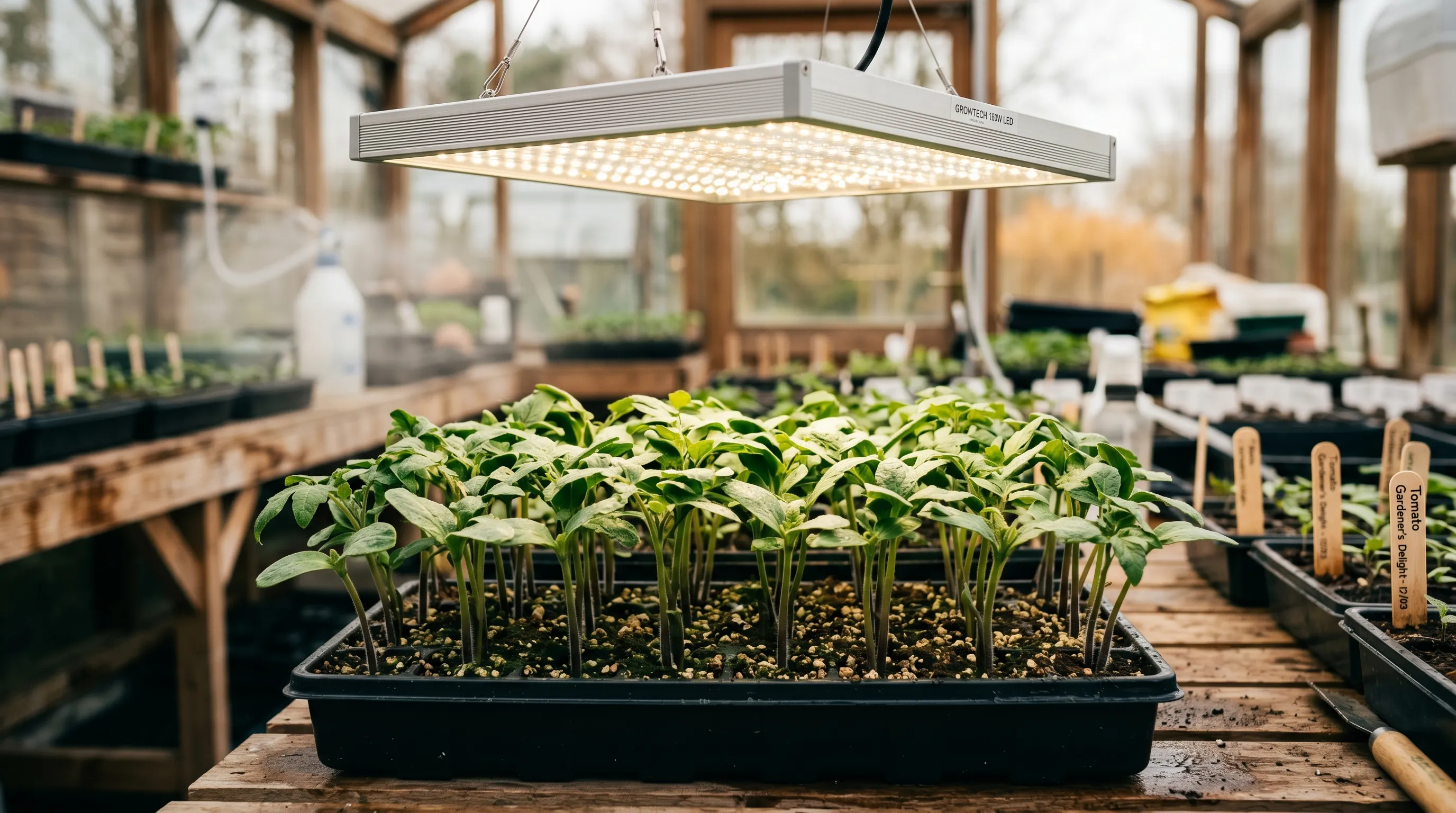 A 100W full-spectrum LED at 300mm hanging distance covers a 60x60cm propagation bench. PPFD at canopy: 400-600 micromoles per second per square metre. Strong stocky seedlings, no stretching.
For the basics of grow light seed starting, our beginner article covers the simple set-up for spring sowing. This guide covers the wider buyer-side detail.
PPFD: The Real Brightness Measure
PPFD (photosynthetic photon flux density) measures the actual photosynthetic light reaching the plant in micromoles per second per square metre at the canopy.
A quality LED brand publishes a PPFD map showing intensity at different points beneath the light at different hanging distances.
| Crop stage | PPFD target | Hanging distance (100W full-spec) | Daily light integral (DLI) |
|---|---|---|---|
| Microgreens | 150-300 | 350-450mm | 8-13 mol/m²/day at 16h |
| Seedlings | 200-400 | 300-400mm | 11-17 mol/m²/day at 16h |
| Lettuce, salads | 300-500 | 250-350mm | 17-22 mol/m²/day at 16h |
| Herbs | 300-500 | 250-350mm | 17-22 mol/m²/day at 16h |
| Tomato vegetative | 400-600 | 200-300mm | 22-30 mol/m²/day at 16h |
| Tomato flowering | 600-900 | 200-250mm | 30-45 mol/m²/day at 16h |
Practical PPFD measurement: the Apogee SQ-500 quantum sensor is the UK standard (£250-£400). For home growers, the Photone smartphone app gives 70-80% accurate PPFD readings using the front camera and a £15 light diffuser cap. Good enough for distance and intensity decisions.
Light burn signal: bleached white patches on upper leaves, often in the centre of the light’s brightest area. Raise the light by 50-100mm if seen.
Light starvation signal: stretched, leggy growth with long internodes. Lower the light or upgrade wattage.
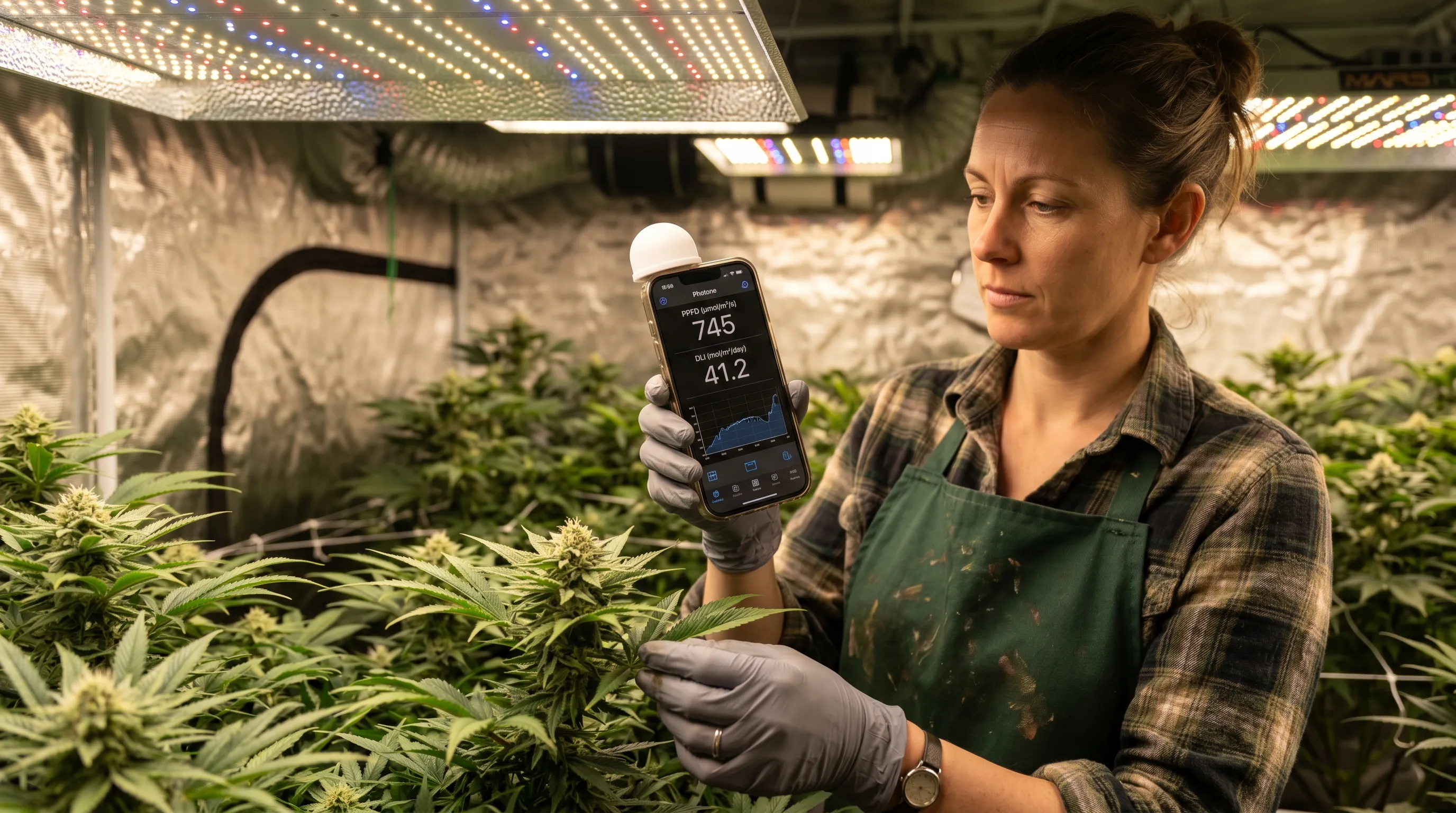 Measuring PPFD with the Photone smartphone app and a £15 diffuser cap. 70-80% accurate enough for hanging distance decisions. PPFD 580 sits in the tomato flowering range; raise the light if seedlings are this close.
Running Cost in the UK at 2026 Electricity Prices
A 100W LED running 16 hours per day uses 1.6 kWh per day. UK electricity in 2026 sits at 28-32p per kWh. The monthly running cost:
| Light wattage | Hours per day | kWh per day | Monthly cost (£) |
|---|---|---|---|
| 60W | 16 | 0.96 | £8-£9 |
| 100W | 16 | 1.6 | £14-£16 |
| 150W | 16 | 2.4 | £20-£23 |
| 250W | 16 | 4.0 | £34-£38 |
| 400W | 16 | 6.4 | £54-£62 |
| 60W | 18 | 1.08 | £9-£10 |
| 100W | 18 | 1.8 | £15-£17 |
| 150W | 18 | 2.7 | £23-£26 |
Running 16 hours per day is the most common UK schedule for vegetative growth and propagation. Flowering tomatoes drop to 12 hours per day from late summer.
Cost vs benefit calculation for a UK home grower:
A 100W LED running March-October (8 months) at 16 hours per day costs roughly £115-£130 per year in electricity. The same setup grows £200-£400 of usable produce (lettuce, herbs, tomatoes) in a 60x60cm tent. Payback under 2 years.
UK heat output from LEDs is 40-60% of the rated wattage. A 100W LED produces 40-60W of heat. This is significant in small grow tents but minor in larger spaces. In an unheated UK shed in winter, the heat helps. In summer, a small extract fan keeps temperatures under 28C.
Hanging Distance and Light Footprint
The right hanging distance depends on the light’s PPFD map and your crop stage.
Full-spectrum 100W (typical UK home grower light):
- Microgreens: 350-450mm above canopy
- Seedlings: 300-400mm
- Vegetative herbs and leaves: 250-350mm
- Flowering tomato: 200-300mm
- Light footprint at 300mm: roughly 60x60cm at full intensity, 90x90cm with edge falloff
Quantum board 200W (mid-tier serious grower):
- Microgreens: 500-600mm
- Seedlings: 400-500mm
- Vegetative: 350-450mm
- Flowering: 300-400mm
- Footprint at 400mm: 90x90cm at full intensity, 120x120cm with edge falloff
Quantum board 400W (serious indoor grower):
- Vegetative: 450-550mm
- Flowering: 400-500mm
- Footprint at 500mm: 120x120cm at full intensity
Best UK LED Grow Light Brands
The UK LED grow light market has 30-40 active brands. Most are rebrands of Chinese OEM products. Five UK-stocked brands have proven track records.
| Brand | Wattage range | UK price (100W) | Strength |
|---|---|---|---|
| Mars Hydro (TS series) | 100-1000W | £100-£140 | Best home grower value |
| Vivosun | 100-650W | £80-£130 | Cheapest reliable option |
| Lumii Pro | 65-600W | £140-£200 | UK-stocked spares |
| Spider Farmer SF/SE | 100-1000W | £120-£180 | Better build quality |
| HLG Quantum Boards | 100-650W | £180-£280 | Highest efficiency |
Mars Hydro TS-1000 is the safe choice for a UK first-time LED buyer. Full-spectrum, 150W actual draw, covers a 60x60cm tent for propagation and vegetative growth. Price £100-£140 with regular sales.
Vivosun VS series is the budget option. Same broad performance at 10-20% lower price. Build quality is acceptable but not premium.
HLG quantum boards are the high-end choice. Top efficiency (2.5-2.8 micromoles per joule), best build quality, and 5+ year warranty. Worth the premium for serious year-round growing.
Avoid no-name Amazon listings with inflated wattage claims (any “1000W” LED claimed to draw 100W is misleading). Check the actual wall draw rating, not the equivalent wattage. Quality brands show both clearly.
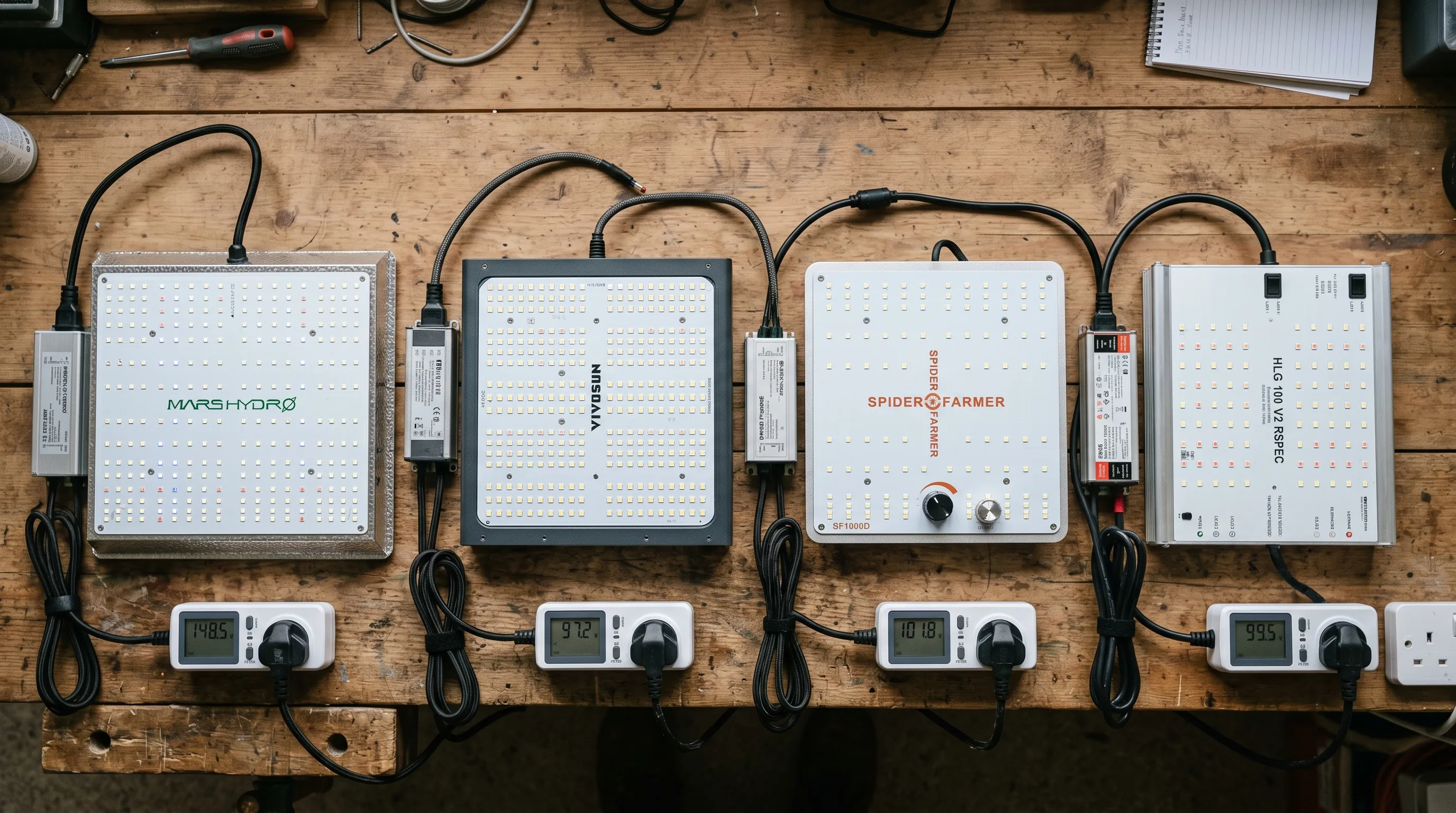 Four reliable UK LED grow light brands compared on the bench. Each shown with actual measured wall draw on a plug-in wattmeter. The Mars Hydro TS-1000 offers the best home-grower value at £100-£140; the HLG quantum board is the premium choice for serious indoor growing.
When to Run the Light Hours: Day Length Schedules
UK indoor growers use different light schedules for different growth stages.
Seedling and propagation (March-May, year-round): 16 hours on, 8 hours off. Drives strong vegetative growth without excess heat.
Vegetative leafy crops (lettuce, herbs): 16-18 hours on, 6-8 hours off. Continuous near-daylight cycle. Crops do not flower under this schedule.
Flowering and fruiting tomatoes, peppers: Drop to 12 hours on, 12 hours off from week 8-10 onwards. The shortened day signals the plant to set fruit. Light intensity stays high during the on hours.
Strawberries (day-neutral varieties): 16 hours on year-round. Many UK indoor strawberry growers harvest 11-12 months per year on this schedule.
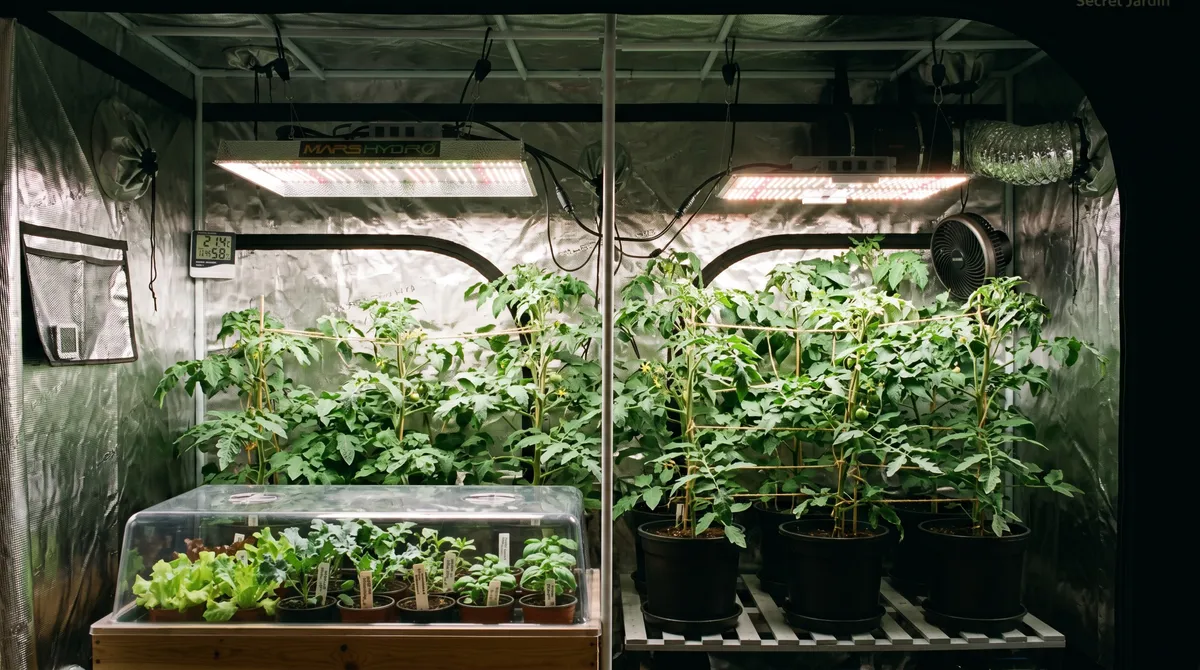
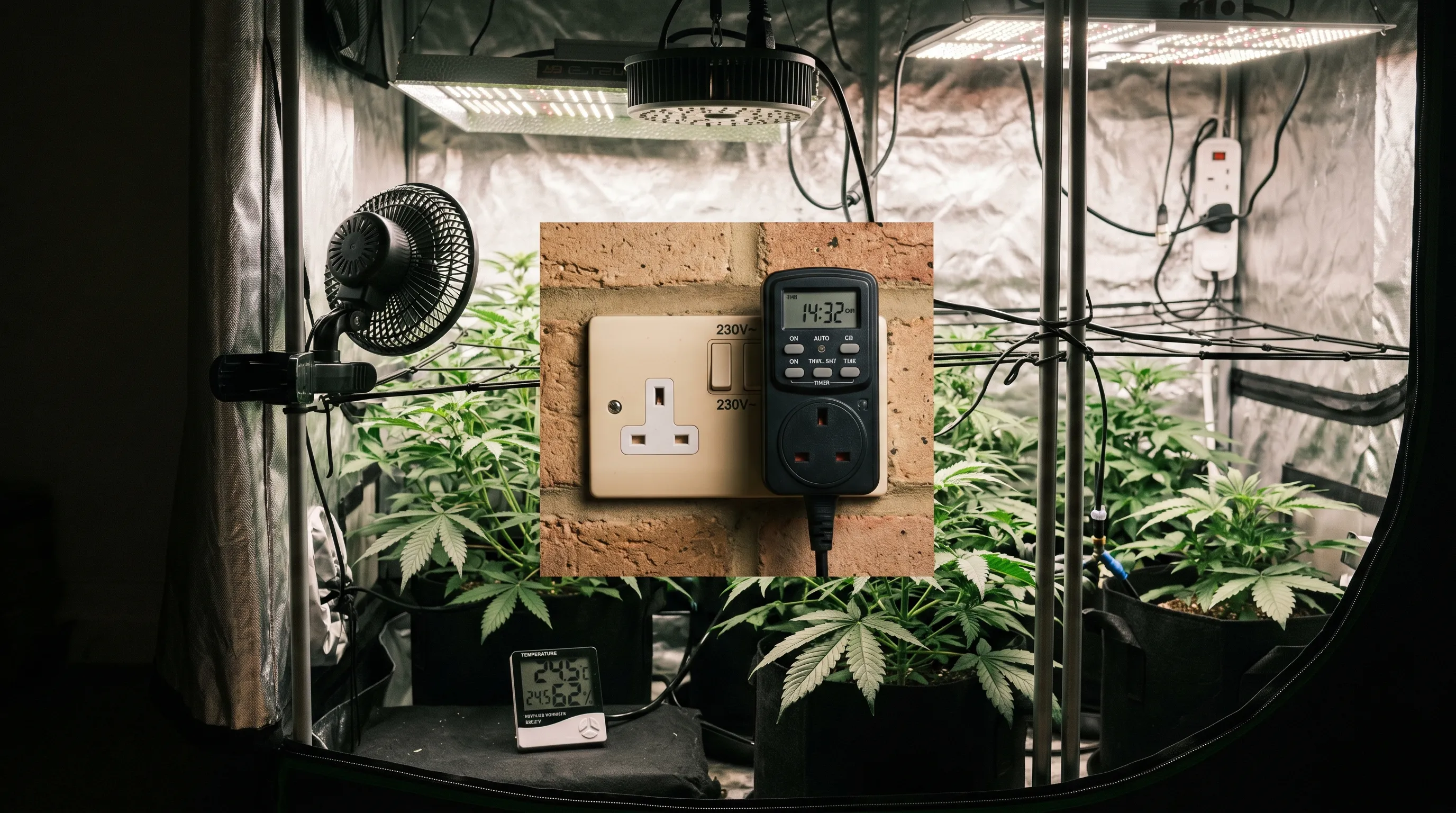 Standard UK grow tent setup: mechanical timer plug on the wall socket, clip-on extract fan on the corner pole for airflow, digital thermometer and hygrometer on the floor for monitoring. Total cost £40-£70 in supporting kit beyond the LED itself.
Microgreens: 14-16 hours on, harvested every 7-14 days. Short cycle but high crop turnover.
Use a mechanical or smart timer (£8-£25) on the light socket. Never run continuous light: plants need a dark cycle for nitrogen metabolism. Continuous 24/7 light reduces yield by 15-25% versus a 16/8 cycle at the same total daily light integral.
Common Mistakes With UK LED Grow Lights
Mistake 1: trusting equivalent-wattage marketing. A “1500W LED” rated at 150W actual draw is performing as a 150W LED, not a 1500W one. Buy on actual wattage at the wall.
Mistake 2: hanging the light too close. Light burn from too-close LEDs bleaches upper leaves. Start at 400mm and lower in 50mm steps until growth is balanced.
Mistake 3: ignoring heat in a small tent. A 100W LED in a 60x60cm tent raises internal temperature 5-8C above ambient. Add a small clip fan for £15-£25.
Mistake 4: switching off for sunny days. Even bright UK summer sun delivers 800-1500 PPFD outside but only 100-300 PPFD on the typical indoor bench position. Keep the LED running.
For the simpler seed-starting set-up, our beginner article covers the basics without the buyer-guide depth. For greenhouse-side growing, our greenhouse heating guide covers heat addition in unheated UK greenhouses.
LED Grow Light Calendar UK Month-by-Month
| Month | LED grow light task |
|---|---|
| January | Plan spring propagation. Stock spare timer plugs |
| February | Start tomato and pepper seeds under LED on a 16/8 schedule |
| March | Light running 16h/day for seedling production |
| April | Move propagation to greenhouse. LED on for late seedlings |
| May | LED off for the summer unless growing indoors year-round |
| June | Service light: clean dust, check driver fan |
| July | Plan autumn microgreen runs |
| August | Light off through warm weeks unless air-conditioned |
| September | Restart for autumn salad and brassica seedlings |
| October | Light back on for overwintering propagation |
| November | Microgreens, lettuce, basil under light |
| December | Year-round herbs and salad under reduced 12h schedule |
Frequently asked questions
What wattage LED grow light do I need in the UK?
20-30W of actual draw per square foot for seedling and salad crops. 40-60W per square foot for flowering and fruiting tomatoes, peppers and cucumbers. Convert: a 60x60cm tent (4 sq ft) needs 80-120W for seedlings, 160-240W for fruiting crops.
Are full-spectrum LEDs better than red-blue blurple LEDs?
Full-spectrum white LEDs grow the same yield as blurple at similar wattage but are far easier on the eyes and let you inspect plants for pest and disease. Blurple is 15-25% cheaper but most UK home growers switch to full-spectrum after their first season.
What is PPFD and why does it matter for grow lights?
PPFD (photosynthetic photon flux density) measures the light intensity reaching the plant in micromoles per second per square metre. Seedlings need 200-400 PPFD. Leafy greens and herbs need 300-500. Flowering crops need 600-900. Most quality LED brands publish PPFD maps for their lights.
How much does it cost to run an LED grow light in the UK?
A 100W LED running 16 hours per day uses 1.6kWh per day. At 2026 UK electricity prices of around 28-32p per kWh, that is £15-£17 per month. A 60W seedling light costs £8-£10 per month. Heat output is low; no greenhouse heater offset is significant.
How close should LED grow lights be to plants?
Most full-spectrum LEDs sit 200-400mm above the canopy. Closer than 150mm risks light burn (bleached leaves). Further than 500mm wastes light. Quality brands publish hanging-distance guides per wattage and growth stage.
Now plan the wider indoor setup
LED grow lights are the centre of any indoor UK growing setup. For the propagation side, our grow lights for seed starting guide covers the simple beginner set-up. For greenhouse growing alongside indoor LED, our greenhouse heating guide covers how to add heat to an unheated UK greenhouse. Our greenhouse ventilation guide covers the airflow that matches LED-grown crops moving outdoors. And to harden off LED-grown seedlings ready for the garden, our how to harden off seedlings guide covers the 7-10 day transition window.
Our team produces practical UK gardening guidance from source research, contributor records and established horticultural practice. Editorial standards are overseen by Matt W.