Key takeaways
- A 9cm or P9 pot holds about 0.5L; a 2L pot is 15 to 17cm across
- Doubling pot diameter multiplies volume by roughly eight, not two
- Pot on one or two sizes at a time to avoid waterlogged unrooted compost
- Trade codes C2, C3 and C5 simply mean 2L, 3L and 5L container-grown
- A 50L bag of compost fills about five 10L pots or twenty 2L pots
- A filled 25L pot weighs 22 to 28kg wet, so site it before you fill it
Plant pot sizes in Britain follow two systems at once, which is why they confuse everyone. Anything above one litre is sold by volume, so you buy a 2L, 5L or 10L pot. Anything below that is sold by top diameter in centimetres, hence the 9cm module. Neither number tells you the pot’s depth, and the two do not convert neatly because pots taper inward towards the base.
This guide gives you the conversion figures nurseries actually work to, from a 9cm module up to a 50L specimen pot. It also covers the part most size charts skip: how to match a pot to a root ball, why potting on one or two sizes at a time matters, and what each size costs, weighs and holds in compost.
UK plant pot size conversion chart: litres to cm
Treat every figure as a working guide rather than a standard. There is no British Standard for nursery pot dimensions. A 5L pot from one grower can be 21cm wide and 22cm deep, while another is 24cm wide and 17cm deep. Both hold five litres.
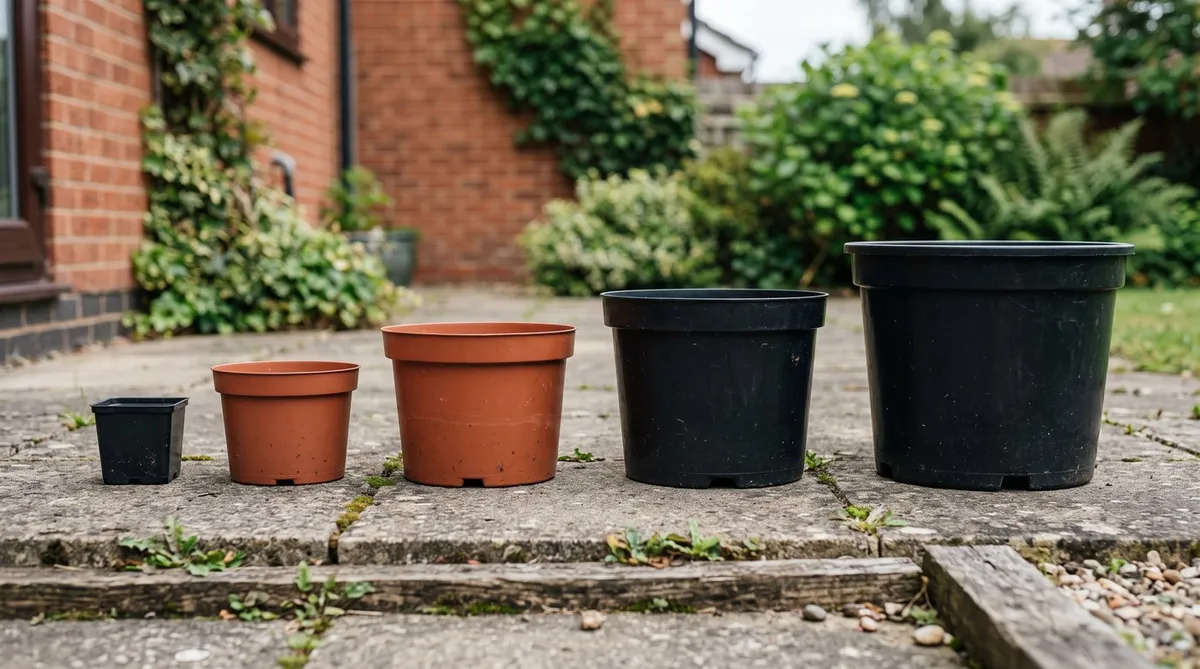
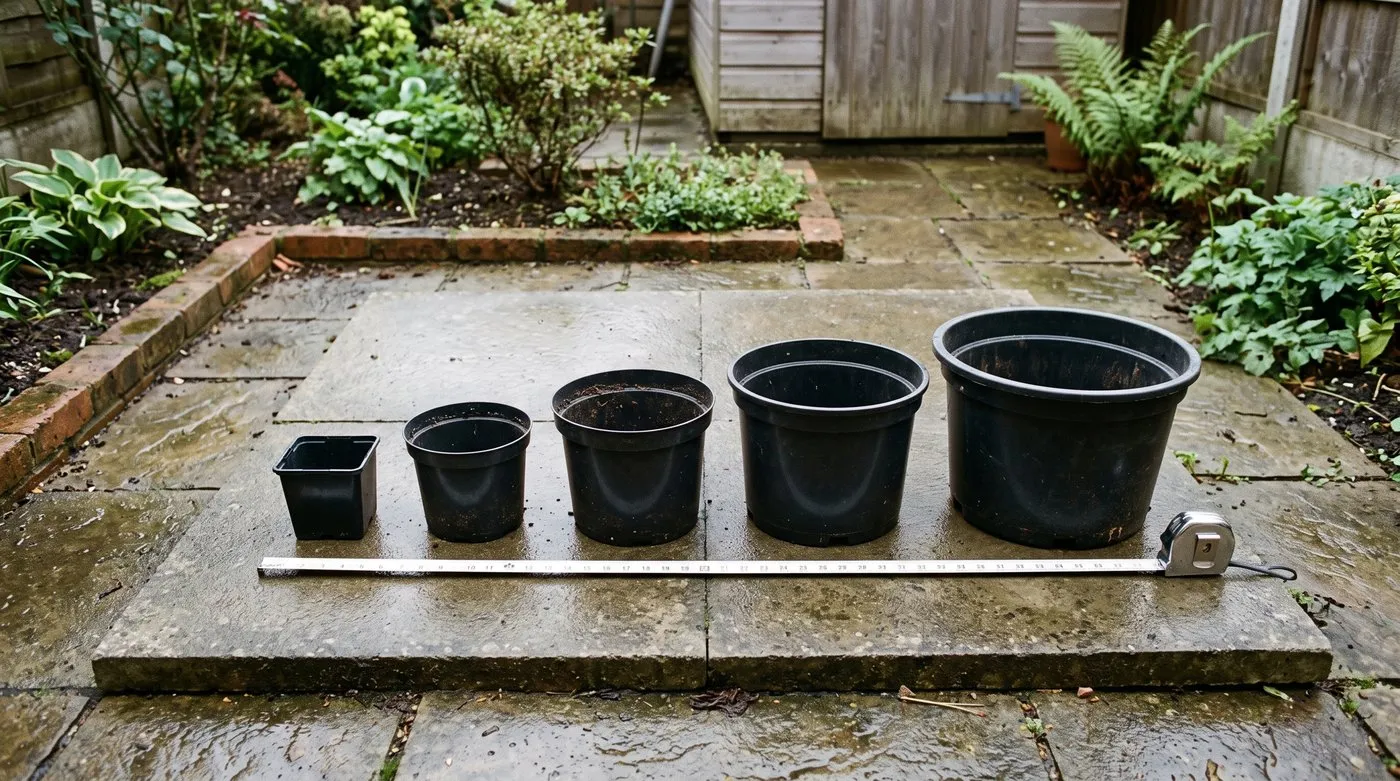 The full working range laid out on a Midlands patio. The jump from 10L to 25L looks small on paper but the larger pot holds two and a half times the compost.
Why litres and centimetres refuse to scale together
Volume grows with the cube of the diameter, not in step with it. Double a pot’s width and you multiply its capacity by roughly eight, assuming the depth doubles too. That single piece of geometry explains why the conversion chart looks so uneven.
A 9cm pot holds 0.5L. A pot twice as wide, at 18cm, holds around 3L rather than 1L. Go to 36cm and you are near 20L. Gardeners who expect a straight line badly underestimate how much compost the bigger sizes swallow.
Pot taper makes it worse. Almost every nursery pot narrows towards its base so pots stack for transport. A typical 5L pot is 22cm at the rim and only 15cm at the base. That taper removes about 25 per cent of the volume a straight-sided cylinder of the same width would hold. Squat pots, sold for alpines and bulbs, lose more again because they trade depth for width.
The practical result is simple. Never assume a pot’s litre rating from its width, and never assume its width from its litres. Read both figures before you buy, especially for mail order.
Trade pot codes P9, C2, C3 and C5 explained
Nursery catalogues use shorthand that rarely gets explained to retail buyers. Once you know the pattern it is straightforward.
P means a pot sized by its top measurement in centimetres. P9 is a 9cm square pot, P11 is 11cm, and so on. These sit below the one-litre threshold where volume labelling takes over. A P9 holds about 0.5L and is the standard unit for young herbaceous perennials.
C means container-grown, followed by the volume in litres. C2 is a 2L container plant, C3 is 3L, C5 is 5L. Some growers write CG2 or simply 2L. The letter matters because it distinguishes container-grown stock from bare-root plants lifted from the field in winter, which carry no compost at all.
You will also meet 9cm written without the P, P13 for a 1.5L equivalent, and litre ratings quoted to one decimal place such as 7.5L. Crocus, one of the larger UK mail-order nurseries, lists both the litre rating and the pot diameter on each plant page, which is the standard other suppliers should follow.
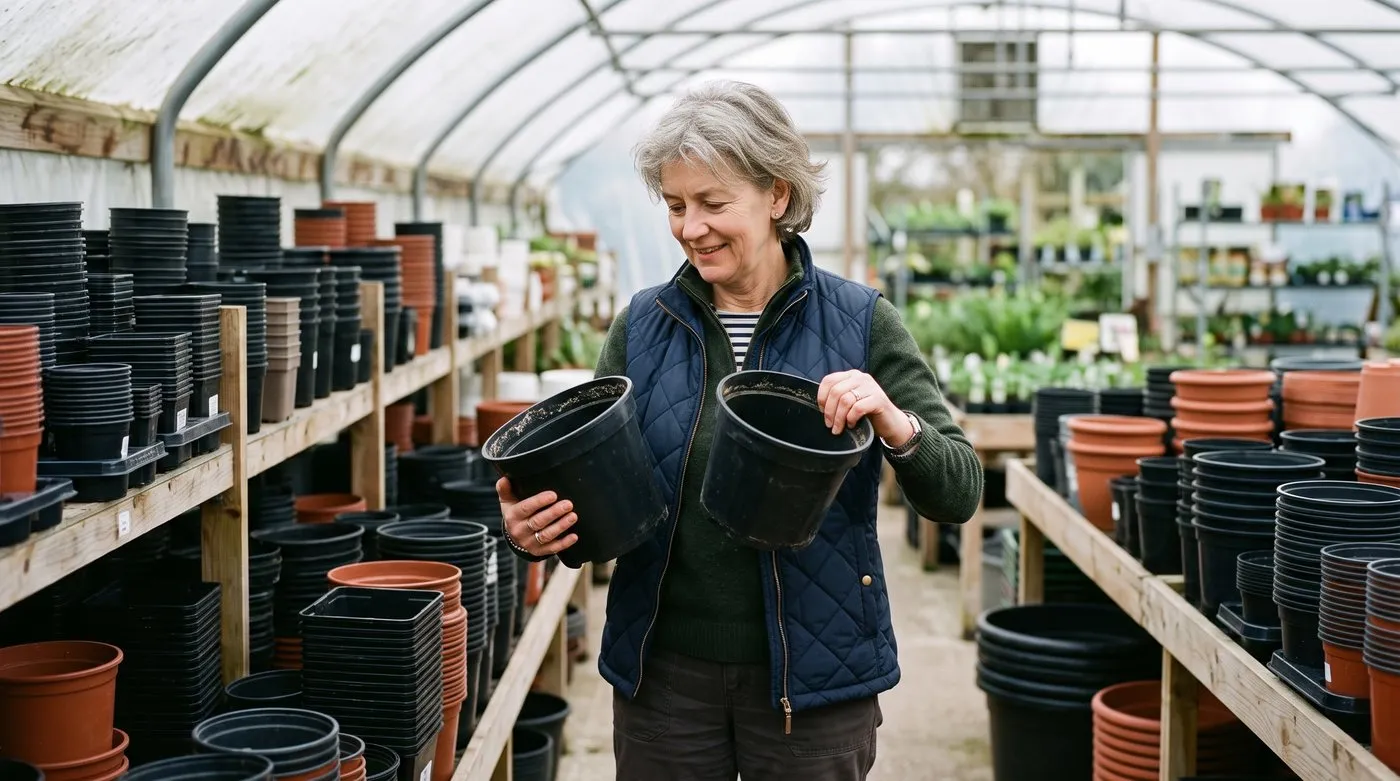 Checking litre rating against rim diameter before buying. The two figures rarely tell the same story, and the label often gives only one of them.
Matching pot size to root ball
Root ball width, not plant height, decides the next pot. Slide the plant out and measure the compost mass across its widest point. That figure sets your target.
For anything currently in 3L or under, choose a pot 4 to 6cm wider than the root ball. Above 3L, allow 8 to 10cm of fresh compost all round. That means a plant with a 20cm root ball wants a pot around 30cm across, which is a 10L to 15L size.
Depth follows a different rule. Leave 2 to 3cm of compost beneath the root ball and 2cm of clear space between the compost surface and the rim. That gap is your watering reservoir. Without it, water sheets off the surface and runs down the inside of the pot without wetting anything.
Gardener’s tip: Check readiness before you check size. Tip the plant out and look at the outside of the root ball. If white roots circle the compost, it is ready. If the compost crumbles away and shows more brown than white, put it straight back and wait four to six weeks.
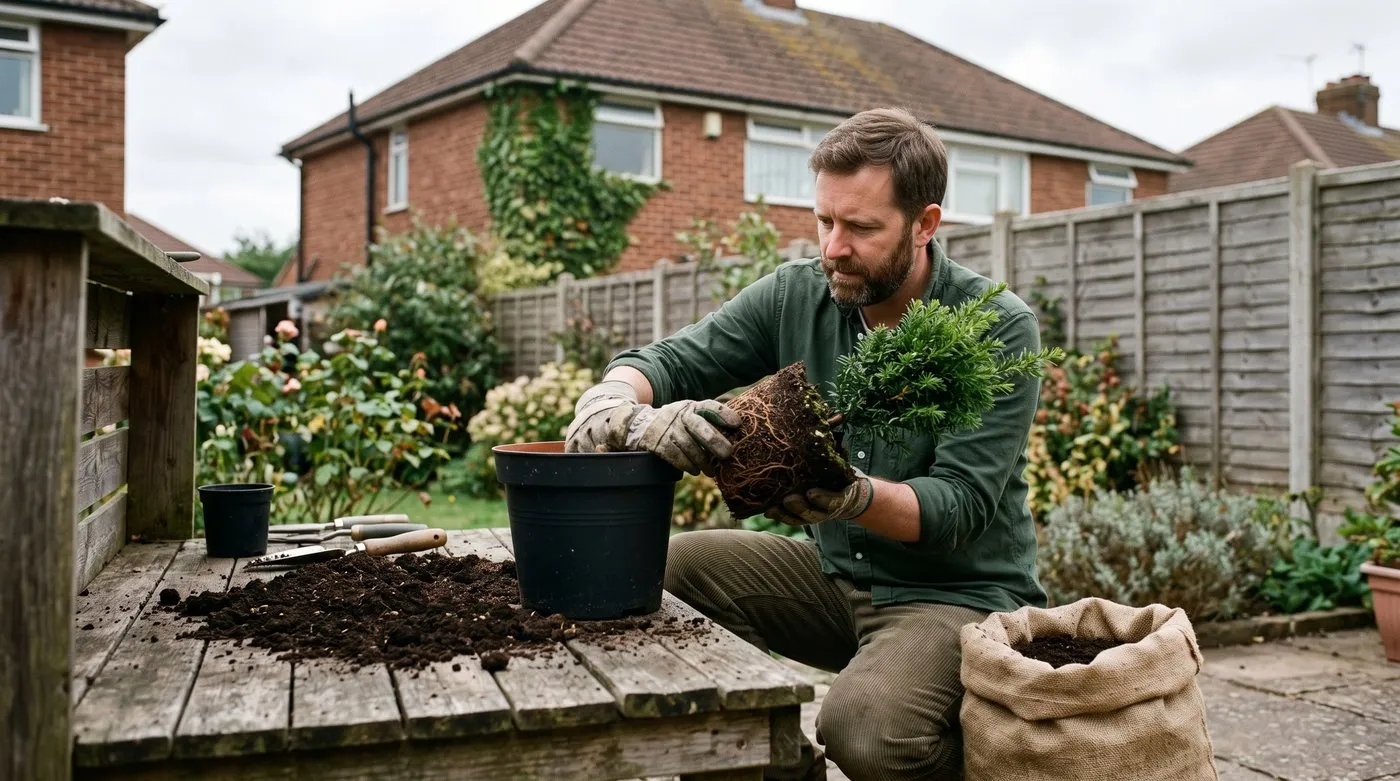 Potting on a viburnum from 3L to 5L on a suburban Midlands potting bench. One size up gives 4 to 6cm of fresh compost all round, which is all the plant needs.
The five stages of a plant filling its pot
Understanding what happens inside a pot after potting on is what stops people over-potting. The process runs in five measurable stages.
- Establishment, days 0 to 14. Roots stay within the original ball. The new compost is wet, unexplored and holding close to its full water capacity of 60 to 70 per cent by volume.
- Bridging, days 14 to 35. Fine white roots cross into fresh compost. Soil temperature drives this. Below 8C root growth nearly stops, while 15 to 20C gives the fastest bridging.
- Colonisation, weeks 5 to 12. Roots occupy the outer third of the new compost. Water use climbs sharply and the pot now dries at a normal rate.
- Full occupation, months 3 to 8. Roots reach the pot wall and begin to circle. Nutrient demand peaks. Slow-release feed applied at potting is typically spent after five to six months.
- Root-bound, month 8 onward. Circling roots form a dense mat. Water runs straight through without wetting the core, and top growth stalls.
The critical mistake sits in stages one and two. Compost with no roots in it has no plant drawing water out of it. In a small step-up that unrooted zone is thin and dries within a fortnight. In a huge pot it is a saturated ring that stays wet for six to ten weeks. Oxygen falls, Pythium and Phytophthora root rots take hold, and the plant dies from the roots up while looking fine on top.
Pot sizes by plant type: what each group actually needs
Different plants need genuinely different volumes, and the differences are larger than most people assume.
Bedding and annuals need very little. One bedding plant per 1 to 2L is plenty, so a 30cm pot at 15L comfortably takes eight to ten plants. Herbs vary widely: basil and coriander are happy in 1L, but rosemary, sage and bay want 7.5L or more within two years, and mint needs its own 5L pot to stop it colonising everything.
Shrubs should go into 10 to 20L for the long term. A hydrangea in a 5L pot needs watering twice daily in July, which no one sustains. Small trees including patio apples on M27 rootstock need 35 to 50L minimum. Tomatoes need 10L absolute minimum per plant, and 15 to 20L gives noticeably better fruit set through irregular watering.
| Plant type | Minimum pot | Recommended pot | Role of the extra volume |
|---|---|---|---|
| Bedding annuals | 1L per plant | 2L per plant | Longer between waterings |
| Culinary herbs | 1L | 5 to 7.5L | Winter survival outdoors |
| Perennials | 2L | 5 to 10L | Three to four years before division |
| Shrubs | 7.5L | 15 to 20L | Gold standard, survives a heatwave |
| Tomatoes | 10L | 15 to 20L | Prevents blossom end rot |
| Patio fruit trees | 25L | 35 to 50L | Root volume for cropping |
The 15 to 20L shrub pot is the gold standard for UK patio planting. It holds enough compost to buffer a 30C July day without daily watering, and it is still light enough for two people to move. Below 10L you are committing to summer watering every single day.
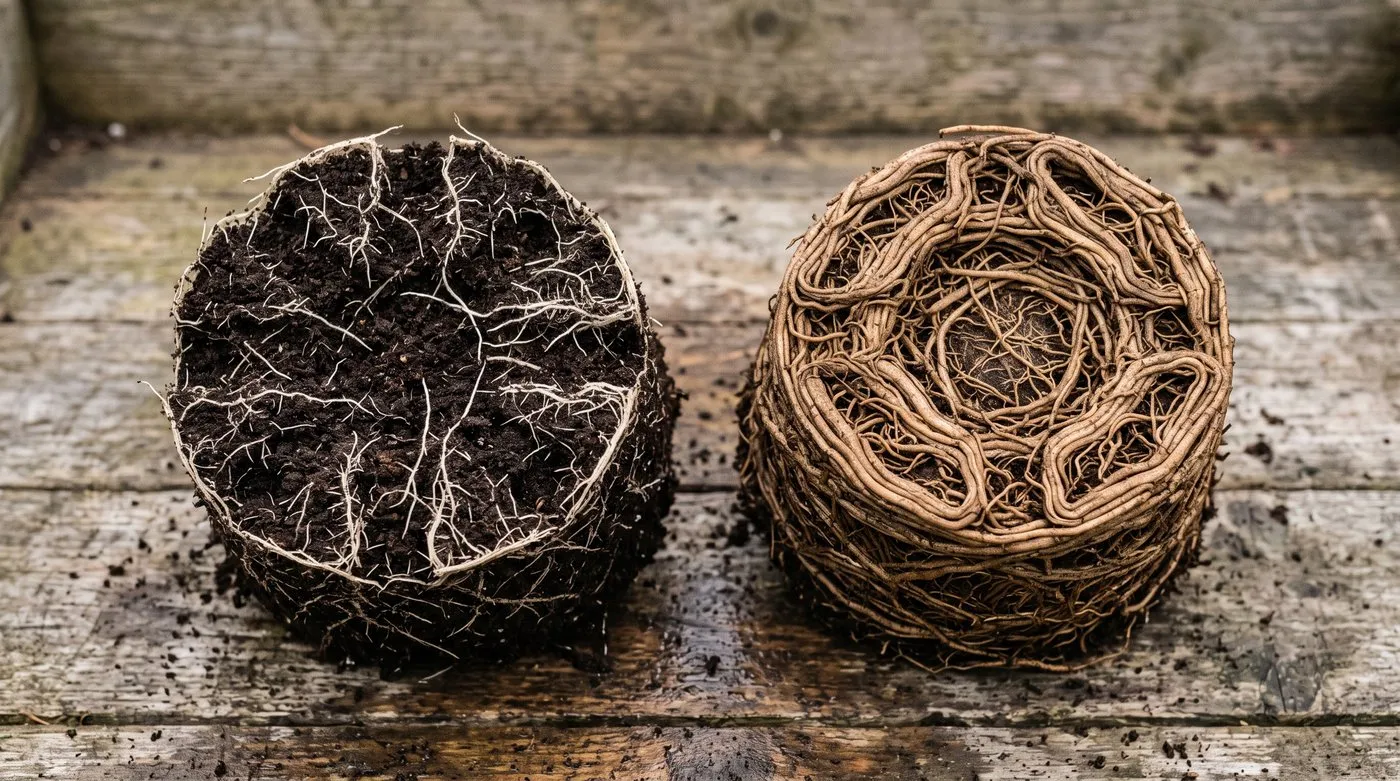 Left, a root ball ready to pot on with white roots just reaching the edge. Right, a root-bound plant left two seasons too long, with a matted shell that water runs straight past.
How much compost each pot size holds
Compost is sold in 40L, 50L and 60L bags in the UK, and a bag never fills as many pots as the arithmetic suggests. Compost compresses when you firm it, and it settles again after the first watering. Allow 10 per cent extra on every calculation.
| Pot size | Pots per 50L bag | Compost cost per pot |
|---|---|---|
| 9cm / P9 | About 110 | 6p |
| 1L | About 45 | 15p |
| 2L | About 22 | 32p |
| 5L | About 9 | 78p |
| 10L | About 5 | £1.40 |
| 20L | About 2 | £3.50 |
| 50L | Just under 1 | £7.50 |
Those costs assume a 50L bag of peat-free multipurpose at £7, which is a realistic 2026 UK price. John Innes No.3 loam-based compost costs more, around £8 to £10 for 25L, but its higher weight and mineral content make it the right choice for permanent shrub and tree planting in pots over 15L.
Mixing helps at the larger sizes. Our standard fill for anything over 15L is two parts peat-free multipurpose to one part John Innes No.3, plus 10 per cent horticultural grit by volume. That mix costs about 40 per cent more than multipurpose alone but lasts three seasons instead of one.
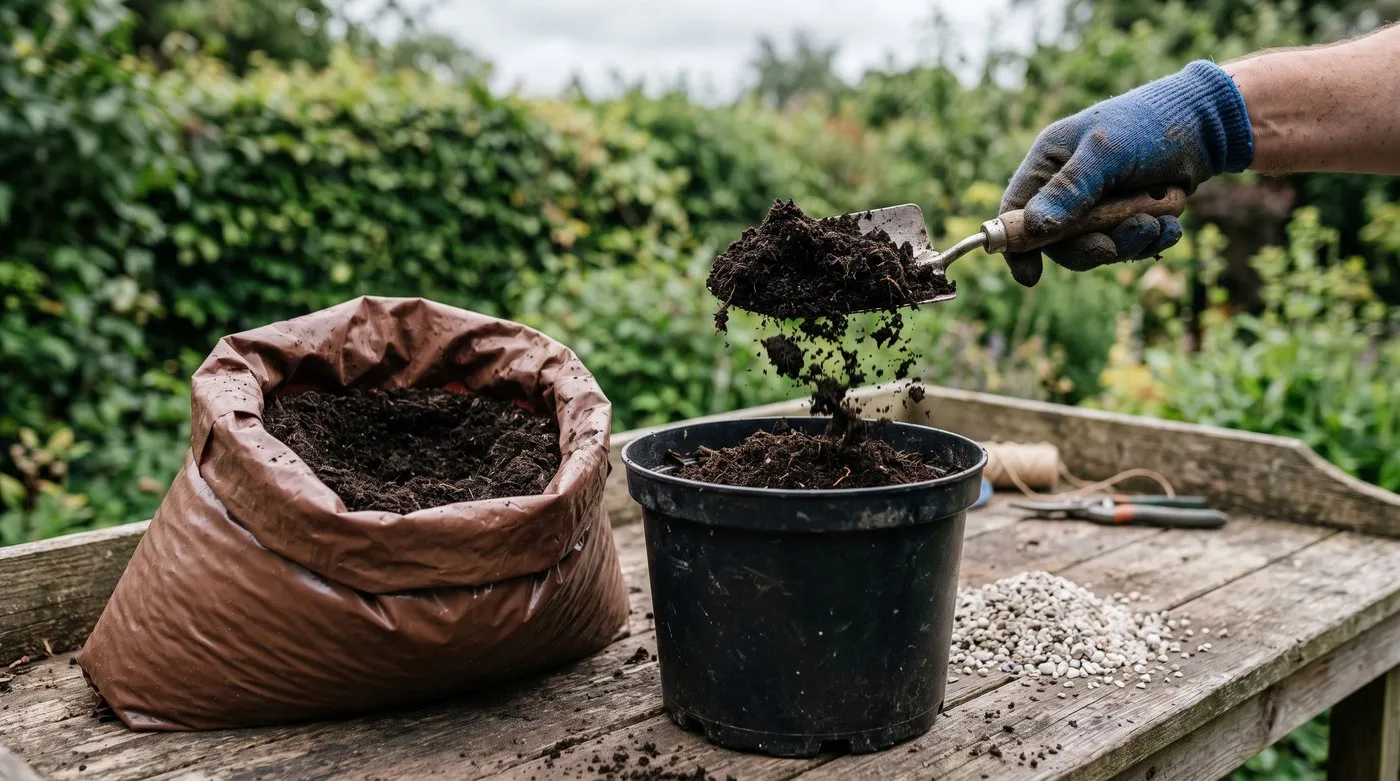 Filling a 10L pot takes just over a fifth of a 50L bag once the compost is firmed and settled. Grit added at 10 per cent by volume keeps drainage open for three seasons.
Air pots and root trainers: when the shape beats the size
Two specialist pot designs solve the root-circling problem that stage five brings, and both work at smaller volumes than a standard pot.
Air pots are perforated plastic cylinders with an eggbox wall profile. When a root tip reaches a hole it meets dry air and stops, which triggers the plant to branch behind the tip. The result is a dense fibrous root mass rather than a coiled shell. A 20L Air-Pot grows a tree that establishes faster than the same tree from a 25L conventional pot. They cost £9 to £14 for 20L, dry out roughly 20 per cent faster, and need watering accordingly.
Root trainers are hinged deep cells, typically 5cm square and 12 to 20cm deep, holding 250 to 500ml each. They suit deep-rooted seedlings that hate disturbance: sweet peas, broad beans, runner beans and tree seedlings. Ribbed inner walls guide roots straight down rather than round. A set of 32 deep cells costs £18 to £25 and lasts a decade.
The shared principle is that root architecture beats raw volume for young plants. A well-branched root system in 0.5L transplants better than a coiled one in 2L.
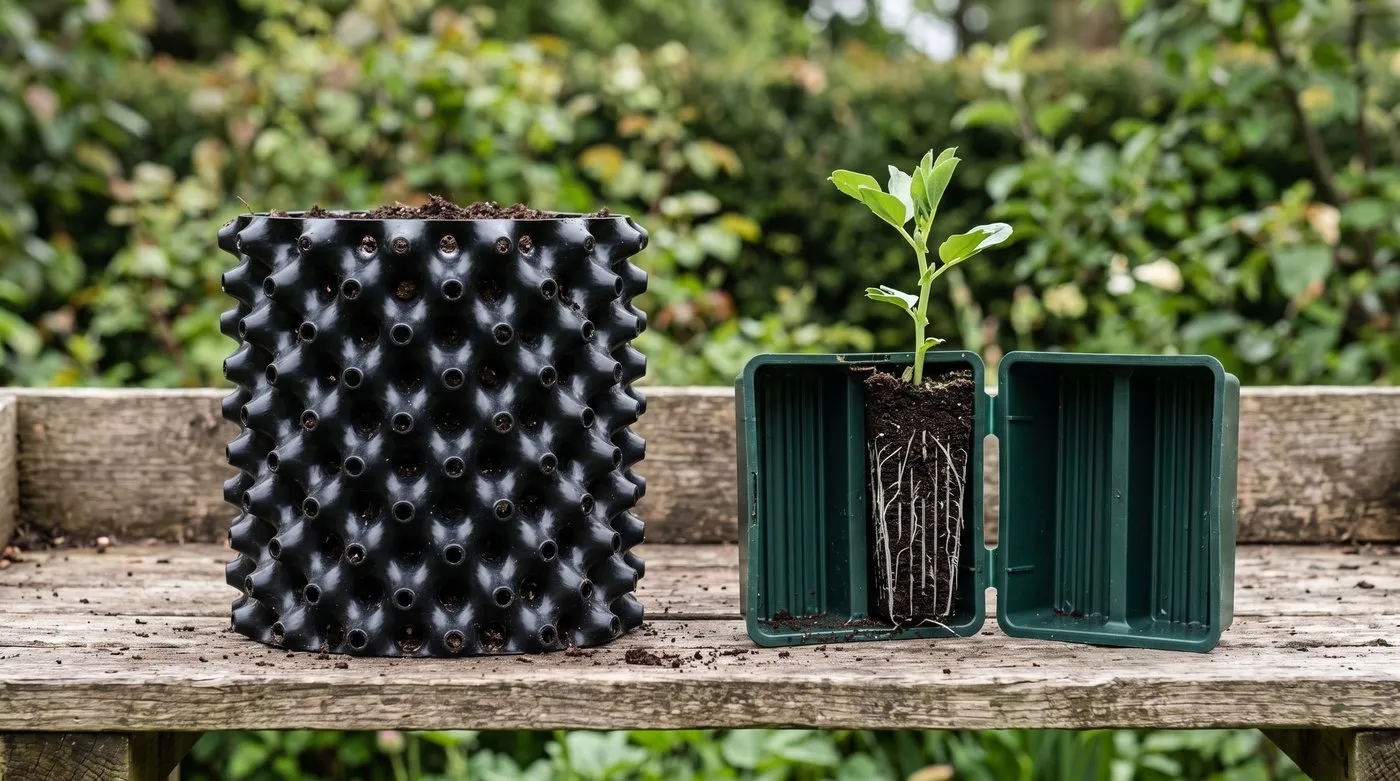 An Air-Pot next to opened root trainers. Both prune roots by air or by ribbing rather than letting them circle the inside of a smooth wall.
Pot weight and drainage: the figures people forget
Weight decides where a pot can live, and it is routinely underestimated. Dry peat-free multipurpose weighs around 400g per litre. Wet, it climbs to 800 to 900g per litre. John Innes No.3 is heavier again at 1.3 to 1.5kg per litre because of its loam and sand content.
| Pot size | Empty pot | Filled dry | Filled wet | Move it how |
|---|---|---|---|---|
| 5L | 0.1kg | 2.1kg | 4.5kg | One hand |
| 10L | 0.2kg | 4.2kg | 9kg | Two hands |
| 20L | 0.4kg | 8.4kg | 18kg | Two hands, short distance |
| 25L | 0.5kg | 10.5kg | 22 to 28kg | Sack truck |
| 50L | 1.1kg | 21kg | 45kg | Trolley, two people |
A 25L pot filled with a loam mix on a first-floor balcony can exceed 45kg. Domestic balconies are typically designed for 150kg per square metre, so three such pots in one corner is a genuine structural question, not a theoretical one.
Drainage needs scale with volume too. A 2L pot manages on its four moulded holes. Anything over 15L wants at least six drainage holes of 10mm or more, plus 3 to 5cm of grit or crocks at the base. Standing large pots on pot feet raising them 20 to 30mm stops the base holes sealing against a patio slab, which is the single most common cause of winter waterlogging.
Warning: Never fill a large pot in its final position and then decide to move it. A wet 50L pot at 45kg will strain your back and crack a terracotta rim if you drag it. Site it first, then fill it. Buy pot trolleys at £12 to £25 for anything you plan to shift seasonally.
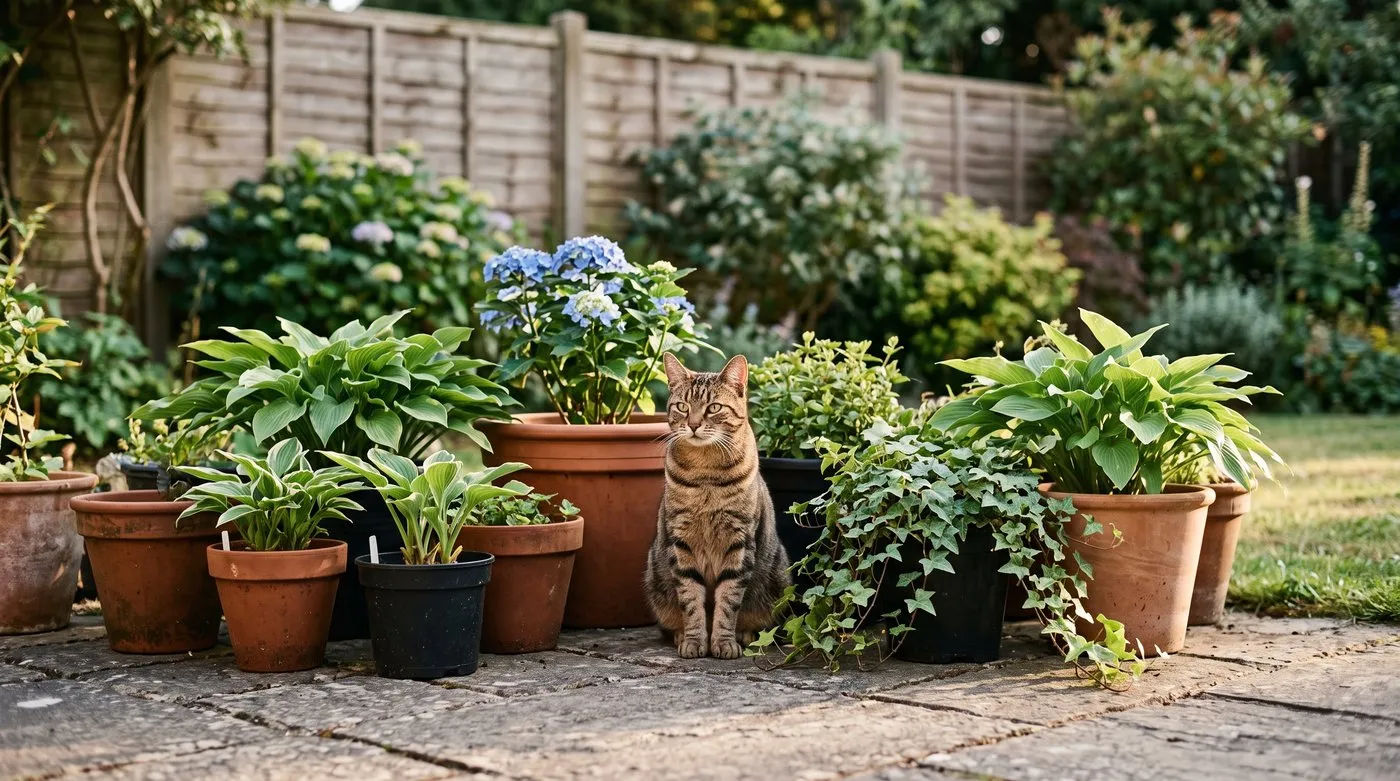 Grouped pots on a Midlands patio. Clustering sizes together shades the pot walls and cuts summer water loss by around a fifth.
What plant pots cost in the UK
Pot prices span two orders of magnitude, and the cheapest option is rarely the false economy people expect.
| Pot type | Size | Price each | Lifespan |
|---|---|---|---|
| Recycled plastic nursery pot | 2L | 40p to 70p | 5 to 8 years |
| Recycled plastic nursery pot | 10L | £1.80 to £3.00 | 5 to 8 years |
| Heavy-duty black plastic | 25L | £4.50 to £8.00 | 10 years plus |
| Terracotta | 30cm / 15L | £18 to £35 | Decades if frost-proof |
| Glazed ceramic | 40cm / 25L | £35 to £70 | Decades |
| Air-Pot | 20L | £9 to £14 | 10 years plus |
| Root trainers, 32 deep cells | 0.5L each | £18 to £25 | 10 years plus |
The hidden costs matter more than the sticker price. A 15L terracotta pot needs refilling with fresh compost every two to three years at £2.50 a time. Unglazed terracotta loses water through its walls, so it needs 30 to 40 per cent more watering than plastic of the same volume. Non-frost-proof terracotta from a supermarket at £8 will flake and split in its first hard winter, which is why the frost-proof grade at £18 upward is the cheaper buy over ten years.
The root cause of pot failure is unrooted compost
Almost every container death blamed on overwatering is actually an over-potting problem. The gardener waters normally. The plant still drowns. The cause is not the watering can.
Compost only dries by two routes: evaporation from the surface, and transpiration through roots. In a correctly sized pot, roots reach most of the compost within a month and drive that second route hard. In an over-large pot, the outer 5 to 10cm may hold no roots for three months. Nothing is pulling water out of it. It sits at field capacity, oxygen falls below the 10 per cent that roots need, and anaerobic conditions follow.
The permanent fix is not better drainage or less water. It is correct pot progression: 9cm, then 1L, then 3L, then 7.5L, then 15L. Each step doubles or triples the volume, which roots colonise in four to eight weeks in the growing season. If you have already over-potted something and it is sulking, the fix is to lift it out and drop it back into a pot one or two sizes down, in fresh compost, and start again. Our guide to fixing root-bound seedlings covers the opposite failure, where plants are left too long in a pot that is far too small.
Month-by-month potting calendar for UK gardens
| Month | Potting task |
|---|---|
| January | Wash and sort last year’s pots. Check terracotta for frost cracks before spring. |
| February | Sow into P9 modules and root trainers under cover at 15 to 18C. |
| March | Pot on overwintered cuttings from 9cm to 1L as growth restarts. |
| April | Main potting-on month. Soil temperature reaches 10C and roots bridge fast. |
| May | Move tomatoes to their final 15 to 20L pots after the last frost. |
| June | Top-dress rather than repot. Scrape off 5cm and replace with fresh compost. |
| July | No potting on. Root disturbance in heat costs plants two weeks of growth. |
| August | Pot up strawberry runners and semi-ripe cuttings into 9cm modules. |
| September | Best autumn window. Pot on shrubs while soil is still 12C or above. |
| October | Move tender plants in pots under cover. Check drainage holes are clear. |
| November | Raise all large pots onto feet before winter rain. Stop feeding. |
| December | Group pots against a wall. Wrap 25L and larger with fleece in cold spells. |
Common mistakes with plant pot sizes
For soil and compost background beyond pot dimensions, the RHS guidance on container growing and Garden Organic both hold sound peat-free advice that pairs well with the sizing figures here.
Now you know exactly what each pot size holds, take the next step with our practical guide to repotting houseplants, or browse more of our how-to gardening guides for the next job.
Frequently asked questions
What size is a 2 litre plant pot in cm?
A 2 litre pot measures roughly 15 to 17cm across the top and 15cm deep. Exact figures vary by manufacturer because pot taper differs. Two litres is the standard UK nursery size for perennials and small shrubs, and it is the size most mail-order plants arrive in.
How many cm is a 5 litre pot?
A 5 litre pot is about 21 to 23cm wide at the rim and 20cm deep. It suits larger shrubs, established roses and small climbers. Squat five-litre pots run wider and shallower, so always check the depth if you are planting something deep-rooted.
What does P9 mean on a plant pot?
P9 means a square pot measuring 9cm by 9cm at the top. It holds roughly 0.5 litres of compost and stands 9 to 10cm tall. Nurseries use P9 for young perennials, herbs and rooted cuttings because the square shape packs efficiently onto a trolley.
What do the pot codes C2, C3 and C5 mean?
C2, C3 and C5 mean container-grown plants in 2, 3 and 5 litre pots. The letter C tells you the plant was grown in a container rather than lifted bare-root. Some nurseries write CG or simply 2L, but the volume figure means the same thing.
Can you put a small plant straight into a big pot?
No, moving a small plant into a very large pot usually kills it. The compost the roots have not reached stays wet for weeks. That sour, airless zone triggers root rot. Step up one or two pot sizes instead and pot on again next season.
How much compost do I need to fill a pot?
A 50 litre bag of compost fills about five 10 litre pots. It also fills roughly twenty 2 litre pots or two 20 litre pots. Allow 10 per cent extra because compost settles and compresses once you firm it and water it in.
What size pot does a tomato plant need?
Our team produces practical UK gardening guidance from source research, contributor records and established horticultural practice. Editorial standards are overseen by Matt W.