Key takeaways
- Lilac flowers on wood produced the previous summer so all pruning must happen within two weeks of flowers fading
- Mid-June is the UK window for routine deadheading and shaping cuts
- Cut spent panicles back to just above the next pair of healthy leaves to direct energy to next year's flower buds
- Rejuvenate old shrubs by taking one third of the oldest stems to ground each year over three consecutive years
- Remove suckers from the base of grafted lilacs in summer but leave them on own-root plants if you want a thicket
- Never prune in winter or autumn or you lose all the next season's flowers
Lilac is one of the most reliable May-flowering shrubs in UK gardens, and one of the most frequently butchered by gardeners pruning at the wrong time of year. The single rule that matters is this: lilac flowers on wood produced the previous summer. Anything that cuts off that wood (winter prune, autumn tidy, hard February cut-back) removes the flowers before they form.
This guide covers the right pruning window, the cut to use after flowering, the three-year rejuvenation routine for old neglected shrubs, and the common mistakes that turn a healthy lilac into a leggy shrub with no flowers.
Why timing is the whole story
Lilac sets its flower buds in July and August on the new wood produced that summer. Those buds sit dormant through winter and open the following May. Cut the buds off and there are no flowers.
This is why every authoritative pruning guide gives a tight window of within two weeks of the last flower fading, typically mid-June in the UK depending on the season. Earlier in spring is too early because the panicles have not finished. Later than late June risks cutting into the new wood that carries next year’s buds.
Pruning in June preserves the longest possible period for replacement shoots to mature and set flower buds. Pruning in August or winter removes much of the wood that would carry the following spring’s display.
For the wider principle of summer-flowering shrub pruning see our guide to shrubs to prune in summer.
How to deadhead spent panicles
The annual job after flowering is deadheading. This is the single most important pruning task on a healthy lilac. It removes the brown spent flowers and redirects the energy the plant would otherwise put into seed production back into next year’s flower buds.
The technique:
- Wait until flowers have faded and turned brown but the leaves below remain green and healthy.
- Use sharp bypass secateurs disinfected with methylated spirits between shrubs.
- Identify the spent panicle and trace the stem down to the first pair of healthy green leaves.
- Cut the stem just above that pair of leaves, around 5mm above the leaf node.
- The buds in those leaf axils become next year’s flowering shoots.
- Repeat on every spent panicle.
The cut must be above the next pair of leaves, not into the older wood lower down. Cutting too deep removes the wood that will produce flowers. The two leaves below the cut are what carry next year’s flowers.
For a 1.8-metre established Syringa vulgaris this job takes roughly 45 minutes and removes 60 to 100 spent panicles. Bin or compost the cuttings (no disease concern, unlike clematis or rose).
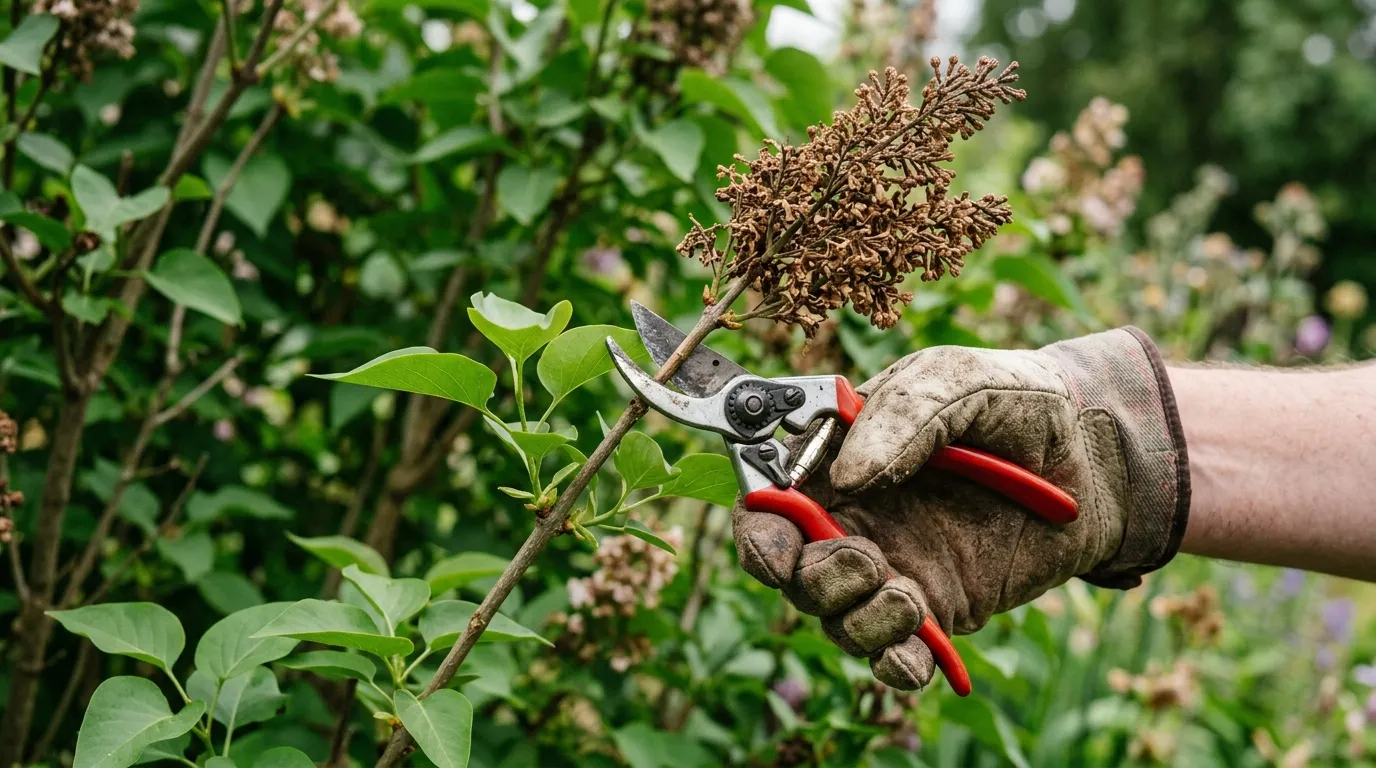 The deadheading cut: just above the next pair of healthy leaves below the spent flower. The two leaf axils visible above the cut will produce next year’s flowering shoots.
Light annual shaping in the same window
Once the deadheading is done, the same mid-June window is the right time for light shaping. The goal is to keep the shrub in proportion without removing flowering wood.
Three types of cut to make in June:
- Crossing or rubbing stems: Remove one of any pair of stems that rub against each other. The wound at the rub point invites infection.
- Dead or damaged wood: Cut back to healthy live tissue, identifiable by the white centre when you nick the bark.
- Wayward stems: Stems heading horizontally into a path or fence can be cut back to the next side branch growing in a useful direction.
Avoid the temptation to “tidy up” by shortening every stem. Every cut you make is one fewer panicle next May. Lilac wants to be left alone once it is shaped.
Rejuvenation pruning for old neglected shrubs
A lilac that has been left for 15 to 30 years often develops a characteristic problem: bare leggy lower stems with flowering only on the top 600mm or so. The shrub looks ugly and the panicles are out of reach.
The fix is three-year rejuvenation pruning. Spread over three consecutive Junes, this restores a multi-stemmed shrub flowering at every height without losing more than one season of bloom.
The protocol:
- June year one: Identify the oldest one third of the main stems (usually the thickest and tallest). Cut these to within 100mm of the ground using a sharp pruning saw or loppers. New shoots will emerge from the base within 6 to 8 weeks.
- June year two: Take the next oldest one third of stems to ground.
- June year three: Take the final one third to ground.
- June year four onward: The shrub is fully renewed. Resume the standard annual deadhead.
By the end of year three you have a multi-stemmed shrub of fresh young wood flowering at every height. The new shoots from year one will have flowered in their second June (year three of the project).
Why three years and not one? Cutting the entire shrub to ground in one go removes all its leafy framework and risks a weak recovery, especially in a dry summer. The staged approach keeps part of the established canopy functioning while new basal shoots develop. For the cutting technique, see our guide to pruning shrubs.
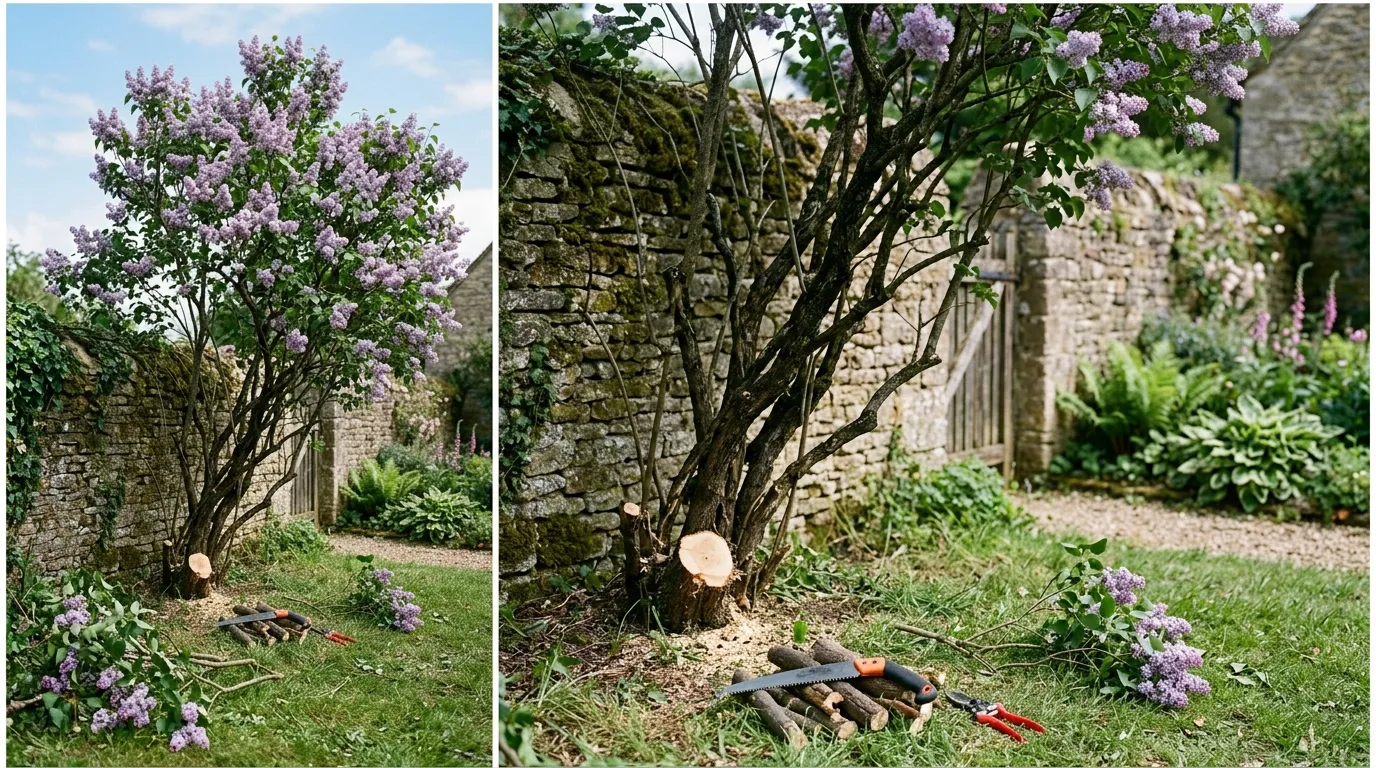 Year one of a three-year rejuvenation prune on a 30-year-old Staffordshire lilac. The first five stems have been taken to 100mm above ground. New shoots emerge from the base within 6 to 8 weeks.
Suckers - when to remove them
Lilac roots produce suckers: new stems that emerge from the root system away from the main shrub. The right action depends on whether the lilac is grafted or on its own roots.
- Grafted lilacs (most named cultivars sold in UK garden centres): The graft union sits at ground level. Suckers emerging below the graft come from the rootstock (usually Syringa vulgaris or privet). They flower a different colour to the cultivar and will overwhelm the named variety if left. Remove all suckers in June by cutting as close to the root as possible and pulling them off if young enough.
- Own-root lilacs (older garden plants and species like Syringa vulgaris): Suckers come from the same plant and flower the same colour. Leave them if you want a multi-stemmed thicket. Remove them if you want a single-stemmed tree-like specimen.
To identify whether your lilac is grafted, look at the base. A swollen knot at soil level indicates a graft union. A smooth taper from stem to root indicates an own-root plant.
For a step-by-step guide to identifying and managing suckers on other shrubs see how to prune shrubs in the UK.
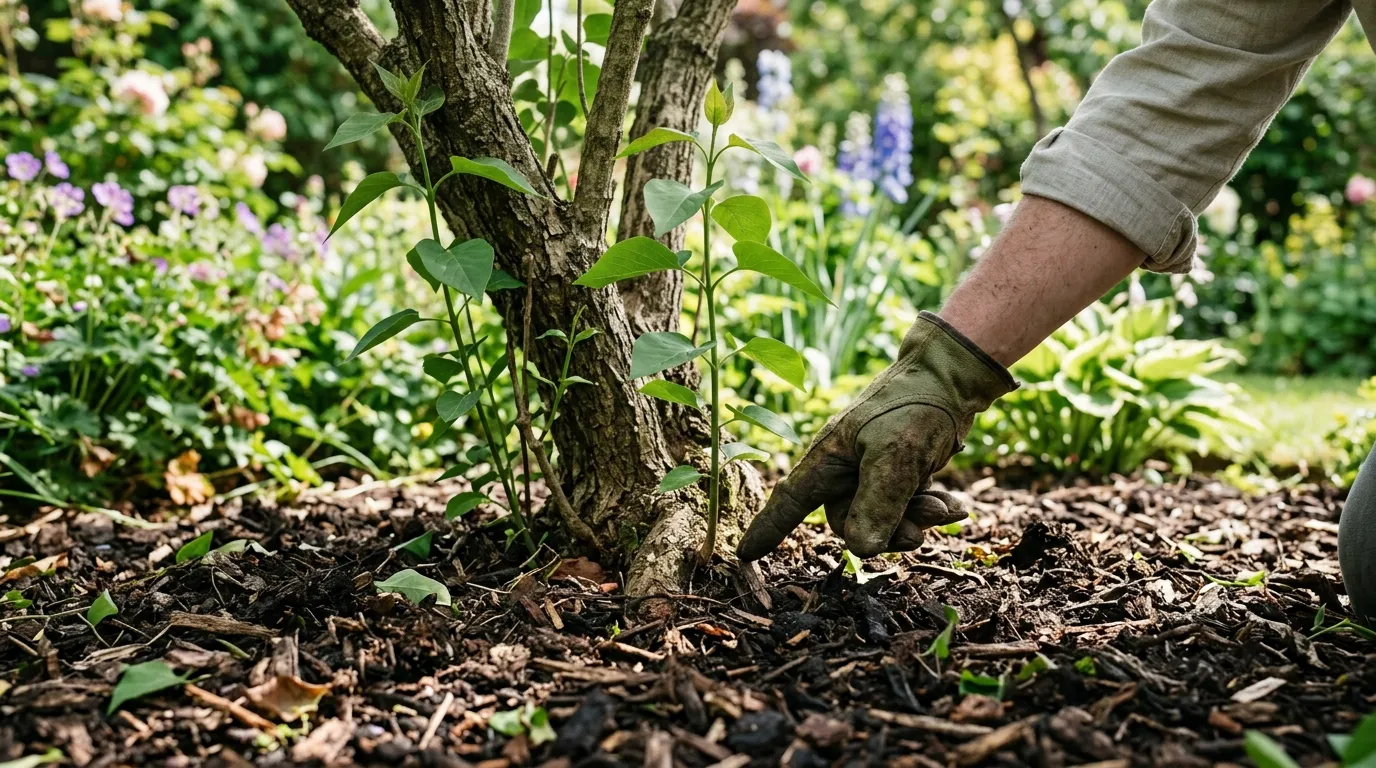 Suckers emerging from the base of a Syringa vulgaris in June. Pull them off while still soft (under 200mm) by sliding a gloved hand down the stem and twisting.
The cardinal sin: winter and autumn pruning
The biology is straightforward. Flower buds for next May are set on this summer’s wood between July and August. By September those buds are visible to the naked eye on the stem tips. A winter prune removes them.
If you have inherited a lilac that has been pruned in February for years, the fix is simple:
- Stop pruning entirely for one season. Let the shrub flower (if any buds survived) and produce fresh wood through summer.
- Resume the correct routine the following June, deadheading and light shaping only.
- By year two or three the panicle count typically recovers to normal.
For another shrub commonly pruned at the wrong time see how to prune hydrangeas in the UK where similar timing rules apply.
Best lilac varieties for UK gardens
| Cultivar | Species | Flower colour | Mature height | Best for |
|---|---|---|---|---|
| Madame Lemoine | S. vulgaris | Pure white double | 4 to 5m | Mature gardens, formal schemes |
| Charles Joly | S. vulgaris | Deep magenta double | 4 to 5m | Strong colour impact |
| Sensation | S. vulgaris | Purple edged white | 3 to 4m | Striking patio specimen |
| Beauty of Moscow | S. vulgaris | Pink bud opening white | 3 to 4m | Cottage gardens |
| Katherine Havemeyer | S. vulgaris | Lavender-purple double | 4m | Strong scent, classic look |
| Palibin | S. meyeri | Pale lilac | 1.2 to 1.5m | Small gardens, containers |
| Superba | S. x persica | Pink-lilac | 1.5 to 2m | Mixed border, lighter scent |
| Esther Staley | S. x prestoniae | Pink | 3m | Later flowering (June) |
| Charisma | S. x josiflexa | Pink panicles | 3m | Hardy in northern UK |
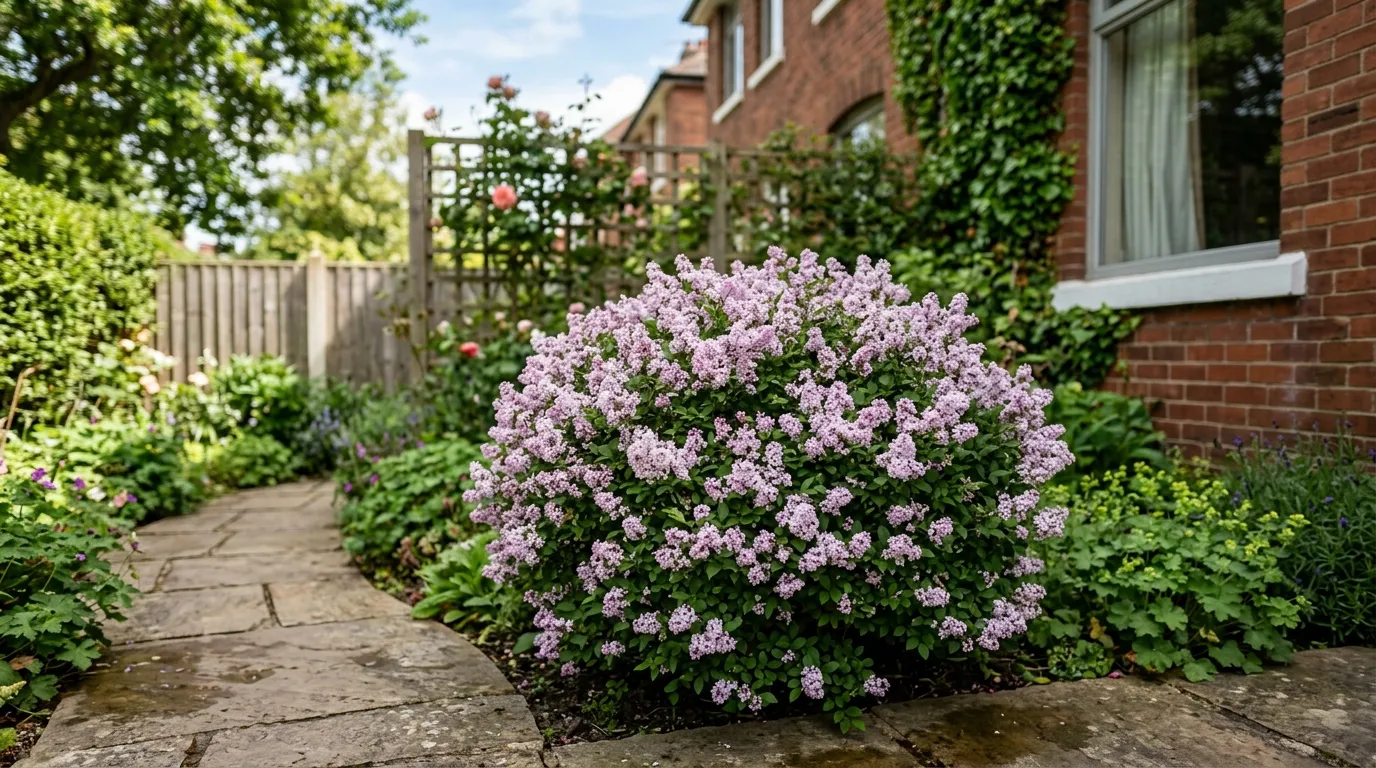
Palibin is the dwarf choice for a small garden or large container. Madame Lemoine is a classic white double. Beauty of Moscow opens from pink buds into pale flowers for a two-tone effect.
Month-by-month lilac pruning calendar
| Month | What to do |
|---|---|
| January | Survey shrub. Plan summer pruning. Do NOT cut. |
| February | NO PRUNING. Removes the flower buds set last summer. |
| March | Top-dress around the base with 50mm composted manure. |
| April | Buds swell. NO PRUNING. |
| May | Flowering. Enjoy. NO PRUNING. |
| June (first two weeks) | Deadhead spent panicles back to the next leaf pair. Take rejuvenation cuts on old shrubs. Remove suckers. |
| June (last two weeks) | Last chance for safe pruning. Finish any work started early in the month. |
| July | NO PRUNING. New wood starting to set next year’s flower buds. |
| August | NO PRUNING. Flower buds visible at stem tips. Water deeply once a week in dry spells. |
| September | NO PRUNING. Flower buds fully formed. |
| October | NO PRUNING. Apply 50mm mulch around base. |
| November | NO PRUNING. Tie in any wayward branches loosely. |
| December | NO PRUNING. Inspect for storm damage. |
Common mistakes to avoid
- Winter or autumn pruning. Removes the flower buds set the previous summer. Switch to June only.
- Cutting hard into old wood in one season. Spread rejuvenation cuts over three years so part of the established canopy remains each season.
- Cutting too deep on the deadhead. The cut should be just above the next pair of leaves, not 200mm down the stem. Going too low removes the wood that flowers.
- Leaving suckers on grafted plants. Rootstock suckers (usually privet) overwhelm the named cultivar in 3 to 5 years.
- Feeding with high-nitrogen fertiliser. Drives lush green growth at the expense of flowers. Use a low-nitrogen feed or composted manure only.
- Planting in heavy shade. Lilac wants six hours of sun a day to flower well. Shaded shrubs grow tall and leggy with few flowers.
Staged June rejuvenation spreads risk across three seasons and keeps some mature foliage on the shrub while replacement stems develop. The Royal Horticultural Society’s lilac growing guide also recommends removing old wood gradually after flowering rather than cutting the whole shrub down at once.
Frequently asked questions
When should I prune lilac in the UK?
Prune lilac in mid-June, within two weeks of the last flower fading. Lilac flowers on wood produced the previous summer. Pruning in winter or autumn removes the buds that will flower the next year. Late June is the latest safe window.
How do you deadhead lilac after flowering?
Cut each spent panicle back to just above the next pair of healthy green leaves on the stem below it. Use sharp bypass secateurs. This directs energy into the buds in those leaf axils which become next year’s flowering shoots.
Can you cut lilac back hard?
Yes but spread the cuts over three years. Take one third of the oldest stems to ground level each June. After year three the shrub is fully rejuvenated. Hard pruning the entire shrub in one go often kills it and always loses two seasons of flowers.
Why has my lilac stopped flowering?
Most non-flowering lilacs have been pruned at the wrong time of year. Winter or autumn pruning removes the flower buds set the previous summer. Switch to mid-June pruning only and the shrub recovers within two seasons. Shade and waterlogged roots are other causes.
Should I remove lilac suckers?
Remove suckers from grafted lilacs in summer (most named cultivars are grafted onto privet or Syringa vulgaris). Leave suckers on own-root plants if you want a multi-stemmed thicket. Cut suckers as low to the root as possible to discourage regrowth.
Can you grow lilac in a pot?
Yes for Syringa meyeri Palibin in a 50-litre container with John Innes No 3. Common lilac (Syringa vulgaris) is too large for permanent container growing. Water container lilacs once a week from May to September and reduce to monthly through winter.
Next steps
Now you can prune lilac at the right time and rejuvenate old neglected shrubs, the next step is matching the wider summer-pruning routine across the garden. Read our guide on shrubs to prune in summer for the full list of UK shrubs that follow the same prune-after-flowering rule.
Our team produces practical UK gardening guidance from source research, contributor records and established horticultural practice. Editorial standards are overseen by Matt W.