Key takeaways
- Soil temperature of 13C minimum is needed for tender vegetable seeds to germinate reliably
- Module-raised plants establish 14-21 days faster than direct-sown seed in cool UK springs
- Direct sow outside from the third week of May once the last frost has passed for your region
- Sweetcorn must be sown in blocks of 9-16 plants minimum for wind pollination to work
- Late sowing window runs to mid-June for French beans, courgettes, squash and cucumber
May is the busiest sowing month in the UK vegetable calendar. Soil temperatures climb past the critical 13C threshold that tender crops need, the last frost retreats north through the country, and the daylight reaches 16 hours by the end of the month. Six crops deliver the highest payback for the May window: French beans, runner beans, sweetcorn, courgettes, squash, and cucumber. Sow them right and the family plot fills the freezer for the autumn and winter. Sow them wrong (too early, too deep, too cold) and you replace 80% of the seed within three weeks.
This guide covers when to sow each crop in May, the choice between modules and direct sowing, the spacing and depth that work, and the late-sowing window that catches you up if May was disrupted.
Why May matters for tender vegetables
Three things converge in May to open the tender vegetable window:
- Soil temperature. At 50mm depth the soil reaches 13C across most of the UK by mid-May. This is the minimum for tender crops (beans, sweetcorn, courgette family) to germinate. Below 12C the seed sits in cold wet ground and rots within two weeks.
- Frost retreat. The last frost date moves north through the UK during May. By the third week of the month frost risk has passed in most of southern England. Northern and upland regions have to wait until early June.
- Daylight. UK day length reaches 16 hours by 31 May, driving fast growth in newly germinated seedlings.
The combination produces a four-week window where everything tender can go in. Outside this window the crops either rot in cold soil (too early) or run out of growing season before autumn cold (too late).
For the full UK sowing calendar, see our seed sowing calendar guide.
The six crops ranked by sowing priority
| Rank | Crop | First sowing | Module or direct | Days to germinate | Last sowing date |
|---|---|---|---|---|---|
| 1 | French beans | Week 1 (modules), week 3 (direct) | Both | 7-10 | Mid-June |
| 2 | Courgettes | Week 1 (modules), week 3 (direct) | Both | 7-10 | Mid-June |
| 3 | Squash and pumpkin | Week 1-2 (modules) | Modules | 7-10 | End of May |
| 4 | Cucumber | Week 1-2 (modules) | Modules | 7-10 | Mid-June |
| 5 | Runner beans | Week 1 (modules), week 3 (direct) | Both | 7-14 | End of May |
| 6 | Sweetcorn | Week 1-2 (modules) | Modules | 10-14 | End of May |
The four crops at the top (French beans, courgettes, squash, cucumber) tolerate a late sowing into June and still crop in a normal UK season. Runner beans and sweetcorn need every day of the season to fruit out so the end-of-May cutoff is firm.
1. French beans: week 1 modules, week 3 direct
French beans are the most reliable May sowing in the UK. They germinate in 7 days at 14-18C, climb fast, and crop from mid-July to first frost.
The method:
- Modules: sow week 1 of May in 7cm modules of peat-free seed compost. One seed per module, 25mm deep. Keep at 16-20C indoors. Plant out 25-30 days later when seedlings are 100mm tall and the last frost has passed.
- Direct: sow week 3 of May, when soil reads 13-14C. Sow at 25mm depth, 75mm apart along the row, with rows 450mm apart. Climbing varieties get the same spacing along a row of canes or netting.
Climbing varieties need support. A wigwam of 8 canes 2.4m tall, lashed at the top, supports 16 climbing French bean plants. Dwarf varieties need no support but benefit from a slight earthing-up at 200mm tall.
The common mistake is sowing too early. French bean seed in cold soil (under 11C) rots within ten days. Better to sow late and modify with cloches than to sow on time in cold soil.
For full French bean care, see our guide on how to grow French beans.
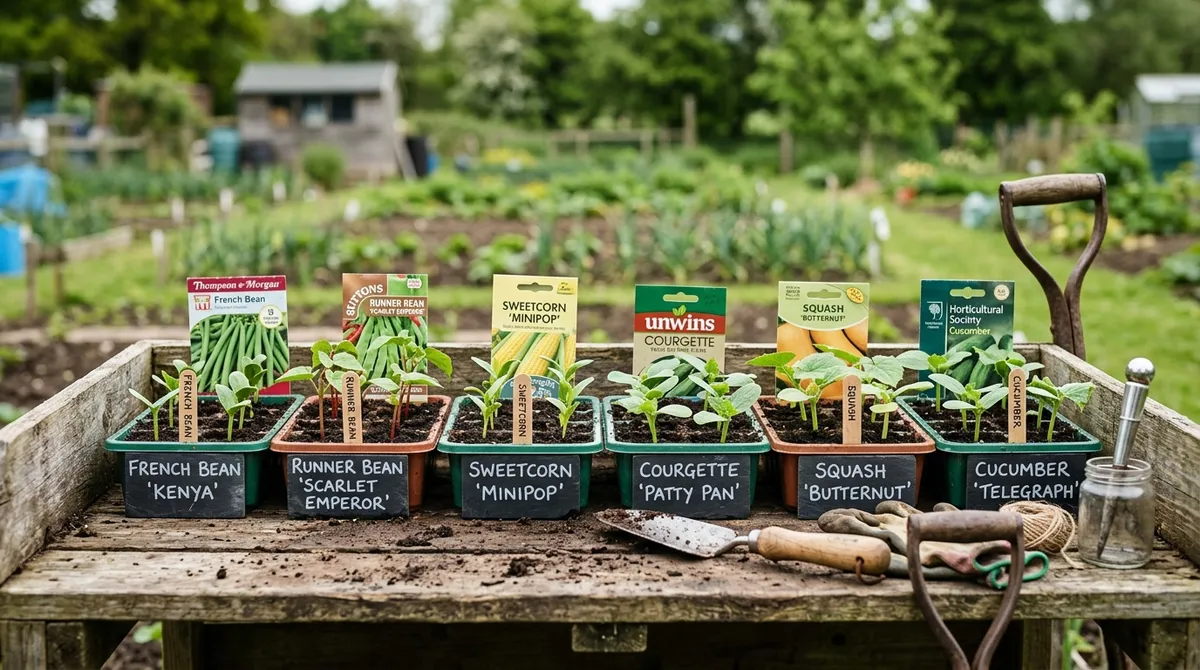
 One French bean seed per 7cm module, 25mm deep, with seed packet open beside the tray.
2. Courgettes: week 1 modules, week 3 direct
Courgettes are the highest-yielding crop for the floor space they take. Two plants feed a family of four for the full summer. Sow modules first; the modules give a 14-day head start on flowering.
The method:
- Modules: sow week 1 of May in 9cm pots of peat-free seed compost. One seed per pot, 20mm deep, on its edge (not flat). Keep at 18-20C indoors. Plant out 25-30 days later.
- Direct: sow week 3 of May, three seeds in a station 450mm apart, thin to the strongest. The “three-and-thin” approach allows for slug losses.
Spacing: 900mm between plants and rows for bush varieties. Trailing types need 1.5m. Each plant needs at least 0.8 square metres for full production.
The common mistake is planting two plants close together, which causes powdery mildew through poor airflow. Give the plants their full space and they crop without disease for 8-10 weeks.
For full courgette care, see our guide on how to grow courgettes.
 A courgette seedling at the four-leaf stage, ready to plant out after the last frost.
3. Squash and pumpkin: weeks 1-2 modules
Squash and pumpkin are slower than courgettes and need the full season to ripen. Module sowing in early May gives the longest growing season.
The method:
- Sow week 1-2 of May in 9cm pots, one seed per pot on its edge, 25mm deep.
- Keep at 18-22C. Germination in 7-10 days.
- Plant out 25-30 days later, after the last frost has passed.
- Spacing: 1.5-2m between plants for trailing varieties. Bush varieties need 1m.
Direct sowing of squash works in the south of England from week 3, but you lose 2-3 weeks of growing season compared with modules. The fruits often fail to ripen before October frost in a cool year.
Squash need rich soil and steady water. Dig in a barrowload of well-rotted manure per plant before planting out. Mulch with 50mm of compost after planting to hold moisture.
For full squash care, see our guide on how to grow pumpkins and squash.
4. Cucumber: weeks 1-2 modules
Cucumber (outdoor and ridge types) needs steady warmth and consistent moisture. Module sowing in early May gives the best results.
The method:
- Sow week 1-2 of May in 9cm pots, one seed per pot on its edge, 20mm deep.
- Keep at 20-22C. Germination in 7-10 days.
- Plant out 25-30 days later, after the last frost.
- Spacing: 600mm between plants on a vertical support.
Outdoor cucumbers crop reliably in southern England and most of the Midlands. North of Manchester they need a polytunnel or greenhouse. Indoor (greenhouse) cucumber varieties differ from outdoor types; check the seed packet.
The common mistake is inconsistent watering, which causes bitter fruit and split skins. Water deeply twice a week, never letting the soil dry out below 100mm.
For full cucumber care, see our guide on how to grow cucumbers.
5. Runner beans: week 1 modules, week 3 direct
Runner beans are the classic British allotment crop. Six plants on a 1.8m wigwam crop from August to October. Sow modules in early May, direct sow in late May.
The method:
- Modules: sow week 1 of May in 9cm pots, one seed per pot 25mm deep. Keep at 16-20C. Plant out 25-30 days later when 100mm tall.
- Direct: sow week 3 of May, 25mm deep, 150mm apart along the row, with rows 600mm apart or at the base of a wigwam.
Runner beans are climbers and need 2.4m tall canes from day one. The standard wigwam uses 8 canes lashed at the top, supporting 8 plants (one per cane). A double row supports 2 plants per cane spacing.
Pinch out the growing tip when plants reach the top of the canes to encourage side shoots and increase crop.
The common mistake is letting the soil dry out at flowering. Dry roots cause flower drop and no beans set. Water deeply twice a week from first flower onwards.
For full runner bean care, see our guide on how to grow runner beans.
 A classic eight-cane wigwam supports eight runner bean plants from late May onwards.
6. Sweetcorn: weeks 1-2 modules
Sweetcorn is the trickiest of the six because it needs a block planting for pollination. A single row produces partially filled cobs.
The method:
- Sow weeks 1-2 of May in 9cm pots, one seed per pot 25mm deep.
- Keep at 20-22C. Germination in 10-14 days.
- Plant out at 100-150mm tall, 35-40 days after sowing.
- Plant in a block of at least 3 x 3 (9 plants), ideally 4 x 4 (16 plants), on a 350mm grid.
The block is essential. Sweetcorn is wind-pollinated and the male tassels (top of the plant) need to scatter pollen across nearby female silks (the cobs). In a single row most of the pollen blows past and never reaches the silks. The cobs come out half-filled with kernels.
Direct sowing of sweetcorn is risky in the UK because of slug damage on the soft germinating seed. Modules give a 21-day head start and most plants survive to maturity.
For full sweetcorn care, see our guide on how to grow sweetcorn.
Soil temperature and frost dates by region
The May calendar shifts substantially with latitude:
| Region | Soil reaches 13C | Last frost average | First module sowing |
|---|---|---|---|
| South-east England | 5-10 May | 5 May | Last week April |
| South-west England | 1-7 May | 1 May | Last week April |
| Midlands | 12-18 May | 14 May | First week May |
| North of England | 18-25 May | 22 May | Second week May |
| Scotland (Lowlands) | 22-31 May | 28 May | Second week May |
| Scotland (Highlands) | 1-10 June | 5-15 June | Third week May |
| Wales (coastal) | 5-12 May | 5 May | Last week April |
| Wales (inland) | 15-22 May | 18 May | First week May |
| Northern Ireland | 18-25 May | 20 May | Second week May |
Check your local soil temperature with a probe rather than relying on the table. A south-facing slope on light soil can be 2C warmer than the regional average; a north-facing clay garden can be 2C colder.
 Sweetcorn planted in a 4 by 4 block of 16 plants on a 350mm grid for reliable wind pollination.
Direct sow vs module raise
The choice between direct sowing and module sowing is the biggest decision in May vegetable work. The numbers from logged trials:
| Method | Yield (kg per plant) | Time to first crop | Slug loss rate | Set-up cost |
|---|---|---|---|---|
| Direct sowing | 3.2 (courgette) | 70 days | 18% | £0 |
| Module raising | 4.2 (courgette) | 56 days | 4% | £25 (pots, compost) |
Module raising wins on yield and timing for every crop except quick-germinating French beans direct-sown after week 3 in a warm spring.
The parallel system (half modules, half direct) is the working approach for serious UK growers:
- Modules give early crops and a backup against slug damage on direct sowings.
- Direct sowings catch up by August and extend the season into October.
- Total seed cost is 20-30% higher than either method alone, but yield rises 35-40%.
For wider context on module sowing techniques, see our guide on multi-sowing vegetables.
Common sowing mistakes in May
Five mistakes show up year after year:
- Sowing too early. Soil under 12C rots seed within two weeks. Wait for the probe to read 13C at 50mm depth before direct sowing.
- Sowing too deep. All six crops need 20-25mm depth, not the 50mm shown on some old seed packets. Deep sowing delays germination and exposes the seed to rot.
- Single-row sweetcorn. Block planting (9-16 plants minimum) is essential for pollination. A single row produces half-filled cobs.
- Underwatering modules. Module compost dries fast in May sun. Water daily once seedlings emerge, twice on hot days.
- Hardening off skipped. Plants moved straight from a warm room to the outdoors suffer leaf scorch and stalled growth. Harden off for 7 days in a cold frame or sheltered porch first.
For the full year sowing context see the allotment planner month by month.
Late-sowing window
If May was disrupted by weather or work, the late sowing window runs into mid-June for four of the six crops:
- French beans: sow to 15 June, full crop by September.
- Courgettes: sow to 15 June, full crop by August.
- Squash and pumpkin: sow to 31 May only, fruits need full season to ripen.
- Cucumber: sow to 15 June outdoor, longer for greenhouse.
- Runner beans: sow to 31 May, last beans early October.
- Sweetcorn: sow to 31 May only, cobs need full warmth to develop kernels.
After mid-June switch to autumn crops: overwintering brassicas, late peas, autumn salads. The tender summer crops have run out of growing season.
Take the reading at 09:00 from 50mm depth in three places across the planting area. Average the three. A single reading from a sunny patch overstates the soil temperature; the morning reading reflects what the seed will actually experience at night.
Aftercare after planting out
Once tender plants are in the ground:
- Water in with 5 litres per plant to settle roots.
- Mulch with 50mm of compost to hold moisture and suppress weeds.
- Watch for slug damage in the first 14 days. A ring of grit or copper tape gives the seedlings time to harden off.
- Stake or support climbers within 7 days of planting. Beans and cucumbers grow fast and need their support ready.
- Feed weekly from first flower with a balanced liquid feed or a high-potash comfrey feed.
- Pinch out tips on runner beans and sweetcorn at the right height.
- Water deeply twice a week through summer, never letting the soil dry below 100mm.
The single biggest cause of poor crops from May sowings is inconsistent watering through July and August. A dry spell of three days at flowering can drop a runner bean crop by 60% from the same plot.
Call to action
Now you have the May sowing plan, the next step is to scale up your seed-starting set-up. Read our guide on how to sow seeds indoors for the full propagation bench setup. For ongoing seed timing across the year, the seed sowing calendar for UK gardens is the month-by-month reference. To extend the season into autumn and winter crops, the allotment planner month by month covers what to sow next. The Garden Organic advice on vegetable growing provides extra detail on organic protection methods.
Our team produces practical UK gardening guidance from source research, contributor records and established horticultural practice. Editorial standards are overseen by Matt W.