Key takeaways
- UK vegetables split into 7 main botanical families, each with shared pests and nutrient demands
- Move each family to a different bed every year on a 3-year, 4-year or 5-year cycle
- Brassicas need calcium (lime) - legumes fix nitrogen - solanaceae need potassium
- Family-specific pests build up over time without rotation: club-root, white rot, eelworm
- Salad leaves, herbs and most flowers are exempt - they do not need rotation
- Crops from the same family cannot follow each other - the most important rotation rule
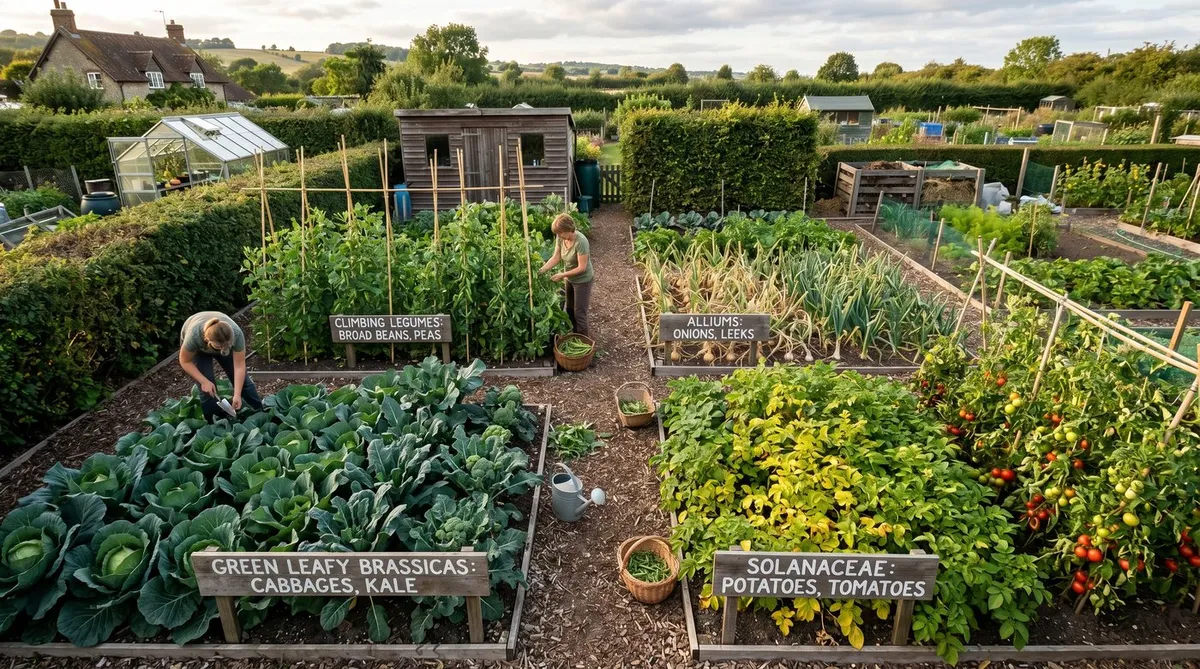
Crop rotation is the practice of moving vegetable families to different beds each year to prevent soil-borne pests and diseases from building up. The system depends on understanding which crops belong to which botanical family - because pests and diseases attack the family, not the individual plant.
This guide covers the seven main UK vegetable families, the specific pests and diseases each shares, the nutrient demands that drive rotation order, and how to group your crops correctly. For the practical multi-year planning workflow with bed layouts and year-by-year planting plans, our crop rotation planner UK guide is the companion piece.
Why family-grouping matters for rotation
Soil-borne pests and diseases evolve to attack specific plant families. Once a pathogen establishes in a bed, it builds up year after year if the same family keeps appearing. Move the family away and the pathogen population starves out. Move it back in after 3-5 years and the soil is clean.
The single most striking example in the UK is club-root on the brassica family. Plasmodiophora brassicae is a soil-borne slime mould that infects brassica roots and forms the characteristic swollen, deformed root galls. Spores persist in the soil for 6-10 years even with no brassica crop grown. Continuous brassica cropping in a single bed will produce club-root within 2-3 years and ruin that bed for half a generation.
Other family-specific pests with long soil memories:
- White rot on alliums (Sclerotium cepivorum) - persists 15+ years in soil
- Potato cyst nematode on solanaceae (Globodera spp.) - persists 6-10 years
- Pea root rot complex (Fusarium, Aphanomyces) - persists 5-8 years
- Brassica eelworm (Heterodera cruciferae) - persists 6-8 years
Knowing the families and rotating them prevents all of these.
The seven UK vegetable families
Most UK vegetables fall into one of seven botanical families. A small number sit in their own families (sweetcorn in Poaceae, lettuce in Asteraceae) but do not generally drive rotation decisions because their pest pressure is lower.
Brassicaceae - the cabbage family
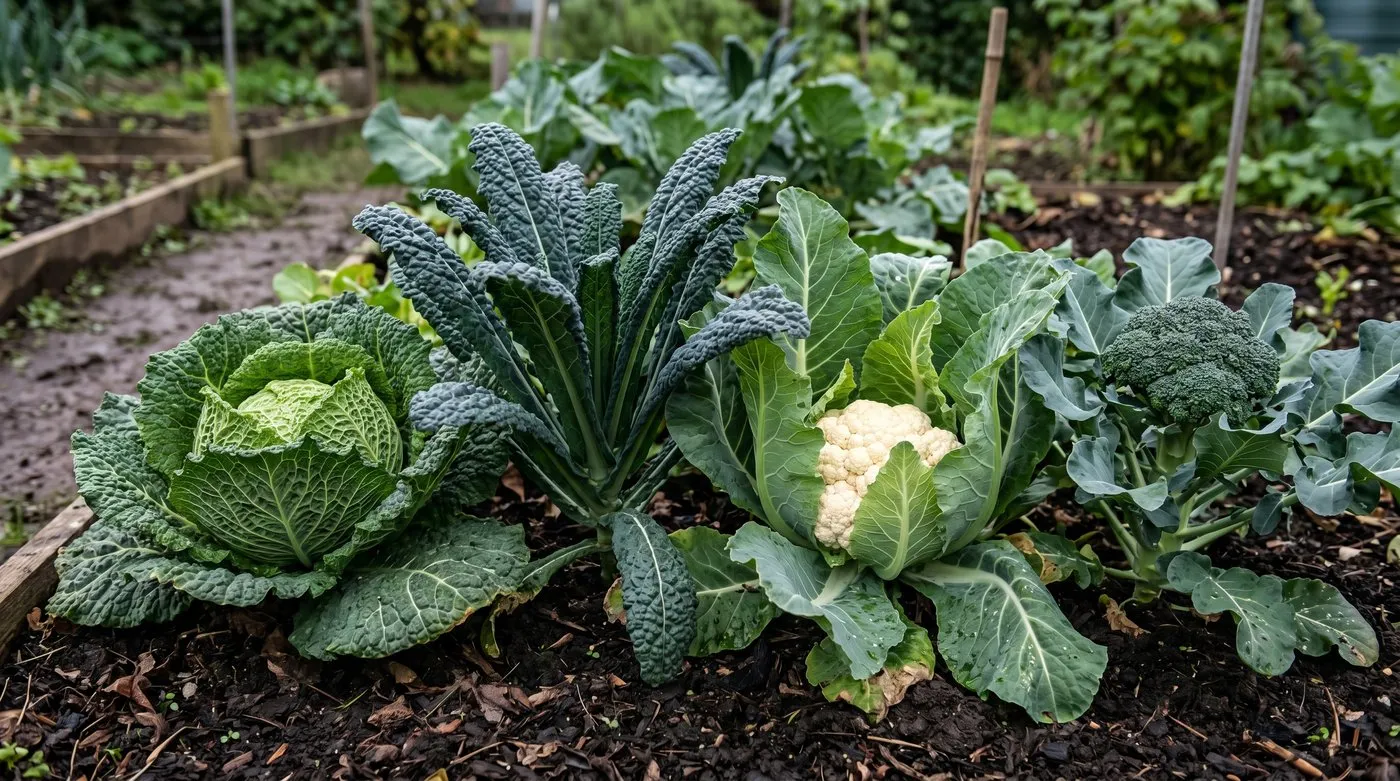 The brassica family - the single most rotation-critical group in any UK kitchen garden.
Members: cabbage, broccoli, cauliflower, Brussels sprouts, kale, kohlrabi, swede, turnip, radish, mustard, rocket, pak choi, mizuna, watercress.
Shared pests and diseases:
- Club-root (worst - persists 6-10 years)
- Cabbage white butterfly caterpillars
- Cabbage moth
- Cabbage root fly
- Brassica eelworm
- Flea beetle (worst on rocket and radish)
- Whitefly
Nutrient demands: Heavy nitrogen and calcium feeders. Apply lime in autumn to keep pH at 6.5-7.2 (alkaline-leaning reduces club-root). Top-dress with high-N feed mid-season.
Best rotation position: Year 2, immediately after legumes - the legume nitrogen residue feeds the brassicas.
Fabaceae (Leguminosae) - the legume family
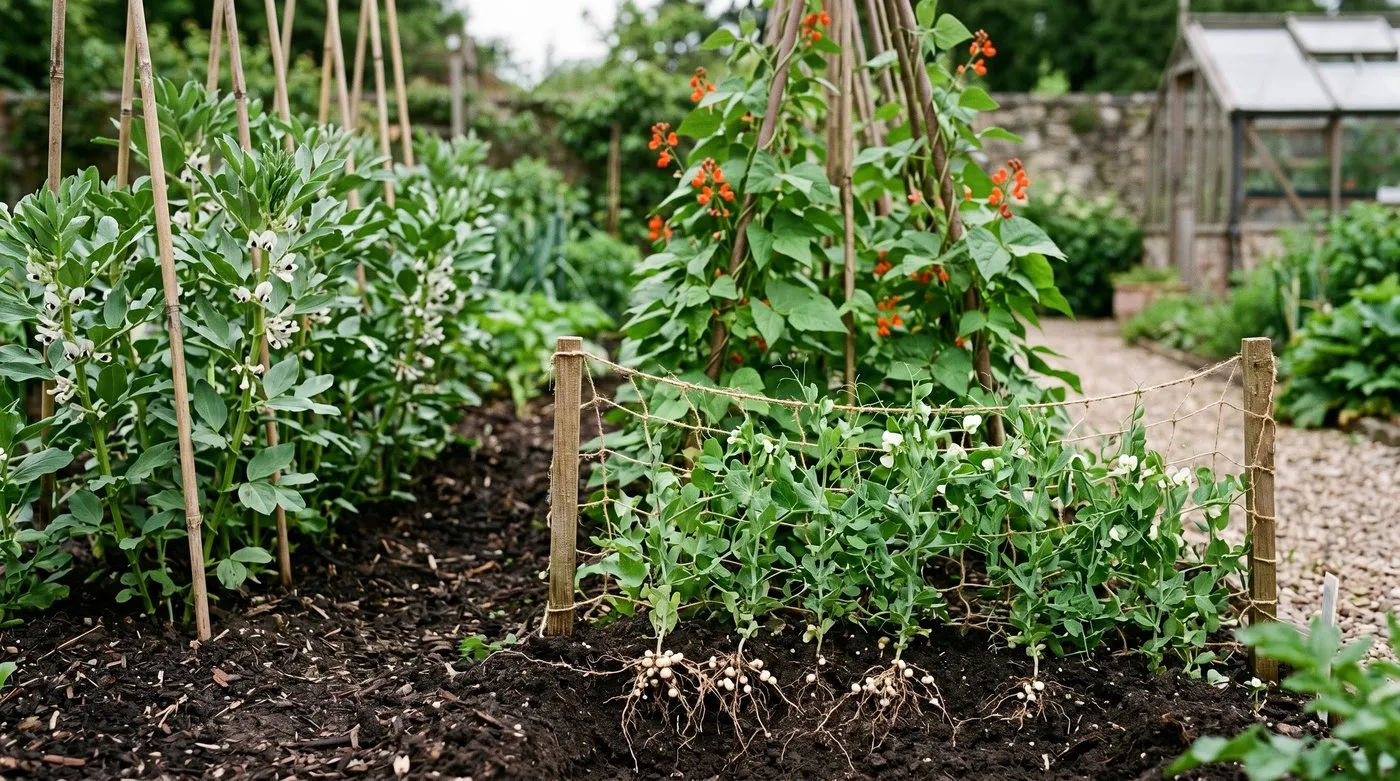 Legumes fix atmospheric nitrogen through root nodules - the only UK garden family that adds N to the soil.
Members: broad beans, runner beans, French beans (climbing and dwarf), peas, mangetout, sugar snap peas, soya beans, clover (used as green manure).
Shared pests and diseases:
- Pea moth
- Black bean aphid (on broad beans especially)
- Pea root rot complex
- Chocolate spot (broad beans)
- Halo blight (French and runner beans)
- Pea and bean weevil
Nutrient demands: Light nitrogen feeders. The Rhizobium bacteria in root nodules fix atmospheric N₂ into ammonia, providing the plant’s nitrogen demand. Legumes leave 50-150kg N per hectare in the soil after harvest - free fertiliser for the next crop.
Best rotation position: Year 1 (or first slot in any rotation). The nitrogen-fixing root nodules feed the brassicas that follow.
For wider crop pairing advice, see our companion planting guide UK.
Solanaceae - the nightshade family
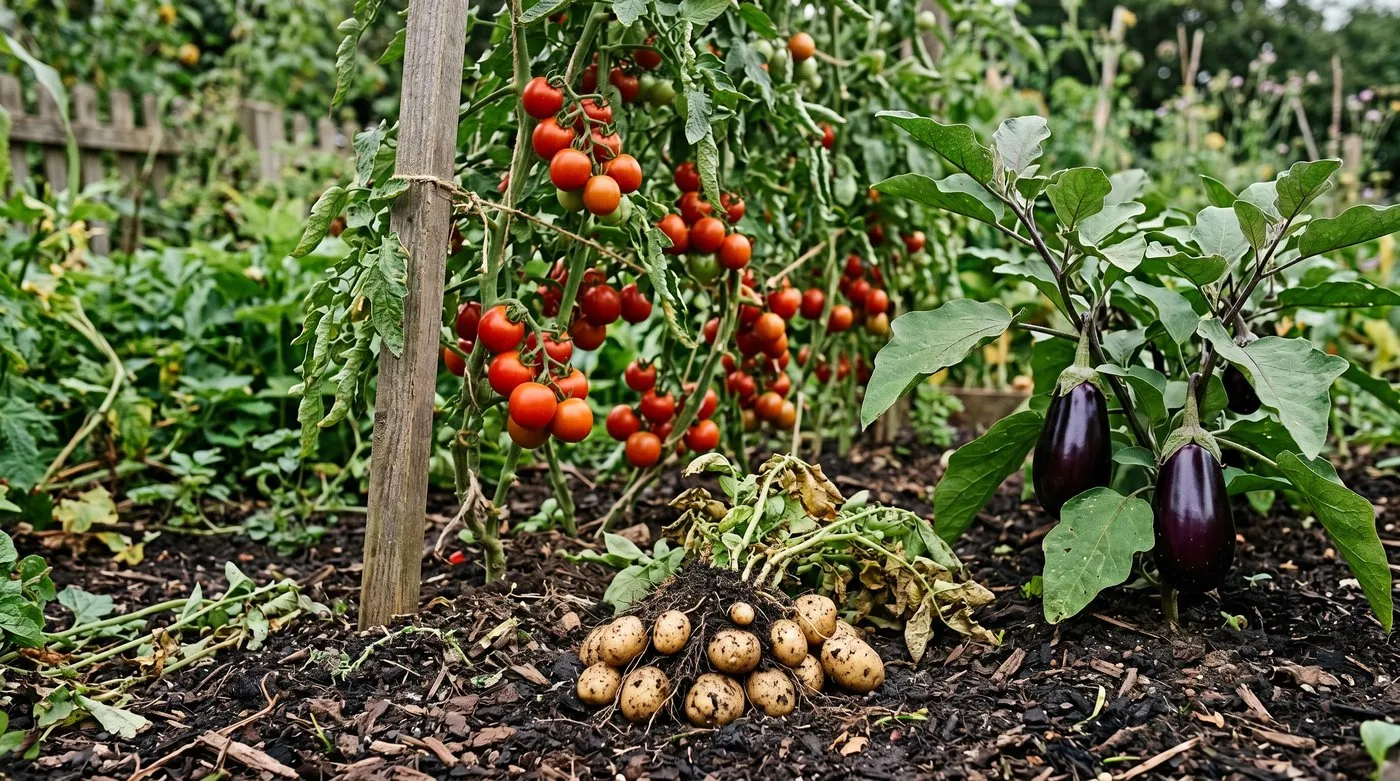 Tomatoes and potatoes share the same family and the same diseases. Never rotate them into the same bed in consecutive years.
Members: potato, tomato, pepper (sweet and chilli), aubergine, tomatillo, physalis (Cape gooseberry).
Shared pests and diseases:
- Tomato/potato blight (Phytophthora infestans) - the single most destructive UK garden disease
- Potato cyst nematode
- Verticillium wilt
- Early blight (Alternaria solani)
- Colorado beetle (if it ever spreads to UK - currently quarantine pest)
- Potato scab
Nutrient demands: Heavy potassium feeders, moderate nitrogen. Apply high-K feed once flowering and fruiting begin. Avoid lime - solanaceae prefer slightly acidic pH 5.5-6.5.
Best rotation position: Year 4 (last slot in a 4-year rotation). They follow root crops well because they exploit the deeper soil structure created by the previous root work.
Alliaceae - the onion family
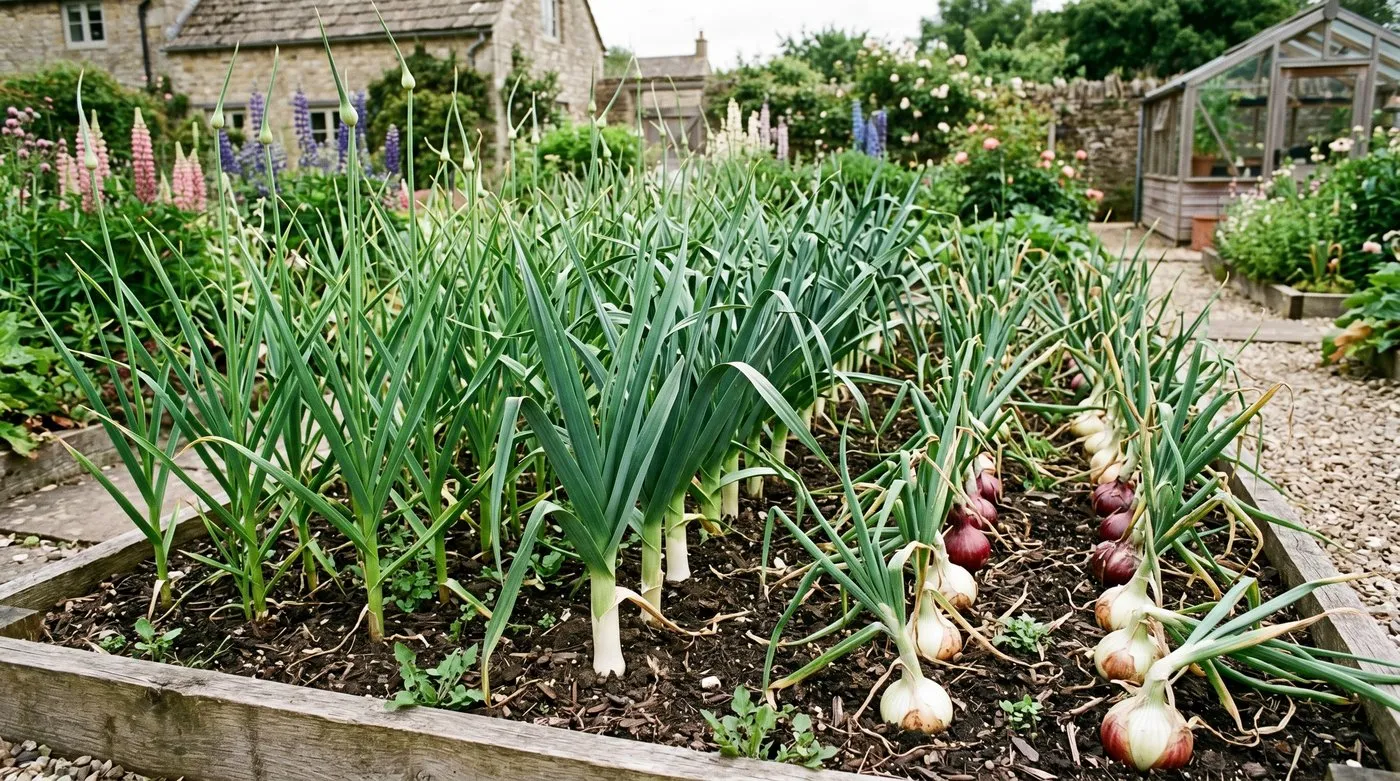 The allium family is rotation-critical because white rot persists in soil for 15+ years.
Members: onion, garlic, leek, shallot, spring onion, chive, Welsh onion.
Shared pests and diseases:
- White rot (Sclerotium cepivorum) - worst persistence at 15+ years in soil
- Allium leaf miner
- Allium rust
- Downy mildew (allium-specific strain)
- Onion fly
- Eelworm (allium-specific)
Nutrient demands: Low nitrogen, moderate phosphorus, low potassium. Heavy nitrogen produces soft growth that fails to store. Soil should be firm rather than freshly dug.
Best rotation position: Often given their own permanent bed because of white rot risk. If rotated, place after legumes but before brassicas, on a 4-year-minimum cycle.
For specific allium pest control, see our allium leaf miner control and allium white rot identification and prevention guides.
Apiaceae (Umbelliferae) - the carrot family
Members: carrot, parsnip, celery, celeriac, fennel, dill, coriander, parsley, lovage, chervil.
Shared pests and diseases:
- Carrot root fly (the major UK pest)
- Carrot fly larvae damage on parsnip and celery
- Parsnip canker
- Celery leaf miner
- Sclerotinia rot (also affects other families)
Nutrient demands: Low to moderate. Avoid fresh manure - forks the roots. Light feeding with balanced fertiliser at planting.
Best rotation position: Year 3 in a 4-year rotation, following brassicas. The root crops break up the soil structure for the heavy-feeding solanaceae that follow.
Cucurbitaceae - the squash family
Members: courgette, marrow, pumpkin, winter squash, summer squash, cucumber (indoor and outdoor), melon, watermelon, gourd.
Shared pests and diseases:
- Powdery mildew (worst on courgette in late summer)
- Cucumber mosaic virus
- Whitefly (under glass)
- Slugs (worst on young plants)
- Root rot in waterlogged conditions
Nutrient demands: Heavy feeders all round. Plant into a hole filled with compost. Liquid feed weekly through cropping with balanced or high-K feed.
Best rotation position: Flexible. Often planted on the previous year’s compost heap site or in dedicated permanent plots. Can rotate through any family slot.
Chenopodiaceae (Amaranthaceae) - the beet family
Members: beetroot, chard, spinach, perpetual spinach, sea beet, quinoa.
Shared pests and diseases:
- Beet leaf miner
- Downy mildew
- Beet rust
- Boltardy disease (early flowering)
- Leaf spot
Nutrient demands: Moderate. Beetroot dislikes heavy nitrogen (produces leaves at expense of roots). Chard and spinach prefer slightly higher nitrogen for leaf production.
Best rotation position: Flexible. Often slotted in with root crops in Year 3 because beetroot fits the root-crop bed structure. Spinach and chard can squeeze into any bed.
Standard UK rotation systems
3-bed rotation (simplest)
| Year | Bed A | Bed B | Bed C |
|---|---|---|---|
| 1 | Legumes | Brassicas | Root crops + Solanaceae |
| 2 | Brassicas | Root crops + Solanaceae | Legumes |
| 3 | Root crops + Solanaceae | Legumes | Brassicas |
Suits small UK gardens with 3 main beds. The compromise is that solanaceae and roots share a slot - acceptable for small-scale growing but not for heavy potato or tomato production.
4-bed rotation (standard)
| Year | Bed A | Bed B | Bed C | Bed D |
|---|---|---|---|---|
| 1 | Legumes | Brassicas | Root crops | Solanaceae |
| 2 | Brassicas | Root crops | Solanaceae | Legumes |
| 3 | Root crops | Solanaceae | Legumes | Brassicas |
| 4 | Solanaceae | Legumes | Brassicas | Root crops |
The UK standard rotation for any allotment plot or substantial kitchen garden. Each family returns to the same bed every 4 years. Adequate break for club-root and most pathogens (though white rot needs longer).
5-bed rotation (premium)
| Year | Bed A | Bed B | Bed C | Bed D | Bed E |
|---|---|---|---|---|---|
| 1 | Legumes | Brassicas | Roots | Solanaceae | Alliums |
| 2 | Brassicas | Roots | Solanaceae | Alliums | Legumes |
| 3 | Roots | Solanaceae | Alliums | Legumes | Brassicas |
| 4 | Solanaceae | Alliums | Legumes | Brassicas | Roots |
| 5 | Alliums | Legumes | Brassicas | Roots | Solanaceae |
Adds a dedicated allium bed for serious onion and garlic growers. The 5-year break also reduces brassica club-root risk further than the 4-bed system.
Where the cucurbits fit
Cucurbits (courgette, pumpkin, squash, cucumber) do not have a fixed slot in standard UK rotations because they are usually grown on a compost heap remnant or in a dedicated permanent bed. If you want them in the rotation:
- Add to Year 2 in the brassica slot if you have light club-root pressure
- Add to Year 4 in the solanaceae slot for the heavy feeding match
- Run a 5-bed system with cucurbits as the fifth slot
They share no major pests with the other families so they slot in safely.
What to do with herbs, salads and perennials
Three crop groups are exempt from rotation:
Perennial herbs (rosemary, thyme, sage, oregano, mint, chives, bay) stay in place permanently. They have their own permanent herb bed or are scattered in mixed borders.
Annual salads (lettuce, rocket, mizuna, spinach if cut-and-come-again) are short-cycle and harvested before any soil-borne pest can build up. Slot them into any bed where there is space, especially between rows of slower-growing main crops.
Perennial fruit (rhubarb, asparagus, raspberries, strawberries, blackcurrants) have their own permanent beds outside the rotation system. Allow 10-20% of plot area for perennials.
Family-specific soil preparation
Different families want different soil treatment. This is why grouping by family makes sense beyond just pest control.
| Family | Soil treatment | When |
|---|---|---|
| Legumes | Light compost only - too much N reduces nodulation | At planting |
| Brassicas | Lime to pH 6.5-7.2 + heavy compost + high-N top-dress | Autumn before, then July |
| Root crops | NO fresh manure - causes forking. Use compost from previous year only | At sowing |
| Solanaceae | Heavy compost + high-K liquid feed weekly when fruiting | Spring and through season |
| Alliums | Firm bed, low N, moderate compost, dressed with bone meal | At planting (autumn for garlic, spring for onion) |
| Cucurbits | Heavy compost in planting hole, weekly liquid feed | At planting |
| Beet family | Moderate compost, balanced fertiliser at planting | At sowing |
The rotation order naturally aligns these preparations: legumes leave nitrogen for brassicas, brassicas leave the soil suitable for roots (some compost, no fresh manure), roots leave loose-textured deep soil for solanaceae.
Common UK rotation mistakes
Mistake 1: Treating tomatoes and potatoes as different. Same family, same diseases. They cannot follow each other in consecutive years, and they cannot be grown next to each other if blight pressure is high in your area.
Mistake 2: Including swede and turnip in the root family. Both are brassicas. They share club-root with cabbage and broccoli. Plant them in the brassica bed, not the root bed.
Mistake 3: Ignoring beetroot family. Some UK gardeners forget chard, spinach and beetroot share family-specific leaf miner. Worth keeping all three in or near the same bed for easier pest management.
Mistake 4: Permanent allium bed without breaking it. White rot pressure builds even without rotation if you keep cropping the same bed continuously. Even a permanent allium bed needs a 2-year break every 5 years.
Mistake 5: Following a fixed rotation that does not suit your garden. The textbook 4-bed rotation assumes equal demand for all families. If you grow huge quantities of brassicas and few potatoes, the standard rotation wastes a bed on potatoes you do not want. Modify the rotation to fit your actual crop preferences while preserving the 3-4 year minimum between same-family plantings.
When rotation breaks down
Crop rotation works less well in three situations:
Very small plots (under 10 square metres). Hard to maintain 3-4 distinct family beds with meaningful crop volume. Use containers or raised beds with imported fresh compost to reduce the rotation dependency.
Container growing. Each container can have fresh compost annually, breaking the pest cycle without spatial rotation. Useful for blight-prone tomatoes - fresh container compost each spring.
Severe existing club-root or white rot infection. Once established, the disease persists so long that rotation alone cannot help. Use containers, raised beds with imported soil, or accept that the affected bed cannot grow those families for 6-15 years.
Building a rotation record
The single most useful aid to a working UK rotation is a written record. A simple notebook tracking what grew in which bed each year prevents the slow drift of accidentally planting brassicas in the same bed three years running.
Minimum record per year:
- Bed layout sketch
- Family planted in each bed
- Specific crops (variety names)
- Any pest or disease problems observed
- Compost or fertiliser applied
Five years of records gives you a clear cycle pattern and the basis for tweaking the rotation to suit your specific UK conditions.
Field note: The RHS holds detailed guidance on crop rotation including family groupings and disease-specific rotation lengths. Their pest and disease pages cross-reference rotation as a primary preventive measure.
Monthly rotation calendar
Rotation planning happens twice a year for most UK gardeners:
October-November: Plan next year’s rotation, order seed potatoes and onion sets, lime any beds going to brassicas next spring.
February-March: Implement the plan, prepare beds, sow first legumes (broad beans) and brassicas indoors.
Continuously: Note what grew where, record any pest issues, plan the modifications for the following year.
Now you’ve understood the families
For the year-by-year planning workflow including bed layouts, what to plant in which slot, and how to integrate green manures, read our crop rotation planner UK guide which is the practical companion to this family-focused article.
Our team produces practical UK gardening guidance from source research, contributor records and established horticultural practice. Editorial standards are overseen by Matt W.