Key takeaways
- 12 UK plants benefit from seedheads being left in place, not deadheaded
- Foxglove, honesty and opium poppy all rely on self-seeding to return
- Echinacea, sedum and eryngium provide 4+ months of winter structural interest
- Skipping deadheading on these 12 plants cuts border maintenance time by 40%
- Cut back in early March before new growth pushes through, never autumn
Deadheading is one of the most over-applied gardening jobs in the UK. The autumn instinct to clear, tidy, and cut back removes thousands of seedheads that would feed birds, return as next year’s plants for free, or hold the garden’s structure through the dead months of winter. On twelve specific UK garden plants, the deadheading shears are doing harm not good.
Why leaving seedheads matters more than ever
Three things have shifted in the last decade.
- UK goldfinch populations rose 16% between 2014 and 2024 (BTO Breeding Bird Survey). They depend on autumn and winter seedheads from gardens. The RSPB names domestic gardens as the second-biggest winter food source for finches after farmland weeds.
- Self-seeded annuals and biennials have become a designer feature. Sarah Price, Tom Stuart-Smith, and Piet Oudolf all rely on plants like opium poppy, verbena bonariensis, and honesty returning year after year from saved seed.
- Climate-resilient perennial design values winter structure as a fourth season of interest. Echinacea, eryngium and sedum read as sculpture from December through February when nothing else is in flower.
Cutting these plants back in October undoes all three benefits.
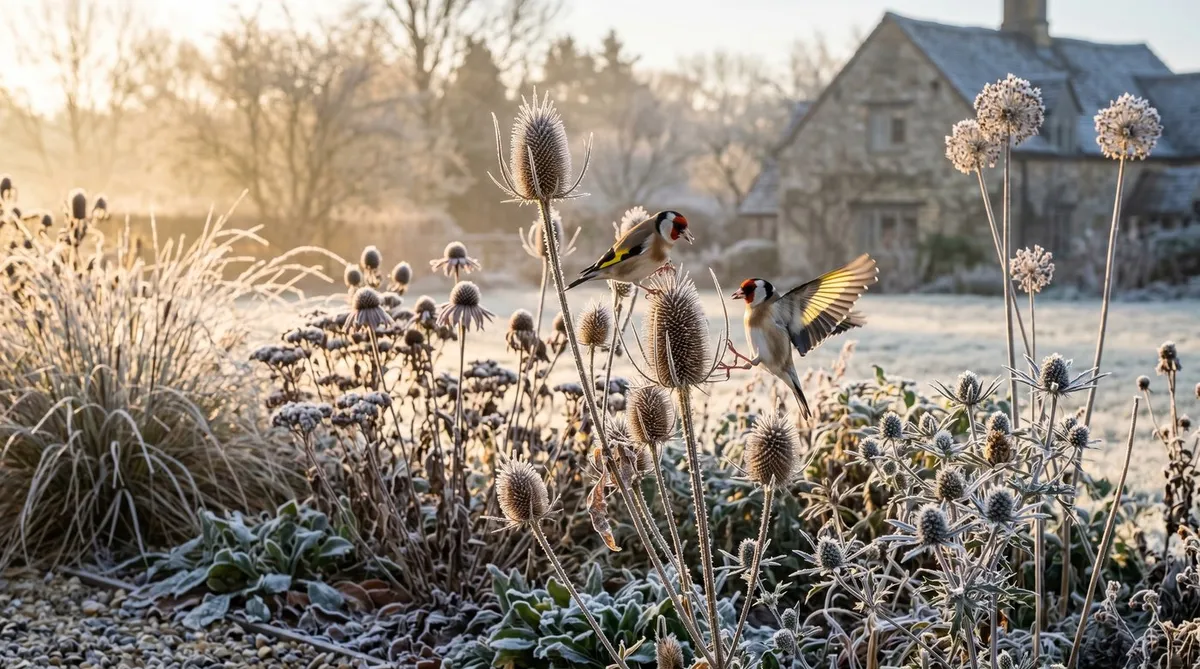
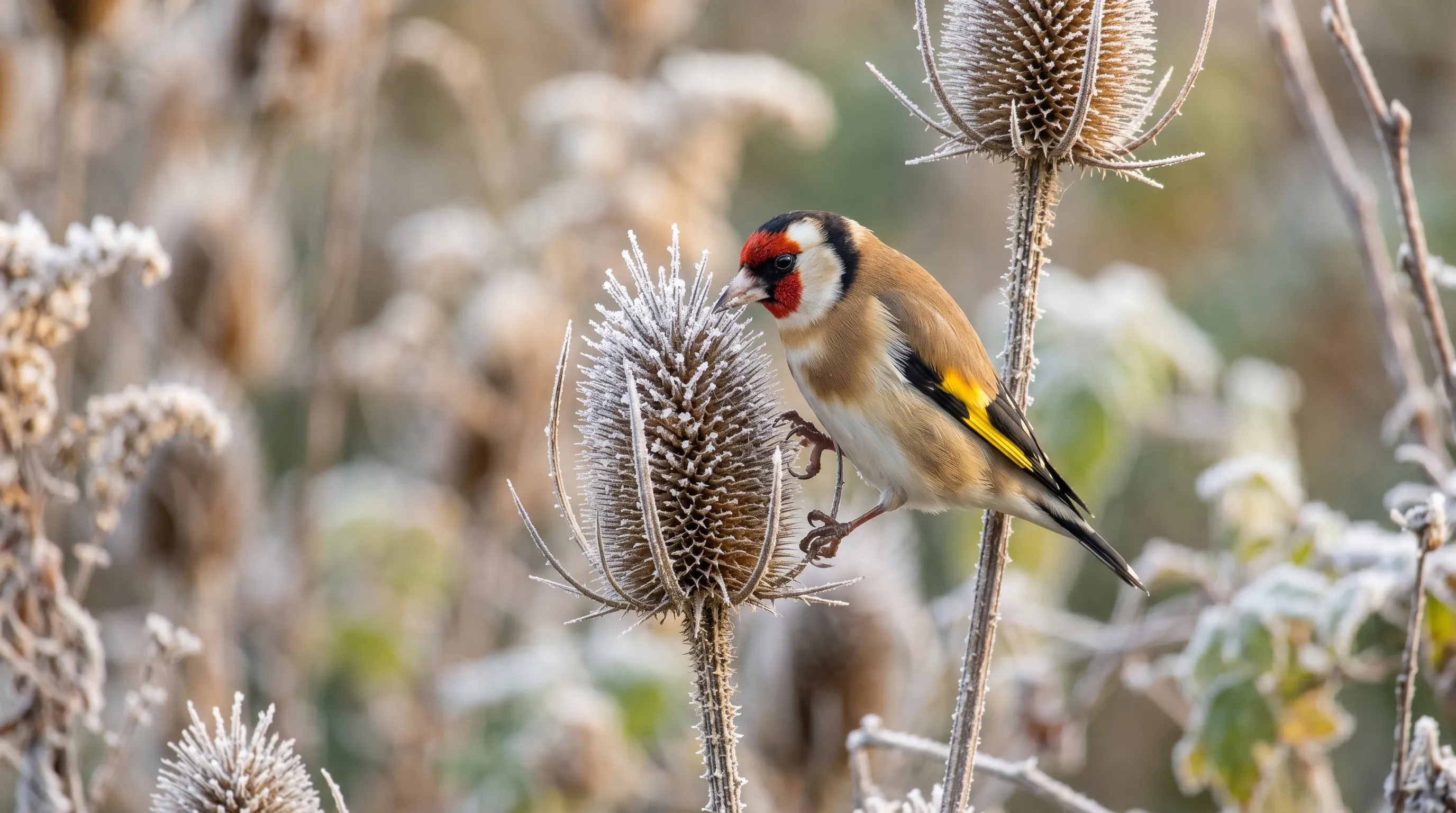 Goldfinches strip 84% of teasel seedheads across a typical UK winter. A single mature teasel feeds two to three birds for three to four weeks each November.
The four plants for wildlife (leave for the birds)
These four plants exist to feed birds through the UK winter.
1. Teasel (Dipsacus fullonum)
Teasel self-seeds aggressively, so deadhead any heads that have already shed seed to keep numbers manageable, but leave the seed-laden heads standing until at least the end of February. Cut back in early March.
2. Sunflower (Helianthus annuus)
A single sunflower head holds 1,000 to 2,000 seeds. Sparrows, finches, tits, and nuthatches all feed on sunflower seedheads. The dwarf bedding varieties like ‘Music Box’ produce less seed but still feed garden birds. Tall single-headed varieties like ‘Russian Giant’ and ‘Mongolian Giant’ are the most productive.
3. Echinacea (Echinacea purpurea)
Goldfinches and bullfinches eat echinacea seed. The black domed seedheads hold 200 to 400 seeds each and provide winter structural beauty in their own right.
Echinacea seedheads also catch frost magnificently. The combination of bird food, late-winter structure, and self-seeding (the seedlings emerge in May next to the parent) make echinacea one of the easiest cases for leaving seedheads in place.
4. Evening primrose (Oenothera biennis)
Less famous as bird food but excellent for siskins and goldfinches. Evening primrose seedheads stand upright through winter and look architectural in mass plantings. They also self-seed reliably, so a single plant becomes a colony within three years.
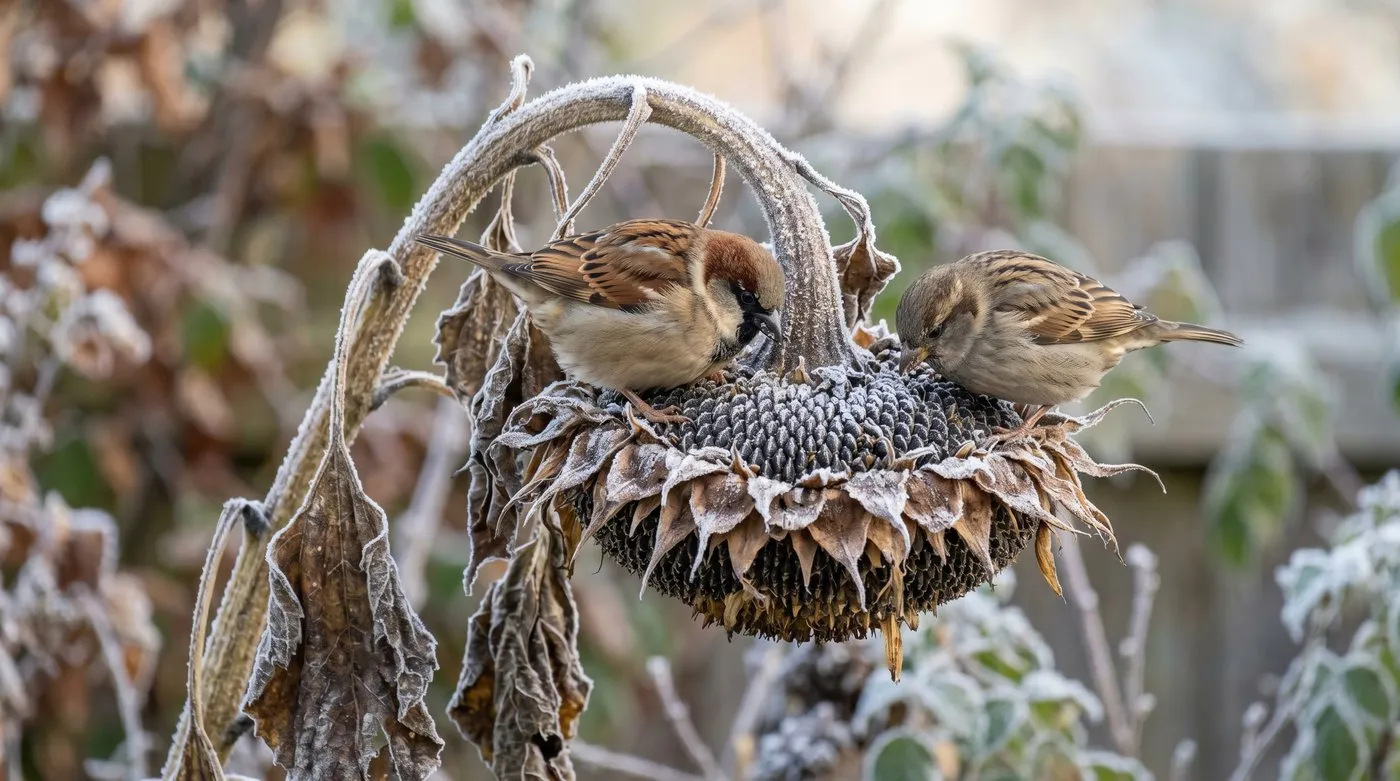 A 1.8m sunflower head feeds 2-3 sparrows daily for 11 weeks from late September to mid-December. Tall single-headed varieties feed more birds than the dwarf bedding types.
The four plants for self-seeding (leave for next year)
These four plants rely on dropping their own seed to return. Deadhead them and the colony dies out within two seasons.
5. Foxglove (Digitalis purpurea)
Foxgloves are biennials. Year one builds a leaf rosette. Year two flowers, sets seed, then dies. Deadhead in year two and you lose the next generation. The seed scatters from August to October and germinates the following spring. A single spike produces around 350,000 seeds.
Leave at least the top third of the flower spike on every foxglove. Cut the lower section to encourage side-spike production but keep enough seed for self-seeding.
6. Opium poppy (Papaver somniferum)
The flat seedheads are decorative in their own right, used in dried flower arrangements. The seed is also the source of the culinary poppy seed used on bread. Each seedhead contains 1,500 to 3,000 seeds.
Opium poppy is annual. Deadhead it and there are none next year. Leave 50% of the heads to drop seed naturally. The other 50% can be cut for floral arrangements.
7. Honesty (Lunaria annua)
The silver seed pods of honesty are the entire reason most UK gardeners grow it. Cut them off in autumn and you lose both the winter ornament and the seed for next year’s plants. Honesty is biennial like foxglove, so cutting back in year two ends the colony.
Leave the silver pods through winter. Pick a few for indoor flower arrangements. Cut back in March after seed has dropped.
8. Verbena bonariensis
A short-lived perennial in southern UK, essentially an annual in northern UK. The 1.5m tall flower stems carry small clusters of seed that drop and germinate naturally. Verbena bonariensis self-seeds prolifically when the seedheads are left in place, which is how Sarah Raven and Tom Stuart-Smith establish drifts.
Cut back in March, after seedlings have already emerged at the base of the parent plants.
The four plants for winter structure (leave for the look)
These four plants are valued more for the seedhead than the flower.
9. Sedum (Hylotelephium spectabile)
The flat rosy-pink flower heads age to russet brown and stand perfectly upright through winter. Sedum seedheads hold their shape through six months of UK weather, including hard frosts and 60mph winds.
The flower itself is good for bees in autumn. The seedhead is structural sculpture through winter. Combined, sedum gives 7 months of garden interest from August to March from a single £6 plant.
10. Eryngium (Eryngium giganteum / E. planum)
Sea hollies dry naturally on the stem. The metallic blue bracts hold colour through winter and the architectural form reads as built sculpture. Eryngium giganteum ‘Miss Willmott’s Ghost’ self-seeds reliably from the autumn seedheads.
Cut back in March, after the seed has dropped.
11. Allium (Allium hollandicum, A. christophii)
Ornamental allium seedheads hold their globe shape for 5 to 6 months after flowering. The straw-coloured spheres catch winter light and contrast beautifully with low evergreen planting. Allium also self-seeds modestly, though most named varieties also bulk up from offsets.
Leave alliums until mid-February at least. The seedheads survive even repeated heavy frost.
12. Phlomis (Phlomis russeliana)
The vertical seedhead spike on a Phlomis russeliana is among the strongest architectural features in any UK perennial border. The whorled tiers of seeds stand 1m tall through winter, the only perennial that gives this strict vertical form when so much else has collapsed.
Phlomis is also drought-resistant and self-seeds without becoming a thug. Cut back in early March.
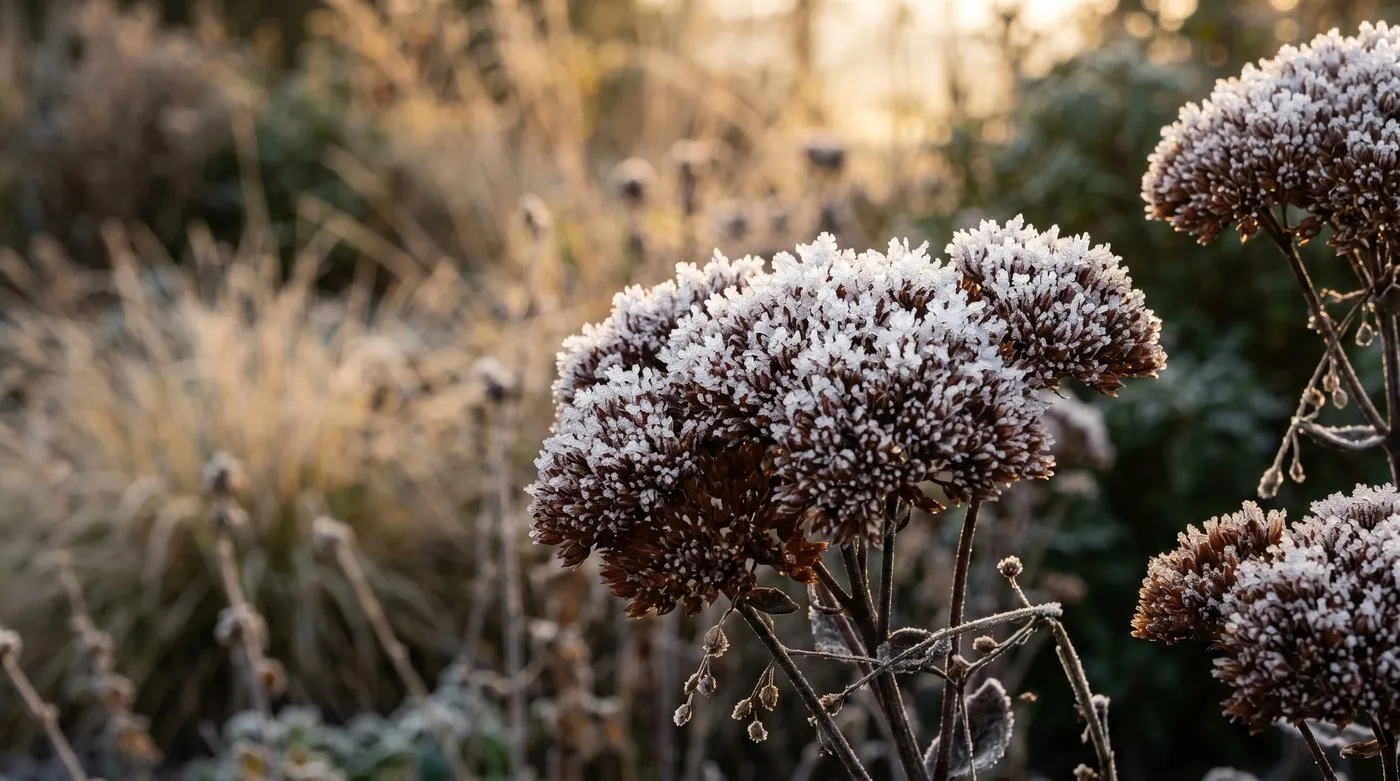 Sedum ‘Autumn Joy’ seedheads hold their shape through six months of UK weather. The russet-brown rosettes give continuous structural interest from September through February.
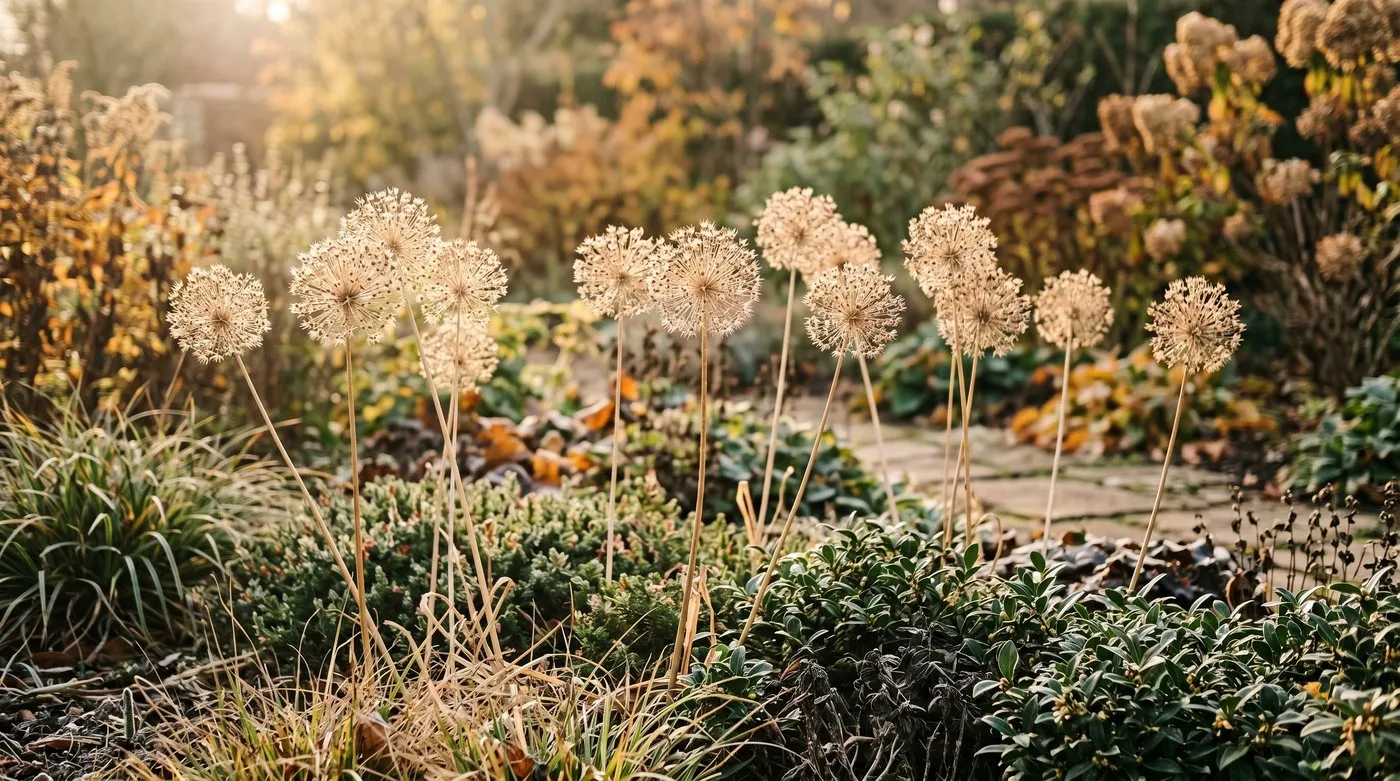 Allium ‘Purple Sensation’ seedheads hold their globe shape for five to six months after flowering. The straw-coloured spheres catch winter sun against low evergreen planting.
Comparison: which seedheads do what
| Plant | Wildlife value | Self-seeds | Winter structure |
|---|---|---|---|
| Teasel | High (goldfinch) | Yes, aggressively | High |
| Sunflower | High (sparrow, tit) | Yes | Medium |
| Echinacea | High (finch) | Yes | High |
| Evening primrose | Medium (siskin) | Yes | Medium |
| Foxglove | Low | Yes, biennial | Low |
| Opium poppy | Low | Yes, annual | Medium |
| Honesty | Low | Yes, biennial | High |
| Verbena bonariensis | Low | Yes | Medium |
| Sedum | Medium | Slowly | High |
| Eryngium | Low | Yes | High |
| Allium | Low | Slowly | High |
| Phlomis | Low | Slowly | High |
Wildlife value, self-seeding, and structural interest combine differently for each plant. Some (teasel, echinacea, sunflower) hit all three. Others (foxglove, honesty) excel at self-seeding only. Pick a mix.
Plants you should still deadhead
For completeness, here are the plants where deadheading still earns its keep.
| Plant | Why deadhead |
|---|---|
| Roses | More flowers across season |
| Dahlias | Continuous flowering until frost |
| Sweet peas | Stops seed set, extends flowering |
| Geraniums (hardy) | Second flush in late summer |
| Penstemon | Continuous flowering until October |
| Lupins | Second flush, prevents legginess |
| Delphiniums | Second flush of side spikes |
| Cosmos | Continuous flowering until frost |
| Bedding annuals | Tidier appearance, extended bloom |
The general rule: plants grown primarily for the flower (and not for the seedhead, the bird food, or the next year’s self-seeded display) benefit from deadheading. Plants on the no-deadhead list belong in a different mental category. They are grown for what they do AFTER the flower fades.
When to finally cut back
Early March is the sweet spot for UK gardens. By then:
- Birds have stripped seedheads of 80% or more of available seed
- Winter frost interest has passed
- New ground-level growth is just emerging
- Slug eggs are still dormant so cutting back does not reveal a feast for them
- Soil is workable on most UK sites
Tip: Cut sedum, eryngium, allium and phlomis to within 5cm of ground level. Cut taller perennials (echinacea, teasel, sunflower) to 10-15cm. The stubble protects emerging crowns from slugs and trampling.
Some gardeners cut back in mid to late February in southern UK. In northern UK and Scotland, hold off until mid-March. The trigger is when new green shoots are clearly emerging at the crown, not a fixed date.
How much time leaving seedheads actually saves
The reason March takes less time than autumn: dried stems snap cleanly, are easier to bundle, and the slug-protection mulch of leaf litter can be left in place rather than raked.
Month-by-month seedhead calendar
| Month | Tasks |
|---|---|
| July | Identify which plants to leave (mark with bamboo canes if needed) |
| August | Deadhead roses, dahlias, sweet peas as normal. Leave the 12 on the list. |
| September | First seedheads ripen on opium poppy, evening primrose, foxglove |
| October | Birds begin feeding on teasel, sunflower, echinacea |
| November | Peak bird activity. Self-seeding begins for honesty, verbena bonariensis |
| December | Frost interest peaks. Resist the urge to tidy. |
| January | Maintain wildlife food source. Top up bird feeders only when seedheads are stripped. |
| February | Birds finish stripping most seedheads. Watch for seedling emergence at the crown. |
| March | Cut everything back to 5-15cm. Compost the stems. New growth pushes through within 2 weeks. |
Common mistakes when leaving seedheads
Mistake 1: cutting back in November when the birds have only just started feeding
The autumn instinct to tidy up costs you four months of bird food. Birds strip seedheads progressively from October through February. Cut back in November and you remove 70% of the available seed.
Mistake 2: leaving collapsed dead stems through to May
By mid-March the seedheads are spent and the structural interest has gone. Holding off cutting until April or May lets slugs hide in the dead foliage and damage emerging shoots. Cut back the first week of March in most of the UK.
Mistake 3: deadheading hybrid varieties expecting self-seeding
Many garden hybrids (especially F1 echinacea and verbena hybrids) produce sterile seed. The plants flower beautifully but the seedlings do not return. If self-seeding matters, choose species or open-pollinated varieties: Echinacea purpurea, not ‘Cheyenne Spirit’; Verbena bonariensis, not ‘Lollipop’.
Where to get the right varieties
Most of the 12 plants are available as seed from Chiltern Seeds, Sarah Raven, or Special Plants. For the species rather than hybrid forms, look for:
- Teasel: Dipsacus fullonum (wild type)
- Sunflower: ‘Russian Giant’ or ‘Mongolian Giant’ for biggest seedheads
- Echinacea: Echinacea purpurea (not F1 hybrids)
- Evening primrose: Oenothera biennis (true biennial)
- Foxglove: Digitalis purpurea, the cottage garden type
- Opium poppy: Papaver somniferum ‘Single Black’ or ‘Lauren’s Grape’
- Honesty: Lunaria annua, purple or white forms
- Verbena bonariensis: the species, not hybrid cultivars
- Sedum: Hylotelephium spectabile ‘Autumn Joy’
- Eryngium: Eryngium giganteum ‘Miss Willmott’s Ghost’
- Allium: Allium hollandicum ‘Purple Sensation’
- Phlomis: Phlomis russeliana
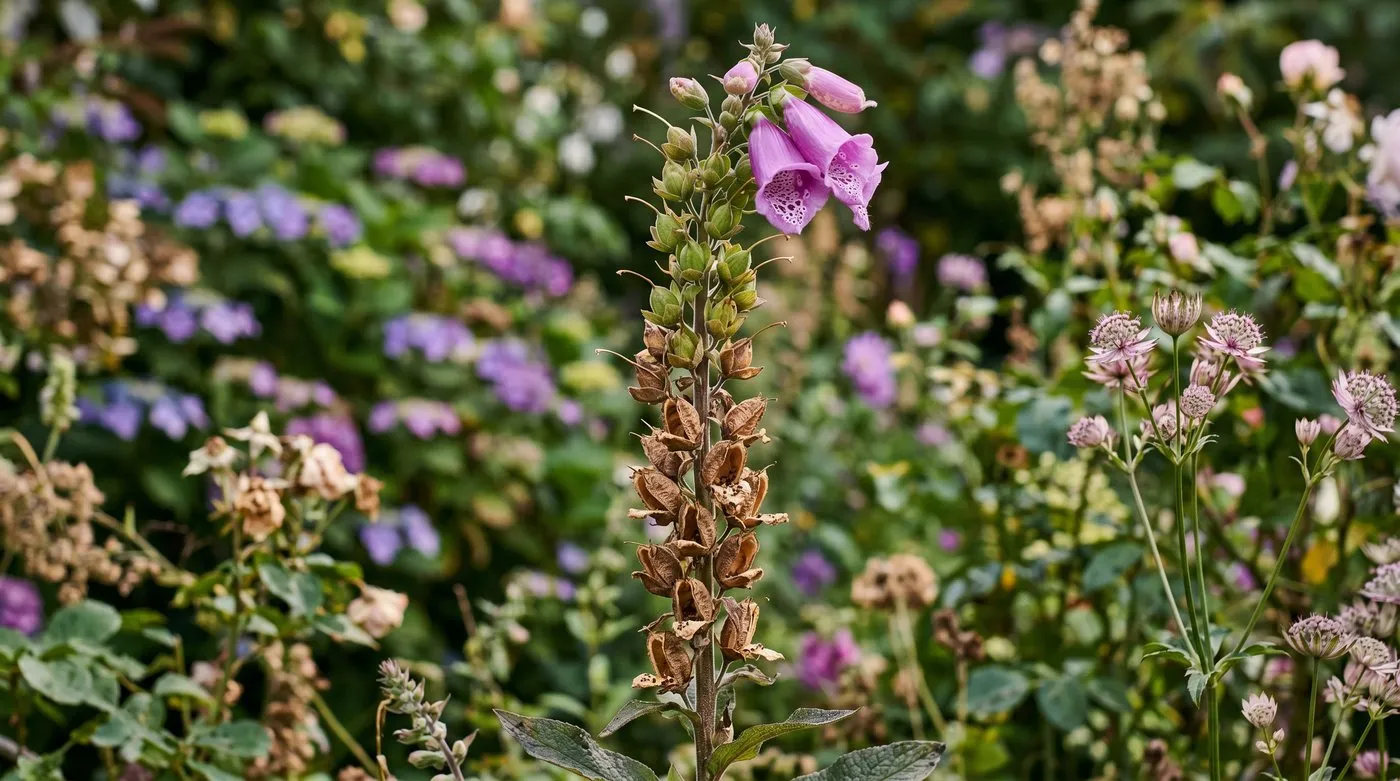 Foxgloves are biennial. Leave the upper third of each spike to ripen seed, which scatters from August to October and germinates the following spring.
Where to read more
The BTO Garden BirdWatch records weekly garden bird data from thousands of UK gardens. Their seedhead-feeder data ranks teasel, sunflower and echinacea consistently in the top 10 winter food sources. The Royal Horticultural Society Wildlife Gardening pages cover seedhead value across hundreds of perennial species.
Frequently asked questions
Which UK plants should you never deadhead?
Twelve in particular: echinacea, teasel, sunflower, evening primrose, foxglove, opium poppy, honesty, verbena bonariensis, sedum, eryngium, allium and phlomis. These either feed birds, self-seed for next year, or provide winter structure - and often all three.
Will leaving seedheads make my garden look untidy?
Initially yes, in late autumn. But by mid-winter the seedheads become a feature. Frost on echinacea, sedum and allium gives the Piet Oudolf naturalistic look UK garden designers are charging hundreds of pounds per square metre to recreate.
When should I cut back seedheads UK?
Early March, before new growth pushes through. By then, birds have stripped most of the seed, frost interest has passed, and the new shoots are not yet damaged by cutting. Use shears or secateurs at 5-10cm above ground.
Do all flowers benefit from being left to seed?
No. Roses, dahlias, sweet peas and most bedding plants should still be deadheaded to encourage more flowers. The 12 plants on this list either feed wildlife, self-seed to return, or hold winter structure. Most others do not.
Does leaving seedheads attract too many birds and slugs?
Will foxgloves come back if I deadhead them?
Most foxgloves are biennials. If you deadhead them, you lose the seed for next year’s plants and the colony dies out within two years. Leave at least one flower spike per plant to ripen seed, which then drops naturally for next year’s display.
Can I cut some stems and leave others?
Yes, and this is the best approach in formal gardens. Cut roses, dahlias and bedding for tidiness. Leave the 12 wildlife and structure plants standing. Mixed beds can be selectively pruned to keep the garden looking maintained while still feeding birds.
Now you know which to leave alone
The autumn deadheading instinct is hard to override. But twelve plants in particular reward restraint with bird life, free next-year plants, and four months of winter structure that would otherwise cost a small fortune in evergreen shrubs.
Our team produces practical UK gardening guidance from source research, contributor records and established horticultural practice. Editorial standards are overseen by Matt W.