Key takeaways
- Rockdust is micronised igneous rock (mostly basalt) that releases trace minerals slowly over years, not weeks
- Apply 250 to 500g per square metre annually on long-cultivated beds, or blend at 5 to 10 percent into potting compost
- SEER Centre Pitlochry rockdust, Volcanic Rock Dust UK and Sea Gold are the three mainstream UK products on the market
- Sea Gold is a rockdust plus seaweed blend, faster acting than pure basalt because it supplies cytokinins and alginates
- Expect 3 to 5 years of consistent application before you see steady yield, Brix and root-quality gains
- Rockdust does not replace nitrogen feeding, compost or green manures: it is a remineralisation tool used alongside them
Rockdust is one of the most misunderstood inputs in UK soil care. Half the gardening internet treats it as a miracle fertiliser and the other half writes it off as snake oil. The truth sits in the middle. It is a slow, mineral-based amendment that works over years, in long-cultivated beds where the soil has been cropped hard without remineralisation, and where the gardener is patient enough to keep applying it without expecting next season’s harvest to double.
What rockdust actually is
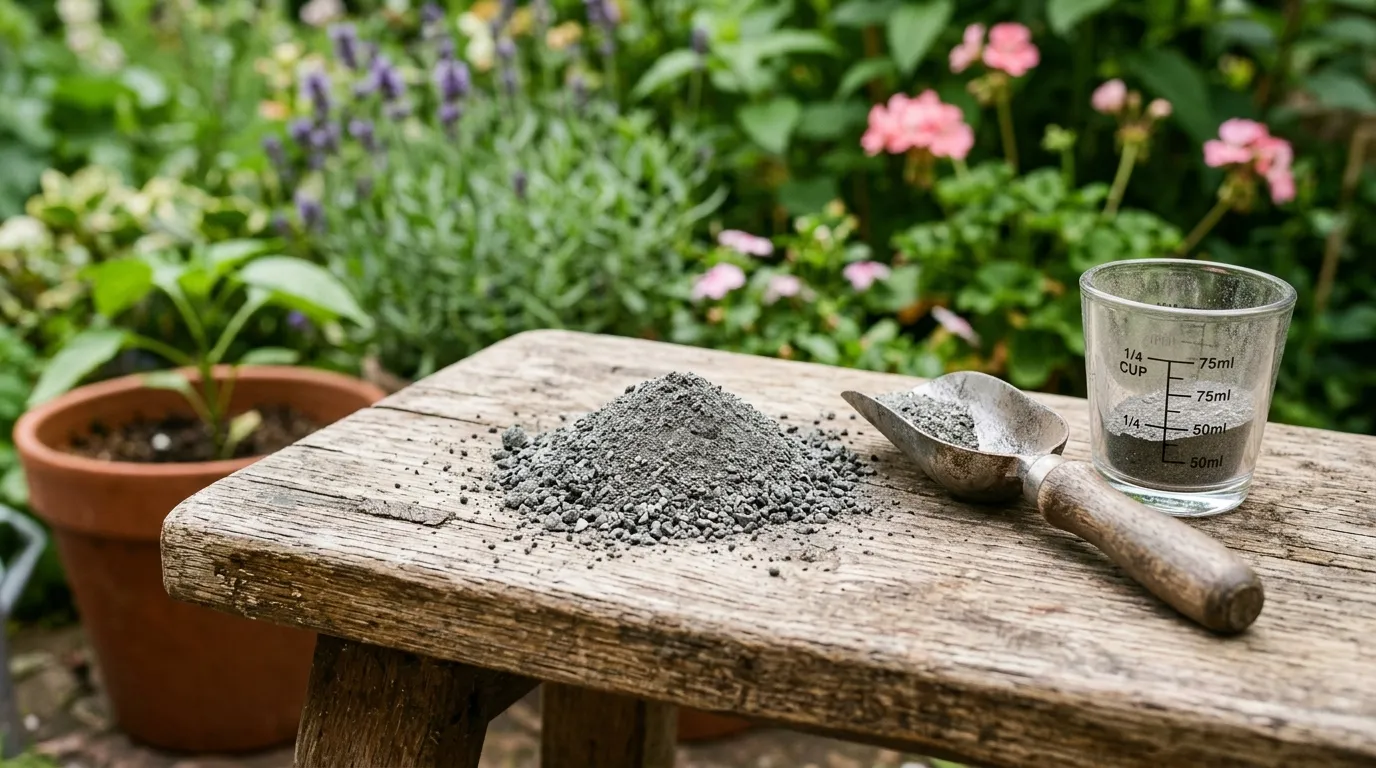
Rockdust is finely milled igneous rock, mostly basalt, sometimes dolerite or granite. The particles are typically 2 to 300 microns, which is fine enough to weather chemically in the soil within years rather than the geological timescale of pebble-sized rock. The mineral profile depends on the source rock, but a typical Scottish basalt rockdust contains calcium, magnesium, iron, manganese, silicon, potassium, phosphorus in trace amounts, and a long list of micronutrients including copper, zinc, boron, molybdenum and selenium.
The mechanism is straightforward. Soil microbes, plant root exudates and weak organic acids in soil water slowly dissolve the rock surfaces, freeing the bound minerals into the soil solution where plant roots can take them up. The rate is slow. Independent measurements suggest a typical UK garden application releases around 5 to 8 percent of its mineral content per year in temperate climate soils. Most of the long-term gain comes from cumulative top-ups year after year.
Rockdust is not a fertiliser in the legal or practical sense. UK Defra fertiliser regulations distinguish between NPK fertilisers and soil improvers, and rockdust sits firmly in the improver category. It does not supply meaningful nitrogen and phosphorus is too slowly released to count. The reason it gets confused with fertiliser is that mineral-depleted soils often respond strongly to a single rockdust application, because the trace deficiency was the bottleneck, not the macronutrients.
A quick word on terminology. You will see basalt rockdust sold under several names: paramagnetic rock dust, glacial rock dust, volcanic mineral dust, basalt fines, basalt meal. Most of these refer to the same product or a close variant. The two genuinely different categories are basalt-source rockdust (the bulk of UK product) and glacial rock dust, which is a mixed-mineral grind of moraine deposits rather than a single rock type. For the UK gardener the practical difference is small; both work on the same slow-weathering principle and both supply broadly similar trace minerals. Buy whichever has the clearest source labelling and the finest grind specification.
There is also a clear difference between rockdust and the older garden lime tradition. Lime is calcium carbonate, designed primarily to raise soil pH. Rockdust is a complex silicate that does not move pH significantly because the calcium it contains is bound inside silicate crystals rather than as a soluble carbonate. The two are complementary rather than interchangeable. A gardener with acidic soil might use both: lime to lift pH into the 6.0 to 6.8 range, rockdust to top up the wider mineral suite.
Why UK soils need remineralisation
The case for rockdust in UK gardens rests on three observations.
First, intensive cultivation strips trace minerals. Every cabbage, carrot or potato leaving the plot exports calcium, magnesium and the micronutrient suite. Modern allotments cropped hard since the wartime Dig for Victory effort have given up 80 years of mineral export to the kitchen. Compost mulches replace organic matter and bulk nutrients but not the geological mineral baseline.
Second, modern fertilisers focus on NPK. A bag of growmore or chicken-pellet feed delivers nitrogen, phosphorus and potassium but little else. The micronutrient gap widens with every fertilised crop on the same soil.
Third, UK soils are generally weathered. Most British gardens sit on weathered glacial deposits, river silts or post-Carboniferous sedimentary rock. Compared with the volcanic soils of Iceland, Hawaii or parts of Italy, our parent rock is mineral-tired before the gardener even picks up a fork. The fix is not chemistry sprayed on the leaves; it is rebuilding the mineral pool in the soil itself.
There is a fourth practical factor worth naming: UK rainfall leaches soluble minerals downward through the soil profile. Annual rainfall of 700 to 1,800mm across the British Isles is enough to wash water-soluble calcium, magnesium and potassium below the rooting zone within a few growing seasons. Insoluble silicate-bound minerals in rockdust resist this leaching because they release minerals only as the rock surface weathers, which means the supply is matched roughly to the rate of plant demand rather than being washed straight through. This is one of the strongest theoretical arguments for rockdust on free-draining UK sandy and loamy soils, and one of the weakest on heavy clays where leaching is slower and the existing mineral pool is naturally larger.
The three UK products: which to buy
Three rockdust products dominate the UK retail market. They are not interchangeable.
SEER Centre rockdust (Pitlochry, Scotland)
Pure micronised Scottish basalt, 2 to 300 microns, sold in 20kg paper sacks at around 35 to 45 pounds delivered. The flagship UK rockdust product, backed by the longest UK trial data. Best for full-bed application at 250 to 500g per square metre. Slow acting because there is no seaweed or organic component. Stocked direct from the SEER Centre and via specialist organic suppliers.
Volcanic Rock Dust (D.J. Turfcare and Vital Earth, UK and EU basalt)
A mix of UK and EU-sourced basalt, sold in 1kg, 5kg and 20kg sizes. Similar mineral profile to SEER Centre rockdust. Slightly coarser grind on some batches, so weathers a touch more slowly. Widely available through garden centres and online. Often the easiest pure rockdust to buy for gardeners not near a Scottish supplier. Price runs 40 to 60 pounds per 20kg sack.
Sea Gold (Sea Action, Pembrokeshire)
A blend of micronised basalt rockdust plus Ascophyllum nodosum (kelp) seaweed meal. Faster acting than pure rockdust because the seaweed supplies cytokinins, alginates, mannitol and chelated trace nutrients within weeks. Sold in 5kg tubs at 25 to 35 pounds and 20kg sacks at 65 to 85 pounds. Best on weak plants, seedling potting mixes and as a foliar feed when wetted and strained.
Generic builders-merchant basalt dust
Sometimes available as a quarry by-product at 8 to 15 pounds per 25kg bag. Cheap but unverified mineral profile, often too coarse for fast weathering, and may include rock from sources with low trace-element content. Useful for soil bulk on heavy projects but not the same product as a horticulturally graded rockdust. Use only if mineral analysis is on the bag.
The three named products are all certified for organic use under either the Soil Association or OF&G schemes, which matters if you are following a peat-free compost protocol and want fully traceable inputs.
How rockdust compares with other soil improvers
Rockdust is one of several mineral-based options for UK gardens. The differences are practical:
| Improver | Primary minerals | Speed of effect | Cost per square metre (250g) | Organic certified | Best use case |
|---|---|---|---|---|---|
| Pure rockdust (SEER, Volcanic) | Ca, Mg, Fe, Mn, Si, K, micros | 3 to 5 years for full effect | 0.45 to 0.75 pounds | Yes | Long-cropped beds and allotments |
| Sea Gold (rockdust plus seaweed) | Same as rockdust plus cytokinins, alginates | 6 to 12 months | 1.30 to 1.80 pounds | Yes | Seedlings, weak plants, container mixes |
| Garden lime (calcium carbonate) | Calcium, raises pH | 6 to 12 months | 0.15 to 0.25 pounds | Yes (limestone) | Acid soils needing pH lift |
| Gypsum (calcium sulphate) | Calcium, sulphur | 3 to 6 months | 0.30 to 0.50 pounds | Yes (mined) | Heavy clay structure, neutral pH soils |
| Seaweed meal | K, Na, alginates, cytokinins | 1 to 3 months | 0.85 to 1.20 pounds | Yes | Foliar feed precursor, faster correction |
| Commercial trace feed (chelated) | All micronutrients | Weeks | 0.95 to 1.50 pounds | Sometimes | Hydroponics, severe deficiency rescue |
For more detail on the macronutrient side and where rockdust fits in a wider feeding plan see best fertilisers for UK gardens, and for soil structure rather than mineral content see the soil drainage and structure guide.
Application rates and timing
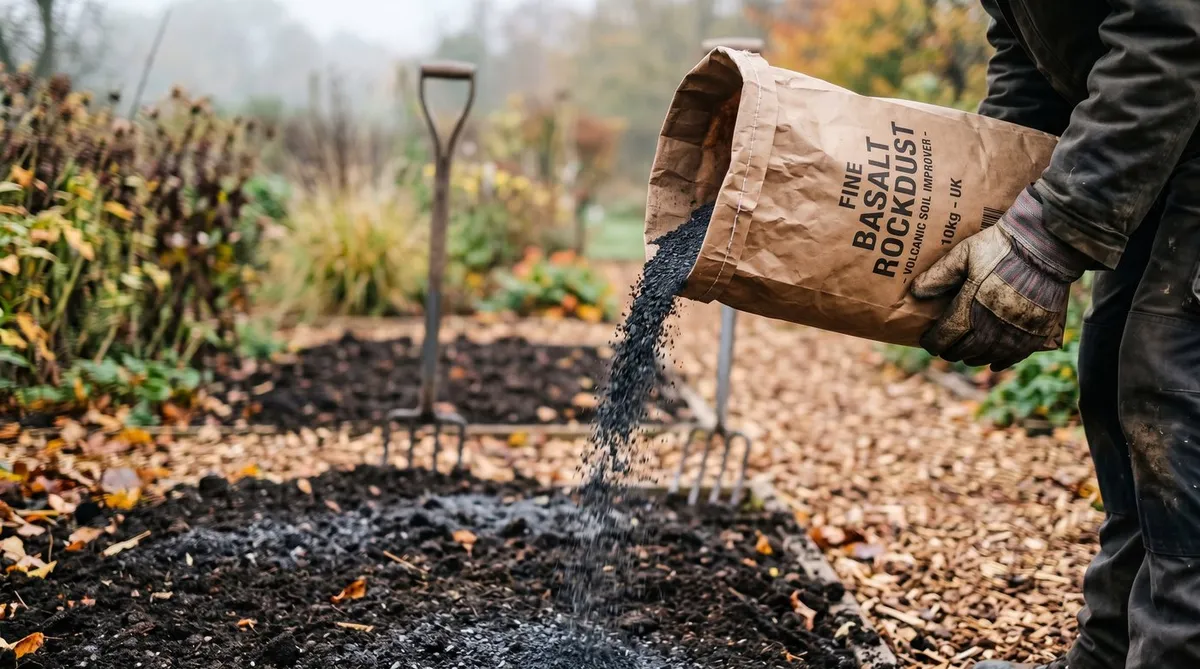
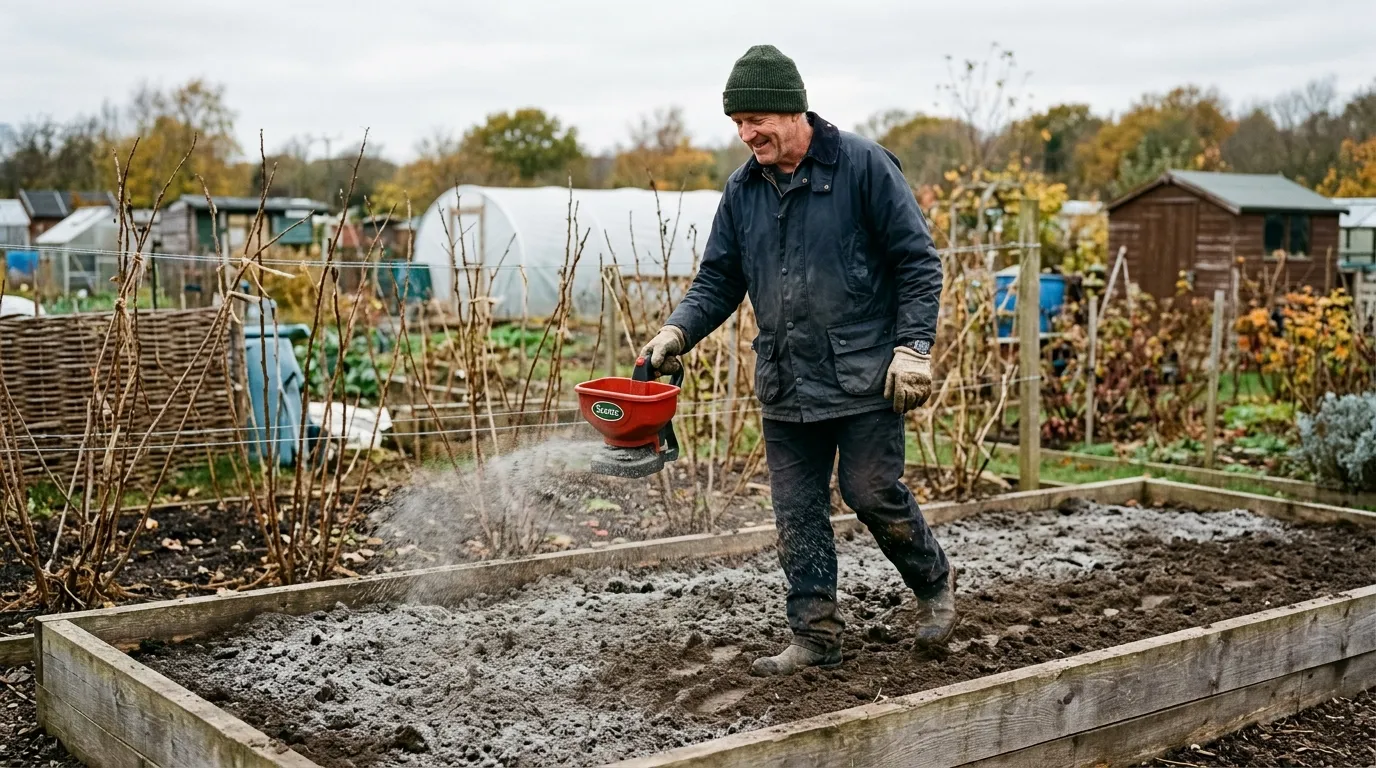
- Established vegetable beds: 350g per square metre, applied in late October or early November after the last harvest. Scatter evenly, rake lightly into the top 25mm of soil, then mulch with a 25 to 50mm layer of compost or wood chip.
- New beds or visibly poor soil: 500 to 750g per square metre in year one, then drop to 250 to 350g annually from year two.
- No-dig beds: apply at the same rate but do not rake in. Scatter on the surface, then mulch over with compost. Worms and rain will integrate the rockdust over winter. For the wider technique see the no-dig heavy clay soil guide.
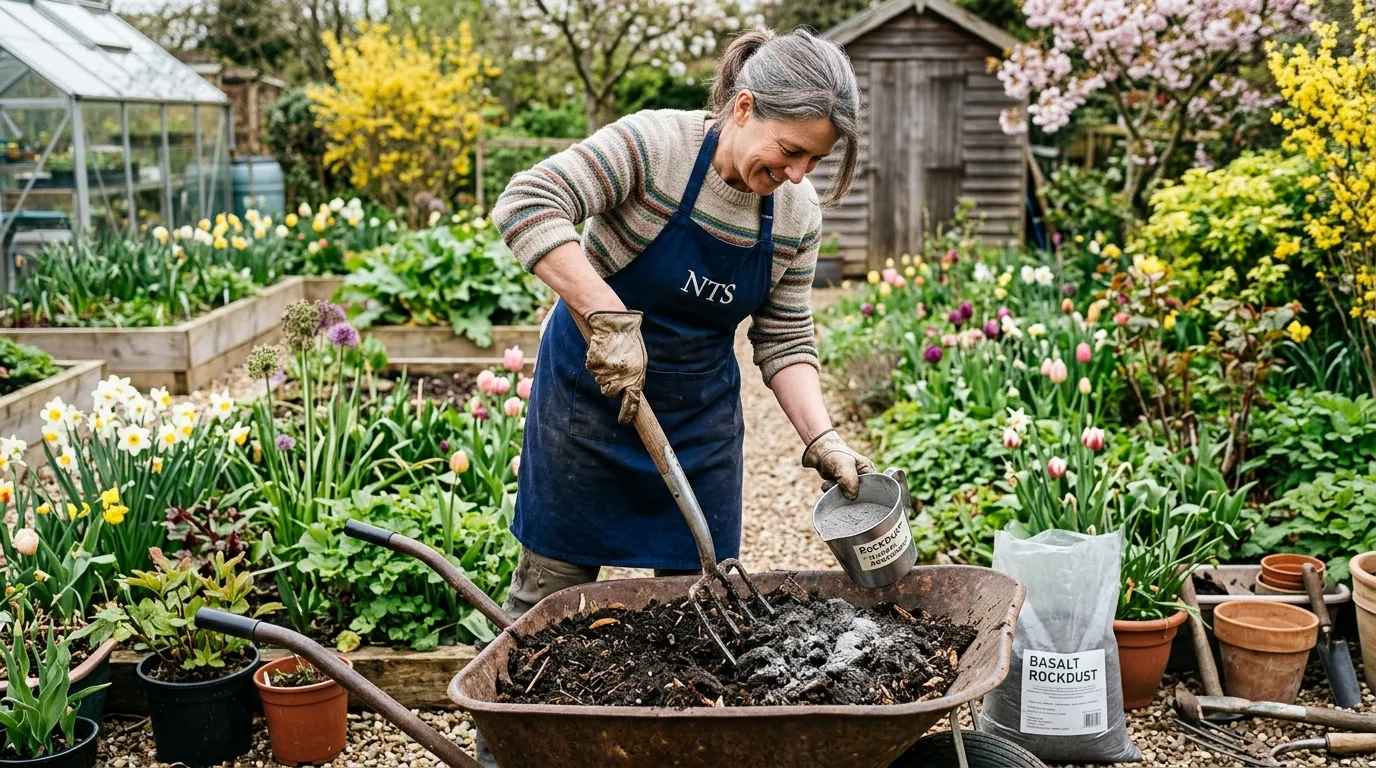
- Container compost: blend at 5 to 10 percent by volume. Roughly one mug (250ml) of rockdust per 30L sack of multipurpose compost. Mix thoroughly with a fork in a wheelbarrow before potting up.
- Lawns: 100g per square metre in autumn, brushed in after scarification. Light annual top-up rather than the heavier vegetable-bed dose.
- Fruit trees and bushes: 500g per established tree, applied in a 1m ring around the trunk in autumn, raked lightly, mulched with compost.
Timing matters. Autumn application gives the rockdust six months of winter weather, frost cycles and rainfall to start breaking down the surface of each particle. By the time spring growth begins the first cohort of minerals is in solution. Spring application works but the lag pushes the visible effect back by a season.
Avoid applying rockdust to dry summer soil. The particles sit on the surface, weather slowly and risk blowing off in wind. If you need a summer top-up, blend rockdust into a watering-can slurry (250g in 10L water, stirred and applied immediately) and pour it on. The slurry method is the fastest way to get rockdust into the soil mid-season, though it suspends rather than dissolves the particles.
Selected data points across the ten years:
| Year | Carrot straightness (% straight roots) | Beetroot Brix (degrees) | Onion bulb weight (g, mean) | Tomato Brix (degrees) |
|---|---|---|---|---|
| 2015 (baseline) | 35 | 6.5 | 165 | 4.2 |
| 2017 | 48 | 7.0 | 178 | 4.6 |
| 2019 | 72 | 7.8 | 198 | 5.1 |
| 2021 | 85 | 8.9 | 222 | 5.7 |
| 2023 | 88 | 9.1 | 230 | 5.9 |
| 2025 | 89 | 9.0 | 232 | 6.1 |
The pattern is consistent across all six crops measured. Years one and two showed little change. Year three brought the first clear improvement in carrot straightness, which is the most visible response to better soil structure and trace mineral availability. By year five Brix readings on all crops had risen by 1 to 2 points. The curve flattens around year seven, suggesting the soil reaches a new mineral equilibrium and further input maintains rather than improves the baseline.
The dataset is one allotment, one set of varieties, one gardener. It is not a controlled scientific trial. It does, however, mirror the directional findings of the SEER Centre’s published Pitlochry work and the longer-running European trials at the Forschungsring soil-health network in Germany. If rockdust were inert the carrots would still be forking after ten years.

Where rockdust does not help
Three situations where rockdust is a poor investment.
Brand-new fertile soil. A freshly built bed on top of imported high-quality topsoil already has the full mineral suite. Adding rockdust costs money and changes nothing measurable. Wait two to three years of cropping before starting rockdust applications.
Highly alkaline soils with naturally high calcium. Chalky South Downs gardens or Cotswold limestone soils already sit above pH 7.5 and have abundant calcium and magnesium. The trace-mineral deficiencies that rockdust corrects are less likely. Soil testing first is the sensible step. If you need calcium for tomato blossom-end rot on alkaline soil, the problem is usually irrigation, not mineral deficiency.
Short-term container growing. Rockdust takes years to weather. A tomato plant in a grow-bag for one summer will not benefit from pure rockdust added at potting time. Use Sea Gold or a chelated trace-feed instead. The exception is reusable potting compost cycled for several seasons, where rockdust pays off over the second and third use.
Pure ornamental beds with no edible cropping. Roses, herbaceous borders and shrub beds rarely benefit measurably from rockdust because they are not exporting their biomass off the plot each year. The leaves and stems return to the soil through natural die-back and any local mulching, so the mineral pool is largely closed-loop. Save the rockdust for vegetable production where the crops physically leave the system. The one exception is fruit trees and bushes, which do export significant mineral content in the fruit and respond well to a 500g annual ring around the trunk.
Hydroponic and soil-less growing. Rockdust depends on biological weathering by soil microbes, which are absent in inert hydroponic media. Adding rockdust to a hydroponic reservoir or a coir-only substrate does nothing useful. Stick to chelated trace-element solutions designed for the specific growing system.
The science: contested but directionally consistent
Mainstream soil science is cautious about rockdust. The chemistry of mineral release is real and uncontroversial: micronised basalt does weather and does release trace minerals into soil. The contested question is the rate, the magnitude of the plant response, and whether the rockdust effect is large enough to matter compared with conventional fertilisation.
The paramagnetic theory promoted by some rockdust advocates (the claim that basalt’s magnetic susceptibility energises plant growth) is not supported by mainstream agronomy. Published studies in journals such as Plant and Soil have either found no paramagnetic effect or could not replicate the original findings. Ignore that claim. The trace-mineral release mechanism, however, is straightforward chemistry and is the basis for the credible rockdust case.
UK soil science researchers at Rothamsted Research (the world’s oldest agricultural research station, founded 1843) have published on basalt amendment in the context of carbon sequestration through enhanced rock weathering, with collaborators including the University of Sheffield. The carbon-capture motive is different from the gardener’s remineralisation motive, but the underlying weathering science is the same and supports the credible claim that basalt dust applied to soil does release minerals on a horticultural timescale.
Garden Organic (formerly the Henry Doubleday Research Association) has been broadly supportive of rockdust as one tool within an organic soil-building toolkit, while warning against treating it as a stand-alone solution. That is the right frame: useful, slow, complementary to compost and green manures, not a miracle.
Integration with a wider soil-building programme
- September to October: harvest finishes, beds cleared, weeds removed
- Late October: 350g per square metre rockdust scattered, raked lightly
- Early November: 25 to 50mm compost mulch over the rockdust, applied without digging
- November to February: beds left to weather; worms and frost integrate the inputs
- Late February: any compacted areas loosened with a broad fork (no inversion)
- March: light scatter of seaweed meal at 100g per square metre on hungry-feeder beds
- April onwards: plant out, with comfrey-leaf liquid feed at fortnightly intervals during peak growth
The rockdust is doing one job: rebuilding the mineral baseline. The compost is doing a different job: feeding the soil biology and supplying organic matter. The seaweed meal is doing a third job: faster-release potassium and biostimulant. None of the three replaces the others. For the composting side of this cycle see the dedicated guide; for sandy soils that need particular attention to organic matter and water retention see how to improve sandy soil.
Green manures fit alongside this programme rather than instead of it. Phacelia or field beans sown after a summer crop and dug in or chopped down in spring add bulk organic matter and nitrogen-fixing potential. They do not, however, replace the trace-mineral function that rockdust performs.
The honest cost-benefit picture
A 20kg sack of SEER Centre rockdust at 40 pounds delivered covers roughly 50 to 80 square metres at 250 to 400g per square metre. A standard 10-rod allotment (250 square metres) needs three to four sacks per year, or 120 to 160 pounds annually. That is not nothing.
For a small back-garden vegetable patch of 10 to 20 square metres, the annual rockdust cost drops to 15 to 25 pounds. At that scale the cost-benefit is purely about quality of produce rather than yield economics, and is well worth it for any gardener who wants vegetables with measurable Brix and trace-mineral profiles for cooking, fermenting or feeding to children.
What to do in your first year
If you are starting from scratch on a UK allotment or vegetable garden, the first-year protocol is straightforward.
- Test your soil pH and texture. Either use a home pH kit or send a sample to RHS or Yara for analysis. Rockdust does not change pH significantly, so this is about knowing your starting point, not adjusting it.
- Buy one 20kg sack of SEER Centre rockdust or Volcanic Rock Dust. That covers 50 to 80 square metres for a full year.
- Apply 350g per square metre on cleared beds in late October. A 250ml plastic cup is roughly 350g of basalt dust by weight, which makes spreading by hand or hand-spreader easy.
- Cover with a 25 to 50mm compost mulch. Buy multipurpose peat-free if you do not yet have homemade compost.
- Repeat every November. Keep a simple record of yields and any Brix readings if you have a refractometer (around 25 pounds online).
- Re-test soil texture and drainage every three years using a jar test. The soil drainage and structure guide covers the method in detail.
Do not expect miracles in year one. The gain comes slowly, then suddenly: by year four or five most growers notice that carrots are straighter, beetroot is sweeter, and onion bulbs are bigger than the rest of the site. The patient gardener wins this game.
Related guides
For broader soil care the no-dig gardening guide UK pairs naturally with rockdust application. For the organic-matter side of the cycle see how to make compost, and for container-growing context peat-free compost guide covers the substrate side.
Our team produces practical UK gardening guidance from source research, contributor records and established horticultural practice. Editorial standards are overseen by Matt W.