Key takeaways
- Best window for the full routine is the first dry week of November, before sustained frost
- Spade and hoe edges sharpen to 35 degrees with a mill file; secateurs and shears to 23 degrees on a diamond stone
- Raw linseed oil on wooden handles, 15ml per handle, two coats 24 hours apart
- Soak rusted tools in 5% white vinegar for 12 hours, scrub, dry, oil within 30 minutes
- Shed humidity above 70% rusts metal in 6 to 8 weeks; vent or use a 500ml dehumidifier
- Pegboard with painted silhouettes returns 23 tools to their place in under two minutes
When to Start Storing Garden Tools for UK Winter
The first dry week of November is the right window for most of the UK. By then the herbaceous border has been cut down, the last leaves have come off the trees, and any final lawn mowing is done. Sustained ground frost is still two to four weeks away. The tools have done their season’s work and need rest.
In Scotland and northern England, bring the routine forward to late October. The first hard frosts there can arrive by early November and you want the work done before the ground freezes. In Cornwall, Devon, west Wales, and other mild south-western counties, mid-November is fine. The Channel Islands can run later still.
Pick a dry stretch in the forecast. Tools must be fully dry before they go into the shed. A damp wire-brushed spade put away in November will be lightly rusted by Christmas, no matter how careful the rest of the routine has been. Two consecutive dry days are the minimum: one for cleaning and sharpening, one for the oiling step to cure.
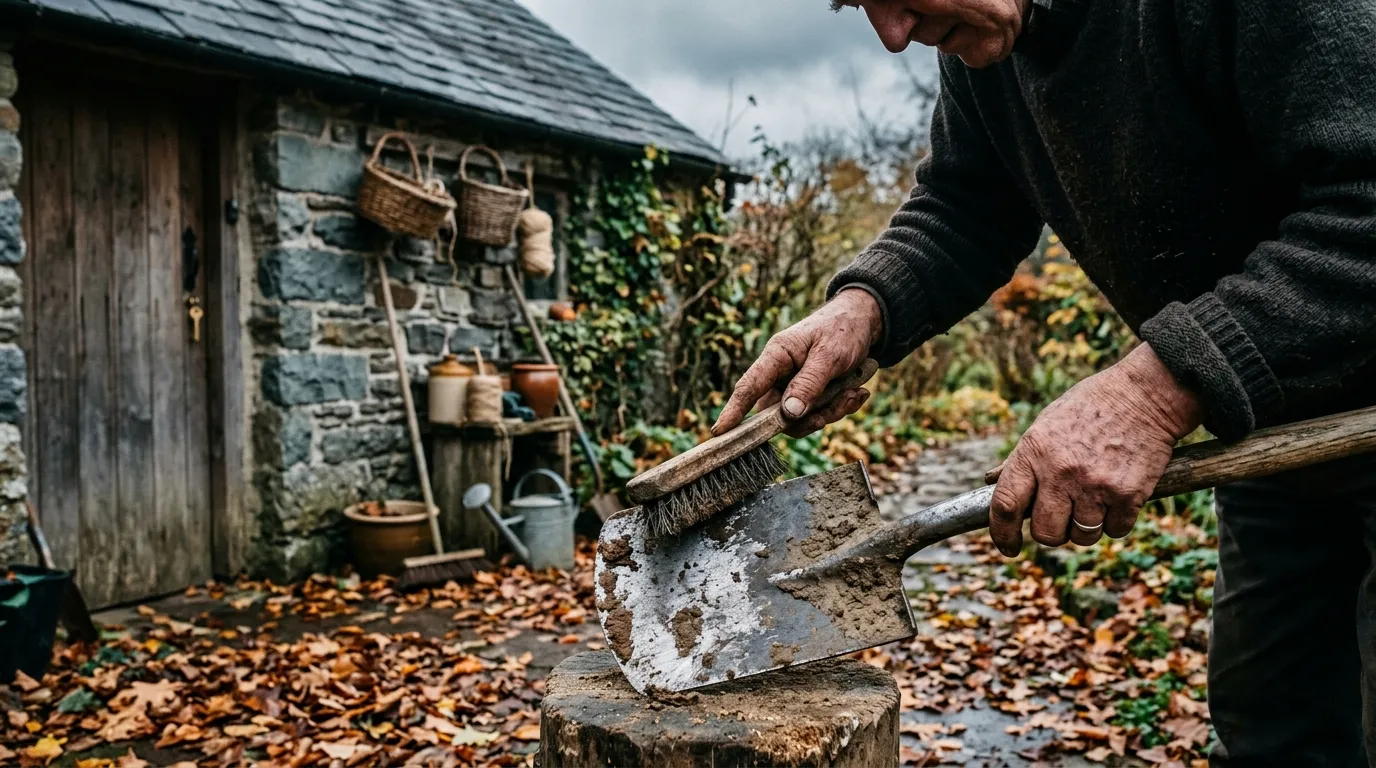 Wire-brushing dried mud off a spade blade outside a Welsh stone shed in late November. Clay must come off before sharpening or oiling, because trapped soil holds moisture against the steel and feeds winter rust.
How to Clean Garden Tools Before Winter Storage
Cleaning is the unglamorous first step that decides whether the rest of the routine works. Soil left on a tool holds moisture against the metal and feeds rust through every damp November night. Five minutes per tool with a wire brush solves the problem.
Removing caked mud and clay
Knock the worst of the dried soil off against a brick wall or paving slab. Heavy clay from a wet autumn cakes onto spades and forks in a hard crust that a wire brush will not shift on its own. The brick knock breaks the crust, then the brush gets the residue.
Use a stiff stainless or brass-wire hand brush, around 200mm long. Wire bristles are essential. Plastic brushes flex too much and leave the steel surface still gritty. Work the brush in long strokes along the blade in the direction of the grain of any milling marks. Pay particular attention to the shoulder where the blade meets the socket, because that join traps soil that rots out the handle’s tang.
For trowels and hand forks with detailed shaping, a small brass-bristle brush gets into the curves where the larger brush cannot reach. A £6 wire brush from any UK ironmonger lasts five winters of weekly use.
Washing and drying
Most tools need no water at all. Wire brushing alone is enough for spades, forks, hoes, rakes, and trowels. Where dried sap or pruning resin sticks to secateurs or loppers, a 30-second dip in a bucket of warm soapy water followed by a stiff brush clears it.
The critical step is drying. Wipe every washed tool thoroughly with an old cotton T-shirt or terry towel. Pay particular attention to pivot joints, springs, and the sockets where blade meets handle. Any water trapped in those joints will rust the tool from the inside out within weeks.
Stand the tools in front of a radiator or in a shaft of sunlight for an hour to drive off the last moisture before sharpening. The vinegar or citric acid soaks for rust removal come later, and only for tools that already have rust to deal with.
Sharpening Garden Tools UK: Angles and Stones
A blunt tool wastes the gardener’s energy. A spade that arrives in March with a season-blunted edge needs twice the foot pressure to cut sod. A blunt secateurs crushes stems rather than slicing them, opening the plant to infection. The sharpening step takes ten minutes per tool and pays back across the next twelve months.
Spades, hoes, and edging irons (35 degrees, mill file)
Spades, hoes, edging irons, and any other digging or chopping tool sharpen to a 35-degree cutting bevel. Use a 10-inch mill bastard file (called a mill file in some catalogues), held at 35 degrees to the blade. The file is single-cut, which is why mill files are right for this and double-cut files are wrong (they tear the edge).
Clamp the spade upside down in a workbench vice with the blade pointing up. File in long single-direction strokes from the socket end to the tip, lifting the file on the return stroke. Six to eight strokes per side restores a working edge. Sharpen the original factory bevel only, not the back of the blade.
A new mill file costs around £11 from any tool supplier and sharpens 30 to 40 spade refreshes before it needs replacing. Burgon and Ball, Spear and Jackson, and Bulldog all make spade-grade mill files.
Secateurs and shears (23 degrees, diamond stone)
Bypass secateurs and garden shears need a much finer edge: 23 degrees on the cutting bevel. A 23-degree edge slices cleanly through green stems without crushing them. The tool of choice is a credit-card-sized diamond sharpening stone, around 600 grit. Diamond is harder than the chromium-plated steel used in modern secateurs and removes very little material per pass.
Hold the stone flat against the bevel at 23 degrees and draw it along the blade from base to tip in single strokes, lifting on the return. Five to seven passes per side restores a season-blunted Felco-style secateurs. Apply two drops of camellia oil to the diamond stone before use so the metal swarf rinses off easily.
For shears, the same diamond stone or a Burgon and Ball Razor Sharp tool at the matching 23-degree setting. Both blades need sharpening, not just one. A diamond credit-card stone costs around £14 and lasts a decade of household use.
Knives, billhooks, and grass hooks (25 degrees, water stone or diamond)
Garden knives, billhooks, and grass hooks sit between the spade angle and the secateurs angle: around 25 degrees. Use a 1,000-grit water stone or a finer-grit diamond plate. Same long single-direction strokes, two passes per stroke direction, both sides of the blade.
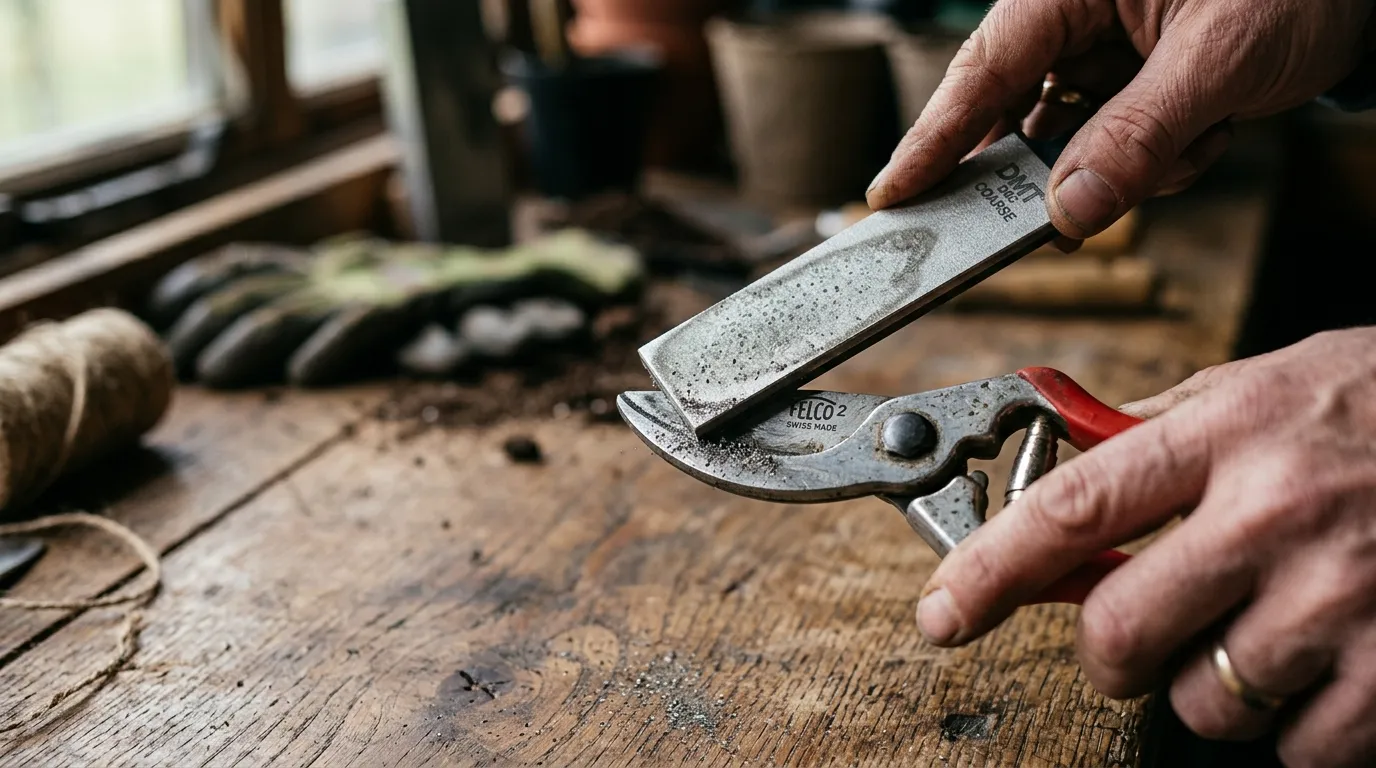 Sharpening a bypass secateurs at the 23-degree cutting bevel angle on a 600-grit diamond credit-card stone. Five to seven single-direction passes per side restores a season-blunted edge. Two drops of camellia oil on the stone keep the swarf moving.
Oiling Spades and Forks: Linseed for Wood, 3-in-1 for Metal
Oil is the membrane that stops the next winter’s damp from reaching the steel and the wood. Two different oils for the two different jobs. Twenty minutes of work covers every tool in the shed.
Wooden handles: raw linseed oil, 15ml per handle
Ash and beech are the two common handle timbers in UK garden tools. Both crack and split when they dry out below 12% moisture content. A November coat of raw linseed oil keeps the cells flexible through a dry shed winter.
Raw linseed oil, not boiled. Raw linseed is pure flax-seed oil that soaks into the timber and polymerises slowly over weeks. Boiled linseed has metallic driers added that make it cure on the surface in 24 hours, but leave the wood beneath unprotected. Raw is the right choice for tool handles, despite the slower drying time.
Pour about 15ml of raw linseed onto a folded cotton rag. Rub the rag along the handle in long strokes in the direction of the grain, working from socket to grip. Use enough to wet the handle thoroughly but not so much that it pools or drips. Leave for 24 hours in a warm dry place. Apply a second coat the next day. The handle should feel silky-smooth and slightly darker in colour after the two coats cure.
Important safety point: cotton rags soaked in linseed oil can spontaneously combust as the oil cures. Lay used rags flat outside on concrete or in a metal bucket of water overnight. Never leave them in a heap or in a closed bin.
A 500ml bottle of raw linseed oil costs around £8 and lasts five winters of handle care on 23 tools.
Metal blades: 3-in-1 or camellia oil
Steel blades need a thin protective film of light machine oil for the winter. The two standard choices are 3-in-1 (a familiar UK household oil) and camellia oil (the traditional Japanese choice for blade care). Either works. Camellia is food-safe and slightly more refined; 3-in-1 is cheaper and easier to find.
Put a few drops on a clean cotton rag and wipe every metal surface: spade blades, fork tines, hoe blades, rake teeth, secateurs blades, shear blades. The film should be visible but not dripping. Pay particular attention to pivot points and springs on secateurs and shears, where a drop down into the mechanism keeps the action smooth.
A 100ml tin of 3-in-1 costs £4 and oils 23 tools twice a year for three years.
WD-40 has a different role
WD-40 is a water-displacing solvent, not a long-term protective oil. Use it to drive moisture off a freshly washed tool before applying the storage oil. The solvent evaporates within two to three weeks and leaves no lasting film. WD-40 by itself is not enough for winter storage.
Applying raw linseed oil to an ash fork handle with a cotton rag. Fifteen millilitres per handle, worked along the grain, two coats 24 hours apart. The membrane keeps the timber flexible at low winter humidity.
Rust Removal: 5% Vinegar Soak and Citric Acid
Any tool that arrived at the November session already rusted needs a separate rust-removal step before the oil goes on. Two cheap, effective methods, both kitchen-cupboard chemistry.
White vinegar soak (12 hours)
Submerge the rusted parts in a bucket of 5% white vinegar (plain shop-bought distilled malt is fine). Twelve hours is enough for light surface rust. Heavy rust pitting needs 24 hours but rarely longer than that.
Acetic acid in the vinegar reacts with iron oxide and converts it to soluble iron acetate, which lifts away from the underlying steel. Scrub the soaked tool with a brass-bristle brush under cold running water to dislodge the loosened rust. Dry the tool thoroughly with a cloth.
Critically, oil the cleaned tool within 30 minutes. Bare steel that has just had its rust stripped develops “flash rust” (a thin orange film) within an hour in any humid air. The vinegar leaves the steel chemically reactive and vulnerable. Wipe with 3-in-1 immediately.
Citric acid (30g per litre)
Citric acid powder dissolves in warm water at 30g per litre and works similarly to vinegar. The advantage is no smell and a cleaner handling experience. Soak time is the same: 12 hours for light rust, 24 hours for heavy.
A 500g bag of citric acid costs around £6 from home-brew suppliers or larger supermarkets and treats a bucket’s worth of tools a dozen times over. Dispose of the spent solution by pouring it down a drain with running water.
When to replace rather than restore
A pitted blade with rust craters deeper than 1mm will never sharpen back to a clean edge. The steel is gone. A spade with rust eating into the shoulder where the socket meets the blade is structurally weak and risks snapping in use. At this stage replacement is the right call. Restoration makes sense for surface rust, not deep pitting.
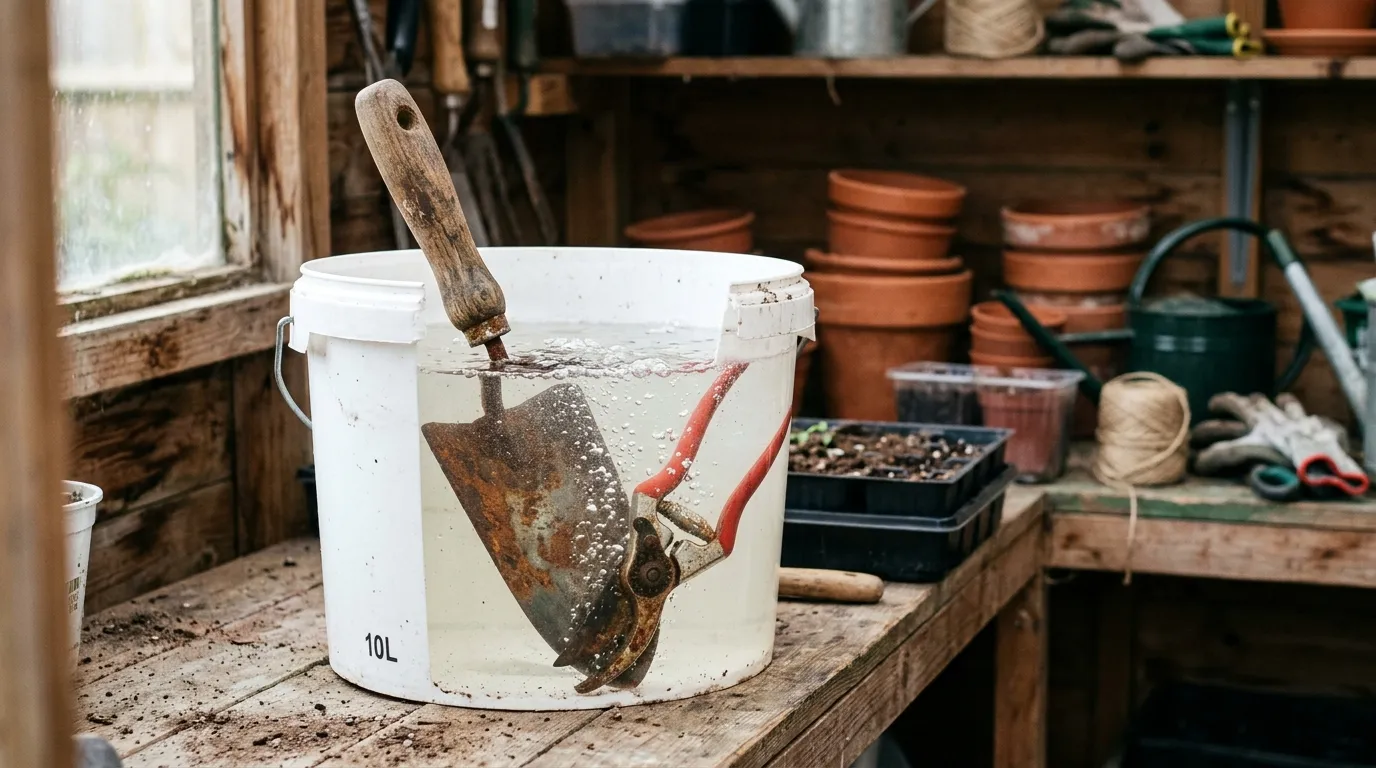 A rusted trowel and hand shears soaking in 5% white vinegar in a 5-litre plastic bucket. Twelve hours dissolves the iron oxide; a brass-bristle brush lifts the loosened rust; oil goes on within 30 minutes before flash rust forms.
Storing Garden Tools in a Wooden Shed UK
Where the tools sit between November and March matters as much as how they were prepared. Cheap mistakes in the shed undo everything done at the bench.
Vented vs sealed sheds
A traditional UK wooden shed is built with gaps in the cladding that allow constant air movement. This is a feature, not a fault. Air movement carries moisture out and stops the humidity rising overnight when surface temperatures drop below dewpoint. A well-vented shed sits at the same humidity as the outside air, give or take a few percent.
A sealed shed (plastic, metal, or wood with sealed cladding) traps moisture from soil floors, damp tools, and any breathing plants stored inside. Humidity climbs from outside levels of 70 to 80% in November to 85 to 95% inside. This is the rust factory. If your shed is sealed, drill two 75mm vents at opposite gable ends to get cross-flow ventilation. A £4 hole-saw fits any cordless drill.
High vs low storage
High storage beats low storage every time. Tools hung on a wall stay clear of damp floor air and dry quickly after being put away. Tools leaning in a corner or piled on the floor sit in the cold layer at ground level, where humidity is highest and condensation forms first.
Long-handled tools (spades, forks, hoes, rakes, edging irons) go on horizontal pegs at shoulder height. Two pegs per tool, spaced to take the socket end and the grip end. The handle stays clear of the wall by 30 to 50mm, letting air circulate around the wood.
Short-handled tools (secateurs, trowels, hand forks, twine, dibbers) go on a pegboard at eye level above the workbench. Magnetic strips work for knives and any other steel-bladed tools. Ladder hooks high above the door hold the items used least often: shears with extension handles, post-hole diggers, long-reach pruners.
Humidity control
A £9 digital hygrometer on the back wall is the single most useful piece of kit in any tool shed. The reading tells you whether the storage strategy is working. Target a year-round average below 70% relative humidity, ideally 55 to 65%.
If readings sit above 70% after adding vents, fit a £24 mini-dehumidifier on a 4-hour timer running through the night when condensation forms. A 500ml unit pulls enough moisture from a 2.4m x 1.8m shed to keep readings at 58 to 65% even in a wet UK November. Empty the reservoir every five to seven days. Running cost is a few pence a week.
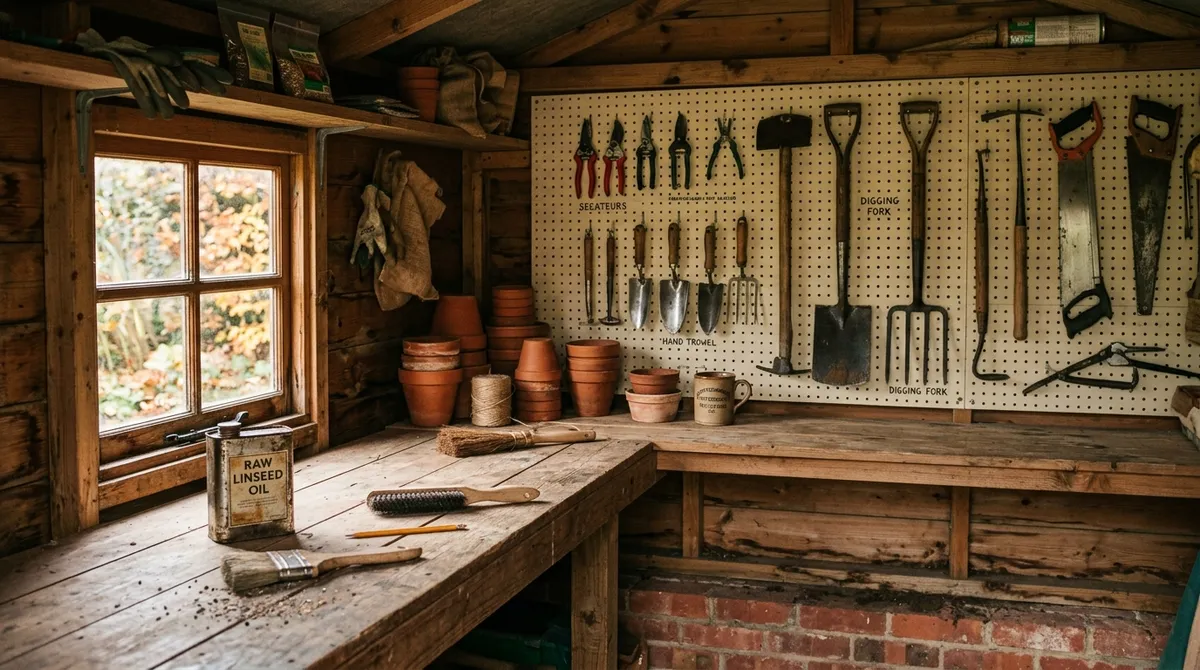
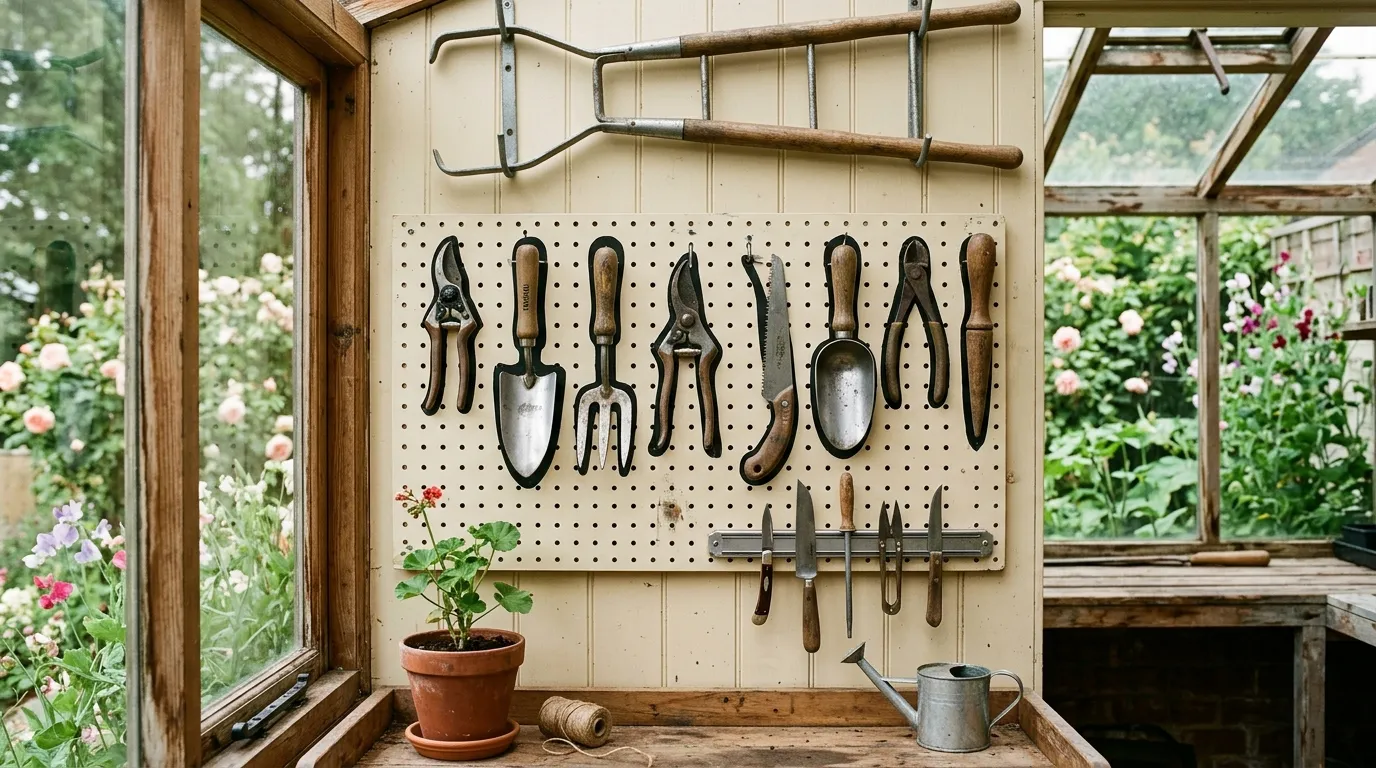 A pegboard with painted-on tool silhouettes inside a Norfolk kitchen-garden lean-to. Every tool has a marked place. Return time for 23 tools after a day’s work is under two minutes.
Best Garden Shed Layout for Tool Storage UK
A good shed layout makes the right action the easy action. Tools go back in their place because the place is obvious. Tools come out cleanly because they are not buried behind other things.
The pegboard wall
A 1.2m x 2.4m sheet of 6mm pegboard (perforated hardboard) mounted on the back wall takes around 30 small and medium-handled tools. Standard pegboard pegs cost £6 for a pack of 50 from any UK DIY shop.
The trick is to paint the silhouette of each tool on the board behind it. A black permanent marker outlines where the secateurs hang, where the trowel hangs, where the twine sits. Empty silhouettes show at a glance which tool has gone missing. Return time for 23 tools after a Saturday in the garden drops to under two minutes once everyone in the household knows the layout.
For long-handled tools, swap the pegboard for two horizontal rails of softwood batten with 80mm pegs at 100mm intervals. Each long tool hangs by its handle from two pegs. Spade, fork, hoe, rake, edging iron, scarifier all line up on the same wall, blades up, handles down.
Magnetic strips
A 600mm magnetic knife strip mounted at eye level beside the workbench holds bladed tools that need to be quickly to hand: garden knife, billhook, grafting knife, scissors. Magnetic strips also work for steel rules, files, and any other thin metal tools. Around £12 for a quality strip.
Ladder hooks and high storage
Two steel ladder hooks in the gable apex above the door take seasonal items used only once or twice a year: long-reach pruners, post-hole digger, extending shears, garden line winder. Keeps them out of the way without taking up wall space.
Workbench and stool
A folding workbench with a 600mm x 1200mm top and a vice on one end gives somewhere to sharpen, oil, and repair tools. A simple wooden stool slides underneath when not in use. Lighting matters: a single 1m LED batten over the bench costs £18 and turns a dark afternoon shed into a usable workshop.
Labelling and Inventory: A Tool List That Pays for Itself
A simple inventory list pinned inside the shed door tells you what you own and where it should be. The list takes 20 minutes to write out and pays for itself the first time a borrowed tool fails to come back.
Twenty-three hand tools is typical for an active UK kitchen garden. Record the name, brand, the year purchased, and the location on the shed wall. Replace the list every five years as tools come and go.
Tool Storage Comparison: Cleaning, Sharpening, Oil, Location, Annual Cost
| Tool | Cleaning method | Sharpening tool | Oil type | Storage location | Annual cost |
|---|---|---|---|---|---|
| Border spade | Wire brush + brick knock | 10in mill file at 35deg | Linseed (handle) + 3-in-1 (blade) | Long-handle rail | £0.80 |
| Digging fork | Wire brush | None (no edge) | Linseed + 3-in-1 | Long-handle rail | £0.50 |
| Dutch hoe | Wire brush | 10in mill file at 35deg | Linseed + 3-in-1 | Long-handle rail | £0.70 |
| Garden rake | Wire brush | None | Linseed + 3-in-1 | Long-handle rail | £0.40 |
| Edging iron | Wire brush + brick | 10in mill file at 35deg | Linseed + 3-in-1 | Long-handle rail | £0.70 |
| Bypass secateurs | Soapy water + brass brush | 600-grit diamond at 23deg | Camellia oil | Pegboard | £1.20 |
| Garden shears | Soapy water + brass brush | 600-grit diamond at 23deg | Camellia oil | Pegboard | £1.10 |
| Loppers | Soapy water | 600-grit diamond at 23deg | 3-in-1 | Ladder hook | £0.80 |
| Trowel | Wire brush | Optional 35deg | 3-in-1 | Pegboard | £0.30 |
| Hand fork | Wire brush | None | 3-in-1 | Pegboard | £0.30 |
| Garden knife | Wipe | 25deg water stone | Camellia oil | Magnetic strip | £0.50 |
| Billhook | Wipe | 25deg water stone | Camellia oil | Magnetic strip | £0.60 |
Annual cost is the share of consumables (oils, files, stones) per tool spread across 23 tools at typical UK supplier prices. Total annual cost for the full kit comes to around £17 to £18.
Month-by-Month Tool Care Calendar
| Month | Task |
|---|---|
| January | Quick visual check of stored tools. Re-oil any that show condensation spotting. |
| February | Sharpen secateurs before pruning season starts. 23 degrees on diamond stone. |
| March | Last chance to apply linseed if November coat looked thin. Tools come back into use. |
| April | Working season. Wipe tools clean after each use. Spot-oil any signs of moisture. |
| May | Mid-season check on secateurs sharpness. Touch up if cuts feel ragged. |
| June | Working season. Clear sap build-up from blades with white spirit if needed. |
| July | Working season. Refresh handle grip tape on any tool showing wear. |
| August | Order replacement files, stones, oils for the autumn routine. |
| September | Working season. Begin watching weather for the November dry window. |
| October | Buy any consumables you are low on. Wash all tools as you finish using them. |
| November | Full routine: clean, sharpen, oil, rust-treat. Update shed inventory. |
| December | Dehumidifier on timer if humidity above 70%. Hygrometer check weekly. |
The Root Cause: Why UK Damp Sheds Kill Garden Tools
The reason garden tools rust in UK sheds is not the rain. The shed walls keep direct rain out. The cause is condensation, and condensation is a temperature and humidity problem, not a leak problem.
UK November air typically sits at 80 to 90% relative humidity. As outside temperatures drop overnight, the shed cools. Cold air holds less moisture than warm air. The same amount of water vapour, in a smaller volume of cold air, means higher relative humidity. Steel tool surfaces cool faster than the surrounding air because steel is a good thermal conductor.
When the surface temperature of a spade blade drops below the dewpoint of the air around it, water condenses on the steel. A bare blade left overnight at 78% air humidity and 2C surface temperature can pick up a fine film of condensation visible as morning dampness. This film alone is enough to start iron oxide formation. Repeat the cycle for 14 nights and the spade is rusted.
The fix is to break the cycle. Either keep humidity low enough that dewpoint never crosses the steel surface temperature (target 65% RH or below), or insulate the steel from cold surface temperatures (oil films, breathable wood handles, dry storage). A combined strategy of ventilation, modest dehumidification, and a thin oil film on every blade keeps tools clean for decades.
Freeze-thaw cycles add a second mechanism for damage. Water trapped in the wood-to-metal joint between a spade socket and its ash handle expands by 9% when it freezes. Across multiple freeze-thaw cycles in a typical UK winter, the joint loosens. A loose socket lets in more water, which freezes again, and the cycle continues. This is why heads come off old garden tools.
A November oiling of the socket-to-handle joint with raw linseed displaces residual moisture and seals the timber against further water ingress. The tools that get this treatment every year stay tight in the socket for 20+ years of use.
Common Garden Tool Storage Mistakes UK Gardeners Make
Mistake 1: leaving tools dirty overnight then doing the routine in spring
Soil left on a blade through December and January is corrosive. By March the steel underneath has spot-rust pitting that no amount of sharpening will recover. The November routine works because tools go into storage clean. Doing the same work in March after a winter of neglect is closing the stable door after the horse has bolted.
Mistake 2: using boiled linseed oil on handles
Boiled linseed contains metallic driers that cure the oil on the surface in 24 hours but leave the timber underneath unprotected. The handle looks oiled but the wood is still drying out beneath. Use raw linseed (no driers, slower cure, full penetration) or food-grade tung oil. Reading the label matters: cheap “linseed oil” in DIY shops is almost always boiled.
Mistake 3: hanging tools on nails through the handle hole
The hole in the end of a spade handle is convenient for hanging, but a single nail concentrates the tool’s weight on one small point and gradually splits the ash. Use a paired peg system instead: two horizontal pegs at socket and grip end, spreading the weight. Handle splits at the hanging hole are a top-three cause of UK garden tool failure.
Mistake 4: storing tools blade-down in a damp corner
Tools propped against a wall with the blade resting on the floor pick up moisture from the concrete or earth floor. Capillary action draws damp up the steel. By March the lower 100mm of every blade is rusted. Always hang or stand tools blade-up if they cannot go on the wall.
Mistake 5: skipping the inventory and label step
A tool whose name is not on a list rarely gets the November routine. It sits forgotten in a corner, returns to the garden the following spring half-rusted, and the gardener wonders what went wrong. The inventory forces a head-count and forces the November routine to be thorough. Twenty-three tools, twenty-three sharpenings, twenty-three oilings, no exceptions.
Where to Buy Tools and Consumables in the UK
Three reliable UK suppliers for the consumables and tools mentioned in this guide.
- Burgon and Ball (Sheffield, since 1730). UK-made spades, forks, hoes, and shears in the National Trust range. Their mill files and sharpening tools are also excellent. Visit burgonandball.com for the full range.
- Garden Organic (Coventry-based charity). Independent advice on tool care and organic gardening. The Garden Organic reference pages on tool maintenance are useful.
- Greenhouse Stores (UK-wide). Wooden sheds, potting benches, and dehumidifiers for tool storage. See the wooden shed range linked above.
Frequently Asked Questions
When should I store garden tools for winter in the UK?
The first dry week of November in most of the UK. By then summer growth has finished and sustained frost has not yet arrived. In Scotland and northern England, late October. In Cornwall and the south-west, mid-November. Pick a dry stretch so tools can clean and dry properly before going into the shed.
How do you stop garden tools rusting in a shed over winter?
Keep shed humidity below 70% and oil all metal surfaces. Add two vents, fit a small dehumidifier if needed, and wipe metal blades with 3-in-1 oil before storage. A £9 hygrometer tells you the truth about your shed. Above 70% humidity, even oiled steel will spot-rust within 6 to 8 weeks.
What angle do you sharpen a garden spade to?
35 degrees on the cutting bevel. Use a 10-inch mill bastard file in long single-direction strokes, working from the handle end to the tip. Six to eight strokes per side restores a season-blunted spade. Finer angles cut better but chip on stones. Coarser angles need more force but last longer.
What is the best oil for wooden tool handles?
Raw linseed oil, not boiled. Raw soaks into the timber over 24 hours and stays flexible. Boiled linseed contains metallic driers and sits on the surface. Apply 15ml per handle with a cotton rag, leave 24 hours, apply a second coat. Two coats a year keeps ash and beech handles smooth for 20+ years.
Can you use WD-40 on garden tools?
Yes for short-term protection, no as the main winter oil. WD-40 is a water displacer that evaporates within a few weeks. Use it to drive moisture off freshly cleaned blades, then follow with 3-in-1 oil or camellia oil for the storage coat. The two-stage approach is what professional tool catalogues recommend.
How do you remove rust from garden tools?
Soak in 5% white vinegar for 12 hours, then scrub with a brass-bristle brush. Rinse in clean water, dry thoroughly with a cloth, and oil within 30 minutes before flash rust forms. Citric acid solution (30g per litre water) works similarly and is cleaner to handle than vinegar.
Should a garden shed have a dehumidifier in winter?
Only if humidity readings sit above 70% for sustained periods. Most UK sheds need ventilation first, dehumidifier second. A £24 500ml mini-dehumidifier on a timer runs at a few pence a week and keeps a 2.4m x 1.8m shed below 65% humidity. Ventilation alone solves the problem in around half of cases.
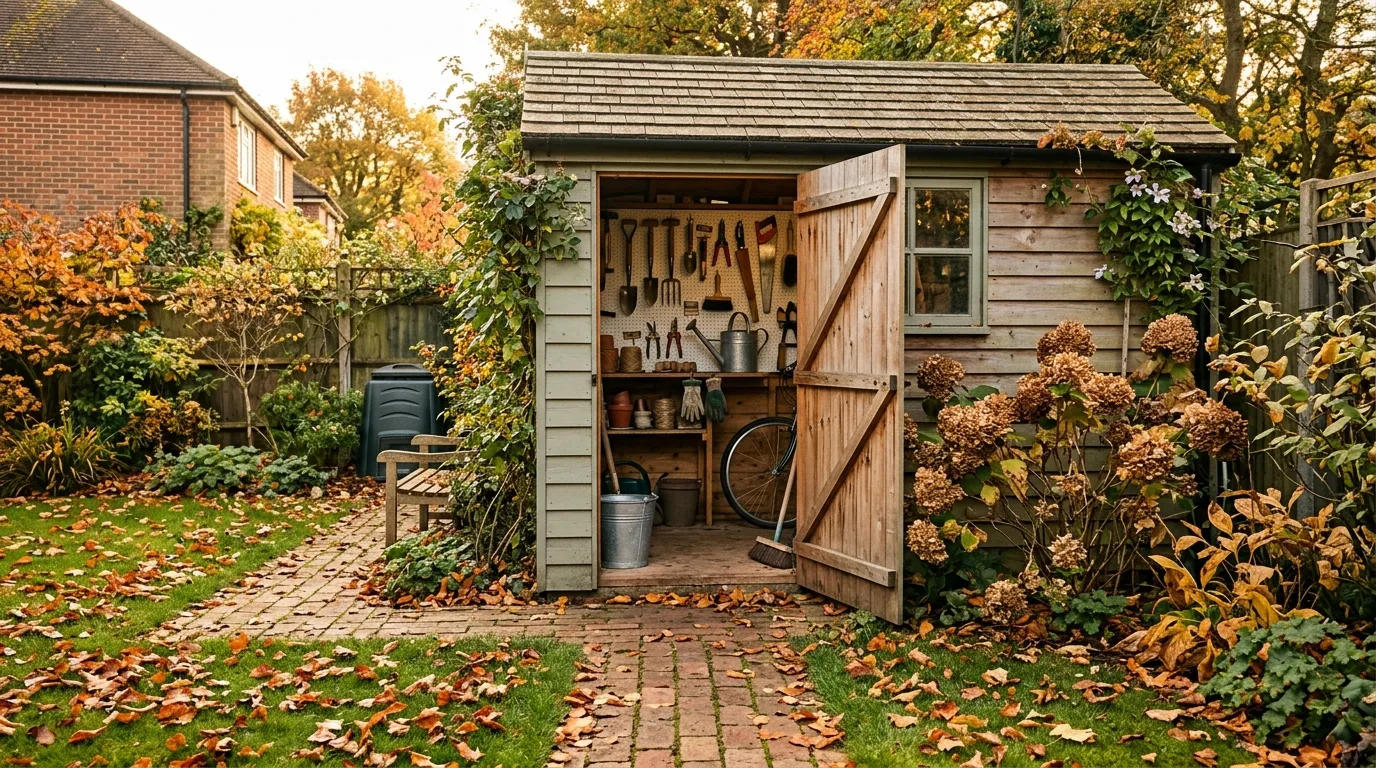 A quality UK wooden shed in late autumn with the door open showing the pegboard wall and organised long-handle tool rail inside. Vented cladding keeps inside humidity below 65% even in a wet November.
Now your tools are away for winter
Our team produces practical UK gardening guidance from source research, contributor records and established horticultural practice. Editorial standards are overseen by Matt W.