Key takeaways
- Ramial chipped wood (small fresh branches) is the best UK woodchip mulch
- Apply 5-8cm thick directly on soil surface; do not dig in
- Best for established beds, fruit trees, shrub borders
- Nitrogen lock-up is real at the soil interface; add nitrogen if planting through
- Avoid on annual vegetable beds (compost the chips first)
- Mulch lasts 2-3 years and improves soil structure underneath
Woodchip mulch is one of the best free or low-cost soil improvements available to UK gardeners. Applied correctly it suppresses weeds, retains moisture, builds soil structure and feeds soil biology - all from a single autumn application that lasts 2-3 years. The catch: applied incorrectly it locks up nitrogen, smothers seedlings, or harbours unwanted pests.
For wider mulching context, see our what is mulch and how to use it, how to make leaf mould UK and feed the soil not the plants UK guides.
Types of UK woodchip
Not all woodchip is the same. Three main categories used in UK gardening:
Ramial chipped wood (RCW)
Made from small fresh branches under 7cm diameter, chipped while still containing leaves and bark.
- Higher nitrogen content (C:N ratio around 70:1 vs 400:1 for mature wood)
- Breaks down faster: 1-2 years on the surface
- Best for soil improvement
- Includes the cambium layer which contains active microbes
Best UK mulch choice for high-fertility uses. Sometimes called “branch chip” or “RCW” in UK arborist circles.
Mature wood chip
Made from larger branches and trunk wood, chipped on its own.
- Lower nitrogen content
- Slower breakdown: 3-4 years
- Best for paths, ornamental surfacing
- Less risk of pest carry-over if sourced from healthy trees
Standard offering from UK tree surgeons when they say “wood chip”.
Bagged ornamental chip
Pine bark chip, coloured chip, or graded ornamental chip from garden centres.
- £6-£12 per 100l bag
- Sterile, weed-seed-free
- Long-lasting (3-5 years)
- Best for visual finish and high-profile areas
Useful for accent areas, focal points, or where ramial chip would be unsightly. Not necessary for general bed mulching.
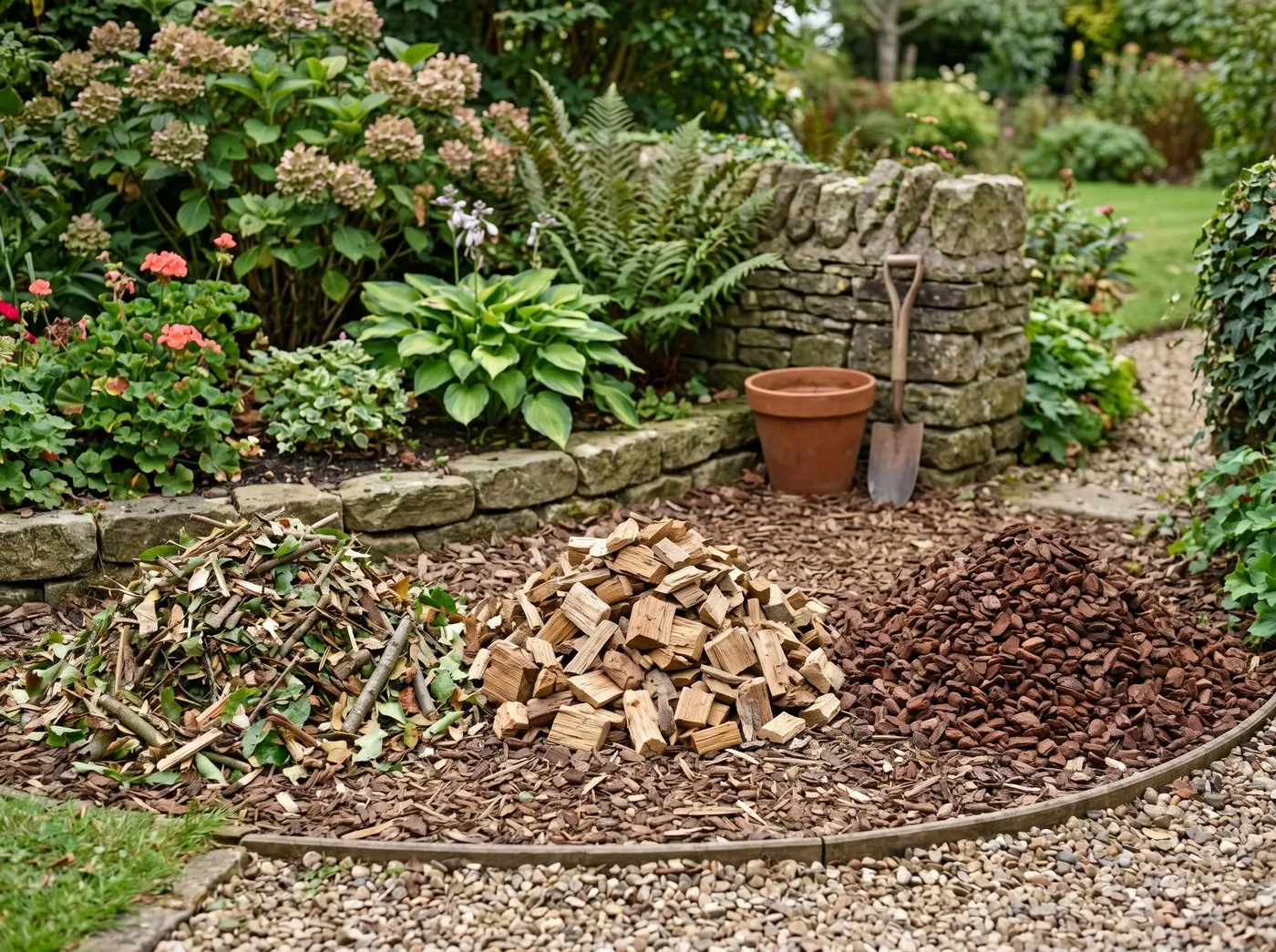 Three UK woodchip types - ramial (left, best soil improvement), mature wood (centre, paths and ornamentals), bagged ornamental bark (right, focal areas).
Where to source UK woodchip
Tree surgeons (free)
The cheapest and most plentiful source. UK tree surgeons typically pay to dispose of chip at green waste sites. They’re happy to drop loads free at your property.
Find local arborists via:
- GetChipDrop.com - free service matching tree surgeons with gardeners who want free chip
- Direct contact with local tree surgery firms
- Council tree services - often have surplus
Expect 2-5 cubic metres per drop. That’s enough to mulch a 30-50m² bed area 8cm thick.
Local council
Many UK councils offer free or low-cost wood chip from their tree maintenance work. Check with your local authority.
Garden centres (bagged)
For small quantities or specific ornamental use. £6-£12 per 100l bag. Most centres stock pine bark; some stock mixed hardwood chip.
Stable mucking out (cautioned)
Stable bedding chips can contain manure traces. Excellent for orchard mulching and soft fruit beds but unsuitable around vegetables without composting first.
The right application method
How you apply woodchip determines whether it helps or hurts.
The correct way
- Prepare the bed - clear weeds, water thoroughly if soil is dry
- Apply directly to the soil surface - do not dig in
- Spread 5-8cm thick - thicker for poor or weedy soil, thinner for already-good soil
- Keep clear of plant stems - leave a 5cm gap around each crown
- Cover the whole bed surface - any gap allows weed germination
The wrong way
- ❌ Mixing chip into the soil - causes nitrogen lock-up throughout the rooting zone
- ❌ Mounding against tree trunks - causes bark rot
- ❌ Applying to actively-germinating annual vegetable beds - smothers seedlings
- ❌ Going too thick (over 15cm) - creates anaerobic conditions
- ❌ Going too thin (under 3cm) - allows weed germination
The general principle: surface-only, thick enough to block light, away from plant stems.
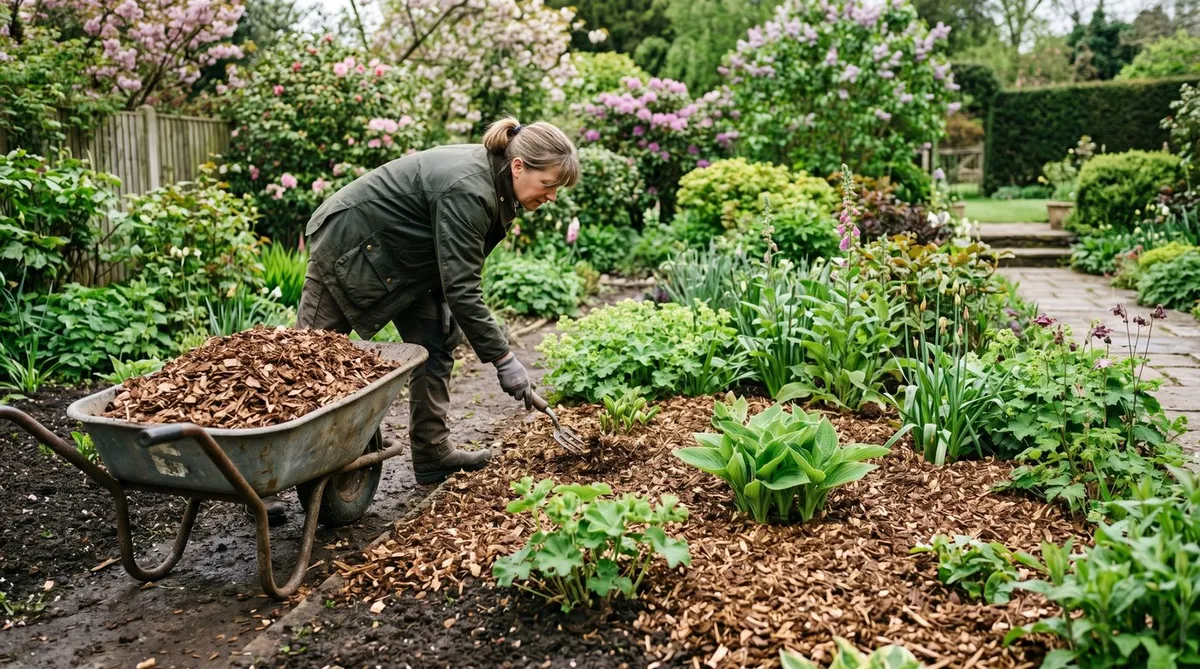
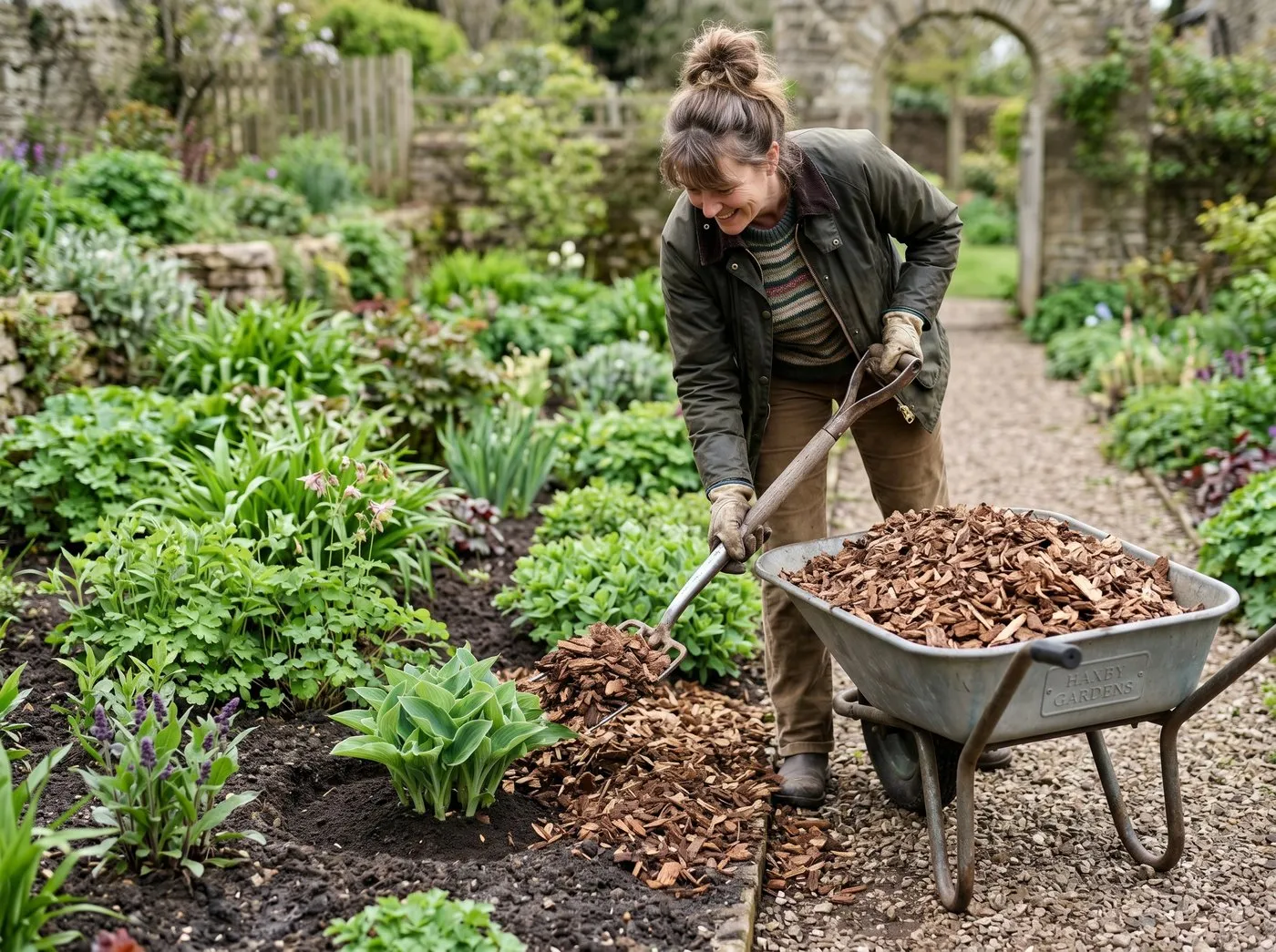 Correct application - 7cm thick on the surface, 5cm gap around each plant stem, even coverage. Apply October-November for best worm incorporation.
The nitrogen lock-up myth and reality
The most-asked question about woodchip mulch.
The chemistry: wood is high in carbon and low in nitrogen (C:N ratio 300-500:1 for mature wood). Microbes breaking down the wood need nitrogen from somewhere. If they take it from the soil, plants lose access to that nitrogen.
The reality in UK gardens:
Surface-applied wood chip causes nitrogen depletion ONLY at the soil-mulch interface - the top 1-2cm of soil. Deeper roots access nitrogen normally.
- Established plants with deep roots: virtually no effect. Trees, shrubs, mature perennials draw nitrogen from 30-60cm depth.
- Young transplants: small effect. Established within 4-6 weeks.
- Seedlings sown directly: significant effect. Avoid - either compost the chip first or use a different mulch.
- Annual vegetables planted into fresh chip: significant effect. Avoid.
The practical rule: surface-applied wood chip on permanent plantings is safe. Direct contact between fresh chip and germinating seeds is not.
If you must plant into recently chip-mulched soil, add a high-nitrogen feed underneath: a handful of chicken manure pellets, blood meal, or comfrey leaves dug in 10cm down. This offsets the nitrogen lock-up effect for 4-6 weeks while plants establish.
Best UK uses for woodchip
1. Perennial borders
Spread 5-8cm thick in October. Lasts 2-3 years before top-up. Reduces weeding to near zero, holds moisture through summer drought.
2. Fruit trees (under tree canopy)
Apply 8-10cm thick in a 1.5m radius around the trunk, leaving a 10cm gap at the trunk itself. Keeps grass and weeds away from the root zone. Adds 1-2 years to young tree establishment.
3. Soft fruit beds (currants, raspberries, gooseberries)
Apply 6-8cm thick under established bushes. Suppresses weeds, holds moisture, gradually feeds soil. Replace top 2cm annually.
4. Paths and seating areas
Mature wood chip works as a soft surface for paths. Walk-on durability is 2-3 years before top-up needed.
5. Established asparagus beds
Asparagus does well under a 5-7cm layer of chip. Top-dress in autumn after final cut-down.
6. Strawberry beds
Apply 3-5cm thick around plants once flower buds appear. Reduces fruit-soil contact, prevents botrytis grey mould.
7. Shrub borders
Same as perennial borders. 5-8cm in October works for most established shrubs.
8. Around mature trees in lawns
A 1m radius of 8-10cm chip improves tree health by reducing grass competition and feeding the root zone.
Where to avoid (or compost first)
Annual vegetable beds (without composting)
Fresh chip causes nitrogen lock-up that affects annual crops badly. Compost the chip for 12-18 months in a separate pile before adding to active vegetable beds.
Newly sown seed beds
Direct contact between fresh chip and germinating seeds suppresses germination. Wait until plants are established (10cm+ tall) before mulching.
Wet boggy areas
Already too much organic decomposition; adding more creates anaerobic conditions.
Direct on plant crowns
Always leave 5-10cm gap around the crown of each plant. Chip against the crown causes rot.
Mediterranean and dry-tolerant plants
Lavender, rosemary, sage, thyme, alpines all dislike heavily-mulched soil. They prefer free-draining mineral surfaces. Use gravel or grit mulch instead.
How to compost woodchip for vegetable beds
If you have plentiful wood chip and want to use it on vegetable beds, compost it first:
- Pile in a separate heap at least 1m × 1m × 1m
- Mix with green material - grass clippings, comfrey leaves, fresh manure - at 30% by volume
- Wet thoroughly when piling
- Turn at 6 months to mix decomposing material
- Use after 12-18 months when chips are dark brown, crumbly, and earth-scented
The composted chip is now safe to mix into vegetable beds without nitrogen lock-up. It also makes excellent potting compost ingredient when fully matured.
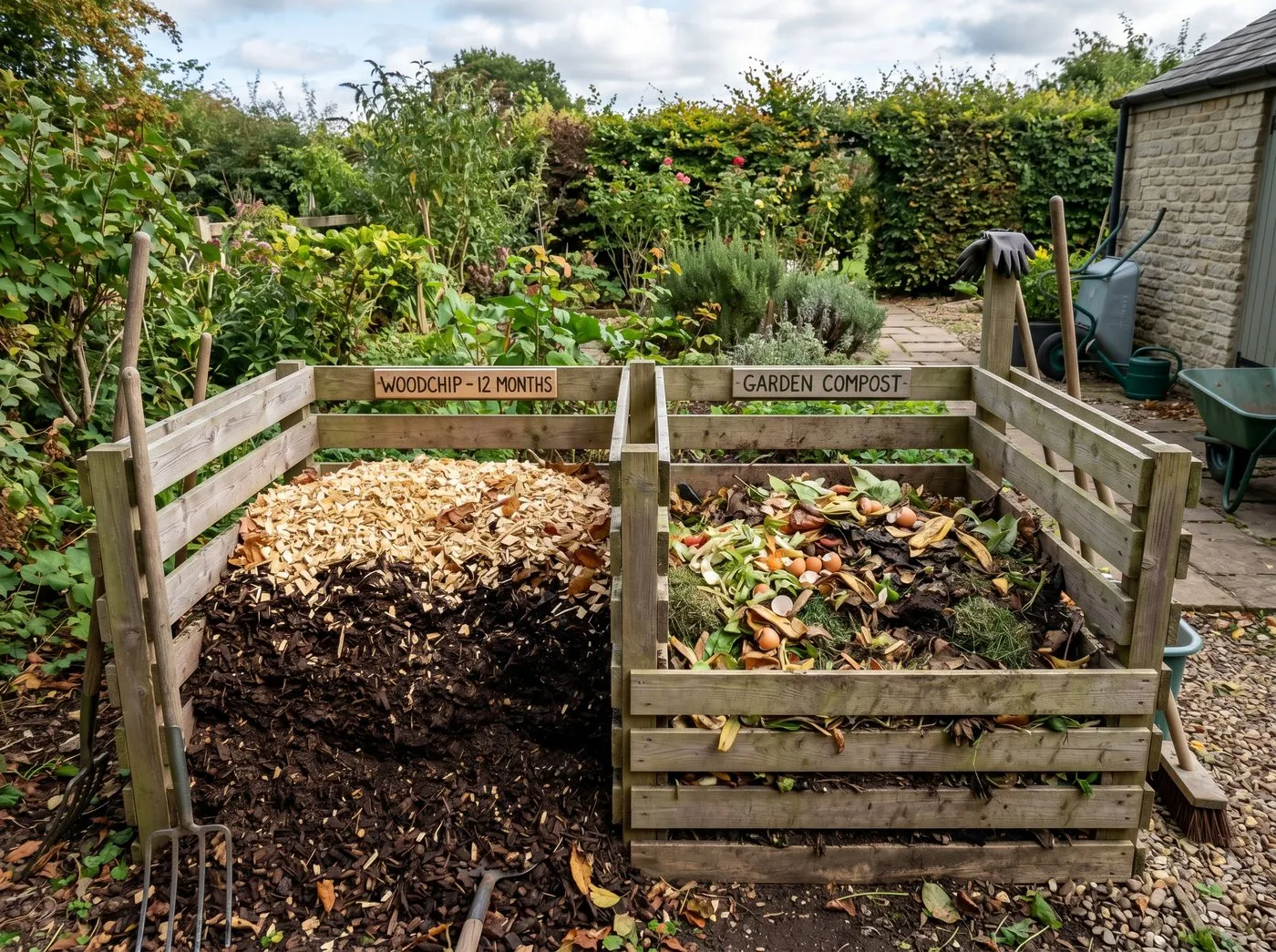 Composting wood chip - 12-18 months in a separate pile mixed with grass clippings and comfrey leaves produces a dark crumbly material safe for vegetable beds.
What the soil shows after 2-3 years
The mulched bed shows the patterns expected from sustained organic matter input - more biology, more depth, better drought resilience.
Common woodchip myths
“Wood chip imports tree disease.” Pathogens in wood chip are mostly destroyed by chipping itself (mechanical damage) and by surface drying. Exception: Phytophthora root rot can survive in chips from infected trees - avoid chips from areas with known Phytophthora outbreaks.
“You need fresh chip - aged chip is no good.” Wrong. Aged chip is excellent and has lower nitrogen lock-up risk. Many UK gardeners specifically request “well-rotted” chip from tree surgeons.
“Wood chip attracts termites.” Termites don’t live in the UK climate. Carpenter ants and woodlice may inhabit chip but they don’t damage live plants.
“Wood chip makes soil acidic.” Marginal effect - chips have near-neutral pH and decompose to near-neutral compost. Coniferous chip is slightly more acidic than hardwood but the effect on soil pH is small over years.
“Wood chip releases harmful chemicals.” Chips from untreated tree wood release only natural compounds during decomposition. Avoid chips from treated timber, pallet wood, or painted wood.
Seasonal application timing
Best application time: October-November. UK autumn rains incorporate the chip, worms work the bottom layer into soil through winter, weed germination is suppressed before spring.
Second best: March before active growth. Apply before emerging perennials start expanding. Avoid established beds with germinating bulbs - the chip may slow emergence.
Avoid: midsummer. Hot dry chip layers can become hydrophobic and shed rain rather than absorb it. Spring or autumn application is far better.
Field note: The Soil Association recognises wood chip mulch as an organic-approved practice when sourced from untreated UK trees. The RHS guide to mulching covers UK-specific application methods.
A 20-tree garden’s annual chip use
For a typical UK garden with 20 trees and shrubs plus 40m² of perennial borders:
| Use | Annual chip volume |
|---|---|
| Fruit tree top-up (8 trees × 0.15m³) | 1.2m³ |
| Perennial border top-up (40m² × 3cm) | 1.2m³ |
| Path replenishment (10m × 1m × 5cm) | 0.5m³ |
| Soft fruit beds | 0.3m³ |
| Total | 3.2m³ per year |
A typical tree surgeon’s chip drop is 3-5m³. One drop covers a full year of UK garden use.
Cost: free.
A free soil improvement that compounds
Wood chip mulch is one of the most cost-effective soil improvements available to UK gardeners. The investment is half a day of spreading per year. The return is suppressed weeds, halved watering, doubled soil biology, and steadily improving structure across the garden.
Three years of consistent annual application transforms a typical UK garden bed. The soil darkens, the worms multiply, the plants grow better. All from material that was being thrown away by local tree surgeons.
Now you’ve got the mulch framework
For wider mulching options and soil-building practices, our what is mulch and how to use it, how to make leaf mould UK and no-dig gardening guide UK guides cover the broader UK garden mulching practice.
Our team produces practical UK gardening guidance from source research, contributor records and established horticultural practice. Editorial standards are overseen by Matt W.