Key takeaways
- Sensation Mixed: tallest UK cosmos at 1.2-1.5m, pink and white
- Purity: best pure white, 1.0-1.2m, classic cutting variety
- Picotee: white with pink edge, 1.0m, garden-centre favourite
- Apricotta: rare peach-apricot tones, 1.2m, sought-after
- Xanthos: yellow flowers, dwarf 0.6m, breakthrough variety
- Sow February-April indoors; flowers June to first frost
Cosmos is the UK summer-garden workhorse. Easy from seed, flowers from late June to first frost, attracts every UK pollinator, picks straight onto the vase. This guide covers the 10 best UK cosmos varieties for cutting gardens, borders and containers, with sowing dates, height ranges, colour notes, and which to pair with which.
Cosmos Bipinnatus: The UK Garden Workhorse
The cosmos sold as garden seed in the UK is almost always Cosmos bipinnatus, native to Mexico. Two other species occasionally appear in UK catalogues: Cosmos sulphureus (orange-yellow, 60-90cm, shorter season) and Cosmos atrosanguineus (chocolate cosmos, tender perennial, deep red-brown).
The bipinnatus species runs as a hardy half-annual. UK sowing window: late February (indoors) to late May (outdoors). UK flowering window: mid-June to first frost (typically late October in Staffordshire, mid-October in Scotland, early November in the South West).
| Species | Height | Colour range | Flowering window | Notes |
|---|---|---|---|---|
| Cosmos bipinnatus | 0.4-1.5m | Pink, white, peach, picotee | Late June to first frost | The UK standard |
| Cosmos sulphureus | 0.6-0.9m | Orange, yellow, red | July to first frost | Shorter season, heat-loving |
| Cosmos atrosanguineus | 0.6m | Deep red-brown | July to October | Tender perennial; chocolate scent |
| Cosmos peucedanifolius | 0.9-1.2m | Pink | August to October | Hardy perennial; rare in UK |
This guide focuses on C. bipinnatus because 95% of UK cosmos seed sold belongs to this species. The other species appear as occasional novelty options.
Best Tall UK Cosmos Varieties (1.0m and Above)
The tall varieties are the backbone of any UK cutting garden. All grow 1.0-1.5m and need light staking in exposed positions.
| Variety | Height | Flower | Colour | Days to flower | UK notes |
|---|---|---|---|---|---|
| Sensation Mixed | 1.2-1.5m | Single, 80-100mm | Pink, white | 70-80 | The UK cutting-garden standard |
| Purity | 1.0-1.2m | Single, 80mm | Pure white | 75-85 | The classic white |
| Picotee | 1.0m | Single, 80mm | White with pink edge | 75-85 | Garden-centre favourite |
| Apricotta | 1.2m | Single, 80mm | Peach to apricot | 80-90 | Sought-after recent introduction |
| Daydream | 1.0m | Single, 70mm | Pale pink with deeper centre | 75-85 | Soft cottage-garden colour |
| Rubenza | 1.0m | Single, 70mm | Deep wine-red | 75-85 | The darkest cosmos |
| Velouette | 1.0m | Single, 70mm | Burgundy with white stripes | 80-90 | Striking bicolour |
| Click Cranberries | 1.0m | Double, 70mm | Deep red | 80-90 | Fully double red flowers |
Sensation Mixed is the variety to start with. Seed available from every UK seed supplier (Sarah Raven, Suttons, Marshalls, Thompson & Morgan, Mr Fothergill’s) at £2.50-£4.50 per packet. Germination 90-95% from fresh seed. The mix produces 60-70% pink shades with 30-40% white. Each plant flowers continuously from July through to first frost if deadheaded.
Purity is the pure white cutting standard. Available from most UK seed suppliers. Pairs well with deep purple verbenas and dark dahlias in mixed borders.
Picotee is the UK garden-centre favourite. White flowers with sharp magenta-pink edge. Hugely photogenic. Stocked at most major UK garden centres at £4-£6 per young plant. From seed at £2.50-£4 per packet.
Apricotta is the sought-after recent introduction. Soft peach to apricot tones, often blending several shades on a single plant. Seed sometimes hard to find; check Sarah Raven, Floret, or specialist UK seed suppliers at £3.50-£5.50 per packet.
Rubenza is the deepest red cosmos. Pairs strikingly with the bright orange of Calendula ‘Indian Prince’ for a hot late-summer border. Reaches full colour intensity in the cooler nights of late August onwards.
 Cosmos Apricotta in full bloom in a Staffordshire cottage border. The peach-apricot tones blend several shades on a single plant. Pairs beautifully with bronze fennel and softly coloured grasses.
Best Dwarf and Compact UK Cosmos Varieties
Dwarf varieties (0.3-0.6m) suit containers, low borders, and beds where tall stems would block sight lines.
| Variety | Height | Flower | Colour | Days to flower | UK notes |
|---|---|---|---|---|---|
| Xanthos | 0.6m | Single, 60mm | Pale yellow | 80-90 | Breakthrough yellow cosmos |
| Sonata Mixed | 0.4-0.5m | Single, 70mm | Pink, white, carmine | 65-75 | Most compact mix |
| Cosmic Mixed | 0.3-0.4m | Single, 60mm | Orange, yellow (sulphureus) | 60-70 | Container favourite |
| Casanova Mixed | 0.5m | Single, 80mm | Pink and white | 65-75 | Tidy bushy habit |
| Antiquity | 0.5m | Single, 60mm | Pink-bronze ageing | 70-80 | Colour shifts with age |
| Pied Piper Red | 0.5m | Quill-petal, 60mm | Red | 75-85 | Unusual quill-shaped petals |
| Double Click Mixed | 0.6m | Double, 60mm | Pink, white, deep red | 80-90 | Fully double dwarf form |
Xanthos is the most significant cosmos breeding development of the last 20 years. The first true yellow cosmos bipinnatus, bred in Japan and released in the UK around 2018. Pale lemon-yellow flowers, dwarf 60cm habit, suits containers and front-of-border use. Seed available from Suttons, Sarah Raven, and most UK garden centres at £3.50-£5 per packet.
Sonata Mixed is the compact cutting alternative for windy UK plots where tall Sensation lays flat. Sturdy 40-50cm plants flower June to October without staking.
Cosmic Mixed is a C. sulphureus variety (orange-yellow shades, not pink-white). 30-40cm dwarf habit. Useful in mixed annual borders where height needs to drop at the front.
Double Click Mixed is the fully-double cosmos series. Pom-pom style flowers, less open-faced than singles but more substantial for cutting.
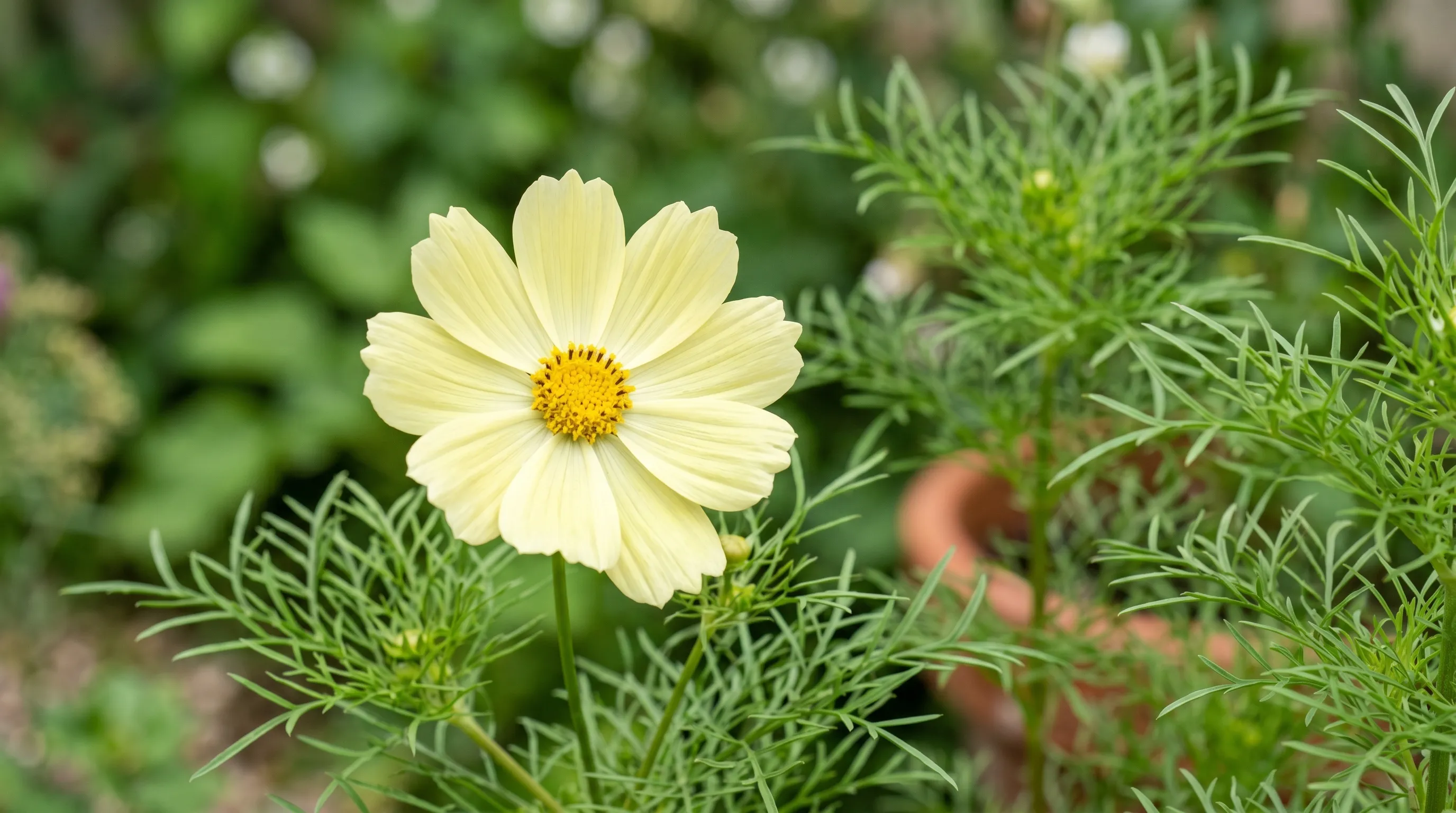 Cosmos Xanthos: the first true yellow Cosmos bipinnatus. Pale lemon petals, dwarf 60cm habit. Released in the UK around 2018 after Japanese breeding work. Suits containers and front-of-border use.
 Dwarf cosmos in UK containers. Xanthos yellow (left) at 60cm, Sonata mixed (centre) at 45cm, Cosmic orange (right) at 35cm. All flowered continuously from late June through the photo period in mid-September with weekly deadheading.
Sowing and Growing UK Cosmos
Cosmos is one of the easiest annuals from seed. Three sowing windows.
Indoor sowing (late February to April):
- Sow into 9cm pots filled with peat-free seed compost
- Sow 2-3 seeds per pot, 5mm deep
- Keep at 15-20C for 7-14 day germination
- Thin to the strongest seedling after first true leaves appear
- Pot on into 12cm pots when roots fill the 9cm pot
- Harden off over 7-10 days from mid-April onwards
- Plant out after last UK frost (typically mid-May to early June)
Direct outdoor sowing (mid-May onwards):
- Wait for soil temperature above 12C
- Rake bed level, removing stones and weeds
- Sow seeds 25mm apart in rows or scatter sparingly across bed
- Cover with 5-8mm of fine soil
- Water gently. Germination 10-14 days
- Thin seedlings to 30-40cm apart at 4-leaf stage
- Flowering begins 10-12 weeks after sowing
Successional sowing:
For continuous summer-to-autumn flowering, sow indoors in late March, again indoors in mid-April, and direct in late May. The three batches flower in sequence from mid-June through to mid-October.
Pinching out for branching:
When plants reach 200mm tall, pinch out the growing tip just above a leaf pair. This forces the plant to produce 3-5 side branches instead of one main stem. Result: 3-5 times as many flowers per plant.
 The pinch-out moment for branching cosmos. At 200mm tall, pinch the growing tip just above a leaf pair. The plant responds by sending out 3-5 side branches, tripling the flower count for the season.
Spacing, Feeding and Watering
Cosmos thrives on poor soil. Over-feeding produces lush leaves and few flowers.
Spacing:
- Tall varieties (Sensation, Purity, Apricotta): 40-50cm apart
- Medium varieties (Daydream, Rubenza, Click Cranberries): 30-40cm apart
- Dwarf varieties (Xanthos, Sonata, Cosmic): 25-30cm apart
- Containers: one tall plant per 30cm pot, three dwarf plants per 40cm trough
Feeding:
Avoid high-nitrogen feeds. A single dressing of fish, blood and bone at planting (50g/m²) is enough for the whole season. In containers, feed with a high-potassium tomato feed once every 21-28 days from July onwards.
Watering:
Cosmos is drought-tolerant once established. Water deeply once a week during dry summer weeks. Containers need watering every 2-3 days at peak summer. Overwatering reduces flower count and increases mildew risk.
For the wider annual border planning, our UK annual bedding guide covers companion plants and colour pairings.
Cosmos for UK Cutting Gardens
Cosmos is one of the highest-yielding cutting flowers in the UK garden.
Picking technique:
- Pick when the flower bud has just opened, showing first day of full colour
- Use sharp scissors and cut deep into the plant, taking 300-400mm of stem
- Cut just above a leaf pair so the plant continues branching
- Place stems in water immediately
- Strip lower leaves below the water line
- Recut stems at 45° before final arrangement
Vase life:
Single-flowered varieties (Sensation, Purity, Picotee): 7-10 days in clean water with daily water changes. Double-flowered varieties (Click Cranberries, Double Click): 5-7 days.
Pairing in arrangements:
- Pink Sensation + dahlias ‘Cafe au Lait’ + Ammi majus
- Purity (white) + dark dahlias ‘Karma Choc’ + Salvia ‘Caradonna’
- Picotee + dianthus ‘Sooty’ + bronze fennel
- Apricotta + peach calendula + soft grasses (Stipa tenuissima)
- Rubenza + bright orange marigold ‘Cinnabar’ + dark heuchera leaves
The Staffordshire cutting border produces 30-50 stems per plant per season with the pinching plus deadheading routine, supplying a 4-5 stem arrangement once a week from July through to October.
 Picking cosmos at peak. Cut deep into the plant for a 300-400mm stem, just above a leaf pair so the plant continues branching. Vase life: 7-10 days for single varieties with daily water changes.
Common Mistakes With UK Cosmos
Mistake 1: too much nitrogen feed. Lush foliage suppresses flowering. Skip the general fertiliser; cosmos thrives on poor soil.
Mistake 2: not pinching out. Unpinched plants produce 1-2 main stems with 30-50 flowers. Pinched plants produce 5-7 branches with 85-110 flowers. Always pinch at 200mm height.
Mistake 3: planting too close to other tall annuals. Cosmos at 1.5m shades cleome, zinnia and rudbeckia. Use cosmos at the back of the border or in dedicated cosmos beds.
Mistake 4: not deadheading. Spent flowers signal the plant to stop producing more. Deadhead every 3-4 days from July onwards.
Mistake 5: planting out before last frost. Cosmos is frost-tender. UK last frost dates vary from late April (South West) to mid-May (Midlands) to early June (Scottish Highlands). Wait for the safe window.
For wider annual planning, our best annual bedding plants UK guide covers companion plants and colour pairings. For sweet peas as the matching cut flower, our sweet peas growing guide covers the spring-to-summer crop. For the wider cut-flower planning, our how to grow cut flowers UK guide covers the full year’s planting plan.
Cosmos Calendar UK Month-by-Month
| Month | Cosmos task |
|---|---|
| January | Order seeds (Sensation, Purity, Apricotta, Xanthos) |
| February | Begin first indoor sowing late February |
| March | Continue indoor sowing. Pot on first batch |
| April | Harden off first-batch plants. Sow second batch indoors |
| May | Plant out after last frost. Direct sow outdoors mid-month |
| June | Pinch out tips at 200mm. First flowers from early sowings |
| July | Main flowering begins. Begin weekly cutting and deadheading |
| August | Peak flowering. Continue daily deadheading |
| September | Continued strong flowering. Late-sown plants reach peak |
| October | Flowering continues until first frost |
| November | Plants killed by frost. Pull and compost |
| December | Save seed from best plants for next year |
The pinch-out moment at 200mm and the daily deadheading routine from July onwards are the two highest-yield actions in the UK cosmos year.
Frequently asked questions
What is the best cosmos variety for a UK cutting garden?
Sensation Mixed is the UK cutting-garden standard. Tall (1.2-1.5m) with strong stems, large flat single flowers in pink and white, and an extended bloom period from July to October. Picks straight onto the vase. Reliable from a single seed packet.
How tall does cosmos grow in the UK?
Standard UK cosmos varieties grow 0.9-1.5m tall. Sensation Mixed reaches 1.2-1.5m. Purity and Picotee 1.0-1.2m. Dwarf varieties like Sonata, Xanthos and the Cosmic series stay at 0.4-0.6m. Stake tall varieties with twiggy support.
When should I sow cosmos seeds in the UK?
Sow indoors in 9cm pots from late February to April for early flowering. Sow direct outdoors from mid-May once frosts have passed. Indoor-sown plants flower from mid-June; direct-sown plants flower from mid-July. Most UK cosmos grow 70-90 days from sowing to first flower.
Do cosmos need staking in the UK?
Tall varieties (Sensation, Purity) need staking in any UK garden exposed to wind. Use twiggy supports or netting at 60-80cm height when plants reach 50cm. Dwarf varieties (Xanthos, Sonata, Cosmic) need no staking.
How do you keep cosmos flowering longer in the UK?
Deadhead spent flowers every 3-4 days. Cosmos will produce flowers continuously from July to first frost (typically late October) if seed heads are removed. Allow some late seed heads to mature for self-seeding next year if desired.
Now plan the wider summer border
Cosmos pairs with many UK annual crops. Our how to grow cosmos from seed guide covers the sowing detail. For matching sweet peas, our sweet peas growing guide covers the spring-to-summer crop. For the wider annual border, our best annual bedding plants UK guide covers the supporting cast of marigolds, calendula and zinnia. And for the cut flower side, our how to grow cut flowers UK guide covers the full year’s planting plan.
Our team produces practical UK gardening guidance from source research, contributor records and established horticultural practice. Editorial standards are overseen by Matt W.