Key takeaways
- True geraniums (cranesbill) are fully hardy perennials. Pelargoniums are frost-tender and die below minus 1C
- Geranium flowers have 5 equal symmetrical petals. Pelargonium flowers have 2 upper and 3 lower petals of different sizes
- The naming confusion dates to 1753 when Linnaeus grouped both genera together under Geranium
- Hardy geraniums tolerate shade and poor soil. Pelargoniums need full sun and free-draining compost
- Geraniums are perennial and maintenance-free. Pelargoniums need overwintering indoors above 5C
- For ground cover and borders, choose geraniums. For pots, window boxes, and summer colour, choose pelargoniums
Geranium and pelargonium are two different plants. They share a family name, Geraniaceae, but they belong to separate genera with different origins, different hardiness, and different growing needs. The confusion between them is one of the oldest naming muddles in British horticulture, and it causes real problems every spring when gardeners plant the wrong one in the wrong place.
This guide explains exactly how they differ, how to tell them apart at a glance, and which one to choose for every situation in a UK garden. If you already grow one or both, our dedicated guides to growing geraniums and growing pelargoniums cover cultivation in full detail.
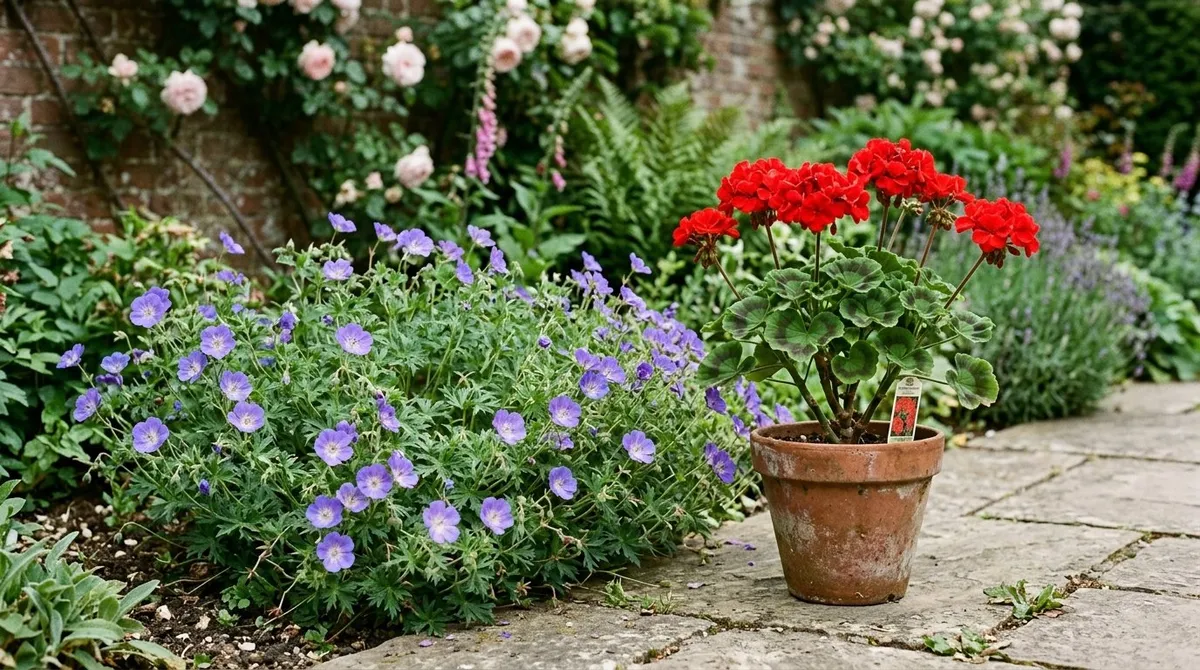
Left: true geranium (cranesbill) with five equal petals. Right: pelargonium with two upper and three lower petals of unequal size.
Why are geraniums and pelargoniums confused?
The mix-up began in 1753 when Carl Linnaeus classified both plants under the single genus Geranium. He based his classification on the beak-shaped seed pods both plants share. The name Geranium comes from the Greek geranos, meaning crane. In 1789, French botanist Charles L’Heritier de Brutelle examined the plants more closely and separated the South African species into a new genus, Pelargonium, from the Greek pelargos, meaning stork.
The botanical community accepted the split. The gardening public did not. By 1789, pelargoniums had been sold as geraniums in Britain for decades. The common name was firmly embedded. Garden centres still sell pelargoniums under the label “geranium” today, over 230 years after the reclassification.
The family Geraniaceae contains five genera. Three are commonly grown in UK gardens: Geranium (cranesbill, 422 species), Pelargonium (280 species, mostly from South Africa), and Erodium (storksbill, about 80 species). All three produce beak-shaped seed pods, which is why Linnaeus grouped them together. But their flowers, growth habits, and hardiness are markedly different.
How to identify geraniums vs pelargoniums
The flower test
The fastest identification method is flower symmetry. True geraniums have actinomorphic (radially symmetrical) flowers. All five petals are the same size, evenly spaced around the centre like the spokes of a wheel. Pelargoniums have zygomorphic (bilaterally symmetrical) flowers. Two upper petals differ in size, shape, or markings from the three lower petals.
Hold the flower face-on and ask one question: are all petals identical? If yes, it is a geranium. If the upper petals differ from the lower ones, it is a pelargonium.
The leaf test
Geranium leaves are typically palmate, deeply divided into five to seven lobes radiating from a central point. They look similar to a buttercup or maple leaf. Many turn red, orange, or bronze in autumn.
Pelargonium leaves vary enormously depending on the type:
- Zonal pelargoniums have rounded leaves with a dark horseshoe-shaped band
- Ivy-leaved types have fleshy, angular leaves resembling ivy
- Regal pelargoniums have serrated, slightly crinkled leaves
- Scented-leaf types range from finely cut to broad and fuzzy
If the leaf has a distinct horseshoe zone or smells strongly when rubbed, it is almost certainly a pelargonium.
The stamen test
Geraniums have ten fertile stamens. All ten produce pollen. Pelargoniums have fewer than ten fertile stamens, usually five to seven, with the remaining stamens reduced to non-functional staminodes. This difference was the key criterion L’Heritier used to split the genera in 1789.
Botanical classification compared
| Feature | Geranium (cranesbill) | Pelargonium |
|---|---|---|
| Family | Geraniaceae | Geraniaceae |
| Species count | 422 | 280 |
| Origin | Temperate regions worldwide | Southern Africa (mainly Cape) |
| Flower symmetry | Radial (5 equal petals) | Bilateral (2+3 unequal petals) |
| Fertile stamens | 10 | 5-7 |
| Hardiness (UK) | Hardy to minus 15-20C | Frost-tender, killed below minus 1C |
| Life cycle | Perennial (herbaceous) | Perennial (treated as annual in UK) |
| Seed dispersal | Explosive ejection up to 6m | Corkscrew mechanism, wind-aided |
| Separated since | Always in Geranium | 1789 (L’Heritier) |
| Common name confusion | Correct usage | Still sold as “geranium” |
Geranium leaf (left) with deep palmate lobes. Zonal pelargonium leaf (right) with the characteristic dark horseshoe marking.
Hardiness and growing conditions compared
Where they survive winter
This is the most important practical difference. True geraniums are fully hardy across every region of the UK. Most species tolerate temperatures down to minus 15 to minus 20C without protection. They die back to ground level in autumn and regrow from the rootstock in spring. Once planted, they stay in the ground permanently.
Pelargoniums are killed by any frost below minus 1C. In the UK, they are either treated as disposable summer bedding or overwintered indoors in a frost-free space above 5C. A pelargonium left outside in a British winter is dead by December.
Sun and soil requirements
| Requirement | Geranium | Pelargonium |
|---|---|---|
| Sun | Full sun to partial shade | Full sun only |
| Soil | Any, including clay and chalk | Free-draining, loam or sandy |
| Moisture | Tolerates drought and damp | Must not sit in wet soil |
| pH | Acid to alkaline | Neutral to slightly alkaline |
| Feeding | Minimal, annual mulch sufficient | Fortnightly high-potash feed May-Sep |
| Watering | Rarely needed once established | Regular in pots, moderate in borders |
Pelargoniums need the opposite: full sun, warmth, and free-draining compost. They rot quickly in wet, heavy soil. In pots, use a mix of multipurpose compost with 25% perlite. In borders, add grit to clay soils before planting. They suit south-facing walls, patios, and windowsills.
Growing habit and maintenance compared
Geraniums: plant and forget
Hardy geraniums are among the lowest-maintenance perennials available. Plant them in autumn or spring, water them in, and leave them. They spread to form weed-suppressing clumps. Most need dividing only every three to four years when the centre of the clump becomes bare.
The one essential maintenance task is the “Chelsea chop” or post-flowering cut-back. After the first flush fades in June, cut the entire plant back to 10cm above ground level. Within three weeks, fresh foliage appears, followed by a second flush of flowers in August and September. See our full guide to the Chelsea chop for timing and technique.
Pelargoniums: seasonal care cycle
Pelargoniums demand a structured care calendar:
- March: Start watering and feeding overwintered plants as new growth appears
- May (after last frost): Plant outdoors or move pots to the patio
- May-September: Feed fortnightly with high-potash fertiliser. Deadhead spent flower trusses
- August-September: Take cuttings for next year’s plants
- October (before first frost): Bring indoors. Cut back to 15cm. Move to frost-free spot
- November-February: Water sparingly, once a fortnight at most
This cycle suits gardeners who enjoy hands-on care. If you prefer low-maintenance planting, stick with hardy geraniums.
Best geraniums for UK gardens
For borders and mixed plantings
Other top performers for borders include G. x magnificum (deep violet, May-June, 60cm), G. pratense ‘Mrs Kendall Clark’ (pale pearl-blue, June-July, 75cm), and G. psilostemon (magenta with black eye, June-July, 90cm). All three make excellent companions in a cottage garden planting scheme.
For ground cover and shade
Geranium macrorrhizum is unbeatable as ground cover. It tolerates deep shade, dry soil, and poor conditions. The aromatic foliage is semi-evergreen, providing winter interest. It spreads by rhizomes to form dense, weed-proof mats within two seasons.
For rock gardens and front of border
Geranium sanguineum (bloody cranesbill) forms low, spreading mounds just 20cm tall. It suits rock gardens, path edges, and raised beds. The variety ‘Album’ produces pure white flowers. G. cinereum ‘Ballerina’ has pale pink flowers with dark veining and reaches only 15cm.
Geranium ‘Rozanne’ in full flower in a West Midlands border. This single plant has returned reliably for seven consecutive seasons.
Best pelargoniums for UK gardens
Zonal pelargoniums for bedding
Zonal pelargoniums are the classic bedding plants of British summers. Named for the dark horseshoe zone on each leaf, they flower continuously from May to October. The best seed-raised series include ‘Maverick’ (compact, strong colours), ‘Horizon’ (weather-resistant), and ‘Bullseye’ (distinctive leaf markings).
Cutting-raised zonals like ‘Ville de Paris’ and ‘PAC Salmon Princess’ produce larger flowers and more uniform plants. They cost more but give a higher-quality display.
Ivy-leaved pelargoniums for baskets
Ivy-leaved types trail up to 60cm, making them ideal for hanging baskets, window boxes, and tall containers. The ‘Balcon’ series is the most weather-resistant, surviving summer downpours that flatten other varieties. ‘Decora’ types have variegated foliage that adds interest even before flowering.
Regal pelargoniums for sheltered spots
Regals produce the largest, most ornate flowers of any pelargonium. They bloom mainly in May and June with a shorter season than zonals. They dislike rain on their flowers and are best grown in conservatories, porches, or very sheltered patios. ‘Lord Bute’ (deep burgundy with dark edges) and ‘Lavender Grand Slam’ are two of the finest.
Scented-leaf pelargoniums
Grown primarily for their aromatic foliage rather than their flowers, scented-leaf pelargoniums offer fragrances including lemon (P. crispum), rose (P. graveolens), peppermint (P. tomentosum), and chocolate (P. quercifolium ‘Chocolate Mint’). They make excellent windowsill plants and their leaves can be used in cooking and baking.
Which should you grow?
The choice depends on what you need from the plant.
| Purpose | Choose | Why |
|---|---|---|
| Permanent border planting | Geranium | Hardy, perennial, low maintenance |
| Ground cover under trees | Geranium | Tolerates shade and dry soil |
| Summer pots and window boxes | Pelargonium | Non-stop colour, drought tolerant in pots |
| Hanging baskets | Pelargonium (ivy-leaved) | Trailing habit, long flowering |
| Rock gardens | Geranium | Low, spreading, frost-hardy |
| Cottage garden borders | Both | Geraniums permanent; pelargoniums in pots among them |
| Cut flowers | Pelargonium (regal/zonal) | Larger, showier individual blooms |
| Fragrant foliage | Pelargonium (scented-leaf) | Unique range of fragrances |
| Beginner-friendly | Geranium | Plant and forget, no winter care |
| Low-maintenance | Geranium | No feeding, watering, or overwintering needed |
For most UK gardeners, the answer is both. Hardy geraniums form the permanent backbone of borders, returning year after year with minimal effort. Pelargoniums add vivid seasonal colour in pots and containers from May to October. The two plants complement each other perfectly.
If you can only choose one, and you want the least work, plant hardy geraniums. If you enjoy seasonal container gardening and have a frost-free space for winter, add pelargoniums to your collection.
Propagation differences
Geranium propagation
Division is the simplest method. Lift established clumps in spring (March-April) or autumn (September-October). Split them with a spade or pull apart by hand. Each section needs roots and at least one growing point. Replant immediately and water in well. Most divisions flower the same season.
Hardy geraniums also grow readily from seed. Collect the explosive seed pods before they fire by tying small paper bags over ripening seed heads. Sow fresh seed in autumn in a cold frame. Many species self-seed freely, and the easiest flowers to grow from seed include several cranesbill species.
Pelargonium propagation
Stem cuttings are the standard method. Take 10cm tip cuttings in August or September. Remove lower leaves, cut just below a node, and insert into free-draining cutting compost. Do not use rooting hormone. Pelargonium cuttings root in two to three weeks at 18-20C. Pot on into 9cm pots once rooted and overwinter on a bright windowsill. Pelargonium stems tend to rot in a jar, so compost beats water here; our guide to which cuttings root in water lists the plants that do suit that method.
Pelargoniums can also be grown from seed, sown in January to March at 20-22C. Seed-raised plants take 14-16 weeks to flower. F1 hybrid seed gives the most uniform results but costs more than cuttings.
Common problems compared
| Problem | Geranium | Pelargonium |
|---|---|---|
| Main pest | Vine weevil (larvae eat roots) | Whitefly and aphids |
| Main disease | Powdery mildew in dry conditions | Pelargonium rust (Puccinia pelargonii-zonalis) |
| Overwatering | Tolerates damp soil | Fatal, causes stem rot within days |
| Frost damage | None, fully hardy | Killed outright |
| Slugs | Moderate risk on young growth | Low risk, stems too tough |
| Virus | Rare | Pelargonium flower break virus |
Pelargonium rust is the most serious disease affecting pelargoniums in the UK. It appears as concentric brown rings on the leaf underside with yellow patches on top. Remove and destroy affected leaves immediately. Do not compost them. Improve air circulation and avoid overhead watering. There is no chemical cure available to amateur gardeners since the withdrawal of myclobutanil products.
Hardy geraniums are largely trouble-free. Vine weevil larvae occasionally eat the roots of container-grown plants. Use biological control nematodes (Steinernema kraussei) applied in spring or autumn as a drench.
The naming confusion: a quick reference
When you see “geranium” in a UK context, use this guide:
The RHS geranium page covers true cranesbills. The RHS pelargonium page covers tender pelargoniums. Both are worth bookmarking if you grow either plant.
Growing both together in UK gardens
The best approach is to use hardy geraniums as the permanent structure and pelargoniums as seasonal shows.
Plant hardy geraniums directly in borders in autumn or spring. Choose varieties to match your conditions: G. macrorrhizum for shade, ‘Rozanne’ for sun, G. sanguineum for dry spots. They establish over the first year and need no further attention beyond the annual post-flowering cut-back.
Add pelargoniums in pots from late May. Position them on patios, windowsills, and among border plants for vivid seasonal colour. Bring them indoors in October. This layered system gives you permanent ground-level interest from geraniums with raised, high-impact colour from pelargoniums above.
Both plants work alongside other perennials in UK gardens. In a cottage garden setting, the combination of permanent cranesbill ground cover with seasonal pelargonium pots creates the lush, overflowing look the style demands.
Frequently asked questions
Are geraniums and pelargoniums the same plant?
No, they are different genera in the same family. True geraniums (Geranium) are hardy perennials native to temperate regions. Pelargoniums (Pelargonium) are tender plants from southern Africa. They were separated into distinct genera in 1789 by botanist Charles L’Heritier. The confusion persists because garden centres still sell pelargoniums labelled as geraniums.
How do I tell a geranium from a pelargonium?
Look at the flowers. Geraniums have five identical petals arranged symmetrically like a wheel. Pelargoniums have two upper petals and three lower petals of different sizes, creating an asymmetrical bloom. Geranium leaves are typically rounded and palmately lobed. Pelargonium leaves vary widely but often have a darker horseshoe-shaped zone on zonal types.
Can pelargoniums survive winter outdoors in the UK?
No, pelargoniums are killed by frost below minus 1C. They must be brought indoors before the first frost, typically in October. Overwinter them in a bright, frost-free spot at 5 to 10C, watering sparingly. Hardy geraniums, by contrast, survive outdoors year-round across all UK regions without any protection.
Which is better for hanging baskets, geraniums or pelargoniums?
Pelargoniums are better for hanging baskets. Ivy-leaved pelargoniums trail over basket edges and flower non-stop from May to October. Hardy geraniums are ground-level border plants that do not trail well. For pots, window boxes, and hanging baskets, pelargoniums are the clear choice.
Why are pelargoniums called geraniums in garden centres?
The name stuck from 1753 when Linnaeus classified both plants under Geranium. Pelargoniums were separated into their own genus in 1789 but the common name never changed in everyday use. Garden centres continue using geranium because customers recognise it. The horticultural trade now sometimes uses the distinction “zonal geranium” for pelargoniums and “hardy geranium” for true cranesbills.
Do hardy geraniums come back every year?
Can I grow geraniums and pelargoniums together?
Yes, they combine well in summer displays. Plant hardy geraniums in the border as permanent ground cover. Add pelargoniums in pots placed among the border plants for height and vivid colour from May to October. The pelargoniums come indoors in autumn while the geraniums stay in the ground. This layered approach gives you colour from both genera all season.
Our team produces practical UK gardening guidance from source research, contributor records and established horticultural practice. Editorial standards are overseen by Matt W.