Key takeaways
- Astrantia thrives in partial shade and moist soil — one of the best perennials for north-facing UK borders
- Deadheading spent flowers extends the season by 4-6 weeks, from June right through to September
- Cut astrantia stems last 10-14 days in a vase, far outlasting most garden flowers
- 'Hadspen Blood' produces the deepest red flowers; 'Shaggy' has the largest, most star-shaped blooms
- Self-seeds freely if not deadheaded — seedlings may not be true to the parent variety
- Divide established clumps every 4-5 years in spring to maintain vigour and control spread
Astrantia major (masterwort) is one of the finest perennials for shady UK borders, producing delicate pin-cushion flowers from June to September in conditions that defeat most other flowering plants. It thrives in the moist, humus-rich soil and partial shade found in countless British gardens, asking for very little maintenance beyond regular deadheading and an occasional division.
This guide covers the best astrantia varieties for UK gardens, how to plant and care for them, and why every cutting garden should include at least a few clumps. For more shade-tolerant options, see our guide to the best plants for shade.
‘Hadspen Blood’ produces the deepest red flowers of any astrantia variety, striking in shade or dappled light.
What is astrantia and where does it grow?
Astrantia major is a clump-forming herbaceous perennial native to European mountain meadows and woodland edges. It has been grown in British gardens since the 16th century. The flowers are actually clusters of tiny florets surrounded by a ruff of papery bracts, it is the bracts that provide the colour.
Plants reach 60-90cm tall depending on variety and form neat clumps 45-60cm wide. The palmate (hand-shaped) foliage is attractive in its own right, emerging fresh green in spring and lasting until autumn frosts. The flowers appear from June and continue until September if deadheaded regularly.
In the wild, astrantia grows in damp meadows and at the edges of mountain woodland, which tells you everything about its garden preferences. It wants partial shade and soil that stays moist through summer. In UK gardens, north-facing borders, under deciduous trees, and alongside streams are ideal locations.
The plant is fully hardy to at least -20C across all UK regions. It tolerates heavy clay, chalk, and loam equally well, provided the soil does not dry out completely. This makes it one of the most reliable shade perennials available to British gardeners.
Best astrantia varieties for UK gardens
Eight varieties consistently outperform the rest in UK conditions, ranging from compact 40cm plants to tall 90cm specimens. Flower colour runs from pure white through pinks to near-black reds.
| Variety | Height | Flower Colour | Key Feature |
|---|---|---|---|
| ’Roma’ | 60cm | Clear pink | Longest flowering season, AGM |
| ’Hadspen Blood’ | 60cm | Deep crimson-red | Darkest flowers |
| ’Shaggy’ (Margery Fish) | 75cm | White, green-tipped | Largest, most star-shaped bracts |
| ’Star of Billion’ | 40cm | Pink with silver tips | Compact, front-of-border |
| ’Buckland’ | 70cm | Soft pink | Vigorous, large flower heads |
| ’Venice’ | 60cm | Deep rose-pink | Rich colour, strong stems |
| ’Sunningdale Variegated’ | 60cm | Pale pink | Cream-edged spring foliage |
| A. major var. rosea | 75cm | Rose-pink | Species form, solid |
‘Roma’ is the best all-round variety for most UK gardeners. It produces clear pink flowers over the longest season (June-September with deadheading), has strong stems that rarely flop, and holds its colour well even in deeper shade. It received an RHS AGM for reliable garden performance.
‘Hadspen Blood’ is the variety to choose if you want drama. The flowers open dark ruby-red and hold their colour without fading. It looks striking planted with silver-leaved plants like Pulmonaria ‘Majeste’ or white foxgloves. The colour is deepest in partial shade, in full sun, flowers can bleach to dull pink.
‘Shaggy’ (also sold as ‘Margery Fish’, named after the famous Somerset plantswoman) has the largest flowers with long, pointed bracts that give each bloom a star shape. The white flowers with green-tipped bracts have an elegance that other varieties lack. It self-seeds more freely than most named cultivars.
The name connects neatly with Margery Fish’s cottage-garden lessons, where astrantia suits the layered, lightly edited planting approach.
How to plant astrantia
Plant astrantia in spring (March-April) or autumn (September-October), setting the crown at soil level in soil enriched with organic matter. Both timings work well in the UK, but spring planting lets plants establish before summer flowering.
Choose a position in partial shade or dappled light. North-facing borders work well. Morning sun with afternoon shade is ideal. Avoid positions under dense evergreen canopies where light levels are very low and soil dries out from root competition.
Dig a hole twice the pot width and fork in plenty of well-rotted garden compost or leaf mould. Astrantia is a hungry plant that performs best in fertile, humus-rich soil. Set the plant at the same depth it was in the pot. Firm gently, water thoroughly, and mulch with a 5cm layer of garden compost, keeping mulch away from the crown.
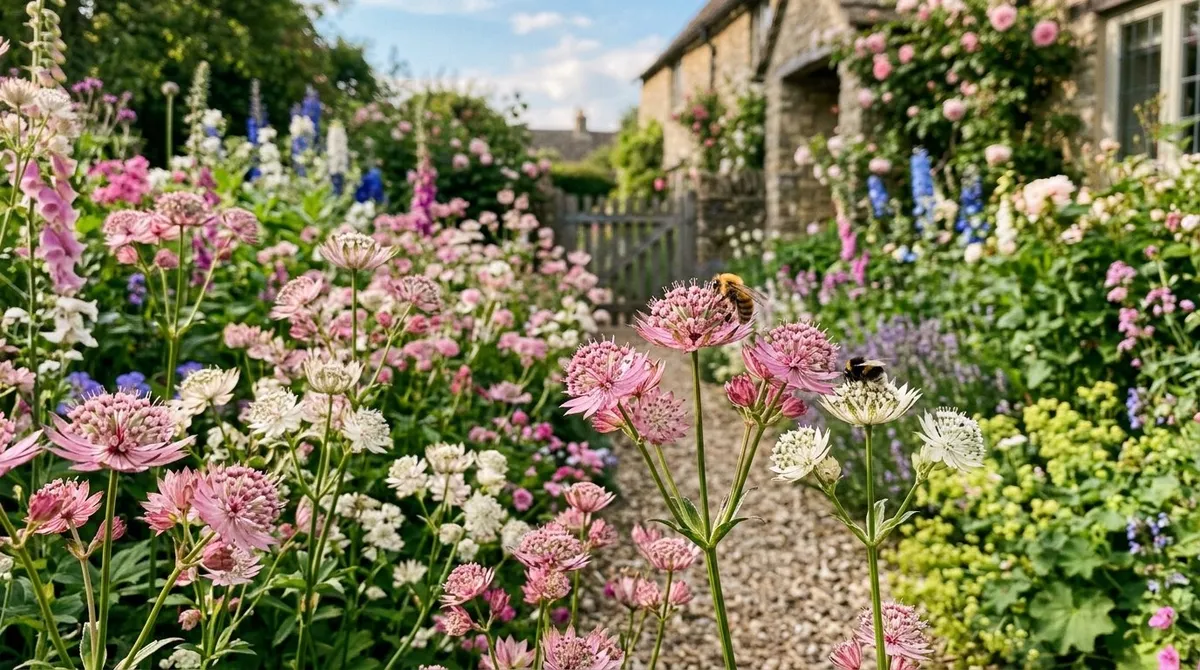
Space plants 40-50cm apart. Astrantia fills out quickly and a group of 3-5 plants makes a strong drift within two growing seasons. For a cottage garden planting plan, combine with foxgloves, hardy geraniums, and ferns for a classic look.
Does astrantia grow well in shade?
Astrantia is one of the most reliable flowering perennials for shady UK borders, tolerating positions where most other flowering plants refuse to bloom. It evolved in mountain woodland edges and damp meadow margins, making it naturally adapted to low light levels.
In partial shade (2-4 hours of direct sun), astrantia flowers freely and maintains strong colour. In deeper shade (no direct sun), it still flowers but produces fewer stems and slightly paler blooms. Even so, it outperforms most shade alternatives.
In full sun, astrantia struggles unless the soil stays consistently moist. South-facing borders with dry soil cause leaf scorch, wilting, and short flowering seasons. If you must plant in sun, water deeply twice weekly through summer and mulch heavily to retain moisture.
The best companions in shade are plants that share the same moisture preferences: hostas, ferns, Brunnera, Tiarella, and Japanese anemones. These combinations create lush, green borders with months of flower colour. For more options, see our guide to the best perennials for UK gardens.
Astrantia ‘Roma’ flowers freely in partial shade alongside ferns and hostas, ideal for north-facing UK borders.
How to deadhead astrantia for longer flowering
Regular deadheading extends astrantia’s flowering season by 4-6 weeks, potentially doubling it from six weeks to nearly three months. This is the single most impactful maintenance task for this plant.
Cut spent flower stems back to the next bud or leaf junction every 2-3 weeks through the flowering season. Use sharp secateurs. Do not just snap off the flower head, remove the entire stem down to a side shoot or leaf cluster. This stimulates the plant to produce new flowering stems from the base.
If you stop deadheading in late July, the plant sets seed and flowering tails off within 2-3 weeks. If you deadhead fortnightly, expect flowers from June through to mid-September. The later flowers are often slightly smaller but no less attractive.
Leave the final flush of flower heads in September to ripen into decorative seed heads for autumn and winter interest. The papery seed heads look attractive through winter, especially when edged with frost.
The Chelsea chop technique does not work well on astrantia. Cutting stems in late May delays flowering without producing a bushier plant. Deadheading after flowering starts is far more effective.
Astrantia as a cut flower
Astrantia is one of the best perennials for cutting, with stems lasting 10-14 days in a vase, longer than most garden flowers. The flowers have become a staple of British floristry, valued for their delicate, lace-like appearance in hand-tied bouquets.
Cut stems in the morning when the outer bracts are fully open but the central dome of tiny florets is still tight. Choose stems with at least 3-4 flower heads per stem. Cut long, right down to the base of the stem.
Condition cut stems by stripping lower leaves and searing the cut end in boiling water for 10 seconds. This stops the milky sap from sealing the stem. Then place in deep, cool water with flower food and leave in a cool spot for 2-3 hours before arranging.
For dried arrangements, cut stems when flowers are at their peak and hang upside down in small bunches in a warm, dry, airy room for 2-3 weeks. The papery bracts dry and retain their colour for months.
If you grow astrantia specifically for cutting, plant a dedicated row of ‘Roma’ or ‘Venice’, both produce long, strong stems with multiple flower heads per stem. Our cut flower growing guide covers planning a full cutting garden. For tips on keeping cut flowers fresh, see our conditioning guide.
How to divide and propagate astrantia
Divide astrantia every 4-5 years in March-April to maintain vigour, increase stock, and prevent clumps from becoming congested and woody at the centre. Division is straightforward and divisions establish quickly.
Lift the entire clump with a large garden fork, shaking off excess soil. Pull or cut the clump into sections, each with 3-5 healthy shoots and a good mass of roots. Discard any woody, dead central portions, these will not regenerate.
Replant divisions immediately at the same depth in soil enriched with compost. Water thoroughly and mulch. Most divisions flower in the first season after splitting, especially if divided in early spring before growth gets going.
Self-seeding: Astrantia self-seeds freely if spent flowers are left on the plant. Seedlings appear around the parent plant from spring onwards. Pull unwanted seedlings while small. Note that seedlings from named varieties will not come true, they revert towards the species type (pale pink or white). If you want identical plants, divide rather than relying on seed.
Root cuttings: An alternative propagation method for named varieties. Take 5-7cm root cuttings in late winter (January-February). Lay horizontally in trays of gritty compost, cover with 1cm of compost, and keep in a cold frame. Shoots appear in spring.
Companion planting with astrantia
Astrantia combines brilliantly with other shade-loving perennials and grasses that share its preference for moist, fertile soil. The delicate, textured flowers contrast with bold foliage plants and upright spikes.
| Companion | Height | Effect |
|---|---|---|
| Hostas | 30-60cm | Bold leaves contrast with astrantia’s delicate flowers |
| Hardy ferns (Dryopteris) | 60-90cm | Textural contrast, same shade/moisture needs |
| Foxglove (Digitalis purpurea) | 100-150cm | Vertical spikes above astrantia’s rounded forms |
| Japanese anemone | 60-120cm | Extends the season into October |
| Brunnera ‘Jack Frost’ | 40cm | Silver foliage lights up dark corners |
| Hakonechloa macra | 40cm | Flowing grass for shade planting |
In a shady cottage garden, plant astrantia with foxgloves, Rosa ‘Gertrude Jekyll’, and Alchemilla mollis for a classic English combination. The astrantia fills the mid-border height (60cm) between low Alchemilla and tall foxgloves.
For contemporary shade planting, combine ‘Hadspen Blood’ with black-leaved Actaea ‘Brunette’, white Tiarella, and Hakonechloa macra. The dark red flowers against dark foliage create a moody, sophisticated effect.
Among the best flowering shrubs for UK gardens, hydrangeas make natural partners for astrantia. Both enjoy the same moisture-retentive, partially shaded conditions.
Common problems with astrantia
Astrantia is remarkably trouble-free compared to most perennials, suffering few pests or diseases in UK gardens. The main challenges relate to cultural conditions rather than pathogens.
Powdery mildew: A white powdery coating appears on leaves during hot, dry spells, particularly in August. Improve air circulation by thinning congested clumps. Water at the base rather than overhead. Severe cases respond to organic fungicide sprays, but prevention through good spacing and consistent soil moisture is more effective.
Slugs and snails: Young spring growth is vulnerable to slug damage. Protect emerging shoots with slug pellets (organic ferric phosphate type), beer traps, or nematode biological controls applied in March. Established plants outgrow slug damage quickly.
Wilting in dry soil: The most common problem. Astrantia wilts dramatically when soil dries out, even for short periods. The leaves go limp and curl. It recovers quickly when watered, but repeated dry spells weaken the plant and reduce flowering. Mulch heavily and water deeply in dry weather.
Self-seeding nuisance: Left undeadheaded, astrantia can seed around vigorously. Seedlings of named varieties revert to the species type, producing weaker-coloured flowers. Deadhead to control this. The species form (A. major) self-seeds most freely; named cultivars like ‘Roma’ are less prolific.
Crown rot: Rare but occurs in poorly drained, waterlogged soil over winter. Improve drainage or plant in raised beds if your soil sits wet through winter. Despite liking moist soil, astrantia does not tolerate standing water.
Frequently asked questions
Does astrantia grow well in shade?
Astrantia thrives in partial shade and dappled light. It flowers freely in north-facing borders with no direct sun. In deeper shade under dense evergreen canopy, flowering reduces but the foliage remains healthy. Avoid full sun unless you can keep soil consistently moist through summer.
When should I cut back astrantia?
Cut plants to ground level in late autumn after foliage dies back. During summer, deadhead spent flower stems every 2-3 weeks back to the next bud or leaf to extend flowering. Leave the final flush in September for seed head interest through winter.
How do I stop astrantia spreading?
Deadhead spent flowers before seeds ripen to prevent self-seeding. Divide congested clumps every 4-5 years in March-April. Pull unwanted seedlings in spring when they are small. Named cultivars self-seed less than the straight species form.
Is astrantia a good cut flower?
Astrantia is an excellent cut flower with 10-14 days vase life. Cut when bracts are fully open but the central dome is tight. Sear stem ends in boiling water for 10 seconds to stop sap sealing the stem. The dried seed heads also work well in winter arrangements.
Can astrantia grow in full sun?
Astrantia tolerates full sun only if soil stays consistently moist throughout summer. In dry, sunny borders, leaves scorch and flowering is poor. In the UK, south-facing borders with regular deep watering and heavy mulching can work, but partial shade gives far better results.
How do I divide astrantia?
Divide in March-April as new growth emerges. Lift the clump with a fork, split into sections of 3-5 shoots with healthy roots, and replant at the same depth immediately. Divisions establish quickly and usually flower in the same season. Divide every 4-5 years to maintain vigour.
Which is the best astrantia variety?
‘Roma’ is the best all-round choice for UK gardens with clear pink flowers, a long season, and an RHS AGM. ‘Hadspen Blood’ has the deepest red flowers. ‘Shaggy’ produces the largest, most star-shaped blooms. ‘Star of Billion’ at 40cm suits small spaces and front-of-border positions.
Our team produces practical UK gardening guidance from source research, contributor records and established horticultural practice. Editorial standards are overseen by Matt W.