Key takeaways
- Oenothera biennis is a biennial — it grows leaves in year one and flowers in year two
- Flowers open in under 60 seconds at dusk, creating one of nature's most dramatic garden spectacles
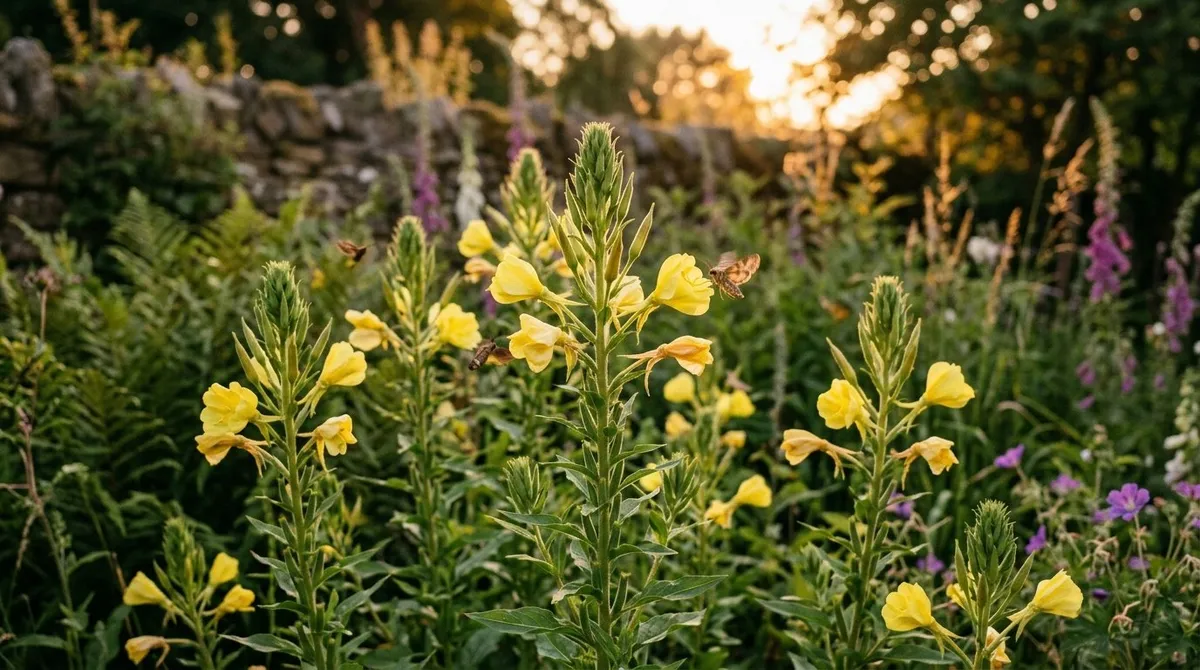
- Moth-pollinated: hawk-moths visit the fragrant yellow blooms from dusk to dawn
- Thrives in poor, dry soil where most garden plants struggle — ideal for gravel and sandy beds
- Self-seeds prolifically and can become invasive — deadhead to control spread
- Four species suit UK gardens, ranging from 15cm ground-huggers to 120cm biennials
Evening primrose is one of the most theatrical plants you can grow in a UK garden. As daylight fades on a summer evening, the tightly furled yellow buds of Oenothera biennis pop open in under 60 seconds, releasing a wave of sweet fragrance that draws hawk-moths from across the neighbourhood. It is a spectacle worth sitting outside to witness.
This North American wildflower has been naturalised in the UK since the early 1600s, colonising sandy soils, railway embankments, and waste ground across England and Wales. In the garden, it thrives where other plants fail: poor, dry, compacted soil in full sun. Rich, fertile borders actually produce worse results. This guide covers the four Oenothera species suited to UK gardens, from the classic tall biennial to compact perennial groundcover forms.
What is evening primrose and why does it open at night?
Evening primrose (Oenothera biennis) is a biennial wildflower in the Onagraceae family. It grows a rosette of leaves in its first year, then sends up a flowering stem of 90-120cm in its second year before setting seed and dying. The common name is misleading, it is not related to true primroses (Primula) at all.
The flowers open at dusk through one of the most rapid plant movements in nature. Each bud unfurls its four petals in under 60 seconds, triggered by falling light levels and temperature. The mechanism involves a sudden change in water pressure within the petal cells. You can hear a faint popping or rustling sound as the petals snap outward. Each individual flower lasts one night only, fading to orange-pink by morning. New flowers open daily along the spike for 8-12 weeks.
This dusk-opening behaviour is an adaptation for moth pollination. The yellow petals reflect ultraviolet light that moths detect, and the sweet fragrance intensifies as darkness falls. Elephant hawk-moths (Deilephila elpenor) are the primary pollinator in UK gardens. They hover in front of each flower, uncoiling a long proboscis to reach the nectar at the base of the tube. Encouraging bats and moths in the garden makes a thriving nocturnal ecosystem.
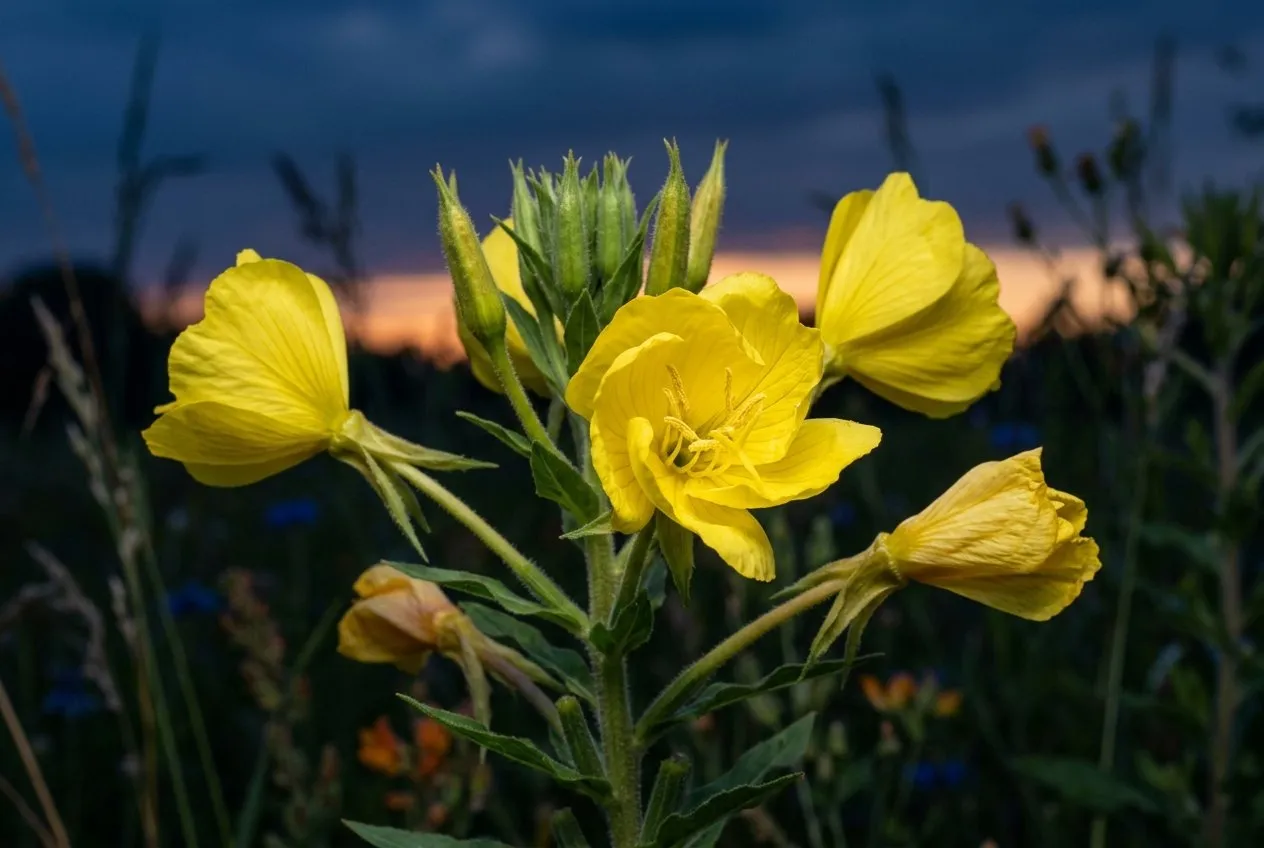 Evening primrose flowers open in under 60 seconds at dusk. The rapid unfurling is triggered by falling light.
The best Oenothera species for UK gardens
Four Oenothera species perform well in UK conditions. They differ in habit, lifespan, and flowering behaviour.
| Species | Type | Height | Spread | Flower colour | Flowering | Hardiness |
|---|---|---|---|---|---|---|
| O. biennis | Biennial | 90-120cm | 30-40cm | Bright yellow | June-Sept (year 2) | Fully hardy |
| O. speciosa | Perennial | 30-50cm | 60cm+ (spreading) | White fading to pink | June-August | Hardy to -10C |
| O. fruticosa | Perennial | 40-60cm | 30-40cm | Golden yellow | June-August | Fully hardy |
| O. macrocarpa | Perennial | 15-25cm | 60-90cm | Bright yellow, 10cm wide | June-September | Fully hardy |
Oenothera biennis (common evening primrose)
The classic species. Tall, upright stems carry dozens of 5cm yellow flowers over 8-12 weeks. Self-seeds freely on light soils. Best in wildflower areas, gravel gardens, and informal borders. The entire plant is edible (roots, leaves, flowers) and the seeds are the commercial source of evening primrose oil.
Oenothera speciosa (pink evening primrose)
A creeping perennial from the southern United States. Bowl-shaped flowers open white and fade to soft pink. Spreads by underground runners and can be invasive in warm, well-drained beds. ‘Siskiyou’ is a popular cultivar with darker pink flowers. Less hardy than biennis, protect the crown in severe winters north of Birmingham.
Oenothera fruticosa (sundrops)
Unlike the other species, sundrops open during the day. Clusters of golden yellow flowers appear in June and July on neat, 40-60cm clumps. The foliage turns red in autumn. ‘Fyrverkeri’ (Fireworks) is an RHS AGM variety with red-flushed buds. The best Oenothera for conventional borders because it stays clump-forming and does not self-seed aggressively.
Oenothera macrocarpa (Ozark sundrops)
A trailing perennial that hugs the ground at 15-25cm but spreads to 90cm. The flowers are enormous for the plant, 10cm across, bright yellow, and opening in the evening. Spectacular trailing over walls and raised bed edges. Needs excellent drainage and full sun. The winged seed pods are decorative in autumn.
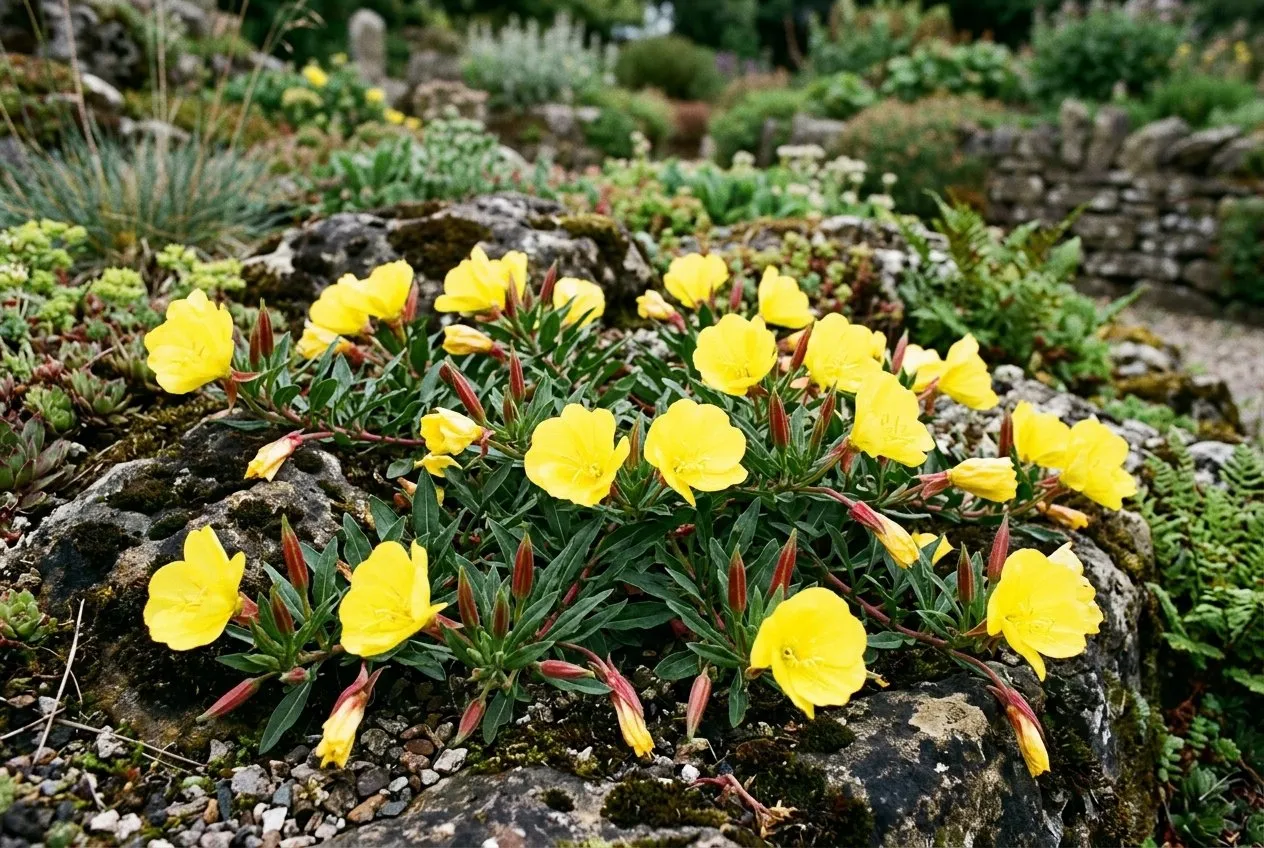 Oenothera macrocarpa produces 10cm yellow flowers on ground-hugging stems. Well suited to walls and raised bed edges.
How to grow evening primrose from seed
Evening primrose is best grown from seed. Plants resent root disturbance, so direct sowing works better than transplanting from pots. Sow directly outdoors in spring (March-May) or autumn (September-October).
Prepare the sowing area by raking to a fine tilth. Scatter seeds thinly on the surface and press lightly into the soil, do not cover, as the seeds need light to germinate. Water gently if conditions are dry. Seeds germinate in 14-21 days at soil temperatures above 10C. Thin seedlings to 30-40cm apart.
Autumn sowing mimics the plant’s natural cycle. Seeds lie dormant over winter, stratified by cold, and germinate strongly in early spring. Autumn-sown plants often flower earlier and more vigorously than spring-sown ones.
For container starting, sow in modules filled with 50:50 multipurpose compost and perlite. Sow on the surface and keep at 15-20C. Transplant carefully when seedlings have 4-6 true leaves, disturbing the root ball as little as possible. Our seed sowing calendar shows the full timing for biennials.
Indoor sowing suits O. fruticosa and O. macrocarpa, which are perennial and slower to establish. Start in February at 18-20C and pot on to 9cm pots before planting out in May. Both benefit from a cold period of 2-4 weeks at 4C before sowing to break dormancy (cold stratification in a fridge).
Where to plant evening primrose
Evening primrose performs best in the poorest soil you have. Rich, fertile garden soil produces tall, floppy stems with fewer flowers. Lean, sandy, or gravelly soil keeps plants compact and maximises blooming.
Full sun is non-negotiable. The flower opening mechanism depends on energy accumulated during sunlit hours. Plants in shade produce weak stems and sparse flowers. A south or west-facing position is ideal.
Ideal locations include gravel drives, dry banks, railway-style embankments, gravel gardens, and the edges of wildflower meadows. Evening primrose is one of the few garden plants that genuinely thrives in compacted, rubble-strewn ground. It colonises waste ground and demolition sites across Europe for precisely this reason.
In formal gardens, contain O. biennis by growing it in a designated self-seeding area and deadheading rigorously elsewhere. The perennial species (O. fruticosa and O. macrocarpa) are better behaved and suit mixed borders without supervision.
How to care for evening primrose
Evening primrose is famously low-maintenance. The biennial species (O. biennis) needs almost no intervention.
Watering: Do not water established plants. Evening primrose is drought-tolerant and performs better in dry conditions. Overwatering promotes lush foliage and weak stems. Newly sown seeds need moisture to germinate, but once established, leave them alone.
Feeding: Do not feed. Any fertiliser pushes leafy growth at the expense of flowers. If your soil is rich, add grit to reduce fertility. Evening primrose is one plant where neglect is a deliberate strategy.
Deadheading and seed control: This is the single most important task. Each seed capsule contains 100-200 seeds and a vigorous plant produces thousands. Deadhead spent flower spikes before capsules ripen and split (late August) to prevent unwanted colonisation. If you want self-seeding, leave 2-3 spikes to shed seed naturally.
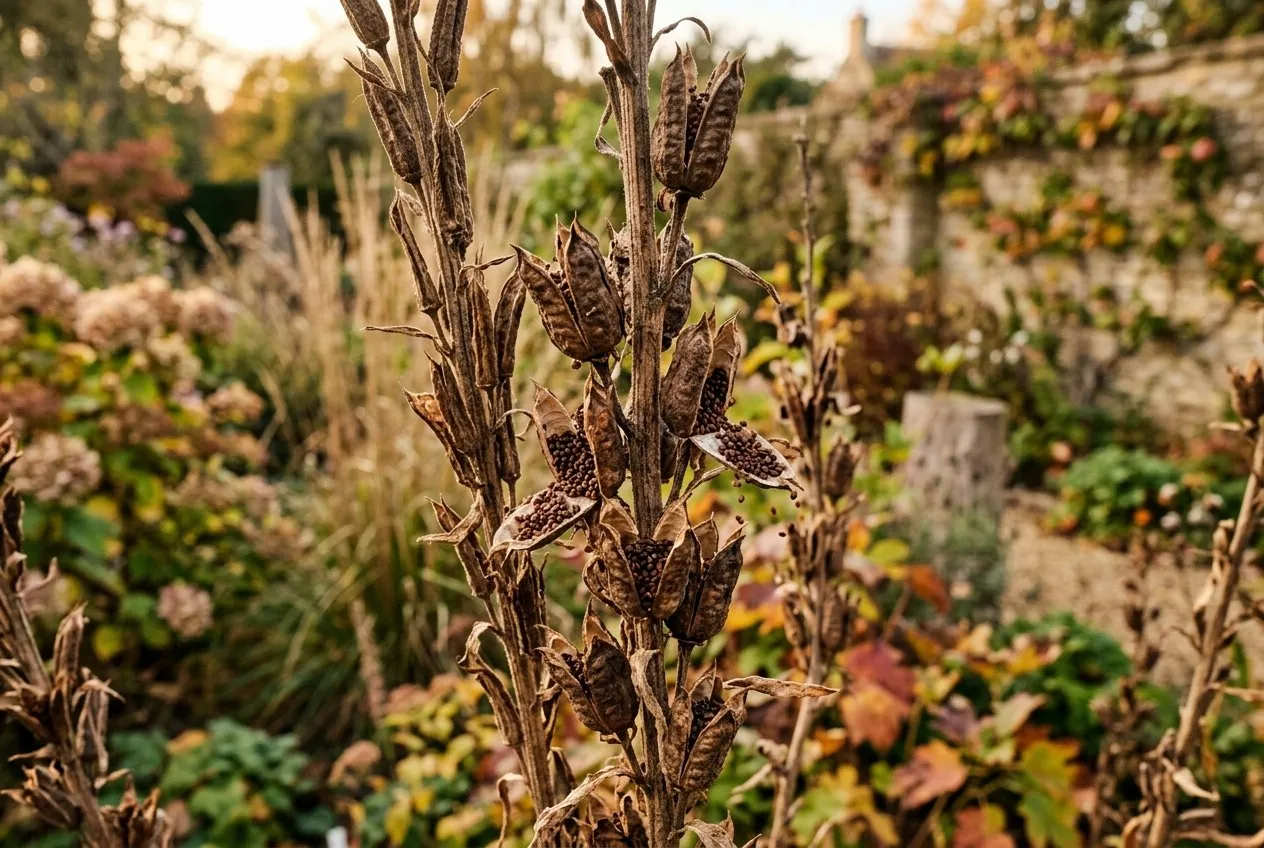 Evening primrose seed capsules each contain 100-200 seeds. Deadhead before they ripen to control self-seeding.
Evening primrose for wildlife
Evening primrose is one of the most valuable plants for nocturnal wildlife in UK gardens. The dusk-opening flowers attract a suite of moth species that are declining across Britain.
Hawk-moths: Elephant hawk-moth (Deilephila elpenor) and small elephant hawk-moth (D. porcellus) are the primary visitors. These large, spectacular pink-and-olive moths hover at the flowers from dusk, using a 3cm proboscis to reach nectar. Lime hawk-moth (Mimas tiliae) and privet hawk-moth (Sphinx ligustri) also visit.
Silver Y moth: This common migrant moth (Autographa gamma) visits evening primrose flowers in large numbers during peak migration years. It also feeds during daylight on windy days.
Bees: Bumblebees and honeybees visit fading flowers at dawn to collect pollen. The morning flowers still contain accessible pollen even as the petals wilt. Early-rising solitary bees are also frequent visitors.
Goldfinches: These brightly coloured finches feed on evening primrose seeds in autumn. Leave some seed heads standing through winter to provide food during the lean months. Our bird feeding guide covers which plants provide natural winter food.
Plant evening primrose alongside other night-scented plants such as nicotiana, night-scented stock (Matthiola bicornis), and honeysuckle to create a dedicated moth garden. A single 3m x 1m bed of mixed night-scented species supports a remarkable diversity of nocturnal pollinators.
The medicinal history of evening primrose
Evening primrose oil (EPO) is extracted from the seeds and has been used medicinally for centuries. Native Americans used root poultices for bruises and leaf teas for gastrointestinal complaints. The oil is rich in gamma-linolenic acid (GLA), an omega-6 fatty acid.
Commercial EPO supplements are sold widely in the UK for conditions including eczema, PMS, and breast pain. The NHS notes that evidence for many EPO claims remains limited, though some studies support its use for eczema in combination with other treatments.
The roots of first-year plants are edible when boiled and taste peppery. Young leaves are edible raw. The flowers make an attractive, edible garnish. In Germany, the root was historically known as German rampion and eaten as a vegetable. If you plan to eat any part, grow the plants without pesticides or chemical treatments.
How to control evening primrose spread
Self-seeding is the main management challenge with O. biennis. One plant can produce 10,000-20,000 seeds per season. On sandy, free-draining soils, germination rates are high and colonies expand rapidly.
The control strategy is simple: deadhead before seeds ripen. Cut the flowering stems to the base in late August, before the lowest seed capsules split open. Compost the stems, the seeds need light to germinate and will not survive in a hot compost heap.
Hoe off unwanted seedlings in March and April when they are small rosettes. The tap root is shallow at this stage and comes out easily. By June, the tap root is deep and plants resist removal. Timing matters.
For gardeners who want the flowers without the spreading, grow O. fruticosa or O. macrocarpa instead. Both are perennial, clump-forming, and do not self-seed. They flower reliably year after year without management.
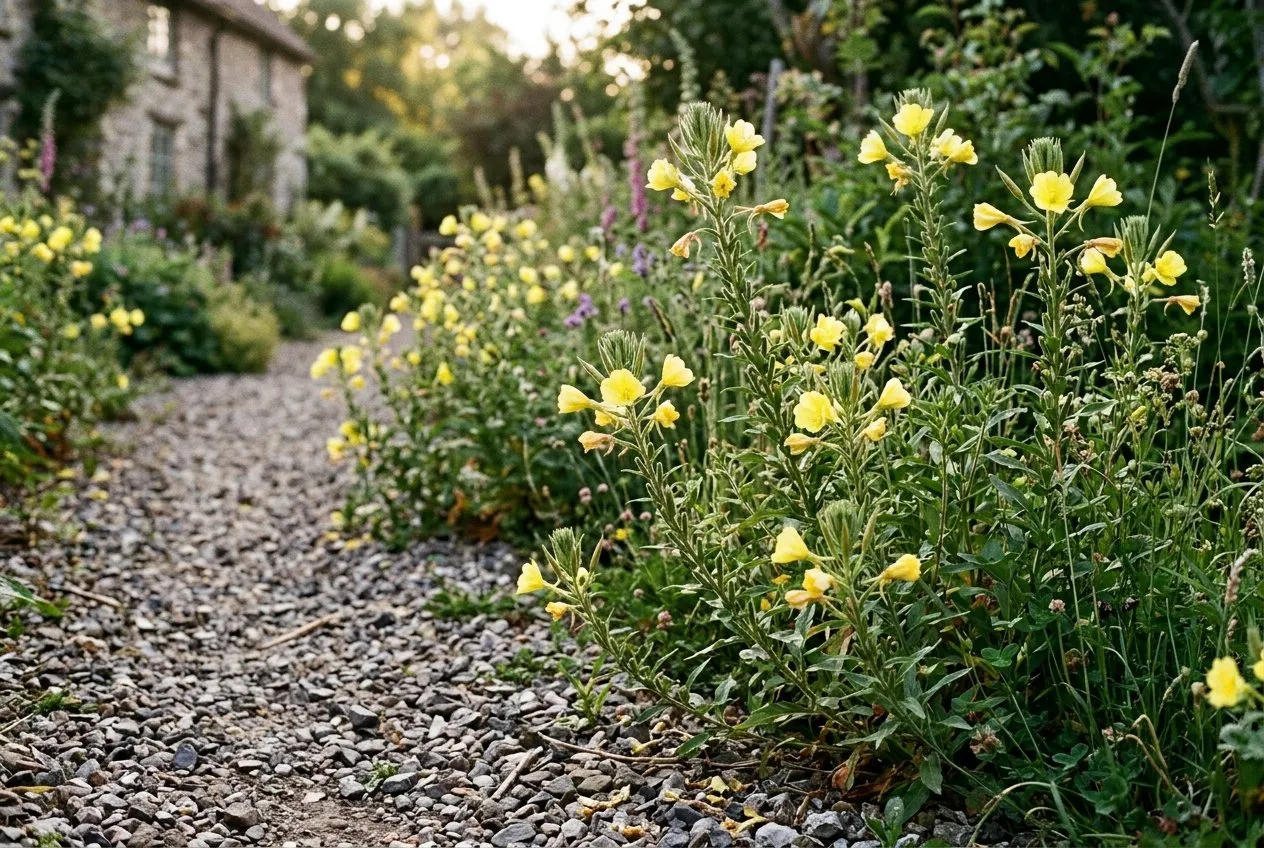 Evening primrose thrives in gravel gardens alongside lavender and ornamental grasses. Poor soil produces the best flowering.
Frequently asked questions
Is evening primrose a weed in the UK?
Not officially, but it self-seeds aggressively in light, sandy soils. Oenothera biennis was introduced from North America in the early 1600s and is now naturalised on railway embankments, waste ground, and sand dunes across England and Wales. In garden settings, deadhead spent flowers before seed capsules ripen to prevent unwanted spread. On heavy clay, self-seeding is much less vigorous.
When does evening primrose flower in the UK?
Evening primrose flowers from June to September in its second year. Individual blooms open at dusk and last one night, fading to orange-pink by morning. New flowers open daily along the spike for 8-12 weeks. The flowering season peaks in July and August, coinciding with the highest hawk-moth activity.
Why do evening primrose flowers open at night?
Evening primrose flowers are adapted for moth pollination. The yellow petals reflect ultraviolet light visible to moths. The strong, sweet fragrance intensifies at dusk to attract hawk-moths from up to 100 metres away. The rapid opening mechanism is triggered by falling light levels and a drop in temperature. Bees visit fading flowers at dawn for residual pollen.
Can I eat evening primrose?
Yes, several parts are edible. First-year roots can be boiled and eaten as a root vegetable (they taste peppery). Young leaves are edible raw in salads. The flowers are edible and make an attractive garnish. Evening primrose oil is extracted from the seeds commercially. Grow plants organically if you plan to eat any part.
How do I stop evening primrose spreading?
Deadhead flower spikes before seed capsules ripen and split. Each capsule contains 100-200 tiny seeds, and a single plant produces thousands. Cut spent stems to the ground in August after flowering finishes. Hoe off any unwanted seedlings in spring when they are small. On poor, sandy soil, vigilant deadheading is essential.
Is evening primrose good for wildlife?
Excellent. Evening primrose is one of the best moth-attracting plants for UK gardens. Elephant hawk-moths, lime hawk-moths, and silver Y moths visit the fragrant flowers at dusk. Bees collect pollen from fading morning flowers. Goldfinches eat the seeds in autumn. The tall stems provide overwintering habitat for insects.
Will evening primrose grow in shade?
No. Evening primrose needs full sun for at least 6 hours daily. In shade, plants become etiolated with weak stems and few flowers. The flower opening mechanism requires direct sunlight during the day to charge the rapid petal movement at dusk. Part shade produces poor results. Plant in the sunniest, driest spot in your garden.
Our team produces practical UK gardening guidance from source research, contributor records and established horticultural practice. Editorial standards are overseen by Matt W.