Key takeaways
- H. 'Hidcote' is the best all-round garden variety: 1.5m tall, flowers June to October, RHS AGM
- H. calycinum covers dry shade banks at 30cm tall and spreads aggressively by runners
- H. androsaemum (tutsan) is a native UK species with ornamental berries turning red then black
- The Magical series produces large, persistent berries in red, pink, green, and white for cutting
- Hypericum rust is the main disease — orange pustules on leaves, worst on H. calycinum
- Prune hard in March to 15cm for H. calycinum or to one-third for shrubby types like Hidcote
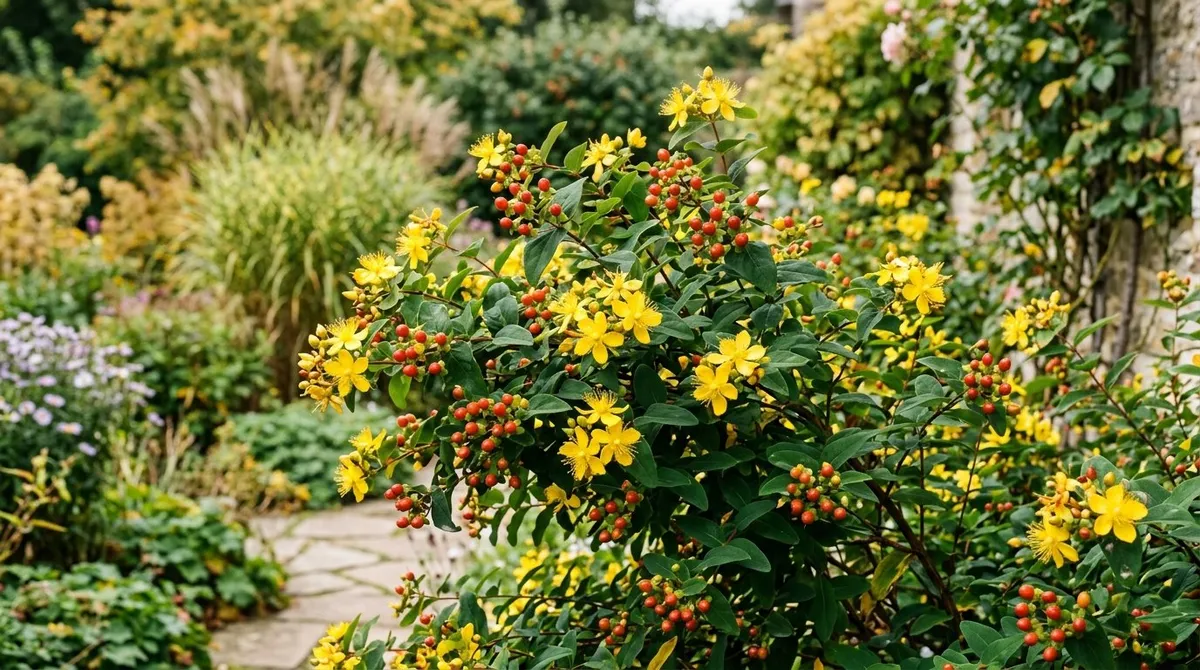
Hypericum earns its place in UK gardens by doing two jobs at once. From June to October, the golden-yellow flowers draw in bees and hoverflies. From August through winter, many species produce ornamental berries in red, pink, and black that look striking in borders and superb in flower arrangements.
Few shrubs cope with as wide a range of conditions. Hypericum thrives in full sun, partial shade, and full shade. It grows in clay, sand, chalk, and loam. Some species cover dry, root-filled banks where nothing else survives. Others form neat, flowering shrubs for mixed borders. There is a hypericum for virtually every difficult spot in a British garden.
What types of hypericum grow in UK gardens?
The genus Hypericum contains over 400 species worldwide. Five or six are commonly grown in UK gardens, and they vary enormously in size, habit, and use. Choosing the right species for the right spot is the key to success.
H. calycinum (Rose of Sharon) is the ground cover specialist. It reaches just 30cm tall and spreads aggressively by underground runners, forming a dense, weed-suppressing mat. The flowers are large at 7-8cm across, bright golden-yellow with prominent stamens. It is evergreen in mild winters and semi-evergreen in cold ones. This is the species for covering banks, filling under trees, and smothering difficult ground.
H. ‘Hidcote’ is the best all-round garden shrub in the genus. A hybrid of uncertain parentage, it reaches 1-1.5m with a neat, domed habit. The flowers are 5-6cm across and produced continuously from June to October. It holds the RHS AGM and has been a staple of UK gardens since the 1950s. Semi-evergreen in most areas.
H. androsaemum (tutsan) is a UK native found in hedgerows and woodland edges. It reaches 60-80cm with smaller yellow flowers followed by distinctive berries that change from green to red to black as they ripen. It is the most shade-tolerant species and genuinely thrives in deep woodland conditions.
H. x inodorum ‘Magical’ series is bred specifically for berry production. The berries are large, bright, and persistent, available in red, pink, green, white, and bicolour forms. These are the varieties favoured by florists and flower arrangers. The plants reach 80-100cm and are semi-evergreen.
H. moserianum reaches 40-60cm with arching stems and golden flowers with prominent red anthers. It is useful for the front of borders and does well in containers.
| Species/Variety | Height | Habit | Flowers | Berries | Best for |
|---|---|---|---|---|---|
| H. calycinum | 30cm | Spreading ground cover | 7-8cm, June-Sept | Small, rarely noticed | Banks, dry shade, difficult ground |
| H. ‘Hidcote’ | 1-1.5m | Dome-shaped shrub | 5-6cm, June-Oct | Small, black | Mixed borders, specimen planting |
| H. androsaemum | 60-80cm | Upright, arching | 2cm, June-Aug | Showy, red to black | Woodland, hedgerows, shade |
| Magical series | 80-100cm | Upright | 3cm, June-Aug | Large, persistent, many colours | Cutting gardens, floristry |
| H. moserianum | 40-60cm | Arching, compact | 5cm, July-Sept | Rare | Front of border, containers |
How do you plant hypericum?
Plant hypericum from October to March during the dormant season, or from container-grown stock at any time of year. Autumn planting is ideal because the roots establish through winter while the soil is moist.
For ground cover planting with H. calycinum, space plants 45-60cm apart. Each plant will fill its allocated space within one to two growing seasons. On a steep bank, plant in staggered rows to hold the soil while the runners colonise the gaps.
For shrubby types like Hidcote, dig a planting hole twice the width of the pot and the same depth. Mix the excavated soil with a handful of garden compost. Plant at the same depth as the pot with the rootball level with the surrounding soil. Water well and apply a 5cm mulch of bark or compost around the base, keeping it away from the stem.
Hypericum is undemanding about soil. It grows in heavy clay, free-draining sand, shallow chalk, and everything between. The one condition to avoid is permanently waterlogged ground where roots sit in standing water. On clay soils, working in a bucket of horticultural grit improves drainage without changing the soil character.
Does hypericum grow well in shade?
This is where hypericum stands out. While most flowering shrubs need sun to perform, hypericum delivers in shade conditions that defeat almost everything else.
H. calycinum is at its most useful in dry shade under trees. This is one of the hardest positions in any garden. Tree roots drain the soil. The canopy blocks rain and light. Few plants survive, let alone flower. H. calycinum not only survives but forms a dense, flowering carpet. It will not produce as many flowers as it would in sun, but the foliage cover remains thick and weed-proof.
H. androsaemum evolved in British woodland and hedge bottoms. It needs no convincing to grow in shade. In full sun, the leaves scorch in hot summers. In the dappled shade of deciduous trees, it looks lush and produces its ornamental berries freely. This is an excellent choice for shady areas in the garden where you want a native plant with genuine wildlife value.
H. ‘Hidcote’ is the most sun-hungry of the common species. It flowers best with 4-6 hours of direct sun daily. In moderate shade, it still flowers but less prolifically. In deep shade, it becomes leggy and sparse. For shady borders where you want a taller shrub, androsaemum is the better choice.
How do you use hypericum berries in flower arranging?
The Magical series of H. x inodorum was bred specifically for the cut flower industry, and the berries have become a florist’s staple. They last 10-14 days in water without deteriorating, adding colour and texture to autumn and winter arrangements.
The berries ripen from August and persist on the plant through to January if the birds leave them alone. Cut stems when the berries are fully coloured and firm. Remove any leaves below the waterline and place in clean water with flower food. The berries do not need conditioning or special treatment.
Available colours include Magical Red, Magical Beauty (pink), Magical Green, Magical White, and Magical Universe (dark purple-red). A row of 5-6 plants provides enough berries for regular flower arranging through the autumn and winter months. Combine hypericum berries with dried grasses, rose hips, and late-flowering chrysanthemums for seasonal arrangements.
H. androsaemum berries also work in arrangements, though they are smaller and change colour over time. The shifting palette from green through red to black is part of their charm. These berries self-seed if they drop into moist soil, so remove spent stems from water carefully.
What is hypericum rust and how do you treat it?
Hypericum rust, caused by the fungus Melampsora hypericorum, is the most serious disease affecting hypericum in UK gardens. It appears as bright orange pustules on the undersides of leaves, typically from June onwards. Heavily infected leaves turn yellow and drop prematurely, defoliating the plant by late summer.
H. calycinum and H. x hidcoteense (the parent of Hidcote) are the most susceptible species. H. androsaemum shows moderate resistance. The Magical series varies, with some cultivars more resistant than others. Rust diseases are generally worse in humid conditions with poor air circulation.
The most effective control is hard pruning in March. Cutting all growth back to near ground level removes overwintering spores and forces fresh, clean growth. On H. calycinum ground cover, this means strimming or mowing the entire area to 5-10cm. On shrubby types, cut back by at least half.
Good cultural practices reduce rust severity. Avoid overhead watering. Ensure adequate spacing between plants. Rake up and dispose of fallen leaves in autumn rather than leaving them on the ground where spores overwinter. There are no fungicides approved for amateur use against hypericum rust in the UK.
In severe, persistent cases, consider replacing susceptible varieties with H. androsaemum or the species H. kouytchense, which shows good rust resistance in RHS trials. The RHS has monitored hypericum rust since 2009 and notes it has become more common as UK summers grow warmer and wetter.
How do you prune hypericum?
Pruning is the single best thing you can do for hypericum. It rejuvenates flowering, controls size, and reduces disease. The timing and method depend on the species.
For H. calycinum ground cover, cut or strim the entire planting to 5-10cm above ground level in March. This removes all old foliage, including any rust-infected leaves. New growth emerges within 2-3 weeks and the plants flower on the current season’s wood from June. Without annual pruning, H. calycinum becomes a tangled mat of woody stems with sparse flowers concentrated at the tips.
For H. ‘Hidcote’ and other shrubby types, prune in March to one-third of the previous year’s height. Remove dead, damaged, and crossing branches first. Then shorten the remaining stems to a strong outward-facing bud. This encourages a bushy, well-shaped plant that flowers from June to October. Neglected plants can be renovated by cutting back to 15cm, though they may take a season to recover fully.
For H. androsaemum, remove one in three of the oldest stems at ground level each March. This removes the oldest, most disease-prone wood while preserving younger stems that carry the best berries. Tutsan flowers and fruits on second-year wood, so cutting everything back annually sacrifices the berry display.
Is hypericum calycinum invasive?
H. calycinum is the one hypericum species that demands a warning. It spreads by underground runners (stolons) that can travel 30-50cm per year in fertile soil. In the right conditions, it colonises ground relentlessly and invades neighbouring beds, paths, and even cracks in paving.
This vigour is exactly what makes it valuable for covering difficult ground. On a dry bank under trees, or on a steep slope that needs stabilising, that aggressive spread is the whole point. The problems start when it escapes into areas where it is not wanted.
Control options include physical barriers sunk 30cm into the soil along the boundary of the planting area. Thick metal or rigid plastic edging works. Regular edge trimming with a sharp spade in spring and autumn cuts wandering runners. In borders, digging out stray runners annually keeps it contained.
None of the other commonly grown hypericum species are invasive. H. ‘Hidcote’ forms a neat clump and stays where you plant it. H. androsaemum self-seeds modestly but the seedlings are easy to pull up. The Magical series is well-behaved and clump-forming. Only calycinum requires active management.
What wildlife does hypericum support?
Hypericum is more wildlife-friendly than most gardeners realise. The open, saucer-shaped flowers are rich in pollen and accessible to a wide range of insects. Bees, hoverflies, beetles, and solitary wasps all visit regularly.
The long flowering season from June to October means hypericum provides food during the late-summer gap when many other plants have finished. This period is critical for bumblebees building up reserves before winter. Pollinator-friendly planting benefits enormously from late-flowering shrubs that fill this gap.
The berries of H. androsaemum and its hybrids are occasionally eaten by blackbirds and song thrushes, though they are not a preferred food. The persistent berries on the Magical series remain on the plant because birds find them unpalatable, which is useful for gardeners who want the ornamental effect to last.
Frequently asked questions
Is hypericum evergreen in the UK?
Most hypericum species are semi-evergreen in the UK. H. calycinum keeps its leaves through mild winters but may drop them in hard frosts. H. ‘Hidcote’ retains foliage in sheltered spots. H. androsaemum is deciduous. Annual hard pruning in March removes tired old leaves regardless.
How do you prune hypericum?
Prune hypericum hard in March before new growth starts. Cut H. calycinum to 5-10cm. Cut Hidcote back by one-third to a half. Remove one in three of the oldest stems on H. androsaemum. Hard pruning rejuvenates flowering and reduces rust disease.
Does hypericum grow in shade?
Yes, hypericum is one of the best flowering shrubs for shade. H. calycinum thrives in full shade, including dry shade under trees. H. androsaemum tolerates deep shade. H. ‘Hidcote’ flowers best in sun to partial shade.
What is hypericum rust?
Hypericum rust is a fungal disease causing bright orange pustules on leaf undersides. It is most common on H. calycinum and Hidcote. Hard pruning in March removes overwintering spores. Good air circulation and avoiding overhead watering reduce infection risk.
Is hypericum invasive in the UK?
H. calycinum spreads aggressively by underground runners and can be invasive. Install a root barrier or edge regularly to control spread. Hidcote and androsaemum are clump-forming and stay where you plant them. No commonly grown hypericum is legally listed as invasive.
Are hypericum berries edible?
No, hypericum berries should not be eaten. They are mildly toxic and can cause digestive upset. The berries are grown for ornamental and floristry use only. They are not attractive to most garden birds, which is why they persist on the plant through winter.
Can I grow hypericum from cuttings?
Yes, hypericum roots easily from semi-ripe cuttings taken in July to September. Take 10-15cm shoots, remove lower leaves, dip in rooting hormone, and insert into gritty compost. Rooting takes 6-8 weeks. H. calycinum can also be divided by digging up rooted runners.
Our team produces practical UK gardening guidance from source research, contributor records and established horticultural practice. Editorial standards are overseen by Matt W.