Key takeaways
- Autumn sowing (September) produces plants 30-40% taller and stronger than spring sowing, with earlier flowers in May-June
- Larkspur must be direct sown where it flowers - it has a long taproot that cannot be transplanted without killing the plant
- All parts of larkspur are toxic and should not be grown in gardens with young children, dogs, or grazing animals
- One established colony self-seeds freely, producing a cottage garden drift within 2-3 years from a single original sowing
- Cut flowers last 7-10 days in vases and dry well for winter arrangements when harvested at one-third open
- Larkspur is the annual equivalent of perennial delphinium, offering the same vertical spires from seed in 12-16 weeks
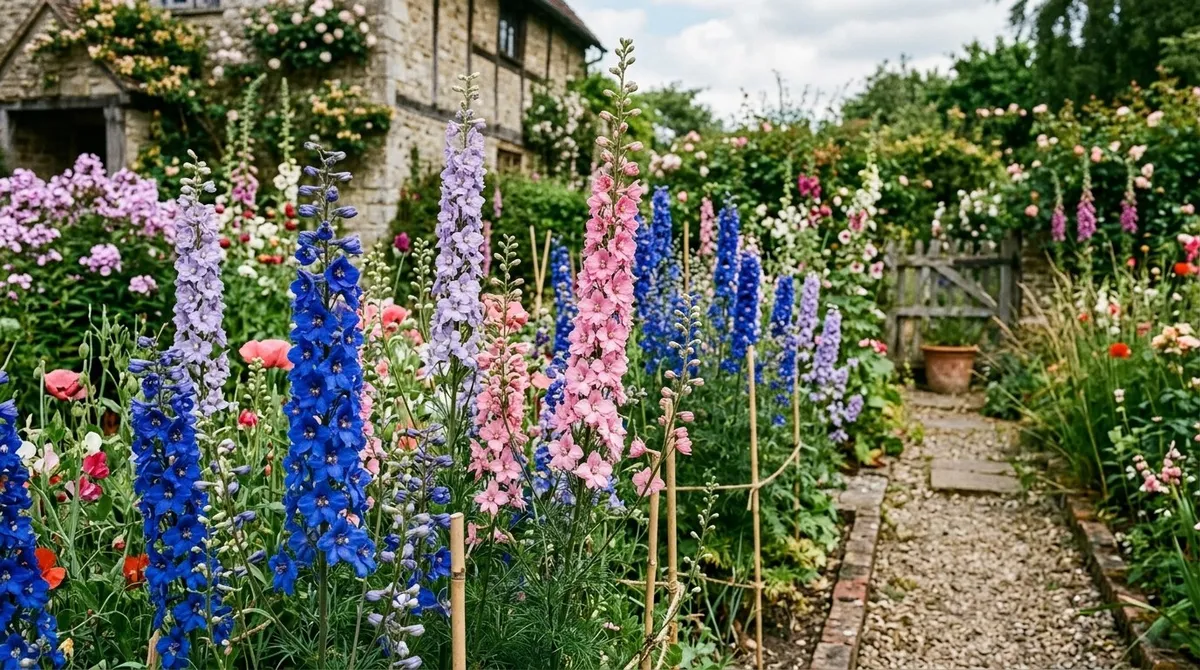
Larkspur is the annual that gives you delphinium spires in a single season. When delphiniums take 2-3 years to reach flowering size and need careful staking, larkspur grows from seed to a 120cm flowering plant in just 9 months. For cottage gardens, cut flower beds, and anyone wanting instant vertical drama, it is the quickest route to tall, elegant flower spires in blue, white, pink, and purple.
This guide covers the autumn sowing technique that produces plants 30-40% taller than spring sowings, the best varieties for UK conditions, the cut flower treatment for 10-day vase life, and the self-seeding habit that turns one initial sowing into a permanent cottage garden drift. It also covers the toxicity warning that means larkspur is not safe everywhere.
What is larkspur and how does it differ from delphinium?
Larkspur (Consolida ajacis) is a hardy annual in the buttercup family. It produces tall flower spikes identical in appearance to perennial delphinium, but grows from seed to flowering in one season. After flowering and setting seed, the plant dies. It is the annual equivalent of its perennial cousin.
The botanical separation happened in 1821 when taxonomists moved larkspur from Delphinium into the new genus Consolida. The main differences are life cycle (annual vs perennial), root system (taproot vs fibrous crown), and fine flower structure. From a gardener’s perspective they look and grow almost identically.
Larkspur reaches 90-120cm when autumn sown, 60-75cm from spring sowings. Perennial delphiniums can reach 180-200cm but take years to get there. For gardeners wanting instant tall spires, larkspur delivers in 9 months from seed.
Larkspur is native to the Mediterranean region. It tolerates UK conditions well but needs a cold period to trigger germination, which is why autumn sowing is so successful. The seed germinates in autumn soil temperatures of 8-12C with natural winter chill to break dormancy.
When to sow larkspur in the UK
September direct sowing gives the best results in every UK region. Autumn-sown plants develop deep taproots through winter and grow away strongly in spring. The result is taller, stronger plants that flower 3 weeks earlier than spring sowings.
The autumn sowing method
- Choose a sunny, well-drained spot where larkspur will flower. Never sow in pots for transplanting
- Rake the soil to a fine tilth and firm it gently with a rake back
- Draw shallow drills 1cm deep, spaced 25-30cm apart
- Scatter seed thinly along each drill, aiming for 2-3 seeds per 5cm
- Cover with 1cm of sieved soil and firm lightly
- Water with a fine rose if the ground is dry
- Thin to 25-30cm the following March
Seedlings will appear in 2-3 weeks if soil is moist. They remain as small green rosettes through winter, unaffected by frost. Rapid growth begins in March and plants flower from late May onward.
Spring sowing alternative
If autumn sowing is not possible, sow in March but first chill the seed for 10-14 days in the fridge at 1-5C. This replaces the natural winter cold period. Sow directly as with autumn seed. Spring-sown plants flower from July to August, 4-6 weeks later than autumn sowings, and reach only 60-75cm tall. Read our hardy annuals from seed guide for more tips on timing and germination.
Which larkspur variety is best for UK gardens?
Giant Imperial Mix
Earl Grey
A distinctive smoky grey-mauve variety popular with florists and cut flower growers. Reaches 90-100cm on strong stems. The unusual colour pairs with cream roses and dusty pink ranunculus in wedding work. Moderate vigour but unmatched for colour.
Sublime Mix
A newer cut flower strain selected for long, straight stems averaging 100-110cm. Pure colours including dark blue, lilac, salmon pink, and white. Flowers 5-7 days later than Giant Imperial. Suited to dedicated cutting beds where stem length matters more than total bloom volume.
White King
Pure white flower spikes reaching 100-120cm. Excellent for cottage gardens where a single colour drift adds elegance. Pairs well with nigella, cornflowers, and old-fashioned roses. Prolific self-seeder that makes a permanent white larkspur colony within 3 years.
Misty Lavender
Soft pale lavender flowers on 90cm stems. The gentlest larkspur colour and very effective in pastel schemes. Moderate vigour. Good for small cottage gardens where the taller Giant Imperial looks out of scale. Flowers late May to July from autumn sowings.
Rocket Mix
A compact strain reaching only 75cm. Suited to windy exposed gardens where taller varieties would snap. Flowers earlier than most other larkspurs. Not the choice for cut flower use but useful for front-of-border planting in cottage schemes.
Best larkspur varieties compared
| Variety | Height (autumn sown) | Colours | Cut flower | Self-seeds |
|---|---|---|---|---|
| Giant Imperial Mix | 120cm | Blue, white, pink, purple | Excellent | Freely |
| Earl Grey | 90-100cm | Smoky mauve | Excellent | Moderately |
| Sublime Mix | 100-110cm | Mixed pure colours | Best for florists | Moderately |
| White King | 100-120cm | Pure white | Very good | Prolifically |
| Misty Lavender | 90cm | Pale lavender | Good | Moderately |
| Rocket Mix | 75cm | Mixed | Fair | Freely |
How to grow larkspur in the UK
Larkspur needs full sun and well-drained neutral soil to perform at its best. Shade and waterlogged conditions cause weak, floppy plants that flop after the first storm.
Choosing the right spot
Select a sunny site with 6-8 hours of direct sun daily. Larkspur tolerates light afternoon shade but produces fewer and shorter spikes. Avoid windy corners where the tall stems will snap. A sheltered spot beside a south-facing wall is ideal.
Soil preparation
Larkspur prefers neutral to slightly alkaline soil (pH 6.5-7.5) with sharp drainage. On heavy clay, fork in 5cm of garden compost and horticultural grit before sowing to improve winter drainage. Avoid freshly manured ground which produces leafy growth at the expense of flowers.
Thinning and spacing
Thin autumn-sown seedlings to 25-30cm apart in March when they reach 10cm tall. Crowded plants develop mildew and flop readily. Thinning feels ruthless but pays off in stronger individual plants. Never attempt to transplant the thinnings - larkspur taproots will not re-establish.
Staking tall varieties
Giant Imperial and other tall varieties may need support in exposed positions. Push pea sticks or bamboo canes between plants in May and tie in gently with soft twine. Staking is rarely needed in sheltered spots if the plants are well spaced.
First-year care
Water weekly during dry spells in April and May when plants are forming flower buds. Once flowering starts, water at soil level only to avoid splashing foliage and spreading fungal spores. Do not feed. High-nitrogen feeds produce soft growth that flops and invites mildew.
How to grow larkspur as a cut flower
Larkspur is one of the top 5 annual cut flowers for UK gardens. The tall straight spikes, long vase life, and range of clean colours make it a florist favourite. A row 3 metres long produces 80-100 cutting stems from a single autumn sowing.
When and how to cut
Harvest when the bottom one-third of the spike has opened. Cutting earlier gives shorter vase life. Cutting later leaves too few unopened buds to continue blooming in water. Cut early in the morning when stems are turgid.
Conditioning for long vase life
- Cut stems with sharp scissors at a 45-degree angle
- Remove all foliage below the waterline
- Place immediately into a bucket of cold water
- Condition in a cool dark place for 4-6 hours
- Recut stems by 2cm before arranging
- Use flower food or replace water every 2 days
Properly conditioned larkspur lasts 7-10 days in a vase. The flowers continue to open from bottom to top during the first 3-4 days. Read our full cut flower conditioning guide for techniques that extend vase life across all garden-grown flowers.
Drying larkspur for winter arrangements
Larkspur dries exceptionally well. Cut when two-thirds of the spike is open, strip foliage, and hang bunches of 5-7 stems upside down in a dark, airy place. Drying takes 2 weeks. The colours hold well for 12-18 months. Blue and purple varieties retain colour best. White dries to cream.
How to use larkspur in cottage garden borders
Larkspur is quintessentially cottage garden. The tall spires rise above softer border plants, adding vertical structure without heaviness. A drift of 5-10 plants creates more impact than scattered individuals.
Classic cottage combinations
| Partner plant | Height | Flowers | Why it works with larkspur |
|---|---|---|---|
| Nigella damascena | 45cm | Jun-Aug | Soft froth beneath tall spires |
| Cornflower | 80cm | Jun-Sep | Contrasting rounded blue heads |
| Calendula | 60cm | May-Oct | Orange against blue larkspur |
| Old-fashioned roses | 120-180cm | Jun-Jul | Classic cottage pairing |
| Sweet william | 45cm | May-Jul | Flat clusters contrast with spires |
| Lady’s mantle | 40cm | Jun-Aug | Chartreuse foam at the front |
Toxicity warning
All parts of larkspur contain diterpene alkaloids that are toxic to humans, pets, and livestock. Symptoms include vomiting, weakness, tremors, and in severe cases cardiac arrest. The seeds and young shoots contain the highest concentration of alkaloids.
Who should avoid growing larkspur
- Gardens with young children who might pick and taste flowers or seeds
- Gardens used by dogs and cats that chew plants
- Rural gardens near grazing horses, cattle, or sheep (larkspur has killed livestock)
- Allotments beside play areas where seed heads might be carried away
Safe handling
Wear gloves when sowing, thinning, and collecting seed. Wash hands after handling. Do not compost seed heads where children or animals may access them. The Royal Horticultural Society lists larkspur on its potentially harmful plants register.
Month-by-month larkspur care calendar
| Month | Task |
|---|---|
| February | Chill seed in fridge for spring sowing |
| March | Thin autumn sowings to 25-30cm. Spring sow chilled seed |
| April | Water regularly. Push in pea sticks for support |
| May | First flowers on autumn sowings. Continue watering |
| June | Peak flowering. Harvest cut flowers daily |
| July | Flowering continues. Deadhead to prolong display |
| August | Final flowers. Let some plants set seed for self-sowing |
| September | Direct sow fresh seed for next year’s plants |
| October | Autumn seedlings emerge as rosettes |
| November | Seedlings overwinter unprotected |
| December | No action needed |
Common mistakes when growing larkspur
Sowing in pots for transplanting
Larkspur has a long taproot that breaks easily during transplanting. Plants that survive are stunted and flower poorly. Always direct sow where they will flower.
Spring sowing without chilling seed
Spring-sown seed that has not been chilled germinates poorly or not at all. Give seed 10-14 days in the fridge before March sowing, or sow in September instead.
Not thinning seedlings
Crowded plants develop mildew, flop under wind, and produce shorter weaker spikes. Thin to 25-30cm in March without exception.
Growing in gardens with children or pets
Larkspur toxicity is serious. The seeds look attractive to small children. Do not grow near play areas or pet runs.
Harvesting too late for cut flowers
Stems cut when fully open give only 3-4 days vase life. Cut when only one-third of the spike has opened for maximum cut flower life.
Frequently asked questions
What is the difference between larkspur and delphinium?
Larkspur (Consolida) is a hardy annual, while delphinium is a perennial. Both belong to the buttercup family and look similar, with tall flower spikes in blue, white, pink, and purple. Larkspur grows from seed in a single season and dies after setting seed. Delphinium returns each year from a crown. Larkspur flowers June to August, slightly later than delphinium. The growing conditions are almost identical.
When should I sow larkspur seed in the UK?
Sow larkspur in September for the strongest plants and earliest flowers. Direct sow where they will flower, as larkspur dislikes transplanting. Autumn-sown seedlings overwinter as small rosettes and grow rapidly in spring, reaching 90-120cm. March sowings produce shorter plants that flower later. Both work, but autumn sowing gives the best results in every UK region. Spring sowings need cold stratification in the fridge for 2 weeks before sowing.
Why is my larkspur not germinating?
Larkspur seed needs cold to germinate, which is why autumn sowing works so well. Spring-sown seed often fails without a cold period first. Chill the seed in a fridge for 10-14 days at 1-5C before sowing in March or April. The seed is also short-lived. Fresh seed from the current or previous year germinates at 70-80%, while 3-year-old seed drops to under 20%. Always use fresh seed for best results.
Is larkspur toxic to dogs and children?
Yes, all parts of larkspur are toxic to humans, dogs, cats, horses, and livestock. The plant contains diterpene alkaloids that affect the nervous system and heart. Symptoms include vomiting, weakness, and paralysis. Young seedlings and seeds are the most toxic parts. Do not grow larkspur in gardens used by young children or where pets graze. Wear gloves when handling, especially when collecting seed. The Royal Horticultural Society lists it as potentially harmful.
How do you grow larkspur as a cut flower?
Larkspur is one of the best annual cut flowers, lasting 7-10 days in water. Harvest when the bottom third of the spike has opened. Cut in the cool of early morning. Strip all lower foliage below water level. Condition in deep cold water for 4 hours before arranging. Replace water every 2 days and recut the stems each time. Larkspur also dries well - hang bunches upside down in a dark, airy place for 2 weeks.
Does larkspur self-seed?
Larkspur self-seeds freely once established in a garden. Allow a few plants to set seed each summer by not deadheading. The dry seed pods split and release 50-100 seeds per plant. Seedlings appear in autumn (from current-year seed) and spring (from older seed). A single initial sowing makes a permanent colony within 2-3 years. Thin self-seedlings to 25cm apart in March to prevent overcrowding and mildew.
What are the best larkspur varieties for UK gardens?
Giant Imperial Mix is the best all-round larkspur variety for UK growing. It produces tall 120cm spikes in blue, white, pink, and purple on strong stems. For cut flower use, the Sublime series gives the best stem length. ‘Earl Grey’ has unique smoky grey-mauve flowers popular with florists. ‘White King’ offers pure white spikes for cottage gardens. All varieties perform best from September sowing in well-drained soil.
Now that you know how to grow larkspur from seed, read our guide on the best hardy annual flowers to grow from seed for more cottage garden favourites that sow themselves year after year.
Our team produces practical UK gardening guidance from source research, contributor records and established horticultural practice. Editorial standards are overseen by Matt W.