Key takeaways
- Flowers from June to October, producing hundreds of blooms over five months without deadheading
- Must be hard pruned to 30cm in March every year. Unpruned plants become top-heavy and snap in wind
- Short-lived shrub lasting 5-8 years. Take cuttings in August to maintain succession plants
- Thrives in poor, dry soil. Rich soil and feeding produces soft growth that is vulnerable to frost
- Barnsley is the most popular UK variety, with white flowers ageing to soft pink
- Fully coastal-tolerant, handling salt spray and exposed positions without damage
Lavatera is one of the fastest-growing flowering shrubs available to UK gardeners. A plant pruned to 30cm stumps in March will reach 2m tall by July, covered in hundreds of funnel-shaped flowers that keep coming until the first hard frosts in October. No other hardy shrub delivers that volume of flower from a standing start each spring.
The trade-off is lifespan. Lavatera is a short-lived plant, typically lasting 5-8 years before declining. This matters less than it sounds. Semi-ripe cuttings root easily in August, giving you free replacement plants on a rolling cycle. The key to success is understanding what lavatera needs: poor soil, hard pruning, and benign neglect. Gardeners who pamper it with rich compost and regular watering lose their plants years earlier than those who treat it mean.
What is lavatera and where does it come from?
Lavatera x clementii is a hybrid tree mallow in the Malvaceae family, closely related to hibiscus and hollyhocks. The garden hybrids grown in the UK are crosses between L. olbia (from the western Mediterranean) and L. thuringiaca (from central and eastern Europe). This hybrid origin gives them greater cold hardiness than either parent species alone.
The plants are semi-evergreen, keeping some foliage through mild winters but losing it in hard frosts below -5C. In spring, they regenerate vigorously from the base. Stems are woody at the base and herbaceous at the tips. Flowers appear in the leaf axils along every stem, creating a continuous display from June until frost. Each individual flower lasts 2-3 days, but hundreds open in succession over the season.
Lavatera arrived in UK gardens in the 1980s when the Barnsley variety was discovered as a sport in Rosemary Verey’s famous garden at Barnsley House in Gloucestershire. It became the defining cottage garden shrub of the 1990s and remains the most widely planted variety today.
Lavatera ‘Barnsley’ produces white flowers that age to soft pink, giving a two-tone display on the same plant.
Best lavatera varieties for UK gardens
Barnsley remains the most popular lavatera variety in UK nurseries, but five others deserve attention. Each variety has a distinct flower colour and slightly different growth habit. All share the same care requirements: full sun, poor soil, and hard annual pruning.
| Variety | Flower colour | Height | Vigour | Key feature |
|---|---|---|---|---|
| Barnsley | White ageing to soft pink | 1.8-2m | Strong | Two-tone effect, most widely available |
| Rosea | Clear mid-pink | 2-2.5m | Very strong | Tallest, most vigorous variety |
| Burgundy Wine | Deep magenta-pink | 1.5-1.8m | Moderate | Darkest flower colour |
| Bredon Springs | Dusky mauve-pink | 1.5-2m | Strong | Subtle, antique colour tone |
| Red Rum | Rich cherry-red | 1.5-1.8m | Moderate | Reddest variety available |
Barnsley
The original garden variety, discovered in 1985. Flowers open white with a red eye and age to soft pink over 2-3 days. This makes a multi-toned display across the entire bush. Growth reaches 1.8-2m in a season from hard-pruned stumps. The most widely stocked variety at garden centres and online nurseries. RHS Award of Garden Merit holder.
Rosea
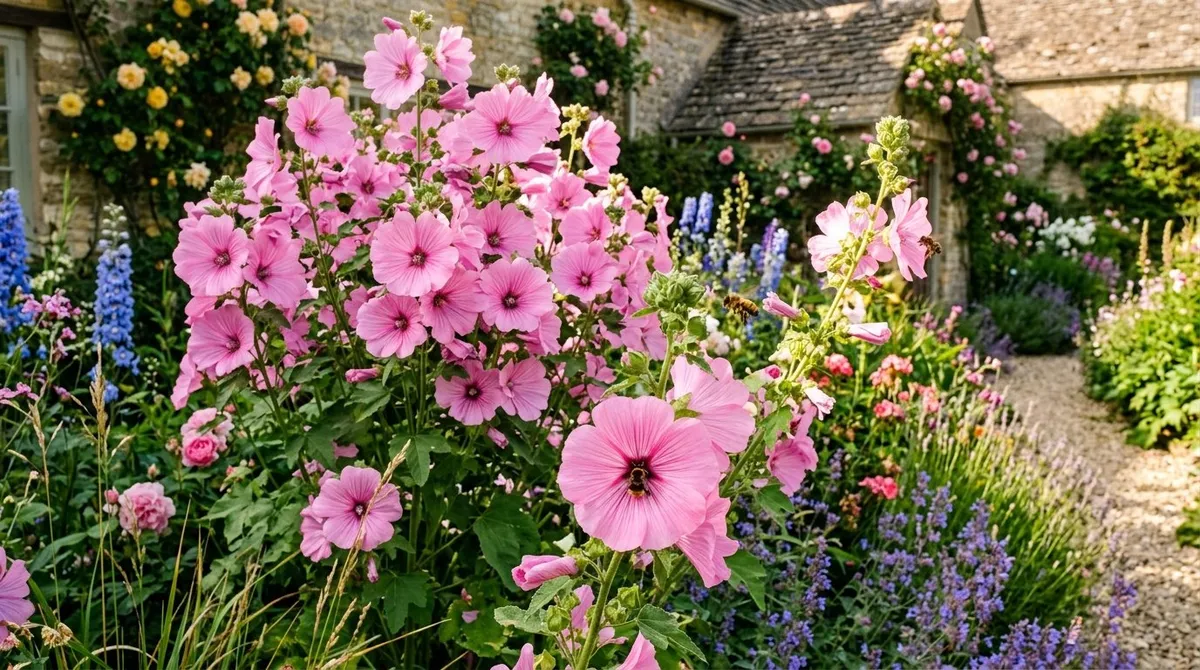
The most vigorous variety, reaching 2-2.5m tall in a single growing season. Flowers are a clear mid-pink, darker than Barnsley but lighter than Burgundy Wine. Choose Rosea where you need rapid height for screening or back-of-border impact. Its extra vigour means even more critical annual pruning to prevent wind damage.
Burgundy Wine
The darkest-flowered lavatera commonly available. Deep magenta-pink flowers with darker veining make it stand out from the paler varieties. Growth is slightly less vigorous at 1.5-1.8m, making it more manageable in smaller gardens. Less commonly stocked than Barnsley but available from specialist nurseries.
Bredon Springs
A subtle variety with dusky mauve-pink flowers that have an antique quality. It pairs well with silver-foliaged plants like artemisia and lavender. Named after the village of Bredon in Worcestershire. Growth to 1.5-2m. A good choice for gardeners who find Rosea too brash.
Red Rum
The reddest variety in the group. Cherry-red flowers with darker veining stand out from 30m away. Moderate vigour at 1.5-1.8m. Less commonly available than Barnsley or Rosea but worth seeking from specialist growers. Pairs well with dark purple foliage plants like cotinus and prunus.
Where to plant lavatera in UK gardens
Plant lavatera in the poorest, driest, sunniest spot in your garden. This is counter-intuitive for most gardeners, but lavatera genuinely performs better in neglected ground than in enriched borders.
Sunlight requirements
Lavatera needs full sun, meaning at least six hours of direct sunlight daily. It tolerates no more than light afternoon shade. In shade, stems become etiolated and floppy, flowers are sparse, and the plant collapses in the first strong wind. South-facing and west-facing borders are ideal.
Soil preferences
Poor, well-drained soil produces the longest-lived, most floriferous lavatera plants. Rich soil and regular feeding produce lush, soft growth that is vulnerable to frost damage and wind snap. The best soil conditions for lavatera are:
- Sandy or gravelly soil with free drainage
- Low fertility, unfed ground
- Slightly alkaline to neutral pH (6.5-8.0)
- Open-textured subsoil that never becomes waterlogged
On heavy clay, improve drainage by adding a full barrow of coarse grit to the planting hole and backfill. Alternatively, plant on a slight mound 15-20cm above the surrounding soil level. Lavatera is well suited to sandy soil and chalky alkaline soil where many other shrubs struggle.
Coastal suitability
Lavatera is outstanding in coastal gardens. It tolerates salt spray, sea winds, and the typically sandy, alkaline soils found near the coast. The Mediterranean parentage of L. olbia means it actively thrives in maritime conditions that stress many other shrubs. In exposed coastal positions, growth may be shorter (1.2-1.5m) but plants are bushier and more compact.
Lavatera Rosea produces clear pink flowers on 2m stems from June to October, filling cottage garden borders.
How to plant lavatera
Plant lavatera from March to May for best establishment. Autumn planting is possible but riskier because wet winter soil can rot the shallow roots before they establish properly.
- Choose a position in full sun with well-drained soil.
- Dig a hole twice the width of the pot and the same depth.
- On clay soil, add 5cm of grit to the base and mix grit into the backfill.
- Remove the plant from its pot and tease out any circling roots.
- Set the plant at the same depth as it was in the pot. Do not plant deeper.
- Backfill firmly and water once to settle the soil around the roots.
- Do not mulch closely around the stem. Leave a 10cm gap between any mulch and the base to prevent stem rot.
Space plants 1-1.5m apart. Lavatera fills its allotted space rapidly and will overwhelm neighbouring plants within one growing season if planted too closely. Allow room for air circulation, which reduces the risk of fungal problems.
How and when to prune lavatera
Hard prune lavatera to 30cm above ground level every March. This is the single most important care task. Do not skip it. Do not compromise. Every stem must be cut back hard.
Why hard pruning matters
Hard pruning also stimulates vigorous new growth from the base. Flowers form on current-season wood, so hard-pruned plants flower just as heavily as unpruned ones, but on sturdier, shorter stems starting from knee height rather than shoulder height.
Pruning step by step
- Timing: Mid to late March, after the worst frosts but before strong new growth begins. In northern England and Scotland, delay to early April if hard frosts are still forecast.
- Cut height: 30cm above ground level. Use loppers or a pruning saw for stems thicker than 2cm.
- Cut angle: Make cuts just above an outward-facing bud or leaf joint. Angled cuts shed rain away from the bud.
- Remove dead wood: Cut any dead stems flush with the ground or main framework.
- Do not prune in autumn. The old stems protect the crown from frost and wind through winter. Wait until spring.
Follow our spring pruning guide for the correct pruning windows for other shrubs in your garden.
What if I inherit an unpruned lavatera?
If you move into a garden with an overgrown, never-pruned lavatera, hard prune it to 30cm in March regardless. Old plants do not always recover from this, particularly if they are over five years old. If the plant fails to regrow by June, it has died. Replace it with a young plant. This is preferable to nursing a leggy, unstable specimen that will eventually blow over.
Lavatera lifespan and succession planting
Expect lavatera to live 5-8 years in UK gardens. This short lifespan is genetic, not a sign of poor care. Plants in ideal conditions (poor soil, full sun, annual pruning) tend towards the upper end of that range. Plants in rich, moist soil or heavy clay may decline after 3-4 years.
Signs of decline include:
- Fewer flowers each season despite hard pruning
- Weak, thin regrowth from the base
- Dieback of main stems that do not resprout
- Hollow or rotten core visible when old stems are cut
Succession strategy
Take semi-ripe cuttings every August from your healthiest plant. Root 3-4 cuttings each year. Grow them on in pots through winter. By the time the parent plant declines, you have vigorous replacements ready to plant. This rolling succession means you never lose lavatera from the garden.
If you grow annuals from seed, you will recognise this approach. Lavatera behaves more like a woody annual than a true long-lived shrub.
How to propagate lavatera from cuttings
Semi-ripe cuttings taken in July or August are the best propagation method. Lavatera does not come true from seed (garden varieties are hybrids), so cuttings are the only way to reproduce a specific variety.
Taking cuttings
- Select a healthy side shoot, 10-15cm long, from current-season growth.
- The base should be starting to firm and turn woody, while the tip is still soft and green.
- Cut just below a leaf node with a clean, sharp blade.
- Remove all leaves from the lower half of the cutting.
- Dip the base 2cm into hormone rooting powder (0.4% IBA concentration).
- Insert the cutting into a 9cm pot filled with a 50:50 mix of perlite and peat-free compost.
- Water once and place in a cold frame, unheated greenhouse, or sheltered spot against a house wall.
- Do not cover with plastic. Lavatera cuttings rot in high humidity.
- Roots form in 4-6 weeks. Test by gently tugging the stem. Resistance means roots have formed.
- Pot on into 1-litre pots in autumn. Overwinter in a cold frame. Plant out the following May.
Success rate
Expect 60-70% rooting success from a batch of cuttings. Take more than you need. Barnsley and Rosea root more readily than Burgundy Wine. Avoid taking cuttings from flowering stems. Choose non-flowering side shoots for the best results.
Each lavatera flower lasts 2-3 days, but hundreds open in succession from June through October.
Common lavatera problems in the UK
Lavatera is largely trouble-free when grown in the right conditions. Most problems stem from planting in soil that is too rich, too wet, or too shaded.
| Problem | Cause | Solution |
|---|---|---|
| Wind snap or uprooting | Top-heavy growth, no annual prune | Hard prune to 30cm every March |
| Sudden collapse | Root rot from waterlogged soil | Improve drainage, plant on a mound |
| Sparse flowering | Too much shade or nitrogen | Move to full sun, stop feeding |
| Short lifespan (2-3 years) | Heavy clay or wet ground | Add grit, raise planting level |
| Rust (orange spots on leaves) | Fungal infection, common in humid summers | Remove affected leaves, improve airflow |
| Capsid bug damage | Distorted shoot tips in spring | Usually cosmetic, plants outgrow damage |
| Frost damage to stems | Young growth hit by late frost | Leave old stems until March, they protect the crown |
Hollyhock rust
Lavatera is in the same family as hollyhocks and can contract hollyhock rust (Puccinia malvacearum). Orange-brown pustules appear on leaf undersides from mid-summer. Severe infections cause leaf drop. Remove and destroy affected foliage. Space plants well apart for air circulation. Chemical control is not necessary for lavatera because the annual hard prune removes all overwintering rust spores from the plant.
Lavatera in the garden: design ideas
Lavatera fills the gap between shrubs and large perennials in cottage garden borders. Its speed of growth makes it useful for instant impact in new gardens. It also screens unsightly views within a single growing season.
Cottage garden combinations
Lavatera pairs naturally with other cottage garden plants. Classic combinations include:
- Lavatera + lavender: Pink mallow flowers above silver-grey lavender foliage
- Lavatera + delphiniums: Pink and blue together, the definitive cottage garden pairing
- Lavatera + climbing roses: Both share the same colour palette and informal habit
- Lavatera + fennel: Bronze fennel’s feathery foliage softens lavatera’s bulk
Screening and temporary structure
Lavatera grows 2m tall in a single season from hard-pruned stumps. This makes it useful as a temporary screen while slower-growing hedges or trees mature. Plant a row at 1m spacing in April. By July, you have a dense, flower-covered screen. Replace the lavatera once permanent planting reaches the required height. Among flowering shrubs for UK gardens, few can match this combination of speed and flower power.
Frequently asked questions
When should I prune lavatera?
Hard prune lavatera in March every year. Cut all stems back to 30cm above ground level. Do not prune in autumn or winter because the old stems protect the crown from frost. Late pruning (April onwards) delays flowering by 4-6 weeks. Never skip a year. Unpruned lavatera becomes top-heavy, leggy, and vulnerable to wind snap that can uproot the entire plant.
Why did my lavatera die suddenly?
Sudden death is usually caused by wind rock or waterlogged roots. Lavatera forms a shallow root system that does not anchor well in wet, heavy soil. Strong winds lever the plant back and forth, tearing roots and allowing rot to enter the crown. Hard annual pruning reduces wind resistance by keeping growth low and compact. Improving drainage with coarse grit at planting time helps on clay soil.
How long does lavatera live?
Lavatera typically lives 5-8 years in UK gardens. It is naturally a short-lived shrub, regardless of care quality. Hard annual pruning extends lifespan towards the upper end of that range. Plants in poor, well-drained soil tend to outlast those in rich, moist conditions. Take semi-ripe cuttings each August to grow replacement plants before the parent plant declines.
Can I grow lavatera from cuttings?
Yes, semi-ripe cuttings taken in July or August root readily with a 60-70% success rate. Cut 10-15cm stems from current-season growth that has started to firm at the base. Remove lower leaves, dip in rooting hormone, and insert into a gritty compost mix. Place in a cold frame or sheltered spot outdoors. Roots form in 4-6 weeks. Pot on individually and plant out the following spring after the last frost.
Does lavatera grow in clay soil?
Lavatera survives on clay but prefers well-drained ground. Heavy clay that stays wet through winter causes root rot and shortens the plant’s already brief lifespan. Add generous amounts of coarse grit to the planting hole and backfill to improve drainage. Raised beds or mounded planting positions also work. On very heavy clay, consider growing in a large container instead.
Is lavatera good for pollinators?
Yes, lavatera is outstanding for bees and butterflies. The open, funnel-shaped flowers provide easy access to pollen and nectar from June to October. Bumblebees are the most frequent visitors, along with honeybees, hoverflies, and painted lady butterflies. The five-month flowering season makes lavatera more valuable to pollinators than many shrubs that bloom for only 3-4 weeks.
What is the difference between lavatera and hibiscus?
Lavatera and hibiscus are closely related members of the Malvaceae family. Lavatera flowers are smaller (6-8cm across) with overlapping petals and a delicate appearance. Hardy hibiscus (H. syriacus) has larger, bolder flowers (8-12cm) and blooms later in the season, from August to October. Lavatera grows faster, flowers earlier and for longer, but is significantly shorter-lived than hardy hibiscus in UK conditions.
Our team produces practical UK gardening guidance from source research, contributor records and established horticultural practice. Editorial standards are overseen by Matt W.