Key takeaways
- Hardy to -15C, making nandina fully hardy across all UK regions including Scotland
- Not a bamboo at all. Nandina belongs to the Berberidaceae family alongside berberis and mahonia
- Firepower is the best compact variety at 45-60cm, ideal for pots and front-of-border positions
- Minimal pruning needed. Remove dead stems at the base in spring, never hedge-trim
- Berries are mildly toxic to pets and children. Birds rarely eat them in UK gardens
- Thrives in sun or partial shade. Best autumn colour develops in full sun positions
Nandina domestica is one of the most reliable evergreen shrubs for winter colour in UK gardens. While most plants look grey and dormant from November to March, nandina foliage turns vivid crimson, scarlet, or burnt orange. It holds that colour for five months without dropping a single leaf.
Despite its common name, heavenly bamboo is not a bamboo. It belongs to the Berberidaceae family, the same group as berberis and mahonia. It does not spread by runners, does not need regular pruning, and tolerates temperatures down to -15C. This guide covers the best varieties for UK conditions, planting requirements, and how to get the strongest autumn colour from your plants.
What is nandina and why grow it in the UK?
Nandina domestica is an evergreen shrub native to eastern Asia, from Japan to the Himalayas. It was introduced to European gardens in the early 1800s and has been grown in the UK for over 200 years. The Royal Horticultural Society lists it as fully hardy (H5), meaning it tolerates temperatures from -10C to -15C.
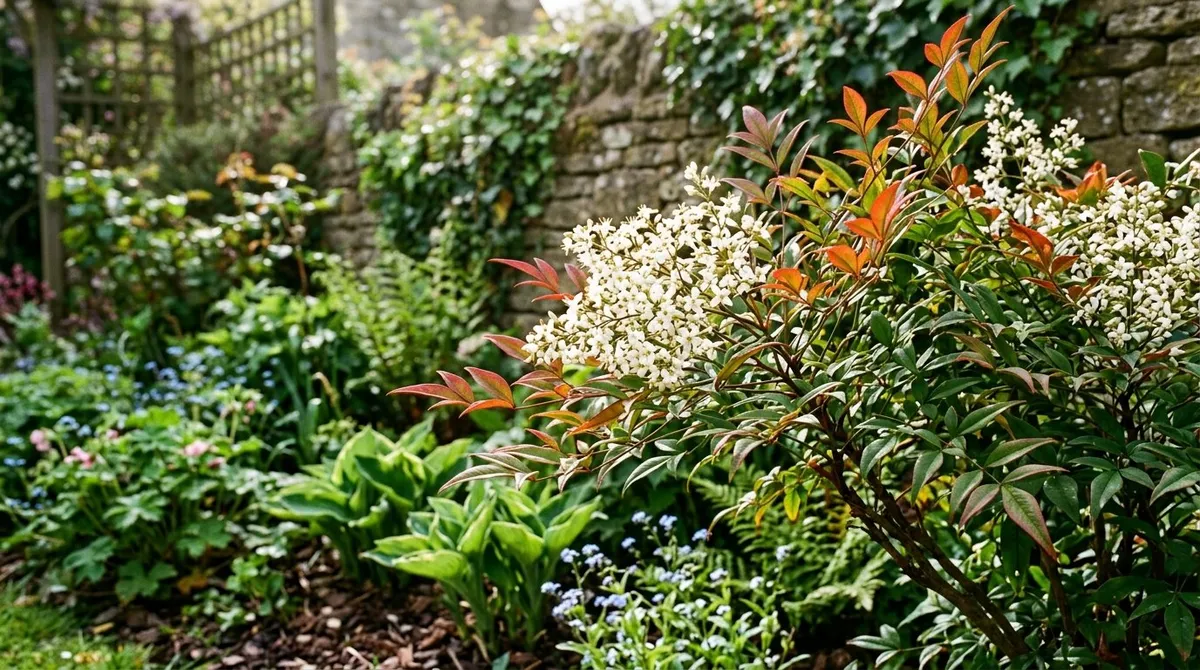
The main reason to grow nandina is winter foliage colour. From October onwards, the compound leaves change from mid-green to shades of red, crimson, purple, and orange. This colour intensifies as temperatures drop and holds until new green growth emerges in April. Few other evergreen shrubs offer this sustained winter display.
Nandina also produces panicles of small white flowers in June and July. In warm summers, these develop into clusters of bright red berries that persist through winter. Berry production is less reliable in northern UK gardens, but the foliage colour performs equally well in all regions.
Nandina foliage transitions from green to vivid crimson as autumn temperatures drop.
Which nandina varieties grow best in UK gardens?
Firepower is the best compact nandina for most UK gardens, reaching just 45-60cm tall. For larger spaces, the straight species or Richmond offer height up to 2m. The table below compares the top five varieties available from UK nurseries.
| Variety | Mature height | Spread | Winter colour | Key feature |
|---|---|---|---|---|
| Firepower | 45-60cm | 40-50cm | Intense red-orange | Best compact form, ideal for pots |
| Gulf Stream | 60-90cm | 50-60cm | Orange to bronze | Dense, mounded habit |
| Obsessed | 60-80cm | 40-50cm | Deep crimson-red | Darkest red colour of any variety |
| Richmond | 1.5-2m | 1-1.2m | Red-purple | Heavy berry crops, self-fertile |
| Twilight | 80-100cm | 60-70cm | Pink, cream, and green | Variegated foliage year-round |
Firepower
The most widely sold nandina in UK garden centres. Firepower forms a tight, compact dome of finely textured foliage. It reaches 45-60cm tall and 40-50cm wide after five years. Autumn and winter colour is the most intense of any variety, turning traffic-light red from November onwards. It rarely flowers or fruits, so the mildly toxic berries are not a concern. Excellent in containers, raised beds, and front-of-border positions.
Gulf Stream
Slightly larger than Firepower at 60-90cm tall. Gulf Stream has a naturally dense, mounded habit without pruning. Winter colour is more orange-bronze than true red. It suits mid-border positions and works well as low informal hedging. Growth rate is moderate at 10-15cm per year.
Obsessed
The deepest red winter colour of any nandina variety. Obsessed reaches 60-80cm tall with very upright stems. New spring growth emerges bright red before turning green in summer, then back to deep crimson in autumn. Introduced to the UK market around 2018 and still less commonly stocked than Firepower.
Richmond
The best choice if you want nandina berries. Richmond is self-fertile, meaning a single plant produces fruit without a pollination partner. Most other nandina varieties need a second plant nearby for cross-pollination. Richmond grows to 1.5-2m tall and suits the back of a mixed border. Winter foliage colour is red-purple rather than true crimson.
Twilight
A variegated form with pink, cream, and green foliage year-round. Twilight is more about summer interest than winter colour. It reaches 80-100cm tall and suits positions where year-round colour variation is needed. It is slightly less hardy than the green-leaved varieties. Protect from cold winds in exposed gardens.
How to plant nandina in UK soil
Plant nandina in well-drained soil with a pH between 5.5 and 7.5. It performs best in slightly acidic to neutral conditions but tolerates mildly alkaline ground. Avoid waterlogged sites where roots sit in standing water through winter.
Soil preparation
Dig a hole twice the width of the pot and the same depth. Do not plant deeper than the existing soil line in the container. On heavy clay, add a 5cm layer of horticultural grit to the base of the planting hole and mix grit into the backfill at a ratio of roughly 70% excavated soil to 30% grit. This prevents root rot during wet winters.
On sandy or chalky soils, work in a bucketful of garden compost or well-rotted bark to improve moisture retention. Nandina tolerates chalky alkaline soil but grows more vigorously with added organic matter.
Sun and shade positions
Nandina grows in full sun, partial shade, or light dappled shade. The best winter foliage colour develops in positions that receive at least four hours of direct sunlight daily. Plants in deep shade remain green through winter and miss the main reason for growing them.
Nandina pairs well with other evergreens in a mixed border. The red winter foliage contrasts against dark green neighbours.
Spacing and positioning
Space full-sized varieties (Richmond, species) 80-100cm apart. Space compact varieties (Firepower, Gulf Stream, Obsessed) 40-50cm apart. Nandina looks best planted in groups of three or five rather than as a single specimen. Position compact forms at the front of borders where the winter colour is visible from paths and windows. Taller varieties work at the back of a border or against a wall or fence.
How to grow nandina in containers
Compact nandina varieties are among the best evergreen shrubs for pots, providing twelve months of interest with minimal care. Firepower and Gulf Stream are the top choices for containers. They suit year-round container planting schemes on patios, balconies, and doorstep displays.
Container requirements
Use a pot at least 30cm wide and 30cm deep. Terracotta and frost-proof ceramic are ideal because they allow some moisture to evaporate through the pot walls, reducing root rot risk. Ensure at least one drainage hole in the base. Place crocks or a layer of gravel over the drainage hole to prevent compost blocking it.
Fill with peat-free multipurpose compost mixed with 20% perlite or horticultural grit. This mix provides the drainage nandina needs while retaining enough moisture between waterings.
Watering and feeding
Water container nandinas when the top 3cm of compost feels dry. In summer, this may mean watering every 2-3 days. In winter, reduce to once a week or less. Overwatering causes more problems than underwatering. Yellowing lower leaves usually indicate too much water rather than too little.
Feed monthly from April to August with a balanced liquid fertiliser (NPK 10-10-10 or similar). Stop feeding in September. Autumn feeding promotes soft new growth that is vulnerable to frost damage and reduces the intensity of winter colour.
Repotting
Repot every 3-4 years in spring, moving into a pot 5cm wider than the current one. If the plant is already in a large container, remove it, trim the outer roots by 10-15%, replace the old compost with fresh mix, and return it to the same pot. Top-dress annually with 3cm of fresh compost in March.
When and how to prune nandina
Nandina needs very little pruning. Remove dead or damaged stems at the base in April. Never hedge-trim nandina into a ball or box shape. The natural, loose habit with arching compound leaves is the entire point of the plant. Hard pruning destroys the form and takes 2-3 years to recover.
Renewal pruning for older plants
After 8-10 years, nandina can become leggy with bare lower stems and a top-heavy canopy. Fix this by cutting one-third of the oldest stems to 15cm above ground level each March, over three years. This triggers new growth from the base while the remaining stems maintain the plant’s shape. The process is identical to renewal pruning described in our spring pruning guide.
Removing suckers
Nandina occasionally produces a small number of suckers from the root system, particularly in moist soils. These are not aggressive like bamboo runners. Pull or cut suckers at soil level if they appear in unwanted positions. Alternatively, dig them up with a section of root to create new plants.
Nandina autumn and winter colour explained
Nandina produces its best colour when exposed to cold temperatures and direct sunlight. The pigment change is driven by anthocyanin production, which increases in response to UV light and freezing temperatures. This is the same pigment group responsible for autumn colour in acers, liquidambar, and other deciduous trees.
Three factors determine colour intensity:
- Sunlight: Four or more hours of direct sun daily produces the strongest reds. Shade-grown plants turn bronze or stay green.
- Cold: Consistent night temperatures below 5C trigger the most vivid colour. Mild winters produce weaker colour than cold ones.
- Variety: Obsessed and Firepower produce the deepest reds genetically. Gulf Stream tends towards orange-bronze even in ideal conditions.
Colour typically appears from mid-October in northern England and Scotland, late October in the Midlands, and November in southern England. It persists until new green growth pushes through in March or April.
Nandina berries and toxicity
Nandina berries contain cyanogenic glycosides and are mildly toxic to humans, cats, dogs, and birds. The berries form in clusters of 6-8mm bright red fruits after flowering. In UK gardens, berry production is inconsistent. Hot summers produce more fruit. Cool, wet summers often result in no berries at all.
The toxicity risk is low but real. Symptoms of ingestion include nausea, vomiting, and stomach cramps. In the USA, large flocks of cedar waxwings have died after gorging on nandina berries. UK birds rarely eat them, possibly because other food sources are available. If you have young children or pets that eat garden berries, choose non-fruiting varieties like Firepower or site plants out of reach.
The RHS nandina page lists the plant with a toxicity warning for all parts.
How to propagate nandina
Take semi-ripe cuttings in July or August for the most reliable propagation method. Nandina can also be divided or grown from seed, but cuttings are the fastest route to new plants identical to the parent.
Semi-ripe cuttings
- Select a current-season stem that has begun to firm at the base but is still flexible at the tip.
- Cut a 10-15cm section just below a leaf node. Remove the lower leaves, keeping 2-3 pairs at the top.
- Dip the base in hormone rooting powder (0.8% IBA).
- Insert into a 50:50 mix of perlite and peat-free compost in a 9cm pot.
- Cover with a clear plastic bag or place in a heated propagator at 18-20C.
- Roots should form in 6-10 weeks. Keep the compost barely moist, not wet.
- Pot on into individual 1-litre pots once rooted. Grow on for one full year before planting out.
Division
Lift established clumps in March and split into sections, each with 3-4 stems and a good root system. Replant immediately at the same depth. Water well and mulch. Divided plants may look sparse for one season but fill out by the following year.
Seed
Growing nandina from seed is slow. Fresh berries collected in December need cold stratification for 60-90 days (store in damp sand in the fridge). Sow in spring at 15-18C. Germination is erratic, taking 4-12 weeks. Seedlings reach flowering size in 3-5 years. Seed-grown plants may not match the parent variety.
Compact nandina varieties like Firepower thrive in containers. This Firepower is in its third winter in a 35cm pot.
Best plant combinations with nandina
Nandina’s red winter foliage works best alongside plants with contrasting textures and colours. The fine, compound leaves pair particularly well with broad-leaved evergreens and structural grasses. Consider these proven plant combinations for UK borders to extend interest across the seasons.
Winter combinations
- Nandina + Sarcococca confusa: The dark, glossy sarcococca leaves make nandina’s red foliage glow. Sarcococca adds winter fragrance from December.
- Nandina + Cornus sanguinea ‘Midwinter Fire’: Red and orange dogwood stems behind red nandina foliage makes a warm winter scene visible from indoors.
- Nandina + Helleborus niger: White Christmas roses at the base of red nandina is a classic winter container combination.
Year-round border scheme
Position compact nandinas at the front of a mixed border containing flowering shrubs and evergreen trees. Underplant with snowdrops and crocus for late winter interest. Add heuchera in complementary colours (lime green or purple) for foliage contrast at ground level.
Common nandina problems in UK gardens
Nandina is largely trouble-free in the UK. It has no serious pest problems and very few diseases. The main issues gardeners encounter are cultural rather than pathological.
| Problem | Cause | Solution |
|---|---|---|
| Yellowing lower leaves | Overwatering or poor drainage | Reduce watering, improve drainage with grit |
| No red winter colour | Too much shade or mild winter | Move to a sunnier spot, or accept bronze tones |
| Slow growth | Heavy clay or compacted soil | Mulch annually, add grit at planting time |
| Leaf scorch in spring | Late frost on new growth | Avoid exposed sites, or fleece young plants briefly |
| Bare lower stems | Natural ageing after 8-10 years | Renewal prune one-third of stems each March |
| Root rot | Waterlogged soil over winter | Improve drainage or grow in raised beds |
Nandina is deer-resistant and rabbit-resistant due to the bitter-tasting compounds in its foliage. Slugs and snails ignore it. Aphids occasionally appear on soft new growth in spring but rarely cause significant damage. A strong jet of water from a hose dislodges them.
Frequently asked questions
Is nandina hardy in the UK?
Yes, nandina is fully hardy across the entire UK. It tolerates temperatures down to -15C without damage. Even in the coldest Scottish gardens, established plants survive winter without protection. Young plants in their first winter benefit from a thick mulch around the base if temperatures drop below -10C for extended periods. The RHS rates nandina as H5 (hardy to -10 to -15C), the second-highest hardiness rating.
Is nandina actually a bamboo?
No, nandina is not a bamboo at all. Despite the common name heavenly bamboo, nandina domestica belongs to the Berberidaceae family alongside berberis and mahonia. True bamboos are grasses in the Poaceae family. Nandina earned the nickname because its upright, cane-like stems and compound leaves resemble bamboo foliage at a glance. Unlike bamboo, nandina does not spread by underground runners.
Are nandina berries poisonous?
Yes, nandina berries are mildly toxic to humans and animals. They contain cyanogenic glycosides, particularly in unripe fruit. Ingestion causes nausea and stomach upset rather than serious poisoning. The berries are also toxic to cats and dogs. In the USA, flocks of cedar waxwings have died after eating large quantities, but UK birds rarely consume them. If young children play near the plant, choose a non-fruiting variety.
Can I grow nandina in a pot?
Yes, compact varieties like Firepower and Gulf Stream grow well in containers. Use a pot at least 30cm wide and deep with drainage holes. Fill with peat-free multipurpose compost mixed with 20% perlite for drainage. Water when the top 3cm of compost dries out. Feed monthly from April to August with a balanced liquid fertiliser. Repot every 3-4 years into a slightly larger container.
Why is my nandina not turning red?
Nandina needs cold exposure and sunlight to trigger its best red foliage. Plants in deep shade stay green all year. Move container plants to a sunnier position in autumn. Some varieties like Gulf Stream have less dramatic colour change than Firepower or Obsessed. Overfeeding with nitrogen-rich fertiliser also suppresses colour development by encouraging green leafy growth at the expense of anthocyanin production.
Does nandina spread or become invasive?
Nandina does not spread aggressively in UK gardens. It grows slowly from a central clump, adding 10-15cm per year. It does not produce runners like true bamboo. In the UK climate, berries rarely germinate into self-sown seedlings because summers are not warm enough for reliable seed production. It is classed as invasive in some southern US states but poses no such risk in the UK’s cooler maritime climate.
When is the best time to plant nandina?
Plant nandina between March and May or September and October. Spring planting gives roots a full growing season to establish before winter. Autumn planting works well if you water through dry spells until the ground cools. Avoid planting in frozen or waterlogged ground. Container-grown plants from garden centres can be planted at any time of year provided you keep them well watered during establishment.
Our team produces practical UK gardening guidance from source research, contributor records and established horticultural practice. Editorial standards are overseen by Matt W.