Key takeaways
- Nerine bowdenii is the only reliably hardy species — it survives temperatures down to -12C in free-draining soil
- Plant bulbs with the neck above soil level against a south-facing wall for best results
- Poor, dry soil produces more flowers than rich, fertile ground — do not add compost or manure
- Leave clumps undisturbed for at least five years — nerines flower best when congested and root-bound
- Flowers appear October to November when most other plants have finished, giving four to six weeks of colour
- Never confuse hardy N. bowdenii with tender N. sarniensis (Guernsey lily), which needs frost-free greenhouse conditions
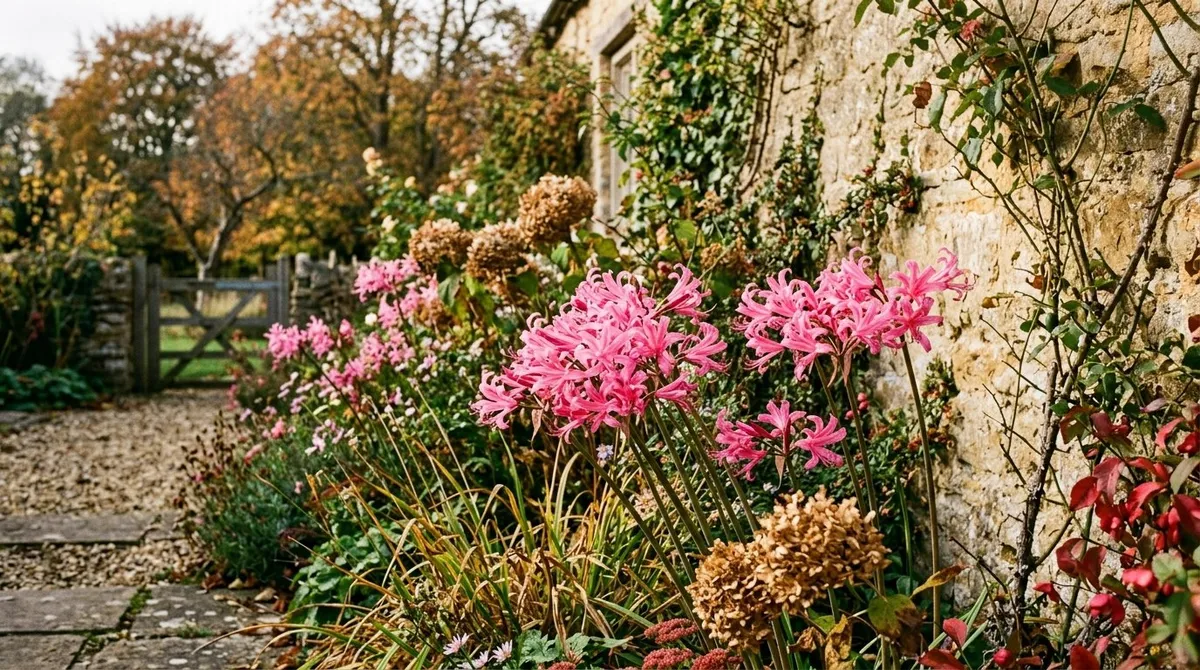
Nerines flower when the rest of the garden has given up. October arrives, the dahlias blacken with frost, the last roses drop their petals, and then these South African bulbs push up bare stems topped with clusters of pink, spidery flowers that last well into November.
Most gardeners have never tried them. Those who have tend to become obsessive about them. The secret is that nerines thrive on neglect. They want poor soil, baking sun, and to be left completely alone for years at a time. If you can resist the urge to feed, water, and fuss, they will reward you with flowers when you need colour most.
Which nerines are hardy in the UK?
Nerine bowdenii is the only species reliably hardy across most of the UK, surviving temperatures down to -12C in free-draining soil. It originates from the Drakensberg mountains of South Africa, where it grows at altitudes above 1,000 metres. This mountain origin gives it a cold tolerance that other nerine species lack entirely.
The confusion starts with Nerine sarniensis, commonly called the Guernsey lily. Despite its Channel Islands name, it is a tender South African species that dies below 0C. It must be grown in a frost-free greenhouse in all but the mildest coastal gardens. Never plant N. sarniensis outdoors in the UK expecting it to survive winter.
Several hybrid nerines bred from N. bowdenii crosses offer improved hardiness and colour range. These are worth seeking out from specialist bulb nurseries. The Royal Horticultural Society lists numerous AGM-awarded cultivars suitable for UK gardens.
If you grow agapanthus successfully, you have the right conditions for nerines. Both are South African, both want sun and drainage, and both flower better when congested. The difference is timing: agapanthus finishes in September just as nerines begin.
Where to plant nerines for best results
The ideal position is against a south-facing wall in poor, free-draining soil. Brick walls absorb heat during the day and radiate it back at night, raising the local temperature by 2-3C. This microclimate mimics the warm, dry conditions nerines experience in their native habitat.
Soil drainage matters more than fertility. Nerines evolved in rocky, nutrient-poor ground. Rich garden soil encourages leaf growth at the expense of flowers. If your soil is heavy clay, dig in generous quantities of horticultural grit, a 50:50 mix of soil and grit along the base of a wall creates ideal conditions. Our guide to improving clay soil covers the techniques in detail.
How to plant nerine bulbs
Plant nerine bulbs in March or April with the top third of the bulb protruding above the soil surface. This is the single most important rule. Unlike tulips and daffodils, nerines must not be buried deep. The exposed neck needs warmth from the sun to trigger flower production.
Space bulbs 10-15cm apart. Plant in groups of at least seven for visual impact. Odd numbers look more natural than even groups. Water once after planting, then stop. Nerines establish their root system during the summer growing season and do not need supplementary watering once settled.
For container planting, use a mix of John Innes No. 2 with 30% added horticultural grit. Terracotta pots dry out faster than plastic, which suits nerines. Choose a pot at least 20cm deep and allow only 2-3cm between bulbs. Tight planting in pots mimics the congestion that triggers flowering.
Mark where you plant them. Nerines produce foliage in spring, which dies back by midsummer. The flower stems appear in autumn from what looks like bare soil. Without markers, it is easy to accidentally dig up dormant bulbs when planting summer bedding.
How to care for nerines year round
The most important care instruction is to leave nerines alone. Do not feed them. Do not water established plants. Do not divide them. These three rules cover 90% of nerine care.
Spring and summer
Strap-shaped leaves emerge in February or March. They photosynthesise through spring, building energy reserves in the bulb for autumn flowering. Do not cut or tidy the foliage until it yellows and dies back naturally in June or July. If you grow spring bulbs nearby, the nerine foliage fills the gap after early bulbs finish.
Autumn
Flower stems push up from bare ground in September. Blooms open in October and last four to six weeks. Each stem carries an umbel of 8-12 individual flowers. Cut stems make excellent vase flowers, lasting 10-14 days in water.
Winter
After flowering, leave the stems standing until they dry completely. Apply a 10cm mulch of dry bracken or straw in December if you garden in a cold, exposed location. Remove mulch in March before new growth appears. In sheltered southern gardens, no winter protection is needed at all.
Do not apply any fertiliser. A light sprinkling of potash (sulphate of potash) in early spring can help flower production on poor-performing clumps, but nitrogen-rich feeds actively reduce flowering. Bone meal at planting time is acceptable but not essential.
Best nerine varieties for UK gardens
Five varieties have proven themselves in UK conditions over multiple growing seasons. The comparison below covers flowering period, height, colour, and hardiness rating based on RHS data and personal observation.
| Variety | Colour | Height | Flowering | Hardiness | Notes |
|---|---|---|---|---|---|
| Bowdenii (species) | Soft pink | 45cm | Oct-Nov | -12C | The classic, most reliable, AGM awarded |
| Alba | White | 40cm | Oct-Nov | -10C | Pure white form, slightly less vigorous |
| Isabel | Deep pink | 50cm | Oct-Nov | -10C | Larger flowers than species, strong stems |
| Zeal Giant | Pale pink | 60cm | Oct-Nov | -8C | Tallest variety, dramatic in groups |
| Stephanie | Rose pink | 45cm | Sept-Oct | -10C | Earliest to flower, extends the season |
Bowdenii is the safest choice for beginners and cold gardens. It is the hardiest, most floriferous, and most widely available. Alba is worth adding for contrast beside the pink forms. Isabel and Zeal Giant suit sheltered, south-facing borders where their extra height shows to advantage.
Specialist bulb nurseries carry a wider range than garden centres. Expect to pay three to five pounds per bulb for named varieties. The species N. bowdenii is available for under two pounds each when bought in bulk packs of twenty or more.
How do nerines compare to other autumn bulbs?
Nerines fill a specific gap in October and November that few other bulbs occupy. The comparison with other autumn flowers shows where they fit in the seasonal sequence.
| Bulb | Flowering period | Height | Sun needs | Soil preference | Hardiness |
|---|---|---|---|---|---|
| Nerine bowdenii | Oct-Nov | 45-60cm | Full sun | Poor, dry | -12C |
| Colchicum | Sept-Oct | 15-20cm | Sun/part shade | Moist, fertile | -15C |
| Autumn crocus (C. speciosus) | Sept-Oct | 10-15cm | Sun/part shade | Well-drained | -15C |
| Cyclamen hederifolium | Sept-Nov | 10-15cm | Part shade | Dry, humus-rich | -15C |
| Sternbergia lutea | Sept-Oct | 15cm | Full sun | Poor, dry | -10C |
Nerines stand taller than every other autumn bulb. At 45-60cm, they work at the front or middle of borders rather than as ground-level carpeting plants. They also flower later than most, starting when colchicums and autumn crocuses are already finishing. To bridge the September weeks before nerines open, pair them with Crinum x powellii for late-summer colour, another South African bulb that wants the same sun and drainage.
For year-round bulb colour, layer nerines above spring-flowering bulbs. Our bulb lasagne planting guide explains how to stack different species at different depths for continuous flowering. Nerines work well as the top layer because they need shallow planting.
Can I grow nerines from seed?
Yes, but expect to wait four to five years for flowers from seed-sown plants. Seed propagation is slow and only worthwhile for gardeners who enjoy the process itself.
Collect seed from ripe capsules in December. Sow immediately in pots of gritty compost, covering seeds lightly. Keep frost-free over winter. Germination takes four to eight weeks. Grow seedlings in pots for at least two years before planting out.
Division is faster and more reliable. Lift congested clumps in March, separate individual bulbs, and replant immediately. Divided bulbs usually flower within one to two years. Our plant propagation guide covers division techniques for all bulbous plants.
Named varieties do not come true from seed. If you want identical plants to the parent, division is the only option. Seed-raised plants will vary in colour intensity and flower size, which some gardeners consider a bonus rather than a drawback.
Common problems when growing nerines
The most frequent problem is no flowers, almost always caused by planting too deep or disturbing the clumps too often. Nerines are remarkably pest-free compared to most bulbs.
Bulb rot occurs in waterlogged soil during winter. Prevent this by so sharp drainage at planting time. If drainage is poor, grow nerines in raised beds or containers rather than open ground.
Slugs occasionally damage emerging flower stems in September. A few organic slug pellets around the base of the wall in early autumn prevents this. The foliage is not usually troubled.
Narcissus fly can attack nerine bulbs, though it prefers daffodils. The large narcissus fly (Merodon equestris) lays eggs near bulbs in late spring. Larvae burrow into bulbs and destroy them from inside. Covering dormant bulb sites with fine mesh from May to July prevents egg laying. Our guide to lily beetle control covers similar bulb pest management techniques.
Vine weevil larvae damage pot-grown nerines. Check compost for the curved white grubs when repotting. Apply a biological nematode drench (Steinernema kraussei) in late August as a preventive measure.
How to use nerines in garden design
Plant nerines in drifts of fifteen or more against warm walls for maximum visual impact. Single bulbs are lost in the autumn garden. Mass planting improves them from a curiosity into a genuine centre piece.
Nerines work well in the mixed border if you accept their dormant summer period. Plant them between late-season perennials like Japanese anemones, asters, and sedums. As these companions fade, the nerine flowers take over the display.
Cut nerines last 10-14 days in a vase. If you grow a cutting garden, add a row of nerines for late-season arrangements. They combine with ornamental grasses, rosehips, and dried seed heads, and with the scented spikes of tuberose lifted from the summer cutting patch.
For container displays, group three or five pots of nerines with pots of cyclamen and autumn-sown violas. This makes a long-running autumn display requiring almost no maintenance. Move the nerine pots to a sheltered spot after flowering finishes.
Related reading: Another late-season bulb worth a sunny wall base, see our guide to growing pineapple lily from bulb to bloom.
Frequently asked questions
When is the best time to plant nerine bulbs in the UK?
Plant nerine bulbs in March or April. Spring planting gives bulbs a full growing season to establish roots before their first winter. Autumn-planted bulbs risk rotting in cold, wet soil before they settle in. Container-grown nerines in active growth can be planted at any time between April and August.
Why are my nerines not flowering?
Newly planted nerines often skip flowering for one to three years. This is normal establishment behaviour. Other causes include planting too deep (neck must sit above soil level), too much shade (they need full sun for at least six hours daily), and over-feeding with nitrogen-rich fertiliser which promotes leaves at the expense of flowers.
Can I grow nerines in pots?
Yes, nerines grow well in pots with gritty, free-draining compost. Use a mix of John Innes No. 2 with 30% horticultural grit. Terracotta pots are better than plastic because they dry out faster. Keep pots against a warm south-facing wall and move to a frost-free spot if temperatures drop below -5C for extended periods.
What is the difference between Nerine bowdenii and Nerine sarniensis?
N. bowdenii is hardy to -12C; N. sarniensis needs frost-free conditions. Nerine bowdenii flowers in October with pink blooms on 45cm stems and grows outdoors across most of the UK. Nerine sarniensis (the Guernsey lily) has larger, more intensely coloured flowers but must be grown in a frost-free greenhouse or conservatory. They are not interchangeable.
How deep should I plant nerine bulbs?
Plant with the neck of the bulb above soil level. This is the opposite of most bulbs. Burying nerines too deep prevents flowering and encourages rot. Set bulbs so the top third protrudes above the soil surface. Space them 10-15cm apart. The bulbs will gradually pull themselves to their preferred depth.
Do nerines need winter protection?
Established N. bowdenii clumps survive most UK winters without protection. In colder regions (Scotland, northern England, exposed sites), apply a 10cm mulch of dry bracken or straw after the foliage dies back in December. Remove it in March. Wall-grown nerines benefit from the radiated heat of brickwork, which raises local temperature by 2-3C.
When should I divide nerine clumps?
Divide only when flowering declines, typically after 5-7 years. Lift clumps in March before new growth starts. Separate individual bulbs carefully and replant immediately at the same depth. Divided nerines often skip flowering for one to two years while re-establishing. Do not divide healthy, free-flowering clumps.
Our team produces practical UK gardening guidance from source research, contributor records and established horticultural practice. Editorial standards are overseen by Matt W.