Key takeaways
- Border phlox (Phlox paniculata) is fully hardy across the UK at RHS H7
- Flowers from July to September in colours from white to deep magenta
- Needs full sun and moist, well-drained soil — avoid dry sandy positions
- Powdery mildew is the main problem — choose resistant varieties and space at 45cm
- Divide every 3-4 years in spring to maintain flower quality and plant health
- Outstanding pollinator plant — attracts butterflies, bees and hoverflies all summer
- Creeping phlox (P. subulata) provides ground cover and spring colour from April
Phlox is one of the finest summer-flowering perennials for UK gardens, producing dense heads of fragrant flowers from July through to September in colours that range from pure white to deep magenta. The scent alone justifies a place in any cottage garden border.
The RHS lists over 120 phlox cultivars suitable for UK growing. Most UK garden centres stock between 10 and 20 named varieties, priced from 6 to 10 pounds per 2-litre pot. This guide covers the best varieties for UK conditions, how to plant and maintain them, and the single most important step for stopping powdery mildew.
What types of phlox can I grow in the UK?
Two main types of phlox thrive in UK gardens: tall border phlox (Phlox paniculata) and creeping phlox (Phlox subulata). Both are fully hardy (RHS H7) and produce masses of flowers, but they serve different roles in the garden.
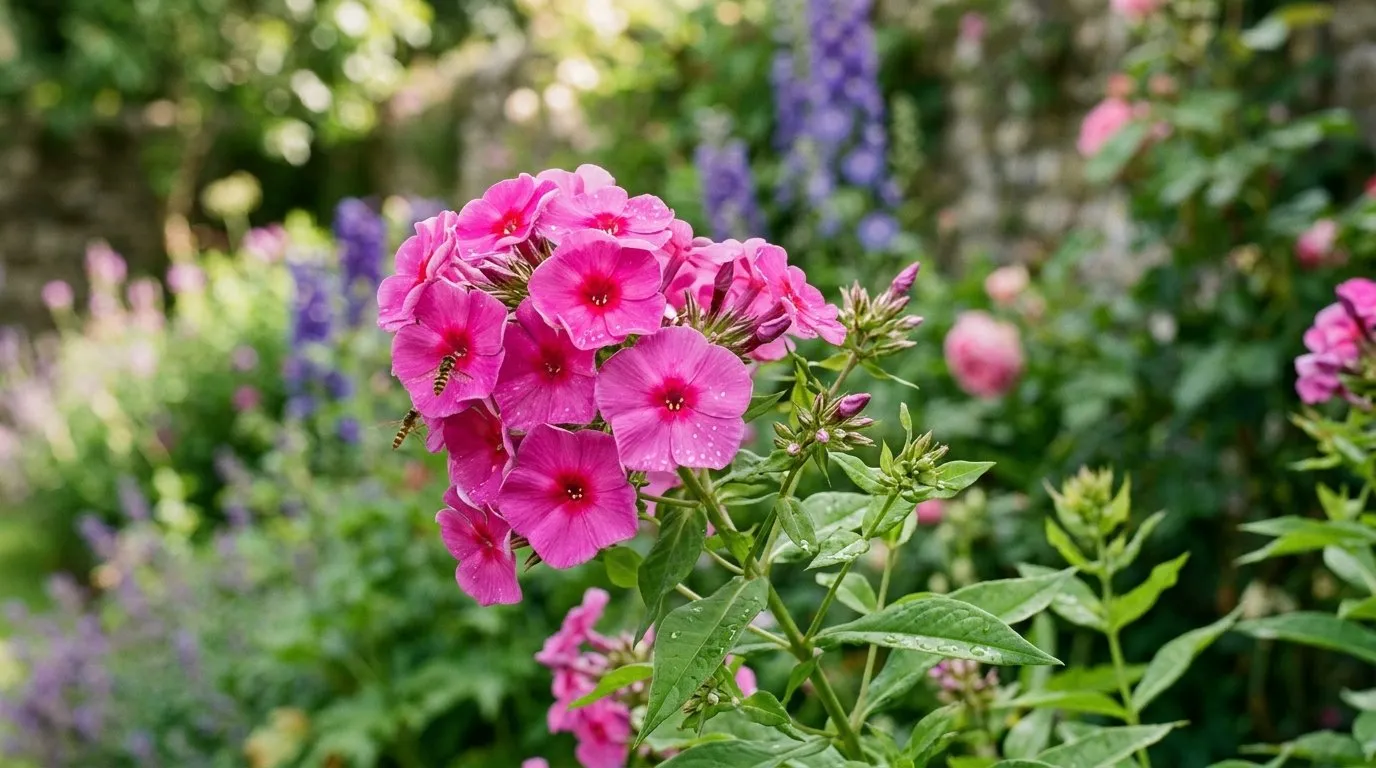 Mixed border phlox in a British cottage garden, showing the range of pink and purple shades available
Border phlox (Phlox paniculata) is the classic cottage garden plant. It grows 60-120cm tall and produces large, dome-shaped flower heads from July to September. Each flower head contains 50-100 individual florets, many of which are sweetly scented. This is the type grown for summer flower borders and cutting gardens.
Creeping phlox (Phlox subulata) is a low-growing alpine reaching just 10-15cm tall. It flowers earlier, from April to May, carpeting rockeries and path edges with sheets of starry flowers. It spreads to 50cm and is drought-tolerant once established. This makes it a useful ground cover plant for sunny banks and wall tops.
Woodland phlox (Phlox divaricata) is a third option for partially shaded positions. It grows 25-35cm tall and flowers in May with soft blue or lavender blooms. It is less widely available in UK garden centres but worth seeking out from specialist nurseries.
What are the best phlox varieties for UK gardens?
Phlox variety comparison table
| Variety | Colour | Height (cm) | Mildew Resistance | Flowering Period | RHS AGM | UK Price |
|---|---|---|---|---|---|---|
| David | Pure white | 90-100 | Excellent | July-Sept | Yes | 7-9 pounds |
| Blue Paradise | Violet-blue | 100-120 | Good | July-Sept | Yes | 8-10 pounds |
| Bright Eyes | Pale pink, red eye | 70-80 | Good | July-Aug | Yes | 7-9 pounds |
| Starfire | Deep magenta-red | 80-90 | Moderate | July-Sept | No | 8-10 pounds |
| Orange Perfection | Salmon-orange | 70-80 | Excellent | July-Sept | Yes | 8-10 pounds |
| Flame Pink | Deep pink | 40-50 | Good | July-Aug | No | 7-9 pounds |
White and pale varieties
Bright Eyes produces pale pink flowers with a distinctive red eye at the centre of each floret. It reaches 70-80cm and flowers prolifically through July and August. The two-tone colouring adds depth to pastel planting schemes.
Bold colour varieties
Starfire has the deepest colour, rich magenta-red flowers on dark-tinted stems. The foliage emerges with a burgundy flush in spring. Its mildew resistance is only moderate, so thin stems carefully in May and ensure good air flow.
Where should I plant phlox?
Phlox needs full sun, moist but well-drained soil, and good air circulation for the best flowers and fewest disease problems. Getting the position right matters more with phlox than with most perennials.
Sun and shelter
Phlox requires at least 6 hours of direct sun per day. In less light, stems stretch, flower heads shrink, and mildew risk increases sharply. A south-facing or west-facing border is ideal.
Shelter from strong winds protects the tall stems from snapping. In exposed gardens, choose compact varieties like Flame Pink (40-50cm) or stake taller types with pea sticks or grow-through supports in May.
Soil requirements
Phlox thrives in fertile, moisture-retentive soil that does not waterlog. This is the main cultural requirement: consistent moisture without sitting in water.
On heavy clay, add garden compost and coarse grit before planting to improve structure. On sandy soil, add well-rotted manure or compost to increase moisture retention. Phlox struggles on thin, dry chalk and very acidic soils below pH 5.5.
How do I plant phlox?
Plant phlox in spring (March to April) or autumn (September to October) in prepared soil enriched with organic matter. Spring planting works best on heavy clay soils. Autumn planting suits lighter, well-drained ground.
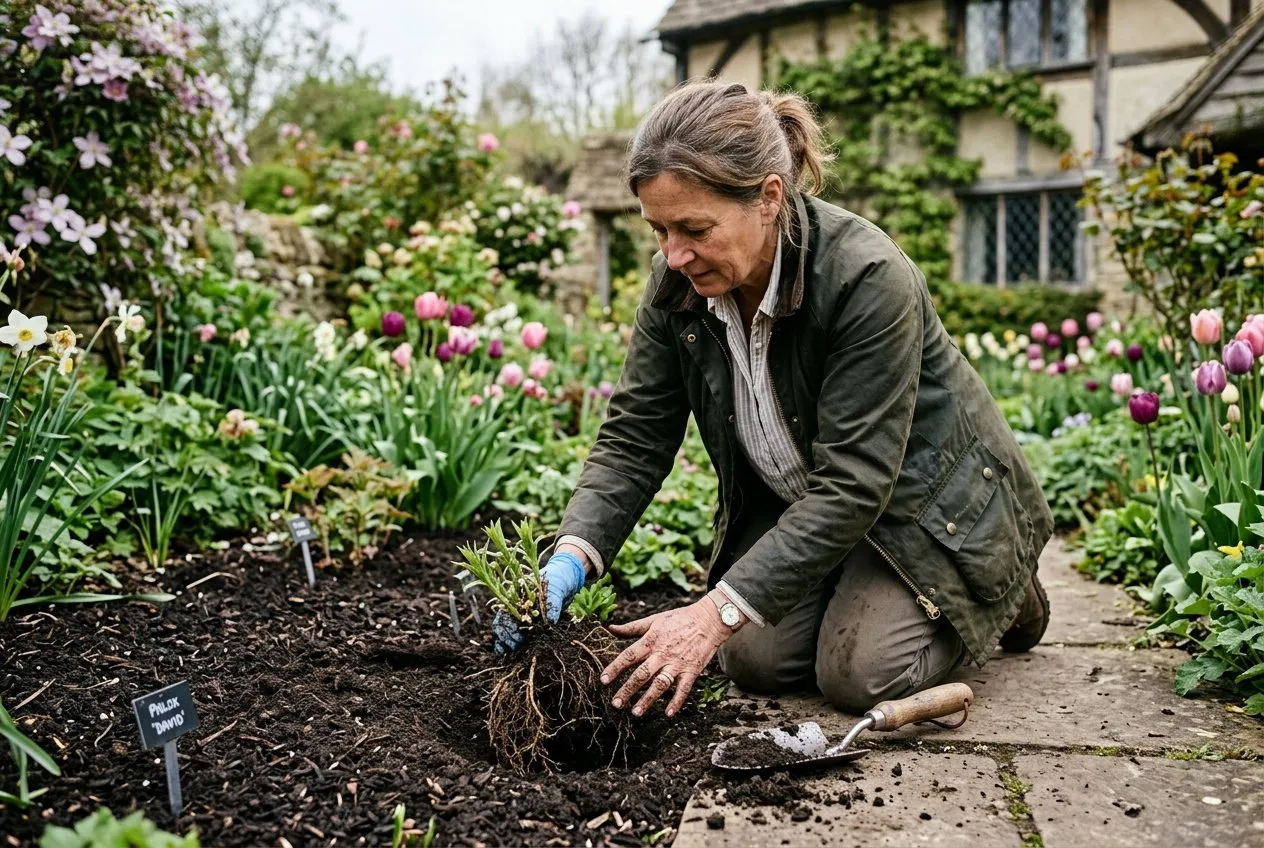 Planting phlox in spring gives roots time to establish before the summer flowering season
Step-by-step planting
- Dig a hole twice the width of the root ball and the same depth
- Mix a spadeful of garden compost into the base
- On clay soils, add a handful of coarse horticultural grit
- Remove the plant from its pot and gently tease out any circling roots
- Place in the hole so the crown sits at soil level
- Backfill, firm gently, and water thoroughly
- Apply a 5cm mulch of bark or compost, keeping it clear of the stems
- Water weekly for the first 6 weeks if rain is scarce
Spacing
Space border phlox 45cm apart. This allows air to circulate between mature clumps, which is critical for reducing powdery mildew. Closer spacing makes a fuller display faster but increases disease risk significantly.
In mixed borders, position phlox in the middle to back third. The 60-120cm height works well behind shorter perennials like catmint, salvias, and hardy geraniums.
How do I stop phlox getting powdery mildew?
Powdery mildew is the single biggest problem with phlox in UK gardens, but three preventive measures reduce it by 70-80 percent. The white powdery coating on leaves is caused by the fungus Erysiphe cichoracearum. It weakens the plant and spoils the display but rarely kills it.
The three rules for mildew prevention
2. Water at the base, not overhead. Wet foliage in still evening air is an open invitation to mildew spores. Use a watering can or drip hose directed at the soil, not a sprinkler.
If mildew does appear, remove affected leaves immediately and put them in the bin, not the compost heap. Fungicide sprays based on triticonazole can help but prevention through cultural practice is always more effective.
What are the best companion plants for phlox?
Phlox combines with other mid-to-late summer perennials that share its need for sun and moisture. The rounded flower heads create a soft, romantic effect in cottage-style borders.
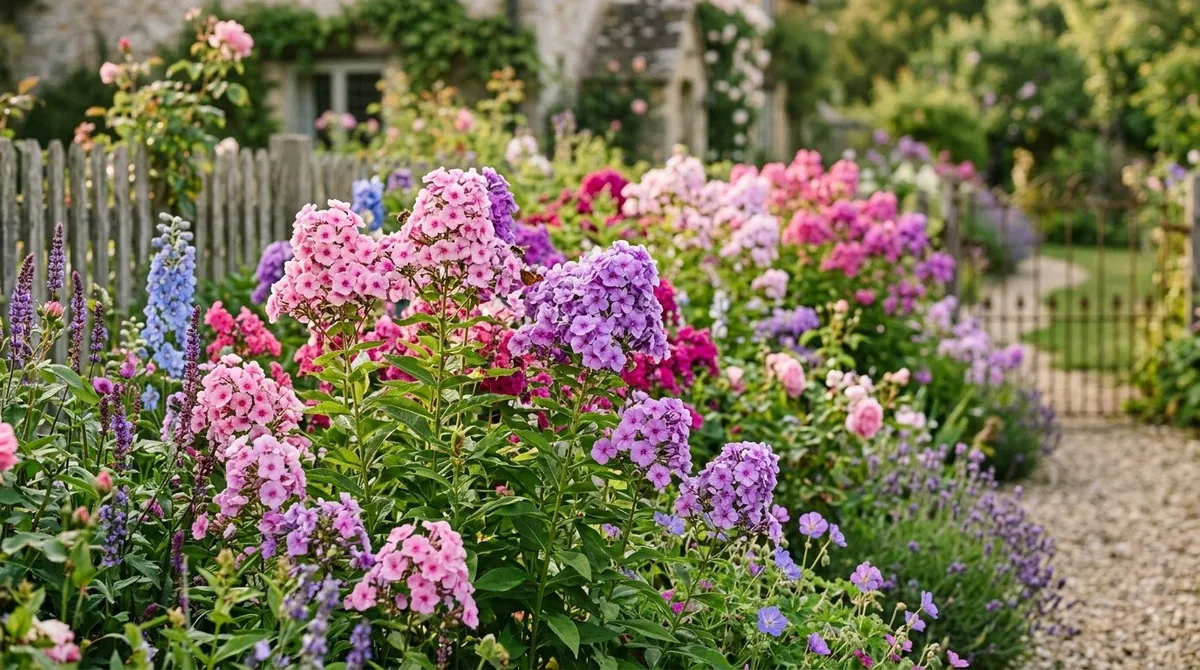
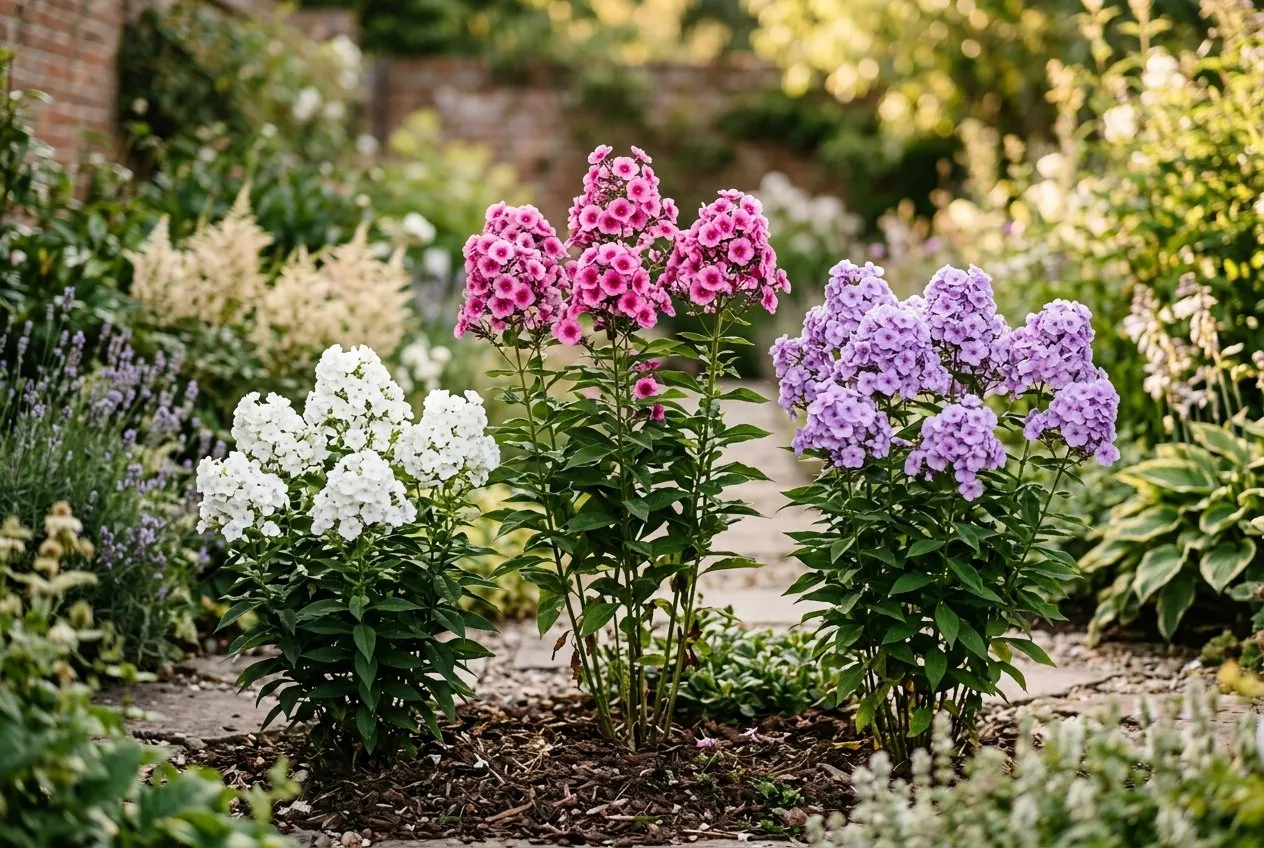 White, pink and lilac phlox varieties grown together create a natural cottage garden palette
Recommended companion planting
| Companion | Why it works | Height (cm) | Flowering |
|---|---|---|---|
| Echinacea purpurea | Contrasting daisy shape, same moisture needs | 60-90 | July-Sept |
| Rudbeckia fulgida | Warm gold against pink/purple phlox | 60-75 | Aug-Oct |
| Salvia nemorosa | Vertical blue spikes below phlox domes | 40-60 | June-Aug |
| Miscanthus sinensis | Feathery foliage backdrop | 120-180 | Aug-Oct |
| Nepeta (catmint) | Soft blue haze at phlox base | 30-45 | June-Sept |
Plant catmint at the front of the border to disguise the bare lower stems of tall phlox varieties. Behind, ornamental grasses like miscanthus provide movement and a natural backdrop.
For butterfly-friendly borders, phlox is one of the best choices. The flat-topped flower heads provide easy landing platforms for butterflies, and the nectar-rich florets attract Red Admirals, Painted Ladies, and Small Tortoiseshells throughout August.
How do I care for phlox through the year?
Phlox needs regular watering in dry spells, annual feeding, and prompt deadheading to extend the flowering season by 2-3 weeks. The seasonal care routine is straightforward once you know the key timings.
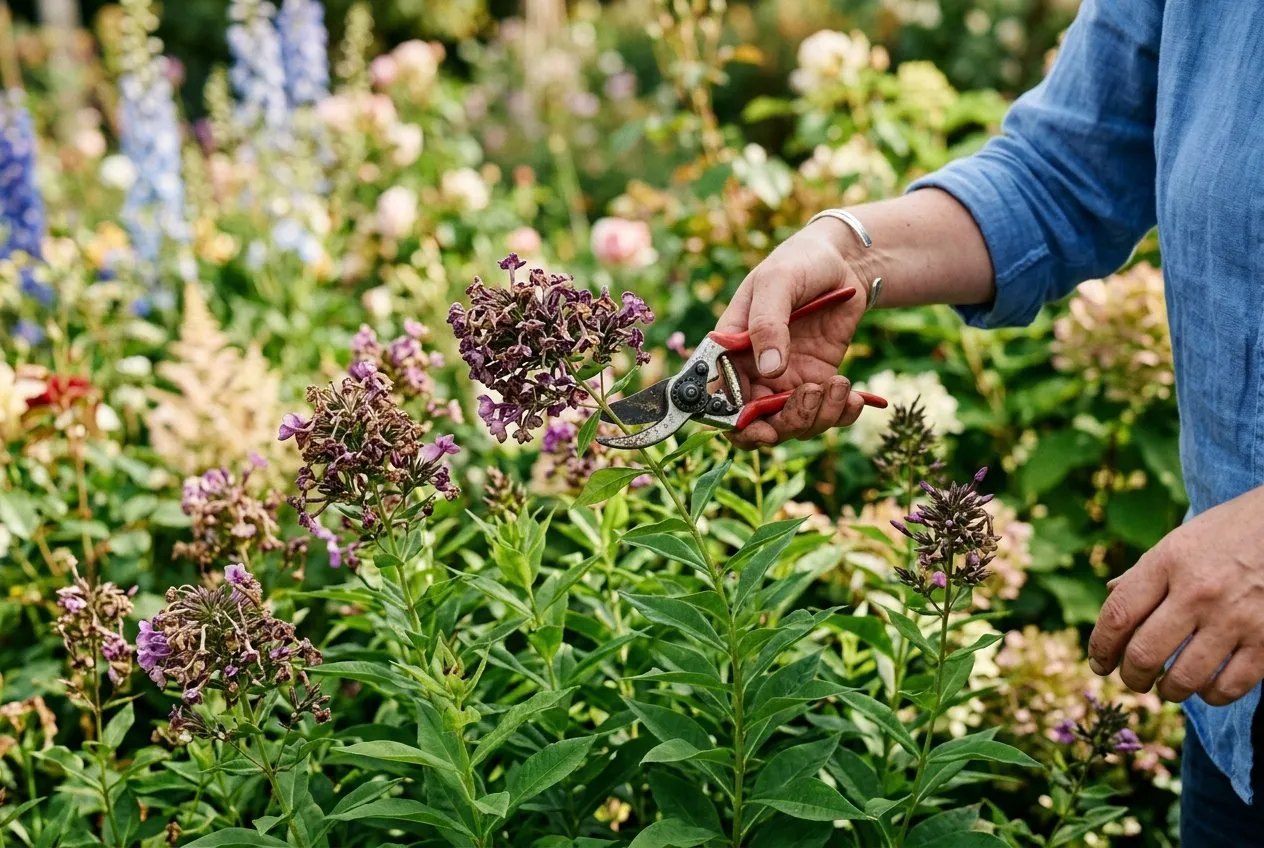 Deadheading phlox promptly encourages side shoots to flower and prevents unwanted self-seeding
Month-by-month care calendar
| Month | Task |
|---|---|
| March | Cut back old stems to ground level if not done in autumn |
| April | Apply 5cm mulch of garden compost around emerging shoots |
| May | Thin stems to 5-6 per clump when 15-20cm tall |
| June | Begin regular watering in dry spells, 2cm per week minimum |
| July | Feed with liquid tomato fertiliser as first buds open |
| August | Deadhead spent flower heads to encourage side shoots |
| September | Continue deadheading; reduce watering as flowering slows |
| October | Cut stems to 5cm above ground after first hard frost |
| November | Apply a light mulch of compost for winter protection on exposed sites |
Deadheading technique
Cut the spent flower head back to just above the first pair of strong side buds. These will produce secondary flower heads within 2-3 weeks, extending the display into September and sometimes early October. Remove the entire stem only when all side shoots have finished flowering.
Feeding
Phlox is a moderately hungry plant. Apply a general-purpose fertiliser such as Growmore (70g per square metre) in April as shoots emerge. Supplement with liquid tomato feed every 2 weeks from mid-July to encourage more flowers. Comfrey and nettle feeds work well as organic alternatives.
Division
Divide established clumps every 3-4 years in March or early April. Lift the entire plant, split into sections with a spade or sharp knife, and replant the outer portions. Discard the woody centre. Each division should have 3-5 strong shoots and a good root system. Water in well and keep moist for 6 weeks.
Can I grow phlox from seed or cuttings?
Phlox propagates reliably from root cuttings taken in winter and from basal stem cuttings in spring. Growing from seed is possible but named varieties do not come true, the offspring vary in colour and habit.
Root cuttings (November to January)
Root cuttings are the most reliable method for named varieties. Lift the plant or expose the roots on one side. Cut pencil-thick roots into 5cm sections. Insert vertically (right way up) into pots of gritty compost. Keep in a cold frame over winter. Shoots appear in March.
Basal cuttings (April to May)
Take 8-10cm basal cuttings when new shoots are growing strongly in spring. Cut just below a node. Remove the lowest pair of leaves. Insert into modules of 50:50 perlite and multipurpose compost. Keep in a propagator or covered tray at 15-18 degrees Celsius. Roots form in 3-4 weeks.
Division (March to April)
Frequently asked questions
When is the best time to plant phlox UK?
Plant phlox in spring (March to April) or autumn (September to October). Spring planting is best for heavy clay soils because roots establish before summer flowering. Autumn planting works well on lighter soils. Avoid planting in waterlogged or frozen ground. Container-grown phlox from garden centres can be planted at any time the ground is workable.
Does phlox come back every year?
Phlox is a hardy herbaceous perennial that returns every year. The stems die back to ground level in autumn. New shoots emerge in March and April. Plants live for 10 years or more with regular division every 3-4 years. Without division, the centre of the clump becomes woody and flower quality declines.
Why does my phlox get powdery mildew?
Powdery mildew thrives in still, humid air around crowded stems. The main cause is planting too close together or failing to thin stems in spring. Space plants 45cm apart. Thin each clump to 5-6 stems in May. Water at the base rather than overhead. Choose resistant varieties like David or Orange Perfection to reduce the problem further.
Can I grow phlox in shade UK?
Phlox performs best in full sun with 6 or more hours of direct light. It tolerates light dappled shade but produces fewer flowers and becomes leggy. In partial shade, mildew risk increases significantly. If your border is shaded, creeping phlox (P. subulata) tolerates lighter conditions better than tall border phlox.
How tall does phlox grow?
Border phlox (Phlox paniculata) reaches 60 to 120cm tall depending on variety. Compact types like Flame Pink reach 40-50cm. Tall varieties like Blue Paradise reach 100-120cm and need staking in exposed gardens. Creeping phlox (P. subulata) grows only 10-15cm tall and spreads to 50cm, making it ideal for rockeries and path edges.
How do I stop phlox from spreading?
Border phlox spreads slowly by clump expansion, not by runners. It is not invasive. Divide every 3-4 years to control size and rejuvenate the plant. Deadhead spent flowers promptly to prevent self-seeding, which produces variable offspring. Creeping phlox spreads more actively but is easily trimmed back after flowering in May.
What grows well with phlox in a border?
Phlox pairs well with other mid-to-late summer perennials. Plant alongside echinacea, rudbeckia, Japanese anemones, and ornamental grasses for a succession of colour from July to October. Shorter companions like catmint and geraniums fill the base of the border. Tall delphiniums provide vertical contrast behind phlox clumps.
Our team produces practical UK gardening guidance from source research, contributor records and established horticultural practice. Editorial standards are overseen by Matt W.