Key takeaways
- Scilla siberica flowers in March with vivid blue, the most intense blue of any spring bulb
- Plant bulbs 8cm deep and 5cm apart in autumn for flowers the following spring
- All scilla species naturalise in grass, under trees, and in gravel with zero maintenance
- S. mischtschenkoana is the earliest, flowering from late January with white-blue striped petals
- Self-seeds freely and spreads by offsets to form large drifts within 5-7 years
- Often confused with Chionodoxa — scilla petals curve back, Chionodoxa petals are flat with a white eye
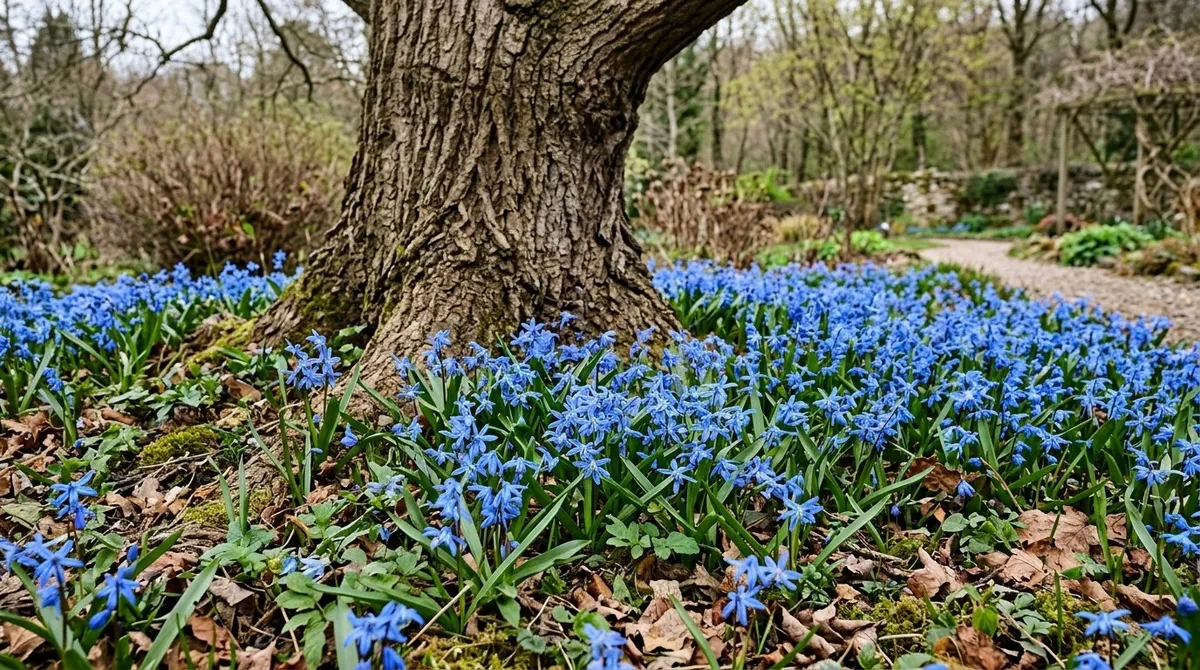
Scilla are the bulbs that paint the ground blue before most gardeners have started their spring routines. These tiny plants, rarely more than 15cm tall, produce flowers of such vivid blue that a naturalised colony under trees looks like a fragment of sky laid on the ground.
They are among the easiest bulbs to grow in UK gardens. Plant them in autumn, forget about them, and they will flower every spring with zero maintenance. Over the years, they multiply by self-seeding and offsets until a handful of bulbs becomes a carpet. They cost pennies per bulb and last indefinitely.
What species of scilla grow best in the UK?
Four species are widely available and reliably hardy across all UK regions. Each fills a slightly different slot in the garden calendar, so planting all four gives you flowers from late January through to mid-April.
Scilla siberica (Siberian squill) is the most popular and widely planted. It reaches 10-15cm tall and produces nodding, bell-shaped flowers of intense gentian blue in March. Each bulb sends up 2-4 flower stems, each carrying 1-5 flowers. The variety Spring Beauty has larger, darker flowers than the straight species and is the one most often sold.
S. bifolia (two-leaved squill) flowers earlier, from late February in mild areas. It reaches 10-15cm with star-shaped flowers in a softer, more violet-toned blue. Each stem carries 6-10 small flowers in a loose raceme. It naturalises well in grass and under trees.
S. mischtschenkoana (Tubergen squill) is the earliest, opening in late January in sheltered spots. The flowers are pale blue-white with a darker blue stripe down each petal. It reaches 10-12cm and is extremely hardy. This is the species for those who want colour while the garden is still deep in winter.
S. lilio-hyacinthus (Pyrenean squill) is the largest species at 15-25cm. It flowers in April and May with dense racemes of pale blue to lilac flowers that resemble a small hyacinth. It prefers moister soil than the others and suits shady borders under deciduous trees.
| Species | Height | Flower colour | Flowering period | Best position | Spread rate |
|---|---|---|---|---|---|
| S. siberica | 10-15cm | Intense blue | March-April | Sun or part shade, any soil | Fast, self-seeds freely |
| S. bifolia | 10-15cm | Violet-blue | February-March | Part shade, woodland | Moderate, steady |
| S. mischtschenkoana | 10-12cm | White-blue striped | January-February | Sheltered, any aspect | Slow to moderate |
| S. lilio-hyacinthus | 15-25cm | Pale blue-lilac | April-May | Moist shade, humus-rich | Slow |
How do you plant scilla bulbs?
Plant scilla bulbs in autumn between September and November. Earlier planting gives the roots more time to establish before the ground cools. The bulbs are small, typically 1-2cm in diameter, and dry out quickly. Plant them within a week of purchase rather than leaving them sitting in a shed.
Dig individual holes 8cm deep and 5cm apart using a narrow trowel or bulb dibber. On heavy clay, drop a small handful of horticultural grit into the base of each hole before placing the bulb. Plant with the pointed end facing upward. If you cannot tell which end is up, plant the bulb on its side and the shoot will find its own way.
For naturalising in grass, scatter the bulbs across the chosen area and plant each one where it lands. This gives a natural, random distribution that looks far better than regimented lines. Use a bulb planter or narrow trowel to cut into the turf, place the bulb at 8cm depth, and replace the plug of turf on top.
Plant in groups of 25-50 minimum. Scilla are tiny individually and need numbers to make an impact. A single bag of 100 bulbs costs a few pounds and fills roughly one square metre. Over 5-7 years, that square metre will expand to 3-4 square metres through self-seeding and offsets. They combine with crocus and snowdrops planted in the same area.
Where is the best place to grow scilla?
Scilla are woodland plants in the wild, flowering on the forest floor before the deciduous canopy closes overhead. In gardens, they perform best in positions that mimic these conditions: dappled shade in spring, with more shade in summer once the foliage has died back.
Under deciduous trees is the classic position. Silver birch, oak, beech, and ornamental cherries all provide the right conditions. The bulbs receive full light during their active growing season in February to May, then rest in shade through summer. Plant directly into the soil around tree roots. Scilla tolerate root competition well.
In open grass, scilla thrive in full sun or light shade. They make superb additions to wildflower lawns and look natural scattered through rough grass at the base of hedges. The critical rule is no mowing until the foliage has yellowed naturally. This typically means leaving the area uncut until late May or early June.
Scilla also work in gravel gardens, at the front of borders, in raised beds, and in containers. They are not fussy about soil type, growing happily in clay, loam, sand, and chalk. The only condition they dislike is waterlogged soil where bulbs sit in standing water for prolonged periods.
What is the difference between scilla and Chionodoxa?
This confusion catches out many gardeners. Scilla and Chionodoxa (glory of the snow) are closely related genera in the Asparagaceae family, and some modern taxonomists have merged Chionodoxa into Scilla. In nursery catalogues and garden centres, they are still sold as separate plants.
The easiest way to tell them apart is the flower shape. Scilla petals curve backwards, away from the centre. Chionodoxa petals open flat, forming a star shape with a distinct white eye at the centre. If you look into the flower and see a white zone around the stamens, it is Chionodoxa. If the flower is a uniform colour with no white centre, it is scilla.
Chionodoxa forbesii and C. luciliae are the species most commonly confused with S. siberica. All three produce blue flowers in March at similar heights. Chionodoxa tends to flower 1-2 weeks before siberica in the same garden. Both genera naturalise in identical conditions and can be planted together for extended flowering.
For practical gardening purposes, the distinction barely matters. Both are planted, grown, and cared for in exactly the same way. They cross-pollinate freely where they grow together, producing hybrid seedlings with intermediate flower shapes.
How do scilla naturalise and spread?
Scilla spread by two mechanisms: self-seeding and vegetative offset production. Together, these turn a modest initial planting into an impressive colony within 5-7 years.
Each flower produces a capsule containing 6-12 seeds. When the capsule ripens and splits in late May, the seeds fall onto the surrounding soil. They germinate the following autumn or spring and take 3-4 years to reach flowering size. In undisturbed ground, this self-seeding is prolific. A single S. siberica flower stem can produce 30-50 seeds across its multiple capsules.
The parent bulb also produces offsets, small daughter bulbs that form around its base. These reach flowering size in 2-3 years. A healthy bulb produces 1-3 offsets per year. Over time, the original single bulb becomes a tight cluster, then each offset begins producing its own offsets and seeds.
The key to encouraging naturalisation is leaving the foliage alone until it yellows and dies back naturally. Cutting, mowing, or tying up the leaves starves the bulb and prevents seed set. In grass areas, this means accepting an area of long grass until late May. Mark the bulb patches with short canes so you remember not to mow too early.
How do you care for scilla after flowering?
Scilla need almost no care after flowering. The single important rule is leaving the foliage to die back naturally. The leaves photosynthesise for 6-8 weeks after the flowers fade, sending energy back into the bulb for next year’s flowers and new offset production.
Do not cut, braid, or tie up the leaves. Do not mow over them if they are growing in grass. Wait until the foliage has turned completely yellow and collapsed, which happens by late May or early June in most UK gardens. After that, you can mow freely or tidy up the area.
Feeding is unnecessary in most soils. The bulbs are small and their nutrient demands are minimal. If you want to encourage faster spreading, scatter a light dressing of bonemeal over the colony in September when root growth resumes. Water is rarely needed since scilla grow during the wettest months of the year.
Scilla are fully hardy to -20C and need no winter protection anywhere in the UK. They are also resistant to most pests and diseases. Squirrels occasionally dig up newly planted bulbs in autumn. Covering the planting area with wire mesh for the first winter prevents this. Once the bulbs have rooted, squirrels lose interest.
Can you grow scilla in pots and containers?
Scilla make charming container displays, particularly the earlier-flowering species that bring colour to doorsteps and patios while the garden is still dormant. Plant bulbs in autumn at 8cm depth in any free-draining, peat-free compost.
Use shallow pans or troughs 15-20cm deep. Plant the bulbs closer together than you would in the ground, spacing them 2-3cm apart for a dense display. A 20cm pot holds 15-20 bulbs comfortably. Water after planting and keep the compost just moist through winter.
Place pots in a sheltered spot where you will see them daily during their short flowering season. A north-facing windowsill works well because the cool conditions extend the flowering period. After flowering, continue watering until the foliage yellows, then let the compost dry out.
Potted scilla can be planted out into the garden after flowering. Tip the entire rootball into a prepared hole and cover to the original depth. They will establish and begin naturalising from the following year. This is an economical way to build up large colonies from a small annual investment in spring bulbs.
How do scilla combine with other spring bulbs?
Scilla are at their best when planted alongside other early bulbs in layers or drifts. The vivid blue is a perfect foil for yellow, white, and purple flowers, creating combinations that no summer border can match for intensity.
The classic combination is scilla with daffodils. Plant daffodil bulbs at 15cm depth, then plant scilla at 8cm depth directly above them. The scilla flower first, forming a blue carpet through which the daffodils push later. This technique, known as bulb lasagne planting, maximises colour from a single planting area.
Scilla also mix well with early crocus, Anemone blanda, eranthis (winter aconite), and chionodoxa. Under trees, combine them with snowdrops for a succession that starts in January and runs through to April. In grass, scatter all these bulbs together and let them spread into a mixed carpet of blue, white, and gold over the years.
Avoid planting scilla next to alliums, which flower much later and can overshadow the tiny scilla in the border hierarchy. Keep scilla at the front of beds or in dedicated bulb areas where they will not be swamped by taller, later-emerging perennials.
Frequently asked questions
When do scilla flower in the UK?
Scilla flower between January and April depending on species. S. mischtschenkoana opens first in late January to February. S. bifolia follows in February to March. S. siberica, the most commonly grown, flowers in March to early April. Flowering time shifts 1-2 weeks between southern England and northern Scotland.
How deep do you plant scilla bulbs?
Plant scilla bulbs 8cm deep and 5cm apart in autumn. September to November is the ideal planting window. The bulbs are small, roughly 1-2cm in diameter. On heavy clay, add grit beneath each bulb. Plant in groups of 25 or more for visual impact.
Will scilla naturalise in grass?
Yes, scilla are among the best bulbs for naturalising in grass. They self-seed freely and spread by offsets to form large colonies. The key rule is not mowing the grass until foliage has died back naturally in late May or early June. Mowing before the leaves yellow starves the bulbs.
What is the difference between scilla and Chionodoxa?
Scilla petals curve backwards while Chionodoxa petals open flat with a white central eye. The two genera are closely related. In gardens, Chionodoxa has a distinct white centre to each flower, while scilla flowers are a uniform colour. Chionodoxa tends to flower 1-2 weeks earlier.
Do scilla grow in shade?
Scilla thrive in partial shade and full shade under deciduous trees. They evolved as woodland floor plants, flowering before the canopy closes. Full sun also works, particularly in grass. Flowers last longer in cool, lightly shaded positions.
Are scilla poisonous?
Yes, all parts of scilla are toxic if eaten. The bulbs contain cardiac glycosides. Wear gloves when handling bulbs if you have sensitive skin. Keep bulbs away from children and pets during planting. Once growing, the risk is low as the leaves are unpalatable.
Our team produces practical UK gardening guidance from source research, contributor records and established horticultural practice. Editorial standards are overseen by Matt W.