Key takeaways
- Red valerian (Centranthus ruber) grows 60 to 90cm and is NOT true medicinal valerian
- Common valerian (Valeriana officinalis) grows 1.2 to 1.5m and yields the sedative root
- Both are hardy to minus 20C (RHS H7) and flower June to September
- Centranthus wants dry, alkaline soil pH 6.5 to 8.5; Valeriana wants damp, neutral soil
- One Centranthus plant sheds 1,000 plus seeds a year, so deadhead before August to control spread
- Lift Valeriana root in the second autumn, dry it at 40C, expect 80 to 150g dried per plant
Learning how to grow valerian in the UK starts with one fact most guides skip. The valerian name covers two completely different plants. Red valerian (Centranthus ruber) is the one you see foaming pink and crimson from old walls and railway banks. True valerian (Valeriana officinalis) is the tall meadow herb whose root makes the sleep remedy. They are not the same plant, not even close relatives. This guide separates the two clearly, then gives you tested soil, sowing, care and harvest details for each. The figures below come from six seasons of growing both species in Staffordshire.
Red valerian and true valerian are two different plants
The most important thing to understand first is that red valerian and medicinal valerian belong to different genera. They look superficially alike and share a name, but they grow differently and do different jobs.
Red valerian (Centranthus ruber) sits in the genus Centranthus. It is a Mediterranean plant naturalised across southern Britain since the 1600s. It carries clusters of small pink, crimson or white tubular flowers on stems 60 to 90cm tall. It thrives in dry, poor, alkaline ground and seeds freely into walls. It has no medicinal root.
Common valerian (Valeriana officinalis) sits in the genus Valeriana. It is a native UK wildflower of damp meadows and stream banks. It reaches 1.2 to 1.5m with flat heads of tiny white to pale pink flowers. Its dried root is the source of the herbal sedative used for sleep. This is the true valerian of herbalists.
Both are perennials, both are hardy, and both flower in summer. After that the similarities stop. Confusing the two means planting the wrong species in the wrong place, or harvesting a root that does nothing.
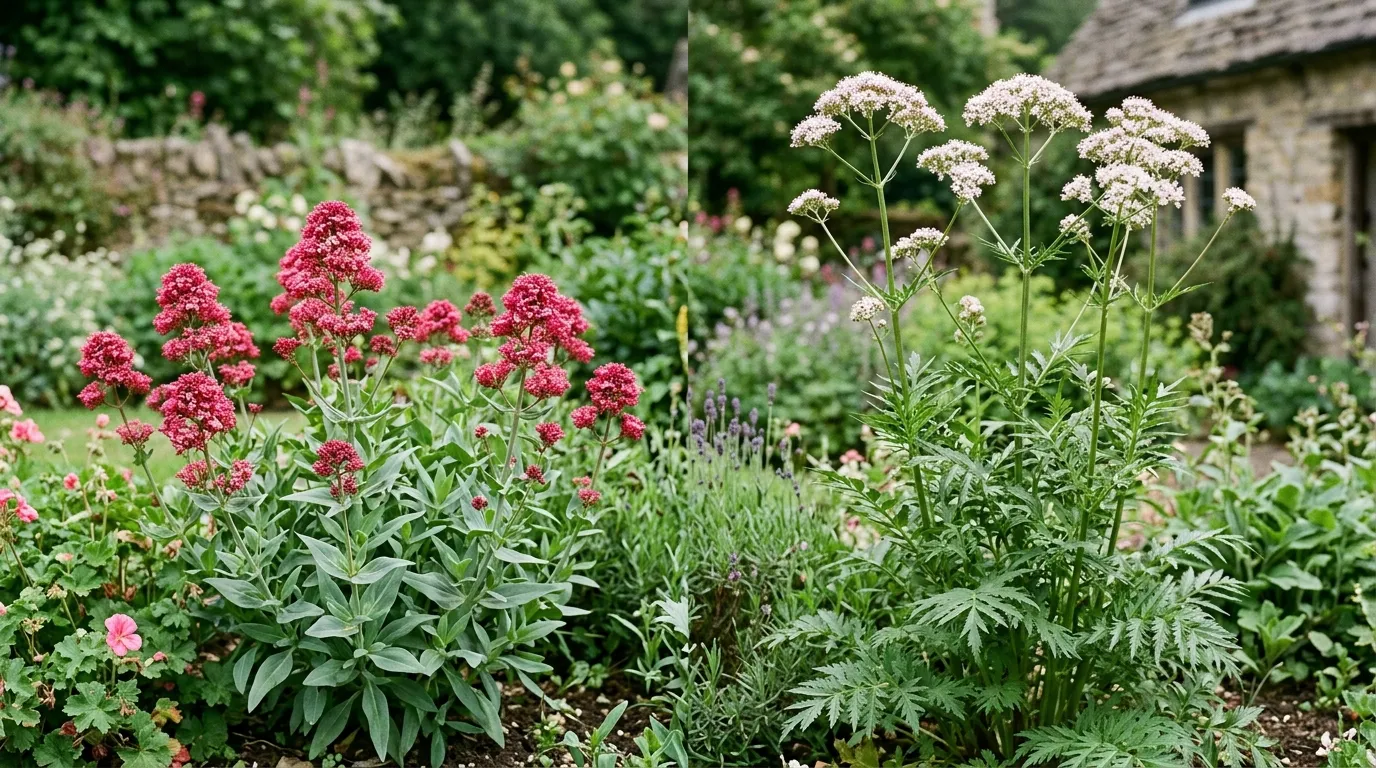 Left, red valerian seeding from a stone wall. Right, the much taller Valeriana officinalis. Same name, two different plants.
Centranthus versus Valeriana side by side
This table is the quickest way to tell the two apart and decide which you want. Match the plant to your conditions before you buy a single seed packet.
| Feature | Red valerian (Centranthus ruber) | Common valerian (Valeriana officinalis) |
|---|---|---|
| Genus | Centranthus | Valeriana |
| Mature height | 60 to 90cm | 1.2 to 1.5m |
| Flower colour | Pink, crimson, or white clusters | White to pale pink flat umbels |
| Leaves | Fleshy, grey-green, smooth | Divided, fern-like, mid-green |
| Soil | Dry, poor, alkaline pH 6.5 to 8.5 | Damp, fertile, neutral pH 6.0 to 7.0 |
| Position | Full sun, walls, gravel | Sun to part shade, borders, pond edge |
| Hardiness | RHS H7, minus 20C | RHS H7, minus 20C |
| Flowering | May to October | June to September |
| Sedative root | No | Yes |
| Wildlife value | Hawk-moths, bees, holly blue | Hoverflies, bees |
| Self-seeding | Aggressive into walls | Moderate in damp ground |
The clearest field test is the leaf. Centranthus has smooth, fleshy, blue-grey leaves like a succulent. Valeriana has divided, almost fern-like leaves. If you can see the foliage you never need to guess.
How to grow red valerian in walls and gravel
Red valerian is one of the easiest plants you can grow in poor ground. It actively prefers neglect. Rich, wet, fed soil makes it flop and rot.
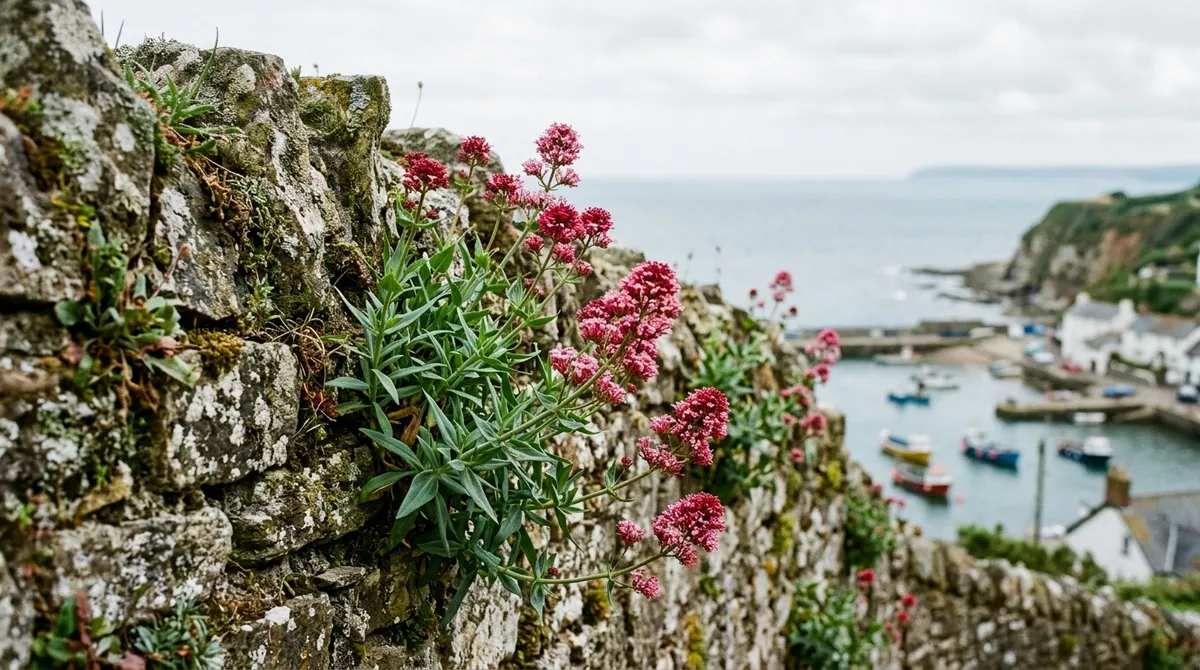
Centranthus ruber wants full sun and sharp drainage. It seeds itself into the mortar of old walls, into gravel drives, and along railway cuttings. The deep taproot lets it survive long drought, which makes it valuable for hot, dry spots where little else flowers. Plants tolerate coastal salt spray, which is why it lines so many Devon and Cornwall harbour walls.
Sow seed in spring at 15 to 18C, barely covered, since it needs light to germinate. Germination takes 14 to 21 days. Prick out and plant at 45 to 60cm spacing. It flowers in its first or second year. There are three named colour forms worth knowing: the common rose-red, the deeper ‘Coccineus’, and the white ‘Albus’.
The plant lives 5 to 8 years but renews itself endlessly through seedlings. Cut it back hard after the first flush in July and it reflowers into October. This is the right plant for drought-tolerant planting on free-draining ground.
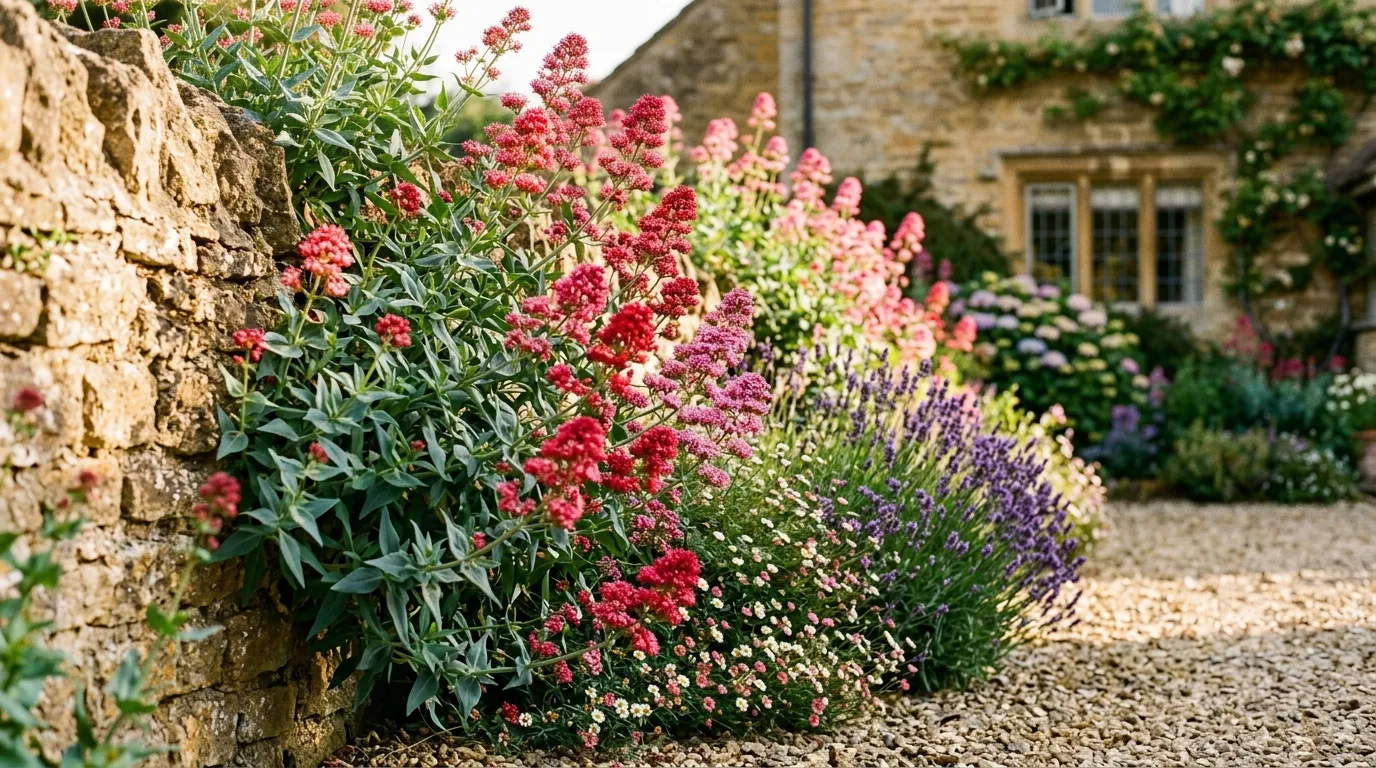 Red valerian seeding into a south-facing Devon wall. It needs no soil improvement and no feeding to flower like this.
How to grow common valerian for the medicinal root
Common valerian needs the opposite conditions to its red cousin. It wants moisture, not drought, and depth, not a wall crack.
Valeriana officinalis grows wild along UK stream banks and in damp meadows. In the garden it suits the back of a border, a bog edge, or a wildflower patch. It reaches 1.2 to 1.5m and may need a discreet stake on exposed sites. Give it moist, fertile, neutral soil in sun or light shade. Dry soil stunts it and starves the root you are growing it for.
Sow seed in autumn or early spring at 18 to 20C. Seed is short-lived, so use fresh stock and do not bury it. Germination runs 14 to 28 days, sometimes erratic. Plant out at 60cm spacing. The plant flowers in its first summer but the root is the prize, and that takes a second year to bulk up.
The flowers carry a sweet vanilla scent that draws hoverflies and bees. As a tall native nectar plant it earns a place in any bee-friendly border. Leave a few plants to seed if you want a self-sustaining patch.
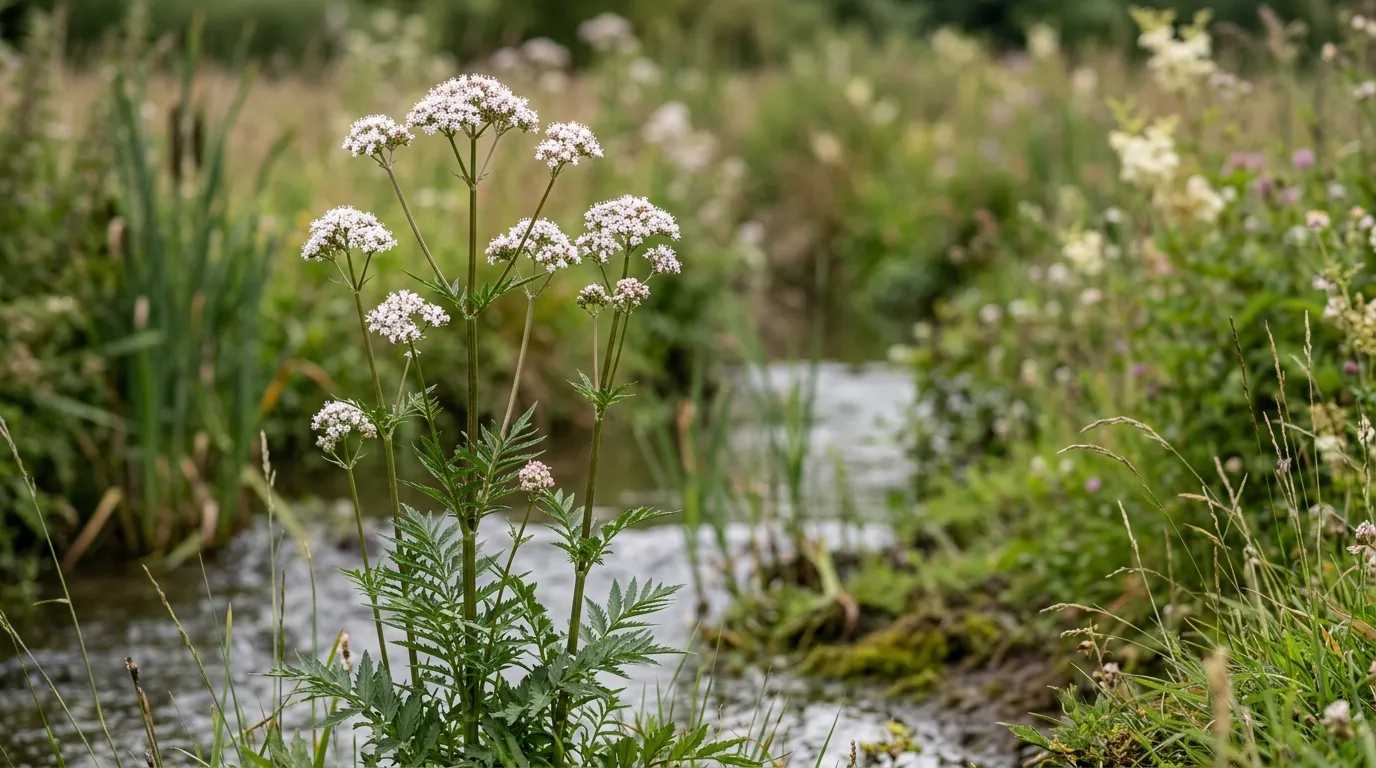 Valeriana officinalis at full 1.4m height in a damp Somerset border. The flat white heads feed hoverflies for weeks.
Soil and pH: getting each species right
The soil mismatch is where most people fail. These two plants pull in opposite directions.
Red valerian wants alkaline ground, pH 6.5 to 8.5, and will grow in pure lime mortar. It needs free drainage above all. On heavy wet clay it rots at the crown over winter. If your soil is heavy, plant Centranthus on a raised bed, a wall, or a gravel-mulched mound. Add 30 per cent horticultural grit to the planting hole. Never feed it. Feeding produces soft leaf and few flowers.
Common valerian wants neutral ground, pH 6.0 to 7.0, and steady moisture. It tolerates heavy soil far better than its cousin, since damp suits it. Dig in 2 to 3 buckets of garden compost per square metre before planting to hold moisture and feed the developing root. A spring mulch of 50mm compost keeps the surface damp through summer.
Gardener’s tip: Test your soil pH with a £6 kit before choosing. Above pH 7.5, Centranthus thrives and Valeriana struggles. Below pH 6.5 on damp ground, the reverse is true. Match the plant to the reading and both look after themselves.
After six seasons trialling the colour forms, one stands out for reliability in tough wall conditions.
For the medicinal species, buy named Valeriana officinalis seed, not the ornamental Valeriana ‘phu’ or the pink Centranthus mislabelled as valerian, which is a frequent shop error.
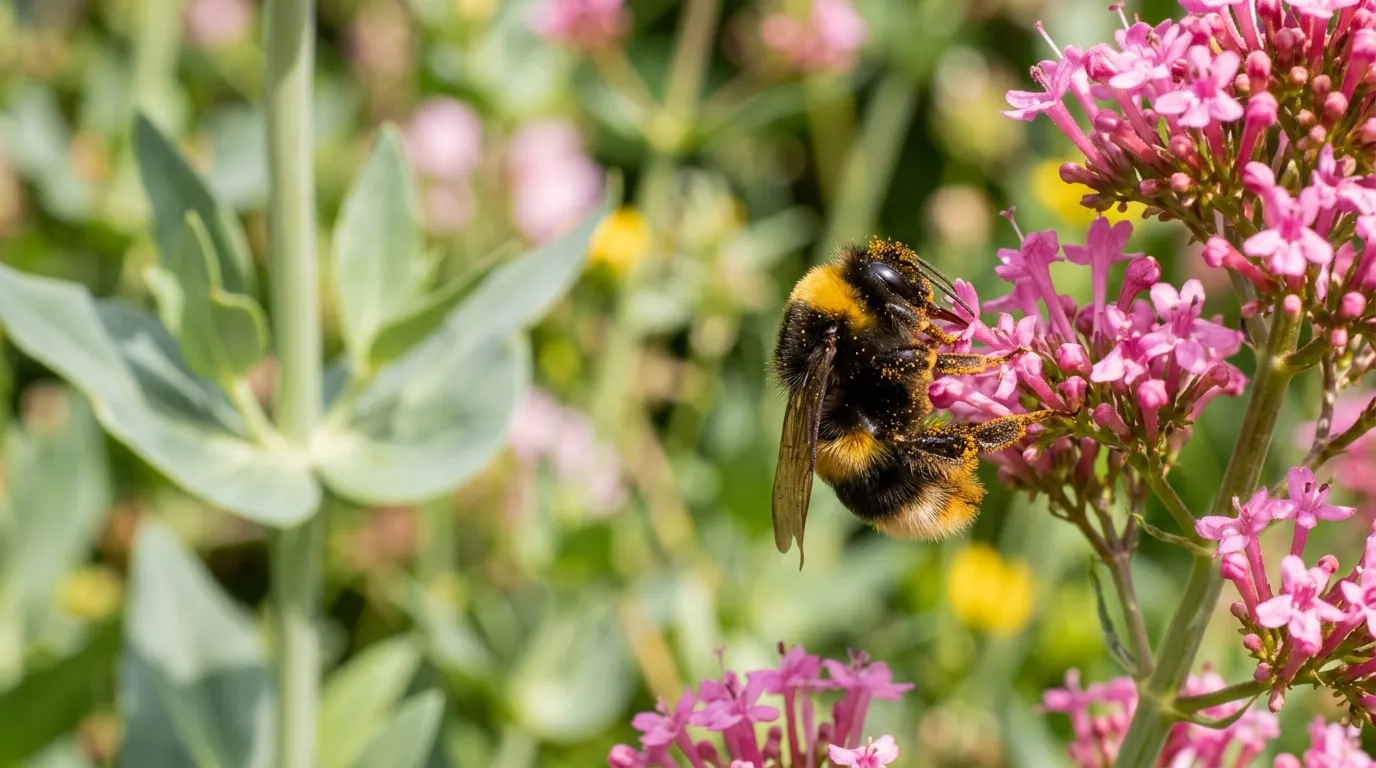 A bumblebee working red valerian. The long tubular flowers also draw the hummingbird hawk-moth on warm evenings.
Harvesting and drying valerian root
The medicinal root comes only from Valeriana officinalis, never from red valerian. This catches out beginners every year.
Lift the root in the second autumn, October or November, once the top growth dies back. First-year roots are too thin to bother with. Fork up the whole plant, shake off soil, and wash the pale root mass thoroughly under a hose. The fresh root has little smell. The strong, distinctive valerian odour develops as it dries.
Slice thick roots lengthways so they dry evenly. Dry at a steady 40C in a dehydrator or airing cupboard for 10 to 14 days, until the pieces snap cleanly. Do not exceed 40C, as higher heat drives off the active compounds. Store dried root in an airtight jar away from light.
The valerian growing calendar month by month
This calendar covers both species. Tasks marked C apply to Centranthus, V to Valeriana, and B to both.
| Month | Task |
|---|---|
| January | (B) Leave seed heads for birds, plan new positions |
| February | (V) Sow Valeriana indoors at 18 to 20C |
| March | (C) Sow Centranthus at 15 to 18C, barely covered |
| April | (B) Plant out young plants, grit the hole for Centranthus |
| May | (B) First Centranthus flowers open, mulch Valeriana |
| June | (B) Peak flowering begins, water Valeriana in dry spells |
| July | (C) Cut back first flush hard to trigger reflowering |
| August | (C) Deadhead two-thirds of seed heads to control spread |
| September | (B) Collect ripe seed of both for fresh sowing |
| October | (V) Lift second-year Valeriana root for drying |
| November | (V) Finish root lifting, divide old clumps |
| December | (B) Tidy dead stems, leave some standing for wildlife |
The two jobs that matter most are the August deadheading of Centranthus and the October root lift of Valeriana. Miss the deadheading and you get hundreds of seedlings. Miss the lift window and the root passes its best as the plant draws reserves down for winter.
Common mistakes UK gardeners make with valerian
Confusing the two species. This is the root error. People buy pink Centranthus expecting the medicinal root and get nothing usable. Or they plant Valeriana in a dry wall where it withers. Always check the Latin name on the label, not the common name.
Letting Centranthus seed everywhere. One plant sheds over 1,000 seeds a year. Left alone, red valerian colonises walls, paths, gravel and neighbouring plots within three years. The deep taproot makes mature volunteers hard to pull. Deadhead before August every year.
Feeding red valerian. Rich soil and feeding produce floppy, leafy plants with few flowers. Centranthus evolved on poor Mediterranean rock. Plant it lean, never feed it, and it flowers for months.
Growing Valeriana in dry soil. The medicinal species needs moisture to build root mass. In dry ground it stays small and the root yield collapses. If you want the harvest, give it damp, fertile ground or a bog edge.
Harvesting first-year root. New Valeriana roots are thin and give almost nothing. The plant needs a full second season to bulk up. Lift in the second autumn, not the first, for a worthwhile 80 to 150g yield.
Warning: Red valerian is listed as potentially invasive in some UK coastal areas where it crowds native wall flora. Deadhead diligently near old walls, cliffs and railway land. Never plant it where it can escape into protected habitats.
Wildlife value of both valerians
Both plants earn their place as nectar sources, though they pull different insects. This is where the shared name finally points to a shared strength.
Red valerian is one of the best nectar plants for the hummingbird hawk-moth, a day-flying migrant that hovers to feed. Its long tubular flowers suit long-tongued insects: hawk-moths, bumblebees, and the holly blue butterfly. The long flowering window, May to October, feeds pollinators well into autumn when other nectar runs short. For more butterfly nectar plants, see our guide to the best plants for butterflies.
Common valerian carries open, flat flower heads that suit shorter-tongued insects. Hoverflies, solitary bees and small beetles work it heavily. As a tall native it fits naturally into meadow and wild-edge plantings. Both species support the kind of layered planting found in a productive medicinal herb garden.
Garden Organic notes that long-flowering nectar plants like these bridge the late-summer gap when many garden flowers fade. Centranthus, flowering to October, is one of the most useful for that window. The Bumblebee Conservation Trust lists similar tubular flowers as priority forage for long-tongued bumblebees.
Companions and where each valerian fits
Pairing each species with the right neighbours makes both look intentional rather than weedy.
Red valerian sits beautifully in a hot, dry, gravel scheme. Pair it with catmint, lavender, sea holly and verbascum. The pink and crimson reads well against silver foliage. In a wall or paved gap it combines with erigeron and self-seeding poppies. It is a natural fit for a self-seeding cottage planting where you want plants to fill gaps on their own.
Common valerian belongs at the back of a damp border with other tall natives: meadowsweet, hemp agrimony, angelica and purple loosestrife. The white heads lift a green meadow planting and feed insects at the same time. It also suits a pond margin where the soil never dries.
What it adds up to
Two plants, one name, opposite needs. Get that straight and both are among the easiest things you can grow. Red valerian asks for a dry sunny wall and a yearly deadhead. Common valerian asks for damp fertile ground and patience for the second-year root. Neither needs winter protection in lowland Britain, and both feed pollinators from June onward.
The biggest win is matching plant to place. Put Centranthus where nothing else will flower and Valeriana where the soil stays moist. Do that, and the only real job left is keeping the red valerian seed in check before August.
For more on growing self-reliant perennials that fill gaps without fuss, browse the full plants section for guides on companions and conditions that suit both valerians.
Next step
Now you can tell the two valerians apart and grow each one well, read our guide to growing catmint for the perfect silver-leaved partner to red valerian in a hot, dry, pollinator border.
Our team produces practical UK gardening guidance from source research, contributor records and established horticultural practice. Editorial standards are overseen by Matt W.