Key takeaways
- Every part of Aconitum is toxic; the tuberous root holds the most aconitine
- As little as 2 to 6mg of pure aconitine can kill an adult
- Aconitine is fat-soluble and crosses unbroken skin, causing tingling in 30 to 60 minutes
- Nitrile gloves blocked sap in all 40 of our divisions; fabric gloves failed 6 times
- Fully hardy at RHS H7, down to about -20C, in moist soil and part shade
- Flowers June to October depending on species, at 0.9 to 1.5m tall
Why Aconitum is the most poisonous plant in British gardens
Aconitum is a genus of around 250 species in the buttercup family, Ranunculaceae. It sits on the Royal Horticultural Society’s list of potentially harmful garden plants in the top category, the one reserved for plants that can cause serious illness or death. Nothing else commonly sold for UK borders sits alongside it in quite the same way.
The active compound is aconitine, a diterpenoid alkaloid. It works on the voltage-gated sodium channels in nerve and heart muscle cells. Normally those channels snap shut milliseconds after firing. Aconitine binds to them and holds them open, so the cell cannot reset. The result is persistent depolarisation: nerves misfire, then stop responding, and the heart loses its rhythm.
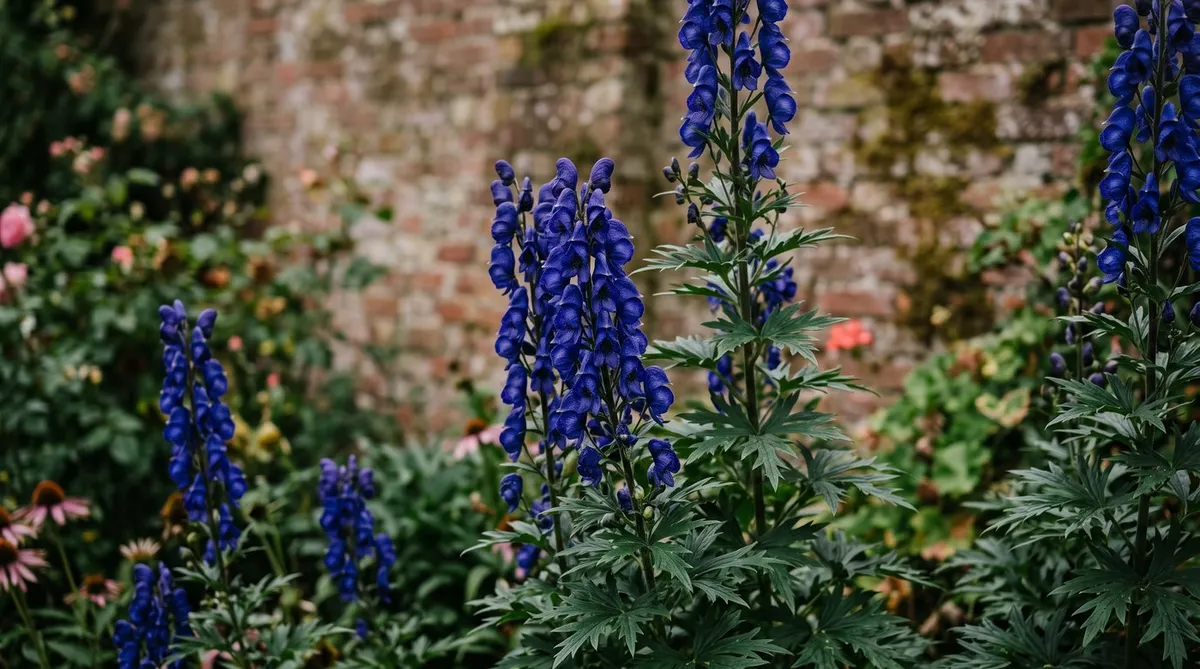
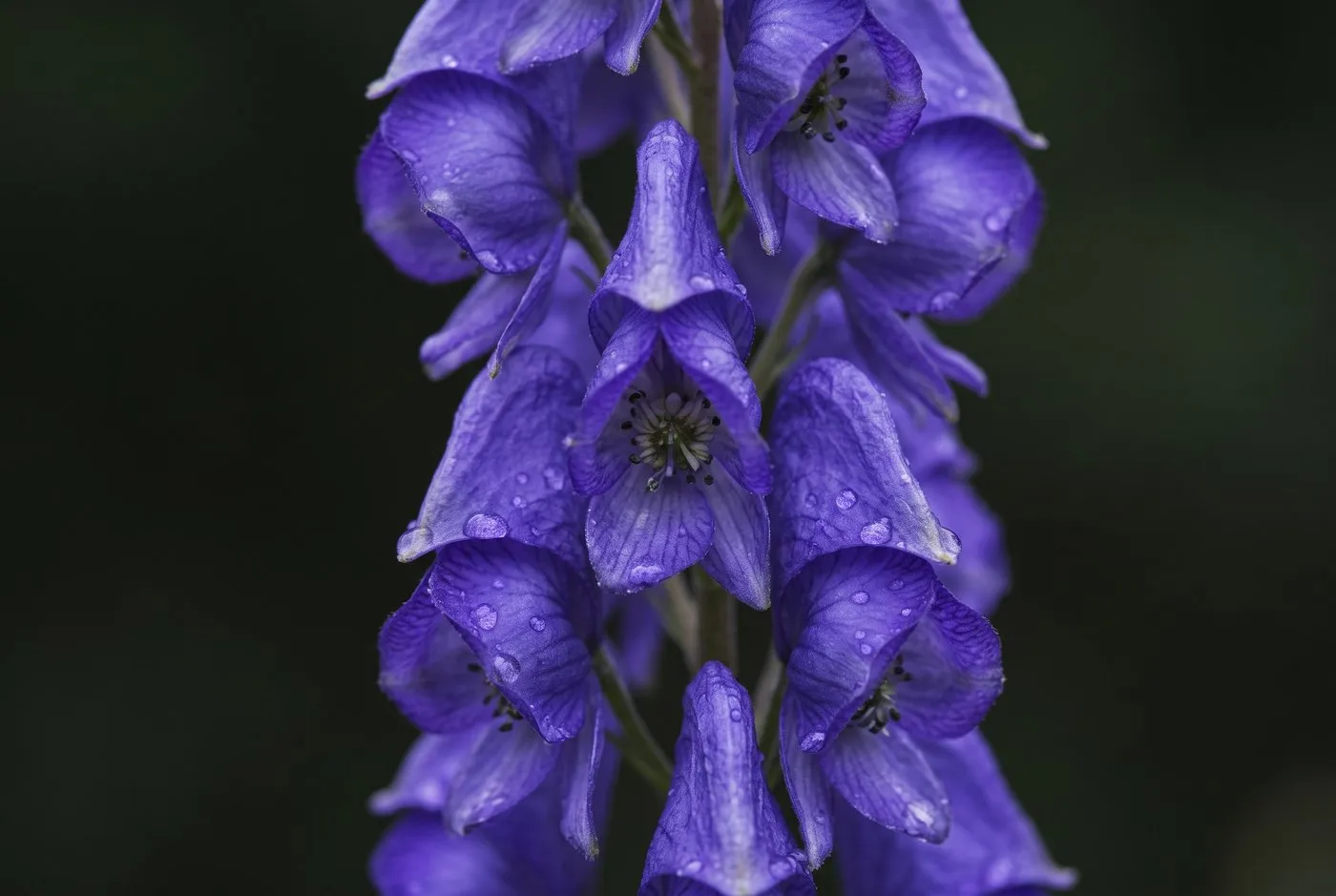 The hood is where the common name comes from. That helmet-shaped upper sepal covers two nectar spurs, and only a long-tongued bumblebee can reach inside.
Which parts of monkshood are toxic, and how to identify it
Every part of Aconitum is toxic, but not equally. The tuberous root is by far the strongest, holding roughly 0.3 to 2 percent aconitine alkaloids by dry weight. Seeds come next. Leaves and flowers are weaker but still dangerous in quantity. Sap concentration also rises through the growing season, peaking around flowering.
That root is the reason most serious poisonings happen. Aconitum tubers look uncomfortably like horseradish and are not far off a small Jerusalem artichoke. Recorded cases in Europe almost always trace back to somebody digging in a border and eating what they thought was a root vegetable. Never plant Aconitum within reach of a vegetable bed, and never leave lifted tubers in a bucket by the shed.
Identification above ground is straightforward once you know it. The leaves are dark green, deeply palmate and cut into five to seven lobes, each lobe further toothed. They look a little like a coarse buttercup leaf or a delphinium leaf. The flower is the giveaway: five sepals, with the upper one arched over into a helmet or hood about 20mm across. Delphiniums carry a backwards-pointing spur instead. If you want the safe blue spire, our guide to growing delphiniums in the UK covers a plant that gives similar height with far less to worry about.
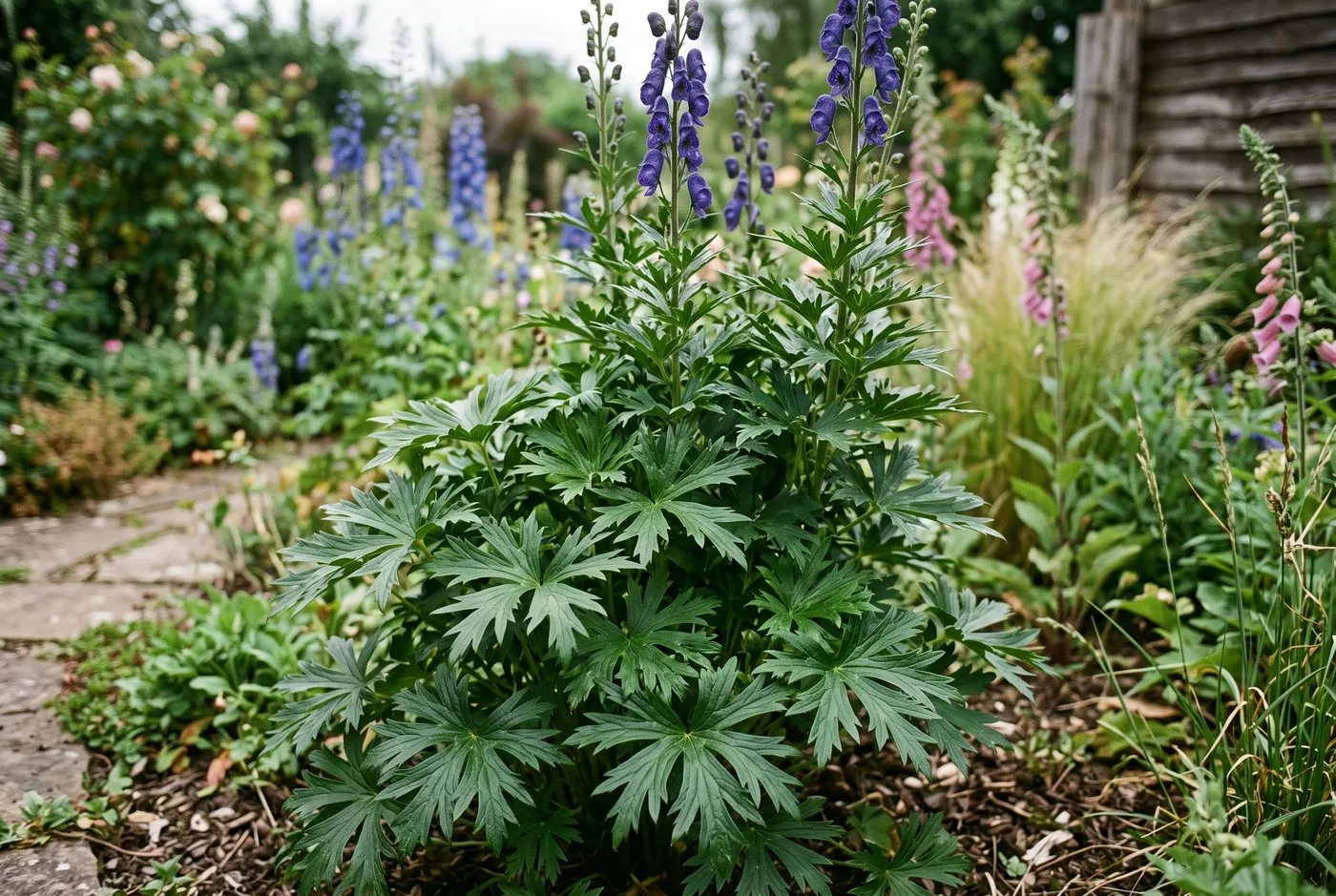 Aconitum foliage: dark, glossy and cut into five to seven toothed lobes. It emerges in March, weeks before any flower spike appears.
Planting monkshood: soil, depth and spacing
Aconitum wants what a woodland edge gives it: moisture-retentive, humus-rich soil and dappled or part shade. It grows in full sun only where the ground stays damp all summer. On a dry, hot, south-facing border it browns off by July and never really flowers. Our best plants sit in a north-east facing bed that gets sun until about 11am.
Plant bare-root crowns or 9cm pots in autumn (September to October) or early spring (March to April). Set the crown 5cm deep, no more, and space plants 45cm apart. Three plants in a triangle read far better than one lonely spire. Work in two buckets of garden compost or leaf mould per square metre first, especially on free-draining sand. Soil pH is not fussy: anything from 5.5 to 7.5 suits it.
Water new plants through their first two summers. An established clump in decent soil needs no feeding beyond an annual 5cm mulch of compost in March. Expect no flowers in year one from a small pot. Ours took two full seasons to reach a proper 1.2m spire. If the ground bakes dry, the plant simply goes dormant early and you lose the display. Our notes on improving clay soil apply in reverse here: clay’s water-holding is an advantage for Aconitum, not a problem.
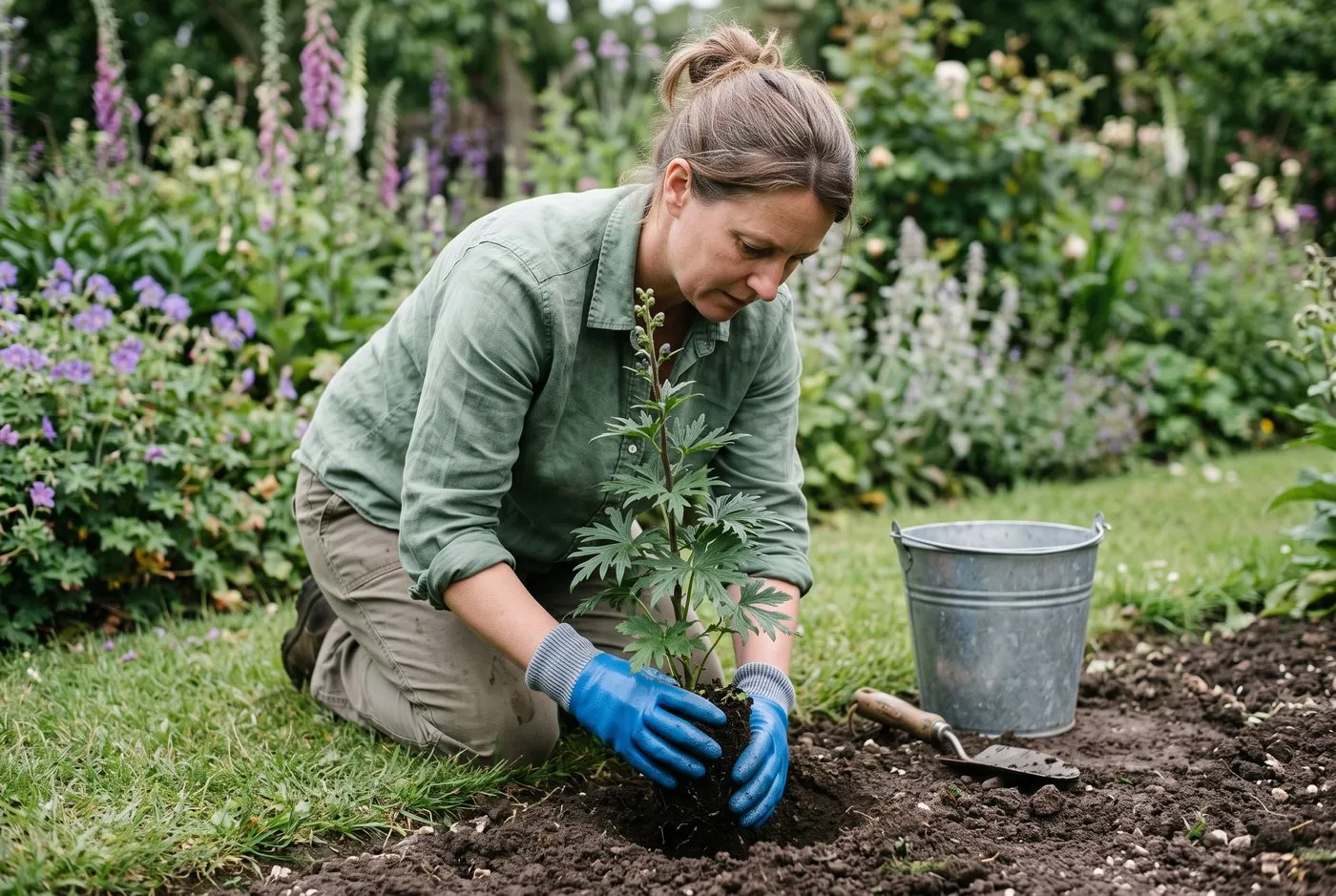 Crowns go in 5cm deep and 45cm apart, in autumn or early spring. Note the nitrile gloves. They go on before the plant leaves the pot, not after.
The glove protocol: handling Aconitum without absorbing aconitine
The pattern is blunt. Anything absorbent is worse than useless. A fabric glove picks sap up, presses it against your palm and keeps it there for the rest of the job. Leather does the same, more slowly. Only an impermeable barrier stops the alkaloid, and it must be changed before it splits.
 Long-cuff nitrile, long sleeves, and the crown handled over a tray rather than a bare hand. The gloves come off inside out and go in the bin.
Why gardeners get the “monkshood tingle” through their skin
The underlying cause of skin absorption is chemistry, not carelessness. Aconitine is lipophilic, meaning it dissolves readily in fats and oils. Your outer skin layer, the stratum corneum, is built from lipids. A water-soluble toxin would sit on the surface and wash off. A fat-soluble one moves straight through it.
This is why the effect is so often missed until it happens. Gardeners assume that intact skin is a barrier, because for most plant irritants it is. With Aconitum the sap crosses in 30 to 60 minutes and produces paraesthesia: tingling, then numbness, usually in the fingertips and sometimes spreading to the lips. Cuts, cracked winter skin or a fresh scratch shorten that to minutes and raise the dose.
Permanent prevention is not a stronger wash. It is never letting the sap contact skin in the first place. Three habits do it. Use an impermeable glove for every job that breaks plant tissue. Wear long sleeves when cutting back, since forearms take splash. Wash tools, secateurs and the fork with hot soapy water afterwards, because sap dries on a blade and rewets on the next damp morning.
If sap touches your skin: what to do in the first hour
Act on contact, not on symptoms. The sequence matters, and it is short.
- Stop the job. Peel gloves off inside out. Do not touch your face, eyes or mouth with anything.
- Wash properly. Soap and warm water, working over the area for a full three to five minutes. Soap matters because it lifts a fat-soluble alkaloid; cold water alone will not.
- Change clothing if sap has soaked a cuff or sleeve, and wash it separately.
- Ring NHS 111. They can contact the National Poisons Information Service, which holds the UK toxicology data on Aconitum. Say clearly that it is aconite or monkshood.
- Watch for two hours. Fingertip tingling alone is common and usually settles. Nausea, vomiting, dizziness, chest tightness or a fluttering heartbeat mean A and E now, not later.
The critical mistake most people make is treating tingling as the end of it and carrying on gardening. The dose keeps building while sap stays on skin. If you have had one contact and keep working in the same gloves, you are simply reapplying it.
Warning: Never burn Aconitum prunings on a bonfire, and never put the stems through a shredder. Aconitine is not destroyed by drying and the fine dust from a shredder is easily inhaled. Bag the top growth and put it in the council green waste, where it is composted at temperatures well above anything a garden heap reaches.
Where to site Aconitum safely around children and pets
Siting does more for safety than any glove. Aconitum belongs at the back of a border, behind at least 60cm of other planting, with no path, lawn edge or seat within arm’s reach. Height helps here: at 0.9 to 1.5m the flowers sit above a small child’s eye line, and the interesting part, the root, stays buried.
Three rules cover almost every risk in a family garden. Keep it out of the vegetable plot and away from anywhere roots get lifted, because root confusion causes the serious cases. Keep it away from digging dogs, which means not in a raised bed a terrier can reach or at the edge of a run. And do not plant it where cut flowers get picked, because a child picking a posy handles broken stems directly.
Dogs and cats rarely eat it. The plant is bitter and both usually spit it out, which is why recorded pet poisonings are uncommon in the UK. Even so, a dog that digs is a different problem to a dog that grazes. Our guides to plants toxic to dogs and to designing a children’s garden both set out how to zone a garden so the risky planting sits where nobody goes barefoot. If you would rather avoid the question entirely, the poisonous garden plants guide lists what else in a typical border deserves the same care.
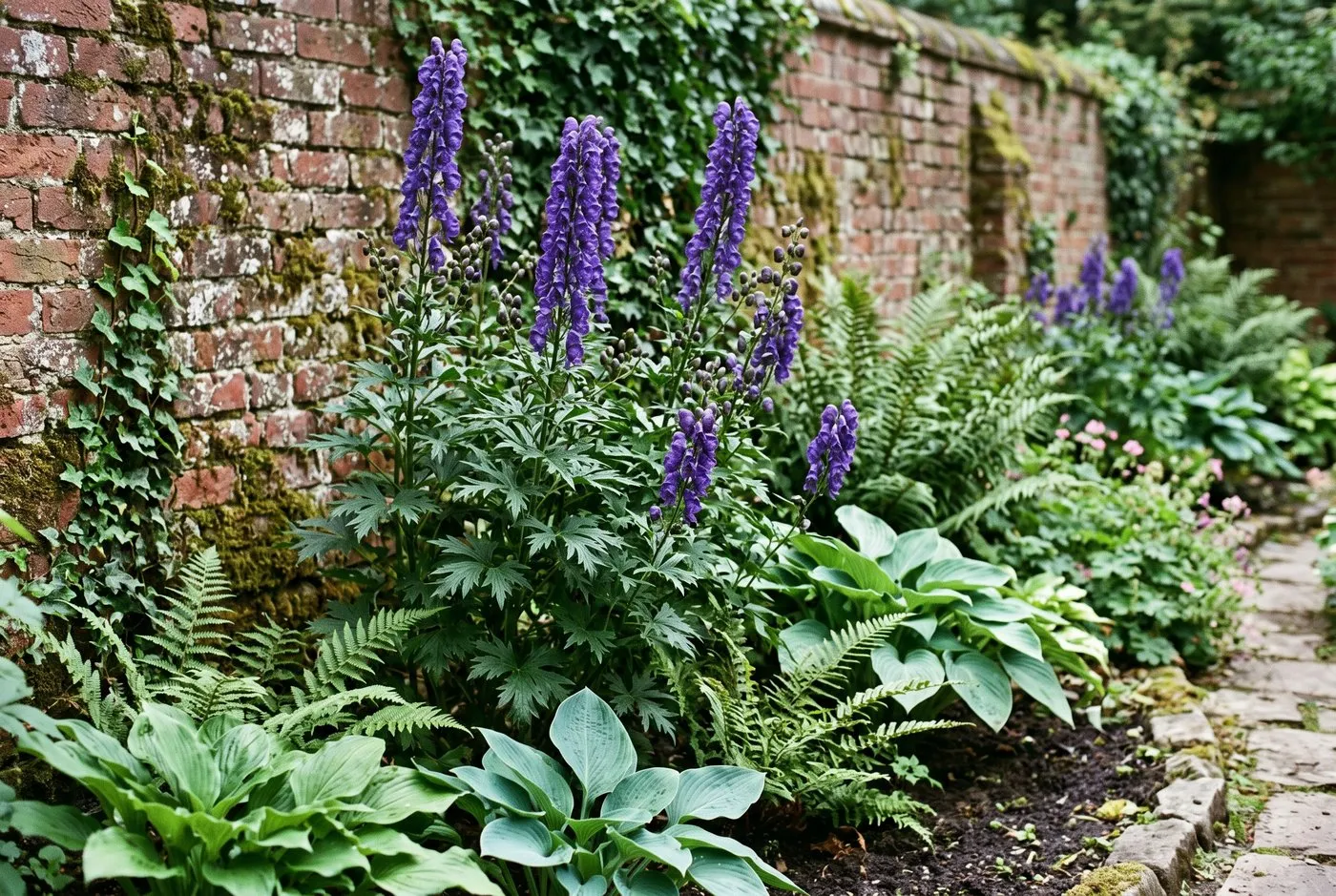 Sited properly: monkshood at the back of a damp, part-shaded border with 60cm of planting in front of it and no path within reach.
Which Aconitum to grow: species and cultivars compared
A. carmichaelii ‘Arendsii’ is the one we would plant if we could only have one. It holds an RHS Award of Garden Merit, it flowers in September and October when the border is thinning out, and its stems are stiff enough to stand a Midlands gale unaided. Expect to pay £8 to £12 for a 2-litre pot, or £4 to £6 for a bare-root crown in autumn.
A. lycoctonum subsp. vulparia is the true wolfsbane, the yellow-flowered species once used to bait wolves. It is a curiosity rather than a border workhorse: the stems flop, and it needs a shrub to lean on.
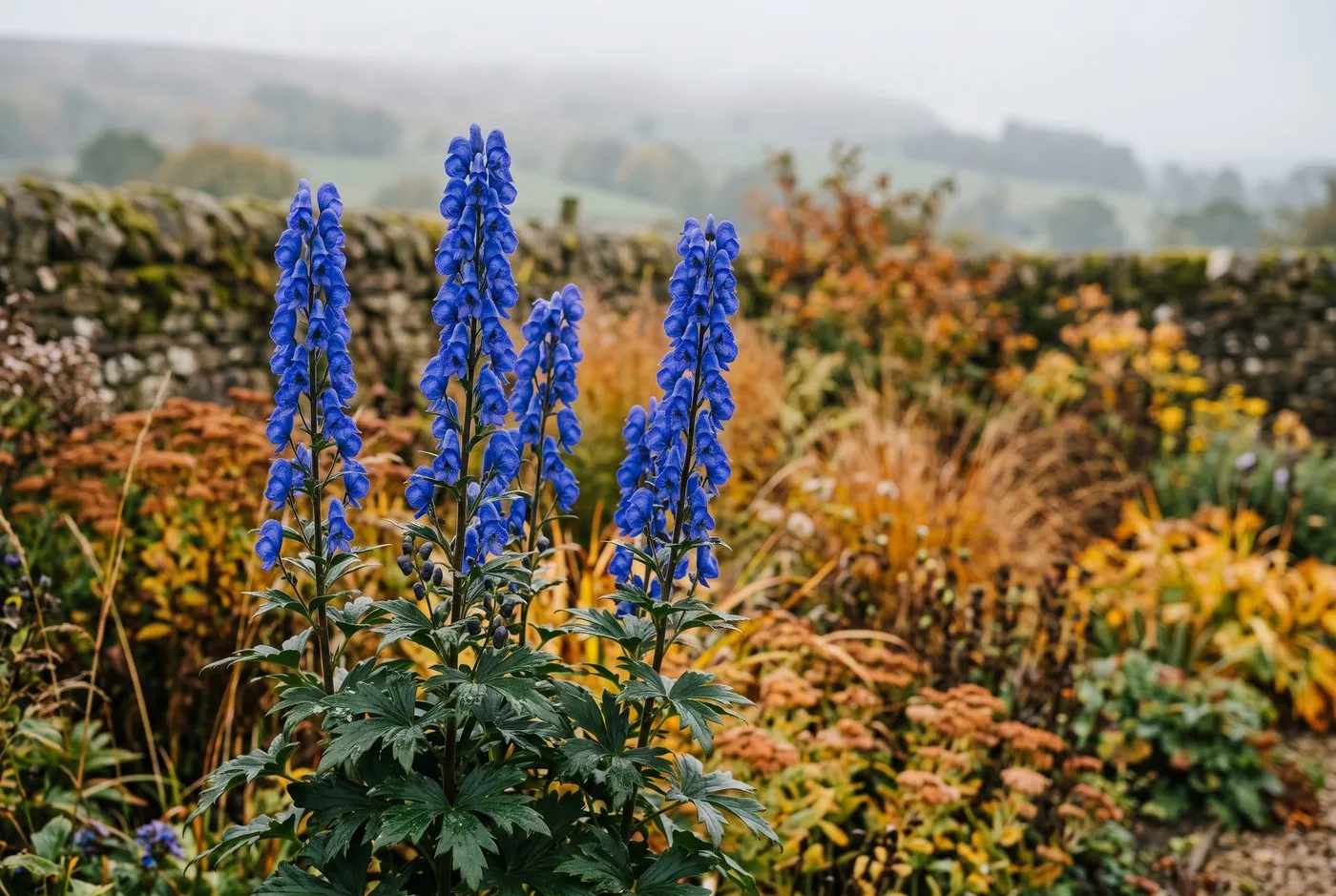 Aconitum carmichaelii ‘Arendsii’ in early October. It carries the border for six weeks after most perennials have finished, and stands up without a stake.
Staking, feeding and dividing without poisoning yourself
Most Aconitum need support, and the time to give it is April, not July. Push in three canes or a grow-through ring at 60cm while the shoots are 20cm high. Stems that grow up through a support look natural. A stem tied in after it has flopped never straightens. Our advice on staking tall perennials applies directly, with one difference: never handle Aconitum stems barehanded when tying in.
Feeding is light work. A 5cm mulch of garden compost each March is enough on decent soil. High-nitrogen feed produces soft, sappy growth that flops badly, particularly on A. napellus. Skip the growmore.
Divide clumps every three to four years in autumn, once flowering finishes. Lift the whole crown, wash the soil off with a hose so you can see the tubers, and pull the clump apart by hand into pieces with two or three growth buds each. Gloves on from start to finish. Replant immediately at 5cm deep. Vine weevil grubs occasionally eat the tubers in pots, and powdery mildew shows on the leaves in a dry August, which is another reason not to let the ground bake.
Month-by-month Aconitum calendar
| Month | Task |
|---|---|
| January | Fully dormant. Nothing to do. Check labels are still legible so nobody digs it by mistake. |
| February | Order bare-root crowns for spring delivery. Clear old mulch off the crown so shoots come through cleanly. |
| March | Shoots emerge. Apply a 5cm compost mulch, keeping it clear of the crown itself. Slug patrol starts now. |
| April | Insert canes or grow-through supports at 60cm while shoots are 20cm tall. Plant new spring crowns. |
| May | Growth speeds up. Water in dry spells; a dry May shortens the flowering season badly. |
| June | A. napellus opens its first spires. Check supports before any windy spell. |
| July | Peak flowering for napellus, ‘Bicolor’ and ‘Spark’s Variety’. Deadhead spent spikes to prompt side shoots. |
| August | Watch for powdery mildew in dry weather. Water deeply once a week rather than daily sprinkles. |
| September | A. carmichaelii takes over. Lift and divide older clumps now, in nitrile gloves. |
| October | Best month for carmichaelii. Plant new bare-root crowns 5cm deep, 45cm apart. Collect no seed unless you label it clearly. |
| November | Cut stems back to 10cm with secateurs on a still day. Bag prunings for council green waste. |
| December | Dormant. Mulch bare crowns lightly on very free-draining soil. Wash and dry tools used on the plant. |
Why monkshood is still worth its place
None of this is an argument against growing it. Aconitum does two things almost nothing else does. It flowers well in damp part shade, where most tall spires refuse, and A. carmichaelii carries strong blue into October when the border has gone to seedheads and rust. Getting that colour, at that height, at that time of year, from a plant that needs no annual lifting, is rare.
Pair it with plants that share the same damp, part-shaded ground. Hostas and ferns in front hide the lower stems, which go bare by August. Japanese anemones flower at the same October moment in soft pink and white against the violet. For a fuller planting list for that difficult half-lit ground, our best plants for shade guide sorts the options by how much light they genuinely tolerate.
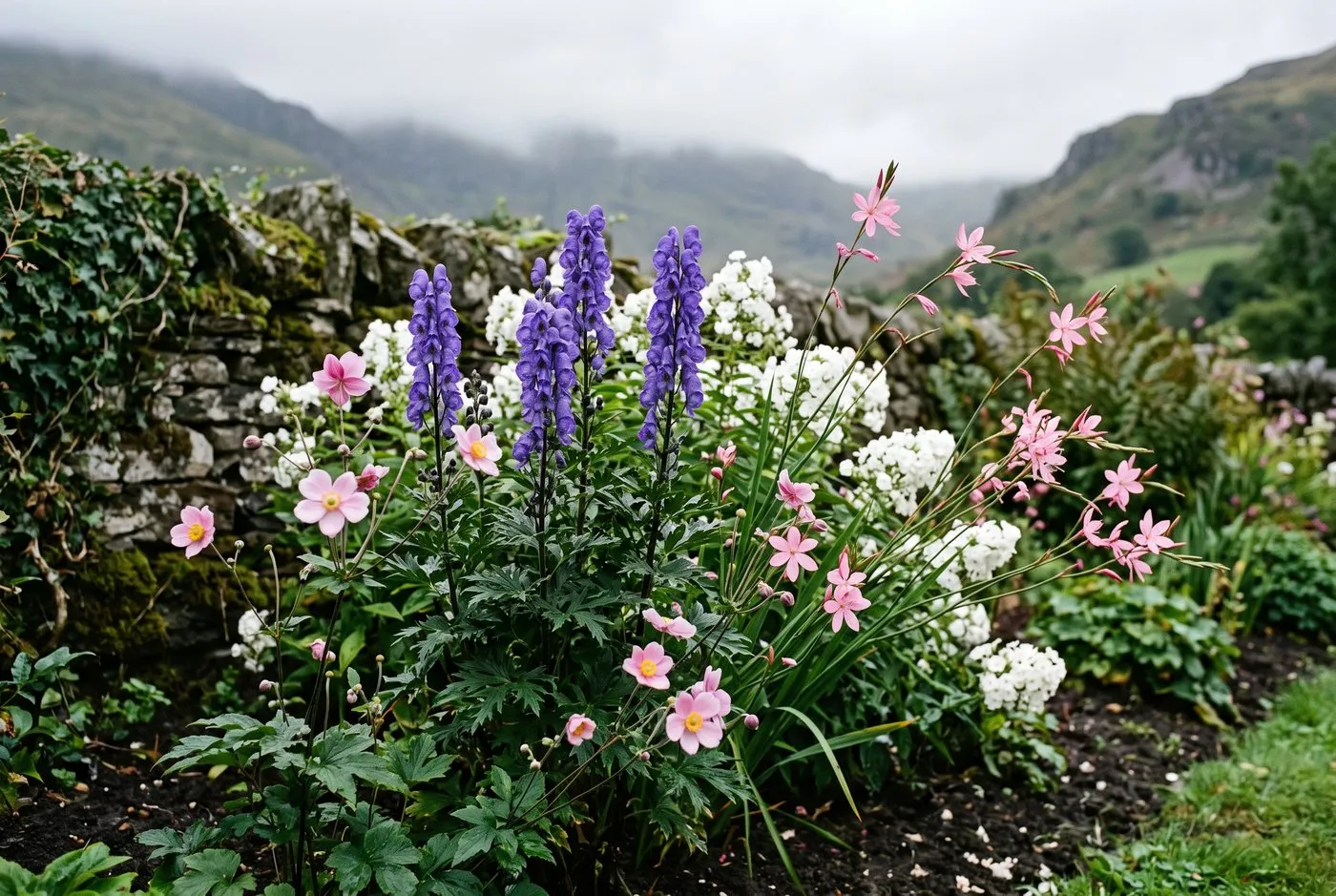 Monkshood earning its place in October, with Japanese anemones and hostas covering the bare lower stems. A tabby cat has claimed the warm flagstone in front.
Common mistakes when growing Aconitum
- Using fabric gloves. They absorb sap and hold it against your palm. Six of our 18 fabric-glove jobs produced tingling. Use disposable nitrile and change it between plants.
- Planting it in a dry, sunny border. Aconitum browns off and stops flowering in dry heat. It wants moisture-retentive soil in dappled or part shade. A south wall is the wrong place.
- Growing it near the vegetable patch. The tuber resembles horseradish closely enough to cause serious accidents. Keep at least a full bed between them, and never store lifted tubers loose.
- Staking too late. Support goes in during April at 60cm, while the shoots are 20cm high. A stem tied up after it has flopped in July stays kinked for the rest of the season.
- Shredding or burning the prunings. The alkaloid survives drying and the dust is inhalable. Cut low with secateurs, bag it, and send it to council green waste.
Now you know how to grow and handle Aconitum safely, read our guide to the best autumn flowers for UK gardens for partners that flower alongside it in October. You can also browse our full range of plant growing guides for more border ideas.
Frequently asked questions
Is Aconitum poisonous to touch?
Yes, aconitine can pass through unbroken skin from cut sap. Brief contact with an intact leaf rarely does harm. The risk comes from broken stems, crushed foliage and freshly lifted roots, where sap is exposed. Wear nitrile gloves for any cutting, dividing or weeding around the plant.
Which part of monkshood is the most poisonous?
The tuberous root is the most poisonous part of monkshood. It carries roughly 0.3 to 2 percent aconitine alkaloids by dry weight, several times the concentration in leaves. Seeds come second. Leaves and flowers are toxic but weaker. Never lift or divide the crown without gloves.
Should I grow Aconitum if I have children or a dog?
You can, but site it at the back of a border behind other planting. Keep it well away from paths, lawns, play areas and anywhere a dog digs. The bigger risk is the root, so avoid growing it near a vegetable bed where roots get lifted and eaten by mistake.
What happens if you get Aconitum sap on your skin?
Most people get tingling or numbness in the fingertips within 30 to 60 minutes. Remove gloves, wash the area with soap and warm water for several minutes, then rinse. Ring NHS 111 for advice. Go to A and E if you feel nausea, dizziness or an irregular heartbeat.
When does monkshood flower in the UK?
Aconitum flowers from June to October depending on the species you grow. Aconitum napellus opens in June and July. Aconitum carmichaelii carries the show into September and October. Growing both gives you hooded blue spires across five months of the year.
Where should you plant Aconitum in a UK garden?
Plant Aconitum in moisture-retentive soil in dappled or part shade. It hates dry, hot spots and sulks against a south-facing wall. A north or east-facing border with humus-rich soil suits it best. Set crowns 5cm deep and space them 45cm apart at the back of the planting.
Is Aconitum the same as wolfsbane?
Yes, wolfsbane is an old common name for Aconitum, alongside monkshood. The name came from using the root to poison wolves. Some gardeners reserve wolfsbane for the yellow-flowered Aconitum lycoctonum. Both names describe the same genus in the buttercup family, Ranunculaceae.
Our team produces practical UK gardening guidance from source research, contributor records and established horticultural practice. Editorial standards are overseen by Matt W.