Key takeaways
- There are 13 RHS daffodil divisions, and Divisions 1 to 3 are separated by cup length alone, not colour or size
- Division 1 is a cup equal to or longer than the petals; Division 3 is a cup under one third of petal length
- Division 6 (Cyclamineus) scored best for naturalising in grass, up 214% in clump count over six years
- Division 4 (Double) was the worst in grass at 61% of the original count, because wet heads snap the stems
- UK flowering runs late January ('Rijnveld's Early Sensation') to mid-May (Division 9 Poeticus), about 15 weeks
- 'Tete-a-Tete', the best-selling daffodil in Britain, is Division 12, the catch-all for cultivars that fit nowhere else
Daffodil types are easier to read than tulips once you know the trick, and the trick is a ruler. The first three RHS divisions, which cover most daffodils sold in Britain, are separated by one measurement and nothing else: how long the cup is compared to the petals. Not colour, not size, not height. Cup length.
This guide covers all 13 divisions in a single table rather than the five thin pages most sites split them across. It also carries something the reference sites do not have: naturalising scores from 650 bulbs planted into Staffordshire grass in 2020, with flowering clumps counted every April since. The divisions behave very differently in turf, and the ranking is not the one the catalogues imply.
How the RHS divides 32,000 daffodils into 13 groups
The RHS holds the International Daffodil Register and sets this classification for the whole world. More than 32,000 cultivars are registered. Thirteen divisions keep that manageable.
The system uses three different sorting rules, which is why it confuses people. It is not one logic applied thirteen times.
Divisions 1, 2 and 3 sort by measurement. One flower per stem, and the cup length against the petal length decides everything. The botanical terms are corona for the cup and perianth segments for the petals.
Divisions 5 to 10 sort by ancestry. Each one is named for the wild species whose character dominates: N. triandrus, N. cyclamineus, N. jonquilla, the Tazettas, N. poeticus, N. bulbocodium.
Divisions 4, 11, 12 and 13 sort by everything else. Doubling, a split cup, misfits, and the wild species themselves.
The measurement rule is worth learning properly, because it settles most arguments in a garden centre.
| Division | Cup against petals | What you see |
|---|---|---|
| 1, Trumpet | Cup equal to or longer than petals | Classic long trumpet |
| 2, Large-cupped | Cup more than one third, less than petal length | Medium cup, most common form |
| 3, Small-cupped | Cup not more than one third of petal length | Shallow cup, almost a disc |
| 9, Poeticus | Cup not more than one fifth, petals pure white | Tiny red-rimmed eye |
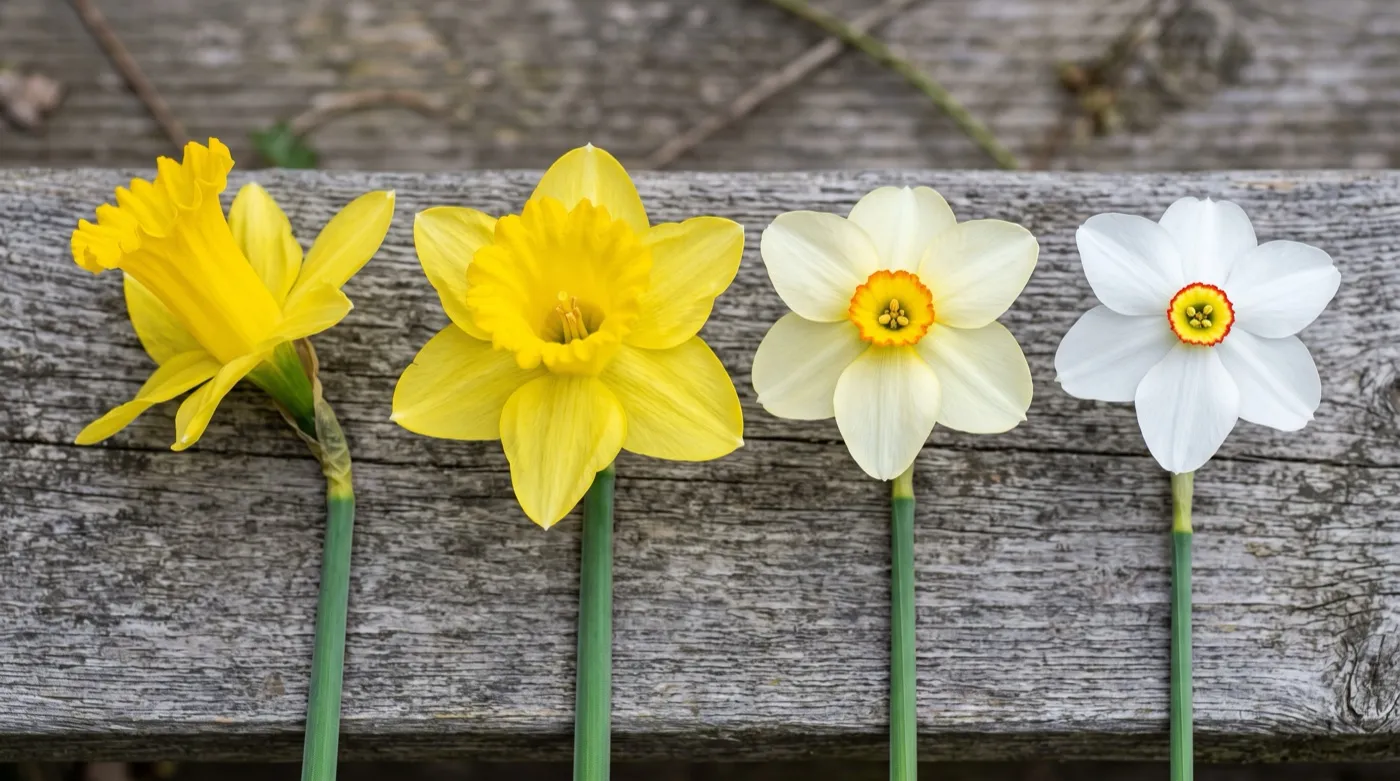 The cup ratio is the whole of Divisions 1 to 3. Hold a flower up and compare cup to petal, and the division reads off in a second.
The 13 daffodil divisions in one table
Divisions 1 to 3: trumpets, large cups and small cups
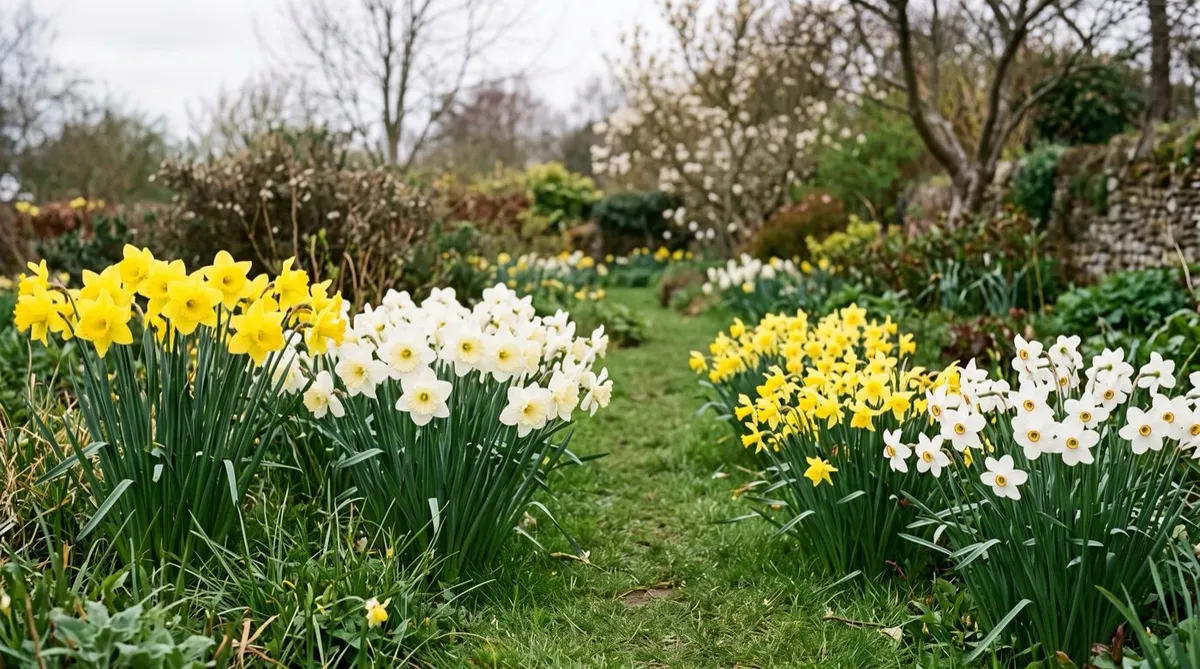
Division 1, Trumpet. One flower per stem, cup equal to or longer than the petals, on 35-45cm stems in March and April. This is the daffodil a child draws. ‘King Alfred’ is the name everyone knows, though almost everything sold as King Alfred today is actually ‘Dutch Master’ or ‘Golden Harvest’. The true 1899 cultivar is nearly gone from commerce. Division 1 naturalises well at 186% and is the right choice for big yellow drifts.
Division 2, Large-cupped. Cup more than a third of petal length but shorter than the petals. This is the biggest division in commerce and where most bicolours live. ‘Carlton’ alone is thought to be the most widely planted daffodil cultivar on earth, and it is what most commercial narcissus fields are growing. 35-50cm, March to April, 138%.
Division 3, Small-cupped. Cup no more than a third of the petals, so it reads as a shallow saucer. This is where the sharp white-and-orange combinations sit, such as ‘Barrett Browning’. They flower slightly later, in April, at 35-45cm, and hold at roughly break-even in grass at 106%.
Division 4: why Double daffodils fail in grass
Doubles get their own section because they are the division that most often disappoints, and the reason is mechanical rather than mysterious.
Division 4 has extra petals, or an extra cup, or both. ‘Cheerfulness’, ‘Tahiti’ and ‘Rip van Winkle’ are the familiar ones. They are heavy. A wet double head on a 40cm stem holds water like a sponge, and in a normal British April that stem goes over.
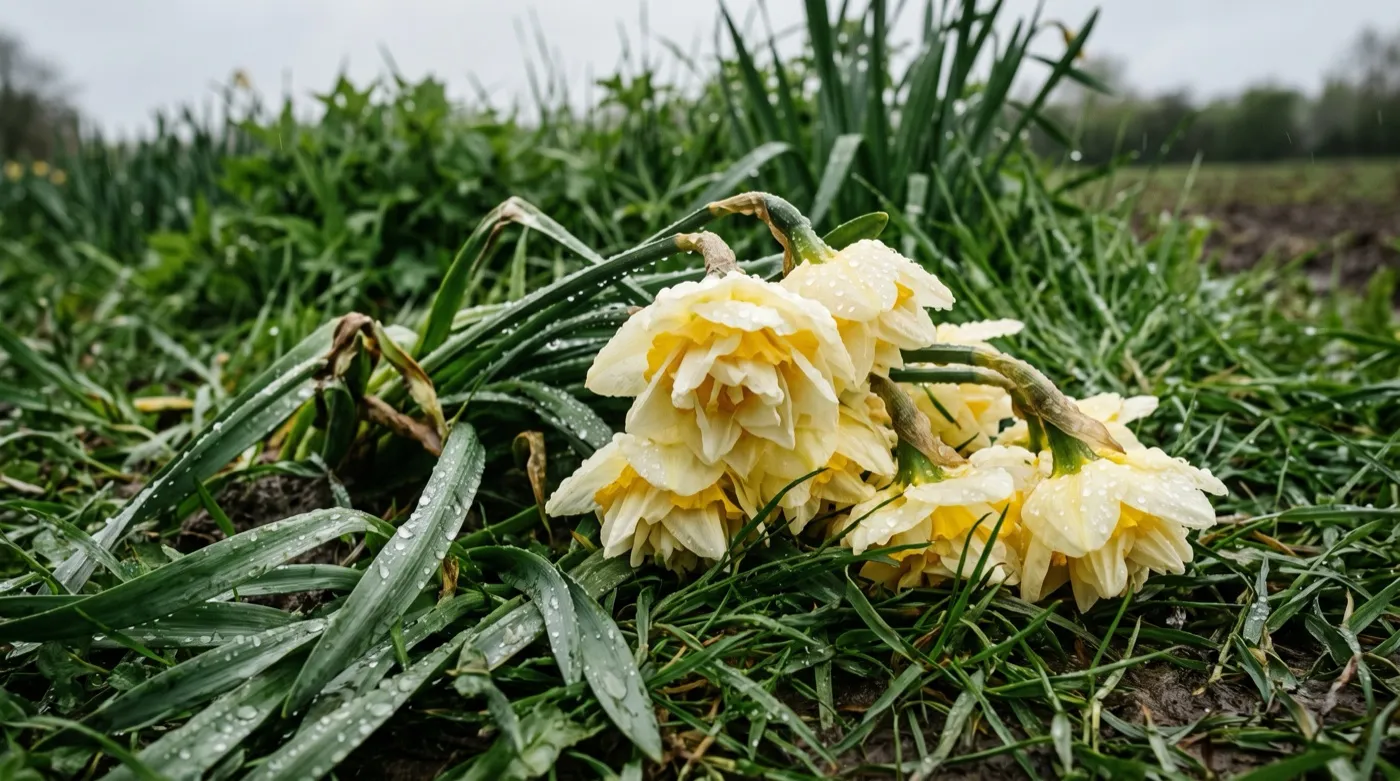 Division 4 after an April downpour. The head holds water, the stem goes over, and the leaves spend six weeks flat in wet grass instead of feeding the bulb.
The same bulbs in a sheltered border did far better. Our border row of ‘Tahiti’ is at roughly 140% after six years, because the wind never gets at it and the stems stay upright. Division 4 is not a bad daffodil. It is a bad grass daffodil.
Warning: Never mow daffodil foliage until at least six weeks after the last flower fades, and ideally not until the leaves yellow naturally. Cutting green leaves in early May is the single biggest cause of daffodil blindness. The bulb builds next year’s flower during those six weeks. Our guide to daffodil blindness and why bulbs stop flowering works through the other causes.
Divisions 5 to 7: Triandrus, Cyclamineus and the scented Jonquils
Division 5, Triandrus. Two or more nodding flowers per stem, petals swept back. ‘Thalia’ is the famous one, a pure white at 30-35cm that looks better than almost anything else in a shady spring border. April, 124%.
The reason they win is timing, not vigour. They flower in February and March, finish flowering by late March, and complete their six-week feed by mid-May. The grass has barely started. By the time you make the first cut in June, the leaves have already done their work and yellowed. Every later division is still feeding when the mower arrives.
Division 7, Jonquilla and Apodanthus. One to five flowers per stem, narrow rush-like leaves, and the best scent in the genus after Poeticus. ‘Pipit’ and ‘Sweetness’ are worth planting by a path for that reason alone. 20-35cm, April, 164%.
Divisions 8 to 10: Tazettas, Poeticus and the hoop petticoats
Division 8, Tazetta. Three to twenty flowers on one stout stem, broad leaves, heavy scent. This division includes the earliest daffodil in Britain: ‘Rijnveld’s Early Sensation’ can open in late January in a mild south-western garden. It also includes the paperwhites grown indoors and ‘Grand Soleil d’Or’, a Scilly Isles crop.
Tazettas are the least hardy division, which is why they scored 74% on a Staffordshire slope. In Cornwall or the Isles of Scilly they thrive. If you want them here, grow them in pots. Our guide to forcing paperwhite narcissi indoors covers the indoor route.
Division 9, Poeticus. Pure white petals, and a cup no more than one fifth of petal length, usually green and yellow with a red rim. ‘Actaea’ is the one to buy. They are the last daffodil of the year, opening in May, because N. poeticus evolved in southern European alpine meadows with late snowmelt. They are also the most powerfully scented. 142%.
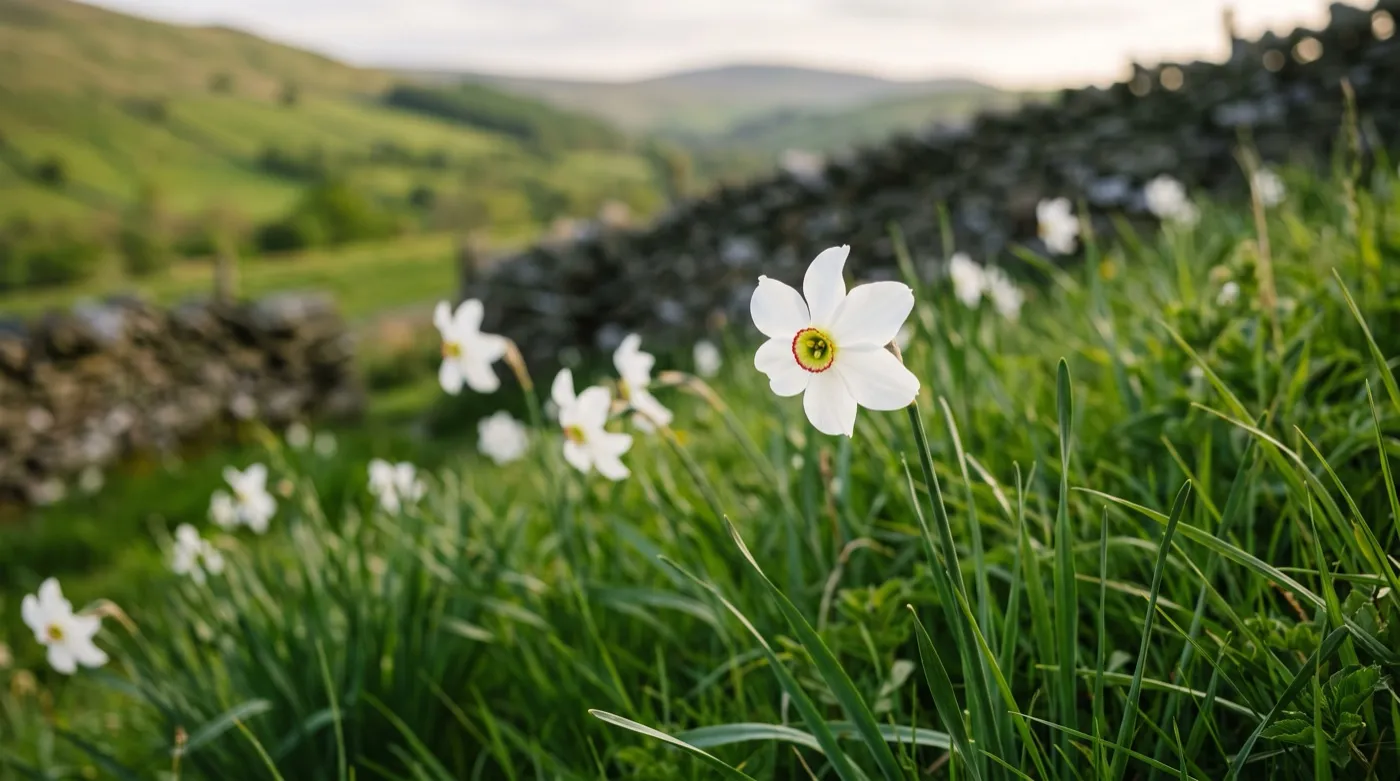 Division 9 in the first week of May, four months after the first Tazettas. The 15-week daffodil season is real if you plan for it.
Divisions 11 to 13: split cups, the misfits and the wild species
Division 11, Split-corona. Recognised since 1975. The cup is split for more than half its length and lies flat back against the petals, producing a flat face that some people love and others think looks broken. Two subdivisions: 11a Collar, where the cup segments sit behind the petals, and 11b Papillon, where they alternate between them. ‘Cassata’ and ‘Orangery’ are the ones you will find. 68% in grass.
Division 12, Other Cultivars. The honest catch-all for daffodils whose parentage fits no single division. Its most famous member is ‘Tete-a-Tete’, the best-selling daffodil in Britain by a wide margin. It looks like a Cyclamineus, but it carries Tazetta blood, so the RHS puts it here. ‘Jumblie’ and ‘Quail’ are the same story.
Division 13, Species. Wild daffodils and natural hybrids, named by botanical name only. This includes the native British wild daffodil, Narcissus pseudonarcissus, the Lent lily, which still carpets Farndale in North Yorkshire and the Gloucestershire golden triangle each March. It also includes N. obvallaris, the Tenby daffodil of south Wales, at 25cm.
At 268%, Division 13 was the second-best naturaliser. It is also the right thing to plant if you want daffodils that belong in a British hedge bottom rather than looking like municipal bedding. The Wildlife Trusts’ guide to wild daffodils explains where the surviving native populations are.
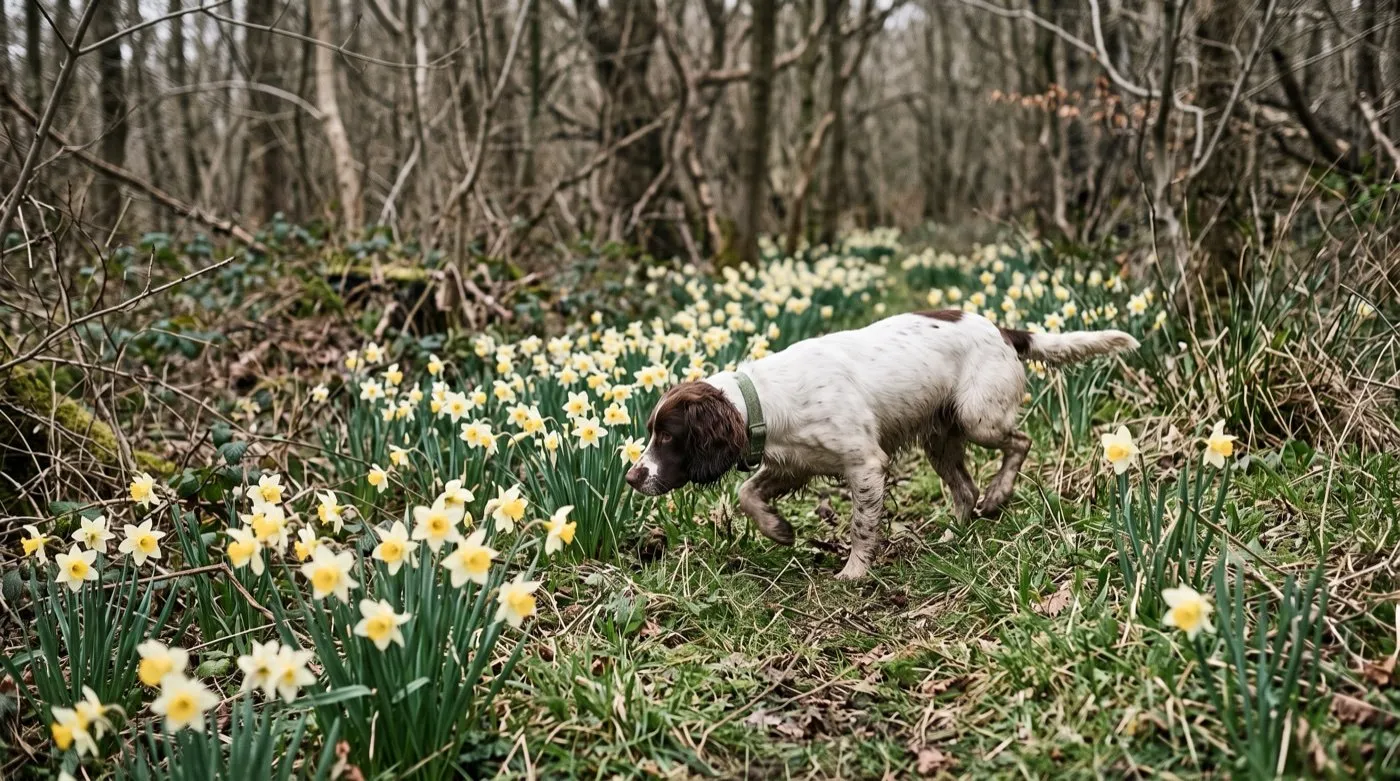 The native Lent lily, Division 13. Smaller and paler than a garden trumpet, at 20-25cm, and it spreads by seed as well as by offset.
The root cause of daffodil decline in grass
Most advice blames poor soil or old bulbs. Both are usually wrong. The real cause is a timing collision between the bulb’s feeding window and the mower, and the division you chose decides whether that collision happens.
A daffodil builds next year’s flower bud inside the bulb during the six weeks after flowering ends. The leaves are doing that work. Cut them, flatten them or shade them in that window and the bud does not form. The bulb still lives, still makes leaves next spring, and never flowers again. That is daffodil blindness, and it is a manufactured problem.
Now map it against the calendar. A Division 6 Cyclamineus finishes flowering in late March, so its window closes around mid-May. Grass growth in most of Britain gets going through late April. The first realistic cut on rough grass is June. Division 6 has already finished.
A Division 4 Double or a Division 11 Split-corona finishes flowering in late April. Its window closes in mid-June. The grass is 40cm tall by then and you either mow through the feeding window or leave the lawn wrecked until July. Most people mow.
The permanent fix is choosing an early division, not mowing later. Plant Divisions 6, 13 and 1 in turf and the conflict disappears, because the plant is finished before you need the mower. Keep Divisions 4 and 11 for borders and pots where no mowing happens. The full method for naturalising bulbs in grass covers the scatter technique and the mowing schedule, and our roundup of daffodil myths worth ignoring deals with leaf-tying and other folk fixes.
Daffodil division calendar month by month
| Month | What to do |
|---|---|
| January | Earliest Tazettas (‘Rijnveld’s Early Sensation’) open in mild gardens. Order for autumn. |
| February | Division 6 and Division 10 start. ‘February Gold’ opens here in the third week. |
| March | Peak of Divisions 1, 6 and 13. The native Lent lily flowers in Farndale now. |
| April | Divisions 2, 3, 5, 7 and 11. The broadest month by a distance. |
| May | Division 9 Poeticus closes the season. ‘Actaea’ in the first week. |
| June | Do not mow. Leaves are still feeding. Deadhead spent flowers to stop seed set. |
| July | Leaves yellow and pull away. First safe mow on naturalised grass. |
| August | Lift and divide congested clumps now. Replant immediately, never store dry. |
| September | The main planting month. Six weeks earlier than tulips. 10-15cm deep. |
| October | Last good window. Later planting means shorter roots before frost. |
| November | Plant containers only. Border planting is late but usually survives. |
| December | Too late. Buy nothing at half price now; the bulbs are exhausted. |
That September planting date is the biggest practical difference between daffodils and tulips, and it catches people every year. Daffodil roots need warm soil to establish. Our guide to daffodil bulb planting times sets out the temperature reasoning, and the general daffodil growing guide covers division, feeding and container work.
Common mistakes when choosing daffodil types
Picking a division for the job in front of you
For rough grass and orchards: Divisions 6, 13 and 1. Early flowering means the feeding window closes before the mower comes out.
For borders: Divisions 2, 3, 5 and 7. Reliable, upright, and the scent of Division 7 near a path is worth the space.
For pots: Divisions 12, 10 and 8. ‘Tete-a-Tete’ is the best pot daffodil there is, and the hoop petticoats get the sharp drainage they want.
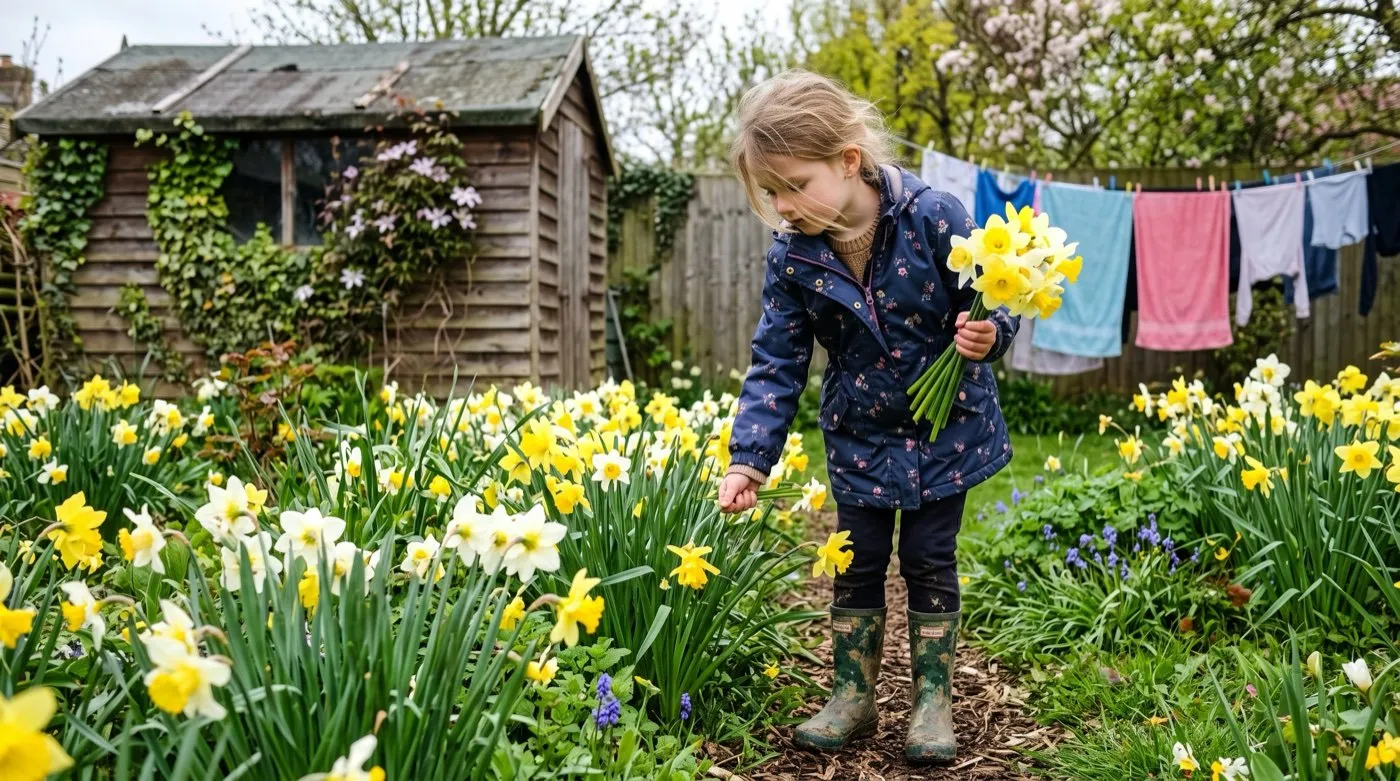 Divisions 2 and 3 are the ones to cut for the house. Pull the stem rather than cutting it, and stand the bunch alone for a few hours before mixing it with anything else.
For scent: Division 7 and Division 9. Poeticus ‘Actaea’ will fill a garden from 10m away.
For the last flower of spring: Division 9, always. It is the only division that reaches May.
For a native planting: Division 13, and specifically N. pseudonarcissus or the Tenby daffodil.
Thirteen divisions, three sorting rules, and one measurement that settles most of it. Once you can read a cup ratio you can classify almost any daffodil in a garden centre without a label. The rest of our plant guides go species by species, and the difference between bulbs, corms, tubers and rhizomes explains why daffodils behave differently from crocus and dahlias underground.
Now you can read a daffodil division off a label, our guide to tulip types and the 15 divisions does the same job for the other half of the spring bulb order.
Frequently asked questions
How many types of daffodil are there?
There are 13 RHS daffodil divisions covering more than 32,000 registered cultivars. The Royal Horticultural Society holds the International Daffodil Register and sets the classification worldwide. Divisions 1 to 12 hold garden cultivars, and Division 13 holds wild species and natural hybrids named only by botanical name. Every daffodil sold in Britain sits in one of them.
What is the difference between a trumpet and a large-cupped daffodil?
Cup length. A trumpet cup is as long as the petals or longer; a large cup is shorter. That single measurement separates Division 1 from Division 2, and nothing else does. Division 3, the small-cupped, has a cup under one third of petal length. Colour, height and flower size play no part in deciding which of the three a daffodil belongs to.
Which daffodils naturalise best in grass?
What division is Tete-a-Tete?
‘Tete-a-Tete’ is Division 12, the Other Cultivars category. It has strong Cyclamineus character but carries Tazetta blood too, so it fits no single division cleanly. It is the best-selling daffodil in Britain, reaches 15-20cm, and flowers from late February. Division 12 exists precisely for hybrids like this with mixed parentage.
Why are Poeticus daffodils always the last to flower?
Poeticus daffodils flower in May because they evolved in alpine meadows with late snowmelt. Narcissus poeticus grows in the mountains of southern Europe, where spring arrives six weeks after ours. ‘Actaea’ typically opens in the first week of May here, four months after the earliest Tazettas. They are also the most strongly scented of all divisions.
How deep should I plant daffodil bulbs?
Plant daffodil bulbs at three times their own height, usually 10-15cm deep. Big Division 1 and 2 bulbs want 15cm to the base. Small Division 6, 7 and 13 bulbs want 8-10cm. Planting too shallow is the main cause of daffodil blindness, because shallow bulbs split into offsets that are too small to flower.
Are split-corona daffodils real daffodils?
Yes. Split-corona daffodils are Division 11, a fully recognised RHS division since 1975. The cup is split for more than half its length and flattens back against the petals, giving a flat, orchid-like face. Division 11a is Collar, with cup segments behind the petals; 11b is Papillon, with the segments alternating between them.
Our team produces practical UK gardening guidance from source research, contributor records and established horticultural practice. Editorial standards are overseen by Matt W.