Key takeaways
- Biennial wallflowers are sown in June, transplanted in October, and flower April to June
- Perennial Bowles's Mauve flowers for up to 10 months without deadheading
- Wallflowers demand alkaline or neutral soil with sharp drainage and full sun
- Pinching biennial seedlings at 15cm tall produces bushier plants with more flower stems
- Traditional spring bedding pairs wallflowers with tulips and forget-me-nots
- Short-lived perennial varieties last 3-5 years and need replacing before they turn woody
Wallflowers are one of the most fragrant plants you can grow in a British garden. Their rich, clove-like scent carries on the spring breeze and fills borders from April right through to June. Few spring bedding plants match them for sheer intensity of colour and perfume.
There are two distinct types to understand before you start. Biennial Erysimum cheiri is the traditional spring bedding wallflower, sown one summer and flowering the next. Perennial wallflowers, led by the outstanding Bowles’s Mauve, flower for up to 10 months of the year. Both types share a preference for well-drained, alkaline soil and a sunny position.
What are the two types of wallflower?
The distinction between biennial and perennial wallflowers matters for how you grow them. Biennial Erysimum cheiri is the classic cottage garden wallflower. It produces a rosette of leaves in its first year and flowers in its second. After flowering, it sets seed and dies. This is the type sold as bare-root bundles at garden centres each autumn.
Perennial wallflowers are different species and hybrids within the Erysimum genus. They flower repeatedly over several years without needing to be resown. The most famous is Erysimum ‘Bowles’s Mauve’, which produces dense spikes of mauve-purple flowers almost continuously from February to November. It earned the RHS Award of Garden Merit for good reason.
Both types belong to the Brassicaceae family. They share that family’s preference for alkaline conditions and its vulnerability to clubroot. Soil pH between 6.5 and 8.0 suits wallflowers perfectly.
How do I sow biennial wallflower seeds?
Sow biennial wallflower seeds in June or early July. This timing gives plants a full growing season to build strong roots and bushy growth before their flowering spring. Sowing too late produces small, weak plants.
Fill seed trays with a free-draining seed compost. Sow thinly on the surface and cover with 3mm of vermiculite or fine compost. Water gently and place in a cold frame or sheltered spot outdoors. Germination takes 10-14 days at soil temperatures of 15-20C.
When seedlings have two true leaves, prick out into individual 9cm pots or space 15cm apart in a nursery bed. The critical step is pinching the growing tip when plants reach 15cm tall. This removes apical dominance and forces side shoots, producing a bushier plant with more flower stems. Without pinching, you get a single leggy spike.
Grow on through summer, watering in dry spells but never allowing waterlogging. By October, plants should be sturdy, 20-25cm tall, with multiple stems. Transplant to final positions in borders while soil is still warm.
When should I plant wallflowers out?
Plant biennial wallflowers in October. Soil temperatures are still warm enough for roots to establish, but air temperatures have cooled enough to discourage soft, frost-vulnerable growth. Planting in October gives 8-10 weeks of root development before hard frosts arrive.
Space plants 25-30cm apart in well-drained soil. Firm them in well. Water once after planting, then rely on autumn rain. Do not mulch heavily around the stems as this holds moisture against the crown and encourages rot.
The classic spring bedding combination pairs wallflowers with tulips and forget-me-nots. Plant tulip bulbs 15cm deep between the wallflower plants at the same time. The forget-me-nots fill the ground level, wallflowers occupy the middle, and tulips rise above. This three-tier approach gives continuous colour from March through June.
If you garden on heavy clay, plant wallflowers slightly proud of the soil surface. Adding a collar of sharp grit around each plant improves drainage around the crown where rot is most likely to start.
Why do wallflowers love walls and rockeries?
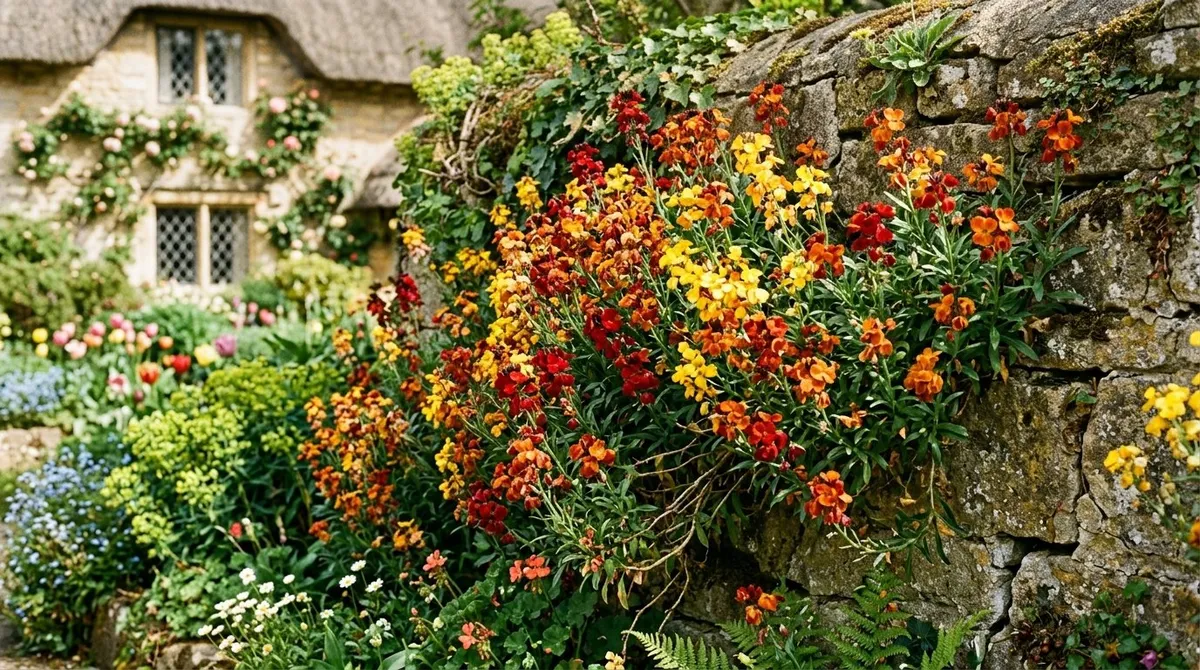
The common name is not accidental. Wallflowers have grown on old stone walls and rocky outcrops across Europe for centuries. They naturalise in lime mortar joints, cliff faces, and ruined buildings. You can still see them colonising castle walls across Britain.
Walls and rockeries provide the three conditions wallflowers demand. First, sharp drainage: water runs off vertical surfaces instantly. Second, alkaline substrate: lime mortar is highly alkaline at pH 8-9. Third, reflected warmth: stone absorbs daytime heat and radiates it back at night, protecting plants from frost.
In the garden, replicate these conditions by planting at the base of a south-facing wall, in a raised bed with added rubble or grit, or in a rockery with pockets of gritty compost. Plants grown against walls also produce stronger fragrance because warmth volatilises the essential oils in their petals.
What makes wallflower fragrance so distinctive?
Wallflower scent comes from a cocktail of volatile organic compounds, with eugenol (the same chemical in cloves) as the dominant note. The fragrance is strongest in the evening as temperatures drop and humidity rises. A border of 20-30 biennial wallflowers in full bloom can scent an entire garden.
Fragrance intensity varies by variety. The old heritage strains bred before the 1960s tend to have the strongest scent. Modern F1 hybrids bred for compact habit and uniform colour sometimes sacrifice fragrance for form. If scent matters most to you, choose open-pollinated seed mixtures labelled ‘Old English’ or ‘Heritage Mixed’.
Among perennial types, Bowles’s Mauve has a mild, sweet fragrance. Erysimum ‘Fragrant Sunshine’ lives up to its name with a stronger honey scent. For cutting gardens, the biennial types outperform perennials for vase fragrance.
Which perennial wallflower varieties are best for UK gardens?
Perennial wallflowers offer something biennial types cannot: flowers over many months without annual resowing. The trade-off is that most are short-lived, lasting 3-5 years before turning woody. Take cuttings annually to maintain your stock.
Erysimum ‘Bowles’s Mauve’ is the undisputed star. It forms a rounded shrub 75cm tall and wide, covered in mauve-purple flower spikes from February to November. In mild winters, it barely stops flowering. It earned the RHS Award of Garden Merit and is sold at virtually every UK garden centre. It is fully hardy to -15C.
Erysimum ‘Winter Orchid’ produces flower heads that shift through bronze, purple, and orange as individual florets age. The multicoloured effect is striking. It flowers from November to May, filling the gap before and after biennial types. Height is 45-60cm.
Erysimum ‘Apricot Twist’ offers soft apricot-orange flowers on compact 30cm plants. It works well at the front of borders and in containers. Flowering runs from March to June, with a secondary flush in autumn. It is less vigorous than Bowles’s Mauve but more restrained for small gardens.
Best wallflower varieties compared
| Variety | Type | Height | Colour | Flowering | Fragrance | Lifespan | RHS AGM |
|---|---|---|---|---|---|---|---|
| Erysimum cheiri ‘Blood Red’ | Biennial | 45cm | Deep crimson | Apr-Jun | Strong clove | 2 years | No |
| Erysimum cheiri ‘Cloth of Gold’ | Biennial | 40cm | Golden yellow | Apr-Jun | Strong clove | 2 years | No |
| Erysimum cheiri ‘Fire King’ | Biennial | 45cm | Orange-scarlet | Apr-Jun | Strong | 2 years | No |
| Erysimum cheiri ‘Ivory White’ | Biennial | 40cm | Creamy white | Apr-Jun | Moderate | 2 years | No |
| Erysimum ‘Bowles’s Mauve’ | Perennial | 75cm | Mauve-purple | Feb-Nov | Mild sweet | 4-6 years | Yes |
| Erysimum ‘Winter Orchid’ | Perennial | 50cm | Bronze/purple/orange | Nov-May | Moderate | 3-4 years | No |
| Erysimum ‘Apricot Twist’ | Perennial | 30cm | Apricot-orange | Mar-Jun + autumn | Mild | 2-3 years | No |
| Erysimum ‘Sunset’ Series | Perennial | 35cm | Mixed warm tones | Mar-Jul | Mild | 2-3 years | No |
Biennial varieties offer the strongest fragrance but need annual resowing. Perennial types give longer flowering seasons with less maintenance. For the best of both worlds, grow both: biennials for spring scent, Bowles’s Mauve for year-round colour.
How do I care for wallflowers through the season?
Wallflowers are low-maintenance once established, but a few seasonal tasks keep them performing well.
Spring (March-June): Feed biennial wallflowers once with a high-potash liquid feed as buds form. Avoid nitrogen-rich fertilisers, which promote leafy growth at the expense of flowers. Deadhead spent flower spikes on perennial types to encourage fresh blooms. Leave biennial types to finish flowering naturally if you want them to self-seed.
Summer (July-August): After biennial wallflowers finish flowering, pull them out and compost them. They will not flower again. For perennial types, give a light trim after the main spring flush, removing spent flower stems and any leggy growth. Take softwood cuttings from perennial wallflowers in June. They root easily in gritty compost.
Autumn (September-November): Plant new biennial wallflowers in October. Check perennial types for woody stems at the base and prune lightly to encourage fresh basal growth. Do not cut into old wood as wallflowers do not regenerate from bare stems.
Winter (December-February): Perennial wallflowers need no protection in most UK regions. In exposed northern sites, a light mulch of grit (not bark) around the base helps prevent crown rot from winter wet. Avoid organic mulches that hold moisture.
What soil conditions do wallflowers need?
Wallflowers have a strong preference for alkaline to neutral soil with a pH between 6.5 and 8.0. They evolved on limestone cliffs and chalky grasslands across southern Europe. If you garden on acid soil, wallflowers will struggle unless you amend the ground or grow in containers.
Drainage is equally critical. Wallflowers will not tolerate waterlogged roots, especially in winter. On heavy clay soils, either raise the planting area by 15-20cm or dig in generous amounts of horticultural grit and sharp sand. A 50:50 mix of garden soil and grit works well for raised beds.
Fertility should be moderate. Rich, heavily composted soil produces lush foliage but fewer flowers and weaker fragrance. Poor to average soil actually produces better results. If your soil is naturally fertile, avoid adding compost or manure before planting wallflowers.
For container growing, use John Innes No. 2 mixed with extra perlite or grit at roughly 3:1. This provides the alkalinity wallflowers enjoy while so water drains through quickly. Stand pots on feet through winter to prevent the base sitting in water.
Can I grow wallflowers with other spring bedding?
Wallflowers are one of the finest plants for traditional spring bedding schemes. Their height, colour range, and fragrance make them natural partners for other spring favourites.
The classic Victorian bedding trio is wallflowers, tulips, and forget-me-nots. Plant tulip bulbs 15cm deep between wallflower plants in October. Scatter forget-me-not plants around the base. As spring progresses, forget-me-nots flower first in March, wallflowers peak in April-May, and late tulips extend into June.
Other strong partners include primroses at the front of borders, honesty for a cottage garden effect, and spring-flowering alliums to take over as wallflowers fade. For containers, pair compact wallflowers with trailing ivy and miniature daffodils.
Avoid planting wallflowers near brassica crops. As members of the same family, they share diseases including clubroot. If your vegetable beds have had clubroot problems, keep wallflowers well away.
How do I take cuttings from perennial wallflowers?
Taking cuttings is essential for perennial wallflowers because plants become woody and unproductive after 3-5 years. Fresh cuttings maintain your stock without cost.
Take softwood cuttings in late May to July. Select healthy, non-flowering side shoots 8-10cm long. Cut just below a leaf node with a clean blade. Remove the lower leaves, leaving 3-4 pairs at the tip. Dip the cut end in hormone rooting powder.
Insert cuttings around the edge of a 9cm pot filled with a 50:50 mix of perlite and peat-free compost. Water gently and cover with a clear plastic bag or place in a propagator. Roots form in 3-4 weeks at 15-18C.
Pot rooted cuttings individually into 9cm pots of loam-based compost. Grow on in a sheltered spot through summer and autumn. Plant out in their final position the following spring, or overwinter in a cold frame.
Cuttings taken from the current season’s growth root more reliably than those from older, woodier stems. Aim to take 3-4 cuttings per parent plant each year as a rolling replacement programme.
Common wallflower problems and solutions
Clubroot is the most serious disease affecting wallflowers. Caused by the soil-borne pathogen Plasmodiophora brassicae, it distorts roots into swollen, club-shaped masses. Plants wilt in warm weather and eventually die. There is no cure once soil is infected. Avoid planting wallflowers (or any brassica) in affected ground for at least 7 years. Raising soil pH above 7.5 with lime reduces severity.
Flea beetle creates small round holes in leaves, giving them a shotgun-pellet appearance. Damage is usually cosmetic and plants grow through it. Severe infestations on young seedlings can be treated with fine mesh netting or pyrethrum spray.
Downy mildew causes yellow patches on upper leaf surfaces with grey-white fungal growth underneath. It thrives in damp, still conditions. Improve air circulation by spacing plants correctly and avoid overhead watering. Remove badly affected leaves promptly.
Crown rot kills perennial wallflowers in wet winters. The crown turns brown and mushy at soil level. Prevention is better than cure: ensure sharp drainage, avoid organic mulches touching the stem, and plant slightly proud of the surrounding soil.
Frequently asked questions
When should I sow biennial wallflower seeds?
Sow biennial wallflower seeds in June or early July. Sow into seed trays or a nursery bed outdoors. Germination takes 10-14 days at 15-20C. Grow seedlings on through summer, pinching the growing tip at 15cm tall. Transplant to final positions in October when the soil is still warm. This gives roots time to establish before winter. Sowing later than mid-July produces smaller plants that flower poorly the following spring.
Why are my wallflowers not flowering?
The most common cause is planting too late in autumn. Wallflowers need 8-10 weeks of root growth before hard frost arrives. Plants set out after November often fail to establish properly and produce weak spring displays. Other causes include too much shade, over-rich soil that promotes leaf growth over flowers, and overcrowding. Biennial wallflowers only flower once then die, so you need fresh plants each year.
Can wallflowers grow in shade?
Wallflowers need at least 6 hours of direct sun daily. They tolerate light afternoon shade but perform poorly in anything less than full sun. Shaded plants become leggy, produce fewer flowers, and are more prone to fungal diseases. South-facing walls and borders are ideal. The reflected warmth from a wall also intensifies their evening fragrance.
How long do perennial wallflowers last?
Perennial wallflowers typically last 3-5 years before becoming woody. Bowles’s Mauve is the longest-lived variety, sometimes reaching 5-6 years on well-drained soil. Other perennial types like Winter Orchid and Apricot Twist are often shorter-lived at 2-3 years. Take softwood cuttings in late spring each year as insurance. Once stems become bare and woody at the base, replace the plant.
Do wallflowers come back every year?
Biennial wallflowers do not come back; perennial types do. Erysimum cheiri is a true biennial. It grows foliage in year one, flowers in year two, then dies. You must sow or buy fresh plants each season. Perennial wallflowers like Bowles’s Mauve return for several years and flower almost continuously. Some biennial types may self-seed if you leave spent flower heads in place.
Are wallflowers related to brassicas?
Yes, wallflowers belong to the Brassicaceae family alongside cabbages. This means they are susceptible to clubroot, a soil-borne disease common in vegetable gardens. Avoid planting wallflowers in ground recently used for brassicas if clubroot is present. They can also attract cabbage white butterflies, although damage is rarely severe enough to affect flowering.
Can I grow wallflowers in pots?
Yes, wallflowers grow well in containers with good drainage. Use a loam-based compost such as John Innes No. 2 mixed with extra grit at a 3:1 ratio. Ensure pots have drainage holes and stand on feet through winter to prevent waterlogging. Feed fortnightly with a high-potash liquid feed once buds form in spring. Both biennial and perennial types suit containers, making them ideal for patios and doorstep displays.
Our team produces practical UK gardening guidance from source research, contributor records and established horticultural practice. Editorial standards are overseen by Matt W.