Key takeaways
- Self-seeding plants drop their own seed and germinate without help, filling gaps for free every year
- Foxgloves, aquilegia, nigella, and honesty are the four most reliable self-seeders in UK gardens
- Leave spent flower heads on the plant until seeds ripen and drop naturally in late summer and autumn
- Thin seedlings to 15-30cm apart in spring rather than weeding them all out
- Welsh poppy, green alkanet, and herb Robert can become invasive and need firm management
- Self-seeders reduce annual bedding costs by 60-80% after the first year of establishment
Self-seeding plants do the work of sowing for you. They flower, set seed, drop it onto the soil, and produce a new generation of plants the following year without any intervention. No seed trays, no compost, no windowsill propagation. The plants replace themselves, filling gaps and creating natural-looking drifts that improve every season.
In a UK garden, self-seeders are the foundation of low-maintenance planting. They suit cottage garden borders where an informal, abundant look is the goal. They fill bare soil that would otherwise grow weeds. And they cut annual planting costs dramatically, because once you buy the first packet of seed or the first plant, you never need to buy that species again.
What makes a plant self-seed successfully?
A plant self-seeds when it produces viable seed that germinates in situ without human help. Three conditions must be met. The plant must set seed before it is deadheaded or killed by frost. The seed must survive winter in the soil. And the soil surface must be open enough for germination in spring.
Heavy mulching suppresses self-seeding because it buries seeds too deep. Thick ground cover prevents seedlings reaching light. Overly tidy gardening, where every spent flower is removed, stops seed production entirely. The best approach for self-seeders is deliberate messiness: leave flower heads standing through autumn and winter, and clear them only in late March when seedlings are already visible.
Self-seeding plants fall into three categories:
- Hardy annuals complete their life cycle in one year. Examples: nigella, calendula, borage
- Biennials grow foliage in year one, flower and die in year two. Examples: foxglove, honesty, sweet rocket
- Short-lived perennials live two to four years but replace themselves from seed. Examples: aquilegia, verbena bonariensis, Welsh poppy
The 15 best self-seeding plants for UK gardens
Foxglove (Digitalis purpurea)
The foxglove is the single most reliable self-seeder in British gardens. A native biennial, it produces rosettes of large, downy leaves in its first year and tall flower spikes up to 1.8m in its second. Each spike carries 20-80 bell-shaped flowers and produces approximately 2,000 seeds per plant.
Aquilegia (Aquilegia vulgaris)
Aquilegia is the queen of the cottage garden, producing elegant spurred flowers in May and June. It self-seeds prolifically, and seedlings often produce unexpected colour combinations because different varieties cross-pollinate freely. This genetic mixing is part of their charm. You may plant pure white and deep purple, then find your seedlings bloom in pink, mauve, and bicoloured patterns.
Plants reach 60-90cm and tolerate partial shade. They thrive in most soil types, including the heavy clay that dominates Midlands gardens. Remove spent flower heads if you want to limit spread, or leave them for maximum self-seeding. Aquilegia is a perfect companion for perennial border plants.
Nigella (Nigella damascena)
Nigella, or love-in-a-mist, is a hardy annual that sows itself with near-perfect reliability. The feathery foliage and blue, white, or pink flowers appear from June to August, followed by decorative inflated seed pods that dry on the plant and split open, scattering fine black seeds.
Sow the first year directly into the soil in September or March. After that, nigella returns every year without help. It dislikes transplanting, so let it grow where it falls. Plants reach 45cm. ‘Miss Jekyll’ is the finest blue variety. The dried seed pods make excellent indoor arrangements.
Honesty (Lunaria annua)
Honesty is grown as much for its translucent silver seed pods as for its purple or white spring flowers. A biennial, it flowers in April and May of its second year, then sets papery disc-shaped pods that persist into winter. Inside each pod, flat brown seeds wait until the pod deteriorates and releases them.
It thrives in partial shade and is one of the best self-seeders for the dry, shady spots under hedges and trees. The variety ‘Alba Variegata’ has white flowers and cream-edged leaves. Heights reach 60-90cm. Honesty is also an important food plant for orange-tip butterfly caterpillars.
Verbena bonariensis
Verbena bonariensis produces clusters of tiny purple flowers on tall, wiry stems reaching 1.5-2m. Despite its height, the stems are so slender they barely obstruct views, making it ideal for planting at the front or middle of borders as a “see-through” plant. It self-seeds freely on open soil and gravel. Our full guide to growing Verbena bonariensis covers sowing and thinning the seedlings.
Welsh poppy (Papaver cambricum)
Welsh poppy produces cheerful yellow or orange flowers from May to October. It is one of the longest-flowering self-seeders available, blooming for five continuous months. However, it is also one of the most aggressive. It seeds into walls, paving cracks, gravel, and any open soil. Once established, it is difficult to eradicate.
Use it deliberately in wild areas, woodland edges, and informal spaces where you want ground cover. Remove it ruthlessly from rock gardens, alpine troughs, and formal borders. Heights reach 30-45cm. The orange form is particularly striking against stone walls.
Calendula (Calendula officinalis)
Calendula, or pot marigold, is a hardy annual flowering from June to the first frost. The bright orange and yellow daisy-like flowers are edible, attract hoverflies, and self-seed generously on open ground. It is one of the easiest flowers to grow from seed and one of the most willing self-seeders.
Sow directly outdoors in March or September. After the first season, expect self-sown seedlings every spring. Thin to 20cm apart. Calendula is also a useful companion plant in vegetable gardens, attracting aphid predators. Plants reach 30-50cm.
Borage (Borago officinalis)
Borage produces vivid blue star-shaped flowers from June to September that are irresistible to bees. A hardy annual reaching 60-90cm, it self-seeds with determination. In a single season, one plant can produce hundreds of seeds that germinate the following spring.
The flowers and young leaves are edible, with a mild cucumber flavour. Borage grows best in full sun on well-drained soil. It is useful in vegetable plots as a companion plant for strawberries and tomatoes, attracting pollinators. Seedlings appear in March and grow rapidly.
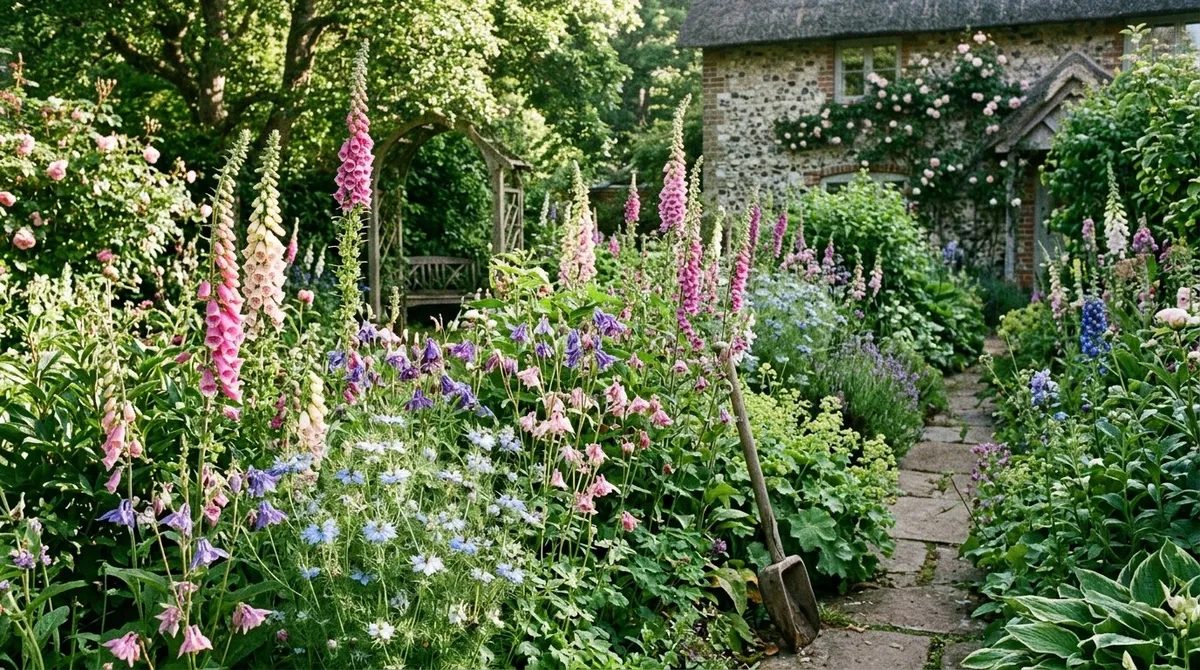
Borage (blue flowers, foreground) and foxgloves (pink spikes, background) self-seeding naturally in a cottage garden border.
Sweet rocket (Hesperis matronalis)
Sweet rocket fills the garden with fragrance on warm evenings in May and June. The white and purple flower spikes reach 90-120cm and release their strongest scent at dusk, attracting moths. A short-lived perennial or biennial, it self-seeds freely and establishes quickly.
Plants tolerate partial shade and most soil types. They are ideal for the back of borders and woodland edges. The RHS notes that sweet rocket can become naturalised along riverbanks and hedgerows, which shows how readily it spreads. Thin seedlings to 30cm apart.
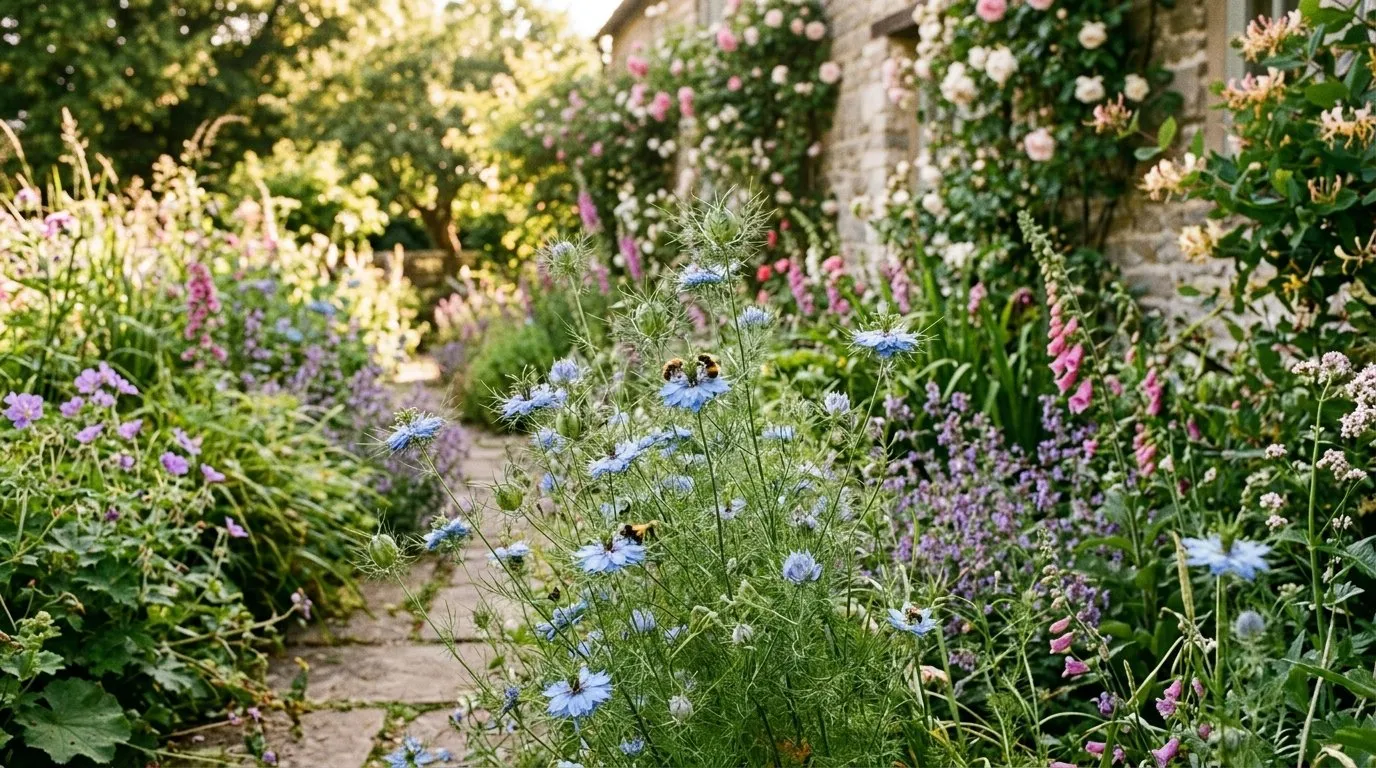 Nigella seeds itself into every gap and crack, filling borders with delicate blue flowers and wispy foliage from May to July. One of the easiest self-seeders for UK gardens.
Forget-me-not (Myosotis sylvatica)
Forget-me-not carpets the ground with tiny blue flowers in April and May. A biennial, it makes a haze of pale blue beneath taller spring flowers like tulips and wallflowers. It self-seeds prolifically and can colonise entire borders within two seasons.
Plants reach just 15-30cm. They tolerate shade and damp soil. After flowering, the plants become straggly and can be pulled out to make space for summer plantings. Fresh seedlings appear in autumn as small rosettes that overwinter and flower the following spring.
Opium poppy (Papaver somniferum)
Opium poppy produces large, showy flowers in June and July followed by distinctive pepper-pot seed heads. Colours range from white and pale pink to deep plum, scarlet, and bicoloured forms. Each seed head contains hundreds of tiny seeds that scatter when wind shakes the dried capsule.
Sow directly in autumn or spring. After the first year, opium poppies self-seed freely on open, disturbed soil. They dislike heavy clay and waterlogging. The peony-flowered doubles and single ‘Lauren’s Grape’ are particularly fine. Plants reach 60-100cm. Growing opium poppies for ornamental purposes is legal in the UK.
Teasel (Dipsacus fullonum)
Teasel is a native biennial producing distinctive spiny flower heads that attract goldfinches. The architectural seed heads persist through winter, providing structure and bird food. Each plant reaches 1.5-2m and produces thousands of seeds.
It suits wild gardens, wildlife areas, and the back of large borders. Too vigorous for small gardens or formal settings. Teasel establishes colonies quickly on clay and damp soil. An excellent choice for a wildflower lawn or mini meadow area.
Feverfew (Tanacetum parthenium)
Feverfew produces masses of small white daisy flowers from June to September. A short-lived perennial reaching 45-60cm, it self-seeds generously and fills gaps in paving, gravel, and border edges. The golden-leaved form ‘Aureum’ is particularly ornamental.
Feverfew tolerates poor soil and partial shade. It is easily controlled by pulling unwanted seedlings. The aromatic foliage has a sharp, medicinal scent. Historically used as a herbal remedy for headaches and fever.
Poached egg plant (Limnanthes douglasii)
Poached egg plant produces white-and-yellow flowers that genuinely resemble a poached egg. A low-growing hardy annual reaching just 15cm, it makes excellent ground cover at the front of borders and along path edges. It flowers from May to July and self-seeds into every available gap.
It attracts hoverflies and other beneficial insects in large numbers. Sow directly in September or March. After the first year, it returns annually without help. It thrives on poor soil in full sun and is particularly effective in gravel gardens and along cottage garden paths.
Red campion (Silene dioica)
Red campion is a native wildflower producing pink-red flowers from May to November. It self-seeds reliably in partial shade and damp soil, making it ideal for woodland edges, hedgerow bases, and north-facing borders. Plants reach 60-90cm.
As a native species, red campion supports a wide range of wildlife. It is an important nectar source for long-tongued bumblebees. It crosses freely with white campion (S. latifolia) to produce pale pink hybrids, which adds variety to self-sown populations.
How to manage self-seeding plants
Encouraging self-seeding
Leave spent flower heads on plants through autumn and winter. Seeds need contact with open soil to germinate, so avoid thick mulching in areas where you want self-seeding. Light hoeing in March creates the disturbed soil surface that many annual seeds need to germinate.
Reduce competition by keeping dense perennial ground cover away from areas where you want seedlings to establish. A thin gravel mulch (10mm depth) actually helps many self-seeders by providing the free-draining surface they prefer.
Controlling spread
The golden rule is to intervene when seedlings are small. Hoe unwanted seedlings at 2cm tall in April. Transplant wanted seedlings at 5cm tall to their final positions. This ten-minute weekly session in spring is the only management most self-seeders need.
Deadhead plants immediately after flowering if you want to stop self-seeding completely. Remove the entire flower spike before seeds ripen. This is the most effective method for controlling foxgloves, aquilegia, and sweet rocket.
For seriously invasive species like Welsh poppy and green alkanet, remove every plant before it sets seed. Dig out the roots. Welsh poppy regenerates from root fragments, so be thorough.
The self-seeding calendar
| Month | Task |
|---|---|
| March | Identify emerging seedlings. Hoe unwanted ones at 2cm |
| April | Thin retained seedlings to correct spacing. Transplant extras |
| May | Let plants flower. No intervention needed |
| June-Aug | Enjoy flowers. Deadhead if you want to reduce seeding |
| Sep-Oct | Leave seed heads standing for natural dispersal |
| Nov-Feb | Leave dried stems for winter structure and wildlife shelter |
Which self-seeders become invasive?
Not all self-seeders are well-behaved. Some spread so aggressively they overwhelm other plants. Know which ones to treat with caution.
| Plant | Invasiveness | Management |
|---|---|---|
| Welsh poppy | High, seeds into walls, paving | Remove from formal areas ruthlessly |
| Green alkanet | Very high, deep taproot, hard to remove | Dig out entire root. Never let it flower |
| Herb Robert | High, seeds everywhere, grows in deep shade | Pull before seeding. Composting does not kill seeds |
| Crocosmia ‘Lucifer’ | High, spreads by corms and seed | Dig out unwanted corms in autumn |
| Himalayan balsam | Invasive species, illegal to plant | Remove and report. Do not introduce |
| Aquilegia | Moderate, crosses and spreads freely | Thin in spring. Accept colour variation |
| Forget-me-not | Moderate, carpets ground rapidly | Pull out after flowering to contain |
| Borage | Moderate, produces many seedlings | Hoe unwanted seedlings in March |
The RHS guide to self-sowing annuals provides further detail on managing spread and choosing appropriate species for different garden sizes.
Where to let self-seeders naturalise
Self-seeders look their best when given space to form natural colonies. The most effective locations in a UK garden are:
Gravel paths and drives. Nigella, calendula, and poached egg plant thrive in gravel. They soften hard edges and create a relaxed, lived-in feel. Hoe or pull any that block pathways.
Base of walls and fences. Foxgloves, honesty, and sweet rocket colonise the narrow strip at the base of walls where border plants rarely reach. They tolerate the dry, lean soil and partial shade typical of these spots.
Woodland edges. Red campion, forget-me-not, and foxglove form natural-looking drifts at the boundary between open garden and tree canopy. They mimic the wild flora of British hedgerows.
Between established perennials. Self-seeders fill the gaps between slow-growing perennials, providing colour while the border matures. They are particularly useful in new cottage garden plantings during the first two years before permanent plants fill their space.
Calendula and nigella self-seeding along a gravel path. Both species thrive in the free-draining conditions and soften the hard edges naturally.
Starting a self-seeding garden from scratch
Year one: buy seed packets. Choose four or five species from the list above. Sow directly into prepared soil in March (hardy annuals) or September (biennials). Nigella, calendula, and borage are the fastest to establish. Foxgloves and honesty need two years to flower.
Year two: edit, do not replant. Seedlings appear in spring from last year’s dropped seed. Thin them rather than adding more plants. The population finds its own balance. Fill any genuine gaps with one more round of direct seed sowing.
Year three onward: maintain. By the third season, a well-chosen mix of self-seeders looks established and naturalistic. Your only job is editing: removing seedlings where you do not want them and transplanting them where you do. Annual planting costs drop to zero for these species.
Related reading: one of the best crevice self-seeders is covered in our guide to growing Erigeron.
Frequently asked questions
What does self-seeding mean in gardening?
Self-seeding means a plant drops its own seed naturally. Those seeds germinate and grow into new plants without any human help. The parent plant flowers, sets seed, and scatters it onto the surrounding soil. The seeds overwinter in the ground and germinate the following spring. No sowing, no trays, no compost required.
What are the easiest self-seeding plants for UK gardens?
Foxglove, aquilegia, nigella, honesty, and calendula are the easiest. All five germinate reliably in most soil types across all UK regions. They need no special conditions. let the spent flowers stand until seeds drop in late summer, and seedlings appear the following spring.
How do I stop self-seeding plants spreading too much?
Deadhead flowers before seeds ripen to prevent any self-seeding. For partial control, leave some seed heads and remove others. Hoe unwanted seedlings when they are 2cm tall in spring. The easiest method is to pull or transplant seedlings in April before they establish deep roots.
Which self-seeding plants become invasive in the UK?
Welsh poppy, green alkanet, herb Robert, and crocosmia can become invasive. Welsh poppy seeds into every crack and crevice. Green alkanet has deep taproots that are almost impossible to remove once established. Himalayan balsam is a notifiable invasive species and must never be planted. Always research a plant’s spreading habit before introducing it.
Do self-seeding plants come back every year?
The individual plants may not return, but their seedlings replace them annually. Biennials like foxglove and honesty grow foliage in year one, flower and die in year two, but their seeds produce a new generation every season. Annuals like nigella and calendula complete their entire life cycle in one year but scatter enough seed to repeat indefinitely.
Can I collect seed from self-seeding plants?
Yes, collecting seed gives you control over where they grow. Wait until seed pods turn brown and papery, then cut the stems and shake seeds into a paper bag. Store in a cool, dry place until sowing time. Our guide to seed saving covers the full technique for drying and storing collected seed.
When should I thin self-seeding seedlings?
Thin self-seeded plants in April or early May when seedlings are 5-10cm tall. At this size you can clearly identify the species and decide which to keep. Space retained seedlings 15-30cm apart depending on the plant’s mature size. Transplant extras to other parts of the garden or give them away.
Our team produces practical UK gardening guidance from source research, contributor records and established horticultural practice. Editorial standards are overseen by Matt W.