Key takeaways
- Ash dieback is caused by the fungus Hymenoscyphus fraxineus, first confirmed in the UK in 2012
- Summer signs: blackened, wilting leaves and dark diamond-shaped lesions on stems around dead shoots
- The clinching diagnostic is tiny white fruiting bodies on last year's leaf stalks, July to September
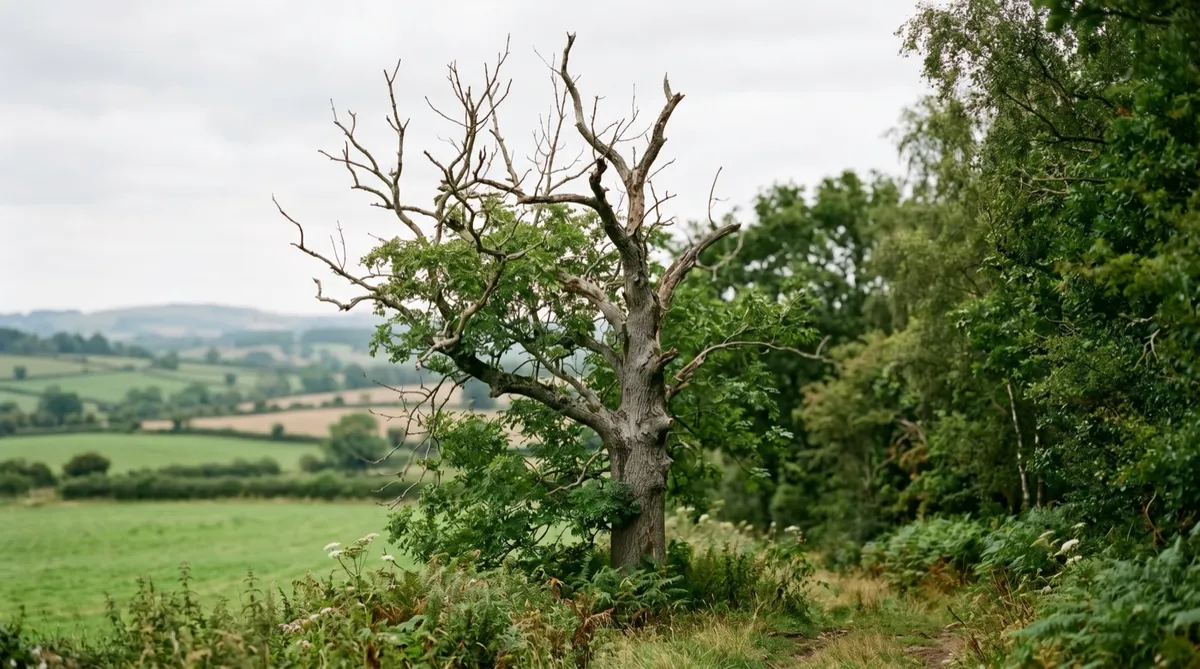
- Crown thinning, bare upper branches (stag-heading) and bushy epicormic growth signal advanced infection
- Up to 80 percent of UK ash are expected to die, but around 1 to 5 percent show genetic tolerance
- Do not fell healthy trees early. Monitor, report to TreeAlert, and clean boots and tools between sites
Ash dieback is the disease reshaping the British countryside, and spotting it early matters for safety and for the future of the species. Caused by the fungus Hymenoscyphus fraxineus, ash dieback was first confirmed in the UK in 2012 and is now found in every county. It is expected to kill up to 80 percent of our common ash. This guide shows you exactly how to identify ash dieback by season, from blackened summer leaves to the tell-tale white fruiting bodies in the leaf litter, and what to do once you have confirmed it.
The disease works slowly on mature trees and fast on young ones. A sapling can die in a single season, while a veteran ash may decline over a decade. Knowing the signs lets you tell genuine dieback from drought, frost or beetle damage, and helps you decide which trees to watch, report or remove.
What causes ash dieback and how it spreads
Ash dieback is caused by a single fungus, Hymenoscyphus fraxineus, once called Chalara fraxinea, which is where the older name “Chalara dieback” comes from. It is native to East Asia, where local ash species tolerate it, and arrived in Europe in the early 1990s. It reached the UK in 2012, both on imported nursery stock and on wind-blown spores crossing the North Sea.
The fungus attacks common ash, Fraxinus excelsior, our native species, along with narrow-leaved ash. The disease blocks the tree’s water-transport vessels, so infected shoots wilt, blacken and die. Over successive years the canopy thins from the top down.
Spread is almost entirely natural now. Spores travel on the wind, so containment by movement controls alone is no longer realistic. What you can still control is the human-assisted spread of infected material: logs, leaves and saplings carried to clean sites. That is why biosecurity, covered later, still matters even when the disease is everywhere.
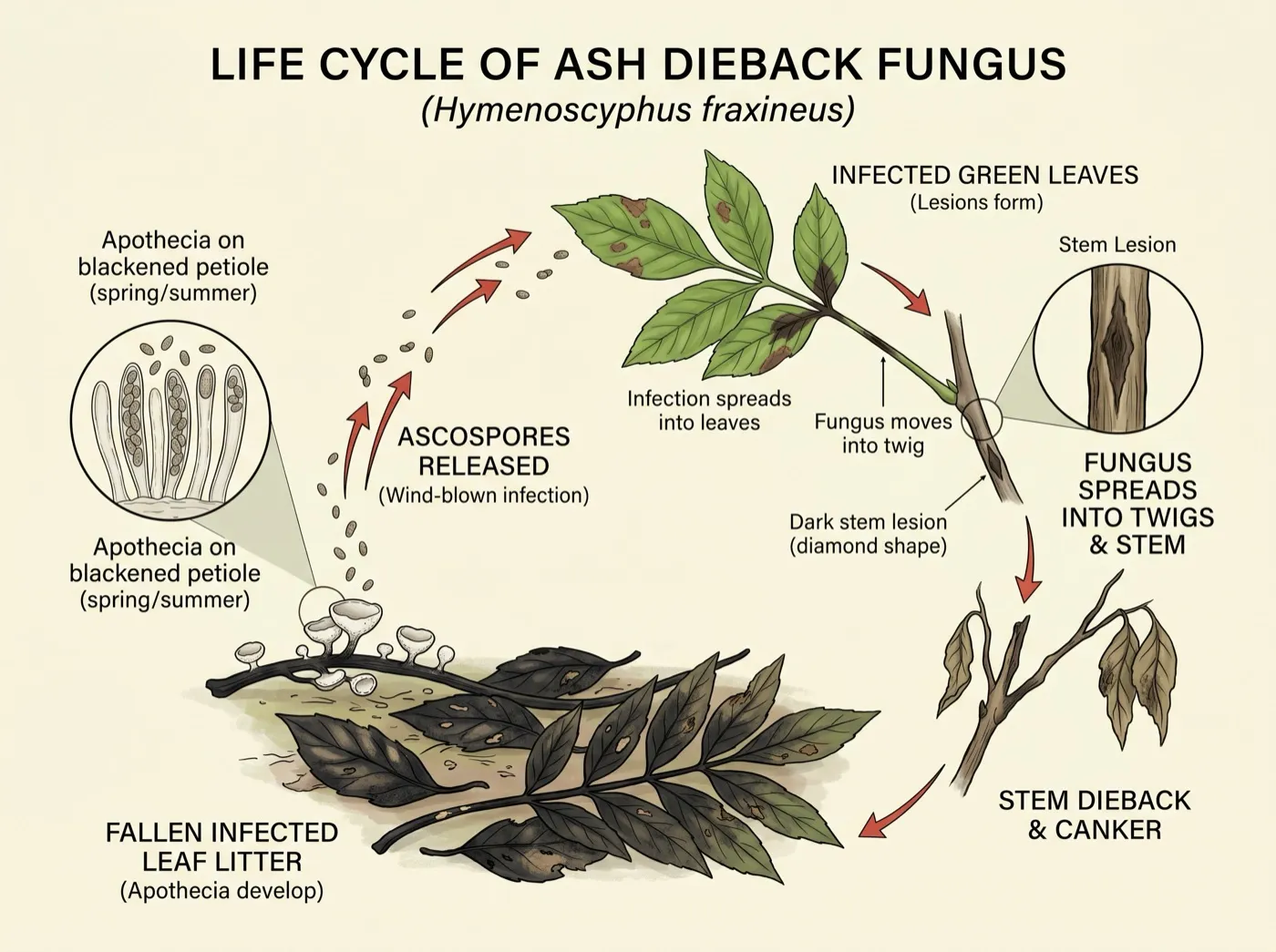 The annual cycle: the fungus overwinters in fallen leaf stalks, fruits in summer, then wind-blown spores infect fresh leaves above.
The ash dieback life cycle stage by stage
Understanding the life cycle explains both the symptoms and the timing of when to look for them. The fungus runs a tight annual schedule tied to the leaf litter.
- Overwintering (October to June). The fungus survives on fallen ash leaf stalks, called rachises, lying in the leaf litter. These blackened stalks are the disease’s nursery.
- Fruiting (July to September). Tiny white, mushroom-like fruiting bodies, around 2 to 7mm across, push up from the old rachises. This is the single best diagnostic window.
- Spore release (July to October). The fruiting bodies fire microscopic spores into the air. Spores travel tens of miles on the wind but most land within a few hundred metres.
- Leaf infection (July to October). Spores landing on fresh ash leaves germinate and penetrate the leaf tissue, especially in damp, still, shaded conditions inside a dense canopy.
- Movement into wood (autumn onward). The fungus grows down the leaf stalk into the twig, then the branch, forming dark lesions and killing the shoot.
The critical mistake most people make is looking for the disease at the wrong time. By the time crown thinning is obvious in winter, you have missed the clearest sign of all: the white fruiting bodies that only appear on the leaf litter in mid to late summer. If you want certainty, look down in August, not up in January.
Gardener’s tip: Higher infection rates follow damp, dense, low-airflow canopies. Thinning crowded young ash and clearing thick leaf litter under specimen trees both cut local spore pressure, though neither stops wind-blown spores arriving from elsewhere.
How to identify ash dieback by season
Ash dieback shows different symptoms through the year, so the sign you look for depends on the month. Use the table below as a field checklist, then confirm with the close-up signs that follow.
| Season | What to look for | Where on the tree |
|---|---|---|
| Spring (Apr-May) | Late or sparse leaf flush, dead twigs from last year, no buds breaking on some shoots | Outer twigs and branch tips |
| Summer (Jun-Aug) | Dark brown or orange blotches on leaves, blackened wilting leaflets, whole shoots dying | Leaves and current-year shoots |
| Late summer (Jul-Sep) | Tiny white fruiting bodies on last year’s blackened leaf stalks | Fallen leaf litter on the ground |
| Autumn (Sep-Oct) | Premature leaf fall, scorched rather than coloured foliage, diamond lesions visible as leaves drop | Leaves, then exposed stems |
| Winter (Nov-Mar) | Crown thinning, bare upper branches (stag-heading), bushy epicormic shoots on trunk and limbs | Whole crown and main stem |
The most reliable summer sign is blackened foliage. Healthy ash leaves stay green into autumn before turning a clear yellow. Diseased leaves develop dark patches, wilt limp, and turn black out of season. On young trees, entire shoots blacken from the tip back toward the trunk.
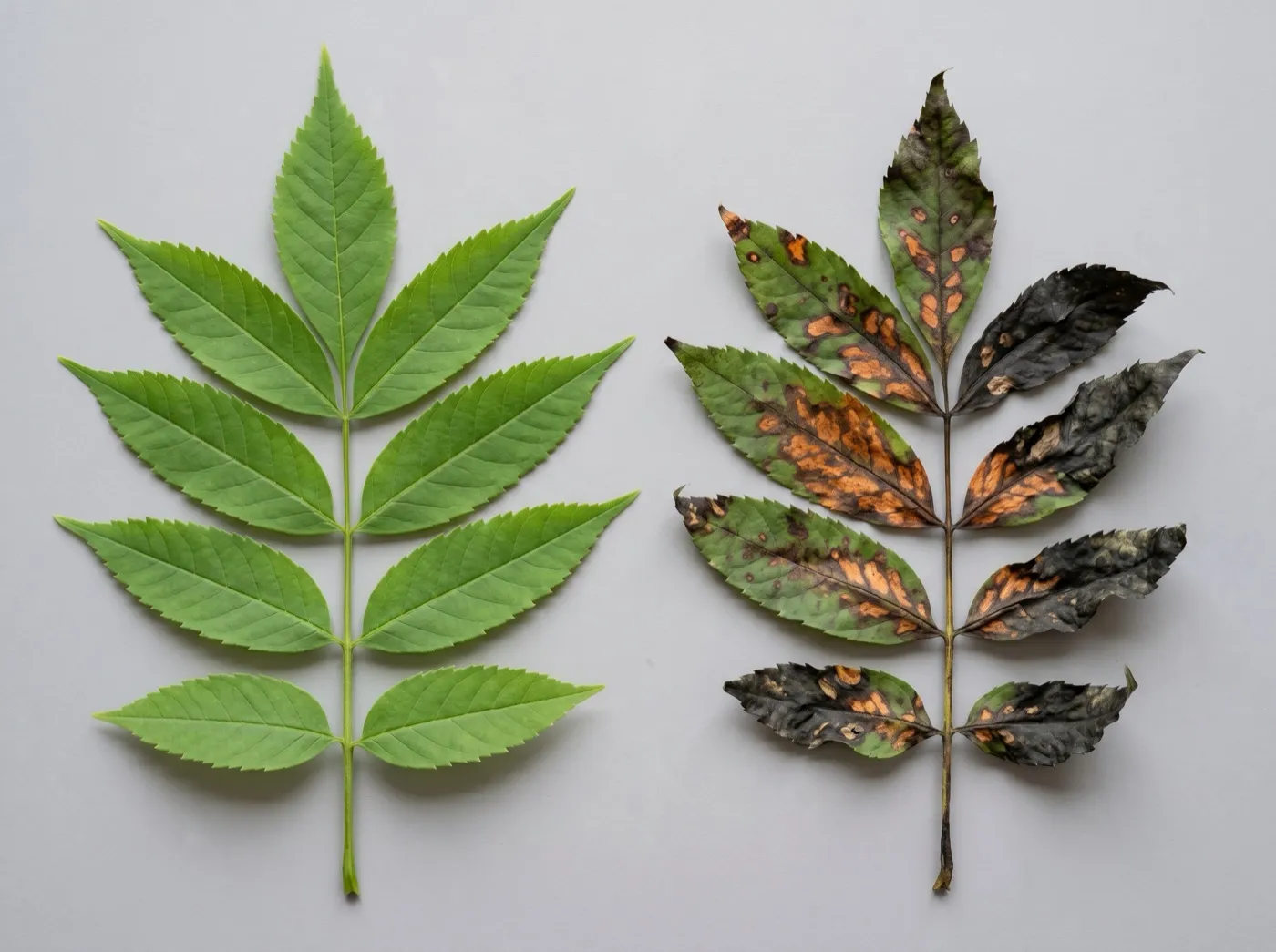 Left, a healthy ash leaf. Right, ash dieback: dark blotches spreading from the midrib with blackened, collapsed leaflets.
Spotting the diamond-shaped stem lesions
The diamond-shaped lesion is one of the most distinctive signs of ash dieback on woody growth. As the fungus moves from a dead leaf or shoot into the stem, it kills a patch of bark. This forms a dark brown or purplish lesion, often diamond or lens-shaped, centred where a dead side shoot joins the stem.
Look closely at the junctions between living stems and dead twigs. The lesion frequently sits directly around the base of a wilted shoot, with the bark sunken and discoloured. Slice a sliver of bark away and the wood beneath shows brown or grey staining running up and down the stem.
On saplings and young trees, these lesions can girdle a thin stem completely, killing everything above in one season. That is why nursery beds and natural regeneration suffer the fastest losses. On a thick mature branch, a single lesion does less damage, so older trees decline more slowly as lesions accumulate year after year.
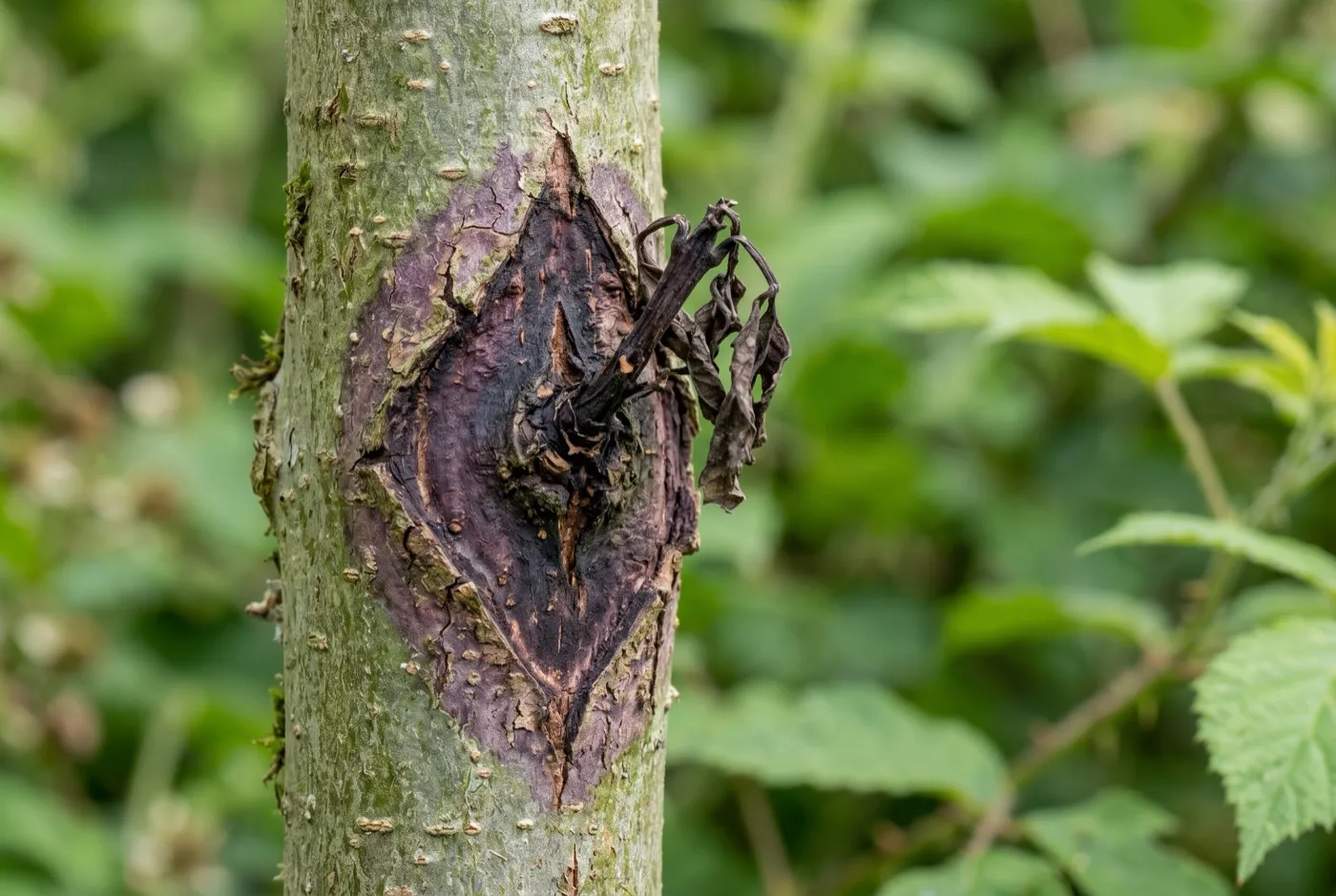 A classic diamond lesion centred on a dead side shoot. The sunken, discoloured bark marks where the fungus entered the stem.
The white fruiting bodies that confirm ash dieback
If you find one sign that settles the question, it is the fruiting bodies on the leaf litter. From July to September, the fungus produces tiny white to pale-buff mushroom-like structures on last year’s fallen ash leaf stalks. Each is small, roughly 2 to 7mm across, with a stalk and a flattened or cupped cap.
Hunt for them by lifting the leaf litter under and around a suspect ash on a damp summer day. Turn over the blackened, skeletonised leaf stalks, the rachises, from the previous autumn. The fruiting bodies grow straight from these old stalks, often in small clusters. A hand lens helps confirm the shape.
This sign matters because it rules out look-alike causes. Drought, frost and beetle damage never produce these structures. Find white fruiting bodies on ash rachises in summer and you have confirmed Hymenoscyphus fraxineus, not a weather or pest problem. Forest Research describes the signs and symptoms of ash dieback in detail if you want a second reference.
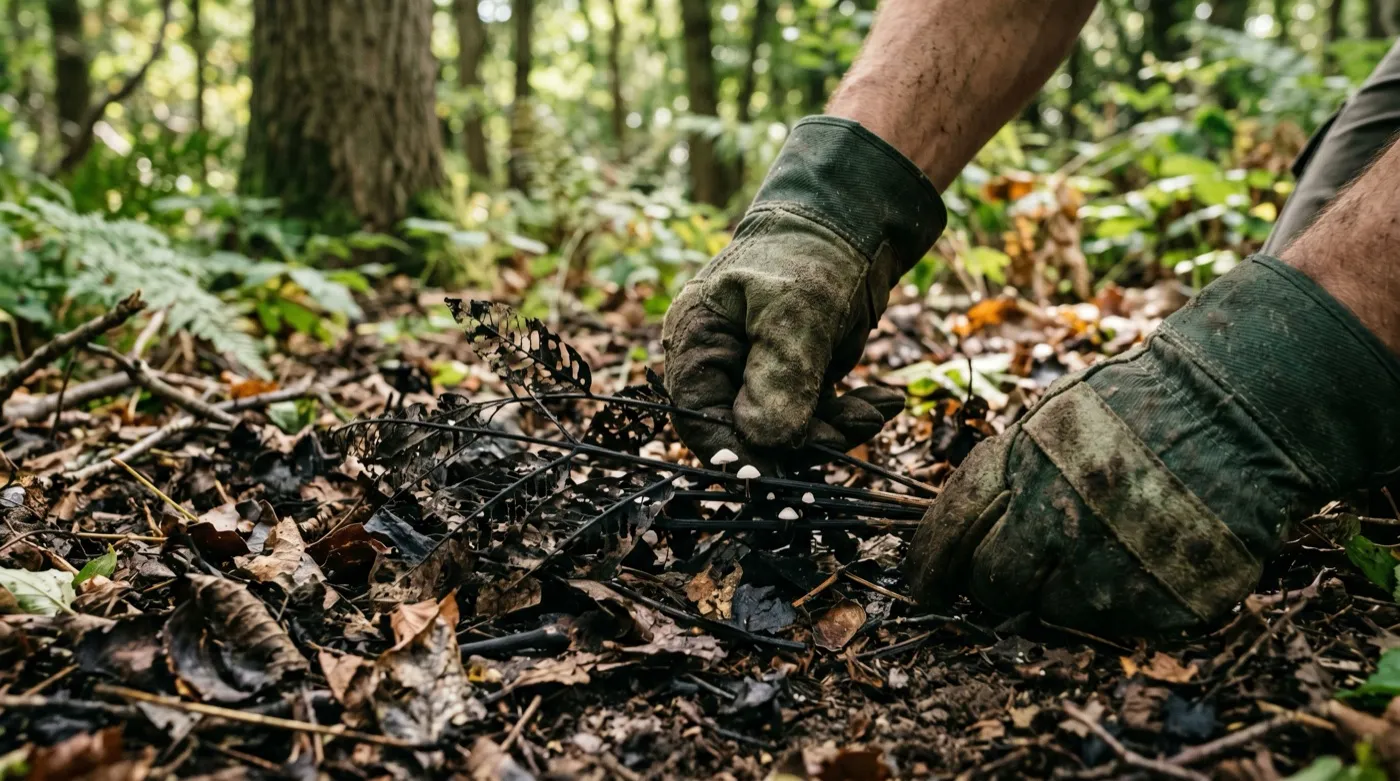 Turning over last year’s leaf litter under a suspect ash in late summer, the best place to confirm the disease.
Is it ash dieback or something else
Several other problems mimic ash dieback, and misreading them leads to needless felling. The table below separates the disease from its common look-alikes.
| Symptom seen | Ash dieback | More likely something else |
|---|---|---|
| Blackened, wilting summer leaves | Yes, out of season, with dead shoots | Frost damage if confined to spring, after a cold snap |
| Brown crispy leaf edges in dry spells | Sometimes | Drought scorch, usually whole-tree and weather-linked |
| Diamond lesions at dead-shoot bases | Yes, diagnostic | Mechanical or animal bark damage looks ragged, not lens-shaped |
| Small round holes and tunnels in bark | No | Ash bark beetle, often in already-stressed wood |
| Fungal brackets at the base or roots | No | Honey fungus or other decay fungi |
| White fruiting bodies on leaf rachises | Yes, confirms it | Nothing else does this |
Drought scorch browns leaves from the edges inward across the whole tree and follows a dry spell. Frost blackens only the soft spring growth and stops once warm weather sets in. Ash bark beetle leaves pinhole entry tunnels and tends to attack trees already weakened by dieback.
The trap to watch is honey fungus, which invades trees stressed by dieback. If you see white fungal sheets under the bark at the base or honey-coloured toadstools in autumn, read our guide on how to deal with honey fungus, because that is a separate root-and-base attack riding on the back of the dieback.
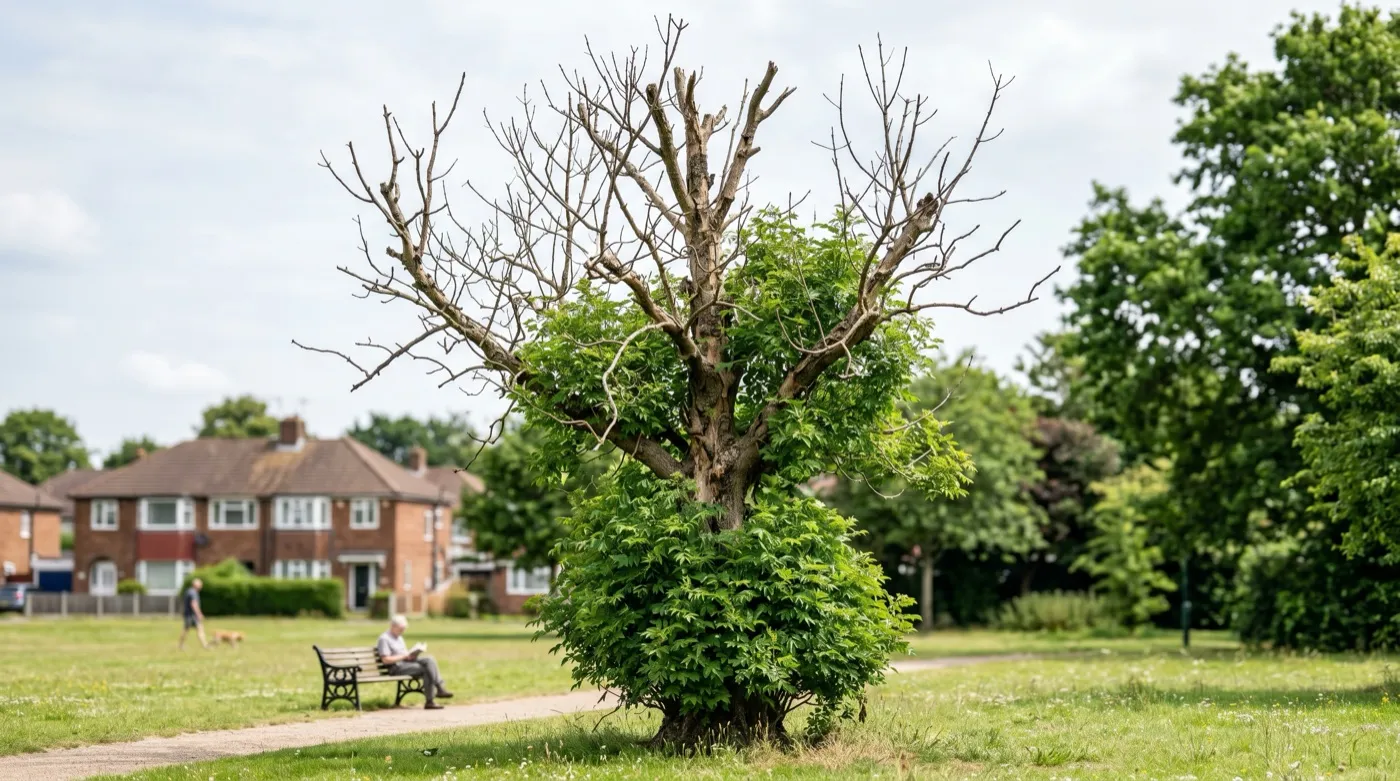 Advanced ash dieback: a stag-headed crown of bare upper limbs above bushy epicormic shoots, where the tree tries to regrow.
Symptom progression from first signs to a dead tree
Ash dieback follows a recognisable progression, though the pace varies hugely between a sapling and a veteran. Tracking the stage tells you how urgent the situation is.
- Year 1 to 2: Scattered dead twigs and blackened shoots in the outer crown. Easy to miss from the ground.
- Year 2 to 4: Diamond lesions multiply, the crown thins noticeably, and bushy epicormic growth sprouts on the trunk and main limbs as the tree responds to stress.
- Year 4 to 6: The crown becomes stag-headed, with bare dead branches standing above living lower growth. Brittle limbs begin to shed.
- Year 6 onward: Major limb loss, basal decay (often honey fungus), and eventual collapse. Mature trees may linger longer; saplings rarely reach this stage and die in one or two seasons.
The epicormic shoots are worth knowing. These are bushy clusters of new leaves erupting straight from the trunk and old wood. They look almost healthy, which fools people, but they signal a tree fighting heavy crown loss rather than recovering. On a garden ash, this is often the stage where you weigh slow decline against planned replacement.
Warning: Trees in the stag-headed stage become structurally dangerous. Dieback dries and embrittles the wood, so whole limbs snap without warning, especially in wind. Keep clear and have hazardous trees assessed by a professional before they shed.
What to do when you find ash dieback
The right response depends entirely on where the tree stands. There is no spray, no cure and no benefit to panic felling. Use this decision approach.
For trees away from people and property, in the middle of a wood, hedge or field, the advice is simple: leave them. Monitor the crown each year and photograph it from the same spot. Most will decline, but the survivors are exactly what the species needs.
For trees near roads, paths, car parks or buildings, safety comes first. Once a tree is shedding limbs or stag-headed, get a qualified arboriculturist to assess it. The Arboricultural Association lists registered consultants. Felling a hazardous roadside ash is a job for an insured professional, not a weekend with a chainsaw.
Crucially, do not fell healthy trees early. A tree holding a full canopy after years of local infection may be one of the tolerant minority. Premature clearance of apparently healthy ash removes the genetic resistance that recovery depends on. The Woodland Trust’s guidance on ash dieback sets out the same monitor-first approach.
Biosecurity and reporting
Even though spores spread on the wind, you should still avoid moving infected material and carrying spores on your kit. Clean your boots, tools and tyres of mud and leaf debris between woodlands. Do not move ash logs, branches, leaves or plants to clean sites. Report suspected cases through TreeAlert, run by Forest Research, with photographs and a location. Reporting maps the spread and flags possible tolerant trees.
Treatment and management options ranked
No method cures ash dieback, so “treatment” here means management. The options differ sharply in what they achieve, ranked below by usefulness.
| Approach | What it does | Effectiveness | Effort | Role |
|---|---|---|---|---|
| Monitor and record | Annual crown checks and photos | High for safety and tolerance spotting | Low | Primary response for most trees |
| Protect tolerant trees | Leave full-canopy survivors untouched | High for species recovery | None | Primary for the resistant minority |
| Hazard felling | Remove only dangerous trees by safety risk | High for risk, zero for the disease | High, needs a professional | Targeted, near people and property |
| Biosecurity | Clean kit, do not move ash material | Moderate, slows human-assisted spread | Low | Maintenance, supports wider control |
| Replanting with diverse species | Replace lost ash with other natives | High for long-term canopy | Moderate | Recovery, not a cure |
| Fungicide spraying | Chemical control of the fungus | None for established trees | High | Not viable, do not attempt |
The gold standard for the wider population is to monitor and protect tolerant trees, because saving the resistant 1 to 5 percent is the only path to a recovered ash population. What no approach can do is reverse infection in a declining tree: there is no chemical cure, and fungicides do not work on mature trees in the wider environment.
Replanting after ash loss
Where ash dies or is removed, the gap matters for wildlife and for the look of a hedge or wood. The root cause of a thin, vulnerable canopy is over-reliance on a single species, and the permanent fix is diversity.
Do not rush to clear, though. Standing deadwood supports insects, fungi and woodpeckers, so where a dead ash is not a safety hazard, leaving it standing or as a habitat pile adds real value. Replant the gaps, keep the safe deadwood, and you turn a loss into a more resilient mix.
Common ash dieback identification mistakes
Most identification errors come from looking at the wrong sign, in the wrong season, or jumping to fell. These are the slips that cost good trees.
- Confusing autumn colour with disease. Healthy ash yellows cleanly in autumn. Disease shows as blackened, scorched leaves out of season, in June and July, not a clean October turn.
- Diagnosing from the crown alone in winter. Crown thinning has many causes, from drought to old age. Without summer leaf signs or the fruiting bodies, a bare winter crown is not proof. Confirm in summer.
- Mistaking frost or drought for dieback. Spring frost blackens only soft new growth; drought scorches whole-tree leaf edges. Neither produces diamond lesions or white fruiting bodies on rachises.
- Felling healthy survivors. Clearing every ash “to be safe” removes the tolerant minority. Leave full-canopy trees standing; they may carry the resistance the species needs. Compare with managing canker on fruit trees, another disease where cutting too hard does more harm than good.
- Moving infected logs and leaves. Carrying ash material to a clean site seeds new infection. Burn or compost it on site and clean your tools before moving on.
Frequently asked questions
How do I know if my ash tree has ash dieback?
Look for blackened wilting leaves, dark diamond lesions on stems, and crown thinning. In summer, check fallen leaf stalks in the litter for tiny white mushroom-like fruiting bodies, the clinching sign. Saplings die fast, while mature trees decline over several years. Confirm in July to September, not from a bare winter crown alone.
What does ash dieback look like on the leaves?
Leaves develop dark brown or orange blotches, then wilt and turn black. Affected leaflets hang limp and shrivelled, often on otherwise green branches. Whole shoots can blacken from the tip down. By late summer infected foliage looks scorched rather than autumn-coloured, which separates it from a normal seasonal turn.
Can a tree recover from ash dieback?
Most infected ash decline and die over several years. A small minority, roughly 1 to 5 percent, carry genetic tolerance and survive with light damage. There is no cure or spray, so the best response is to monitor, protect tolerant trees, and remove only hazardous ones near people or buildings.
Should I cut down an ash tree with ash dieback?
Only fell where the tree poses a real safety risk. Trees near roads, paths or buildings need a qualified arboriculturist to assess them. Healthy-looking ash and tolerant survivors should be left, as premature felling removes the resistance the species needs to recover. Never clear a wood of all ash on sight.
Is ash dieback dangerous to humans or pets?
The fungus itself does not harm people or animals. The danger is structural: dieback makes branches and whole trees brittle, so they shed limbs or collapse without warning. Keep clear of badly affected trees in wind and have hazardous ones professionally assessed before they drop limbs over a path or road.
How do I report ash dieback in the UK?
Report suspected cases through TreeAlert, run by Forest Research. Submit photographs of leaves, stems and the crown with a location. Reporting helps map the spread and identify tolerant trees. Do not move ash logs, leaves or plants, which spreads spores to new areas and undermines wider control efforts.
Now you can identify ash dieback with confidence, read our guide to choosing the best trees for small gardens so you can replant lost ash with disease-resilient native species.
Our team produces practical UK gardening guidance from source research, contributor records and established horticultural practice. Editorial standards are overseen by Matt W.