Key takeaways
- Cabbage root fly has three generations per year in the UK, with egg-laying peaks in April-May, July, and September
- Enviromesh or horticultural fleece applied immediately after transplanting provides 95%+ protection against all three generations
- Brassica collars (15cm cardboard or carpet discs fitted around stems) block egg-laying and reduce maggot damage by 70-80%
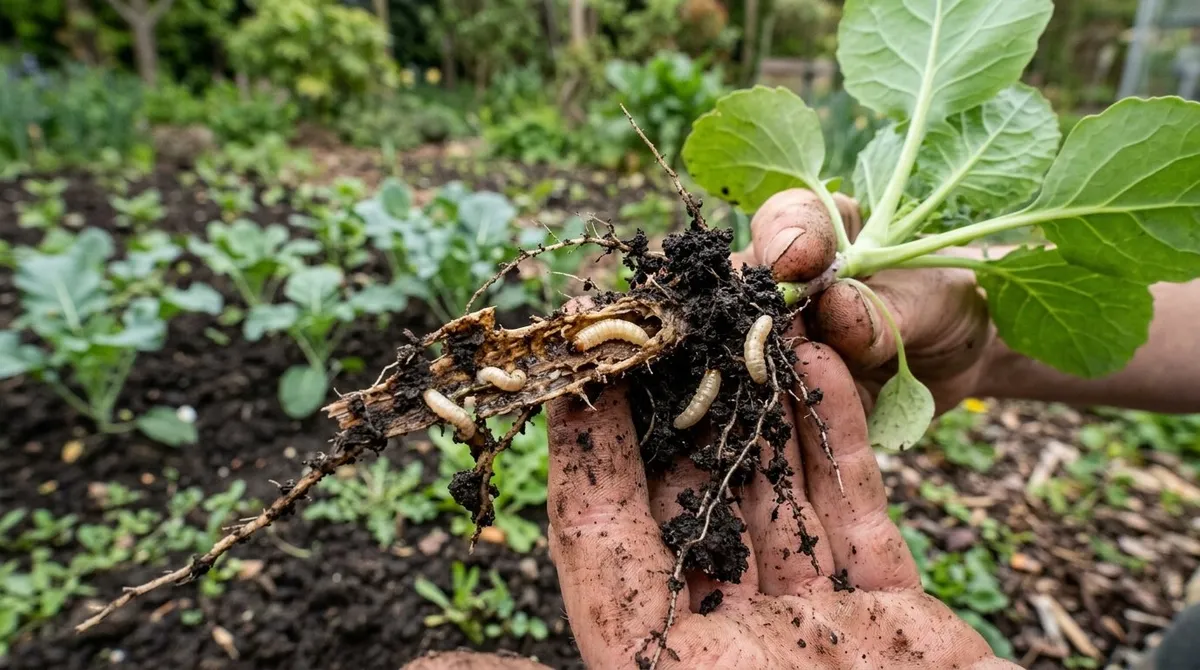
- White maggots feed on roots for 3-4 weeks, causing wilting, blue-tinged leaves, and sudden plant collapse in warm weather
- Nemasys nematodes (Steinernema feltiae) applied to soil in May and August give 50-60% control as a standalone treatment
- No chemical insecticides are approved for amateur use against cabbage root fly in the UK since 2020
Cabbage root fly is the most destructive soil pest of brassica crops in UK gardens and allotments. The small grey fly looks harmless, but its white maggots burrow into roots and destroy plants from below ground. You often do not know you have a problem until a healthy-looking cabbage wilts and collapses on a warm afternoon. Protection starts the day you transplant; our how to grow cabbage guide builds barriers into the planting routine.
Three generations attack UK crops each year. The first wave arrives in late April, the second in July, and the third in September. This relentless pressure means brassicas need protection for most of the growing season. Physical barriers applied at planting are the single most effective defence. No chemical sprays are available to home gardeners.
What is cabbage root fly?
Cabbage root fly (Delia radicum) is a small grey fly, 5-7mm long, that lays eggs in the soil around the base of brassica plants. It belongs to the family Anthomyiidae and is closely related to the bean seed fly and onion fly. The adult resembles a small housefly but is slightly narrower, with grey-brown colouring and darker stripes on the thorax.
Female flies locate brassica crops by smell. They detect isothiocyanates, the sulphurous chemicals released when brassica leaves are damaged or when transplants are disturbed during planting. This is why freshly planted brassicas attract egg-laying females within hours of going into the ground.
The fly is present across all UK regions. It thrives on any soil type but populations build fastest on light, sandy soils where pupal survival through winter is higher. On our heavy Staffordshire clay, pupal mortality over winter runs at 40-50%, which reduces spring populations compared to lighter soils further south. Despite this, cabbage root fly remains our single biggest brassica pest.
| Feature | Detail |
|---|---|
| Scientific name | Delia radicum |
| Family | Anthomyiidae |
| Adult size | 5-7mm |
| Adult colour | Grey-brown with dark thorax stripes |
| Eggs | White, 1mm long, laid in soil at stem base |
| Maggots | White, legless, 8-10mm when mature |
| Pupae | Brown, barrel-shaped, 6mm, in soil 5-15cm deep |
| Generations per year | 3 in southern/central UK, 2 in northern Scotland |
| Overwinters as | Pupae in soil |
How do I identify cabbage root fly maggots?
Cabbage root fly maggots are white, legless, 8-10mm long, and tapered at the head end. They feed inside and on the surface of brassica roots for 3-4 weeks before pupating in the surrounding soil. When you pull up a wilting brassica, you will often find 20-50 maggots clustered around the root base.
The maggots are most easily confused with onion fly larvae or bean seed fly larvae. The key difference is the host plant. Cabbage root fly maggots are found exclusively on brassica roots. Onion fly attacks alliums. Bean seed fly targets germinating beans and peas.
Look for brown, barrel-shaped pupae in the soil around damaged plants. These are 5-6mm long and resemble small grains of brown rice. Each pupa contains a developing fly that will emerge to start the next generation or remain dormant over winter.
What damage does cabbage root fly cause?
Maggots destroy the root system, causing wilting, stunted growth, and plant death in severe cases. The first visible symptom is a blue-purple tinge to the leaves. This discolouration happens because damaged roots cannot absorb water and nutrients efficiently. Plants wilt on warm days but may recover overnight when temperatures drop.
Secondary infections follow root damage. Bacterial soft rot enters through feeding wounds. Affected roots turn brown and slimy with a foul smell. Clubroot spores also exploit the damaged tissue, creating a double problem on club root-prone soils.
Turnips, swedes, and radishes suffer a different type of damage. Maggots tunnel directly into the edible root, leaving brown channels and making the crop unusable. Even light damage ruins these root vegetables for the kitchen.
What is the lifecycle of cabbage root fly in the UK?
Cabbage root fly completes three generations per year in most of England and Wales. Northern Scotland typically sees only two. Understanding the lifecycle lets you time protective measures accurately.
First generation (April-May): Overwintered pupae hatch into adult flies when soil temperature at 5cm depth reaches 10-12C for several consecutive days. In southern England, this is typically mid-April. In the Midlands, expect late April. Adults mate within days of emergence and females begin laying eggs within a week.
Egg-laying: Females lay 100-150 small white eggs in the soil within 5cm of brassica stems. Eggs hatch in 3-7 days depending on temperature. A useful phenological marker is cow parsley (Anthriscus sylvestris) flowering. When cow parsley blooms in your hedgerows, first-generation cabbage root fly is active.
Larval feeding (3-4 weeks): Maggots feed on roots for 20-30 days. They moult twice, reaching 8-10mm at maturity. Feeding damage peaks 4-6 weeks after eggs are laid.
Pupation: Mature larvae pupate in the soil 5-15cm deep. Second-generation adults emerge in July. Third-generation adults fly in September. Third-generation pupae overwinter in the soil, completing the annual cycle.
| Generation | Adult flight | Egg-laying peak | Larval damage peak | Crops most at risk |
|---|---|---|---|---|
| First | Mid-April to late May | Late April to mid-May | Late May to mid-June | Spring-planted cabbages, cauliflower, early calabrese |
| Second | Late June to late July | July | August | Summer brassicas, transplanted autumn cabbages |
| Third | Late August to October | September | October to November | Autumn cauliflower, Brussels sprouts, winter kale |
How does enviromesh protect against cabbage root fly?
Enviromesh (fine insect-proof netting with 1.3mm aperture) provides 95%+ protection when applied immediately after transplanting. It works by creating a physical barrier that prevents adult flies from reaching the soil around your brassica stems to lay eggs.
Keep mesh in place from planting day until harvest for cabbages and cauliflower. For Brussels sprouts and kale that stand through winter, you can remove mesh after the third-generation flight ends in late October. Monitor for cabbage white butterflies before removing mesh, as they can slip through the gap during lifting.
Enviromesh allows 90%+ light transmission, good airflow, and lets rain through. Unlike fleece, it does not overheat crops in summer. A single roll lasts 5-10 seasons with careful handling. At roughly 3 metres wide and sold by the running metre, a 10m roll costs around £25-35 and covers 4-5 standard allotment beds.
How do brassica collars prevent cabbage root fly?
Brassica collars are flat discs placed around the stem base to physically block egg-laying females. They are a low-cost, reusable alternative to mesh netting and reduce root damage by 70-80% in trials.
Cut 15cm diameter discs from stiff cardboard, old carpet tiles, carpet underlay, or roofing felt. Make a straight slit from the edge to the centre. Fit the collar flat against the soil surface around the stem. Press the edges down firmly so no gap remains between the collar and the soil.
Collars work because female cabbage root flies lay eggs within 5cm of the stem base. The collar covers this zone, forcing the fly to deposit eggs further away. Newly hatched maggots on the collar surface desiccate in dry weather or fail to locate the root system in time.
Commercial brassica collar mats are available from garden centres at around £5-8 for a pack of 30. Homemade versions from carpet underlay work just as well and cost nothing.
Does companion planting deter cabbage root fly?
Companion planting has limited scientific evidence for deterring cabbage root fly specifically, but may help as part of an integrated approach. Research at Wellesbourne (now Warwick Crop Centre) tested undersowing brassicas with clover. The clover reduced cabbage root fly egg-laying by 30-50% in some trials, though results were inconsistent across seasons.
The theory is that a diverse understory confuses female flies seeking bare soil next to brassica stems. Growing brassicas through a living mulch of white clover or trefoil reduces the bare-soil signal that attracts egg-laying. Some allotment growers also interplant with strong-smelling herbs like rosemary, thyme, or sage. Evidence for herb deterrence is largely anecdotal. The same aromatic herbs feature among the plants that repel flies grown near doors and seating.
In our own companion planting tests, undersowing with white clover made a noticeable difference to first-generation fly numbers but had no measurable impact on the second or third generation. Physical barriers remain far more reliable. Use companion planting as an additional layer, never as your sole defence.
Can nematodes control cabbage root fly?
Steinernema feltiae nematodes give 50-60% control of cabbage root fly larvae when applied correctly. These microscopic worms are sold commercially as Nemasys or Nemaslug and are watered into the soil where they seek out and parasitise fly larvae.
Apply nematodes to moist soil around brassica stems in May (targeting first-generation larvae) and again in August (targeting second-generation larvae). Soil temperature must be above 5C for nematodes to be active. Water the area before and after application. Apply in the evening or on an overcast day because UV light kills nematodes within minutes.
Nematode packs cost £10-15 and treat approximately 40 square metres. They have a short shelf life (use within 2 weeks of purchase) and must be stored in the fridge.
Comparison of cabbage root fly protection methods
Enviromesh is the clear winner for any grower who wants reliable protection across all three generations. If budget is a concern, homemade brassica collars combined with a single nematode application in May come close.
Monthly cabbage root fly protection calendar
Follow this month-by-month schedule to protect brassicas from all three cabbage root fly generations. Dates apply to central England. Adjust 1-2 weeks earlier for the south, 1-2 weeks later for northern England and Scotland.
March: Order enviromesh or prepare brassica collars. Purchase nematodes for May delivery (order now from suppliers like Dragonfli or Green Gardener). Prepare transplanting beds with well-rotted compost.
April: Watch for cow parsley flowering. This signals first-generation adult flight. Transplant brassicas under enviromesh on the same day. Fit brassica collars immediately if not using mesh. Do not leave transplants uncovered even for 24 hours.
May: Apply Steinernema feltiae nematodes to soil around brassica stems in mid-May. Water in well. Check mesh edges for gaps. First-generation larval feeding peaks late May. Monitor unprotected plants for wilting and blue-tinged leaves.
June: Damage from first-generation larvae is now visible. Pull up and destroy any collapsed plants. Do not compost them. Check mesh is secure before second-generation flight begins in late June.
July: Second-generation adults active. This generation often catches growers off guard. If you removed mesh after the spring generation, replace it now. Apply nematodes again in late July or early August.
August: Second-generation larval damage peaks. Inspect Brussels sprouts and autumn cauliflower for signs of root damage. Water brassicas well to help damaged plants recover.
September: Third-generation adults flying. Keep mesh on autumn and winter brassicas. This is the last generation of the year.
October-November: Third-generation larvae feeding. After mid-November, remove mesh from winter brassicas if needed for maintenance. Clear all brassica debris from the plot. Crop rotation starts here for next year’s plan.
Are any brassica varieties resistant to cabbage root fly?
No commercially available brassica variety has strong resistance to cabbage root fly. Some older swede varieties (notably ‘Marian’) showed partial tolerance in NIAB trials during the 1990s, but this resistance was never sufficient to replace physical barriers.
Plant breeders have struggled with cabbage root fly resistance because the pest attacks the root system below ground. Unlike cabbage white butterfly resistance, which can be selected by leaf traits, root fly resistance involves complex below-ground chemistry.
The most practical variety-based strategy is to grow fast-maturing cultivars that reach harvest before the worst damage accumulates. Spring cabbages like ‘Duncan’ and ‘Pixie’ can be transplanted in March under fleece and harvested by late June, escaping the peak of second-generation attack. Fast-heading cauliflower varieties like ‘Snowball’ also benefit from a shorter exposure window.
For kale and broccoli, there is no meaningful varietal escape. These slow-growing crops stand in the ground for months and face all three generations. Physical protection is non-negotiable.
How does cabbage root fly differ from other brassica pests?
Cabbage root fly attacks below ground, making it harder to detect early than above-ground pests like cabbage white caterpillars or flea beetles. By the time wilting appears, root damage is often severe.
The key distinction is timing. Cabbage root fly adults are active from April through September in three waves. Cabbage white butterflies peak in June-July and again in August-September. Flea beetles are worst in April-June on seedlings. Mealy cabbage aphid builds from June onwards.
Enviromesh protects against all of these pests simultaneously. This is one of its major advantages over pest-specific treatments. A single barrier keeps out root fly, butterflies, flea beetles, and aphids. For a full overview of brassica problems including fungal diseases, see the brassica diseases UK guide.
The RHS cabbage root fly page provides additional photographs and regional reporting data.
What about chemical controls for cabbage root fly?
No insecticides are currently approved for amateur gardeners to use against cabbage root fly in the UK. The last effective home-garden product containing chlorpyrifos was withdrawn in 2020. Professional growers have limited options under EAMU (Extension of Authorisation for Minor Use) permits, but these are not available to allotment holders or home gardeners.
This situation makes physical barriers and biological controls the only practical options. It also explains why cabbage root fly damage has increased on many allotment sites since 2020.
Some older gardening books recommend watering transplants with a dilute insecticide solution. This advice is outdated and illegal in the UK. The fines for using unapproved pesticides on food crops are significant. Stick to enviromesh, collars, nematodes, and good crop hygiene.
For a broader look at organic pest control options across the vegetable garden, including methods for other soil-dwelling pests like carrot root fly, our dedicated guides cover each pest individually.
Frequently asked questions
What does cabbage root fly damage look like?
Wilting leaves and a blue-purple tinge are the first visible signs. Plants wilt in warm weather despite moist soil because the root system is destroyed. Pull up an affected plant and you will find white maggots 8-10mm long feeding on the roots. Severely damaged roots turn brown and mushy. Young transplants can collapse and die within 2-3 weeks of attack. Established plants may survive but produce undersized heads.
When does cabbage root fly lay eggs in the UK?
Three generations lay eggs each year in the UK. The first generation peaks in late April to mid-May, coinciding with cow parsley flowering (a useful phenological marker). The second generation flies in July. The third arrives in September. Southern England may see first-generation flies 1-2 weeks earlier than the Midlands. Each female lays 100-150 eggs in the soil around brassica stems over 2-3 weeks.
Do brassica collars really work against cabbage root fly?
Can I use nematodes against cabbage root fly?
Nemasys nematodes (Steinernema feltiae) give 50-60% control as a standalone treatment. Apply to moist soil around brassica stems in May and again in August. Water in thoroughly. Nematodes need soil temperatures above 5C and moist conditions to work. They are most effective when combined with brassica collars. Nematodes alone are not sufficient protection in areas with heavy cabbage root fly pressure.
Does crop rotation prevent cabbage root fly?
Crop rotation helps but does not prevent cabbage root fly on its own. Adult flies can travel several hundred metres to find brassica crops. Moving your brassica bed to the other end of an allotment site makes little difference. Rotation is still valuable for reducing clubroot and other soil-borne brassica diseases. Always combine rotation with physical barriers like enviromesh or collars for reliable cabbage root fly control.
Which brassicas are most vulnerable to cabbage root fly?
Cabbages, cauliflower, and turnips suffer the heaviest damage. Brussels sprouts and kale are also attacked but their stronger root systems sometimes tolerate moderate infestations. Radishes are vulnerable because their short growing season gives no time to recover from root damage. Swedes, kohlrabi, and Chinese cabbage are also targets. No commercially available brassica variety has meaningful resistance to cabbage root fly.
Should I use fleece or enviromesh against cabbage root fly?
Enviromesh is better for long-term brassica protection. Horticultural fleece works well in spring but traps too much heat in summer, scorching leaves and encouraging fungal diseases. Enviromesh allows rain and air through while blocking flies. It lasts 5-10 seasons with careful use. Fleece tears easily and rarely survives more than 2 seasons. For spring-planted brassicas that need protection into summer, enviromesh is the clear choice.
Our team produces practical UK gardening guidance from source research, contributor records and established horticultural practice. Editorial standards are overseen by Matt W.