Key takeaways
- Annual weed; spreads by 15,000 seeds per plant
- Identify: oval leaves opposite each other, line of hairs on one side of stem
- Edible and nutritious; high in vitamin C and iron
- Hoe at 2-4 leaf stage before flowering
- Mulch heavily to suppress germination
- Seed bank persists 10 years; expect ongoing emergence
Chickweed (Stellaria media) is the UK garden’s most common annual weed. Each plant produces 15,000 seeds and the seed bank persists 10+ years. This guide covers identification (the line of hairs on the stem is the diagnostic), the hoeing technique that prevents seed set, and the edible-foraging angle for gardeners who want to make use of the plant rather than just remove it.
Identifying Chickweed in the UK
Chickweed grows year-round in UK gardens but is most active March-May and August-October.
Diagnostic features:
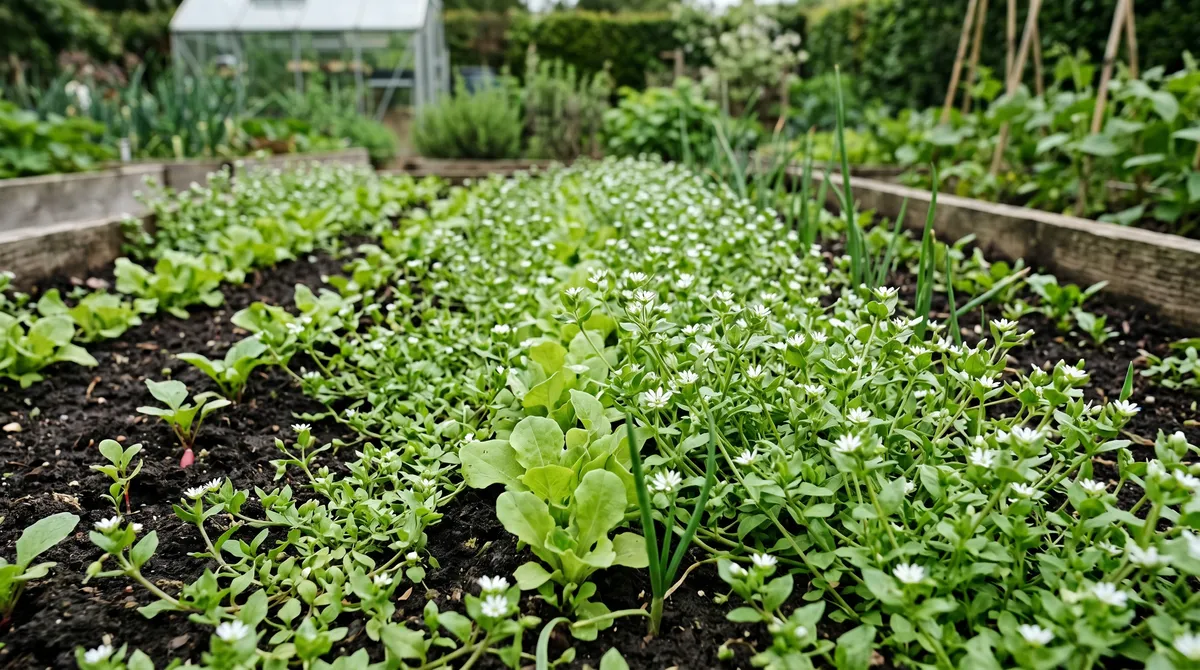
- Small oval pointed leaves, 10-25mm long, opposite each other on the stem
- Sprawling habit, forming mats 200-400mm across
- Tiny white star-shaped flowers with 5 deeply notched petals (appearing as 10 petals)
- Single line of fine hairs running down one side of each stem segment (rotates side at each node)
- Pale green colour, slightly succulent stems
- Often grows in shaded damp positions
The line of hairs is the unmistakable test. Run a finger along a stem; one side is hairy, the other smooth. The line swaps sides at each pair of leaves. This is unique to true chickweed.
Plants commonly confused with chickweed:
| Plant | Key differences |
|---|---|
| Common mouse-ear (Cerastium fontanum) | Hairy all over, leaves narrower |
| Pearlwort (Sagina procumbens) | Tiny leaves, no flowers visible |
| Speedwell (Veronica species) | Blue flowers, not white |
| Forget-me-not seedlings | Hairy stems, rough leaves |
If in doubt, look for the hair-line and the star-shaped flower. Both confirm chickweed.
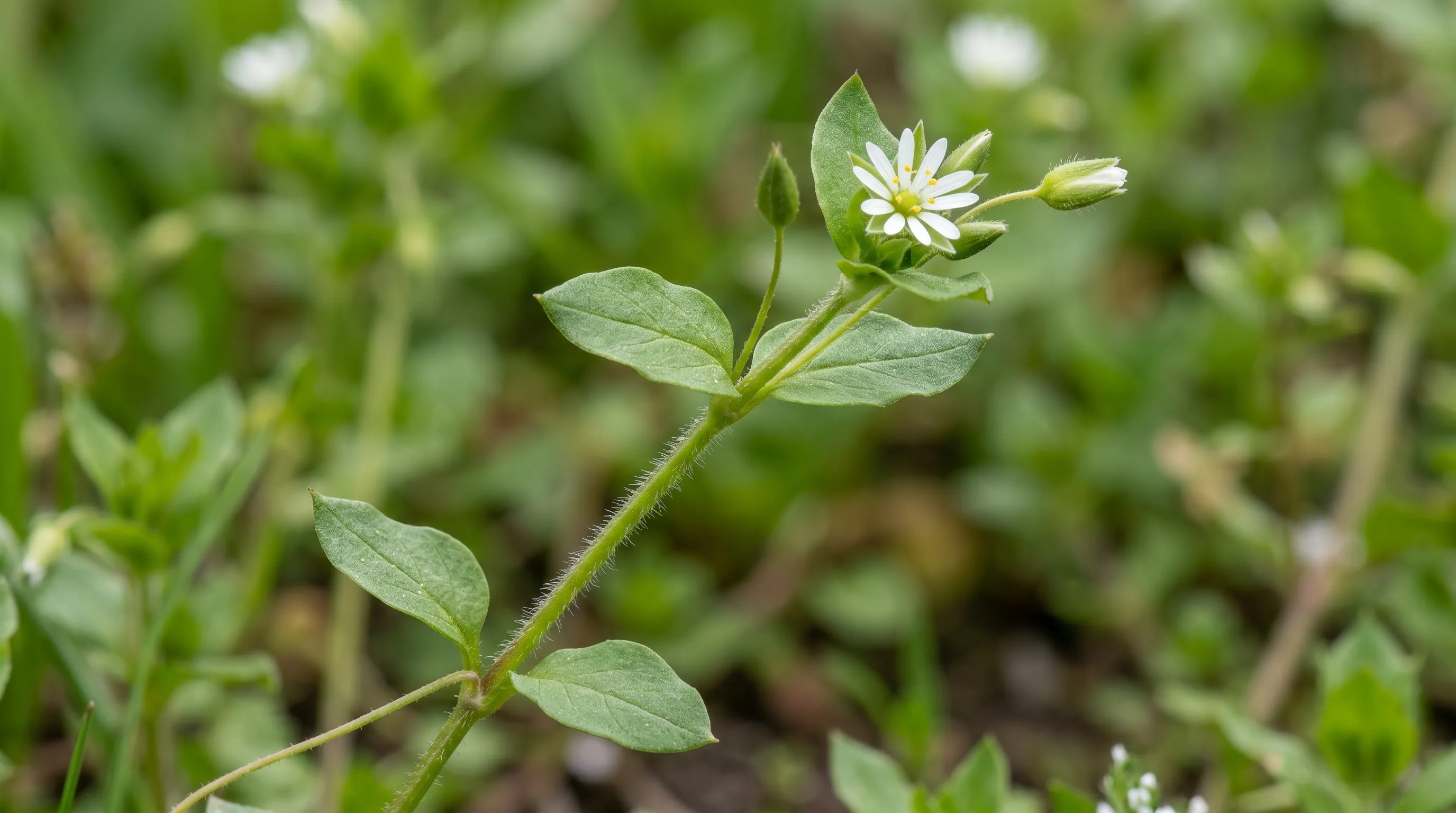 The diagnostic line of hairs on a UK chickweed stem. Hairs run down only one side, swapping sides at each node. Combined with star-shaped white flowers and opposite oval leaves, this confirms Stellaria media.
Chickweed Lifecycle and Seed Bank
Understanding the lifecycle explains why control is ongoing.
Stage 1 (germination): Seeds germinate at 5-12C soil temperature. UK windows: late February-May, August-November.
Stage 2 (vegetative growth): Plant produces 20-100mm of stem and 4-8 leaves over 14-21 days.
Stage 3 (flowering): Starts at 4-6 weeks old. White flowers open for 1 day each. Self-pollinating.
Stage 4 (seed set): Seed pods form within 3-5 days of flowering. Each plant produces 15,000+ seeds over its lifetime.
Stage 5 (seed dispersal): Pods split open, throwing seeds 100-300mm. Animals and shoes spread seeds further.
Stage 6 (seed dormancy): Seeds enter soil and remain viable for 10+ years. Each soil disturbance triggers new germination.
The Hoeing Technique
The single most effective UK chickweed control.
Timing:
- Hoe weekly through the active season (March-May, August-October)
- Catch plants at 2-4 leaf stage before flowering
- Soil should be dry on the surface; wet soil causes plants to re-root
- Sunny morning is ideal
Method:
- Use a Dutch hoe or oscillating hoe (not draw hoe)
- Hold at shallow angle, 25-50mm depth
- Slice through stems at soil level with light back-and-forth motion
- Leave cut plants on the soil surface to die in the sun
- In wet weather, rake the cut plants off the bed
- 15-30 minutes per 100m² for thorough coverage
Best hoes for UK chickweed:
- Wolf-Garten Dutch hoe (£25-£40): the UK classic
- Burgon and Ball stirrup hoe (£18-£28): cuts in both directions
- Felco oscillating hoe (£35-£55): premium, lasts decades
- Hand-held onion hoe (£8-£15): for tight spaces between rows
For the wider UK garden weed defence, our weedkillers guide covers the chemical-free approach across UK weed species.
Mulch as Long-Term Suppression
A thick mulch reduces chickweed germination by 70-90% by blocking light from reaching surface seeds.
Effective UK mulches for chickweed:
| Mulch | Depth | Effectiveness | Lifespan |
|---|---|---|---|
| Bark chip | 75-100mm | 80-90% | 2-3 years |
| Garden compost | 50-75mm | 70-85% | 12-18 months |
| Grass clippings | 50-75mm | 75-90% | 6-12 months |
| Leafmould | 50-75mm | 70-85% | 12-18 months |
| Cardboard + grass | Multi-layer | 90-95% | 6-12 months |
| Gravel | 50-75mm | 60-75% | 5+ years |
| Black plastic | n/a | 95%+ | 1-2 years |
For UK ornamental borders, the cardboard plus grass mulch combination gives 90%+ control while improving soil structure. For the cardboard plus grass technique, our mulching guide covers the lasagne layer method.
For UK vegetable beds, the gap between rows is the chickweed habitat. Use grass clippings or leafmould 50mm thick between crop rows. Refresh after rain.
Edible Chickweed: The Forager’s Angle
Chickweed is one of the most useful UK edible weeds.
Nutritional content (per 100g raw):
- Vitamin C: 60-80mg (more than spinach)
- Iron: 5-8mg (more than spinach)
- Calcium: 80-120mg
- Vitamin A: 5,000 IU
Culinary use:
- Young tips raw in salads (mild grassy flavour)
- Lightly steamed as a vegetable
- Added to omelettes, soups and stews
- Pesto base alternative to basil
- Tea (high in vitamin C for winter use)
Pick safely:
- From clean garden soil, never lawns treated with weedkiller
- Away from road verges and dog-walking areas
- Wash thoroughly before use
- Avoid older flowering stems (tougher and slightly bitter)
For UK gardeners wanting to grow chickweed deliberately, allow a small dedicated patch in a shaded corner. The harvest from 1m² provides 4-6 salads per week through the active season.
Lawn Chickweed: Different Tactics
Chickweed in UK lawns needs different management to bed chickweed.
Methods:
- Hand-pull large patches with a daisy grubber. Reseed bare patches immediately.
- Regular mowing at 25-35mm weakens chickweed and favours grass.
- Selective weedkiller (dicamba, mecoprop-P): apply in spring or autumn when chickweed actively growing.
- Improve grass density: overseed thin patches; chickweed cannot establish in dense turf.
- Lawn feed boosts grass growth, crowds out chickweed.
The combined approach (mow + feed + overseed + selective spot-treat) clears UK lawn chickweed in 12-18 months.
For the wider UK lawn care, our lawn feeding guide covers grass density management.
Common Mistakes With UK Chickweed Control
Mistake 1: pulling and composting. Plants re-root, seeds inside half-formed flowers ripen. Hoe and remove from the bed.
Mistake 2: hoeing in wet soil. Cut plants re-root within 24-48 hours. Hoe in dry weather.
Mistake 3: ignoring the 2-4 leaf window. Plants at 8-leaf stage have already initiated flowers. Hoe early and often.
Mistake 4: expecting eradication. Seed bank persists 10+ years. Plan ongoing annual control.
Mistake 5: spraying garden chickweed before identification. Confirm with the line-of-hairs test before treating. Several look-alikes need different control.
For the wider weed control across UK garden problems, our organic guide covers the toolkit. For the supporting cardboard plus grass mulch, our mulching guide covers the layer method.
Chickweed Calendar UK Month-by-Month
| Month | Chickweed task |
|---|---|
| January | Winter emergence in mild gardens; spot-hoe |
| February | Early spring flush; weekly hoeing begins |
| March | Peak spring growth; hoe weekly |
| April | Peak flowering season; intense hoeing |
| May | Continued hoeing; mulch ornamental beds |
| June | Reduced growth in summer heat |
| July | Light hoeing only |
| August | Autumn flush begins; resume weekly hoeing |
| September | Peak autumn growth |
| October | Continued hoeing through autumn |
| November | Reduced growth; final autumn hoe |
| December | Light winter monitoring |
Related reading: Hoeing fails against bulbil-forming weeds, see our guide to getting rid of lesser celandine.
Frequently asked questions
How do I identify chickweed in the UK?
Small oval pointed leaves growing opposite each other on a sprawling stem. Tiny white star-shaped flowers with five deeply notched petals (looks like 10 petals). Diagnostic feature: a single line of hairs runs down one side of each stem segment. Grows close to the ground in mats up to 400mm across.
Is chickweed edible?
Yes. Chickweed is highly edible and nutritious, containing more vitamin C and iron than spinach by weight. Use young tips raw in salads or lightly cooked. Mild grassy flavour. Pick from clean garden ground only, not from chemically treated lawns or near roads.
How do you kill chickweed in a UK lawn?
Hand-pull large patches with a daisy grubber. Mow regularly to weaken plants. Selective weedkillers (containing dicamba, mecoprop-P) work on established lawn chickweed. Improve grass density to crowd it out. Repeated mowing alone reduces but does not eliminate chickweed.
Will chickweed come back after weeding?
Yes. The seed bank persists in UK soil for 10+ years. Each disturbance triggers new germination. Annual control reduces populations 60-80% per year over 3-4 seasons but eradication is rare. Plan for ongoing management rather than one-off clearance.
When is the best time to hoe chickweed?
At the 2-4 leaf stage, before flowering begins. This is typically 3-5 weeks after seed germination. UK growing windows: March-May spring flush, August-October autumn flush. Weekly hoeing across the active season catches plants before they set seed.
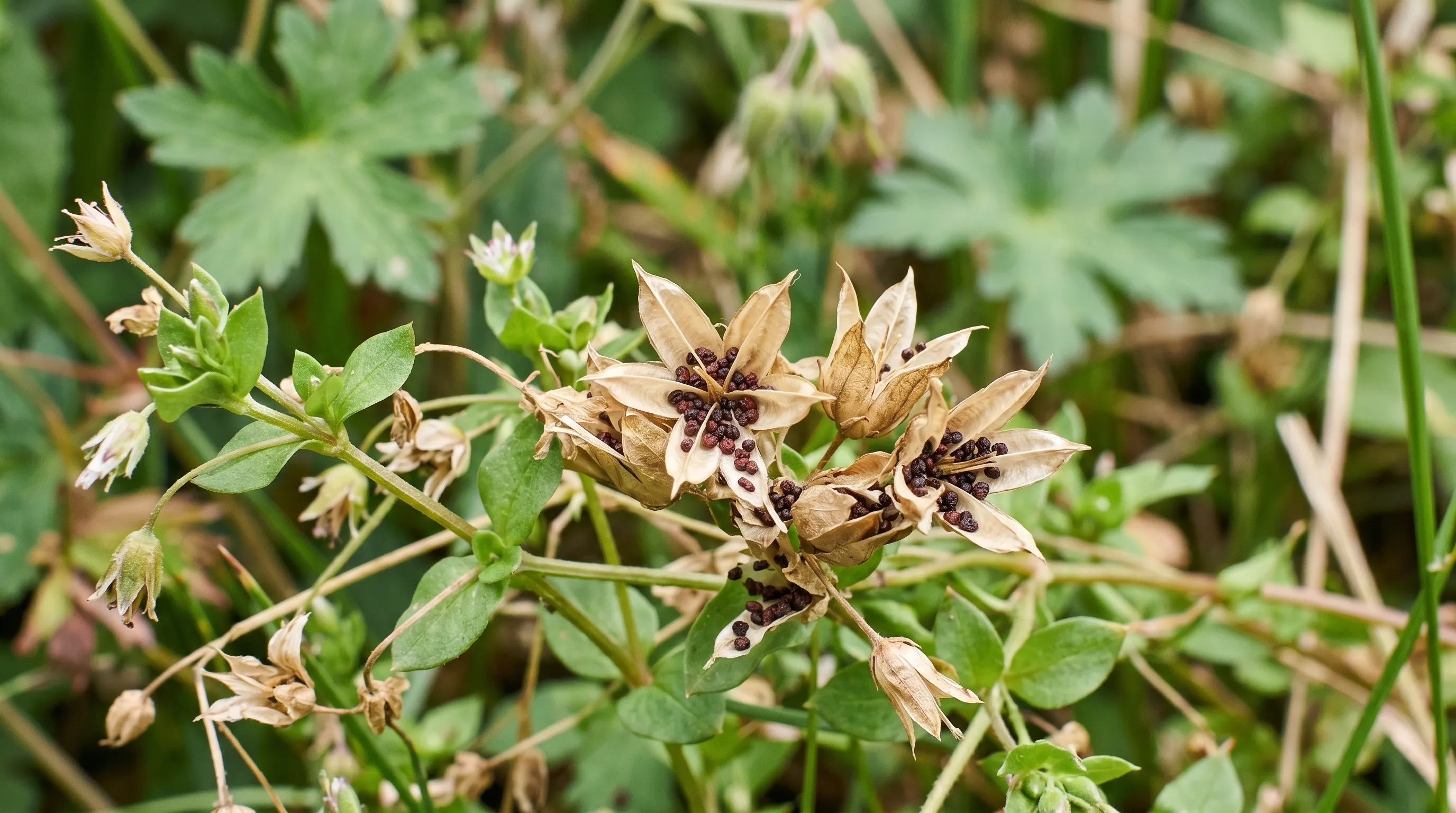 Chickweed seed pods at the explosive dispersal stage. Each pod holds 6-15 seeds. A single mature plant produces 15,000+ seeds across its lifetime. Catching plants before this stage is the goal of weekly hoeing.
Now plan the wider annual weed defence
Chickweed is one of several UK annual weeds. Hairy bittercress needs similar early action, but its exploding pod control guide shows a different dispersal problem. For the wider organic weed control toolkit, our weedkillers guide covers the chemical-free approach. For the no-dig mulch that suppresses germination, our mulching guide covers the cardboard plus grass technique. To rebuild lawns where chickweed has thrived, our feed lawn UK guide covers grass density management. And for the broader plot weed-defence plan, our organic pest control guide covers the wider framework.
Our team produces practical UK gardening guidance from source research, contributor records and established horticultural practice. Editorial standards are overseen by Matt W.