Key takeaways
- Black tar-like spots with yellow halos on acer leaves
- Largely cosmetic; does not kill trees or affect growth
- Most common UK acer leaf disease
- Worst on sycamore (Acer pseudoplatanus) and Norway maple
- Control: rake and remove fallen leaves in autumn
- Increased since 1990 due to UK air quality improvement
Acer tar spot (Rhytisma acerinum) is the UK garden’s most-photographed but least-damaging leaf disease. Large black tar-like spots with yellow halos appear on sycamore, Norway maple and other acers from July onwards. The disease looks alarming but is largely cosmetic. This guide covers identification, why it’s worse than it looks isn’t true, the autumn raking control, and why UK air-quality improvements have actually increased tar spot since 1990.
Identifying UK Acer Tar Spot
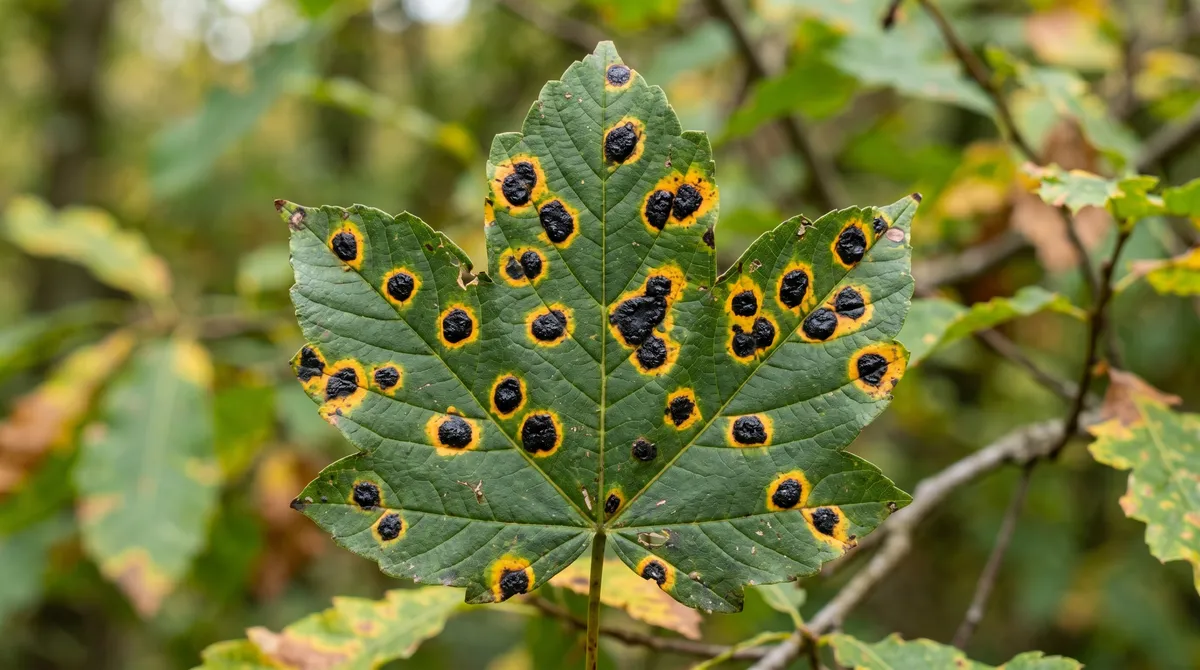
The black tar-like spots are unmistakable.
Diagnostic features:
- Raised black spots 10-20mm diameter on leaf upper surface
- Tar-like or asphalt appearance, slightly raised from leaf surface
- Yellow halo around each spot
- Appears from July onwards; persists until leaf fall
- Most common on sycamore in UK; also Norway maple, Field maple
- Multiple spots per leaf in heavy infections
The yellow halo distinguishes tar spot from other leaf blackening issues like aphid sooty mould (which is sticky and removes by washing).
Plants commonly confused with tar spot:
| Plant condition | Key differences |
|---|---|
| Sooty mould | Sticky, washes off, no yellow halo |
| Acer leaf scorch | Brown not black, leaf edges affected |
| Verticillium wilt | Whole-leaf yellowing, no spots |
| Anthracnose | Brown lesions, no tar texture |
If it’s black, raised, tar-textured and has yellow halo, it’s acer tar spot.
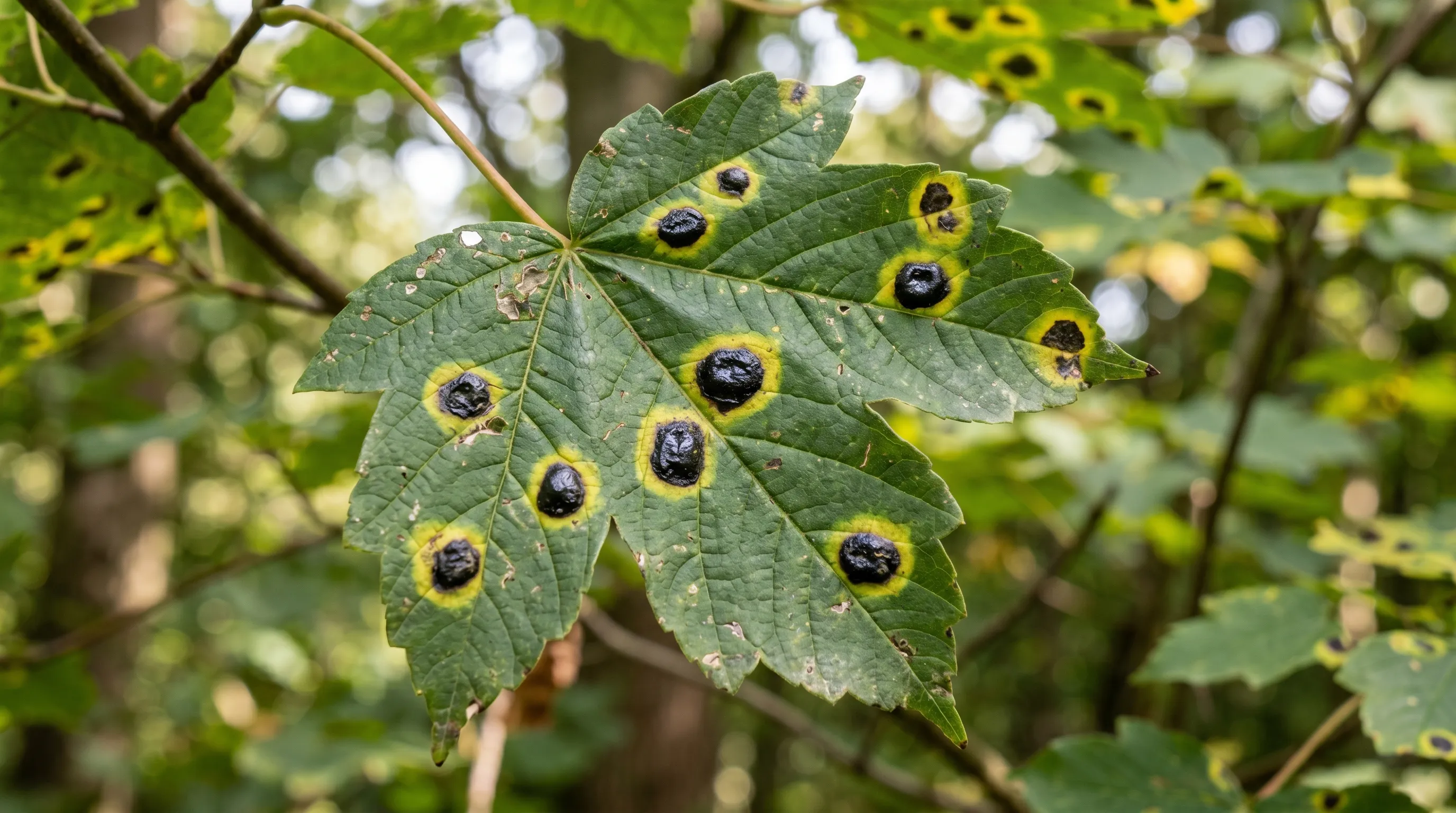 Classic UK acer tar spot on a Staffordshire sycamore leaf in late August. Raised black tar-like spots with yellow halos. Multiple spots per leaf on heavily infected trees. Cosmetic only; the tree continues to grow normally.
The Rhytisma Lifecycle
The fungus has a simple annual cycle.
Autumn-winter: Spores mature inside dead fallen leaves on the ground.
Spring (April-June): Spore-bearing structures rupture and release wind-borne spores. Spores travel to emerging leaves of the host tree.
Summer (July-August): Spots become visible on infected leaves. Spots grow and mature.
Autumn (September-November): Infected leaves fall. Spores overwinter inside the dead leaves.
The critical control point is breaking the autumn-winter overwintering stage. Removing fallen leaves eliminates 40-60% of next spring’s spore release.
Why Tar Spot Is Not a Problem
UK long-term studies show no measurable harm from tar spot.
What the disease does NOT do:
- Kill trees (not a single recorded UK tree death from tar spot alone)
- Reduce annual growth rate
- Reduce flowering or seed production
- Spread to non-acer species
- Damage timber or wood quality
What the disease DOES do:
- Make leaves look unsightly from July onwards
- Cause some early leaf-drop in heavily infected trees (3-5 weeks early)
- Spread between neighbouring acer trees
For UK gardeners with acer trees, the practical advice is: accept the appearance. The tree is fine.
Autumn Leaf Raking: The Only Useful Control
If tar spot bothers you cosmetically, autumn leaf raking helps.
Method:
- Wait for full leaf fall (typically late October-November)
- Rake all leaves from under the tree and adjacent area (5m radius)
- Bag in sealed black plastic for landfill, or burn on a hot fire
- Never compost (spores survive composting)
- Repeat annually for compounding effect
Time investment: 30-60 minutes per medium tree per autumn. Cost: £0 (just disposal bags).
Why UK Tar Spot Has Increased
UK acer tar spot has spread significantly since 1990, counterintuitively due to improved air quality.
The science:
- Rhytisma acerinum fungus is highly sensitive to sulphur dioxide
- UK SO2 emissions dropped 95% since 1990 (Clean Air Act, coal phase-out)
- Pre-1990 industrial UK had near-zero tar spot in cities
- Post-2000 clean UK air has allowed tar spot to spread to all regions
Tar spot is actually a biological indicator of clean UK air. If your acer has bad tar spot, the local air quality is good. If a city park sycamore has clean leaves, check for nearby SO2 sources.
This is an unusual case where an improvement in UK environment has produced a visible “decline” in tree appearance. The trees are healthier; only the leaves look worse.
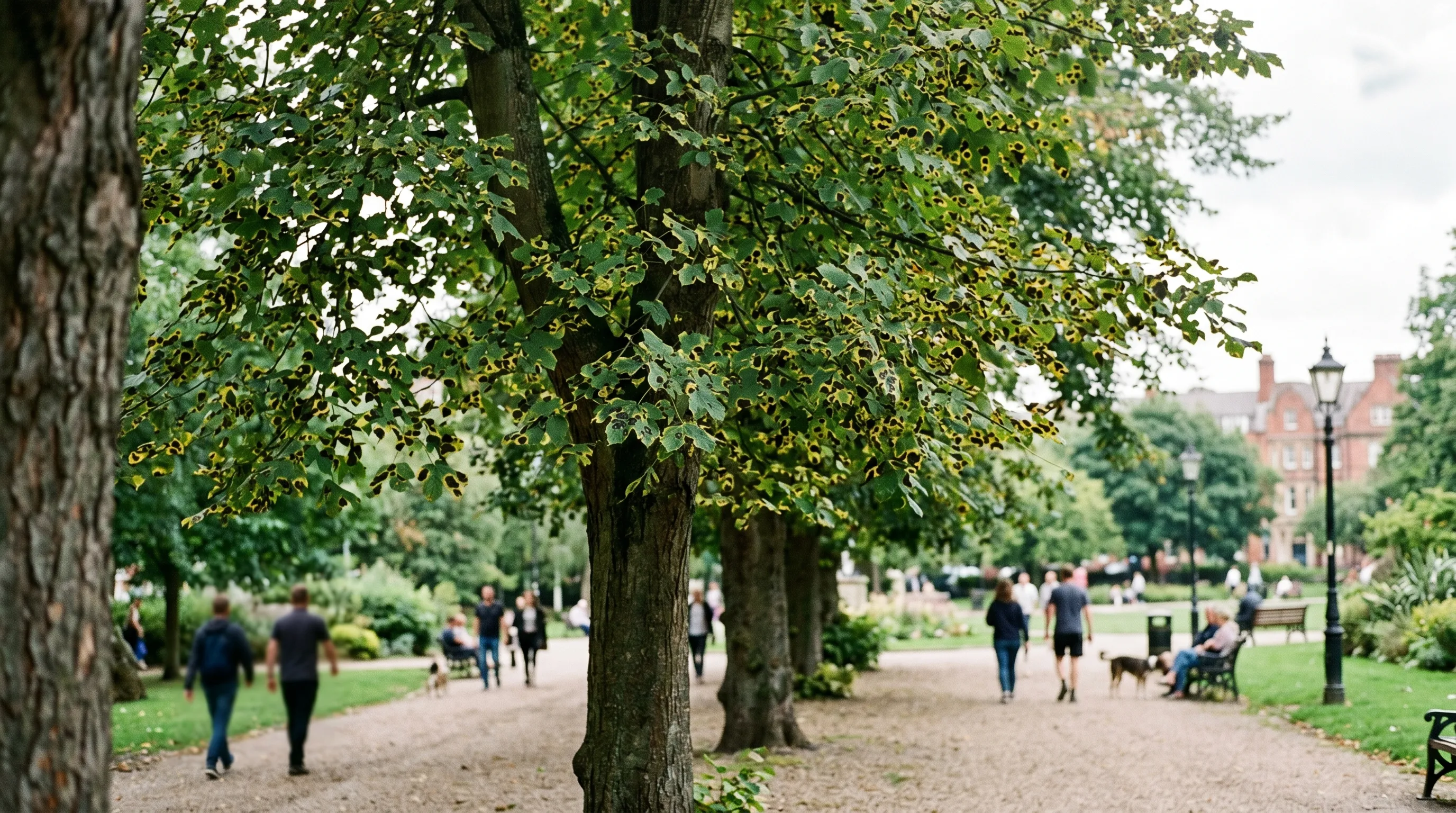 Acer tar spot on a Staffordshire town centre sycamore in August. Spots visible on every leaf. Counterintuitively, this is a sign of clean UK air; the fungus could not survive in the high SO2 environments of pre-1990 cities.
Variety Choice for Low Tar Spot Gardens
Some UK acers are far less affected.
Highly susceptible:
- Sycamore (Acer pseudoplatanus) – the worst
- Norway maple (A. platanoides) – moderate to severe
- Field maple (A. campestre) – moderate
Rarely affected:
- Japanese maple (A. palmatum) – very rare
- Paperbark maple (A. griseum) – rare
- Snake bark maples (A. davidii, A. capillipes) – rare
- Vine-leaved maple (A. cissifolium) – rare
For new UK garden plantings in areas with high tar spot pressure, choose Japanese maples and Asian species. They give acer foliage interest without the tar spot pattern.
For the wider UK tree selection for small gardens, our small tree guide covers acer alternatives.
Common Mistakes With UK Acer Tar Spot
Mistake 1: spraying fungicides. Tar spot fungus is inside the leaf; sprays cannot reach it. Wasted money.
Mistake 2: pruning affected branches. Removes nothing useful; the disease is on every leaf.
Mistake 3: composting fallen leaves. Spores survive composting. Sealed-bag disposal.
Mistake 4: panicking about tree health. Tar spot does not harm the tree. Cosmetic only.
Mistake 5: planting sycamore in heavy tar spot areas. Choose Japanese maple instead.
For the wider UK small garden tree options, our small tree guide covers alternatives. For related leaf and fungal disease management, our scab guide covers a more impactful UK leaf disease.
Acer Tar Spot Calendar UK Month-by-Month
| Month | Tar spot task |
|---|---|
| January | No action; spores dormant on fallen leaves |
| February | Plan autumn raking schedule |
| March | Watch for spring spore release |
| April | Early leaves emerging; first infection possible |
| May | No visible symptoms yet |
| June | First spots may appear in warm years |
| July | Spots typically appearing |
| August | Peak visible spot development |
| September | Heavily affected leaves may drop early |
| October | Main autumn leaf fall |
| November | Peak raking and disposal window |
| December | Complete sanitation before winter |
Frequently asked questions
What is the black spot on my acer leaves?
Acer tar spot (Rhytisma acerinum), a fungal leaf disease affecting UK sycamore, Norway maple and other acer species. Black tar-like raised spots up to 20mm across, often surrounded by a yellow halo. Appears from July, persists until leaf fall. Cosmetic only.
Will tar spot kill my acer tree?
No. UK trials and long-term studies show no growth reduction or tree death from acer tar spot even on severely infected trees. The disease affects leaf appearance but the tree continues to grow normally. Infected leaves still photosynthesise around the spots.
How do I treat acer tar spot?
Rake and remove all fallen leaves in autumn. The fungus overwinters on dead leaves and releases spores the following spring. Removing leaves breaks the cycle and reduces next year’s infection by 40-60%. No spray treatment is needed or effective.
Why has tar spot got worse in recent years?
UK air quality improvement since 1990 has actually increased tar spot. The fungus is sensitive to sulphur dioxide pollution. As UK SO2 emissions dropped 95% since 1990 (Clean Air Act and coal phase-out), tar spot fungus has spread to previously clean areas.
Which acer trees get tar spot?
Sycamore (Acer pseudoplatanus) is the most commonly affected UK tree. Norway maple (A. platanoides) and Field maple (A. campestre) also susceptible. Japanese maple (A. palmatum) and most Asian acer species are rarely affected. Variety choice matters for low-tar-spot UK gardens.
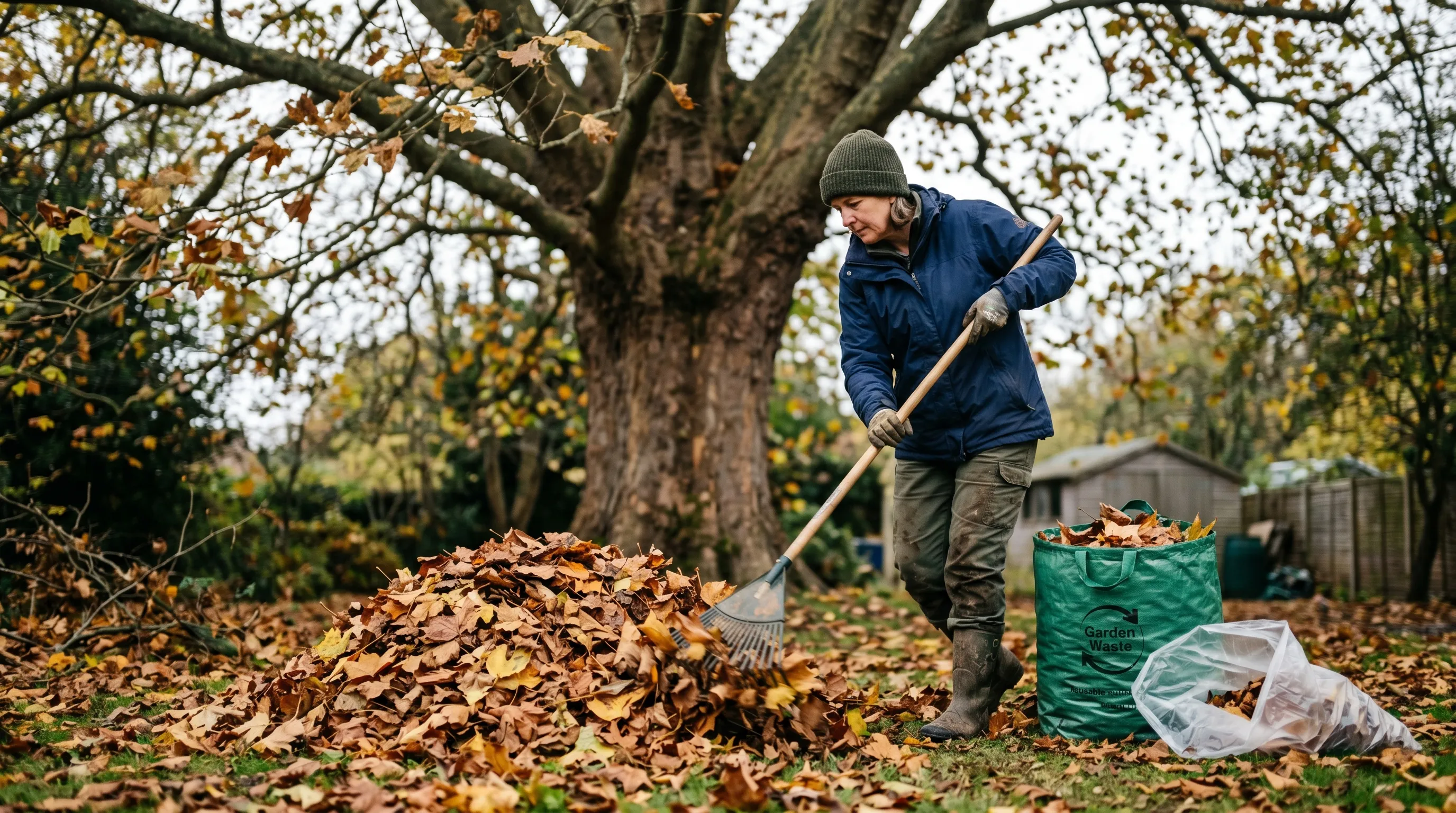 The autumn rake under a Staffordshire sycamore. All fallen leaves collected from within 5m of the trunk. Sealed-bag disposal to landfill or hot burn pile. 40-60% reduction in next year’s tar spot.
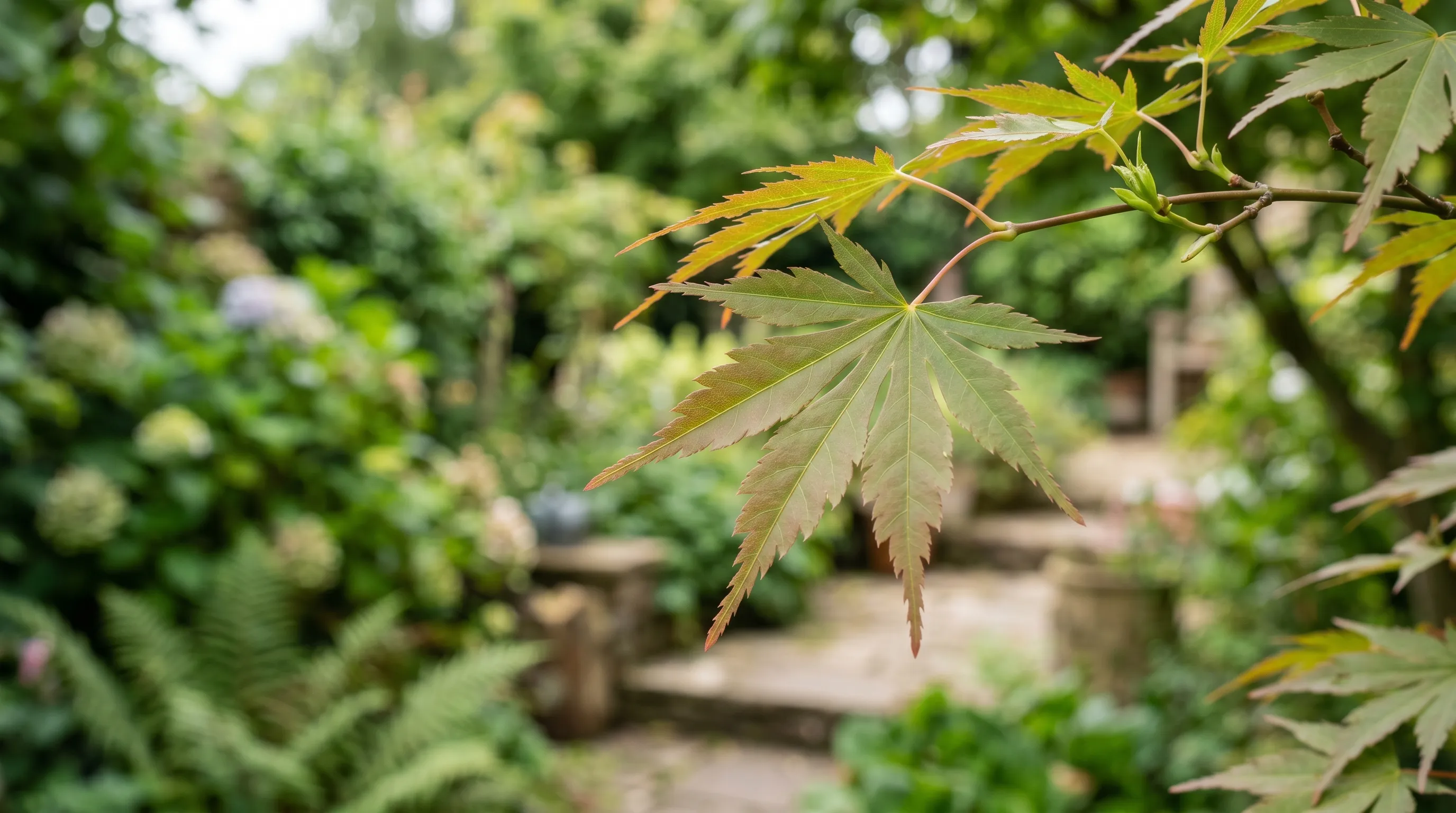 A clean Japanese maple (A. palmatum) leaf at Staffordshire in late August. The Asian acer species are rarely affected by tar spot. Variety choice gives acer interest without the cosmetic disease.
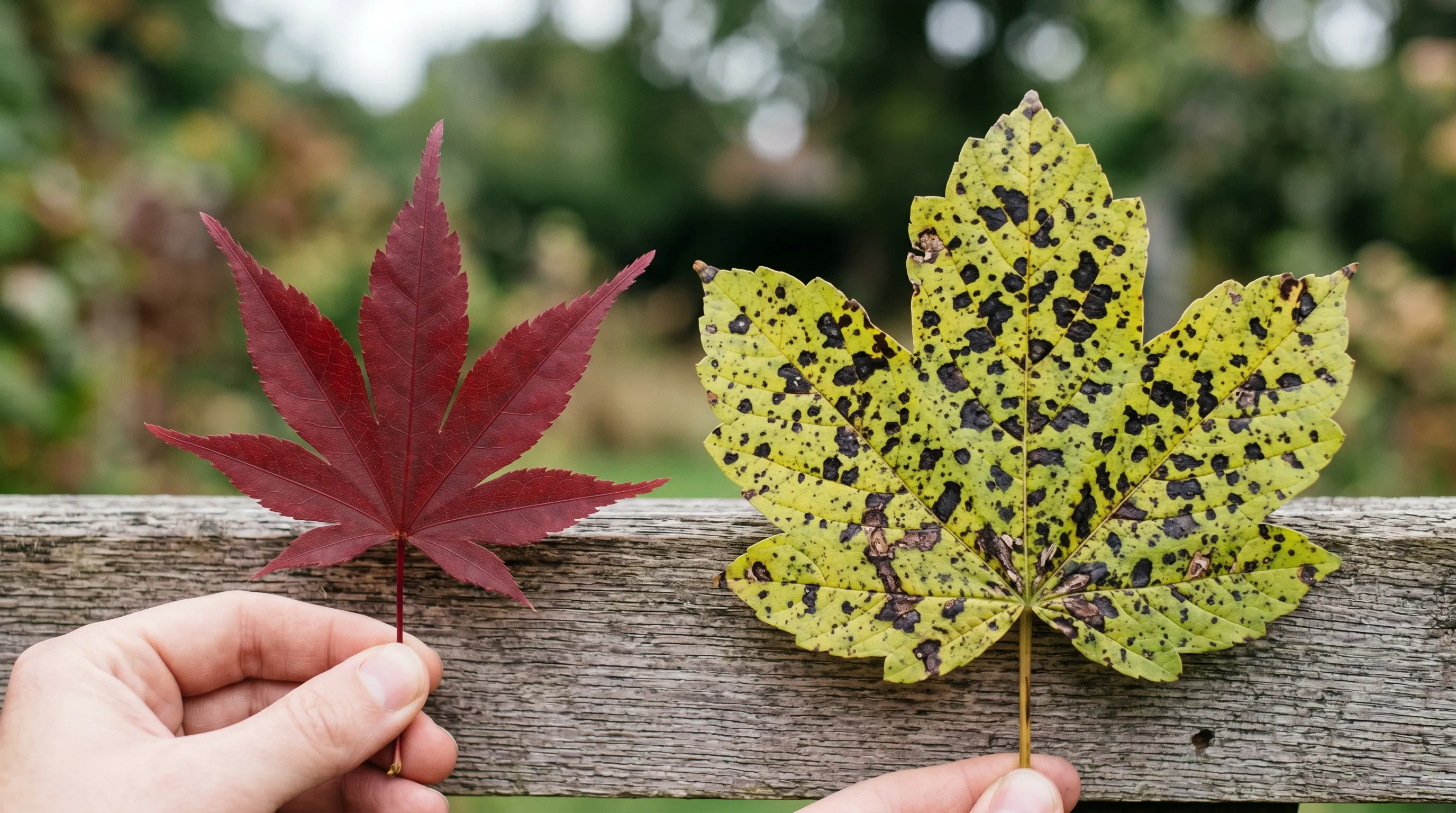 Variety susceptibility comparison. Heavily-affected UK sycamore leaf (left) versus clean Japanese maple leaf (right) both in late August. The 30-50x susceptibility difference is the strongest argument for variety choice in new UK gardens.
Now plan the wider acer and tree health
Our team produces practical UK gardening guidance from source research, contributor records and established horticultural practice. Editorial standards are overseen by Matt W.