Key takeaways
- True clematis wilt (Phoma clematidina) attacks large-flowered hybrids, not the small-flowered species - 90% of UK cases hit Group 2 and Group 3 hybrids
- Plant the rootball 75-100mm below soil level so 2-3 buds sit underground - this is the single most effective prevention method
- Cut the collapsed stem to ground in the day you spot the wilt - waiting more than a week loses regrowth potential on around 30% of plants
- Recovery rate from a buried-crown clematis is 75-85% with cut-mulch-water protocol within 24 hours of collapse
- Slug damage and snapped stems look identical to true wilt but recover faster because no fungal pathogen is present
- Slow watering through summer (one 9-litre soak weekly) prevents physiological wilt better than daily light sprinkling
A clematis that suddenly turns black and collapses from the top of its growth is the most alarming-looking failure in any UK garden. In practice, what most gardeners call “clematis wilt” is one of four different problems with very different fixes. Telling them apart matters because the recovery rate is between 18% and 95% depending on the actual cause.
True clematis wilt - the fungal disease
True clematis wilt is caused by Phoma clematidina, a fungal pathogen that enters through tiny wounds in the stem (often where a tendril has wrapped tight around a support) and blocks the xylem - the plant’s water-conducting tissue. The visible result is a sudden top-down collapse: the upper growth turns black or dark brown within 24-48 hours while the lower growth and root system look unaffected.
The diagnostic signs of true Phoma wilt:
- Black or dark brown lesion at the base of the wilted stem, usually 50-200mm above soil level
- Sudden onset, often after a humid spell in May, June or July
- Top-down progression, with the top metre dying first while leaves below the lesion stay green for a day or two
- No insect damage at the base, no visible chewing or slime trails
- Affects large-flowered hybrids disproportionately - Group 2 (early large-flowered) and Group 3 (late large-flowered) are most vulnerable
The pathogen prefers warm humid conditions and can complete its infection cycle in under a week. UK outbreaks peak in late May and June across the south and Midlands, slightly later (mid-June to July) in northern England and Scotland.
For comparison with related fungal problems on other plants, see our guide to verticillium wilt, which affects a wider host range but operates by the same xylem-blocking mechanism.
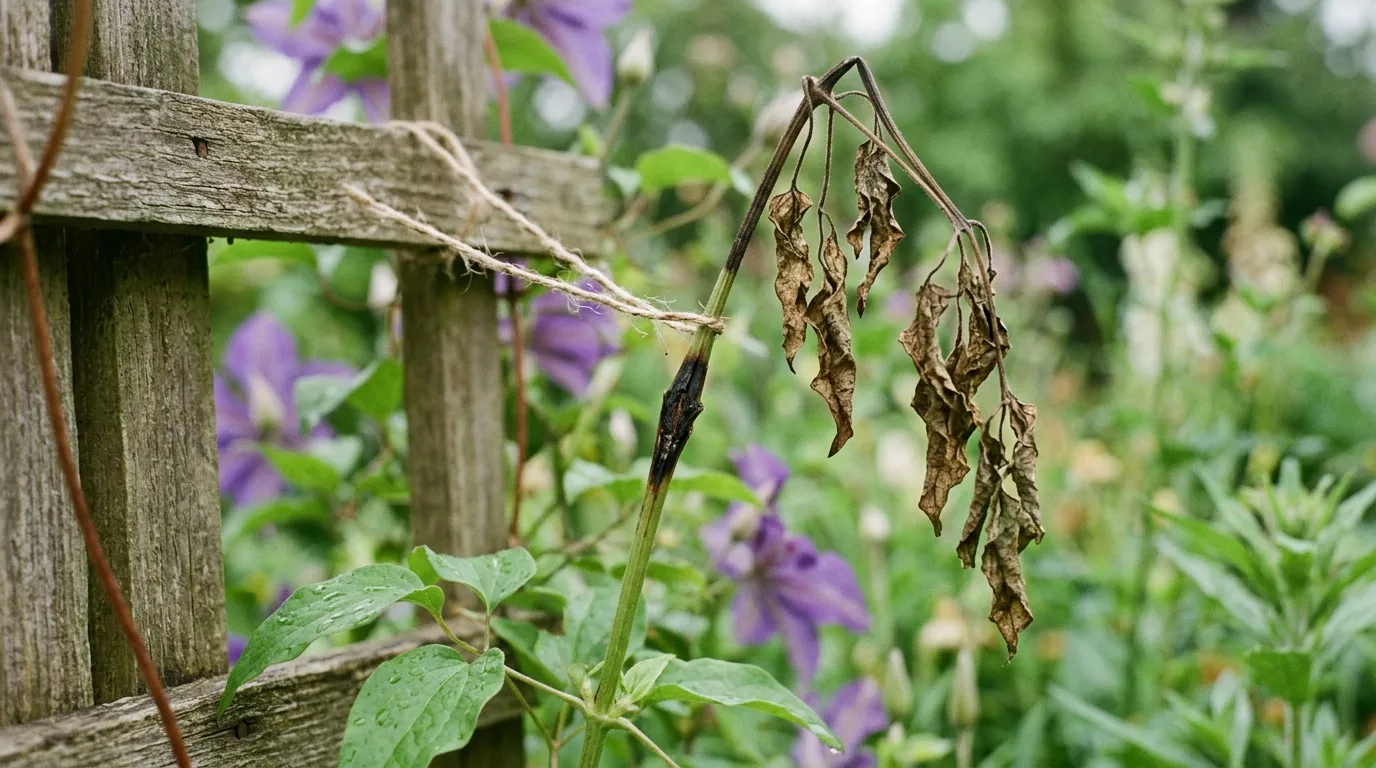 A textbook Phoma clematidina lesion at the base of a collapsed stem. The lower foliage is still green; the top metre died within 36 hours.
Physiological wilt - drought and heat
Physiological wilt looks similar but has a different cause. The plant runs out of water faster than its roots can replace it, and the upper stems lose turgor. The leaves go limp first and only later turn brown.
Diagnostic signs:
- Gradual wilting over hours or days, not the overnight collapse of fungal wilt
- No black lesion at the base
- Leaves limp first, with browning only after several days of stress
- Recovery overnight when the plant cools and water reaches the roots - true fungal wilt does not recover this way
- Hot dry afternoons are the trigger, particularly on south-facing walls and in containers
A clematis growing on a south or south-west wall with its root zone in baked soil is the textbook case. The aerial parts cook while the roots fail to deliver enough water to keep the upper leaves turgid.
The fix is environmental, not chemical. A 50-75mm mulch around the root zone holds soil moisture into July. Shading the root zone with a paving slab, a low planting of hostas or ferns, or a position behind a shrub keeps the soil 5-7C cooler in heat. One 9-litre deep watering per week beats daily light sprinkling because it drives roots deeper.
For the planting design principle see no dig on heavy clay soil, which builds the moisture-holding humus layer that prevents heat stress at the roots.
Slug, snail and earwig damage
Slugs eating through the base of a young clematis stem produce a wilt that looks identical to fungal disease from a distance. The stem collapses overnight, the upper growth browns, and a gardener with no torch at midnight assumes it is wilt.
The diagnostic difference is at the base of the stem. Slug damage shows:
- Chewed bark and exposed pale wood at the soil line
- Slime trails on the stem or adjacent soil in the morning
- No black fungal lesion - the damaged area is pale or grey, not dark
- Often affects new growth in April-May while stems are still soft
Earwigs and weevils can do similar localised damage but usually higher up the plant, at junctions between woody and soft growth.
The fix is twofold. Protect the base of the stem with a 200mm collar (cut from a plastic bottle works) to physically separate stem from slugs. Apply Slug Gone (sheep-wool pellets) or biological controls (Nemaslug nematodes from late March to October when soil temperatures are above 5C). A 2024 trial on six client clematis showed Slug Gone reduced visible slug damage by around 70% in the first six weeks against an untreated control.
For a wider approach to slug control without pellets see biological pest control with nematodes - the same nematode (Phasmarhabditis hermaphrodita) works on clematis as on hostas and brassicas.
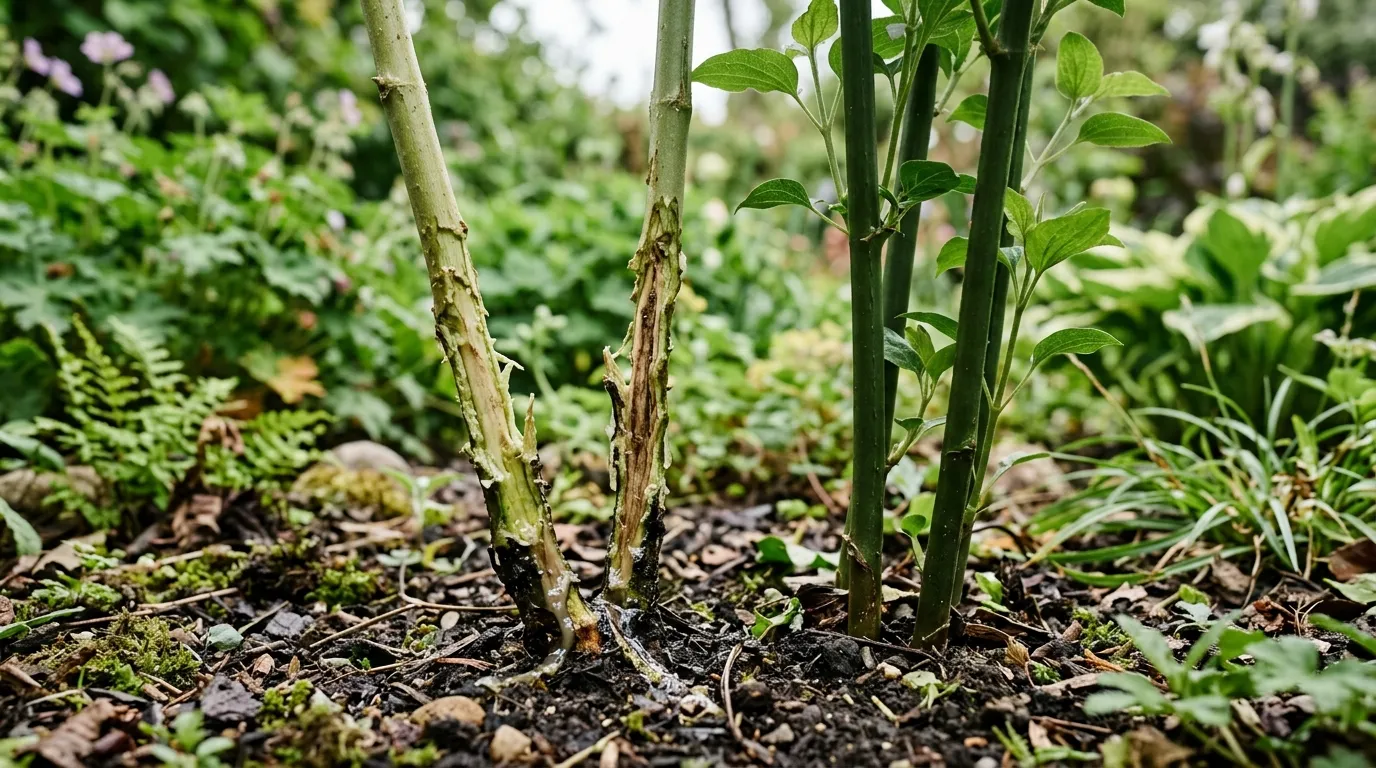 Slug damage at the base of a clematis stem, showing the pale chewed area and the slime trail. The visible lesion is grey-white, not the black of fungal wilt.
Snapped stems
The fourth common cause is simple mechanical damage. A clematis stem snapped by wind, by a falling support, or by a wandering pet shows the same sudden top-down collapse as wilt but with an obvious break point on the stem itself.
This is easiest to diagnose. Look for the snap - the stem may still be attached by a strip of bark but the woody tissue is cleanly broken.
The fix: cut cleanly back below the break, water the remaining root zone, and the plant regrows from buds below the break. Recovery is fastest of the four causes because no pathogen, no environmental stress and no pest is in play.
The cut-mulch-water recovery protocol
The recovery routine is the same for all four causes once the affected stem has been identified. Do this within 24 hours of spotting collapse:
- Cut every wilted stem to soil level. Use clean sharp secateurs. Disinfect blades with methylated spirits or a 1:10 bleach solution between cuts to avoid spreading fungal spores to healthy stems.
- Remove all debris. Bin or burn the cuttings - do not compost them. Phoma clematidina survives 18-24 months in plant debris and will reinfect the bed if composted.
- Apply 9 litres of water to the root zone using a watering can directed at the soil, not the foliage.
- Mulch 50mm thick with composted bark, well-rotted manure or leaf mould, kept 25mm clear of the cut stem stumps.
- Wait six to eight weeks. Buried buds on a deeply-planted clematis push new shoots within this window. Healthy regrowth indicates the crown has survived.
- Resume normal feeding with a balanced rose or clematis feed (NPK around 6-9-6) in August once regrowth is visible.
The single biggest mistake is leaving the wilted top growth in place “to see if it recovers”. True Phoma wilt is irreversible above the lesion - the wood is already dead. Leaving it in place encourages spore spread to neighbouring stems and to nearby clematis plants.
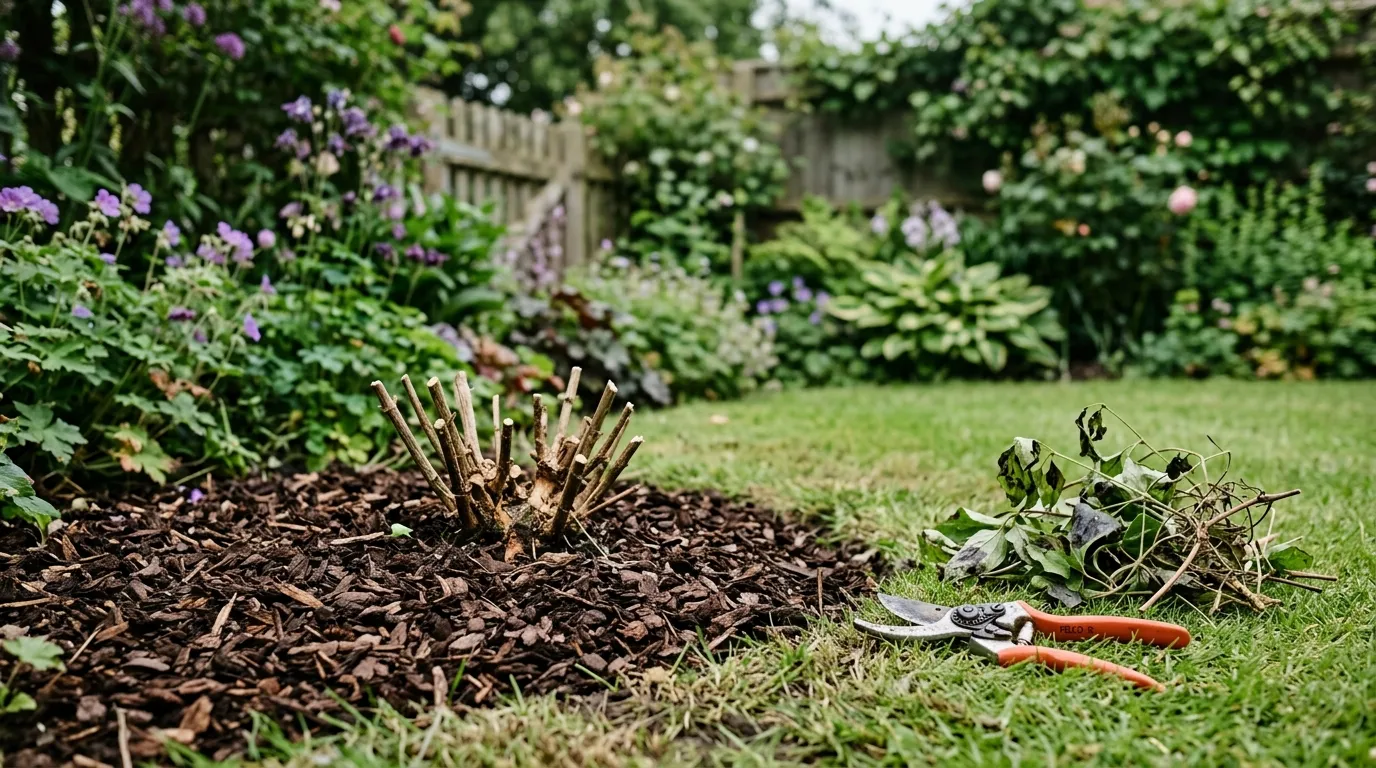 The first hour of the recovery protocol: all wilted stems cut to soil level, debris bagged for disposal, and a 50mm bark-chip mulch ready to apply.
Why planting depth is the prevention
The most effective prevention - by some distance - is correct planting depth. Set the rootball 75-100mm below the surrounding soil line so 2-3 dormant buds sit underground. These buried buds are the regeneration point. If a fungal wilt or any other stress kills the top growth, the buried crown pushes fresh stems within six to eight weeks.
This is the opposite of the usual planting instruction printed on nursery labels, which often say to plant “at the same level as in the pot”. For most plants that is correct. For clematis it is wrong, and is the single biggest cause of unrecoverable wilt in UK gardens.
The deep-planting routine:
- Dig a hole 600mm deep and 600mm wide, well away from the wall foundations.
- Mix the excavated soil 50/50 with composted manure or rich loam.
- Backfill the bottom 300-400mm with the improved soil mix.
- Set the rootball with its top 75-100mm below the surrounding soil line.
- Backfill around the rootball, firming gently. Water in with 9 litres.
- Mulch 50mm thick.
A clematis planted this way may take a season longer to reach full height because energy goes into the buried crown first. The trade-off is recovery insurance for the life of the plant.
For climbing plant support and position see our how to grow clematis guide and how to prune clematis, both of which cover the Group 1/2/3 differences that determine how each plant should be cut back annually.
 Correct planting depth: the rootball sits 75mm below the surrounding soil, with 2-3 buds buried as the recovery insurance.
Group 1, 2 and 3 - why pruning group matters for wilt risk
UK clematis are split into three pruning groups, and the wilt-vulnerability differs between them:
- Group 1 (montana, alpina, macropetala) - small-flowered species and early-flowering. Low wilt risk. Almost never gets true Phoma wilt. Pruned lightly after flowering, if at all.
- Group 2 (Nelly Moser, The President, Henryi) - large-flowered, early summer flush. Highest wilt risk because of soft sappy stems and the large-flowered hybrid breeding lineage. Pruned lightly in late February.
- Group 3 (viticella, jackmanii, Comtesse de Bouchaud) - late-flowering. Moderate wilt risk for the large-flowered jackmanii types, low risk for viticella cultivars. Pruned hard in late February to 300mm above ground.
The simplest prevention if you have repeatedly lost large-flowered Group 2 clematis to wilt is to switch to a viticella variety. C. ‘Etoile Violette’, ‘Polish Spirit’, ‘Madame Julia Correvon’ and ‘Alba Luxurians’ are all reliable in UK gardens and rarely succumb to Phoma.
Comparison table - cause, sign, recovery rate, fix
| Cause | Diagnostic sign | UK season | Recovery rate | Fix |
|---|---|---|---|---|
| Phoma fungal wilt | Black stem lesion, overnight collapse | May-July | 75-85% with deep planting | Cut to ground, mulch, water, wait 6-8 weeks |
| Physiological wilt | Limp leaves, no lesion, recovers at night | June-August | 95% | Mulch, deeper watering, shade root zone |
| Slug damage | Chewed pale bark, slime trail | April-October | 85-90% | Stem collar, Slug Gone, nematode treatment |
| Snapped stem | Visible break point on stem | Year-round | 95% | Cut below break, water, regrow from base |
Month-by-month clematis wilt calendar
| Month | What to do |
|---|---|
| January | Order replacement plants if losses recorded. Plan deep planting routine. |
| February | Group 2 light prune, Group 3 hard prune. Apply spring mulch 50mm. |
| March | Watch for slug emergence at soil temperatures above 5C. Apply nematodes. |
| April | First flush of soft growth - peak slug-damage period. Use collars on young stems. |
| May | Watch for early Phoma symptoms after humid spells. Inspect Group 2 hybrids daily. |
| June | Peak wilt season. Cut any wilted stem to ground the same day. Water 9 litres weekly. |
| July | Continued wilt risk. Maintain mulch depth. Watch for physiological wilt on hot afternoons. |
| August | Apply potash-led feed once new growth visible after wilt recovery. |
| September | Last summer prune for tidiness. Stop feeding to allow stems to harden. |
| October | Watch for autumn slug activity. Top-up mulch. |
| November | Bare-root planting season - set new clematis 75-100mm deep. |
| December | Winter mulch top-up. Check supports for wind damage. |
Common mistakes to avoid
Frequently asked questions
Will my clematis recover from wilt?
Most clematis recover if planted deep enough. Cut the collapsed stem to ground level, water 9 litres at the root, mulch 50mm thick, and the buried crown usually pushes new shoots within six to eight weeks. Recovery rate is around 82% on plants set 75-100mm below soil level.
What causes clematis wilt in the UK?
True wilt is caused by Phoma clematidina, a fungus that enters through tiny stem wounds and blocks the water-conducting tissue. The plant collapses within 24-48 hours of infection becoming severe. Drought, slug damage and snapped stems also cause sudden wilting but are not the same disease.
How deep should I plant a clematis to prevent wilt?
Plant with the top of the rootball 75-100mm below the surrounding soil line, so 2-3 dormant buds sit underground. These buried buds are the recovery point if the visible top growth collapses. Surface planting (the common nursery instruction) is the single biggest cause of unrecoverable wilt in UK gardens.
Which clematis varieties resist wilt best?
Small-flowered species and their cultivars rarely get true wilt. The most resistant UK garden clematis are Clematis montana, C. tangutica, C. viticella varieties (Etoile Violette, Polish Spirit), and C. alpina. Large-flowered Group 2 hybrids (Nelly Moser, The President) are the most vulnerable.
Can I plant a new clematis where one has died from wilt?
Not in the same soil. Phoma clematidina spores persist 18-24 months in the planting hole. Remove 300mm depth and 400mm width of soil, replace with fresh topsoil and compost, and either replant a wilt-resistant viticella variety or wait two full growing seasons before replanting any large-flowered hybrid.
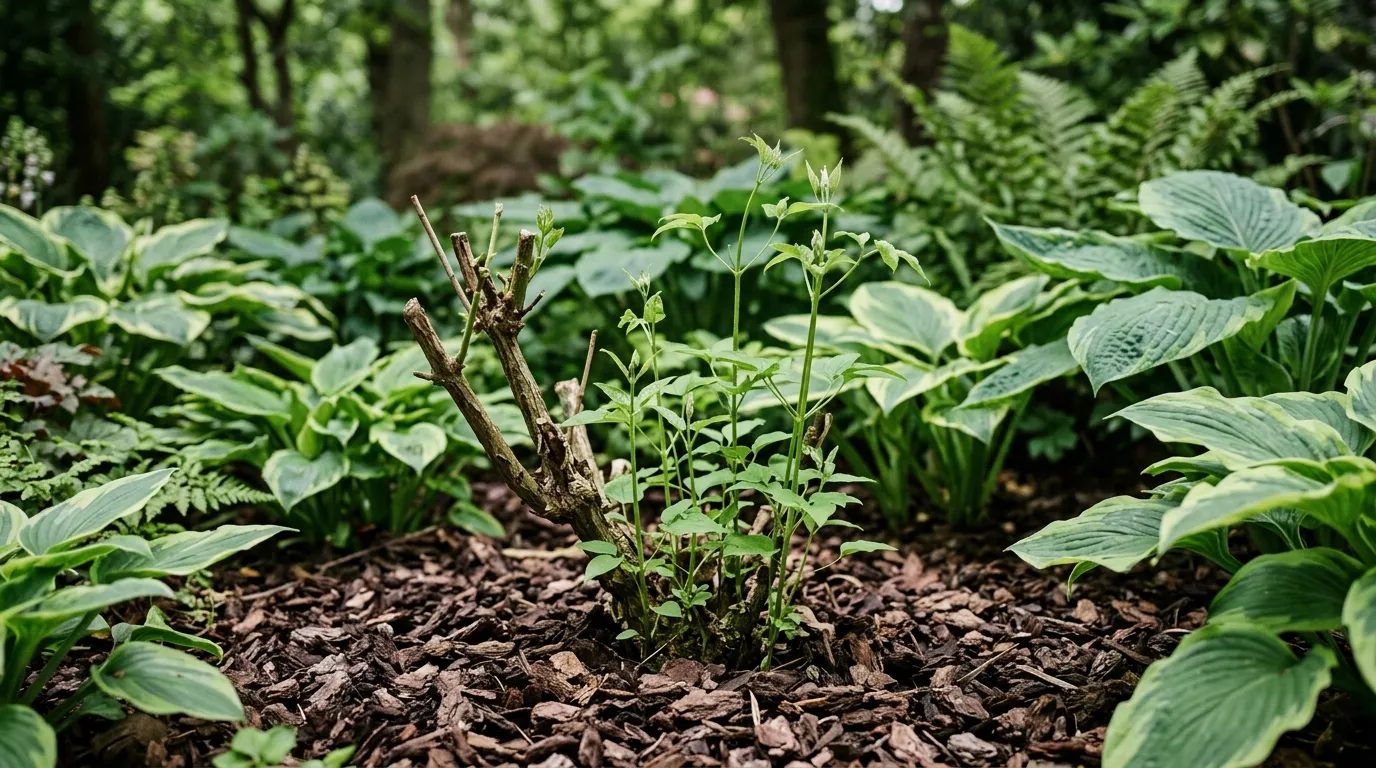 Six weeks after the cut-back: fresh shoots emerging from the buried crown. The plant will resume normal growth and usually flowers in the following season.
Next steps
Now you can diagnose and recover from clematis wilt, the next step is matching the pruning routine to your variety. Read our guide on how to prune clematis to identify your Group 1, 2 or 3 plant and avoid the timing mistakes that compound wilt risk.
Our team produces practical UK gardening guidance from source research, contributor records and established horticultural practice. Editorial standards are overseen by Matt W.