Key takeaways
- Codling moth adults fly from late May to July, laying eggs directly on developing apple and pear fruitlets
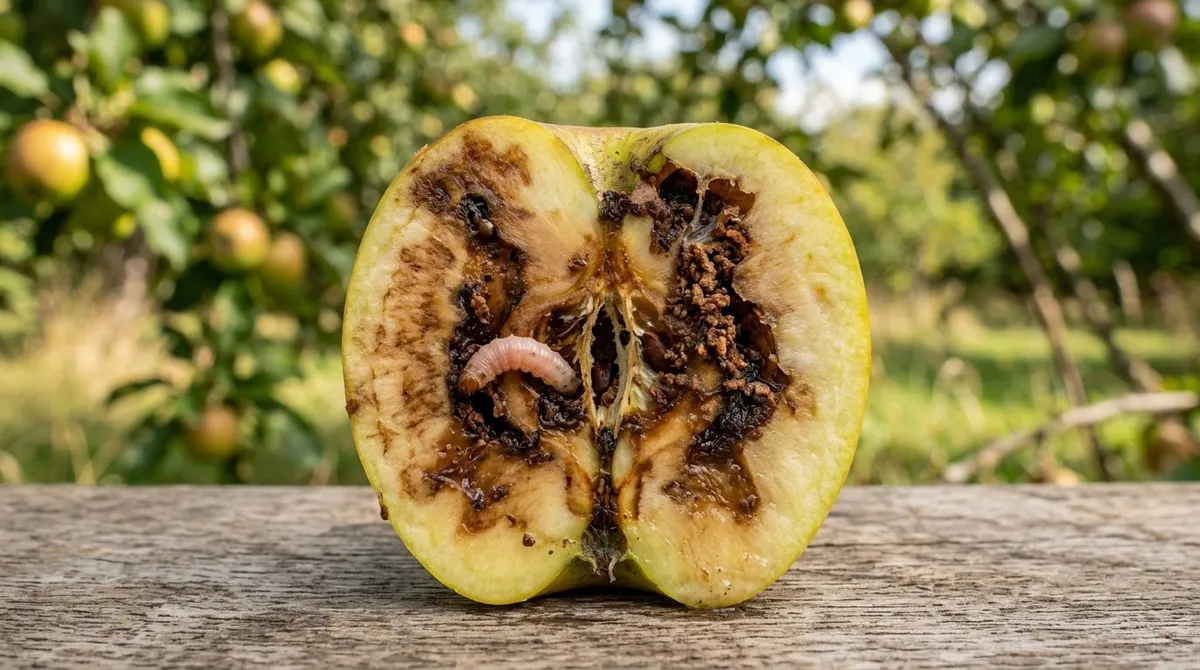
- Pink-white caterpillars tunnel into the fruit core and feed for 3-4 weeks, leaving brown frass at the base of the fruit
- Pheromone traps hung in late May monitor male moth numbers and help time spray applications accurately
- Codling moth granulovirus (CpGV) sprayed in mid-June kills newly hatched larvae before they enter the fruit
- Corrugated cardboard bands tied around trunks from July trap pupating caterpillars before they overwinter
- Nematodes (Steinernema carpocapsae) applied to soil and trunk bark in September-October target overwintering larvae
Codling moth is the most common cause of maggoty apples in UK gardens. The brown moth is rarely noticed, but its caterpillars tunnel into the core of developing fruit and feed there for weeks. By the time you bite into an affected apple and find the telltale brown frass and tunnelling, the caterpillar has usually left.
This pest attacks apples, pears, and occasionally walnuts. It is present across all UK regions. One generation hatches each year, with adults flying from late May into July. The damage is done by the caterpillar stage, which is hidden inside the fruit and beyond the reach of contact sprays. Successful control depends on accurate timing and a combination of monitoring, biological sprays, and physical traps.
What does codling moth look like?
The adult codling moth (Cydia pomonella) is 15-20mm wingspan, with grey-brown forewings marked by a distinctive copper-bronze patch at the wing tip. The hindwings are plain brown. At rest, the moth holds its wings flat along the body, making it look like a small piece of bark. Adults are active at dusk and night. They are rarely seen during the day.
The moth belongs to the family Tortricidae. It is native to Europe and Central Asia but has spread worldwide wherever apples are grown. In the UK, it is the single most important pest of apple crops in both commercial orchards and garden trees.
Adults emerge from overwintering pupae when evening temperatures consistently reach 15C, which in central England occurs from late May. Females produce a sex pheromone that attracts males over distances of up to 100 metres. After mating, each female lays 30-70 eggs singly on developing fruitlets and nearby leaves.
| Life stage | Appearance | Size | When found |
|---|---|---|---|
| Adult moth | Grey-brown, copper wing tip patch | 15-20mm wingspan | Late May to July |
| Egg | Flat, translucent disc on fruit or leaf surface | 1mm diameter | June to early July |
| Young larva | Cream-white with dark head | 2-3mm | Mid-June onwards |
| Mature larva | Pink-white body, brown head | 15-20mm | July to September |
| Pupa | Brown, in silk cocoon under bark or debris | 10-12mm | September to following May |
How do codling moth caterpillars damage apples?
Newly hatched caterpillars tunnel into the developing fruit, usually entering near the calyx (eye) end, and feed inside the core for 3-4 weeks. The caterpillar eats the developing seeds and surrounding flesh. As it grows from 2mm to 20mm, it fills the core cavity with brown granular frass.
The entry hole is small, just 2-3mm, and often hidden near the eye of the fruit. Externally, affected apples may look perfectly normal until you pick them up and notice the exit hole or the premature colour change that signals internal damage. Many affected fruit drop from the tree in August and September, well before the normal harvest window.
When the caterpillar is fully grown, it chews an exit hole through the flesh and emerges on the fruit surface. It then crawls down to the trunk or drops to the ground. Under bark, in old pruning wounds, or in debris at the tree base, it spins a silk cocoon and pupates. It remains as a pupa through winter, emerging as an adult moth the following May.
The damage is more than cosmetic. Tunnelled apples develop secondary fungal rots, particularly brown rot (Monilinia fructigena), which enters through the caterpillar’s tunnel. A single caterpillar ruins the entire fruit. In heavy infestation years on unprotected trees, 40-60% of the crop can be affected. Our worst year in Staffordshire was 2023, when 55% of fruit on an unsprayed Bramley showed codling moth damage.
When do codling moths fly in the UK?
Adults fly from late May to mid-July in most of England and Wales, with peak activity in mid-June. Flight timing varies by region. Southern England sees first moths 1-2 weeks earlier than the Midlands. Northern England and Scotland are 2-3 weeks later.
Temperature drives emergence. Adults emerge when accumulated degree-days (above a base of 10C) reach approximately 100 from 1st January. In practical terms, this means first flight around 20-25 May in London and the south-east, and early June in northern England.
Egg-laying begins 2-5 days after mating. Females lay eggs singly on developing fruitlets, usually on the sunny side of the fruit. Eggs hatch in 8-14 days depending on temperature. The newly hatched larva spends less than 24 hours on the fruit surface before boring into the flesh. This brief surface exposure is the only window for granulovirus spray to work.
How do pheromone traps help control codling moth?
Pheromone traps are monitoring tools that catch male moths using a synthetic copy of the female sex pheromone. They tell you when moths are flying and how heavy the infestation is. They do not control the population on their own because they only catch males.
Hang one trap per 3-5 trees in the canopy at head height from late May. Use a delta-style trap with a sticky insert and a pheromone lure. Replace the lure every 6 weeks. Check the trap weekly and record the number of moths caught.
A catch of 1-2 moths per week suggests low pressure. Five or more moths per week indicates enough adults are present to cause significant fruit damage. At this threshold, granulovirus spray is justified.
Pheromone traps are available from garden centres and online suppliers at £8-12 each. The lures cost £3-5 for replacement capsules. For gardens with only 1-2 apple trees, a single trap is sufficient.
How does codling moth granulovirus spray work?
Codling moth granulovirus (CpGV) is an organic biological insecticide that kills newly hatched caterpillars before they enter the fruit. The caterpillar ingests virus particles as it crawls across the treated fruit surface. The virus replicates inside the larva, killing it within 3-5 days.
CpGV is specific to codling moth. It does not harm beneficial insects, bees, birds, or other caterpillar species. It is approved for organic growing and certified by the Soil Association. The most widely available UK product is Granupom, though availability varies by year.
Timing is everything. Spray when pheromone trap catches indicate peak adult flight, which in central England means mid-June. The first spray should go on when you record the highest weekly trap count. Apply a second spray 14 days later. The virus degrades in UV light within 7-10 days, so two applications cover the 3-4 week egg-hatching window.
Spray in the evening to maximise virus survival on the fruit surface. Cover all developing fruitlets thoroughly. Rain within 4 hours of application washes the spray off and requires reapplication. Our five-season average showed CpGV reduced fruit damage from 45% (unsprayed control) to 12% (two correctly timed sprays).
| Treatment detail | Recommendation |
|---|---|
| Product | CpGV-based spray (e.g. Granupom) |
| First spray | Peak pheromone trap catch (mid-June in Midlands) |
| Second spray | 14 days after first |
| Time of day | Evening, after 6pm |
| Rainfall reapplication | Respray if rain falls within 4 hours |
| Shelf life | Store in fridge, use within season of purchase |
| Cost | £12-18 per pack, treats 5-10 trees |
How do corrugated cardboard bands trap codling moth?
Corrugated cardboard bands tied around apple tree trunks attract pupating caterpillars, which crawl into the ridges to spin their cocoons. You then remove and destroy the bands in autumn, killing the pupae before they can overwinter and emerge as adults the following spring.
Wrap a 10-15cm wide strip of corrugated cardboard around the trunk at about 50cm height. Tie it snugly with string. The corrugation ridges should face inwards, towards the bark, providing sheltered crevices that mimic natural bark fissures.
Apply bands in mid-July, before the first mature caterpillars leave the fruit. Leave them in place until late September or early October. Remove the bands and burn them, or seal them in a bag for household waste. Do not compost them. Each band typically catches 10-40 pupae per season depending on infestation levels.
Commercial corrugated band kits cost £5-8 for a pack of 3-5. You can also make them from any single-wall corrugated cardboard box, cut into strips. Homemade versions work equally well.
Can nematodes reduce codling moth populations?
Steinernema carpocapsae nematodes target overwintering codling moth larvae and pupae in bark crevices and soil. Applied as a water spray to the trunk, main branches, and soil beneath the canopy in September-October, the nematodes enter cocoon sites and parasitise the developing larvae.
This treatment tackles the overwintering stage, reducing the number of adults that emerge the following spring. In published trials, autumn nematode applications reduced the following year’s codling moth population by 40-60%.
Apply nematodes in the evening when bark is damp. Soil temperature must be above 12C for nematodes to be active. Mist the trunk bark thoroughly from ground level to the first main branches. Also drench the soil in a 1-metre radius around the trunk base. Repeat the application 2 weeks later if conditions are suitable.
Nematode packs for codling moth cost £12-18 and treat 5-10 standard trees. Order for delivery in September and use within 2 weeks. Store in the fridge until application day. The treatment is compatible with organic growing and has no impact on beneficial insects or wildlife.
Comparison of codling moth control methods
Every control method has a specific role in the seasonal cycle. No single method eliminates codling moth on its own. Combining 2-3 methods gives the best long-term results.
| Method | Timing | What it targets | Effectiveness | Cost per season | Organic approved |
|---|---|---|---|---|---|
| Pheromone traps | Late May onwards | Male moths (monitoring) | N/A (monitoring only) | £8-12 per trap | Yes |
| CpGV granulovirus spray | Mid-June (2 sprays) | Newly hatched larvae on fruit | 60-80% damage reduction | £12-18 | Yes |
| Corrugated bands | July to October | Pupating caterpillars on trunk | 20-30% population reduction | £5-8 or free (DIY) | Yes |
| Nematodes (S. carpocapsae) | September-October | Overwintering larvae/pupae | 40-60% next-year reduction | £12-18 | Yes |
| Winter tree hygiene | November to March | Overwintering pupae | 10-20% reduction | Free | Yes |
| Combined (all above) | May to October | All life stages | 80-95% damage reduction | £35-55 | Yes |
Should I pick up fallen apples to reduce codling moth?
Collecting fallen fruit throughout August and September removes caterpillars before they can leave the fruit to pupate. Many caterpillars are still inside windfall apples when they hit the ground. Picking up these fruit and destroying them prevents the caterpillars from completing their lifecycle.
Check under your trees twice a week from early August. Collect all fallen and damaged fruit. Do not leave them on the ground. The traditional advice is to compost windfalls, but this may not kill all pupae. Sealing in black bags and leaving in full sun for 2 weeks is more reliable.
In orchards, running poultry beneath fruit trees achieves the same result. Chickens scratch through fallen fruit and eat caterpillars and pupae. This is a common practice in traditional UK orchard management.
How do I prevent codling moth without spraying?
A spray-free approach combines corrugated bands, nematode trunk treatments, and strict fruit hygiene. This gives 50-70% control compared to an untreated tree. It is less effective than including granulovirus spray but suits gardeners who prefer to avoid any spray application.
The three pillars of spray-free control are: corrugated bands from July trapping pupating larvae, nematode application in September-October killing overwintering stages, and twice-weekly collection of all fallen fruit from August onwards. Add winter tree care by scrubbing loose bark from the trunk with a stiff brush in January to expose hidden cocoons to birds and weather.
For gardeners who grow heritage apple varieties and want to maintain an organic orchard, this approach keeps codling moth at manageable levels. Accept that 15-25% of fruit may still show some damage. Affected apples are safe to eat after cutting away the damaged area. The rest of the fruit tastes normal.
Good fruit tree pruning also helps. Open, well-ventilated canopies dry faster after rain and provide fewer sheltered overwintering sites for pupae. Prune out crossing branches, water sprouts, and dead wood each winter.
Does codling moth affect other fruit trees?
Codling moth primarily attacks apples but also damages pears, quinces, and walnuts in the UK. Pears are the second most common host. The caterpillar feeds inside the fruit in exactly the same way as in apples. If your pears brown and drop while still small, suspect pear midge rather than codling moth, as the two pests cause very different damage.
Plum, cherry, and other stone fruit trees are not affected. These are attacked by different moth species, particularly plum moth (Grapholita funebrana). If you find caterpillars inside plums or damsons, they are plum moth larvae, not codling moth. The same pheromone traps will not work because each moth species responds only to its own pheromone.
For a wider view of fruit tree problems including bacterial canker, scab, and woolly aphid, our dedicated pest and disease guides cover each issue. The RHS codling moth identification page provides additional photographs and the latest regional data.
Walnut trees in the UK are occasionally attacked but damage is rarely severe enough to justify control measures. Quinces are more frequently affected, especially in warmer southern counties. Apply the same pheromone monitoring and granulovirus spray protocol used for apples.
Frequently asked questions
How do I know if my apples have codling moth?
A small hole with brown frass at the base or side of the fruit is the classic sign. Cut the apple open and you will find a tunnel leading to the core. The core cavity contains brown frass (caterpillar droppings) and sometimes a pink-white caterpillar 15-20mm long. Affected fruit often drops prematurely in August and September. The entry hole is typically 2-3mm wide and may be partially sealed with frass.
When should I hang codling moth pheromone traps?
Hang pheromone traps in late May, before adult moths begin flying. Place one trap per 5 trees at head height in the canopy. Check weekly and record the number of male moths caught. The trap count tells you when moths are active and helps time granulovirus spray applications. A catch of 5 or more moths per week indicates spraying is worthwhile. Traps alone do not control the population; they are a monitoring tool only.
Does codling moth granulovirus spray actually work?
CpGV (codling moth granulovirus) reduces fruit damage by 60-80% when timed correctly. It works by infecting newly hatched larvae as they crawl across the treated fruit surface towards their entry point. Spray when pheromone trap catches peak, typically mid-June in central England. Apply two sprays at 14-day intervals. The virus breaks down in UV light within 7-10 days, so reapplication is necessary. It has no effect on larvae already inside the fruit.
Can I use nematodes against codling moth?
Steinernema carpocapsae nematodes target overwintering codling moth larvae in September and October. Mix with water and spray onto the trunk bark and soil beneath the tree. Nematodes penetrate the bark crevices where larvae pupate and kill them before they emerge as adults the following spring. Apply in the evening when bark is damp. Soil temperature must be above 12C. Nematode treatment reduces the following year’s population by 40-60% in trials.
Will codling moth damage my pear trees too?
Yes, codling moth attacks pears as well as apples. Pears are the second most common host after apples. The caterpillar tunnels through pear flesh to the core in the same way. Damage is identical: brown frass, tunnelling, premature fruit drop. Walnut trees can also be attacked. All the same control methods apply: pheromone traps, granulovirus spray, corrugated bands, and nematodes.
Do codling moth grease bands work?
Grease bands do not control codling moth directly. Grease bands target winter moth, whose wingless females crawl up trunks from October to January. Codling moth adults fly, so grease bands do not intercept them. The confusion arises because both are apple tree pests controlled with trunk-applied methods. For codling moth, use corrugated cardboard bands (not grease bands) tied around trunks from July to September to trap pupating larvae.
How many codling moth generations occur in the UK?
One generation per year is normal in the UK. Adults fly from late May to July. Larvae develop inside fruit through summer and exit in August-September to pupate. They overwinter as pupae under bark or in soil debris. In exceptionally warm years, a partial second generation may occur in southern England, but this is rare. Continental Europe regularly sees two full generations, which may become more common in the UK as temperatures rise.
Our team produces practical UK gardening guidance from source research, contributor records and established horticultural practice. Editorial standards are overseen by Matt W.