Key takeaways
- Chocolate spot affects 60-80% of autumn-sown broad beans in wet springs. Space 20cm apart for airflow
- Halo blight is seed-borne with no cure. Buy certified seed and destroy infected plants immediately
- Bean rust appears as orange pustules from July onwards. Remove lower leaves and avoid overhead watering
- White mould (sclerotinia) persists in soil for 8-10 years. Rotate beans on a 4-year minimum cycle
- Bean mosaic virus is spread by aphids. No treatment exists. Control aphids early and grow resistant varieties
- Foot rot (Fusarium) kills seedlings at soil level. Avoid sowing into cold, wet soil before April
Bean diseases cost UK growers more crops than any single pest. Chocolate spot alone infects 60-80% of autumn-sown broad beans in wet springs. Halo blight can destroy an entire planting with no available treatment. Understanding which diseases affect which beans, and when they strike, is the difference between a full harvest and an empty freezer.
This guide covers nine diseases that affect broad beans, runner beans, and French beans in UK gardens. For each disease, it explains identification, causes, timing, and the most effective prevention. If you are growing beans for the first time, start with our guides to broad beans, runner beans, and French beans for sowing and general care. Choosing seed first? Compare the best runner bean varieties for UK gardens, including reliable disease-resistant and heat-tolerant options.
Bean disease identification at a glance
The table below helps you identify the most likely disease from the symptoms you can see. Check leaves, stems, and pods for the features described. Several diseases share similar early symptoms, so look at the full pattern rather than a single symptom.
| Disease | Main symptom | Affected beans | Peak season | Severity |
|---|---|---|---|---|
| Chocolate spot | Brown circular spots on leaves | Broad beans | March-June | Moderate to severe |
| Halo blight | Water-soaked spots with yellow halo | Runner, French | June-August | Severe, no cure |
| Bean rust | Orange pustules on leaf undersides | Runner, French | July-September | Moderate |
| White mould (sclerotinia) | White fluffy growth on stems | All beans | July-September | Severe |
| Anthracnose | Dark sunken lesions on pods | Runner, French, broad | June-September | Moderate to severe |
| Bean mosaic virus | Mottled yellow-green leaves | All beans | May-August | Severe, no cure |
| Foot rot | Dark stem base, plant collapse | All beans | April-June | Severe in cold soils |
| Downy mildew | Grey-purple fuzz on leaf undersides | Broad beans | April-June | Moderate |
| Bacterial brown spot | Brown angular leaf spots | Runner, French | June-August | Moderate |
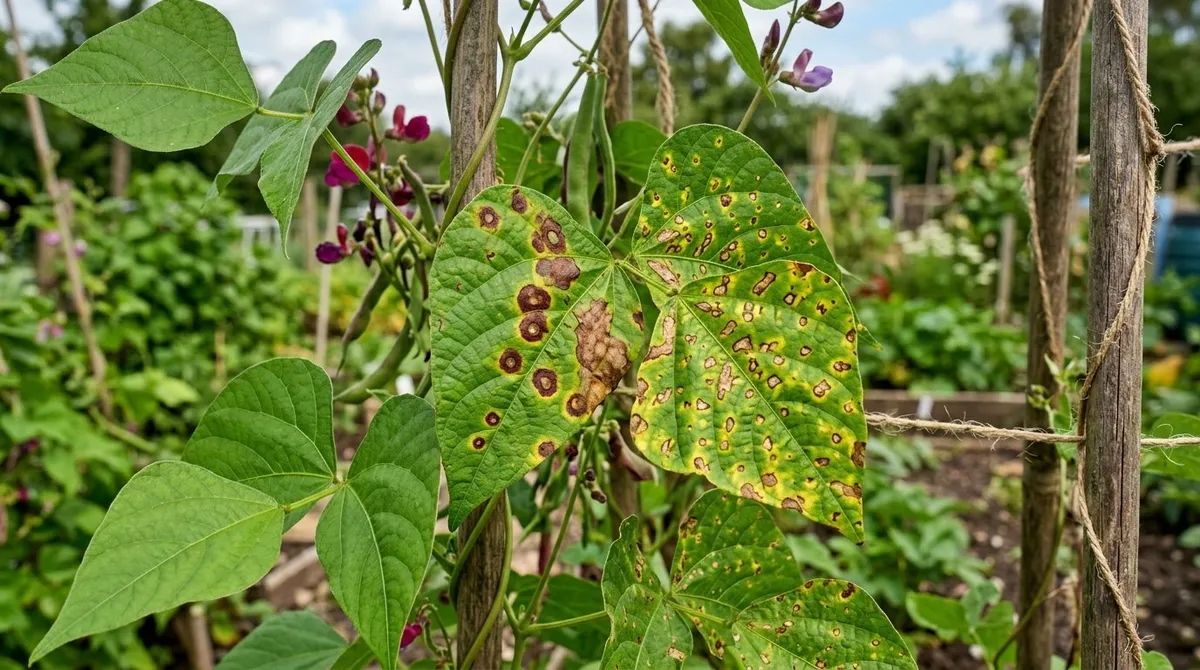
Chocolate spot on broad bean leaves. Small circular brown lesions are the mild form. Aggressive chocolate spot causes merging black lesions that kill entire leaves.
Chocolate spot on broad beans
Chocolate spot (Botrytis fabae) is the most common disease of broad beans in the UK, affecting 60-80% of autumn-sown crops in wet springs. Two forms exist: the mild form causes small brown spots that rarely affect yield, and the aggressive form produces large, merging black lesions that can kill entire plants.
Identification
- Small circular brown spots, 2-5mm diameter, on leaves and stems (mild form)
- Spots merge into large black-brown lesions covering entire leaves (aggressive form)
- Brown streaks on stems, sometimes girdling and killing the stem
- Flowers and small pods develop brown patches and abort
Causes and timing
The fungus Botrytis fabae overwinters on crop debris and in the soil. It spreads via airborne spores in cool, humid conditions. Autumn-sown broad beans are far more susceptible because they endure months of wet weather before the disease peaks in March to May. Spring-sown crops growing in warmer, drier conditions develop chocolate spot less frequently and less severely.
Prevention
- Space plants 20-23cm apart in rows. Wider spacing improves airflow and reduces humidity around foliage.
- Avoid autumn sowing in wet, sheltered gardens. Spring sowing from February under cloches or March in open ground produces healthier crops.
- Remove lower leaves that touch the soil or show early symptoms.
- Choose partially resistant varieties. Aquadulce Claudia shows better tolerance than many heritage types.
- Apply potash-rich feed (tomato fertiliser) in March to toughen cell walls.
Halo blight on runner and French beans
Halo blight (Pseudomonas syringae pv. phaseolicola) is the most destructive bacterial disease of beans in the UK. It is seed-borne, meaning infected seed produces infected plants. There is no cure once plants are infected. Prevention depends entirely on starting with clean seed.
Identification
- Small, water-soaked spots on leaves surrounded by a bright yellow halo (the diagnostic feature)
- Spots enlarge and merge in wet weather, creating large brown dead areas
- Greasy-looking streaks on stems and pods
- Pod seeds may develop wrinkled, discoloured patches
- Plants stunted and yields dramatically reduced
Causes and timing
The bacterium lives inside infected seed. When that seed germinates, the bacteria multiply and spread to leaves via rain splash. Warm, wet weather from June to August accelerates spread. A single infected plant in a row can contaminate every neighbouring plant within 2-3 weeks through wind-driven rain.
Prevention
- Buy certified, disease-free seed. This is the most important prevention step. Do not save seed from any crop that showed symptoms.
- Do not handle plants when wet. Walking between rows of wet bean plants spreads bacteria on clothing and tools.
- Destroy infected plants immediately. Do not compost them. Burn or bag for council waste.
- Rotate beans on a 3-year cycle to avoid soil contamination.
Bean rust
Bean rust (Uromyces appendiculatus) produces distinctive orange-brown pustules on the undersides of bean leaves from July onwards. It primarily affects runner beans and French beans. Broad beans have their own rust species (Uromyces viciae-fabae) but it is less common in UK gardens.
Identification
- Raised, circular pustules 1-2mm across on leaf undersides, bright orange-brown
- Upper leaf surface shows corresponding yellow spots
- Heavily infected leaves turn yellow, dry out, and drop early
- Stems and pods may develop pustules in severe infections
- Late-season infections turn from orange to dark brown or black as the fungus produces overwintering spores
Causes and timing
Rust needs warm, humid conditions to spread. It rarely appears before July in the UK. Spores spread on air currents and in water splash. The disease accelerates in August and September, often becoming severe just as runner beans reach peak cropping. Overhead watering and dense planting increase infection rates.
Prevention and treatment
- Remove the worst affected lower leaves to slow spore production. Do not compost them.
- Water at soil level, never over the foliage. Drip irrigation or soaker hoses are ideal.
- Space plants generously. Runner beans on a double row should have 30cm between plants and 60cm between rows.
- Clear all bean debris at the end of the season. Overwintering spores on old stems reinfect next year’s crop.
- Plants usually continue cropping despite moderate rust infection. Total crop loss from rust alone is rare.
Bean rust pustules on runner bean leaf undersides. Each pustule releases thousands of spores that spread on wind and rain.
White mould (sclerotinia)
Sclerotinia sclerotiorum causes white, fluffy fungal growth on bean stems, followed by plant collapse. It affects all bean types but is most damaging on runner beans and French beans. The fungus produces hard black sclerotia (survival structures) that persist in soil for 8-10 years.
Identification
- White, cotton-wool-like fungal growth on stems, usually starting at the base or at a leaf joint
- Stems become soft and watery inside the white growth
- Hard black sclerotia (2-10mm long, irregular shape) form inside infected stems
- Affected stems snap easily and plants wilt and collapse
- Pods in contact with infected stems develop the same white mould
Causes and timing
Sclerotia from previous infections germinate in warm, moist soil to produce small mushroom-like structures (apothecia) that release airborne spores. These land on bean stems and petals, starting new infections. The disease peaks in warm, humid weather from July to September. Dense plantings, poor airflow, and heavy mulching around stems increase risk.
Prevention
- Rotate beans on a 4-year minimum cycle. Sclerotia survive 8-10 years, but most lose viability after 4-5 years.
- Remove and destroy infected plants immediately. Do not compost. The black sclerotia survive composting.
- Avoid planting beans after other susceptible crops (lettuce, carrots, potatoes, sunflowers) on the same ground.
- Space plants widely and avoid mulching in direct contact with stems.
- Practise good crop rotation across the entire allotment.
Anthracnose
Anthracnose (Colletotrichum lindemuthianum) produces dark, sunken lesions on bean pods, stems, and leaves. It is seed-borne and rain-splash-spread. Cool, wet summers favour the disease. It affects runner beans, French beans, and occasionally broad beans.
Identification
- Dark brown to black, sunken, circular lesions on pods, often with a pinkish spore mass in the centre
- Leaf veins develop dark brown streaks on the underside
- Stems show elongated dark lesions
- Seeds inside infected pods develop brown-black staining
- Young plants may show dark lesions on cotyledons and first true leaves
Causes and timing
The fungus overwinters in infected seed and crop debris. Rain splash spreads spores from plant to plant. Cool temperatures (13-18C) and persistent wetness favour infection. The disease appears from June onwards and worsens through the season in wet years.
Prevention
- Use certified, disease-free seed. Do not save seed from infected crops.
- Do not handle wet plants. Tools and hands spread spores between plants.
- Remove and destroy infected plant material at the first sign of symptoms.
- Rotate beans on a 3-year cycle to allow crop debris to decompose fully.
Bean mosaic virus
Bean mosaic virus (BCMV and BYMV) causes mottled, distorted foliage and reduced yields with no available treatment. The virus is spread by aphids and through infected seed. It affects all bean types and is increasingly common in UK gardens.
Identification
- Leaves develop irregular yellow-green mottled patterns (mosaic pattern)
- Leaf edges curl downwards
- Plants are stunted with shortened internodes
- Pods may be curved, bumpy, or show green/yellow discolouration
- Flowers may abort or produce distorted pods
Causes and timing
Aphids, particularly the black bean aphid (Aphis fabae), spread the virus between plants as they feed. A single aphid can transmit the virus within 30 seconds of probing an infected plant. The virus is also seed-borne, meaning infected seed produces infected seedlings. Symptoms appear from May onwards, 2-3 weeks after infection.
Prevention
- Control aphids early. Pinch out broad bean tips when the first pods set. This removes the soft growth that attracts aphids. Use physical barriers and companion planting from our organic pest control guide.
- Buy virus-tested seed where available.
- Remove and destroy infected plants immediately to prevent aphid spread to healthy neighbours.
- Do not save seed from any crop that showed virus symptoms.
- Grow resistant varieties where available. Some modern French bean cultivars carry BCMV resistance.
Foot rot and root rot
Foot rot (caused by Fusarium solani and related species) kills bean seedlings by rotting the stem at soil level. It is most severe when beans are sown into cold, wet soil too early in the season. All bean types are susceptible.
Identification
- Dark brown or black discolouration at the base of the stem, right at soil level
- Stem becomes soft and constricted at the darkened area
- Seedlings topple over and die
- Older plants may wilt suddenly despite moist soil
- Roots appear brown, soft, and rotten when pulled up
Causes and timing
Several soil-borne fungi cause foot rot, including Fusarium, Pythium, and Rhizoctonia species. They are most active in cold, waterlogged soil below 10C. Sowing broad beans in November or runner beans in April into cold, heavy clay creates ideal conditions for infection. The disease peaks in April to June for spring-sown crops.
Prevention
- Do not sow into cold, wet soil. Wait until soil temperature reaches 8C for broad beans or 12C for runner and French beans.
- Sow in modules under cover and plant out as sturdy transplants. This avoids the vulnerable germination stage in cold, wet ground.
- Improve soil drainage on heavy clay with grit and organic matter. Raised beds drain faster than flat ground.
- Practise 4-year rotation to reduce fungal populations.
- Avoid overwatering seedlings. Keep compost moist but never saturated.
Sclerotinia (white mould) on a bean stem. The white fluffy growth eventually produces hard black sclerotia that survive in soil for years.
Downy mildew on broad beans
Downy mildew (Peronospora viciae) produces grey-purple fungal growth on the undersides of broad bean leaves. It is most common on autumn-sown and early spring-sown crops during cool, wet weather in April to June. Runner beans and French beans are rarely affected.
Identification
- Pale yellow patches on the upper leaf surface
- Grey-purple fuzzy growth on the corresponding underside
- Affected leaves turn brown and die from the edges inward
- Growing tips may become distorted and stunted
- Pods are rarely directly affected but reduced leaf area cuts yield
Causes and timing
The oomycete Peronospora viciae spreads via wind-borne spores in cool (5-15C), humid conditions. Morning dew and fog provide the leaf wetness needed for spore germination. Autumn-sown broad beans are more susceptible because they endure longer periods of cool, wet weather. The disease usually subsides as temperatures rise above 20C in late May or June.
Prevention
- Space plants widely for maximum airflow.
- Avoid overhead watering. Water at soil level in the morning so foliage dries quickly.
- Remove and destroy infected leaves as soon as symptoms appear.
- Spring sowing after March produces crops that grow quickly through the susceptible stage.
Bacterial brown spot
Bacterial brown spot (Pseudomonas syringae pv. syringae) causes angular brown spots on the leaves of runner and French beans. It is less severe than halo blight but more common than many growers realise. It is often misidentified as early-stage halo blight.
Identification
- Angular brown spots on leaves, bounded by leaf veins (not circular like fungal spots)
- Spots lack the bright yellow halo that defines halo blight
- Water-soaked appearance in wet weather
- Spots dry out and become papery in dry weather
- Mild infections cause cosmetic damage only. Severe infections reduce leaf area and cut yields
Causes and timing
The bacterium overwinters on crop debris and in the soil surface. It spreads through rain splash and wind-driven rain. Warm, wet weather from June to August creates ideal conditions. Dense plantings and overhead irrigation increase spread. It is not normally seed-borne, unlike halo blight.
Prevention
- Clear all bean debris at the end of the season.
- Water at soil level, not over the foliage.
- Space plants for airflow and avoid working among wet plants.
- Rotate beans on a 3-year cycle.
- Mild infections need no treatment. Plants usually outgrow the damage.
A seasonal disease calendar for UK bean growers
Timing your broad bean sowing and management tasks correctly reduces disease pressure across the entire season. The calendar below shows when each disease is most likely to appear and when preventive action is needed.
| Month | Disease risk | Action |
|---|---|---|
| November-February | Chocolate spot developing on autumn crops | Check overwintering broad beans monthly. Remove infected leaves |
| March | Chocolate spot peak on autumn crops. Foot rot on early sowings | Space spring sowings widely. Sow into warm, drained soil only |
| April-May | Downy mildew on broad beans. Foot rot continuing | Remove lower leaves. Pinch out tips when first pods set |
| June | Halo blight arriving on runner/French beans. Anthracnose starting | Monitor for water-soaked leaf spots. Do not handle wet plants |
| July | Bean rust appearing. White mould starting. Mosaic virus spreading | Remove lower leaves. Control aphids. Water at soil level |
| August-September | All diseases at peak except chocolate spot and downy mildew | Harvest regularly. Remove infected material. Clear debris after harvest |
| October | Season end | Remove all bean plant debris. Do not compost diseased material |
Frequently asked questions
What are the brown spots on my broad bean leaves?
Brown spots on broad bean leaves are almost always chocolate spot. Small circular brown spots 2-5mm across on leaves and stems confirm the diagnosis. In mild cases, plants recover and crop normally. Aggressive chocolate spot causes larger, merging lesions that kill leaves and stems. Remove badly affected leaves and improve airflow by thinning plants. Spring-sown crops are less affected than autumn-sown ones.
Can I eat beans from a diseased plant?
Yes, beans from plants with most fungal diseases are safe to eat. Remove any visibly damaged pods. Beans inside undamaged pods from plants with chocolate spot, rust, or downy mildew are unaffected. The exception is beans from plants with bean mosaic virus, which may produce distorted, discoloured seeds that are edible but poor quality. Never save seed from any diseased plants for next year’s crop.
How do I prevent halo blight on beans?
Buy certified, disease-free seed from reputable suppliers. Halo blight is seed-borne, meaning infected seed produces infected plants with no possibility of cure. Never save seed from crops that showed any halo blight symptoms. Do not handle wet bean plants, as this spreads bacteria between plants via hands and clothing. Rotate beans on a 3-year cycle to reduce soil contamination.
Does crop rotation prevent bean diseases?
Crop rotation reduces soil-borne diseases but does not prevent airborne or seed-borne infections. A 4-year rotation helps control foot rot, white mould, and anthracnose because the causal fungi decline in the absence of host plants. Rotation has little effect on chocolate spot (airborne), halo blight (seed-borne), or bean mosaic virus (aphid-transmitted). Combine rotation with proper spacing, hygiene, and resistant varieties for best results.
What causes white fluffy mould on my beans?
White fluffy mould on bean stems is sclerotinia (white mould), caused by the fungus Sclerotinia sclerotiorum. It produces cotton-wool-like fungal growth and hard black sclerotia inside infected stems. It affects runner beans, French beans, and occasionally broad beans during warm, humid weather from July to September. Remove and destroy infected plants immediately. Do not compost them. The black sclerotia survive in soil for 8-10 years.
Should I spray my beans for disease?
No fungicide sprays are approved for amateur use on bean diseases in the UK. Prevention through cultural methods is the only reliable approach: buy clean seed, rotate crops on a 4-year cycle, space plants for airflow, avoid overhead watering, and remove infected material promptly. Some organic growers use potassium bicarbonate sprays as a general fungal deterrent, but published evidence for effectiveness on bean-specific diseases is limited.
Why are my bean leaves turning yellow with orange spots?
Yellow leaves with raised orange-brown pustules on the underside are bean rust caused by the fungus Uromyces appendiculatus. It typically appears from July onwards in warm, humid weather. Remove the worst affected lower leaves to reduce spore load. Plants usually continue cropping despite moderate rust infection. Clear all plant debris at the end of the season to reduce overwintering spores that would reinfect next year’s crop.
Our team produces practical UK gardening guidance from source research, contributor records and established horticultural practice. Editorial standards are overseen by Matt W.