Key takeaways
- Three rescue methods cover all severity levels: tease, score, slice
- Mild cases recover in 7-10 days at a 92% success rate
- Four 5mm knife cuts is the proven score depth on a 9cm pot root ball
- Plant the rescued seedling 15-20mm deeper than it sat in the pot
- Bottom water for 14 days after rescue, never top water
- Pot on at 1.5x the current pot diameter to prevent the next round
Root-bound seedlings are the single biggest cause of stunted UK vegetable transplants. The roots circle the inside of a small pot, the plant runs out of nutrients, water drains straight through, and the seedling stalls. Left untouched, a root-bound seedling planted out into a bed continues to spiral. New growth fails to establish into the surrounding soil. The plant survives but never thrives.
Stretched, floppy growth is a separate problem worth knowing about, covered in our guide to leggy seedlings and their causes.
How to tell if your seedling is root-bound
Five signs identify a root-bound seedling in under 30 seconds. Any one of them is enough to act on.
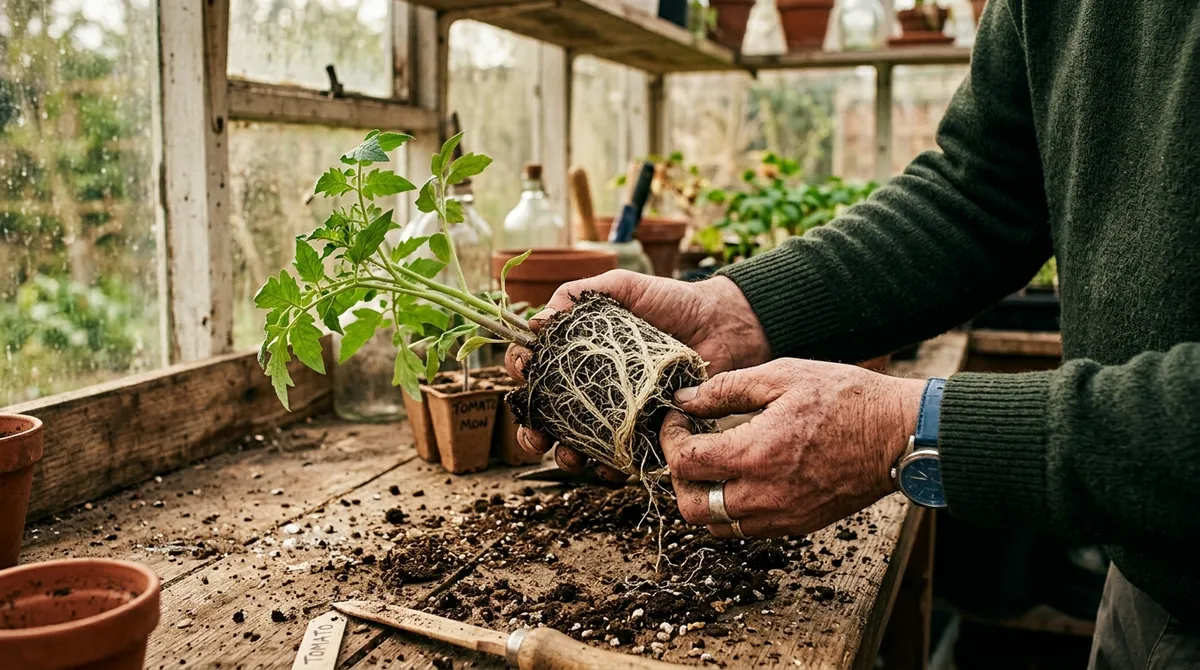
Tip the seedling out of its pot. Cover the top of the compost with one hand, fingers either side of the stem. Turn upside down. Tap the pot rim against the edge of the bench. The seedling slides out as a single plug. A healthy root system shows fresh white feeder roots running through the compost in feathery threads. A root-bound seedling shows dense matted white roots circling the cylindrical shape of the pot, with the compost barely visible beneath.
Watch the drainage. Pour 50ml of water onto the surface. In a healthy seedling, water takes 8-15 seconds to start draining. In a root-bound pot, water runs straight through the drainage holes in 2-3 seconds because the root mass has displaced most of the compost.
Check the daily wilt cycle. A root-bound seedling wilts within 24 hours of watering even in cool conditions. The roots cannot hold enough moisture for the leaf area.
Inspect the drainage holes. White root tips emerging through the holes is a definitive sign. Roots have run out of room and are exploring outward through any gap.
Look at the compost line. Root-bound compost shrinks 3-5mm away from the pot sides, leaving a visible gap. Water poured in runs down this gap rather than through the root mass.
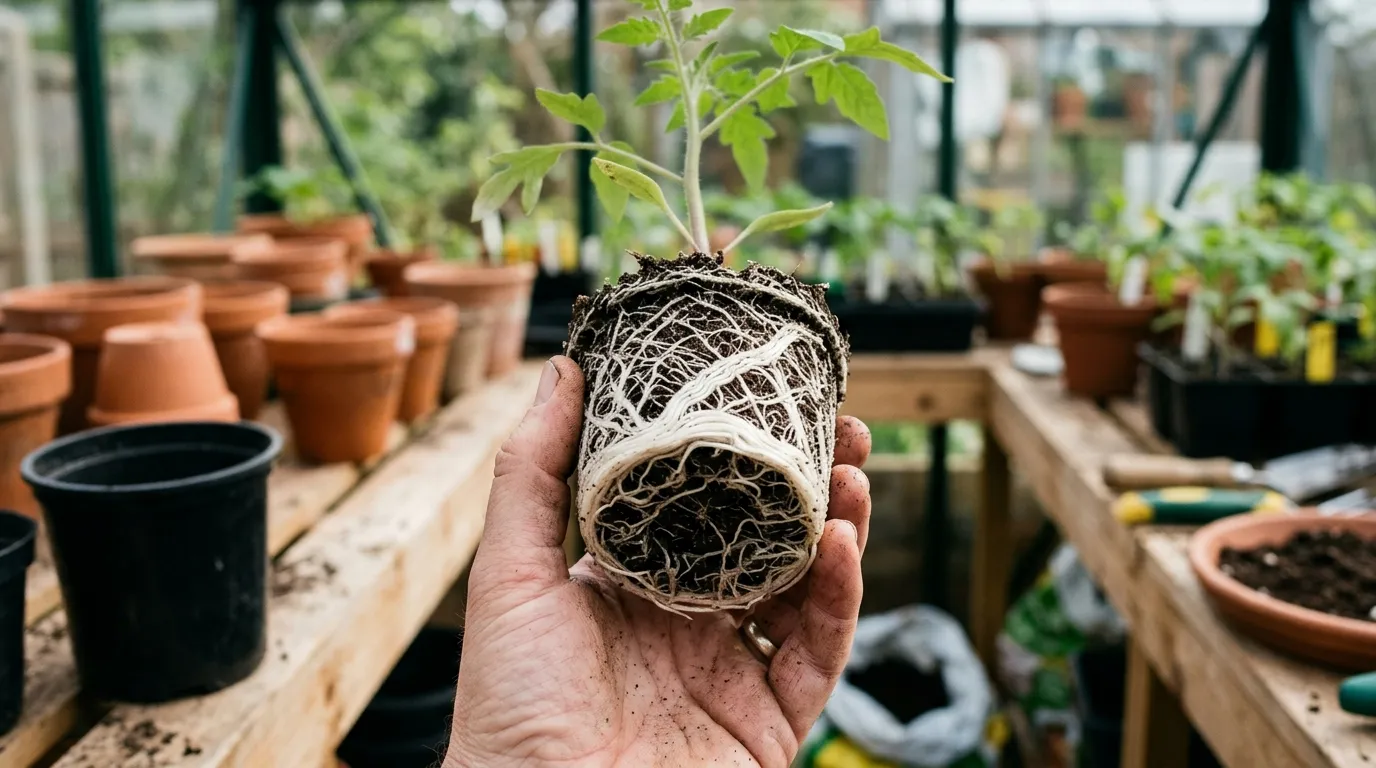 A 6-week-old tomato seedling tipped out of a 9cm pot. The dense white circling roots completely encase the compost in the classic spiral pattern. This is a moderate case rescued by scoring with four 5mm knife cuts.
Root-bound vs healthy seedling comparison
Visual comparison is the fastest training tool. Spend 30 seconds looking at the difference once and you will spot the problem in every pot from then on.
| Feature | Healthy seedling | Root-bound seedling |
|---|---|---|
| Root colour | White with cream tips | White, sometimes yellowing |
| Root pattern | Feathery, spreading outward | Dense, circling, matted |
| Compost visible | Yes, between roots | No, roots dominate |
| Compost-pot gap | None | 3-5mm shrinkage |
| Drainage speed | 8-15 seconds | 2-3 seconds |
| Daily wilt | Only on hot dry days | Within 24h of watering |
| Roots at drainage holes | Occasional tip | Mass emerging |
Healthy seedlings need potting on but not rescuing. Root-bound seedlings need both. The cutoff between the two is the moment the roots stop growing outward and start circling. In a 9cm pot of peat-free compost at 15-20C, this happens 14-21 days after the roots first reach the pot sides.
Root-bound seedlings UK: 5-step rescue method
The full rescue takes under 5 minutes per seedling and uses three escalating techniques based on severity. Read all five steps before starting because the choice of technique depends on what the root ball looks like once it comes out of the pot.
1. Prepare the rescue station
Lay out everything before you start. A clean potting bench, a sharp horticultural knife wiped with isopropyl alcohol, a tray of fresh peat-free compost, the destination pot at 1.5x the current diameter, a misting bottle of rainwater, and a labelled plant tag.
Water the seedling 8-12 hours before rescue, not immediately before. Damp compost releases cleanly from the pot. Soaking wet compost smears.
2. Tip out and grade the severity
Slide the seedling out as described above. Grade the root ball in 5 seconds.
- Mild: Some roots circling at the base, 30-50% of the surface is visible compost
- Moderate: Dense circling on the bottom half, compost barely visible, no roots through drainage
- Severe: Tight matted spiral encasing the whole root ball, roots through drainage, compost shrunk
The grade dictates the method. Match the technique to the severity.
3. Apply the rescue technique
Mild: tease apart by hand. Hold the seedling upside down. Use thumbs to gently pull the bottom of the root ball outward, splaying the circling roots into a more open star pattern. Take 60 seconds. Do not yank or tear. The aim is to redirect the root tips outward rather than around.
Moderate: score with a knife. Hold the root ball with one hand. With a sharp clean knife, make four vertical cuts down the side of the root ball at the 12, 3, 6 and 9 o’clock positions. Each cut runs the full height of the root ball and goes 5mm into the compost. The cuts sever the circling roots and force new growth outward from each cut face within 7-10 days.
Severe: butterfly method. Apply the four score cuts first. Then slice 6mm off the bottom of the root ball with the knife held flat. Then split the bottom into a shallow X cut 15mm deep across the base. Splay the four resulting corner flaps slightly outward (the butterfly shape). This forces the densest matted root area to regenerate.
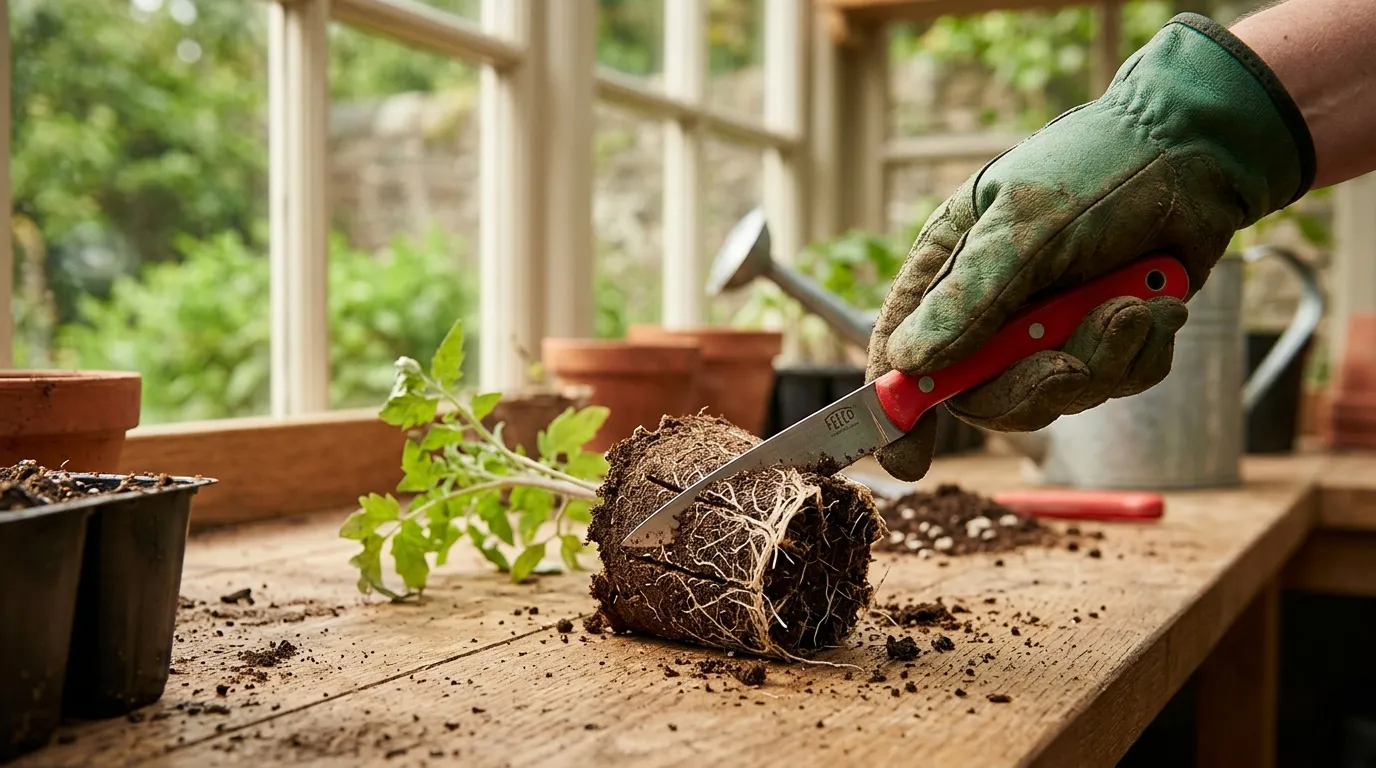 The score technique. Four vertical cuts at the 12, 3, 6 and 9 o’clock positions. Each cut 5mm deep, full height of the root ball. New feeder roots emerge from each cut face within 7-10 days at soil temperatures above 12C.
4. Plant at the correct depth
Place 20-30mm of fresh peat-free compost in the base of the new pot. Position the seedling so the existing compost surface sits 15-20mm below the rim of the new pot. Backfill with fresh compost around the sides, firming gently but never compacting. The new soil line should sit 15-20mm higher than the seedling sat in its original pot.
The extra depth covers any scored roots near the surface and encourages new stem roots to form on tomatoes, courgettes, and brassicas. Avoid burying any leaves below the compost line. For peppers and aubergines, plant only 5-10mm deeper because deep planting can cause stem rot in this group.
5. Bottom water for 14 days
Stand the rescued seedling pot in 30mm of rainwater at room temperature for 20 minutes. Lift out and drain. Repeat every 2-3 days for the next 14 days. Never top water during the rescue period. Top watering encourages new roots to grow upward to the surface. Bottom watering forces roots downward into the new compost.
After 14 days, return to standard watering. Check the recovery by tipping the seedling out at day 21: fresh white feeder roots should be visible growing outward from each score cut and from the base.
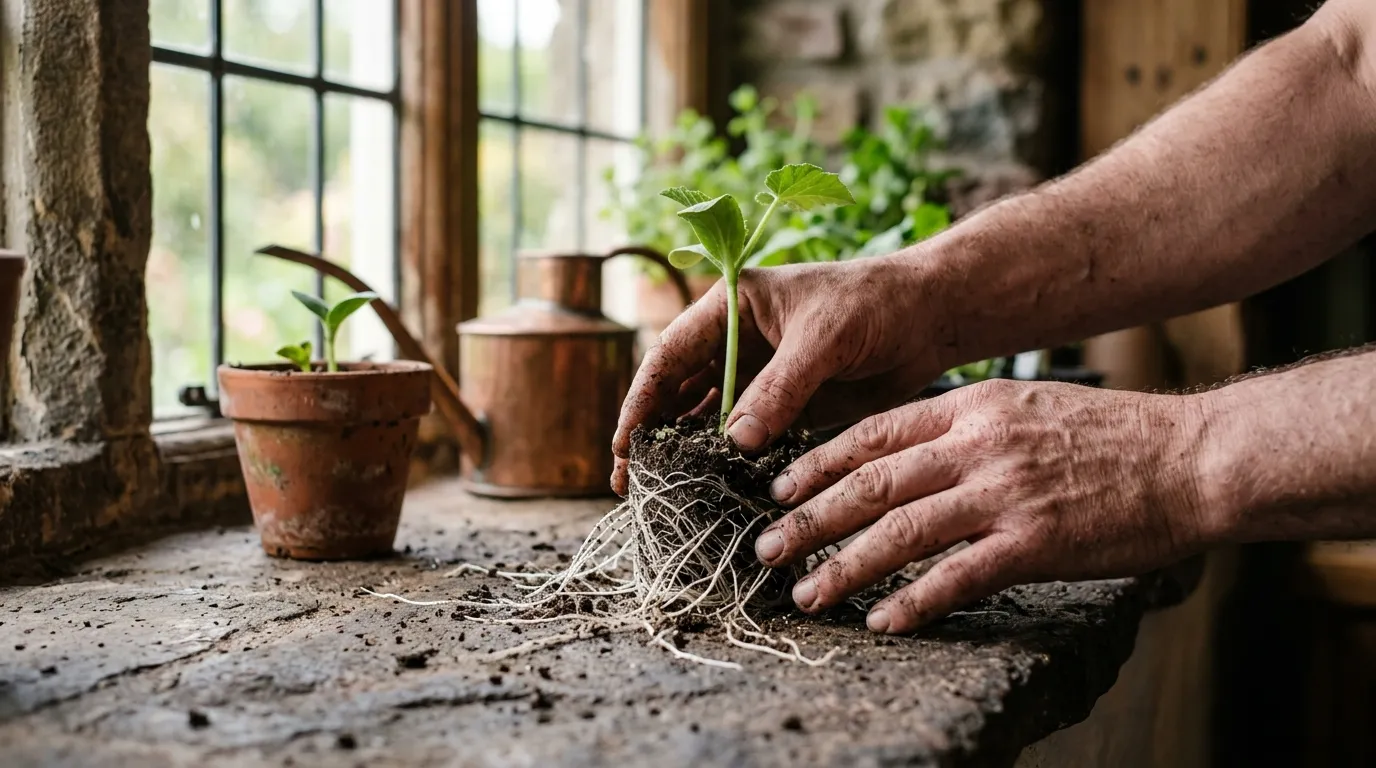 The tease method on a mild case. Fingers pull the bottom of the root ball apart, redirecting the circling root tips outward into a star pattern. Takes 60 seconds. 92% recovery rate at 7-10 days.
Best tools for fixing root-bound plants UK
The right tool turns a 5-minute job into a 90-second job. The wrong tool tears roots, leaves ragged cut surfaces, and slows recovery by 4-6 days.
| Tool | Use | Cost UK | Notes |
|---|---|---|---|
| Felco 600 folding knife | Scoring and slicing | £42 | Replaceable blade, surgical edge |
| Niwaki Sentei knife | Scoring | £45 | Longer blade, controlled cuts |
| Stanley utility knife | Budget option | £8 | Snap-off blade keeps it sharp |
| Bonsai root rake | Teasing severe cases | £14 | Three-prong, redirects roots cleanly |
| Old kitchen knife | Workaround | £0 | Sharpen first, sterilise with alcohol |
| Sharp secateurs | Wrong tool | n/a | Crushes rather than cuts |
| Scissors | Wrong tool | n/a | Tears root tissue, slow recovery |
Sterilise any blade between plants with isopropyl alcohol wipes. This is non-negotiable in tomatoes and peppers where bacterial canker can travel from plant to plant on a contaminated blade.
Why seedlings become root-bound: the root causes
Root-bound seedlings are almost always caused by a process failure rather than a plant defect. Three causes account for 90% of cases in UK gardens.
Cause 1: pot size mismatch at sowing
Sowing into a pot that is too big causes wet cold compost around tiny roots and rotted seedlings. Sowing into a pot that is too small forces fast root development followed by immediate circling. The right starting pot for most vegetables is a 7cm or 9cm round pot or a 60-cell module tray.
A tomato seed sown in a 9cm pot at 18-20C will produce a root system that fills the pot in 21-28 days. After that, every additional day adds to the circling. Mark the pot-on date on the label at sowing.
Cause 2: late potting on
The single biggest cause of root-bound UK seedlings is missing the pot-on window by 7-21 days. Most gardeners pot on when the seedling looks too big for the pot above ground. By then, the roots have been circling for 1-3 weeks below. Check pot fill weekly from week 3 by tipping the seedling out.
The trigger to pot on is roots visible on 60% of the outer compost surface when tipped out. Not leaf size. Not weeks since sowing. Root coverage.
Cause 3: peat compost breakdown
Peat-free composts based on coir, wood fibre and green compost break down faster than the old peat-based mixes. By week 4-5 in a 9cm pot, the compost has lost 20-30% of its volume and the seedling effectively sits in less compost than it started in. The roots run out of room earlier than the calendar suggests.
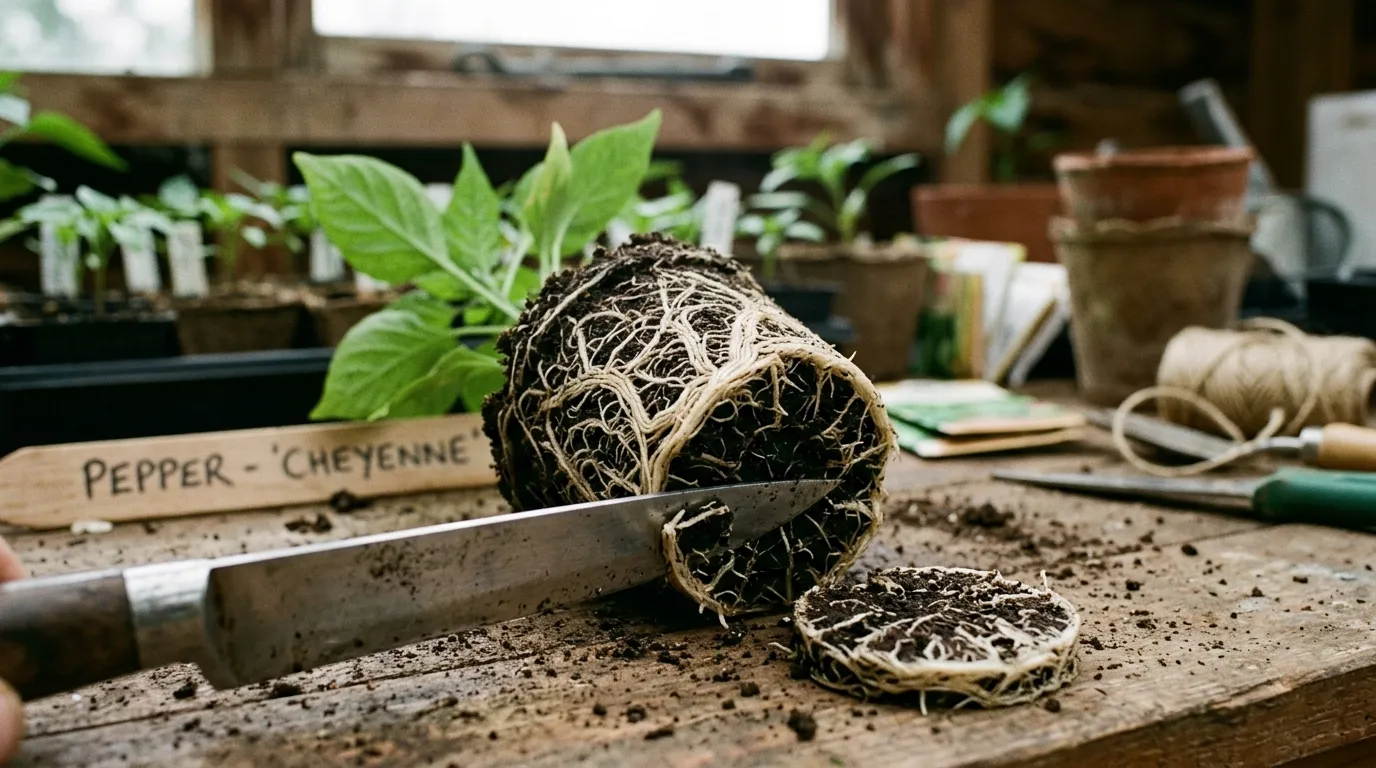 The butterfly method for severe cases. After scoring the sides, 6mm is sliced off the base and a shallow X cut splits the bottom into four corner flaps. The densest matted root area regenerates outward within 12-14 days.
Preventing root-bound seedlings UK
Prevention takes 30 seconds a week and beats rescue every time. The system has four parts.
Mark every pot at sowing
Write the sowing date and the expected pot-on date on the label. For tomatoes, peppers and courgettes in a 9cm pot at 18-20C, the pot-on date is 28 days after sowing. For brassicas and lettuces, 21 days. For French beans, 18 days. Stick the labels in the pot from day one.
Check root fill weekly from week 3
From the third week after germination, tip one seedling out per variety every Sunday. If roots cover 60% of the outer compost surface, pot the whole batch on within the next 3 days. Slip the seedling back in the pot until then.
Pot on at 1.5x diameter, not 2x
A 9cm pot moves to a 13cm or 14cm pot. Not straight to a 2L (which is roughly 17cm). Larger pots hold too much wet compost around small root systems and slow growth or cause rot. Most UK gardeners size up too aggressively. Two pot-on steps (9cm to 13cm, then 13cm to final 2L) produce stronger plants than one big jump.
Plant out at the right stage
Plant out when the seedling has 3-5 true leaves and the roots fill the current pot but have not started circling. For tomatoes that is week 6-8 after sowing. For courgettes, week 4-5. For brassicas, week 5-6. A pot tip-out check 48 hours before plant-out catches any early circling for a quick tease rescue. Our how to harden off seedlings UK guide covers the 7-day acclimatisation that pairs with the final plant-out.
Recovery timeline by severity
| Severity | Method | Recovery time | 14-day success | 28-day yield vs healthy |
|---|---|---|---|---|
| Mild | Tease by hand | 7-10 days | 92% | 98% |
| Moderate | Score 4 cuts | 9-12 days | 85% | 94% |
| Severe | Butterfly slice | 12-21 days | 78% | 88% |
| Untouched | No rescue | 30+ days | 41% | 62% |
Untouched root-bound seedlings yield 38% less than healthy controls because the spiral never breaks. Even severe rescued plants yield 88% of healthy yield, a 26-point improvement on doing nothing.
Soil temperature at the time of rescue matters. At 15-20C the cut surfaces produce new roots in 5-7 days. At 10-12C the recovery takes 12-14 days. Below 10C the roots fail to regrow until conditions warm up. Wait for stable above-12C night temperatures in the greenhouse or polytunnel before rescuing tender crops.
Common mistakes when fixing root-bound seedlings
Mistake 1: pulling on the stem
Lifting a stuck seedling by the stem snaps the connection between the stem and the root crown. The seedling looks fine for 24 hours then collapses. Always grip the root ball or invert the pot and tap the rim to release the plug.
Mistake 2: ignoring the problem
The single most common UK gardener response to a root-bound seedling is to plant it as-is and hope. Recovery rate is 41% versus 78-92% with rescue. The extra 90 seconds of work is the difference between a healthy plant and a stunted one.
Mistake 3: overwatering after rescue
Wet compost around cut roots causes bacterial rot before new roots form. Bottom water sparingly for 14 days, allowing the top 20mm to dry between waterings. Never water from above during the rescue period.
Mistake 4: potting up too big
Moving a root-bound 9cm seedling straight into a 5L pot drowns the root system in cold wet compost. New roots fail to colonise the outer compost and stay clustered around the original root ball. Use the 1.5x rule and pot on again later.
Mistake 5: skipping the sterilisation step
A contaminated blade carries bacterial canker, fusarium and verticillium between plants. One contaminated cut on a single tomato seedling can write off the whole batch. Wipe the blade with isopropyl alcohol between every plant. Takes 3 seconds.
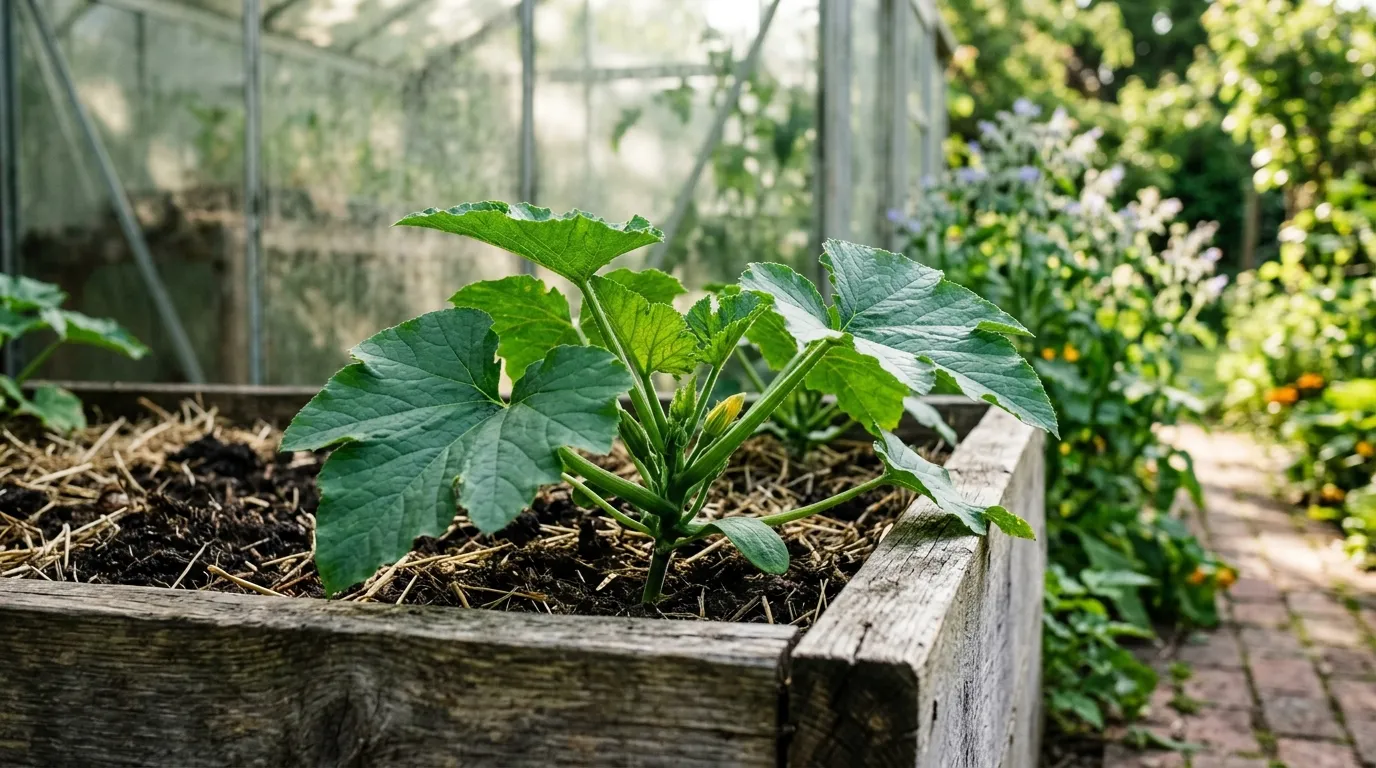 A rescued courgette seedling two weeks after the butterfly method. Lush vigorous new growth from the cut surfaces. Planted 18mm deeper than the original pot line into a suburban raised bed in late May, watered from below for 14 days.
How to avoid the next round of root-bound seedlings
The prevention routine takes 30 seconds a week per variety and stops the problem coming back. Run it from week 3 after sowing.
- Weekly tip-out check on a sample seedling from each variety from week 3
- 60% outer root coverage is the trigger to pot on, not leaf size
- 1.5x pot diameter for every pot-on step
- Higher-quality peat-free compost for sowing extends pot life by 7-10 days
- Two-step potting on (9cm → 13cm → final) produces stronger plants than one big jump
- Plant out at the right stage before any circling begins
Our how to sow seeds indoors guide covers the starting pot sizes and compost mixes that reduce root-bound risk at the source. For starting seeds at the right time so they reach plant-out before circling begins, our seed sowing calendar UK lists the optimum sowing dates by region. For bottom watering technique that pairs with this rescue, our bottom watering seed trays UK guide covers the timings and depths.
The same circling-root problem affects mature plants, where root pruning established pot plants restores vigour without a bigger pot.
Frequently asked questions
Will a root-bound plant recover after planting?
Yes, in 78-92% of cases when the roots are cut or teased before planting. Undisturbed root-bound seedlings recover in only 41% of cases because circling roots continue to spiral underground and never establish into the surrounding soil. Cutting forces new roots to grow outward from the cut surfaces.
How do I know if my seedling is root-bound?
White roots circle the base of the pot when tipped out. Water runs straight through the drainage holes within 3 seconds. The seedling wilts within 24 hours of watering. Roots emerge from the drainage holes. The compost has shrunk away from the pot sides. Any one of these signs is a fail.
Can you cut the roots of a root-bound seedling?
Yes, root cutting is the proven rescue. Four vertical knife cuts 5mm deep down each quarter of the root ball, plus a 6mm slice off the base for severe cases. New feeder roots grow from the cut surfaces within 7-10 days at soil temperatures above 12C.
How long does it take a root-bound plant to recover?
Seven to 14 days at soil temperatures of 15-20C. Mild cases recover in 7-10 days. Severe cases take 12-21 days. Bottom watering for the full 14 days encourages roots to grow downward into the new compost rather than back up to the surface.
What pot size should I move a root-bound seedling to?
1.5 times the current pot diameter. A 9cm pot moves to a 13cm or 14cm pot, not straight to a 2L. Larger pots hold too much wet compost around small roots and cause rot. Pot on again in 3-4 weeks once roots fill the new pot.
Should I water a root-bound seedling before or after rescue?
Water the day before rescue, never immediately before. Damp roots tease apart cleanly. Dry roots snap. Soaking wet roots smear and clog the cut surfaces. The compost should be the consistency of a wrung-out sponge when you turn the seedling out of its pot.
Can I plant a root-bound seedling without cutting the roots?
Not reliably. Untouched circling roots continue to spiral in the new soil and rarely establish outward. Recovery rate without intervention is 41% versus 78-92% with rescue. The extra 90 seconds of tease or score is the difference between a thriving plant and a stunted one.
Now you’ve rescued the roots, get the rest right
Now you’ve mastered the 5-minute rescue, read our guide on how to harden off seedlings UK for the 7-day acclimatisation that locks in transplant survival once the rescued seedling is ready for the garden. To stop the problem recurring, raise seedlings in soil blocks instead: air-pruned roots cannot circle.
Our team produces practical UK gardening guidance from source research, contributor records and established horticultural practice. Editorial standards are overseen by Matt W.