Key takeaways
- Flea beetles are 2-3mm jumping beetles that riddle brassica and salad leaves with small round holes from April
- Damage peaks in warm dry weather when soil temperatures exceed 15C and seedlings grow slowly
- Rocket, radish, pak choi, and turnip are the most vulnerable crops, losing 80%+ of leaf area without protection
- Enviromesh or horticultural fleece applied at sowing is the only reliable organic control method
- Watering seedlings regularly speeds growth past the vulnerable stage and reduces beetle feeding pressure
- Chinese cabbage planted as a trap crop draws beetles away from valued salad and brassica plantings
Flea beetles are the single most frustrating pest for anyone growing salads and brassicas in a UK garden. These tiny jumping beetles, just 2-3mm long, appear from April and punch hundreds of small round holes through leaves. A heavy attack can destroy a bed of rocket seedlings in under a week.
Several Phyllotreta species cause the damage. The most common in British gardens are the small striped flea beetle (P. undulata) and the large striped flea beetle (P. nemorum). Both target plants in the brassica family: rocket, radish, pak choi, turnip, cabbage, kale, and cauliflower. There is no effective organic spray. Physical barriers are the only reliable defence.
How do I identify flea beetles in the UK?
Flea beetles are shiny, dark beetles 2-3mm long that jump like fleas when disturbed. This jumping behaviour is the quickest way to confirm their presence. Tap a damaged leaf and watch for tiny beetles springing into the air from the leaf surface.
The small striped flea beetle (P. undulata) is 1.5-2mm long and black with a distinctive yellow stripe running down each wing case. It is the most common species on UK brassicas. The large striped flea beetle (P. nemorum) is 3-4mm long with similar markings but a noticeably larger body.
Other species include the turnip flea beetle (P. cruciferae), which is entirely dark metallic blue-black and 2-3mm long. All species have enlarged hind legs that power their characteristic jump. They fly short distances too, which is why they colonise new sowings quickly. The jumping habit is the giveaway when telling flea beetles from harmless pollen beetles, which are larger, do not leap, and cluster on open flowers rather than riddling seedling leaves.
What damage do flea beetles cause to crops?
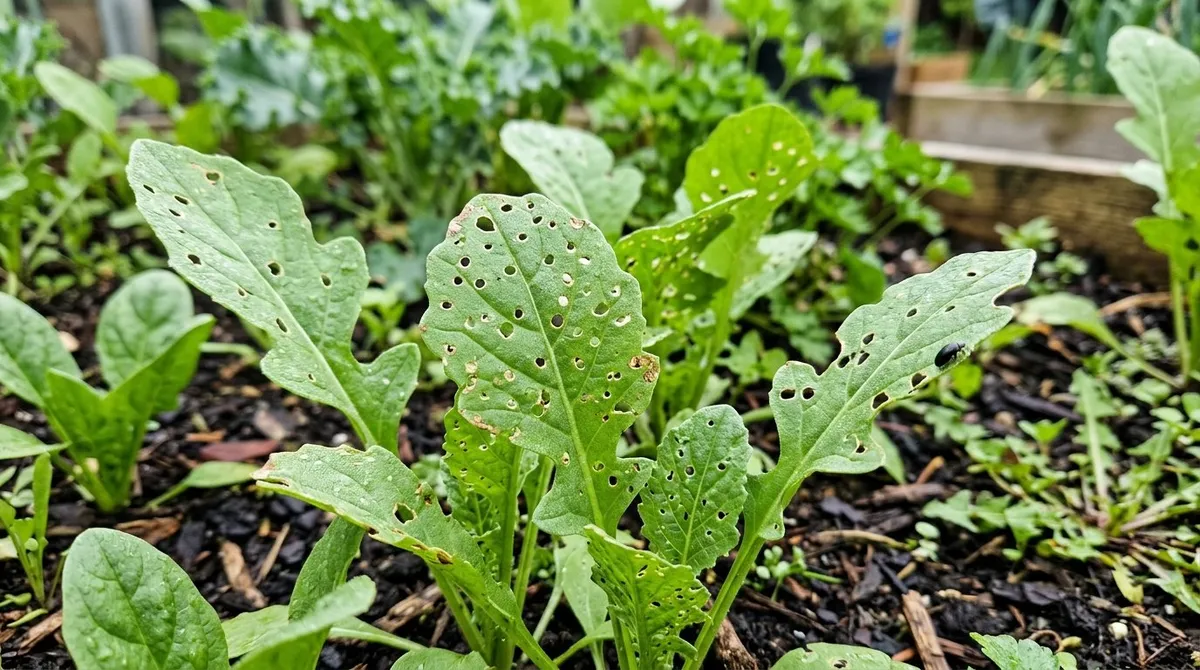
Flea beetles chew small round holes, each 1-2mm across, through the upper leaf surface. The damage pattern is distinctive: dozens to hundreds of tiny perforations scattered randomly across the leaf. Heavy feeding makes leaves look like they have been peppered with fine shot.
Seedlings are the most vulnerable growth stage. Plants with fewer than 4 true leaves can be killed outright by heavy flea beetle feeding. The beetles eat faster than the seedling can grow, and the plant runs out of leaf area to photosynthesise.
Older plants tolerate damage better. A mature kale or cabbage plant can sustain moderate flea beetle feeding without any meaningful yield loss. The danger is overwhelmingly concentrated in the first 3-4 weeks after germination.
Root damage is less well known but does occur. Larvae of some Phyllotreta species feed on roots and root hairs of brassica plants. This below-ground damage is rarely severe enough to cause plant death but may slow early growth. The RHS flea beetle page provides additional identification photographs.
Which crops are most vulnerable to flea beetle?
Susceptibility varies significantly between crops. Thin-leaved salad brassicas suffer far worse than thick-leaved heading types.
| Crop | Susceptibility | Damage severity | Notes |
|---|---|---|---|
| Rocket | Very high | Leaves destroyed in days | Thinnest leaves, most attractive to beetles |
| Radish | Very high | Cotyledons and first leaves shredded | Fast-growing but beetles often win the race |
| Pak choi | High | Seedlings heavily holed | Damage reduces marketable quality |
| Turnip | High | Young leaves worst affected | Roots develop poorly after heavy leaf loss |
| Chinese cabbage | High | Attracts beetles strongly | Useful as a trap crop for this reason |
| Kale | Moderate | Seedlings at risk, mature plants tolerate it | Tough waxy leaves resist damage once established |
| Cabbage | Moderate | Vulnerable at transplant stage | Outgrows damage from 6-leaf stage |
| Cauliflower | Low-moderate | Seedlings only | Transplant at 5-6 leaf stage to avoid worst |
| Brussels sprouts | Low | Rarely significant | Thick stems and leaves resist feeding |
| Swede | Moderate | Young plants worst hit | Late sowings escape worst spring attacks |
How do I prevent flea beetle damage?
The mesh must go on before beetles arrive. That means at sowing, not after you see the first holes. By the time holes appear, beetles are already on the crop and laying eggs in the soil nearby.
Use 0.8mm aperture enviromesh for the best results. Standard butterfly netting (5-7mm mesh) allows flea beetles straight through. Horticultural fleece works too but traps more heat, which can stress seedlings in warm weather. Support mesh on hoops to keep it off the leaves. Direct contact between mesh and foliage allows beetles to feed through the fabric.
Watering seedlings to outrun the damage
Keeping soil consistently moist helps seedlings grow past the vulnerable stage faster. Flea beetle damage is worst in dry conditions for two reasons. First, seedlings grow slowly in dry soil, extending the period when they are small enough to be killed. Second, beetles are more active and feed more heavily in warm, dry weather.
This is a supporting measure, not a standalone solution. Watering alone will not save unprotected seedlings from a heavy infestation. Combine it with mesh for the best outcome.
Does companion planting deter flea beetles?
The one intercropping strategy with some evidence behind it is trap cropping. Chinese cabbage is highly attractive to flea beetles. Plant it 3 metres from your main brassica bed, 2-3 weeks before your main sowing. Beetles concentrate on the trap crop. Once it is heavily infested, remove and destroy it. This reduces local beetle numbers but does not eliminate them entirely.
What is the best organic control for flea beetle?
Here is a comparison of every commonly recommended method and its real-world effectiveness:
The data is clear. Spend your money on enviromesh. Everything else is either unreliable or entirely ineffective. One roll of mesh protects a 5-metre bed for several years and pays for itself in the first season of saved crops.
When should I sow to avoid flea beetles?
Late sowings from mid-June onwards often escape the worst flea beetle pressure. Beetle activity peaks in May and early June when overwintered adults are feeding heavily and laying eggs. By mid-June, the first generation is declining and the next generation has not yet emerged.
This timing works well for autumn and winter crops. Kale, turnips, and swede sown in late June or early July often establish with minimal flea beetle damage. Late-sown radish for autumn harvesting can sometimes escape entirely.
Spring and early summer salads cannot avoid the peak period. Rocket, radish, and pak choi sown between March and May will face maximum beetle pressure. For these crops, mesh is essential.
Successional sowing helps too. Rather than sowing one large batch, sow small rows every 2-3 weeks from April to August. If one sowing is badly hit, the next will establish into different conditions. This approach works well alongside mesh protection for crops like lettuce and spring onions that you harvest progressively.
How does flea beetle affect rocket and radish specifically?
Rocket and radish are the two crops most devastated by flea beetle in UK gardens. Both produce thin, tender leaves that beetles can penetrate in seconds. Both germinate quickly but grow slowly in cool spring conditions, creating a dangerous window where seedlings are too small to tolerate any leaf loss.
Radish suffers similar devastation. The cotyledons (seed leaves) are attacked within hours of emergence. Plants that lose their cotyledons grow very slowly because they lack the initial photosynthetic area to drive root development. Radish roots remain small and fibrous instead of swelling into usable bulbs.
For rocket specifically, consider growing it under cover in a greenhouse or cold frame from April to June. Flea beetles rarely enter enclosed structures. Outdoor rocket from July onwards faces lower beetle pressure and can be grown with lighter protection.
Can flea beetles damage brassica transplants?
Transplants are less vulnerable than direct-sown seedlings but still need protection in their first week. A strong transplant with 5-6 true leaves can tolerate moderate flea beetle feeding without significant setback. The leaf area is large enough to sustain some loss while the plant establishes new roots.
The danger comes when transplants are stressed. A small transplant moved from a sheltered greenhouse to an open bed in hot, dry weather faces maximum risk. The plant is recovering from transplant shock, growing slowly, and exposed to peak beetle activity simultaneously.
For brassica crops like cabbage, cauliflower, and sprouting broccoli, grow transplants under cover until they have at least 5 true leaves. Harden them off over a week. Plant out into well-watered soil and apply mesh immediately. Remove mesh once plants are growing strongly, typically 2-3 weeks after transplanting.
Do flea beetles spread plant diseases?
Flea beetles can transmit bacterial and viral diseases through their feeding wounds. The holes they create in leaves provide entry points for secondary infections. Bacterial soft rot, downy mildew, and ring spot are all more common on flea-beetle-damaged plants because the wounds break the leaf’s natural disease barriers.
More significantly, the large striped flea beetle (P. nemorum) is a known vector of turnip mosaic virus in the UK. This virus causes mottled, distorted leaves and stunted growth in brassicas. It is incurable once a plant is infected. Controlling flea beetle access to crops therefore provides disease prevention as well as direct damage reduction.
This is another reason why physical barriers outperform sprays. Even a spray that killed every beetle on contact would not prevent disease transmission from the initial feeding wounds. Mesh stops beetles reaching the crop at all, stopping both direct damage and disease introduction.
Keeping plants healthy through good watering practice and soil nutrition helps them resist secondary infections after flea beetle damage. A well-fed plant recovers from moderate leaf loss faster than one growing in poor soil.
Frequently asked questions
What does flea beetle damage look like?
Dozens of tiny round holes peppered across leaves are the signature sign. Each hole is 1-2mm in diameter, punched cleanly through the leaf tissue. Heavy infestations make leaves look like they have been hit with fine shotgun pellets. Seedlings under 4 leaves old can be killed outright. Older plants survive but grow slowly with reduced vigour.
When are flea beetles most active in the UK?
Flea beetles become active from April when soil temperature reaches 15C. Activity peaks during warm, dry spells in May and June. Beetles feed most heavily on sunny days and shelter in soil cracks at night. A late cold spring delays their emergence. Autumn activity resumes in September on late-sown crops before beetles hibernate in leaf litter and soil over winter.
Does fleece or enviromesh stop flea beetles?
Do flea beetles attack all brassicas equally?
No, susceptibility varies greatly between brassica crops. Rocket and radish suffer the worst damage because their thin leaves are easy to penetrate. Pak choi and turnip seedlings are highly vulnerable. Kale and cabbage seedlings are moderately affected but outgrow damage once established. Brussels sprouts and cauliflower are rarely troubled after the 6-leaf stage.
Is there an organic spray for flea beetles?
No organic spray provides reliable flea beetle control in the UK. Pyrethrum-based sprays kill on contact but beetles jump away before spray reaches them. Garlic sprays, neem oil, and diatomaceous earth show minimal effectiveness in trials. Physical barriers remain the only proven organic method.
What is a trap crop for flea beetles?
A trap crop is a sacrificial planting that draws beetles away from your main crop. Chinese cabbage and turnip greens are the most effective trap crops for flea beetles. Plant them 2-3 weeks before your main sowing, 3 metres away from valued crops. The beetles concentrate on the trap crop. Destroy it once heavily infested to reduce the local population.
Do flea beetles overwinter in UK soil?
Yes, adult beetles hibernate in soil, leaf litter, and hedge bases from October. They emerge the following spring when soil warms to 15C. Clearing crop debris in autumn removes some overwintering sites but does not eliminate the population because beetles also shelter in hedgerows and rough ground beyond the growing area.
Our team produces practical UK gardening guidance from source research, contributor records and established horticultural practice. Editorial standards are overseen by Matt W.