Key takeaways
- Greenhouse whitefly completes its lifecycle in 21-28 days at 20C — populations double weekly
- Encarsia formosa parasitic wasps achieve 80-90% control and cost £10-15 per introduction
- Yellow sticky traps placed every 2 metres catch 50-100 adults per trap per week
- Whitefly has developed resistance to most synthetic pesticides — biological control is more reliable
- Prevention starts in autumn: a thorough greenhouse clean removes 80-90% of overwintering populations
- French marigolds planted alongside tomatoes reduce whitefly numbers by up to 50%
Greenhouse whitefly is the single most common pest in UK greenhouses. These tiny, white-winged insects breed at terrifying speed under glass, doubling their population every week at 20C. Left unchecked, a few whitefly in May become thousands by July, coating leaf undersides, dripping honeydew, and coating crops in sooty black mould.
How to identify greenhouse whitefly
Three whitefly species are found in UK gardens. Only one is the true greenhouse pest. Correct identification determines the right control method.
Greenhouse whitefly (Trialeurodes vaporariorum)
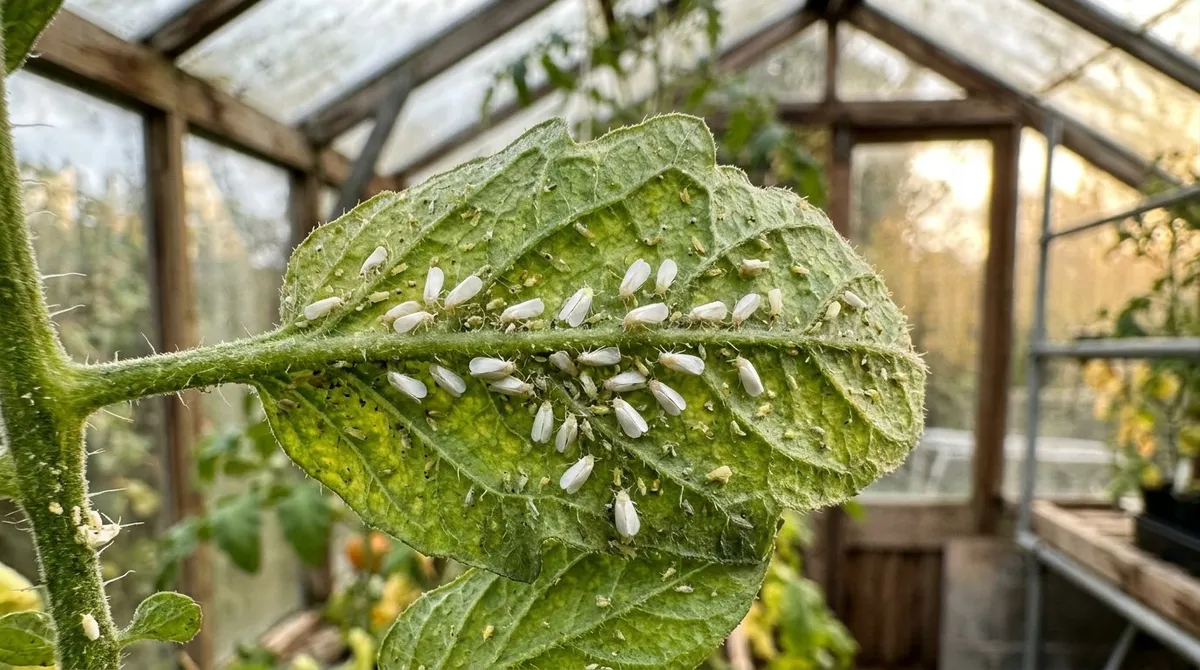
The primary pest. Adults are 1.5mm long with white, waxy wings held flat over the body like a tent. They cluster on the undersides of young leaves and fly up in a distinctive white cloud when the plant is shaken. Nymphs are flat, oval, translucent scales 0.7mm across, fixed to the leaf underside. Eggs are pale, 0.2mm, and laid in a characteristic crescent or arc pattern on new growth.
Cabbage whitefly (Aleyrodes proletella)
Found outdoors on brassicas (cabbage, kale, broccoli). Slightly larger than greenhouse whitefly at 2mm. Does not survive in greenhouses and is not controlled by Encarsia formosa. Causes cosmetic damage but rarely affects crop yield. Not the same pest as greenhouse whitefly despite looking similar.
Tobacco whitefly (Bemisia tabaci)
A notifiable quarantine pest in the UK. Smaller than greenhouse whitefly (1mm) with wings held angled upwards rather than flat. Transmits tomato yellow leaf curl virus and other plant viruses. If you suspect tobacco whitefly, report it to APHA (Animal and Plant Health Agency) immediately. It is not established outdoors in the UK but occasionally arrives on imported plants.
| Feature | Greenhouse whitefly | Cabbage whitefly | Tobacco whitefly |
|---|---|---|---|
| Size | 1.5mm | 2mm | 1mm |
| Wing position | Flat, tent-like | Flat | Angled upward |
| Habitat | Greenhouses, conservatories | Outdoors on brassicas | Quarantine pest (report) |
| Eggs | Crescent pattern, pale | Scattered, no pattern | Random, yellow-green |
| Encarsia effective? | Yes (80-90%) | No | Partially |
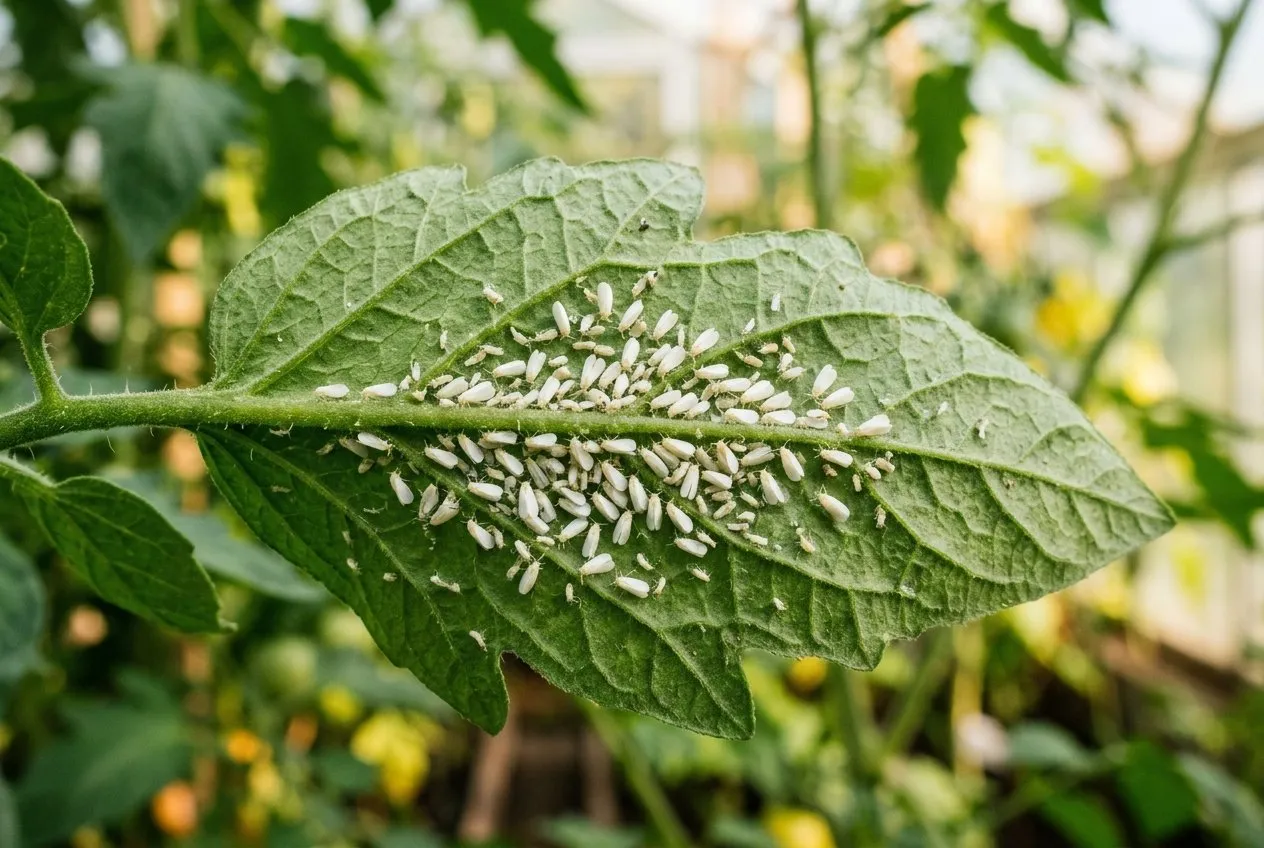 Greenhouse whitefly adults cluster on leaf undersides. The flat, oval nymphs are visible as pale scales.
The greenhouse whitefly lifecycle
Understanding the lifecycle is essential for timing controls correctly. At 20C, greenhouse whitefly completes egg to adult in 21-28 days. At 25C, this drops to 18-21 days. Below 15C, development stalls.
Eggs (stage 1): Females lay 150-200 eggs each, on the undersides of young leaves. Eggs are pale, stalked, and 0.2mm long. They hatch in 8-12 days at 20C.
Nymphs (stages 2-4): Newly hatched nymphs (crawlers) walk a short distance, then fix themselves to the leaf surface. They moult through three sedentary nymphal stages over 12-16 days, feeding on plant sap through piercing mouthparts. Late-stage nymphs have visible red eyes.
Pupa (stage 5): The fourth nymphal stage acts as a pupa. The adult develops inside and emerges through a T-shaped split in the pupal case.
Adult: Adults live 30-40 days and begin laying eggs within 2-3 days of emergence. A single female produces 150-200 eggs. At 20C, one whitefly can produce over 300 descendants within 60 days.
This exponential growth is why early detection matters so much. A population of 10 whitefly in May becomes 3,000+ by July without intervention. Our greenhouse pest control guide covers the broader context of managing multiple pest species simultaneously.
Damage caused by greenhouse whitefly
Whitefly damage greenhouse crops through three mechanisms.
Sap feeding: Nymphs and adults extract phloem sap through piercing mouthparts. Heavy infestations weaken plants, reduce yield, and cause leaf yellowing and premature leaf drop. Tomato plants with heavy whitefly loads produce 20-30% less fruit by weight.
Honeydew: Both nymphs and adults excrete honeydew, a sticky, sugary waste product. Honeydew coats lower leaves, fruit, and greenhouse surfaces. It makes fruit unmarketable and attracts wasps and ants.
Sooty mould: Black fungal growth colonises honeydew-covered surfaces. Sooty mould blocks light from reaching leaf cells, further reducing photosynthesis and plant vigour. It does not directly infect the plant tissue but coats it in an unsightly black layer that is difficult to wash off.
Tomatoes, cucumbers, peppers, and aubergines are the most commonly damaged crops. Ornamentals including fuchsias, pelargoniums, and poinsettias are also heavily attacked. Our guide to growing tomatoes covers whitefly prevention as part of the full growing programme.
Biological control with Encarsia formosa
Encarsia formosa is a tiny parasitic wasp (0.6mm) that has been used commercially against greenhouse whitefly since the 1920s. It achieves 80-90% whitefly control in hobby greenhouses when introduced correctly.
Each female Encarsia parasitises up to 300 whitefly nymphs over her 14-day lifespan. She inserts an egg into the third or fourth-stage whitefly nymph. The wasp larva develops inside, killing the whitefly. Parasitised nymphs turn black, this is the visible sign that Encarsia is working. The adult wasp emerges through a round hole in the black scale and begins parasitising more whitefly immediately.
How to use Encarsia formosa
Temperature is the critical factor. Encarsia needs daytime temperatures of 18-25C to breed effectively. Below 18C, the wasps are sluggish and whitefly outbreeds them. Above 25C, Encarsia performs well but whitefly breeds even faster, so higher introduction rates are needed.
Introduce Encarsia in May or June when greenhouse temperatures reliably stay above 18C during the day. In an unheated greenhouse, this is typically late May in the Midlands. In heated houses, introduction can start in April.
Cards containing 100+ parasitised whitefly scales are supplied by post from biological control suppliers (Dragonfli, Biocontrol Solutions, Green Gardener). Hang cards among the crop foliage at a rate of 5-10 per plant. Repeat introductions every 2 weeks for 3-4 applications to maintain pressure as whitefly populations cycle.
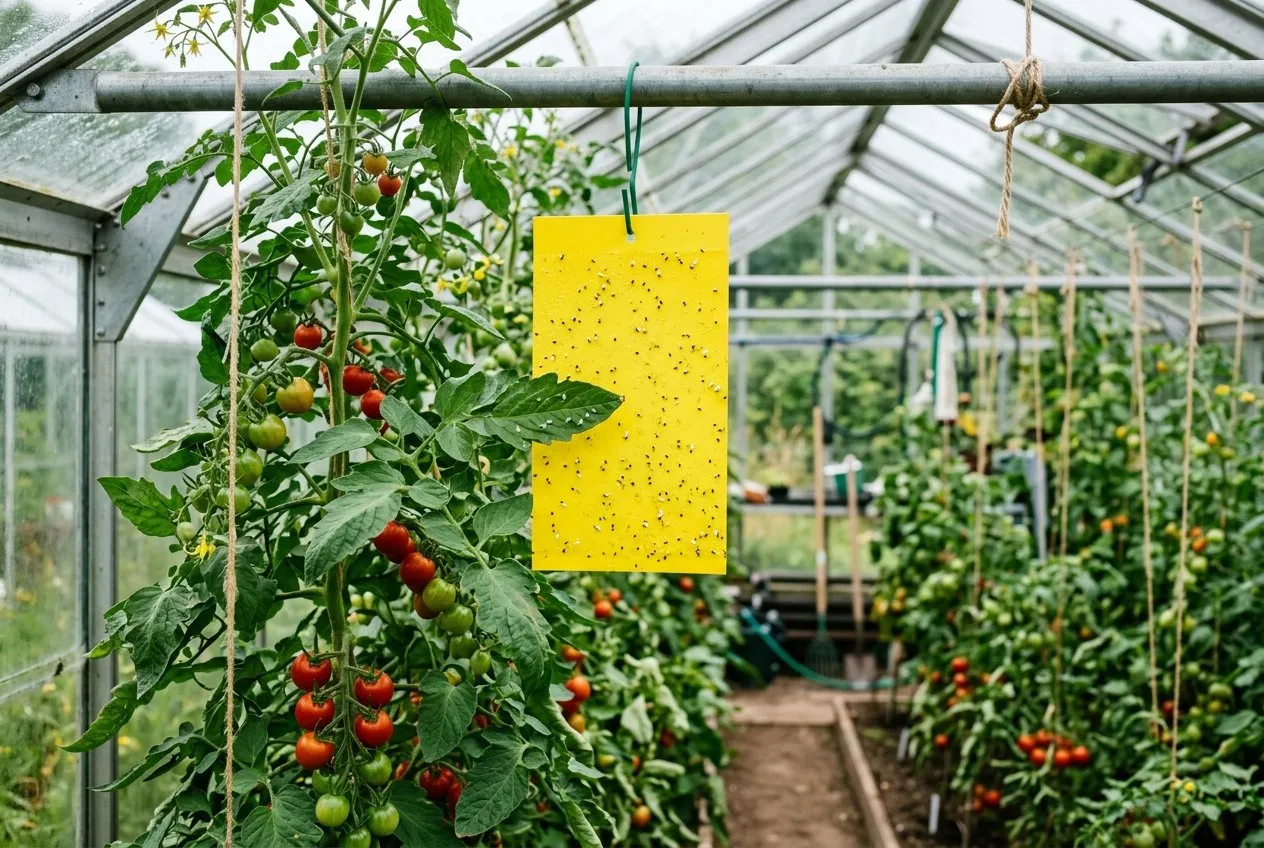 Parasitised whitefly nymphs turn black — the visible sign that Encarsia formosa is working.
Cost of biological control
A single introduction of Encarsia for a small hobby greenhouse (6x8ft) costs £10-15. Three introductions over a season totals £30-45. This is more expensive than a single can of insecticide (£5-8) but far more effective given widespread pesticide resistance. It is also safe to use on edible crops right up to harvest.
Yellow sticky traps for whitefly monitoring
Yellow sticky traps serve two purposes: early detection and population reduction. Hang traps from March onwards, before whitefly populations build.
Whitefly are strongly attracted to yellow. The adhesive surface traps adults on contact. Place one trap every 2 metres at plant canopy height. In a standard 6x8ft greenhouse, 2-3 traps provide adequate coverage.
Check traps weekly. A single whitefly on a trap in March is an early warning. Twenty per week indicates a building population. A hundred or more per week signals an established infestation requiring biological control.
Traps reduce adult numbers but do not control nymphs or eggs. They are a monitoring tool and supplement, not a standalone solution. Remove traps during Encarsia introductions, as the wasps can also be caught. Replace traps after 48 hours.
Commercial growers use trap counts to time biological control introductions precisely. Hobby growers can adopt the same approach. When trap catches exceed 10 per trap per week, introduce Encarsia within 7 days.
Cultural controls and prevention
Autumn greenhouse clean
The single most effective prevention measure. A thorough autumn clean removes 80-90% of overwintering whitefly populations. Clear all plant debris by mid-October. Remove every dead leaf, spent plant, and piece of organic matter. Wash all glazing, staging, and frame joints with horticultural disinfectant (Jeyes Fluid diluted 1:30 or Citrox).
Pay special attention to frame joints, bolt holes, and gaps behind staging. Whitefly nymphs and adults shelter in these crevices over winter. A stiff brush removes them physically. On aluminium-framed greenhouses, wash the frame channels where condensation collects.
Inspect new plants
Every plant brought into the greenhouse is a potential whitefly source. Check the undersides of all leaves before placing any new plant inside. Quarantine new purchases for 7-10 days in a separate room and check for emerging adults. One infested plant from a garden centre can start a season-long whitefly problem.
Ventilation
Good airflow makes the greenhouse environment less favourable for whitefly. Open vents and doors during warm days. Automatic vent openers maintain air circulation without manual intervention. Whitefly prefer still, humid conditions, moving air disrupts their flight and feeding patterns.
Companion planting
French marigolds (Tagetes patula) planted alongside tomatoes reduce whitefly numbers by up to 50% according to Newcastle University research. The volatile compounds from marigold foliage appear to confuse whitefly host-finding behaviour. Plant one marigold for every two tomato plants, positioned within 30cm. Basil and nasturtiums also show repellent effects. Our companion planting guide covers the full range of pest-deterrent combinations.
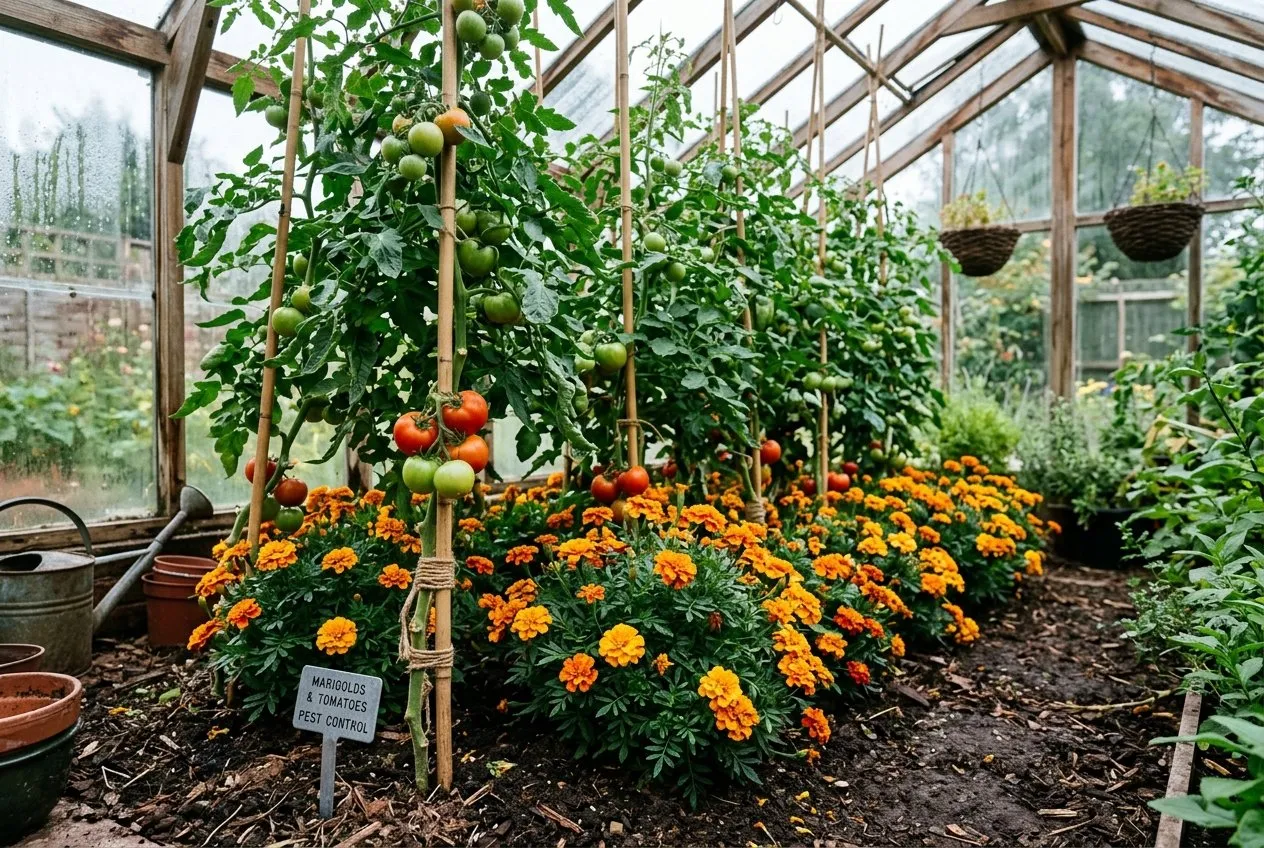 French marigolds planted within 30cm of tomatoes reduce greenhouse whitefly by up to 50%.
Insecticidal soap and neem oil
Where biological control is impractical or populations are already severe, contact sprays provide short-term knockdown.
Insecticidal soap (potassium salts of fatty acids) suffocates whitefly on contact by blocking the spiracles through which they breathe. It has no residual action and must contact the insects directly. Spray leaf undersides thoroughly every 5-7 days for 3-4 applications. SB Plant Invigorator (£8-12 per 500ml) is the most popular UK brand and doubles as a foliar feed.
Neem oil contains azadirachtin, which disrupts whitefly feeding, growth, and reproduction. It acts as an antifeedant and growth regulator rather than a contact killer. Mix at the manufacturer’s rate and spray at 7-10 day intervals. Neem oil degrades in sunlight within 24-48 hours.
Both products are compatible with biological controls after a 24-48 hour gap. Do not spray when Encarsia wasps are freshly introduced.
Chemical resistance: Greenhouse whitefly has developed resistance to pyrethroids, organophosphates, and neonicotinoids across much of the UK. Synthetic insecticides are largely ineffective and their use harms biological control agents. The RHS recommends biological and physical controls as the primary approach.
Monthly whitefly control calendar
| Month | Action |
|---|---|
| January-February | Order Encarsia formosa and sticky traps from suppliers. Clean greenhouse if not done in autumn. |
| March | Hang yellow sticky traps. Check weekly for first whitefly adults. Inspect any overwintered plants. |
| April | Monitor trap catches. Sow companion French marigolds for greenhouse planting in May. |
| May | Introduce Encarsia formosa when daytime temperatures exceed 18C. Plant French marigolds beside tomatoes. Remove sticky traps during Encarsia introduction. |
| June | Second Encarsia introduction. Check for black parasitised scales, signs of Encarsia activity. Replace sticky traps. |
| July | Third Encarsia introduction if trap catches remain high. Spray insecticidal soap on heavily infested lower leaves if needed. Peak whitefly season. |
| August | Monitor. Encarsia should be controlling populations. Continue spray programme on worst-affected plants. |
| September | Populations decline as temperatures drop. Remove spent crop plants promptly. |
| October | Full greenhouse clean. Remove all debris. Wash surfaces. Close down for winter. |
| November-December | No action required. Greenhouse should be clean and empty or containing only hardy overwintering plants. |
Spider mite vs whitefly: telling them apart
Gardeners often confuse whitefly damage with spider mite damage. Both cause leaf yellowing and affect greenhouse crops. The differences are distinct.
Whitefly are visible as white-winged adults that fly when disturbed. They produce sticky honeydew and sooty mould. Spider mites are 0.5mm, barely visible without magnification, and produce fine silky webbing on leaf undersides. Spider mites cause a distinctive yellow stippling pattern rather than the general yellowing caused by whitefly.
Spider mites thrive in hot, dry conditions while whitefly prefer warm, humid environments. If your greenhouse is well-ventilated and dry, spider mites are the more likely pest. If it is warm and humid with poor airflow, whitefly dominates.
Both pests have effective biological controls. Encarsia formosa for whitefly. Phytoseiulus persimilis for spider mites. The two biological control agents are compatible and can be used simultaneously without interference. See our full greenhouse pest control guide for managing multiple pests together.
Integrated pest management: combining all methods
The most effective whitefly control uses every method together. No single approach provides 100% control, but layering them makes a system where whitefly populations never reach damaging levels.
Start with biological controls as the foundation. Encarsia formosa provides the sustained, season-long suppression that no spray can match. Add yellow sticky traps for early warning and adult capture. Plant French marigolds as companion plants to reduce colonisation. Spray insecticidal soap only on localised hot spots where whitefly concentrate.
Behind everything, the autumn greenhouse clean prevents the cycle restarting. A greenhouse cleaned properly in October starts the following spring with near-zero whitefly. Combine that with Encarsia in May and you have a system that keeps whitefly below damaging thresholds all season with minimal effort.
Commercial tomato growers in the UK have used this integrated approach for decades. It works at hobby scale too. The investment in biological controls and companion plants pays for itself in healthier crops, cleaner fruit, and far less time spent spraying.
Frequently asked questions
What does greenhouse whitefly look like?
Adult greenhouse whitefly are 1.5mm white-winged insects. They cluster on the undersides of leaves and fly up in a cloud when disturbed. Nymphs are flat, oval, pale green-yellow scales 0.7mm across, fixed to the leaf underside. Eggs are tiny (0.2mm), pale, and laid in a crescent pattern on young leaves. Do not confuse with cabbage whitefly, which is found outdoors on brassicas.
What plants do greenhouse whitefly attack?
Tomatoes are the most commonly attacked crop. Greenhouse whitefly also targets cucumbers, peppers, aubergines, French beans, strawberries, and ornamentals including fuchsias, pelargoniums, and poinsettias. Any soft-leaved plant grown under glass is a potential host. Herbs like basil are rarely attacked and may deter whitefly when grown alongside susceptible crops.
Does Encarsia formosa really work against whitefly?
Yes, Encarsia formosa achieves 80-90% whitefly control in hobby greenhouses. Each tiny parasitic wasp (0.6mm) parasitises up to 300 whitefly nymphs over its lifetime. The key requirement is temperature: Encarsia needs 18-25C to breed effectively. Introduce in May when greenhouse temperatures reliably stay above 18C. Expect visible results in 3-4 weeks.
When should I hang yellow sticky traps in my greenhouse?
Hang yellow sticky traps from March onwards, before whitefly populations build. Place one trap every 2 metres at plant canopy height. Traps catch 50-100 adults per week in a moderate infestation. Use them for early detection and to reduce adult numbers. Replace traps every 4-6 weeks. Traps alone will not control an established infestation.
Why do whitefly keep coming back every year?
Whitefly overwinter as nymphs on plant debris and greenhouse surfaces. Adults shelter in cracks, joints, and under staging. Without a thorough autumn clean, surviving populations breed rapidly when temperatures rise in spring. Remove all plant debris in October, wash every surface with disinfectant, and scrub frame joints. This single annual clean removes 80-90% of overwintering pests.
Can I use pesticide sprays for greenhouse whitefly?
Most synthetic pesticides are ineffective due to widespread resistance. Greenhouse whitefly has developed resistance to pyrethroids, organophosphates, and neonicotinoids across much of the UK. Insecticidal soap and neem oil still work through physical modes of action. SB Plant Invigorator (£8-12 per 500ml) suffocates whitefly on contact and is compatible with biological controls after 24 hours.
Do companion plants repel greenhouse whitefly?
French marigolds reduce whitefly numbers on adjacent tomato plants by up to 50%. This finding comes from Newcastle University research. Basil may deter whitefly through volatile oil emissions. Nasturtiums act as trap crops, attracting whitefly away from valuable plants. Place companions within 30-50cm of susceptible crops. Companion planting reduces but does not eliminate whitefly.
Our team produces practical UK gardening guidance from source research, contributor records and established horticultural practice. Editorial standards are overseen by Matt W.