Key takeaways
- Overwatering and root rot cause around 80% of yellow Monstera leaves, with soft leaves and soggy compost
- Let the top 2-5cm of compost dry before watering, checking with a finger first
- Monstera deliciosa grows best at 18-27C in bright indirect light, away from draughts below 13C
- Nitrogen shortage yellows the oldest lower leaves first, so feed monthly from April to September
- One yellowing bottom leaf on a healthy plant is usually natural ageing, not a problem
- Use filtered or rainwater if leaf tips brown from tap-water salts
A yellowing leaf on your Monstera is the plant telling you something is wrong. Most of the time, the message is the same: too much water. The Monstera deliciosa, or Swiss cheese plant, is one of the most popular houseplants in the UK, and yellow leaves are the single most common complaint. The good news is that yellowing is a clear signal you can read and fix.
This guide walks through every cause, from overwatering and root rot to cold draughts and tap-water salts. You will learn how to check the soil and roots, water correctly, and prevent the problem coming back. For more indoor plant rescues, see our problems section.
Start by reading the leaf
Before you change anything, look closely at the yellow leaf and the compost. The pattern of yellowing tells you the cause. A soft, limp yellow leaf sitting in wet, heavy compost points to overwatering. A crispy yellow leaf in bone-dry compost points to the opposite. Yellowing that starts on the oldest lower leaves and creeps upward usually means a nitrogen shortage.
One single yellow leaf at the very bottom of an otherwise glossy plant is often just natural ageing. Monstera sheds its lowest leaf as it grows, and this is normal. Multiple yellow leaves, or yellowing higher up the plant, signals a real problem you need to act on.
Check the position too. Leaves nearest a cold window in winter often yellow from draughts. Leaves with brown crispy tips alongside yellowing suggest tap-water salts or dry air from central heating. Reading the leaf first saves you from guessing and making the wrong change.
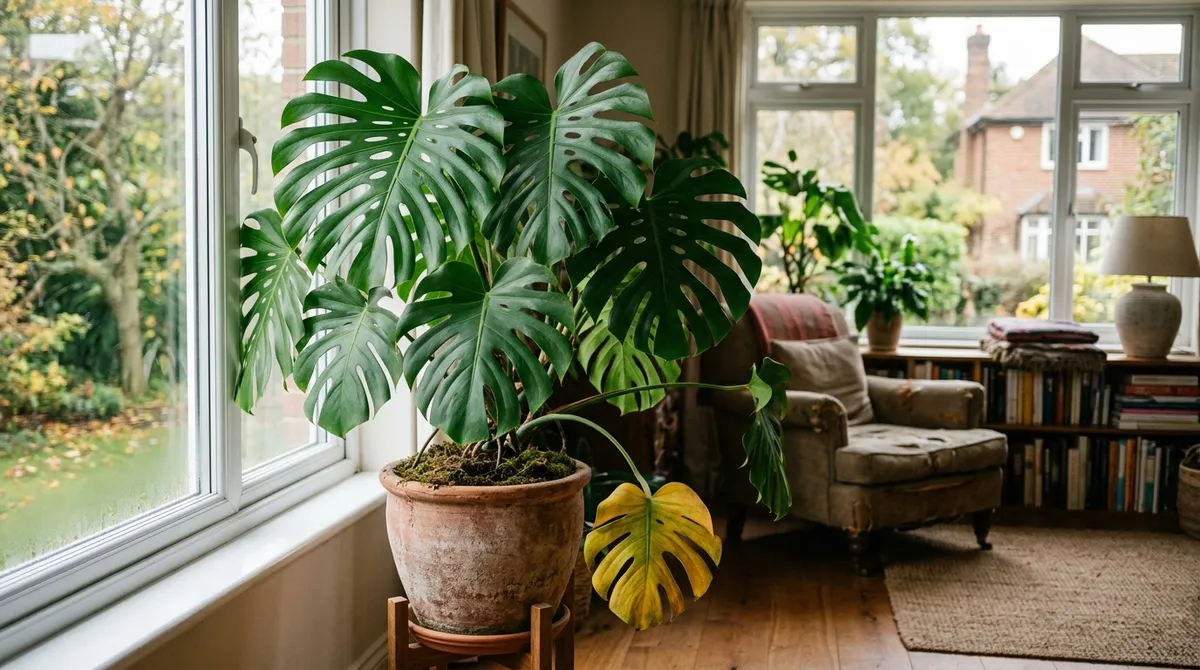
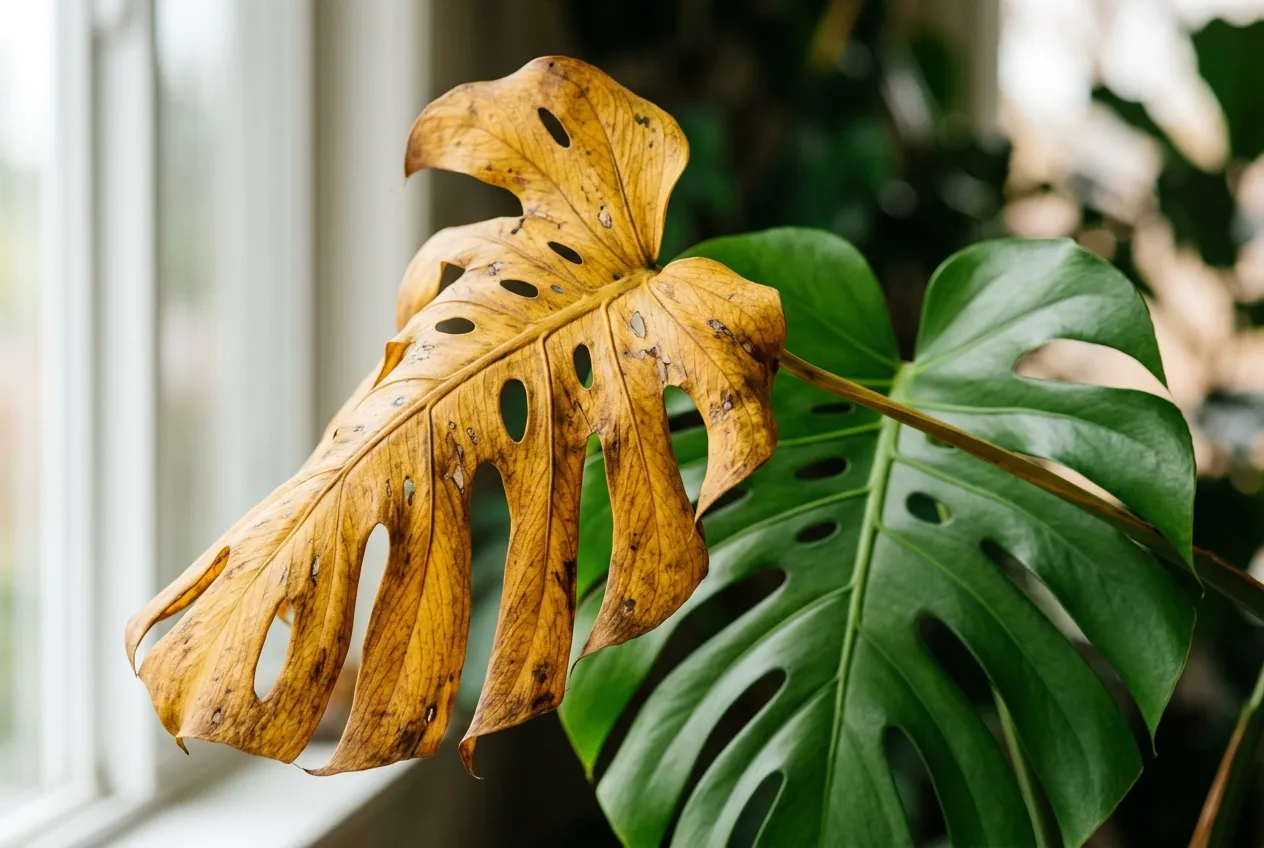 A yellowing lower leaf against a healthy green one. The colour change tells you which cause to investigate first.
Diagnosis table
Use this table to match what you see to the most likely cause and the fix. Work through it before reaching for the watering can, because the wrong response can make things worse.
| Symptom | Likely cause | Fix |
|---|---|---|
| Soft yellow leaves, soggy compost, musty smell | Overwatering and root rot | Stop watering, check roots, cut away rot, repot in dry aroid mix |
| Crispy yellow leaves, bone-dry compost, drooping | Underwatering | Soak the rootball, then water when top 2-5cm dries |
| Yellowing despite careful watering, water sits on top | Poor drainage or compacted compost | Repot into chunky, free-draining aroid compost with drainage holes |
| Lower older leaves yellow first, slow growth | Nitrogen deficiency | Feed monthly with balanced houseplant food, April to September |
| Pale yellow leaves, leggy growth, small new leaves | Low light | Move to bright indirect light near a window |
| One bottom leaf yellow, rest of plant healthy | Natural ageing | Remove the old leaf, no other action needed |
| Yellow leaves near a window in winter | Cold draught below 13C | Move away from glass and doors, keep at 18-27C |
| Yellow leaves with brown crispy tips | Tap-water salts or dry air | Switch to filtered or rainwater, raise humidity |
Most UK houseplant owners land on the first row. Overwatering accounts for around 80% of yellow Monstera cases, so always rule it out before anything else.
Overwatering and root rot
Overwatering is the number one killer of houseplants, and Monstera is no exception. The leaves turn soft and yellow, the compost stays wet for days, and you may notice a sour, musty smell from the pot. The plant looks thirsty, so many people water more, which makes the damage worse.
The real problem is underground. Waterlogged compost has no air gaps, so roots cannot breathe. They begin to suffocate and rot. Healthy roots are firm and white or pale tan. Rotten roots are brown, soft, and mushy, and they may smell. This is root rot, and it spreads if you ignore it.
To fix it, stop watering at once. Slide the plant out of its pot and inspect the roots. Cut away every brown, mushy root with clean scissors, leaving only firm white ones. Rinse the remaining roots, then repot into fresh, dry, free-draining aroid compost. Do not water for several days, letting the cut roots heal first.
Warning: Never let your Monstera sit in a saucer of standing water or a pot without drainage holes. Waterlogged roots rot within days. Always tip away water that collects in the saucer or cache pot after watering.
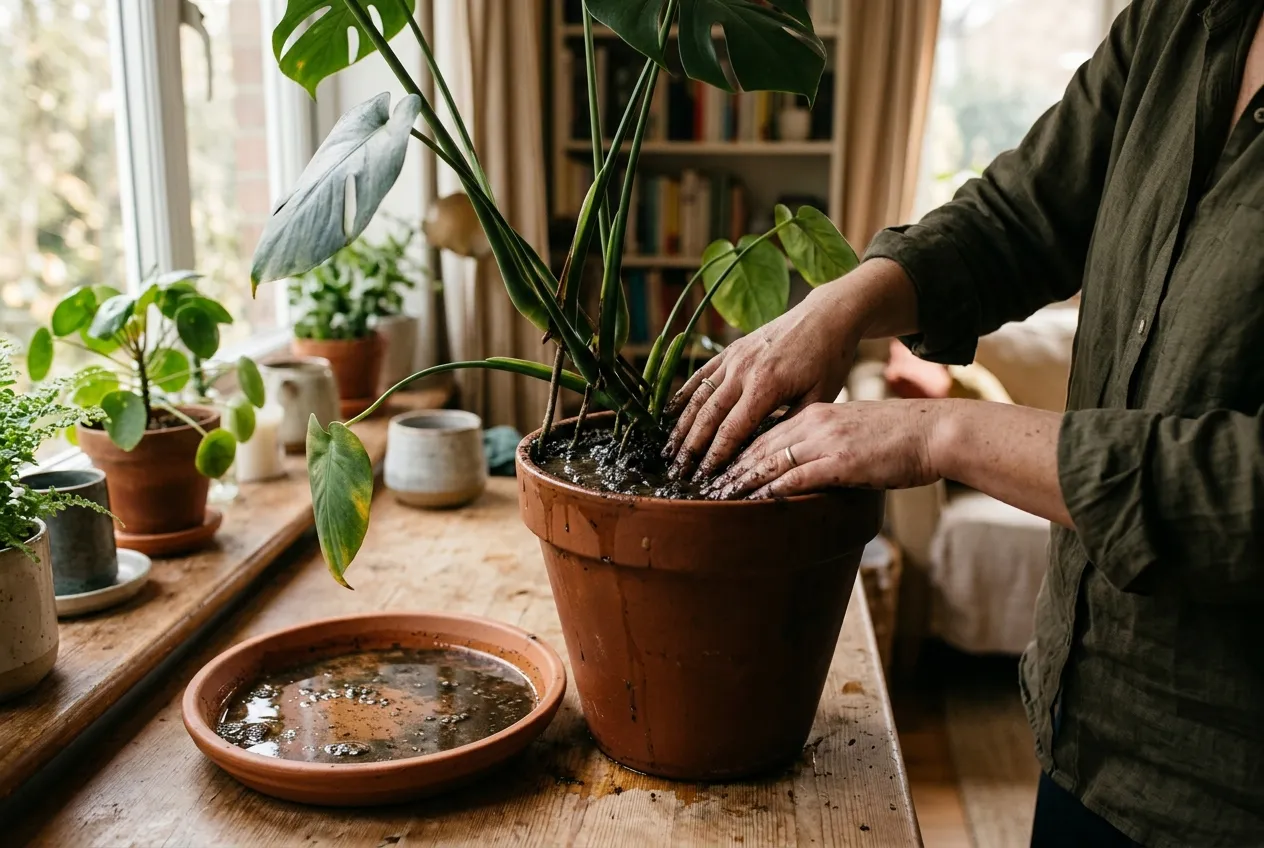 Pressing into the compost reveals waterlogged, soggy soil. Standing water in the saucer is a classic sign of overwatering.
How to check soil moisture and roots
Guessing kills more Monsteras than any pest. The single best habit is to check the compost before every watering. Push a clean finger into the soil up to the second knuckle, around 2-5cm deep. If it feels moist, wait. If it feels dry, water.
A wooden chopstick or moisture meter works well too. Push a chopstick to the bottom of the pot, leave it a minute, then pull it out. Damp compost clings to the stick and darkens it. Dry compost comes out clean. Lifting the pot also helps, because a wet pot feels noticeably heavier than a dry one.
If leaves are yellowing and you suspect rot, inspect the roots directly. Gently lift the plant from its pot. Healthy roots are white or light tan and firm to the touch. Rotten roots are brown, slimy, and fall apart when pressed. A bad smell confirms rot. Checking roots once is far better than watering blindly and hoping the yellowing stops.
 Lifting the plant to inspect roots. Firm white roots are healthy, while brown, mushy roots show rot that must be cut away.
Correct watering technique
Once you have ruled out rot, set up a watering routine that prevents it returning. The rule is simple. Water only when the top 2-5cm of compost is dry. Monstera prefers a slight dry spell between waterings rather than constant moisture.
When you do water, water thoroughly. Pour until water runs freely from the drainage holes, which moistens the whole rootball evenly. Then let the pot drain completely and empty the saucer. This deep-but-infrequent approach beats frequent light splashes, which leave the lower roots dry and the surface soggy.
Frequency depends on the season and your home. In summer, an established Monstera in a warm UK room may need water every 7-10 days. In winter, with lower light and slower growth, the gap stretches to 14-21 days. Central heating complicates this, drying the top layer fast while the core stays wet, so always test with a finger rather than following the calendar.
Gardener’s tip: Use room-temperature water, not cold tap water straight from the cold tap. Cold water shocks tropical roots. Leave a filled watering can to stand overnight, which warms it and lets some chlorine off-gas at the same time.
Light, temperature and draughts
Monstera evolved on the forest floors of Central America, dappled by sunlight through the canopy. Indoors, it wants bright indirect light. Too little light produces pale, yellowing leaves, leggy stems, and small new growth with few of the famous holes. Too much direct sun scorches leaves with bleached patches.
In UK homes, a spot near an east or west-facing window is ideal. South-facing windows work behind a sheer curtain to soften the midday glare. Winter is the hard season here, because UK daylight is weak and short from November to February. Moving the plant closer to the window through winter often stops the yellowing on its own.
Temperature matters just as much. Monstera grows best at 18-27C and dislikes anything below 13C. Cold draughts from single-glazed windows, doors, and hallways yellow leaves fast. Keep the plant away from frosty glass on cold nights. Equally, avoid placing it directly above a hot radiator, which dries the air and crisps the foliage.
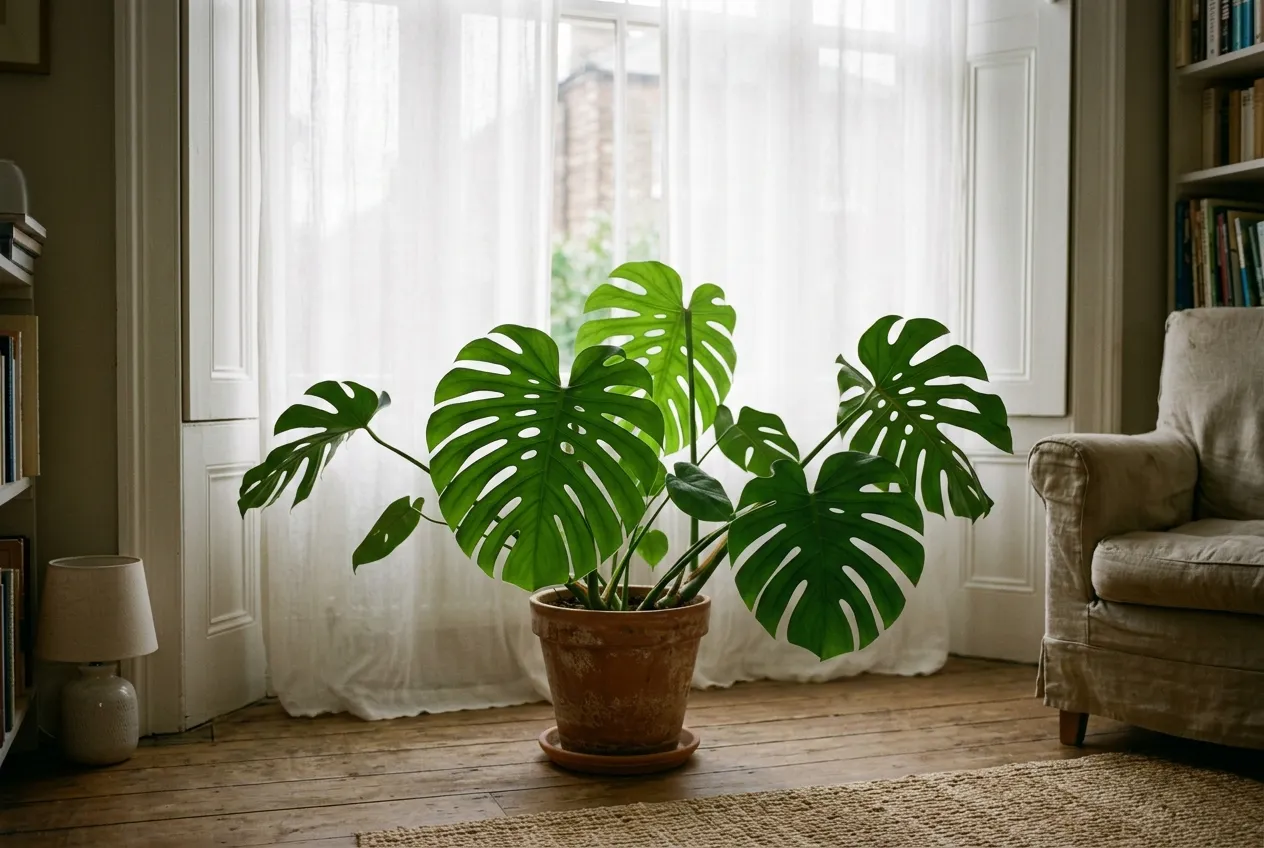 Bright indirect light behind a sheer curtain suits Monstera perfectly, giving strong growth without scorching the leaves.
Feeding and nutrient deficiency
If your watering and light are right but the oldest lower leaves yellow first, the cause is often a nitrogen shortage. Nitrogen is mobile inside the plant, so when it runs short, the Monstera pulls it from old leaves to feed new growth. The old leaves fade to pale yellow while the newest stay green.
Compost holds only a few months of nutrients before the plant uses them up. From April to September, feed every four weeks with a balanced liquid houseplant fertiliser, diluted to the strength on the label. A feed with roughly equal nitrogen, phosphorus and potassium suits Monstera well and supports those large, glossy leaves.
Stop feeding in autumn and winter. Growth slows right down in low UK light, and unused fertiliser builds up as salts in the compost. These salts can scorch roots and brown the leaf tips, adding a new problem on top of the old one. Less is safer than more.
Over-feeding causes its own yellowing, with brown crispy edges and a white crust on the compost surface. If you see this, flush the pot. Run plenty of plain water through it to wash out the excess salts, let it drain fully, and pause feeding for a couple of months.
Repotting and removing rot
When root rot has set in, or the plant has outgrown its pot, repotting is the cure. Choose a pot only 2-4cm wider than the old one. An oversized pot holds too much wet compost around the roots, which invites rot all over again. The pot must have drainage holes.
Monstera needs a chunky, free-draining aroid mix, not standard compost. A good blend is two parts houseplant compost, one part orchid bark, and one part perlite. The bark and perlite create air gaps so water drains through and roots breathe. Adding a few lumps of charcoal helps keep the mix sweet.
Ease the plant out, tease away old compost, and cut off any brown, mushy roots with clean, sharp scissors. Set the plant in the new pot at the same depth as before, fill around it with fresh mix, and firm gently. A moss pole gives the climbing stems support and encourages bigger, more fenestrated leaves. Water lightly once, then resume your normal routine.
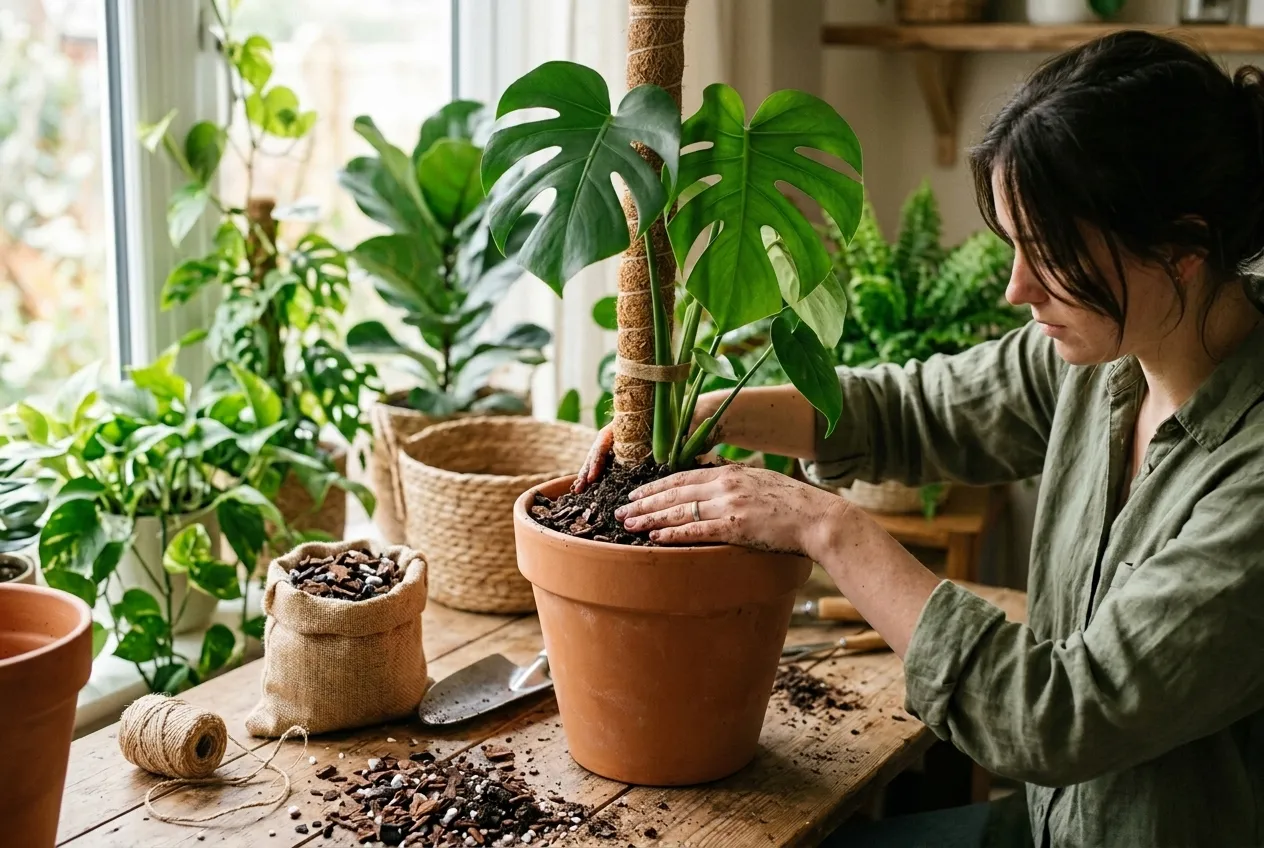 Repotting into fresh, free-draining aroid compost with a moss pole. Chunky bark and perlite keep roots aerated and healthy.
Tap-water salts and dry air
If your leaves yellow with brown, crispy tips, the cause may be your water or the air. Much of the UK has hard tap water, high in calcium, chlorine, and fluoride. These minerals build up in the compost over time and burn the fine root tips and leaf edges.
The fix is to switch to filtered water, cooled boiled water, or rainwater. Collecting rainwater in a butt or bucket gives free, soft water that Monstera loves. If you must use tap water, let it stand overnight in an open container so some of the chlorine escapes before you use it.
Dry air is the second culprit, and UK central heating makes it worse through winter. Monstera enjoys humidity of around 40-60%. In a dry, heated room, leaf edges crisp and yellow. Group plants together, stand the pot on a tray of damp pebbles, or use a small humidifier nearby. Wiping the leaves with a damp cloth keeps them clean and lets them breathe.
Gardener’s tip: Misting gives only a brief humidity lift and can encourage leaf spots if water sits on the foliage. A pebble tray or grouping plants together raises humidity far more reliably around your Monstera.
Seasonal care under UK conditions
Monstera care changes through the year, especially in the UK where light and indoor heating swing dramatically between seasons. This table shows how to adjust watering, feeding, and position month by month.
| Season | Watering | Feeding | Light and warmth |
|---|---|---|---|
| Spring (Mar-May) | Increase as growth restarts, check top 2-5cm | Begin monthly balanced feed in April | Bright indirect light, growth speeds up |
| Summer (Jun-Aug) | Every 7-10 days, check first | Feed every 4 weeks | Shade from harsh midday sun behind a curtain |
| Autumn (Sep-Nov) | Reduce as days shorten | Last feed in September, then stop | Move closer to the window as light fades |
| Winter (Dec-Feb) | Every 14-21 days, let dry more | No feeding | Brightest spot available, away from cold draughts and radiators |
The biggest seasonal risk is winter overwatering. The plant uses far less water in low light, but the watering habits from summer carry over. Always stretch the gaps between waterings through winter and test the compost every time.
Common mistakes
Most yellowing comes down to a handful of avoidable errors. Spotting these in your own routine prevents the problem returning.
Watering on a fixed schedule
Watering every Sunday regardless of need is the classic mistake. The plant’s needs change with season, light, and room temperature. A fixed schedule leads to overwatering in winter and underwatering in a summer heatwave. Always check the top 2-5cm of compost with a finger first, then water only if it is dry.
Reacting to a drooping plant by watering
A drooping, yellowing Monstera looks thirsty, so the instinct is to water. But droop from root rot mimics droop from thirst. Watering a rotting plant kills it faster. Check the compost and roots before adding water. If the compost is already wet, the problem is too much water, not too little.
Using a pot with no drainage
A decorative pot with no hole traps water around the roots. Even careful watering pools at the bottom and rots the roots. Always grow Monstera in a plastic nursery pot with drainage holes, sitting inside any decorative cache pot. Tip the water out of the cache pot after it drains.
Feeding in winter
Pouring fertiliser into a barely growing winter plant builds up salts that scorch roots and brown leaf tips. Monstera barely grows in low UK light from October to March. Stop feeding entirely over winter and resume only in April when new growth appears.
Panicking over one old leaf
A single yellow leaf at the base of a thriving plant is natural ageing, not a crisis. Repotting, moving, or drenching a healthy plant in response causes real stress and more yellowing. Remove the old leaf, watch the rest of the plant, and change nothing else if growth is good.
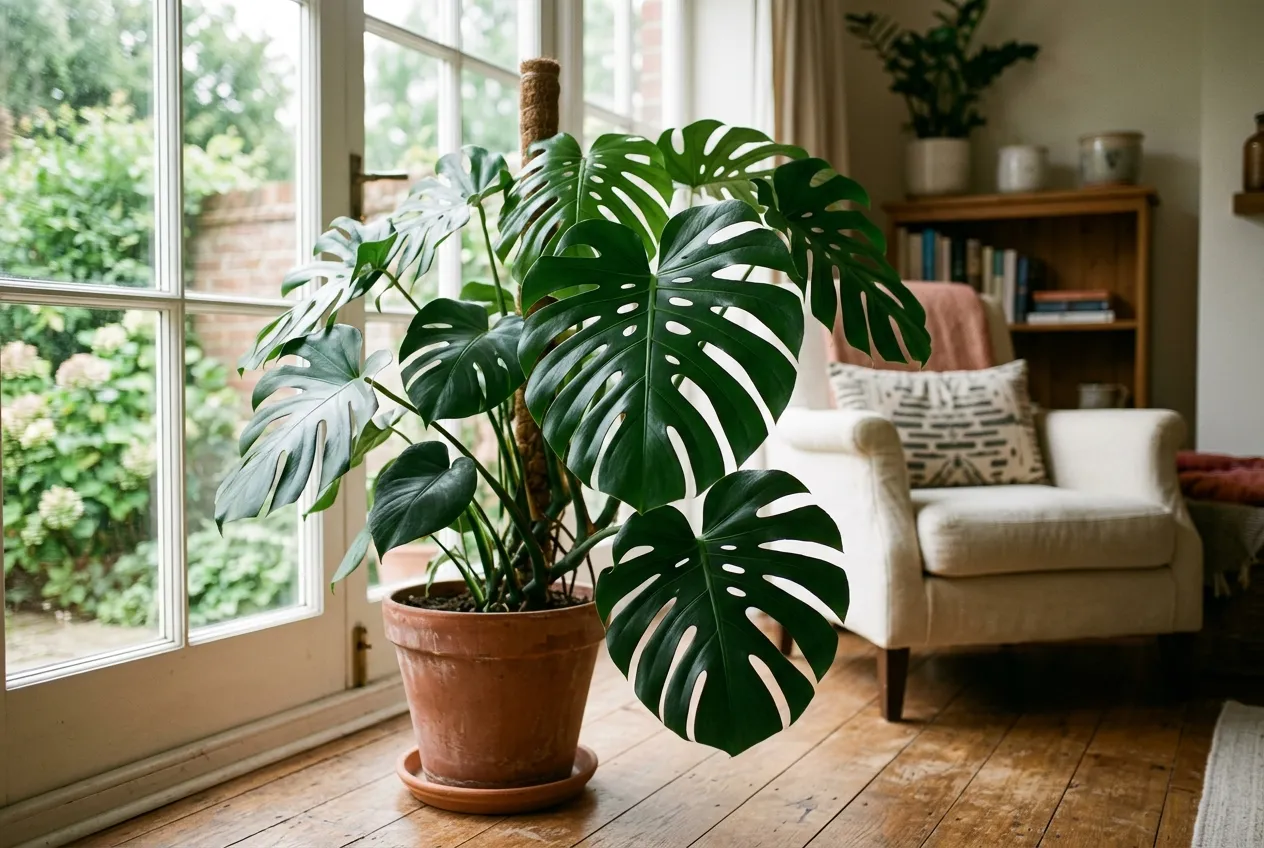 A recovered, thriving Monstera. Glossy dark-green leaves with strong fenestration show watering, light, and feeding are all in balance.
Prevention and ongoing care
Keeping a Monstera green long-term is about steady habits, not constant fussing. Check before watering every single time, and you avoid the biggest cause of yellow leaves. Give the plant bright indirect light, keep it at 18-27C, and feed monthly only through spring and summer.
Wipe the large leaves with a damp cloth every few weeks. Dust blocks light and slows the plant, and clean leaves photosynthesise better. This is also the moment you spot early problems, from pests on the leaf backs to the first hint of yellowing. A quick monthly health check catches issues while they are still easy to fix.
 Wiping the leaves clean removes dust, improves light capture, and gives you a regular chance to spot problems early.
Frequently asked questions
Why is my Monstera turning yellow?
Overwatering is the most common cause. Soft yellow leaves with soggy compost point to waterlogged roots and root rot. Check the soil moisture and roots before watering again. Other causes include low light, cold draughts below 13C, a nitrogen shortage, and the natural ageing of the oldest lower leaf.
Should I cut yellow leaves off my Monstera?
Yes, remove fully yellow leaves with clean scissors. A yellow leaf will never turn green again, so cutting it lets the plant direct energy into healthy new growth. Always fix the underlying cause first, whether that is overwatering, light, or feeding, or more leaves will follow the same way.
Can a yellow Monstera leaf turn green again?
No, a yellowed leaf cannot recover its colour. The loss of chlorophyll in that leaf is permanent. New leaves will grow healthy and green once you correct the watering, light, or feeding. Focus your effort on the cause rather than trying to save the damaged leaf itself.
How often should I water a Monstera in the UK?
Roughly every 7-10 days in summer and every 14-21 days in winter, but always check first. Water only when the top 2-5cm of compost feels dry to your finger. UK central heating dries the surface fast while the core stays wet, so test before every watering rather than following a fixed schedule.
Does overwatering turn Monstera leaves yellow?
Yes, overwatering is the leading cause of yellow Monstera leaves. Waterlogged compost starves the roots of oxygen and triggers root rot. Leaves turn soft and yellow, often starting from the lower leaves and moving up. Let the compost dry out and check the roots for brown, mushy rot.
Why are my Monstera leaves yellow with brown spots?
Yellow leaves with brown spots usually signal root rot from overwatering. The brown, mushy patches show dying tissue spreading from the roots. Remove the plant, cut away the rotten roots, and repot in fresh, free-draining aroid compost. Crispy brown edges instead suggest dry air or a build-up of tap-water salts.
What temperature does a Monstera need in winter?
Keep Monstera between 18-27C and never below 13C. Cold draughts from windows and doors yellow the leaves quickly. Move plants away from single-glazed windows on frosty nights. Avoid placing them directly above hot radiators, which dry the air and scorch the foliage with brown, crispy edges.
Our team produces practical UK gardening guidance from source research, contributor records and established horticultural practice. Editorial standards are overseen by Matt W.